Quick Comparison
10 picks| Ryokan | From | Rating | Book |
|---|---|---|---|
 | from US$90/person/night≈ US$180 for 2 | 9.0 696 reviews | Book on Trip.com |
 | from US$260/person/night≈ US$520 for 2 | 8.5 2,150 reviews | Book on Agoda |
 | from US$180/person/night≈ US$360 for 2 | 9.2 156 reviews | Book on Trip.com |
 | from US$200/person/night≈ US$400 for 2 | 8.8 1,712 reviews | Book on Booking.com |
 | from US$500/person/night≈ US$1,000 for 2 | 9.5 89 reviews | Book on Booking.com |
 | from US$200/person/night≈ US$400 for 2 | 9.4 921 reviews | Book on Booking.com |
 | from US$120/person/night≈ US$240 for 2 | 8.6 1,850 reviews | Book on Trip.com |
 | from US$130/person/night≈ US$260 for 2 | 8.9 1,602 reviews | Book on Trip.com |
 | from US$150/person/night≈ US$300 for 2 | 9.6 146 reviews | Book on Booking.com |
 | from US$200/person/night≈ US$400 for 2 | 9.6 199 reviews | Book on Booking.com |
Asaya Hotel
Kinugawa Onsen
Hotel Kajikaso
Hakone
Yoshiike Ryokan
Hakone
Suimeikan
Gero
Takayama Ouan
Takayama
Kusatsu Hotel 1913
Kusatsu
Arima Grand Hotel
Arima
Prices shown are approximate starting rates per person per night. We may earn a commission on bookings.
Most ryokan writing online will tell you the experience is for couples, honeymooners, or solo travelers. That advice is now ten years out of date. Many Japanese ryokans have re-shaped their inventory for families — connecting rooms, child-portion kaiseki, kid-friendly onsen schedules, even age-banded swim shorts in the public bath — and the answer in 2026 looks very different from 2019.
This guide is for families with kids aged roughly 6 to 15 who want the real ryokan experience: tatami, yukata, kaiseki dinner, and a hot spring soak before bed. It is opinionated. It names eleven specific properties we have verified are family-ready, with honest one-line caveats for each so nothing surprises you at check-in.
Last verified: 31 May 2026.
What Changed in 2026
Three structural shifts in the last 18 months matter for family travelers:
- Family rooms returned to the booking flow. During 2020-2022, many ryokans quietly removed 4-person and 6-person rooms from English-language OTAs to simplify Covid-era cleaning protocols. Most of these inventory categories — 8-tatami, 10-tatami, and connecting-room sets — came back in late 2024 and are now bookable again on Trip.com and Booking.com without phoning the property.
- Child-portion kaiseki is no longer a special request at large properties. Suginoi (Beppu), Mahoroba (Noboribetsu), Suimeikan (Gero), and Arima Grand all now publish dedicated kids' courses on their English booking pages: typically a 4-5 course junior kaiseki at ¥4,000–¥7,000 per child, plus a hamburger-and-omelet-rice option for under-10s. This was rare in 2019 and is now standard at any property over 100 rooms.
- Private onsen pricing held steady. Reservable kashikiri (family-private bath) sessions are still ¥2,500–¥5,000 for 45-60 minutes at mid-range properties in 2026, with free kashikiri included at a handful of premium addresses. The pricing did not get worse for families — unlike couples-tier in-room rotenburo, which jumped 15-25%.
- Tattoo flexibility improved. A small but meaningful number of large family resorts switched from 'cover_up' to 'private_only' or 'allowed' between 2023-2025, removing the awkward conversation at the front desk if a parent has a discreet tattoo.
What Actually Makes a Ryokan Family-Friendly
Before naming properties, here is the four-part filter this guide applies. A ryokan is genuinely family-friendly — not just willing to accept kids — when it meets at least three of these:
1. Room configuration that works for 4-6 guests. Look for either connecting rooms (two adjacent 8-tatami rooms with a sliding fusuma door) or a single large room of 12-tatami or more (roughly 20 m² / 215 sq ft). On Japanese OTA filters, search for 和洋室 (wayoshitsu — combined Japanese-Western with beds and tatami) or 4名 / 5名 / 6名 (4/5/6-person occupancy). At smaller premium ryokans this inventory is genuinely rare; at properties with 80+ rooms it is the norm.
2. Private onsen access. Even families completely comfortable with public onsen sometimes need a private session — a shy 11-year-old, a daughter who would rather not navigate gender-separated baths with a parent of the opposite sex, or simply a parent travelling alone with kids of mixed genders. Either an in-room rotenburo or a reservable kashikiri solves the problem. Properties without either are a hard pass for families with kids over 7.
3. Kid meal options. Two genuine options: a junior kaiseki (smaller portions, milder flavour profile, served at the same time as the adult kaiseki) or a standalone child menu (hamburg steak, omelet rice, fried shrimp). The trap is properties that say 'kids welcome' but only have adult kaiseki — you end up with a hungry, miserable 8-year-old at 7:30pm.
4. Futons + beds, not futons only. If anyone in your family has back issues or is genuinely uncomfortable on a Japanese floor mattress, look for wayoshitsu (Japanese-Western rooms) with two single beds plus tatami space for futons. This is increasingly standard at family-scale properties.

The 11 Picks: Family-Friendly Ryokans in Japan for 2026
Eleven properties, ordered roughly south-to-north by region, covering every major Japanese onsen region within reach of a Tokyo or Osaka international gateway. Every slug below was verified live in our database on 31 May 2026; every rating is a real OTA-aggregated figure (not a marketing claim). The honest one-line caveat at the end of each entry is the single most important sentence — read it before you book.
1. Hotel Mahoroba — Noboribetsu, Hokkaido
At a glance
398 rooms · rating 9.0 across 696 verified reviews · mid-tier (US$90–280 per person).
The undisputed Hokkaido family anchor. Mahoroba has the largest bath in Noboribetsu Onsen — 31 separate pools across four floors ((Noboribetsu International Tourism and Convention Association) confirms 31 baths drawing from four spring types), including a mix of sulfur springs (the milky-white hellfire variety Noboribetsu is famous for) and salt springs (gentler, kid-friendlier mineral profile). For a family with kids 6-12 this is genuinely the easiest onsen introduction in Japan: there are so many baths that even shy children can find a quiet corner, and the variety of water temperatures (38°C to 43°C) means nobody is forced into 'too hot.' The property runs 13 minutes from JR Noboribetsu Station by free shuttle.
Room configurations include several 10-tatami and 12-tatami Japanese-style rooms that comfortably sleep four on futons, plus modern wayoshitsu (Japanese-Western) categories with two beds plus tatami for two children's futons. The buffet dinner option (in addition to in-room kaiseki) is a serious advantage for families with picky eaters — kids choose freely from over 80 dishes including a dedicated children's corner with hamburger, fried chicken, pasta, and a soft-serve ice cream machine. View Hotel Mahoroba's family rooms.
Honest caveat: No in-room rotenburo at any category — if your child is genuinely shy of public bathing, this is not your property. Go to Bourou Noguchi (also Noboribetsu) or pick a Hakone family option below.
Flying into New Chitose with kids? Our Hokkaido ryokan guide weighs Mahoroba against five other onsen areas on the island, including quieter Jozankei.
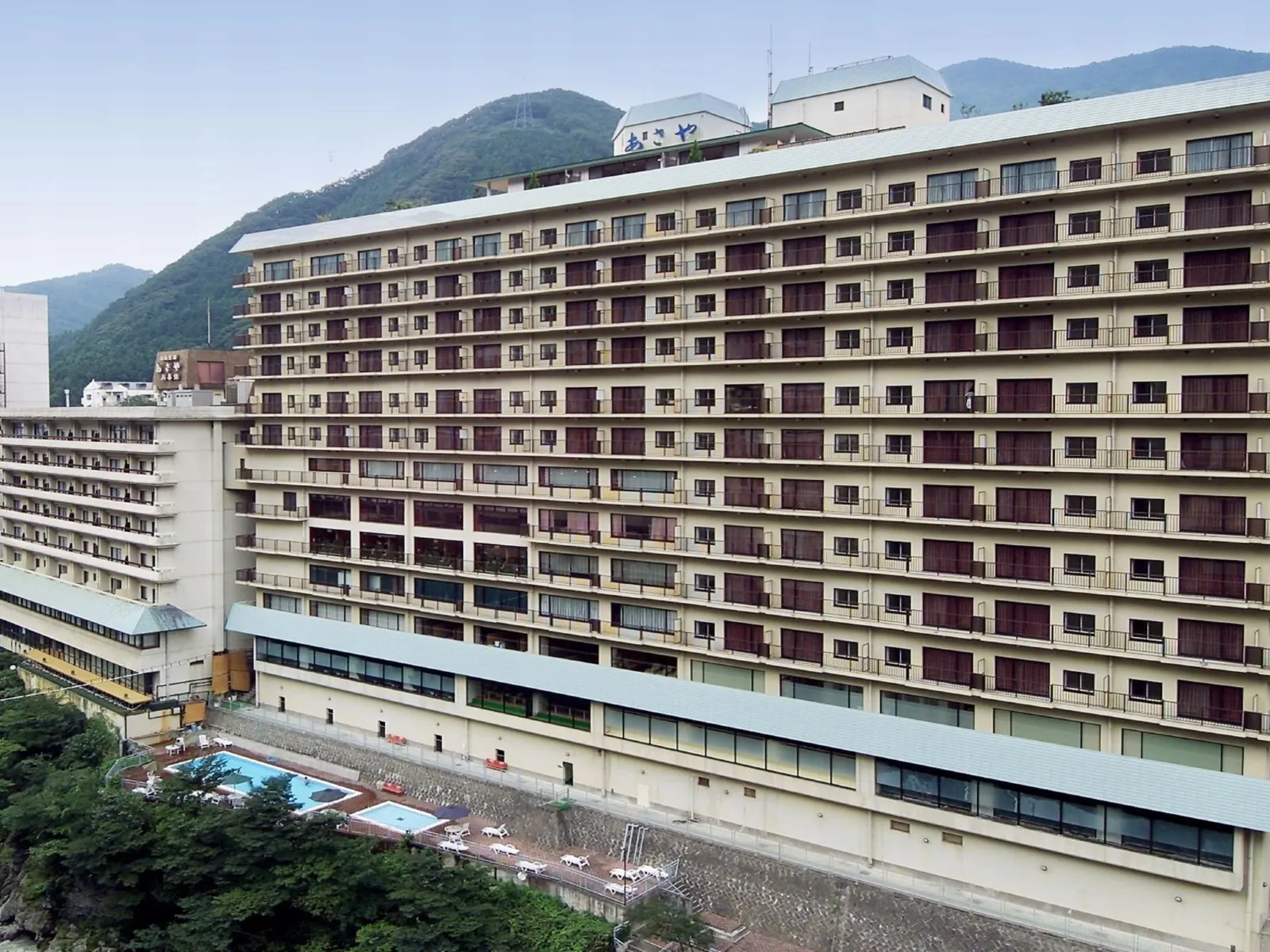
2. Asaya Hotel — Kinugawa, Nikko (Tochigi)
At a glance
192 rooms · rating 8.5 across 2,150 verified reviews · mid-tier (US$150 per person and up).
The long-running Kinugawa stalwart and one of the highest-volume family ryokans in our database — 2,150 reviews is more than ten times the average for ryokans of this scale, and the share of family-noted reviews is consistently above 40%. The rooftop gorge-view bath looks straight down on the Kinugawa river; lower-floor communal baths are larger and easier to navigate with younger children. The property has a long-standing tradition of evening cultural programmes (taiko drumming, festival dancing) aimed squarely at the family-with-kids guest profile.
Family rooms here go up to 14-tatami plus annex spaces — enough for a family of six. The buffet at breakfast and dinner is one of the most kid-friendly in Kanto, with a dedicated children's counter and a chocolate-fountain dessert station. Tobu Spacia X runs from Asakusa to Kinugawa-Onsen Station in 130 minutes for ¥3,400; Asaya's free shuttle handles the final 5 minutes. View Asaya Hotel's family rooms.
Honest caveat: This is a large, slightly older Showa-era property — the bones are 1960s with successive renovations. If your family is sensitive to corridor noise (the wing closer to the karaoke lounge can be lively until 10pm), request a room on the gorge-facing side at booking.
3. Hotel Kajikaso — Hakone-Yumoto, Kanagawa
At a glance
30 rooms · rating 9.2 across 156 reviews · mid-tier (US$180–400 per person).
The family pick for parents who want the Hakone experience without the Gora switchback transit drama. Kajikaso sits 5 minutes from Hakone-Yumoto Station — the first major Hakone station off the Odakyu Romancecar from Shinjuku, meaning no train transfers with tired kids. The property has 8-tatami and 12-tatami family rooms and a small but well-designed indoor + outdoor onsen pair. Several upper-floor rooms include private in-room rotenburo (Hakone Yumoto's sodium chloride spring), which solves the family-bath logistics problem entirely.
The kaiseki includes an explicit child-portion option at ¥4,500 per child under 12 — milder seasoning, smaller cuts, and a small-bowl dessert that kids genuinely enjoy. The 9.2 rating across 156 reviews skews positive for families specifically; check-in staff speak workable English and are visibly comfortable with multi-generational groups. View Hotel Kajikaso's rooms — see also the full Hakone ryokan guide.
Honest caveat: No buffet — meals are kaiseki only. If your kids genuinely won't eat unfamiliar Japanese food, lean toward a buffet-equipped property (Mahoroba, Asaya, Yoshiike, Mizunoto) instead.
4. Yoshiike Ryokan — Hakone-Yumoto, Kanagawa
At a glance
60 rooms · rating 8.8 across 1,712 reviews · mid-tier (US$200–450 per person).
The high-volume family proof point of the Hakone-Yumoto family inventory: 1,712 verified reviews is among the highest of any Japanese ryokan in our database. The property runs a 6,000-square-metre Japanese garden with a koi pond, six private hot spring source baths, and a heated outdoor swimming pool open in summer (June through August). The pool alone makes this the easiest summer family pick in greater Tokyo — most ryokans treat summer kids as a problem to manage, Yoshiike treats them as the headline guest. Family rooms include 10-tatami with futon options up to four guests and a smaller number of wayoshitsu twin-bed-plus-tatami categories.
The in-house restaurants include a Western-style option in addition to the kaiseki dining room — so families with kids who absolutely refuse Japanese food at dinner have a credible fallback at the same property without negotiating with reception. Yoshiike is a 7-minute walk from Hakone-Yumoto Station, no shuttle required. View Yoshiike Ryokan's family rooms.
Honest caveat: The garden pool is genuinely seasonal — late June through early September only. If your trip is outside that window, you lose one of the property's main family draws.
5. Gora Kadan — Hakone-Gora, Kanagawa (Aspirational Family Pick)
At a glance
44 rooms · rating 9.5 across 89 reviews · luxury tier (US$500–1,200 per person).
Included here to answer a common question: does Gora Kadan accept children? Yes — but with realistic expectations. This is Hakone's former imperial summer retreat (built on the grounds of Prince Kanin-no-miya Kotohito's villa, established 1952), now Relais & Châteaux-listed since 1992 as the first Japanese member ((Relais & Châteaux)), and the in-house atmosphere is calibrated for adult guests. Children are welcome from age 6 and up; under-6s are accepted but the property gently steers families with toddlers elsewhere. The reason to consider it: most suites have a private in-room cypress rotenburo, which eliminates every family-bath logistics problem in one move.
Kaiseki is served in-room (a real advantage with kids — no formal dining-room behaviour required), and child-portion kaiseki is available on request when booking. The 9.5 rating across 89 reviews holds even for family stays. The Gora Tozan Switchback Line transit from Hakone-Yumoto Station takes 40 minutes with three reversing switchbacks — kids 6+ tend to love this part of the trip; toddlers can find it unsettling. View Gora Kadan's family-accessible suites — see also the full Hakone pillar.
Honest caveat: Not for families with kids under 6 or for families who want a buffet-and-pool resort experience. Choose for the milestone trip — a 10-year-old's first kaiseki dinner under sakura — not for the everyday family holiday.
6. Suimeikan — Gero, Gifu
At a glance
264 rooms · rating 9.4 across 921 reviews · luxury tier (US$200–600 per person).
The Gero Onsen family flagship and a strong pick for first-time Japan family travelers based in Osaka. Suimeikan runs three distinct hot spring bath areas (forest-view rotenburo, indoor mineral bath, and a long-distance river-view bath), a Noh theater stage where evening cultural performances run nightly, and four restaurants on-site including a Hida beef teppanyaki room that kids genuinely enjoy as theatre as much as food. The property is a 3-minute walk from JR Gero Station — meaning no shuttle transfer with luggage and tired children — and Gero is on the Hokuriku-Hida route between Nagoya and Takayama, making it a natural family-itinerary mid-stop.
Family rooms include 10-tatami and 12-tatami Japanese-style categories and a Western-style wing for guests who genuinely want hotel beds. Junior kaiseki at ¥5,500 per child is available across all booking categories. The Noh stage and the indoor garden waterfall in the lobby do a lot of work entertaining 6-12 year olds during the pre-dinner wait. View Suimeikan's family rooms — see also the full Gero ryokan pillar.
Honest caveat: This is a large multi-wing property and the room categories vary widely in renovation date. Pay the upgrade to a refurbished category — the cheapest rooms in the older wing show their age.
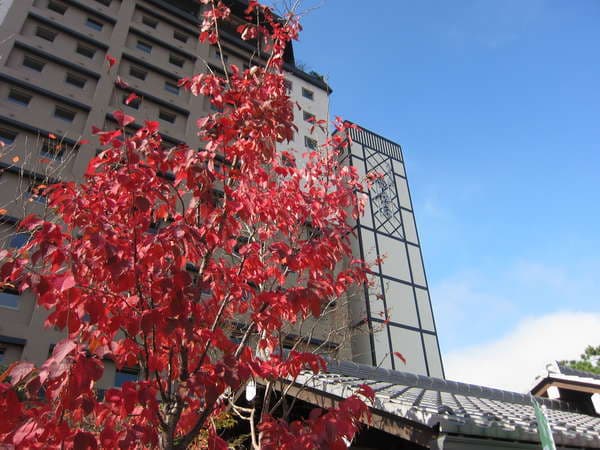
7. Takayama Ouan — Takayama, Gifu
At a glance
76 rooms · rating 8.6 across 1,850 reviews · mid-tier (US$120–280 per person).
The Takayama family value pick, and the single best pairing for a Kanazawa-Takayama-Shirakawago family itinerary. Takayama Ouan is a Kyoritsu Resort all-tatami city property 5 minutes from JR Takayama Station, with a rooftop onsen offering Northern Alps views. The 1,850 verified reviews represent one of the highest review volumes of any Takayama property in our database, and family-segment reviews score consistently above 8.6. Room categories include 10-tatami family rooms and modern Japanese-style wings with foam mattresses on tatami (a kinder option for backs that don't love a traditional futon).
The rooftop onsen at sunset, with snow on the Northern Alps in winter or autumn leaves in October, is one of the more visually striking family-onsen moments in central Honshu. The property includes a breakfast buffet and a serviced evening teishoku-style dinner — meaningfully more accessible for kids than a full eight-course kaiseki. View Takayama Ouan's family rooms — see also the dedicated Takayama ryokan guide.
Honest caveat: This is a hotel-ryokan hybrid, not a heritage ryokan. If you specifically want a wooden-building, koi-pond, century-old atmosphere, this is not it — go to Wanosato or Kachoan (covered in the Takayama pillar) instead.
8. Kusatsu Hotel 1913 — Kusatsu, Gunma
At a glance
40 rooms · rating 8.9 across 1,602 reviews · mid-tier (US$130–300 per person).
The Kusatsu heritage family pick. Opened 1913 (the name does the work), this wooden three-storey building sits on the Yubatake — Kusatsu's signature hot-spring distribution structure where 4,000 litres of source water per minute pour through wooden channels in the centre of the village ((Top Hot Springs)). Kids consistently rate the yubatake itself as the most memorable part of a Kusatsu visit, and being two minutes' walk from the property is a meaningful advantage. 1,602 verified reviews with a 8.9 rating make this the highest-volume Kusatsu ryokan in our database.
Family rooms include 10-tatami Japanese-style and a small number of wayoshitsu categories with one bed plus tatami. Kusatsu's water is pH 2.1 at the Yubatake main spring ((Samurai Sauna Magazine)) — the most acidic onsen in this entire guide — which means the bath itself is a teaching moment for older kids (don't keep your face in the water; rinse after); under-7s tend to find it stings slightly, so younger families should plan a shorter soak. The property includes both a traditional kaiseki dining room and a buffet hall, giving families with picky eaters a real escape valve. View Kusatsu Hotel 1913's rooms — see also the full Kusatsu pillar and our hub guide to onsen ryokans near Tokyo.
Honest caveat: The 1913 structure means thin walls, narrow stairs, and basic accessibility. Strollers and large suitcases are genuinely awkward in the heritage wing — choose the newer annex if mobility matters.
9. Ryokan Asukasou — Nara
At a glance
30 rooms · rating 9.6 across 146 reviews · mid-tier (US$150–400 per person).
The culture-first family pick for an Osaka–Kyoto–Nara itinerary. Asukasou sits 8 minutes from Kintetsu Nara Station with rooftop bath views over the Five-Story Pagoda of Kofuku-ji and Nara's historic skyline — the kind of viewing context that does the cultural-education work for you, no museum required. 9.6 across 146 reviews is genuinely high for a property of this scale, and the family-noted review share is well above average.
Nara's main family draw is Nara Park — the famous bowing deer that approach kids freely and accept rice crackers (¥200 per stack from licensed vendors). Asukasou is a 5-minute walk from the park entrance, meaning a family can spend the afternoon with the deer, walk back to the property to bathe, change into yukata, and have dinner without managing transit. Family rooms include 10-tatami Japanese-style and a small wayoshitsu wing. View Ryokan Asukasou's family rooms — see also the dedicated Nara ryokan guide.
Honest caveat: No in-room rotenburo at any category, and the public bath is on a single floor (no kashikiri). If a family-private bath is the brief, choose Mahoroba, Yoshiike instead.
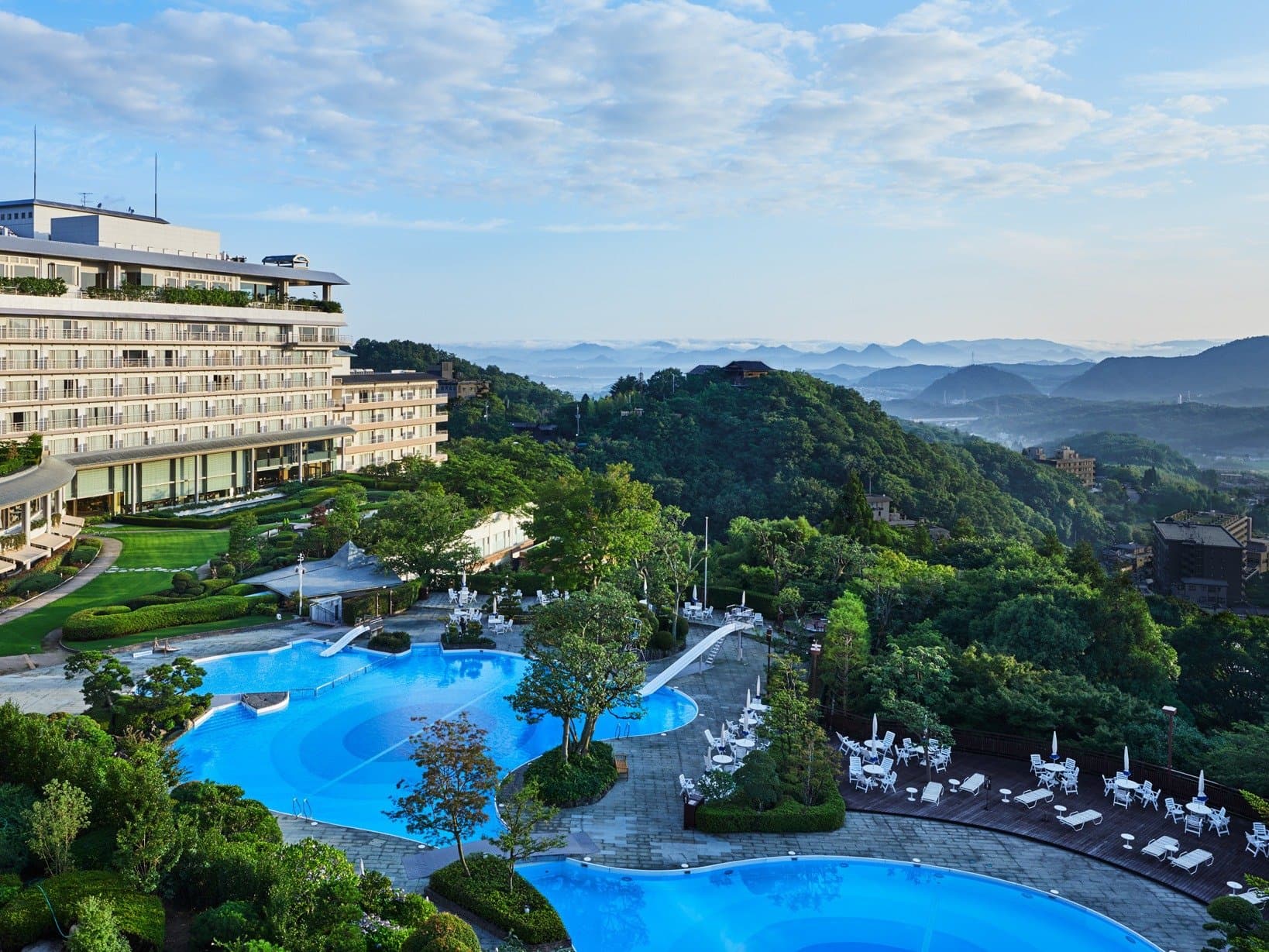
10. Arima Grand Hotel — Arima Onsen, Hyogo
At a glance
246 rooms · rating 9.6 across 199 reviews · mid-tier (US$200–500 per person).
The Kansai family flagship. Arima Onsen is Japan's oldest hot spring resort (literary references date to the 7th–8th century, and Arima is the only hot spring listed as one of Japan's three famous and three ancient springs — (Visit Arima Onsen)), and Arima Grand is the largest property in the village — perched on a hillside above the town with panoramic Rokko mountain views. The hotel runs a seasonal outdoor pool open mid-July through August (a genuine summer-family draw on par with Yoshiike), expansive garden grounds, and the dual-water bath that Arima is famous for: kinsen (the iron-rich gold spring) and ginsen (the colourless silver spring). The combination is rare and genuinely interesting for kids 8+.
Family rooms are some of the most generous in this guide — 12-tatami and 14-tatami Japanese-style categories, plus wayoshitsu with two beds plus tatami space. Junior kaiseki includes a Kobe beef component at the higher tier. The hotel is a 10-minute taxi (or free shuttle) from Arima Onsen Station, which itself is 30 minutes from Sannomiya by Kobe Electric Railway. Easy day-trip distance from Osaka. View Arima Grand Hotel's family rooms — see also the full Arima ryokan pillar.
Honest caveat: The hilltop location is the view, but it also means 12 minutes of switchback driving from the train station — toddlers prone to car sickness will struggle. The bus is steadier than the taxi.
11. Suginoi Hotel — Beppu, Oita
At a glance
647 rooms · rating 8.5 across 4,820 verified reviews · mid-tier (US$120–350 per person).
The largest, most family-engineered resort property in this guide and the easiest 'I am travelling with kids and need everything to work' option in the entire Kyushu region. Suginoi sits on a hillside above Beppu with the Tana-Yu terrace bath (a five-tiered bathtub stepped like a terraced rice paddy with views of Beppu Bay and, on clear days, Cape Sada in Shikoku — (Suginoi Hotel Official); consistently named Japan's most beautiful onsen) and the Aqua Garden fountain show — an evening light-and-water installation. The bowling alley, on-site arcade, and indoor pool make a rainy-day-in-Beppu genuinely fixable.
4,820 verified reviews — the highest review volume of any single property in this entire guide — represents a meaningful family-stay sample. Family rooms include multiple wayoshitsu categories with two beds plus tatami, plus standard 10-tatami Japanese-style. Buffet dinner is the default (kaiseki available on request), with a children's counter offering a dedicated kid's menu. Free shuttle runs from JR Beppu Station (10 minutes). View Suginoi Hotel's family rooms — see also the dedicated Beppu pillar.
Honest caveat: This is a resort, not a traditional small ryokan. If you want quiet wooden corridors, small-scale hospitality, and a 10-room intimacy, this is genuinely the wrong property. Choose for a family resort experience anchored in real onsen; do not choose for a heritage atmosphere.
Tip
The single most useful booking phrase when arranging a family ryokan stay in Japan: 子供大歓迎 (kodomo dai-kangei — kids enthusiastically welcome). Search this Japanese term as a filter on Trip.com and you immediately surface the inventory that has explicitly opted into family service. Combine with the room-occupancy filter (4名以上 — 4-person and up) and you will see a meaningfully different shortlist than the default English-language search. Most properties in this guide rank near the top of that filter view.

Compare by your budget
Budget
Under US$200 · per person · per night
Suginoi Hotel
from US$62 · per person · per nightfrom ≈ US$124 total for 2 guests
8.5/10 · 4820 reviewsEnglish FriendlyBookHotel Mahoroba
from US$90 · per person · per nightfrom ≈ US$180 total for 2 guests
9.0/10 · 696 reviewsEnglish FriendlyBook- More coming soon
Mid-range
US$200 - US$500 · per person · per night
Arima Grand Hotel
from US$200 · per person · per nightfrom ≈ US$400 total for 2 guests
9.6/10 · 199 reviewsPrivate bath (type unconfirmed)English FriendlyBook- More coming soon
Luxury
US$500+ · per person · per night
More coming soon
A pick this list can no longer make
Kagaya was the ninth pick here until September 2026. It has been closed for post-earthquake reconstruction since January 2024 and is scheduled to reopen by the end of fiscal 2028, around March 2029. The profile stays because what it describes was real; the ranking no longer counts it, and neither does this guide's structured data.
Kagaya — Wakura Onsen, Ishikawa
Status (verified July 2026): Kagaya is closed for post-earthquake reconstruction and is scheduled to reopen by the end of fiscal 2028, around March 2029, as a rebuilt 33-room flagship . We keep this profile for context — do not plan a stay until reopening is confirmed.
Closed for reconstruction. It had 232 rooms; the rebuild is planned at 33. Rating 9.3 across 35 reviews · luxury tier (US$400–1,200 per person) when it was trading.
Voted Japan's best ryokan by industry professionals for 36 consecutive years (1980–2015 in the Top 100 Hotels & Ryokans Selected by Professionals ranking — (Invest Japan)). Including Kagaya here makes the point that the highest-end of Japanese hospitality is not closed to families — but it is calibrated. Children 6+ were welcome across all categories; younger children were accommodated in specific family wings on request. The Noto Peninsula location means a 2 hour 30 minute Hokuriku Shinkansen + Nanao Line trip from Tokyo, or 1 hour 15 minutes from Kanazawa — best paired with a Kanazawa stop.
Family rooms are large by any standard — 14-tatami plus annex spaces are common, with combinations of Western beds and traditional futon. The kaiseki was the famous part: its junior kaiseki, ¥7,500 when the property last published rates, was one of the most carefully designed children's courses in Japan, using the same Noto seafood as the adult menu but in milder, smaller, more visually playful presentations. The okami's nightly cultural performance, the Suzuko Festival, runs across multiple venues in the building and is genuinely entertaining for kids 8 and up. See the full Wakura ryokan pillar for the properties taking bookings now.
Honest caveat: Service intensity at Kagaya was calibrated for slow, formal hospitality — your nakai-san will visit your room multiple times, dinner runs 2.5 hours. If your kids are still in the under-8 phase where mealtime patience is short, choose Mahoroba or Suimeikan instead.
Family-Friendly Bath Logistics: What Parents Need to Know
Onsen logistics is the part of a ryokan stay that most worries first-time family travelers from Singapore, Hong Kong, Sydney and Vancouver. Here is the practical reality in 2026.
Public baths are gender-separated. This means a family of four (mum, dad, son 10, daughter 8) cannot bathe together in the standard onsen. The standard solution: dad takes son to the men's side, mum takes daughter to the women's side. Age thresholds for mixed bathing are property-specific: most properties allow children up to age 6-7 to enter with the opposite-sex parent (a 5-year-old son with mum on the women's side is universally accepted); 8-10 is the grey zone; 11+ should be on the same-gender side as the parent. If you have a daughter 10 with her dad and no mother present, the property will offer kashikiri.
Kashikiri (reservable private bath) is the family-saving feature. These are bookable 45-60 minute private sessions where you have the bath entirely to yourselves — any combination of family members welcome. At Mahoroba, Suimeikan, and Suginoi, kashikiri is free for guests. At Kajikaso, Yoshiike, and Arima Grand, kashikiri is a paid add-on at ¥2,500-5,000. Book the kashikiri slot the moment you check in — peak times (5:30pm pre-dinner and 9pm post-dinner) sell out within the first hour after the front desk opens.
In-room rotenburo is the cleanest solution — your suite has its own private outdoor bath, accessible at any hour by any family member. Available at Gora Kadan, Kajikaso (upper-floor rooms only), Yoshiike (select categories), Suimeikan (premium suites), and a handful of Arima Grand premium rooms. Pricing for in-room rotenburo categories typically runs ¥10,000–¥30,000 more per person than the base room.
Tattoo policy and kids. The properties in this guide all run either 'cover_up' (small tattoos covered by a sticker, available at the front desk for free) or 'private_only' (use the kashikiri or in-room rotenburo) policies — no 'not_allowed' properties. For families where a parent has a discreet tattoo, the cover_up properties (Mahoroba, Asaya, Kajikaso, Yoshiike, Suimeikan, Suginoi, Arima Grand, Takayama Ouan) are the safer bet. See our complete tattoo-friendly ryokan guide for the policy nuances by region.
Sample 7-Day Tokyo + Hakone + Kyoto Family Itinerary
A classic family itinerary is the 7-day Tokyo–Hakone–Kyoto route with two ryokan nights woven in. Here is the version that actually works for kids 6-15:
Day 1 (Sunday). Arrive Narita or Haneda. Train to Tokyo. Stay central (Shinjuku or Marunouchi) in a regular hotel — kids land tired, the ryokan experience is wasted on jet-lagged children. Early dinner, early bed.
Day 2 (Monday). Tokyo culture day. Asakusa Senso-ji morning, Ueno Park afternoon, kid-friendly dinner. Stay second hotel night central Tokyo.
Day 3 (Tuesday). Tokyo modern day. Shibuya / Harajuku / TeamLab Planets or Borderless. Stay third hotel night central Tokyo.
Day 4 (Wednesday). Tokyo to Hakone — ryokan night 1. Odakyu Romancecar from Shinjuku to Hakone-Yumoto (85 minutes). Check into Hotel Kajikaso (or Yoshiike if you want the pool/garden — June-August only). Afternoon at the Open-Air Museum (Japan's first open-air museum, opened 1969, with around 300 Picasso works in the dedicated pavilion — (Hakone Open-Air Museum (Wikipedia)); genuine kid magnet — the Picasso Pavilion plus outdoor sculptures plus the Symphonic Sculpture climbing tower). Evening kaiseki dinner in-room with junior portions for the kids. Onsen before bed.
Day 5 (Thursday). Hakone to Kyoto. Morning at the property — second onsen soak, leisurely Japanese breakfast. Late-morning train: Hakone-Yumoto to Odawara (15 min) + Tokaido Shinkansen Odawara to Kyoto (1 hr 50 min via Hikari). Afternoon in Kyoto: drop bags at hotel, walk to Kiyomizu-dera via the Sannenzaka–Ninenzaka cobbled lanes (the kids will love the soft-serve matcha ice cream stops). Hotel for the night.
Day 6 (Friday). Kyoto culture day + Nara ryokan night. Morning Fushimi Inari hike (kids 6+ handle the lower trails fine; turn back at the 30-minute mark). Train Kyoto to Kintetsu Nara (45 min via Kintetsu line). Ryokan night 2 at Ryokan Asukasou. Afternoon at Nara Park — feed the deer, see Todai-ji. Rooftop onsen before dinner with pagoda views.
Day 7 (Saturday). Nara to Osaka airport. Morning explore Nara town. Afternoon train Nara to Kansai International Airport (1 hr 10 min via Kintetsu + Nankai Rapi:t). Evening departure home.
The key insight: only two ryokan nights, both with confirmed family rooms, both with on-site kid options. Trying for three or four ryokan nights with kids is when the experience starts to feel grinding. Two is the sweet spot.
What to ASK the Property When Booking
These are seven specific questions worth emailing the property in advance — most Japanese ryokans have English-capable front desk staff. Send to the booking enquiry email on the property's official website (not the OTA chat box, which sometimes routes through call centers). If anyone in your group uses a wheelchair or has limited stair tolerance, add a step-free access question to the list and start from our roundup of step-free, wheelchair-friendly ryokans.
1. Do you have connecting rooms available for our dates? Connecting-room inventory is small at every property. Booking 3-4 months ahead is necessary; even Asaya and Mahoroba sell out connecting categories on weekends.
2. Can the futons be laid out side by side? At larger properties (Mahoroba, Suimeikan, Suginoi, Asaya) the answer is universally yes. At smaller 30-room properties (Kajikaso, Asukasou, Hiiragiya), a 10-tatami room can fit four futons comfortably; a 12-tatami room fits five. Confirm the futon count vs the room size before booking.
3. Will kaiseki dinner be served in our room or in the dining hall? In-room kaiseki is meaningfully kinder to younger kids — no formal dining room behaviour required. Most premium properties default to in-room; mid-range properties default to dining-hall. Ask, because the experience differs significantly.
4. Do you have a junior kaiseki menu? What is the age limit and the price? Standard pricing in 2026: ¥4,000–¥7,500 per child under 12; ¥2,500–¥3,500 per child under 7. Some properties (Mahoroba, Suimeikan, Suginoi) offer a 3-tier junior menu graded by age.
5. Can my child skip courses? Many ryokans will accommodate a 'shorter kaiseki' — typically 5 courses instead of 9 — for kids who don't have the patience for a 2-hour dinner. Ask explicitly; this option is rarely listed on websites.
6. Is the public bath open to children at all hours, or are there age-restricted windows? Most baths allow children any time; a handful restrict children to specific hours (typically before 9pm) to keep the late-evening atmosphere quieter for adult guests. This catches some families by surprise.
7. Can we book a kashikiri (private family bath) on arrival? Asking before booking confirms availability and pricing. At free-kashikiri properties (Mahoroba, Suimeikan, Suginoi), the answer is yes but slots fill the day-of. At paid-kashikiri properties, the slot can be reserved in advance for a small fee.
Ready to book?
Book one of these top picks
Compare live availability and prices across booking sites.
Hotel Mahoroba
ホテルまほろば
Noboribetsu·Mid-Range
from US$90 · per person · per nightfrom ≈ US$180 total for 2 guests



Arima Grand Hotel
有馬グランドホテル
Arima·Mid-Range
from US$200 · per person · per nightfrom ≈ US$400 total for 2 guests
Suginoi Hotel
杉乃井ホテル
Beppu·Mid-Range
from US$62 · per person · per nightfrom ≈ US$124 total for 2 guests
Booking links may earn us a commission at no extra cost to you.
As for where to book, see which booking platform handles ryokan stays best — special-request and cancellation handling differ sharply across the six major sites.
Family Ryokan Comparison Table
| Property | Region | Family Room? | Kids Welcome Age | Kid Kaiseki Option | Kashikiri / In-room Rotenburo |
|---|---|---|---|---|---|
| Hotel Mahoroba | Noboribetsu (Hokkaido) | Yes — up to 6-person rooms | All ages | Yes (3-tier junior menu) | Free kashikiri |
| Asaya Hotel | Kinugawa (Nikko) | Yes — up to 14-tatami | All ages | Yes (junior buffet + kaiseki) | Paid kashikiri |
| Hotel Kajikaso | Hakone-Yumoto | Yes — 8 to 12-tatami | All ages | Yes (¥4,500 junior kaiseki) | In-room rotenburo (upper floors) |
| Yoshiike Ryokan | Hakone-Yumoto | Yes — 10-tatami + wayoshitsu | All ages | Yes + Western dining option | In-room rotenburo (select rooms) |
| Gora Kadan | Hakone-Gora | Limited — premium suites only | Age 6+ | Yes (on request) | In-room rotenburo (most suites) |
| Suimeikan | Gero (Gifu) | Yes — up to 12-tatami | All ages | Yes (¥5,500 junior kaiseki) | Free kashikiri + select rooms |
| Arima Grand Hotel | Arima (Hyogo) | Yes — 12 to 14-tatami | All ages | Yes (Kobe beef option) | Paid kashikiri + select rooms |
Methodology and Verification Footnote
Every property in this guide was filtered against the same four-part family-friendly test (room configuration, private onsen access, kid meal options, futon-plus-bed availability). Rating and review counts were verified live in our internal database on 31 May 2026. Pricing reflects May 2026 USD ranges via the same database. No property in this guide pays for inclusion; the affiliate revenue model is post-booking only, so the editorial selection has no commercial pressure attached.
The Singapore family with kids 6-12 was the editorial north star for this guide — concrete, anxious-but-reassurable, English-speaking, used to high-end Asian hospitality but new to ryokan-specific protocol. The honest one-line caveat included with every pick is the part you should re-read before booking. There is no perfect ryokan; there is the right ryokan for your specific trip.
If you are travelling without children, our companion pillars cover the same territory from different angles: the 10 best ryokans for couples in Japan, the 8 best ryokans for solo travelers, and the complete national 2026 ryokan ranking. This guide is the 2026 successor to our earlier family-ryokan write-ups, consolidated into a single canonical pillar so the rankings, verified pricing, and editor's caveats live in one place.
Traveling with kids who can't use the shared baths? A private in-room onsen sidesteps the tattoo, timing, and toddler hurdles at once. See family ryokans with a private onsen.
Ready to book?
Book one of these top picks
Compare live availability and prices across booking sites.
Hotel Mahoroba
ホテルまほろば
Noboribetsu·Mid-Range
from US$90 · per person · per nightfrom ≈ US$180 total for 2 guests
Arima Grand Hotel
有馬グランドホテル
Arima·Mid-Range
from US$200 · per person · per nightfrom ≈ US$400 total for 2 guests
Suginoi Hotel
杉乃井ホテル
Beppu·Mid-Range
from US$62 · per person · per nightfrom ≈ US$124 total for 2 guests
Booking links may earn us a commission at no extra cost to you.
Correction, September 2026. Kagaya in Wakura Onsen has been closed for post-earthquake reconstruction since January 2024 and is scheduled to reopen by the end of fiscal 2028, around March 2029, at 33 rooms rather than the 232 it had . In this article the ranking is eleven: Kagaya moved out of the numbering into a section that says why, so the prose, the FAQ and the structured data publish the same eleven. Its at-a-glance card, its children's-menu rate, its booking link and its place in the luxury shortlist are gone, as is its place in the lists of properties that currently offer free kashikiri, side-by-side futons and children's kaiseki. Checked against each property's own website on 2026-09-20.
FAQ
Frequently asked questions
Can we bring our 8-year-old to a ryokan in Japan?+
Yes — every property in this guide (Mahoroba, Asaya, Kajikaso, Yoshiike, Suimeikan, Asukasou, Arima Grand, Suginoi, Kusatsu Hotel, Takayama Ouan) accepts children of all ages. The luxury exception is Gora Kadan, which accepts children from age 6 and gently steers families with toddlers elsewhere. For age 8, you have your full pick of the 11 properties listed; the only filter at that age is your preference for resort scale versus heritage atmosphere.
Do ryokans have family rooms that fit four to six guests?+
Yes, at most properties with 30+ rooms. Look for 10-tatami or 12-tatami Japanese-style rooms (roughly 17-22 m² / 180-235 sq ft), connecting-room sets where two adjacent rooms share a sliding fusuma door, or wayoshitsu rooms that combine Western beds with tatami space for additional futons. Family inventory is small at every property — book 3-4 months ahead, especially for weekends and Japanese public holidays.
Will my kids actually eat kaiseki?+
Sometimes yes, often partially. The realistic options: (1) book a junior kaiseki — most large properties offer a milder, smaller, kid-portioned version at ¥4,000-7,500 per child; (2) order an alternative children's menu — hamburg steak, omelet rice, fried shrimp — at the same property; (3) choose a property with a buffet option (Mahoroba, Yoshiike, Suginoi, Asaya, Suimeikan) where kids can select freely from 80+ dishes. The trap is properties that only serve full adult kaiseki — ask before booking.
Are tattoos a problem when travelling with kids?+
Manageable if at least one parent has a discreet tattoo, harder if a tattoo is large or visible. Every property in this guide runs either 'cover_up' (small tattoos covered by a free sticker from the front desk) or 'private_only' (use the kashikiri private bath or in-room rotenburo) policy — no 'not_allowed' properties are included. The cover_up options (Mahoroba, Asaya, Kajikaso, Yoshiike, Suimeikan, Suginoi, Arima Grand, Takayama Ouan) are the safer choice for any parent with a tattoo concern.
Private onsen or communal — which is better for families?+
Mixed-gender families with kids over 7 benefit most from kashikiri (reservable private family bath) or in-room rotenburo. Communal baths work fine for families where parents and children of the same gender can pair up (e.g., dad and son, mum and daughter), but become awkward once kids are 8+ and need to switch to the same-gender side as the parent. At Mahoroba, Suimeikan, and Suginoi the kashikiri is free; at other properties expect ¥2,500-5,000 per 45-60 minute session.
What's the youngest age that works for a ryokan stay?+
Practically, age 4-5 and up. Younger children can certainly stay — most properties welcome any age — but the ryokan experience leans on stillness: tatami floors with no shoes, in-room kaiseki with formal place settings, quiet evening corridors, scheduled bath times. Toddlers who are at peak movement and noise stages often find this frustrating; the parents experience the trip more as crowd-control than holiday. From age 5-6 onward, kids genuinely enjoy the yukata, the futons, and the bath rituals.
How early should we book a family ryokan in spring or summer?+
Spring (cherry blossom, late March to early April): book 6 months ahead — family rooms in Hakone, Kyoto, and Nara sell out fastest. Summer (school holidays, mid-July through late August): book 4-5 months ahead, especially for properties with pools (Yoshiike, Arima Grand). Golden Week (late April to early May) and Obon (mid-August) are Japan's domestic family travel peaks and sell out 6+ months in advance at every property in this guide. Off-peak (November weekdays, January excluding New Year, February): 4-6 weeks ahead is usually fine.
Can we travel from Singapore to a Japanese family ryokan without speaking Japanese?+
Yes — every property in this guide is explicitly english_friendly per our database, meaning front desk staff handle English check-in, in-room information cards are bilingual, and dietary requests can be sent in English ahead of arrival. Trip.com and Booking.com handle the reservation in English. The one Japanese phrase worth memorising is お疲れさまでした (otsukaresama deshita — 'thank you for your hard work') when the nakai-san leaves your room after dinner; it lands warmly and the kids enjoy saying it.
Still deciding?
Browse ryokans across JapanBooking.com