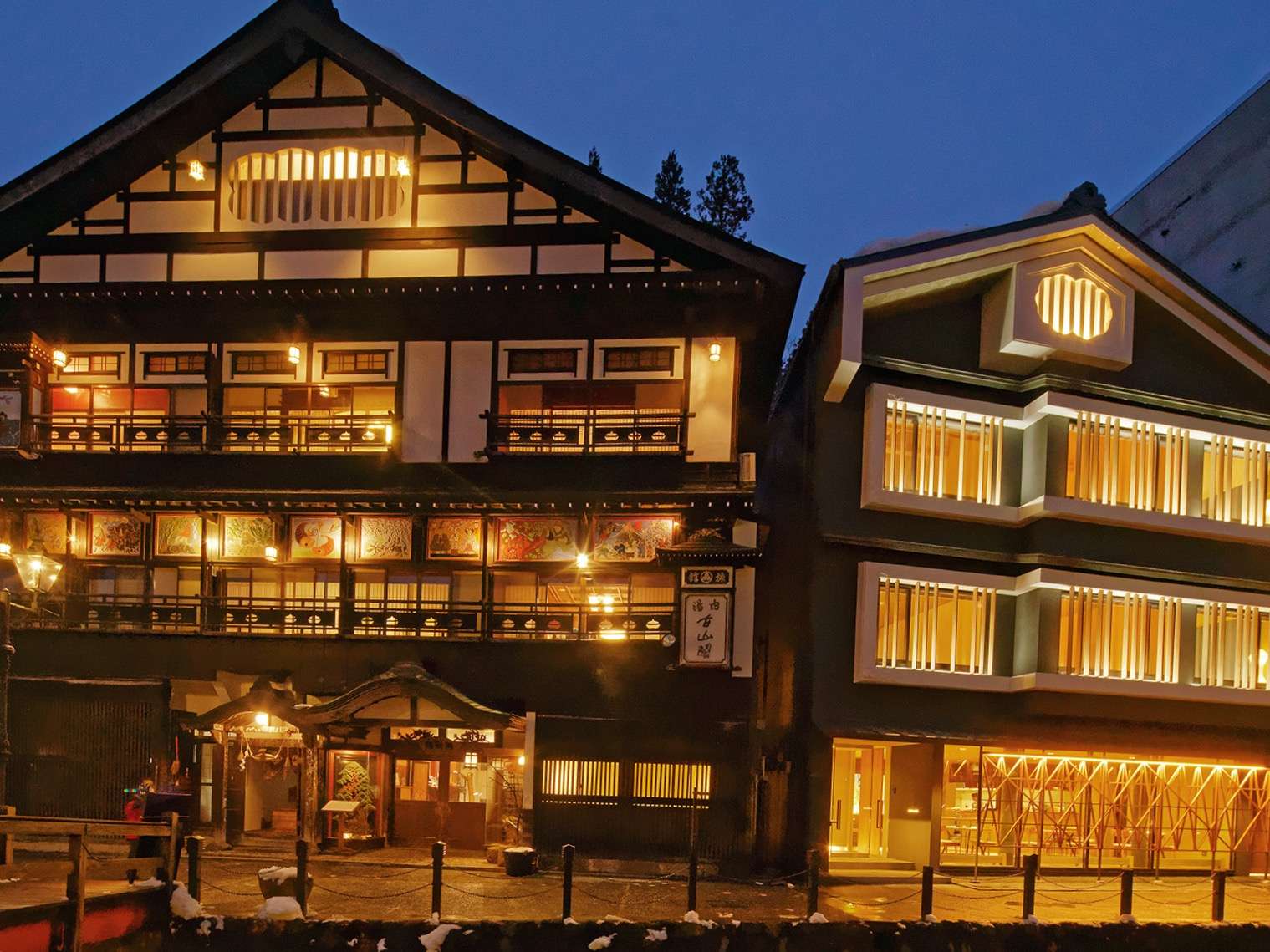
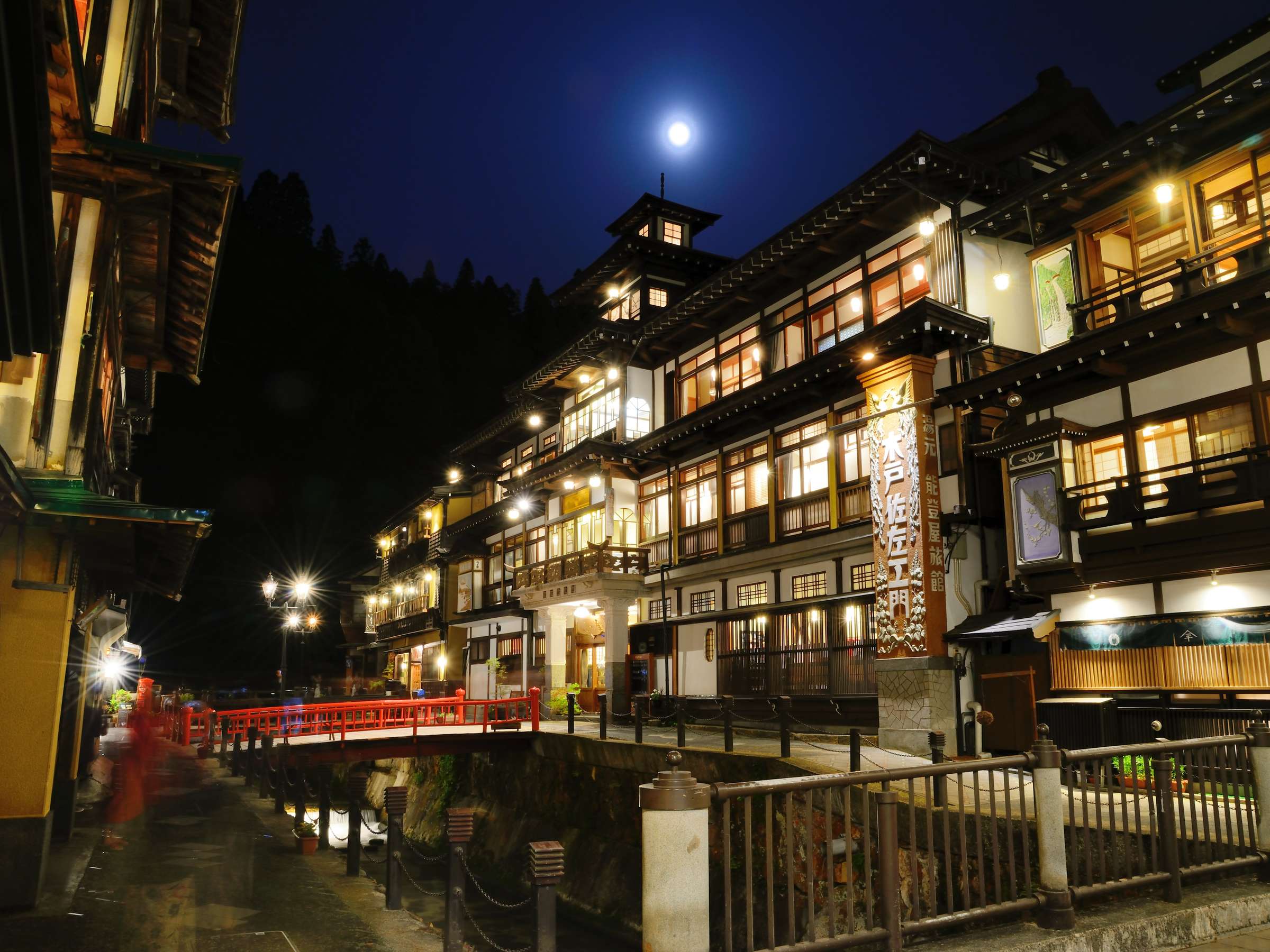
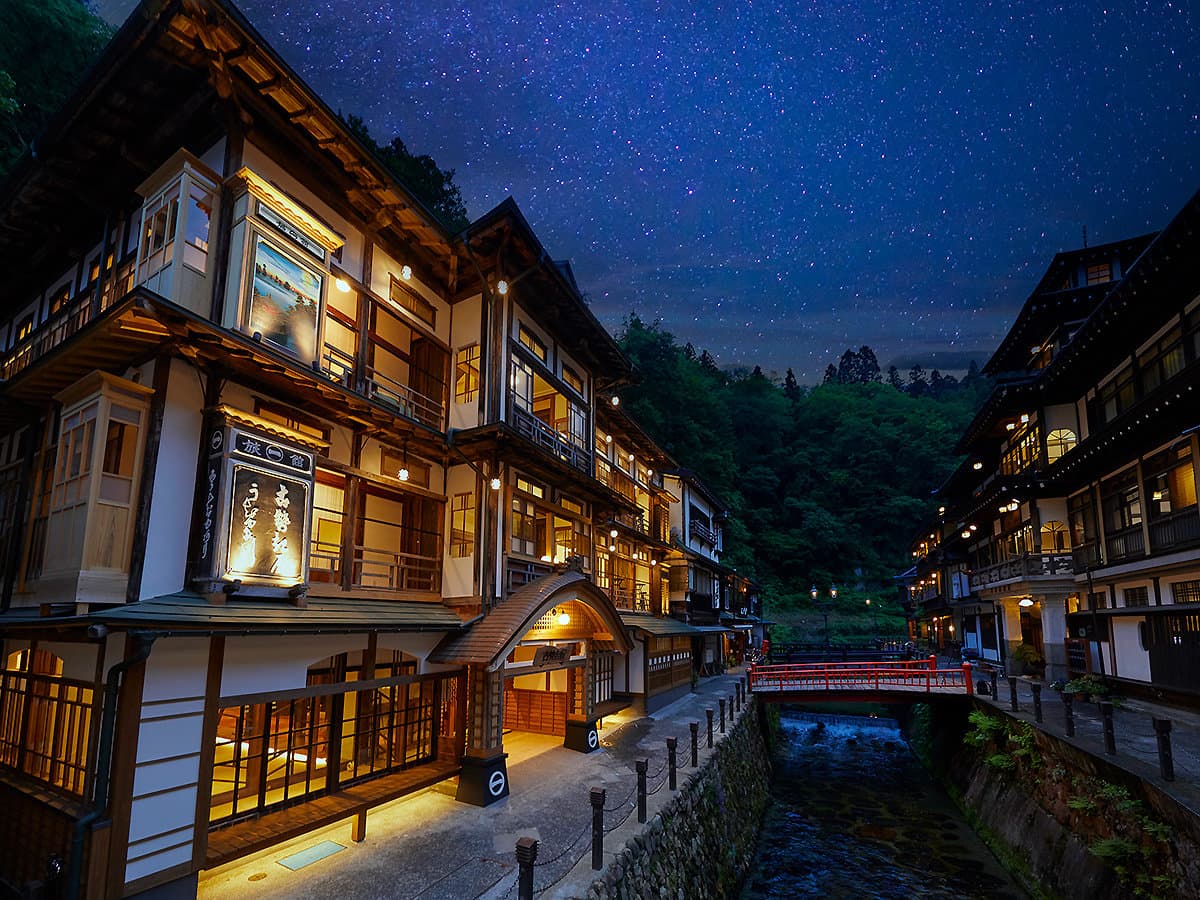
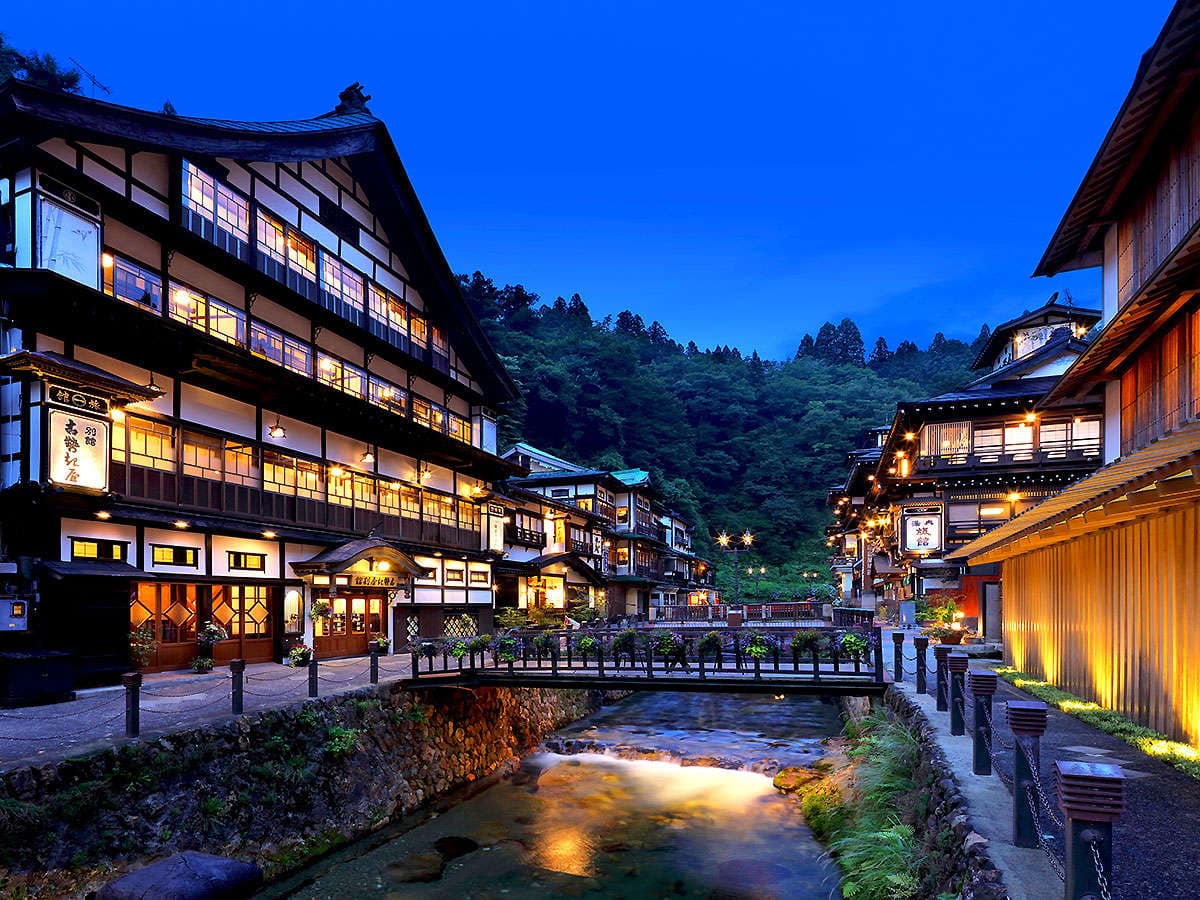
*Ginzan Onsen's iconic Takimi Bridge and ryokan row in winter — snow-covered Taisho-era architecture illuminated by gas lamps (photo: Bruno Plus / Wikimedia Commons, CC-BY 4.0)*
Introduction
The first thing that hits you isn't the cold — it's the smell of sulfur carried on mountain air, and then the amber glow. Gas lamps, real ones burning actual gas, line the riverbanks. Snow sits thick on wooden balconies. The Ginzan River runs black between two rows of Taisho-era ryokans, their paper screens lit from inside like paper lanterns. If you're weighing the best ryokans in Ginzan Onsen, you're already asking the right question — because where you stay here shapes the entire experience.
This is Ginzan Onsen — thirteen ryokans on a 300-meter cobblestone strip in the mountains of Yamagata Prefecture. In 2026, [National Geographic named Yamagata Prefecture](https://www.nationalgeographic.com/travel/best-of-the-world-2026/article/yamagata-japan) one of its Best of the World destinations, singling out Takimikan and Fujiya ryokan. The village also happens to look uncannily like the bathhouse town in *Spirited Away* — Studio Ghibli has never confirmed the connection, but the visual resemblance is hard to shake. The combination of those two facts has driven a surge of English-language interest in a village that previously flew almost entirely under the radar.
Here's the problem: most English guides describe the atmosphere and stop there. You'll get the vibe, but not the prices, not the private-versus-shared onsen breakdown, not the booking lead times, and not the honest answer to whether a given ryokan works for a solo traveler or a honeymoon couple with tattoos. This guide covers all thirteen properties with verified pricing, per-property onsen details, and a straight answer on who each one actually suits. If you're planning a trip to one of the [best onsen towns in Japan](/blog/best-onsen-towns-japan), Ginzan belongs on your shortlist — with your eyes open about what it takes to book it.
---
Why Ginzan Onsen is unlike any other ryokan village in Japan
Less than 1% of Japan's 37 million 2024 visitors made it to Yamagata Prefecture [National Geographic, 2026](https://www.nationalgeographic.com/travel/best-of-the-world-2026/article/yamagata-japan). That number is about to change. The NatGeo recognition specifically highlighted Takimikan and Fujiya ryokan as recommended stays, meaning these two properties in particular will face a step-change in demand from 2026 onward. If you're reading this after the article went viral on travel forums — which it did — winter availability is already tighter than it was a year ago.
National Geographic described Ginzan Onsen as offering "scenes more evocative of a Taisho period (1912–26) novel than a modern resort" [National Geographic Best of the World 2026](https://www.nationalgeographic.com/travel/best-of-the-world-2026/article/yamagata-japan). That framing is accurate. No competing destination in Japan replicates this particular combination of architectural preservation and working onsen infrastructure.
The village owes its existence to a silver mine. "Ginzan" means silver mountain, and the mine ran from the 16th century until it flooded in 1689. The hot springs that had been feeding the mine workers' baths stayed open. By the Taisho era (1912–1926), wealthy merchants and city workers were coming to soak, and the multi-story wooden ryokans they built line both banks of the Ginzan River to this day. A local ordinance protects the Taisho-era townscape — no modern concrete facades, no signage that breaks the period aesthetic, no cars permitted inside the hot spring area at all. What you see in photographs is what you get in person, which is rare in Japan and almost unheard of in a working onsen village. See the [Yamagata Prefecture Tourism](https://www.yamagatakanko.com/en/) site for the wider regional context.
The 300-meter strip matters for another reason: location within Ginzan Onsen is not a meaningful differentiating factor. All thirteen ryokans are within a five-minute walk of each other. What actually matters when choosing where to stay is price tier, private versus shared onsen access, English-booking ease, and meal quality. This guide is structured around those factors. For the wider context of the [best ryokans in Yamagata](/blog/best-ryokans-yamagata), Ginzan is the flagship — but the prefecture has far more to offer beyond this one valley. The [Ginzan Onsen area guide](/onsen-areas/ginzan) covers the village-level detail.
The village also shares its public bathing infrastructure. Shirogane no Yu, the public bathhouse designed by architect Kengo Kuma, is available for ¥500 per person and accessible to all guests including those at budget properties without in-house private facilities. (Note: as of research date, one of the two baths in the complex was closed — verify current status before arriving.) There's also a free riverside foot bath open year-round.
---
Quick comparison: all 13 Ginzan Onsen ryokans at a glance
All prices are per person, per night, including dinner (kaiseki multi-course) and breakfast — the standard pricing convention at Japanese ryokans. A room rate for two people is roughly double the per-person figure. USD conversions use an approximate rate of ¥145/USD (at May 2026 rates); treat dollar figures as directional. Rates vary by room type and season.
| Property | Price/Person (¥, 2 meals) | Price/Person (USD approx.) | Rooms | Private Onsen | English Booking | Booking Lead Time | Best For | |---|---|---|---|---|---|---|---| | Matsumoto Ryokan | ¥20,000–25,000 | ~$138–172 | 10 | No | Basic (3rd-party) | 6–8 wks (autumn); 3–4 mo (winter) | Budget; first-timers | | Oyado Yanadaya | From ¥18,700 | From ~$129 | 4 | Unconfirmed | Not confirmed | 3–6 mo (winter) | Couples; exclusivity | | Showakan | ¥20,000–30,000 | ~$138–207 | 13 | No | Not confirmed | 1–2 mo (summer); 3–4 mo (winter) | Families; central location | | Kozankaku | From ¥26,550 | From ~$183 | 8 | Yes (rental) | Limited | 3–6 mo (winter) | Budget; groups; cash only | | Notoya Ryokan | ¥25,300–28,600 | ~$174–197 | 15 | Yes (cave + rental) | Yes (online) | 3–6 mo (winter) | History lovers; solo | | Honkan Kosekiya | Contact property | — | 14 | No | Yes | 3–6 mo (winter) | Taisho romance | | Kosekiya Bekkan | Contact property | — | 14 | No | Yes | 3–6 mo (winter) | Central; dietary needs | | Hatago Itouya | From ¥22,000 | From ~$152 | 4 | Yes (all-private) | Japanese site only | 6–12 mo (winter) | Privacy; tattoo-friendly | | Eizawa Heihachi | From ¥22,000 | From ~$152 | 7 | Yes (outdoor rental) | Limited | 6–12 mo (winter) | Couples; winter atmosphere | | Ginzanso | ¥24,000–39,600 | ~$165–273 | 40 | Yes (deluxe rooms) | Yes | 2–3 mo (autumn); 3–6 mo (winter) | Families; groups; first-timers | | Kuranoba (Clanuova) | ¥30,000 | ~$207 | 6 | Yes | Limited; cash only | 3–6 mo (winter) | Couples; food-forward | | Takimikan | ¥26,700–42,800 | ~$184–295 | 18 | Annex only | Email workable | 3–6 mo (autumn/winter) | Foodies; views | | Fujiya Inn | ¥33,000–68,000 | ~$228–469 | 8 | Yes (5 private baths) | Yes (platforms) | 6–12 mo (winter) | Couples; design lovers; luxury |

*Aerial view of Ginzan Onsen showing the 300-meter strip of 13 ryokans on both banks of the Ginzan River (photo: Wikimedia Commons, CC-BY-SA 3.0)*
Tip
**Booking platforms:** Most properties can be reached via Trip.com, Booking.com, or Expedia — the three widest-coverage platforms for Ginzan Onsen. Trip.com generally carries the most complete Japanese ryokan inventory.
[Check rates on Trip.com](#) | [Compare on Booking.com](#) | [Search Expedia](#)
---
Budget tier (under ¥22,000 per person): best value picks
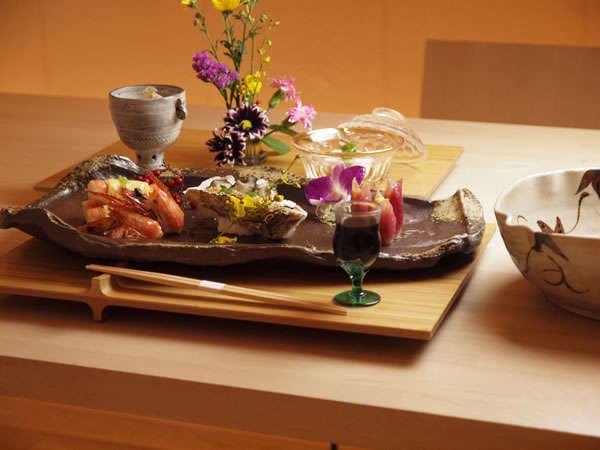
At this price point in Ginzan Onsen, "budget" is relative. You're still getting a tatami room, a multi-course kaiseki dinner featuring local Yamagata beef and mountain vegetables, breakfast, and access to genuine kakenagashi (source-flow, non-recycled) hot spring water. What you're typically trading off is a private in-room bath and, in some cases, English support at the front desk. The Shirogane no Yu public bath (¥500) fills the gap for onsen access.
Every property in this tier includes dinner — that's not a Ginzan-specific quirk, it's the nationwide ryokan standard. Guests who worry they're "only getting a budget ryokan" should know that even the most affordable property here is serving a dinner that would cost ¥8,000+ at a standalone restaurant in Yamagata City.
Matsumoto Ryokan
Matsumoto is the most affordable overnight option in Ginzan Onsen — recent traveler reports suggest around $100–$138 per person, though current 2025 pricing has likely settled around ¥20,000–25,000 per person with meals [haveyaseenjapan.com; HotelsCombined May rates]. It's a ten-room, family-run property directly beside the red bridge and riverside walking path, which puts you in the heart of the nightly gas-lamp spectacle without paying Fujiya prices. Rooms are traditional tatami with futon. Onsen access is through the surrounding shared facilities — no private bath. English booking works via Klook and Rakuten Travel. Tattoo policy for the shared baths is unconfirmed — contact the property directly. For a first-time ryokan experience where the village itself is the star, Matsumoto delivers without the premium. Book 6–8 weeks ahead for autumn; 3–4 months for winter.
Oyado Yanadaya
Four rooms, a maximum of four groups per night, and a dinner menu built around Obanazawa wagyu steak and shabu-shabu — Yanadaya is one of the quietest stays in the village. Pricing starts from ¥18,700 per person with meals [yanadaya.com, Japanese search summary, verified 2026-05-15], making it the most accessible entry point for exclusivity in Ginzan Onsen. The property provides colored yukata robes (most ryokans offer only the standard white or indigo), and the covered terrace serves onsen eggs and beverages — a small ritual that's pleasant on a cold evening. The bath configuration — whether private or shared — is not confirmed on the official site; contact Yanadaya directly before booking. Tattoo policy is also unconfirmed — worth a direct inquiry. With four rooms total, this fills faster than its price suggests. Best for couples who want the intimacy of a four-room inn, prime wagyu on the table every night, and a stay that costs significantly less than most private-bath properties.
Showakan
Showakan sits at the entrance to the main Ginzan Onsen area, which is convenient for guests arriving without ryokan shuttle coordination. Pricing runs approximately ¥20,000–30,000 per person with meals [Trip.com/Tripadvisor, approximate]. The standout feature is the 24-hour open-air bath on the second floor — gender-separated, fed directly from the spring, and open all night including during snowfall. The kaiseki dinner highlights Yamagata beef and sashimi; breakfast comes with safflower rice cooked in a kamado (traditional hearth pot), which is a regional specialty worth noting. At 13 rooms with capacity for 50, it's one of the easier budget-tier properties to actually get a reservation at. Tattoo policy for shared baths is unconfirmed — inquire directly before booking. Best for families or groups who want convenient access and an outdoor bath experience without the luxury price tag.

*Traditional Japanese winter architecture — similar aesthetic to budget-tier Ginzan Onsen ryokans in Yamagata (photo: Pexels, CC0)*
[Check Budget Ryokan Availability on Trip.com](#)
---
Mid-range tier (¥22,000–¥43,000 per person): nine properties, clear differences
This is the widest band in Ginzan Onsen — nine of the thirteen properties start within it — and where the real differentiation work happens. Private onsen access, English-booking infrastructure, meal philosophy, and room count all vary significantly across this group. The properties are ordered here from smallest to largest to make the intimacy trade-off easy to see at a glance.
Tip
**Booking lead times by season:** Winter weekends (December–February) book out 3–6 months ahead for mid-range properties, and 6–12 months for the four-room properties (Itouya); autumn foliage peak (late October–early November) books 2–3 months ahead; spring cherry blossom week (mid-April) books 4–6 weeks ahead; summer is the most forgiving at 1–2 months. The smaller the property, the faster it fills regardless of season.
Hatago Itouya
Itouya takes the private-bath principle further than any other property in the village: every bath is private, and only four groups stay per night. That's it. The in-room onsen system means no scheduling around shared bath hours, no navigating the tattoo-policy question, and no encountering other guests in the water. The snow-viewing bath on the second floor is the signature feature — a small private tub with a direct sight line to the white-covered valley below. Pricing starts from ¥22,000 per person with meals [hatago-itouya.com, verified 2026-05-15], though the per-night figure for a two-person booking will reflect the exclusive nature of the property. The kaiseki features Obanazawa beef as the main course alongside locally sourced mushrooms and fish. The website is Japanese only, which makes this one of the harder properties to book without Japanese ability or a travel agent — third-party platforms are the practical English-language route. Given four groups maximum, winter dates require booking the moment the reservation window opens. Best for couples who want maximum privacy, and for tattooed travelers who want hot spring bathing without navigating policy variations.
Eizawa Heihachi (Nagasawa Heihachi)
Seven rooms, and the highlight is a private rental outdoor onsen bath in snow conditions — a kashikiri tub under open sky in a valley that goes silent after dinner, with no shared-bath scheduling required. The Taisho-era aesthetic reads as intimate rather than grand. The exterior and outdoor bath also photograph exceptionally well in winter, which is why the property turns up repeatedly in photography guides, but that's the consequence of being good, not the reason to stay. Pricing starts from approximately ¥22,000 per person (based on ¥44,000 per night for two people) [jalan.net, verified 2026-05-15]. English support on-site is not confirmed; limited is the safer assumption. Tattoo policy for the private outdoor bath is likely accommodating — confirm directly before booking. For couples who want the intimate scale of a small property with reliable private onsen access, Eizawa Heihachi is worth the extra coordination required to book it.
Kozankaku
Kozankaku is priced from ¥26,550 per person including two meals [gltjp.com, verified 2026-05-15], but there's a critical caveat every foreign visitor needs to know upfront: Kozankaku is cash only. No credit cards accepted. Bring enough yen before leaving Yamagata City. The property is a historic wooden inn from the early Showa period, and the interior preserves the period faithfully — retro sofas, antique clocks, wooden beams that creak reassuringly. It has two shared baths (wooden bath for women, stone bath for men) plus two private baths available to all guests on a first-come basis. Tattooed guests can use the private baths [verified via tattoo-friendly.com]. English support at reception is limited — booking through a third-party platform is the easier route. Kozankaku also has one spacious suite accommodating up to eight guests, making it one of the few Ginzan options for a small group traveling together.
Notoya Ryokan
Notoya was founded in Meiji 25 — that's 1892 — and is designated a tangible cultural property of Japan [selected-ryokan.com, 2026-05-15]. Pricing runs ¥25,300–28,600 per person with meals [selected-ryokan.com, verified 2026-05-15]. The old folk-house construction uses traditional joinery techniques that haven't changed since the Meiji era, and the cave bath — said to be the original hot spring used since the founding — is now available as a kashikiri (private rental) bath. There's also an outdoor observation bath with waterfall views. Some sources specifically cite Notoya's facade as resembling the bathhouse in *Spirited Away*, though Studio Ghibli has never confirmed any connection. Notoya was also a filming location for the NHK drama *Oshin* (1983–84). English online booking is available via the official site; phone reservations are Japanese only. Tattooed guests can use the private baths; shared bath policy is unclear — confirm directly. The on-site café serving tea and light refreshments makes it a reasonable base for an afternoon in the village even if you're only day-tripping. For overnight stays, solo travelers and history enthusiasts get the most out of Notoya's atmosphere.
Kuranoba (Clanuova)
Kuranoba opened in 2017 as the new wing of the Kozankaku property, and it does something no other ryokan in Ginzan Onsen attempts: the dinner is Italian-French cuisine using Yamagata ingredients. The owner-chef trained in Tokyo before returning to the region, and the menu is built around Obanazawa beef and Kahoku Town vegetables prepared with Italian technique, paired with Yamagata and Italian wines. At only six rooms (capacity: 12), this is the most intimate property in the village by room count. Pricing is approximately ¥30,000 per person with meals [gltjp.com, verified 2026-05-15]. The private bath on the third floor of the Kozankaku building is accessible to Kuranoba guests, and the communal bath on the first floor is also available. The name blends Italian *nuovo* (new) and *classico* (classic) — the design is Western-style rooms looking out over the historic onsen street, which is an unusual combination that works. English support is limited — same caveat as Kozankaku, book via a platform. Cash-only payment applies to Kozankaku/Kuranoba — bring yen. Best for food-forward travelers and couples seeking something that doesn't feel like every other ryokan in Japan.
Takimikan
Takimikan sits at the top of the Ginzan Onsen hillside — literally the highest-elevation property in the village — and the panoramic open-air bath up there is among the best views available from any onsen in the valley. On a clear winter day you're looking out over snow-covered rooftops with nothing blocking the horizon. The property runs ¥26,700–42,800 per person with meals [selected-ryokan.com, verified 2026-05-15], placing it across both the mid-range and upper end of this band depending on room type. The signature dish is handmade soba from Obanazawa-grown buckwheat — a specific regional variety that Takimikan makes in-house, and it's legitimately good. The kaiseki also features Obanazawa beef. National Geographic's 2026 Yamagata article specifically mentioned Takimikan as a recommended stay. It also served as a filming location for the NHK drama *Oshin* (1983–84). The main building has shared baths only; the annex *Bettei Takimitate*, set at the base of Shirogane Falls, has a private onsen for annex guests. Tattoo policy for the shared baths is not confirmed — contact the property directly before booking. Email communication in English reportedly works for shuttle booking from Oishida Station, which you must arrange in advance. Best for foodies and winter-view enthusiasts.
Ginzanso
With 40 rooms and capacity for 200, Ginzanso is the largest property in Ginzan Onsen — founded around 1900, one of the oldest establishments, and a filming location for the NHK drama *Oshin* [selected-ryokan.com, verified 2026-05-15]. The scale means you get the smoothest operational experience: an English website, international booking agencies supported, and a free shuttle from JR Oishida Station. Deluxe rooms include attached open-air hot spring baths fed by three spring types (sulfur, chloride, and sulfate), and tattooed guests can use the private baths [selected-ryokan.com]. The shared communal baths are also available. Pricing runs ¥24,000–39,600 per person with meals [selected-ryokan.com, verified 2026-05-15] — the starting price sits firmly in mid-range; the upper end reflects premium river-view deluxe rooms. Ginzanso is also the property best positioned for winter side trips: Zao Snow Monster (juhyo) viewing excursions are possible January–March. It's the most practical choice for first-time ryokan visitors who want a guaranteed smooth experience, and the only property in the village that can comfortably handle larger family groups.
Honkan Kosekiya
The main Kosekiya building holds the distinction of being the first Taisho-era structure built in Ginzan Onsen, which is a meaningful claim in a village where the architecture is the entire point. The aesthetic is retro-modern: stained glass, antique furnishings, and three room types (mountain-view, river-view, and traditional Japanese-style). Pricing is currently unverified on English-language sources — check the official site or Booking.com directly for current rates. The two indoor baths rotate by gender and run from 16:00–24:00 only; there's no open-air bath in the main building, but guests can use Ginzanso's facilities. Tattoo policy for shared indoor baths is not confirmed. Honkan Kosekiya has a free shuttle from JR Oishida Station running three times daily, which simplifies the final leg from the shinkansen. Best for travelers who want to sleep inside a piece of Japanese architectural history without paying luxury prices.
Kosekiya Bekkan (Annex)
The annex sits in the center of the historic townscape and shares the same Taisho aesthetic as its parent building. At 14 rooms for 30 guests, it's slightly roomier than the main building per guest. Pricing is also currently unverified on English-language sources. The practical standouts here are operational: Kosekiya Bekkan is one of the few Ginzan properties that explicitly accepts UnionPay (useful for Chinese visitors and some Southeast Asian cardholders) and has a documented process for dietary accommodation — allergen substitutions are available for approximately ¥1,500 extra, which must be requested at booking. Free Wi-Fi throughout. Three daily shuttles from Oishida Station. Shared baths only — no private onsen access — and tattoo policy for shared baths is not stated; inquire directly. Best for travelers who need dietary flexibility or are coming from destinations where UnionPay is the primary card.
*Traditional yukata robe — standard evening wear at all Ginzan Onsen ryokans (photo: Wikimedia Commons, CC-BY-SA 3.0)*
[Check Mid-Range Ryokan Rates — Trip.com](#) | [Booking.com](#) | [Expedia](#)
---
Luxury tier (¥33,000–¥68,000 per person): Ginzan's top end
The honest case for spending at the top of Ginzan's price range: a private in-room or reserved onsen bath, a kaiseki menu at the level of standalone high-end restaurants, and a room count so small the property functions more like a private house than a hotel. Compared to luxury ryokans in Kinosaki or Hakone, Ginzan's top tier is often priced 20–30% lower for a comparable experience, partly because it hasn't been on the international radar until now.
That won't last. Book accordingly.
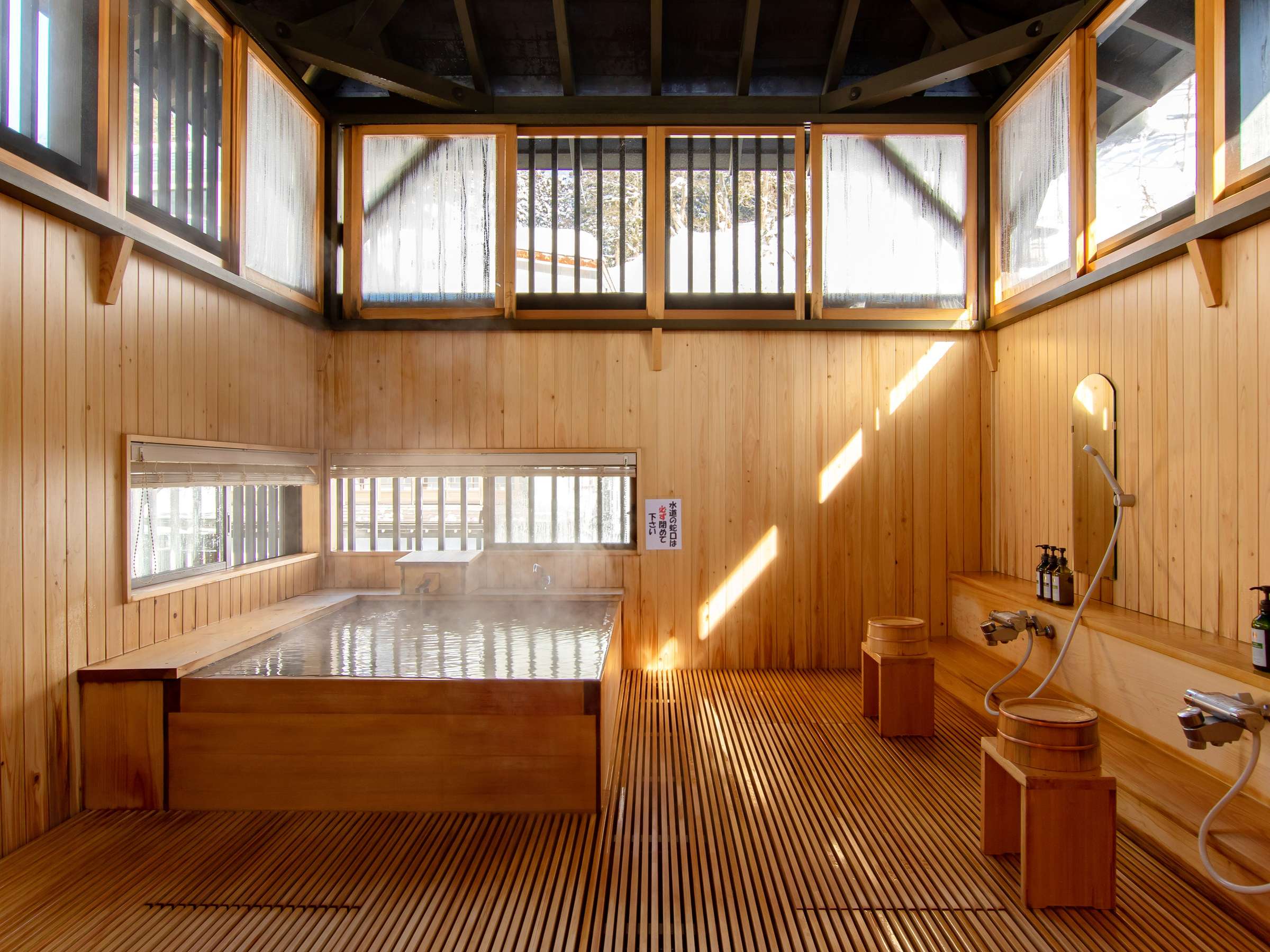
*Snow-viewing onsen bath — the quintessential winter hot spring experience at luxury Ginzan properties (photo: Unsplash, CC0)*
Fujiya Inn
Fujiya Inn is the property that most directly put Ginzan Onsen on the international map, and the [National Geographic Best of the World 2026](https://www.nationalgeographic.com/travel/best-of-the-world-2026/article/yamagata-japan) article named it explicitly. The origins trace to the Edo period, but the current building was completely redesigned in 2006 by architect Kengo Kuma — the same designer responsible for the Tokyo National Stadium and the Shirogane no Yu public bath down the street. Kuma used bamboo *sumushiko* screens and *Dalle de Verre* stained glass to create a space that feels simultaneously ancient and severe. There are only eight rooms (capacity: 21), and dinner is served in-room. The five private hot spring baths — available 24 hours, free of charge — are the entire bathing setup here; there is no shared communal bath at all. That means tattooed guests are fully unrestricted at Fujiya, which is a rare and explicit advantage. Pricing runs ¥33,000–68,000 per person with meals [selected-ryokan.com / gltjp.com, verified 2026-05-15]. The range is wide because the three room types (Type A with private bath, Type B, and Type C with covered porch) vary significantly. For winter dates, book 6–12 months ahead — this is not an exaggeration. The ryokan runs a shuttle from Oishida at approximately 13:30 and 15:30, but you must reserve in advance. Best for couples, architecture enthusiasts, and anyone who wants the Ginzan Onsen experience distilled to its most intentional form.
[Check Availability — Books Fast in Peak Season — Trip.com](#) | [Booking.com](#)
---
Which ryokan is right for you? Recommendations by traveler type
First-time ryokan guests: Go with Ginzanso. The English website, international booking infrastructure, airport-style shuttle service, and large staff make the learning curve manageable. You'll still get the full tatami-and-kaiseki experience without the communication friction that smaller properties can involve. Read the [first-time ryokan guide](/blog/first-time-ryokan-guide) before arriving.
Couples on a honeymoon or anniversary: Fujiya Inn or Hatago Itouya. Both have entirely private bathing, which removes the shared-bath social dynamic entirely. Fujiya brings Kengo Kuma architecture and a specific refinement that justifies the top-end pricing. Itouya brings the snow-viewing bath and maximum seclusion at a mid-range starting price. If budget is a factor, Eizawa Heihachi offers the same private outdoor bath intimacy for a similar starting price.
Solo travelers: Notoya Ryokan. The history is genuine (1892, designated cultural property), the pricing is reasonable at ¥25,300–28,600, and the village is small enough that solo evening strolls along the gaslit riverbank are the entire experience — which is exactly what solo travelers come here for. The cave bath is a singular detail that stays with you.
Winter photography enthusiasts: Notoya and Eizawa Heihachi for exterior architecture; Takimikan for the elevated panoramic outdoor bath with rooftop views over the snow-covered village. All three photograph differently and are within a three-minute walk of each other.
Families with children: Ginzanso. It's the only property with the room count and operational infrastructure to handle the logistics of a family stay. Confirm children's pricing and meal arrangements at booking — ryokan meal portions and formats are designed for adults, and most properties ask that you notify them in advance.
Tattooed travelers: Fujiya Inn (all baths private — unrestricted) or Hatago Itouya (all baths private — unrestricted). Ginzanso and Notoya offer private baths for tattooed guests if you can't get into the former two. Kozankaku also has private bath access for tattooed guests, but remember the cash-only payment requirement.
Food-forward travelers seeking something different: Kuranoba (Clanuova) for Italian-French kaiseki with Yamagata ingredients — the most unusual dining option in the village. Takimikan for the homemade soba from Obanazawa buckwheat. Oyado Yanadaya for wagyu steak and shabu-shabu at one of the village's smallest and most intimate properties.
---
Ginzan Onsen in winter vs other seasons: when to visit and what to book
Winter (December–February) is peak season, and the photos that circulate on Instagram every January are why. Snow on wooden rooftops, gas lamps burning amber over the frozen river, outdoor baths in falling snow — this is the Ginzan Onsen winter ryokan experience that drives most international searches. It's real, and it's worth the extra planning. The caveat: visitor management is now formal. From December 20 to March 1, day visitors are capped at 100 per hour after 5 PM; after 8 PM, only overnight guests are permitted in the village. Day-trippers must park at the Taisho Romakan visitor center (approximately 2km out) and take a paid shuttle (¥1,150) into the village. If you're staying overnight, you enter as a guest and none of this applies to you — which is the strongest possible argument for booking a room rather than day-tripping.
Booking lead time for winter: 3–6 months ahead for most mid-range properties. Fujiya Inn and Hatago Itouya: 6–12 months. Some ryokans open winter reservations approximately one year prior to the date.
Autumn foliage (September–November) is widely called the most underrated season. Fiery orange and red kaede maple leaves cover the hillsides above the ryokan strip, and the visual contrast with white plaster walls and dark timber frames is sharp. Late October through early November is peak foliage. Book 3–6 months ahead.
Spring (March–May) brings cherry blossoms along the Ginzan River — typically mid-April — and the Shirogane Falls runs at full flow after the winter thaw. Crowds are smaller than winter or autumn. The snow-viewing magic is gone, but the green valley shows a different, quieter character. Book the cherry blossom peak 4–6 weeks ahead; the rest of spring is more forgiving.
Summer (June–August) is the quiet season. The mountain location keeps temperatures noticeably cooler than urban Japan's brutal August. Easiest availability, often lowest prices. The gas lamps have less drama without snow, but the hiking trails above the village are fully open, and yukata evening strolls without winter gear are genuinely pleasant. 1–2 months' lead time is typically sufficient.
Golden Week (late April–early May) and Obon (mid-August): book 6 months ahead or reconsider your dates entirely. These national holiday windows compress the entire country into the same destination at once.
---
How to get to Ginzan Onsen from Tokyo and Yamagata
Getting here is straightforward once you know the route. The [Japan Rail Pass guide](/blog/japan-rail-pass-guide) covers the shinkansen booking side of things — the Yamagata Shinkansen is JR-operated and JR Pass holders pay no additional fare for the train portion.
From Tokyo: 1. Take the JR Yamagata Shinkansen "Tsubasa" from Tokyo Station to Oishida Station (大石田駅). Journey time approximately 200 minutes (3 hours 20 minutes); trains run every 1–2 hours. One-way fare approximately ¥13,780 without a JR Pass [selected-ryokan.com access guide, verified 2026-05-15]. 2. From Oishida Station, take the Yamagata Kotsu (山交バス) local bus to Ginzan Onsen. Journey time 35 minutes, fare ¥1,000 one-way, frequency approximately every 1–2 hours. 3. Most ryokans offer a free shuttle from Oishida Station — confirm and reserve this when booking. Total door-to-door from Tokyo: approximately 3 hours 20 minutes to 3 hours 50 minutes.
From Yamagata Airport: Direct bus to Ginzan Onsen (no reservation required): 75 minutes, ¥2,000. Shared taxi (reserve by 5 PM the prior day): 60 minutes, ¥4,800–5,300.
From Sendai: Highway bus to Obanazawa then local bus, approximately 2 hours 10 minutes, ¥2,760–2,790.
Driving in winter: Private cars cannot enter the Ginzan Onsen hot spring area from December 20 through March 1 (non-staying visitors). If you're an overnight guest, the ryokan will advise on parking — the lot is a 5–10 minute walk from the strip, and ryokans offer pickup service. Come with winter tires fitted.
---
What to expect when you arrive: ryokan etiquette for Ginzan Onsen
First-time ryokan guests sometimes spend the first hour unsure of what they're supposed to do. Here's the sequence.
- Check-in is typically between 14:00 and 15:00 (Showakan offers a later 14:00, Kozankaku from 14:30). Remove your shoes in the entryway (genkan) and you'll be led to your room in slippers. - Yukata robes are provided and are worn in your room, in common areas, and for evening walks along the riverside. This is normal and expected — you'll see everyone doing it. - Dinner is typically served between 18:00 and 19:00, either in your room or a private dining room. The meal is kaiseki-style — multiple courses arriving sequentially. Notify the ryokan of dietary restrictions at booking, not on the day. - Onsen etiquette: Wash and rinse your body thoroughly at the shower stations before entering any communal bath. Towels should not touch the water. Keep the atmosphere quiet. Most properties ask guests not to use the baths after drinking. - Check-out is typically 10:00–11:00 (Kozankaku 10:00, Showakan 12:00). Breakfast is served at 07:30–09:00 depending on property. - Payment: Most properties accept major credit cards. Kozankaku and Kuranoba (Clanuova) are cash only — bring yen. Kosekiya Bekkan accepts UnionPay.
The village itself is 300 meters long. The gas lamps ignite at dusk. After dinner, a slow walk in your yukata along the riverbank — even in temperatures well below zero — is the point of coming here.
---
Ginzan Onsen ryokan FAQs
How many ryokans are in Ginzan Onsen?
Exactly 13 ryokans operate in Ginzan Onsen, ranging from around ¥18,700 per person at the budget end to over ¥68,000 per person per night at the luxury end. All 13 line the banks of the Ginzan River along a single 300-meter strip [ginzanonsen.jp].
There's no meaningful location difference between properties — the entire strip is a five-minute walk end to end. What separates them is price, private versus shared onsen access, and English-booking ease.
What is the best ryokan in Ginzan Onsen?
For couples prioritizing privacy and design, Fujiya Inn is the standout — 8 rooms, 5 all-private hot spring baths, Kengo Kuma architecture, and a National Geographic 2026 mention. For first-time visitors wanting a smooth English-friendly experience, Ginzanso is the most practical choice. Budget travelers get honest value from Notoya, a 130-year-old designated cultural property priced from ¥25,300 per person.
No single property works for every traveler. The tattooed-traveler section and the tier breakdowns above will narrow it down faster than any ranking.
How far in advance should I book a Ginzan Onsen ryokan?
Winter weekends (December–February): 6–12 months for small luxury properties; 3–4 months for mid-range. Autumn foliage peak (late October–November): 3–6 months. Spring cherry blossoms: 4–6 weeks. Summer: 1–2 months. Golden Week and Obon: 6 months minimum.
Most properties hold 4–18 rooms. They fill faster than hotel logic suggests — the smallest places have fewer rooms than some hotel floors. Book the moment you have confirmed dates.
Do Ginzan Onsen ryokans have private onsen baths?
Several properties offer kashikiri-buro (private reserved onsen) or in-room hot spring baths. Fujiya Inn and Hatago Itouya have exclusively private baths — no shared communal bath at all, making both fully tattoo-friendly. Budget properties use shared gender-separated communal baths plus the public Shirogane no Yu (¥500).
See the comparison table above for the per-property private onsen breakdown. For tattooed travelers, the recommendations section has a dedicated subsection.
Is Ginzan Onsen worth visiting in winter?
Yes — winter is peak season for real reasons. Snow transforms the Taisho-era wooden facades into a landscape that shares an uncanny resemblance with the bathhouse town in *Spirited Away* (Studio Ghibli has never confirmed this connection). Yamagata Prefecture was named to [National Geographic's Best of the World 2026](https://www.nationalgeographic.com/travel/best-of-the-world-2026/article/yamagata-japan). Overnight guests bypass the day-visitor restrictions entirely.
The main practical caveat: winter weekends at small properties book 6–12 months ahead. Weekday stays are far less competitive and noticeably less crowded.
How do I get to Ginzan Onsen from Tokyo?
Take the JR Yamagata Shinkansen "Tsubasa" from Tokyo Station to Oishida Station (approximately 3 hours 20 minutes, ¥13,780 one-way; JR Pass valid for shinkansen portion). Then take the Yamagata Kotsu bus to Ginzan Onsen (35 minutes, ¥1,000). Most ryokans offer a free shuttle from Oishida — book it when you reserve your room [selected-ryokan.com access guide].
Driving is possible outside winter restrictions, but December 20–March 1 non-staying visitors cannot enter the onsen area by car. Overnight guests should ask their ryokan about the parking lot and pickup service.
---
Ready to book the best ryokans in Ginzan Onsen?
The best rooms at the most sought-after properties sell out 12 months in advance of peak winter dates — that's not urgency framing, it's the operational reality of a village where the largest property has 40 rooms and the smallest has four. Thirteen ryokans. One 300-meter strip. The most photographed onsen village in Japan, and as of 2026, firmly on the international radar after the National Geographic selection. Prices start below ¥20,000 per person with two meals included.

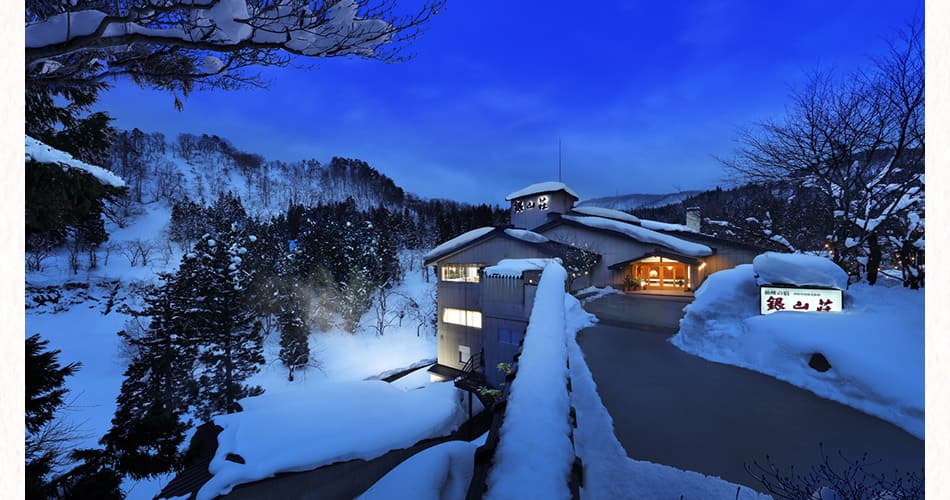
*Ginzan Onsen village — the 300-meter strip where all 13 ryokans create an unbroken Taisho-era townscape (photo: Bruno Plus / Wikimedia Commons, CC-BY 4.0)*
[Book on Trip.com](#) | [Compare on Booking.com](#) | [Search Expedia](#)
For the wider prefecture, see our guide to the [best ryokans in Yamagata](/blog/best-ryokans-yamagata) — Ginzan is the headline act, but Yamagata has a lot more onsen going on.

*冬日银山温泉标志性的滝见桥与旅馆街 — 雪中大正建筑在煤气灯映照下的夜景(照片:Bruno Plus / Wikimedia Commons, CC-BY 4.0)*
前言
第一个触动你的不是寒冷,而是山风中带来的硫磺气息,以及那片琥珀色的光晕。河岸边排列着真正燃烧煤气的路灯。木质阳台上积雪厚重。银山川在两排大正时代木造旅馆之间流淌,房内灯光透过障子纸像纸灯笼一样透出来。如果你正在权衡银山温泉最好的旅馆(日式旅馆)选哪家,那你已经问对了问题——因为在这里,住在哪里决定了整段体验的质量。
银山温泉位于山形县深山之中,沿着一条300米的石板路,分布着13家旅馆。2026年,[《国家地理》将山形县评为年度最佳旅行目的地之一](https://www.nationalgeographic.com/travel/best-of-the-world-2026/article/yamagata-japan),特别点名推荐了瀧见馆和藤屋旅馆。这座温泉小镇的景观与宫崎骏动画电影《千与千寻》(日文原名:千と千尋の神隠し)中的汤屋小镇惊人地相似——吉卜力工作室从未正式承认这种联系,但视觉上的相似令人难以忽视。这两件事的叠加,让这个此前几乎不为外界所知的小村庄,迎来了英语世界搜索热度的井喷。
问题在于:大多数英文攻略只是描述氛围便戛然而止。你能感受到那种意境,却找不到具体价格、包租浴与共用温泉的区别、预订需要提前多久,以及哪家旅馆适合独自旅行者或有纹身的蜜月夫妇。本指南涵盖全部13家旅馆,提供经核实的价格、各家的温泉设施详情,以及每家旅馆究竟适合哪类旅客的直接答案。如果你在规划[日本最值得去的温泉小镇](/blog/best-onsen-towns-japan)之旅,银山温泉值得列入候选名单——但也要对预订的难度心中有数。
---
为什么银山温泉与日本其他旅馆村落截然不同
2024年,日本接待了约3700万名外国游客,其中到访山形县的不足1% [《国家地理》,2026年](https://www.nationalgeographic.com/travel/best-of-the-world-2026/article/yamagata-japan)。这一数字即将发生改变。《国家地理》的推荐特别点名了瀧见馆和藤屋旅馆,意味着从2026年起,这两家旅馆将面临需求的跨越式增长。如果你是在相关文章在旅行论坛上疯传之后读到本文的——确实已经疯传了——那么冬季的空房已经比一年前紧张许多。
《国家地理》将银山温泉描述为"让人想到大正时代(1912—26年)小说场景,而非现代度假村的地方" [《国家地理》2026年度最佳旅行目的地](https://www.nationalgeographic.com/travel/best-of-the-world-2026/article/yamagata-japan)。这个定位准确无误。日本没有任何其他目的地能够同时具备这种建筑保护程度与完整运营的温泉基础设施。
银山温泉的存在源于一座银矿。"银山"二字,字面意思就是"银之山"。银矿从16世纪一直开采,直至1689年涌水报废。供矿工沐浴的温泉泉眼随后对外开放。到了大正时代(1912—1926年),富裕的商人和城市工人纷纷前来泡汤,他们修建的多层木制旅馆至今仍矗立在银山川两岸。当地法规明确保护大正时代的街道风貌——禁止现代混凝土外立面,禁止破坏时代美感的招牌,完全禁止车辆驶入温泉区域。照片中的景象与亲眼所见别无二致,这在日本已属罕见,在一个仍在运营的温泉小镇则几乎闻所未闻。关于山形县更广泛的旅游信息,可参阅[山形县旅游官方网站](https://www.yamagatakanko.com/en/)。
这300米的距离还有另一层意义:在银山温泉,住宿位置并不是有意义的差异因素。全部13家旅馆都在彼此步行5分钟的范围内。真正影响选择的是价格档次、包租温泉与共用温泉的区别、英文预订的便利度,以及餐饮质量。本指南正是围绕这些因素来构建的。若想了解[山形县最值得住的旅馆](/blog/best-ryokans-yamagata),银山温泉是旗舰代表——但这个县在这个小山谷之外还有更多值得探索的温泉。[银山温泉地区指南](/onsen-areas/ginzan)涵盖了小镇层面的详细信息。
温泉小镇还有共用的公共浴场。由建筑师隈研吾设计的公共浴场"白银之汤"(しろがねの湯),人均500日元(约¥25人民币),包括住在没有私人设施的经济型旅馆的住客也可以使用。(注:调研截止日期时,该浴场两个浴池之一处于关闭状态——抵达前请确认最新开放情况。)沿河还设有全年免费开放的足浴。
---
快速对比:银山温泉13家旅馆一览
所有价格均为每人每晚含晚餐(怀石料理多道菜)和早餐的价格——这是日本旅馆的标准计费方式。两人同住的房费大约是单人价格的两倍。美元换算使用约145日元/美元的汇率(2026年5月汇率),仅供参考。具体价格因房型和季节而异。人民币换算使用约20日元/人民币的参考汇率。
| 旅馆名称 | 每人价格(¥,含2餐) | 每人价格(USD约) | 房间数 | 包租温泉 | 英文预订 | 预订提前期 | 最适合 | |---|---|---|---|---|---|---|---| | 旅馆 松本 | ¥20,000—25,000 | 约$138—172 | 10 | 无 | 有(第三方平台) | 秋季:提前6—8周;冬季:提前3—4个月 | 经济实惠;初次体验者 | | 御宿 弥那田屋(やなだ屋) | ¥18,700起 | 约$129起 | 4 | 未确认 | 未确认 | 冬季:提前3—6个月 | 情侣;私密体验 | | 昭和馆 | ¥20,000—30,000 | 约$138—207 | 13 | 无 | 未确认 | 夏季:提前1—2个月;冬季:提前3—4个月 | 家庭;交通便利 | | 古山阁(こざんかく) | ¥26,550起 | 约$183起 | 8 | 有(包租) | 有限 | 冬季:提前3—6个月 | 团体;仅限现金 | | 能登屋旅馆 | ¥25,300—28,600 | 约$174—197 | 15 | 有(洞窟浴+包租) | 有(在线) | 冬季:提前3—6个月 | 历史爱好者;独行侠 | | 本馆 古势起屋 | 请联系旅馆 | — | 14 | 无 | 有 | 冬季:提前3—6个月 | 大正风情爱好者 | | 古势起屋别馆 | 请联系旅馆 | — | 14 | 无 | 有 | 冬季:提前3—6个月 | 饮食需求;银联用户 | | 旅笼 伊藤屋(いとうや) | ¥22,000起 | 约$152起 | 4 | 有(全包租) | 仅日文官网 | 冬季:提前6—12个月 | 私密体验;纹身友好 | | 旅馆 永泽平八 | ¥22,000起 | 约$152起 | 7 | 有(露天包租) | 有限 | 冬季:提前6—12个月 | 情侣;冬日氛围 | | 银山庄(ぎんざんそう) | ¥24,000—39,600 | 约$165—273 | 40 | 有(豪华房) | 有 | 秋季:提前2—3个月;冬季:提前3—6个月 | 家庭;团体;初次体验者 | | 仓乃叶(CLANUOVA) | ¥30,000 | 约$207 | 6 | 有 | 有限;仅限现金 | 冬季:提前3—6个月 | 情侣;美食爱好者 | | 瀧见馆 | ¥26,700—42,800 | 约$184—295 | 18 | 仅别馆 | 邮件可沟通 | 秋冬季:提前3—6个月 | 美食家;景观爱好者 | | 藤屋旅馆 | ¥33,000—68,000 | 约$228—469 | 8 | 有(5间私汤) | 有(预订平台) | 冬季:提前6—12个月 | 情侣;设计爱好者;高端体验 |

*鸟瞰银山温泉,银山川两岸300米内排列着全部13家旅馆(照片:Wikimedia Commons, CC-BY-SA 3.0)*
Tip
**预订平台说明:** 大多数旅馆可通过 Trip.com、Booking.com 或 Expedia 预订,这是覆盖银山温泉最全面的三个平台。Trip.com 的日本旅馆库存通常最为完整。
[在 Trip.com 查询价格](#) | [在 Booking.com 比较](#) | [在 Expedia 搜索](#)
---
经济档(每人¥22,000以下):最具性价比的选择
在银山温泉,"经济实惠"是相对而言的。即便是这个价位,你依然能获得榻榻米客房、以山形牛和山野菜为特色的多道怀石料理晚餐、早餐,以及真正的"掛け流し"(源泉直流,不循环利用)温泉水。通常需要放弃的是客内私人浴池,以及在某些情况下的英文前台服务。公共浴场"白银之汤"(500日元)可弥补温泉体验的差距。
这个档次的所有旅馆都包含晚餐——这不是银山温泉的特例,而是日本全国旅馆的标准。担心"只住经济型旅馆"的客人不必顾虑:这里最平价的旅馆提供的晚餐,如果在山形市的独立餐厅点,至少要花8,000日元(约400元人民币)以上。
旅馆 松本
松本旅馆是银山温泉最实惠的过夜选择,含两餐价格约¥20,000—25,000每人 [haveyaseenjapan.com;HotelsCombined 5月价格]。这是一家10间客房的家庭经营旅馆,就在红桥旁边,紧邻沿河步道,让你身处每晚煤气灯点亮的核心地带,却不必支付藤屋的高昂价格。客房是传统的榻榻米加被褥样式。温泉需使用周边共用设施,无私人浴池。英文预订可通过 Klook 和乐天旅游完成。共用浴场的纹身政策尚未确认——请直接联系旅馆询问。对于第一次体验旅馆、以温泉小镇本身为主角的旅客而言,松本旅馆物超所值。秋季需提前6—8周预订;冬季需提前3—4个月。
御宿 弥那田屋
4间客房,每晚最多接待4组客人,晚餐以尾花泽和牛牛排和涮涮锅为主角——弥那田屋是小镇上最安静的住宿之一。含两餐价格从¥18,700/人起 [yanadaya.com,2026年5月15日确认],是进入银山温泉独特体验的最实惠门槛。旅馆提供彩色浴衣(大多数旅馆只提供白色或藏青色),有顶露台提供温泉煮鸡蛋和饮品——寒夜里的一份小仪式感。浴室是包租还是共用在官网上未有说明,预订前请直接联系确认。纹身政策同样未确认——值得直接询问。4间客房意味着比价格所暗示的更快满房。适合希望体验四间客房小旅馆亲密感、每晚享用顶级和牛、且费用明显低于大多数私汤旅馆的情侣。
昭和馆
昭和馆位于银山温泉主区入口,对于无需协调旅馆接送即可抵达的客人而言位置便利。含两餐价格约¥20,000—30,000/人 [Trip.com/Tripadvisor,约略价格]。最大亮点是2楼全天24小时开放的露天浴场——男女分开,直接引入源泉,包括降雪时也整夜开放。怀石晚餐以山形牛和刺身为主;早餐有用传统地炉(kamado,灶台)烹制的红花米饭,这是值得一提的地方特产。13间客房、容量50人,在这个价格档里相对更容易订到房间。共用浴场纹身政策未确认——预订前请直接询问。 适合希望便捷抵达、享受露天浴体验而不想支付豪华价格的家庭或团体。

*日本冬日传统建筑——与山形县银山温泉经济档旅馆相近的美学风格(照片:Pexels, CC0)*
[在 Trip.com 查询经济型旅馆空房](#)
---
中档(每人¥22,000—¥43,000):九家旅馆,各有侧重
这是银山温泉中覆盖范围最广的档次——13家中有9家的起价都在这个区间——也是真正需要仔细甄别的地方。私人温泉的有无、英文预订体验、餐饮理念和客房数量,在这组旅馆中差异相当显著。以下按客房数从少到多排列,方便你一眼看出私密感与规模的取舍。
Tip
**各季节预订提前期参考:** 冬季周末(12月—2月),中档旅馆需提前3—6个月,4间客房的旅馆(如伊藤屋)需提前6—12个月;红叶高峰期(10月下旬—11月上旬)需提前2—3个月;春季赏樱周(4月中旬)需提前4—6周;夏季最宽松,提前1—2个月即可。客房数越少,无论什么季节都订满得越快。
旅笼 伊藤屋
伊藤屋将私密浴场的理念发挥到极致:全部浴池均为包租,每晚仅接待4组客人。就是这样。客房内的温泉系统意味着无需迁就共用浴池时段,无需应对纹身政策的问题,也不会在水中碰到其他客人。2楼的雪见浴池是标志性设施——小型私人浴缸,直接俯瞰白雪覆盖的山谷。含两餐价格从¥22,000/人起 [hatago-itouya.com,2026年5月15日确认],两人预订的实际金额会体现出旅馆的专属性质。怀石料理以尾花泽牛为主,配以本地采摘的菌菇和鱼类。官网仅有日文,因此没有日语能力或旅行社帮助的情况下,通过第三方平台预订是最实际的英文路径。鉴于最多仅接待4组,冬季日期需要在预订窗口开放的第一时间出手。适合追求最大私密度的情侣,以及有纹身且希望泡温泉而不想面对政策门槛的旅行者。
旅馆 永泽平八(旅馆 永澤平八)
7间客房,亮点是雪景中的露天包租浴——在万籁俱寂的山谷中,一处仰望露天星空的专属浴桶,晚饭后无需考虑共用浴场的时间。大正时代的建筑风格流露出亲密感,而非宏伟气势。冬日外观与露天浴拍出来的效果极佳,因此这家旅馆频繁出现在摄影攻略中,但这是品质使然,而非选择它的理由。含两餐价格从约¥22,000/人起(按两人¥44,000/晚折算)[jalan.net,2026年5月15日确认]。英文现场服务未经确认,谨慎起见应视为有限。露天包租浴的纹身政策可能可以接纳——预订前请直接确认。 对于希望在小型旅馆享受可靠包租温泉的情侣而言,永泽平八值得花额外精力去预订。
古山阁
古山阁含两餐价格从¥26,550/人起 [gltjp.com,2026年5月15日确认],但有一个每位外国游客都必须提前知道的重要注意事项:古山阁仅收现金,不接受信用卡。 请在离开山形市之前准备好足够的日元。旅馆是昭和初期的历史性木造旅馆,内部忠实还原了那个年代的风貌——复古沙发、古董钟表、令人踏实的木梁吱呀声。共用浴场有两处(女汤为木制、男汤为石制),另有两处可供全体住客先到先用的包租浴。有纹身的客人可使用包租浴 [tattoo-friendly.com 已核实]。前台英文支持有限,通过第三方平台预订更为方便。古山阁还有一间可容纳最多8人的宽敞套房,是银山温泉为数不多适合小型团体同行的选择之一。
能登屋旅馆
能登屋创立于明治25年,即1892年,被指定为日本有形文化财 [selected-ryokan.com,2026年5月15日]。含两餐价格¥25,300—28,600/人 [selected-ryokan.com,2026年5月15日确认]。老民居建筑沿用了明治时代以来未曾改变的传统榫卯技法。据说是创业时便开始使用的洞窟温泉现在以包租(私汤)形式开放,另有一处可观赏瀑布的露天观景浴池。部分资料特别提及能登屋的外立面与《千与千寻》中的汤屋相似,但吉卜力工作室从未正式确认这一关联。能登屋还曾是NHK晨间剧《阿信》(おしん,1983—84年)的拍摄地。官网提供英文在线预订,电话预订仅接受日文。有纹身的客人可使用包租浴;共用浴场政策尚不明确——请直接确认。 馆内提供茶饮和轻食的茶室,即便只是日归游,也适合在此停留休息。在此过夜,独行旅客和历史爱好者能最充分地感受能登屋的氛围。
仓乃叶(CLANUOVA)
仓乃叶于2017年作为古山阁的新馆开业,做了一件银山温泉其他旅馆都未曾尝试的事情:晚餐是使用山形食材烹制的意法融合料理。主厨兼老板在东京修炼后回乡,以尾花泽牛和河北町蔬菜为主料,运用意大利技法料理,搭配山形及意大利出产的葡萄酒。仅有6间客房(容量12人),是以客房数论全镇最私密的旅馆。含两餐价格约¥30,000/人 [gltjp.com,2026年5月15日确认]。客人可使用古山阁3楼的包租浴及1楼的公共浴场。馆名融合了意大利语"nuovo(新)"和"classico(经典)"——洋式客房俯瞰历史温泉街,这种不寻常的组合出人意料地和谐。英文支持有限,与古山阁相同,建议通过平台预订。古山阁/仓乃叶均为现金结算——请携带足够日元。适合追求不一样体验的美食爱好者和情侣。
瀧见馆
瀧见馆位于银山温泉山坡的最高处——从字面意义上是全村海拔最高的旅馆——那里的全景露天浴是整个山谷中视野最开阔的温泉体验之一。晴朗的冬日里,眼前是无遮挡的积雪屋顶连绵的画卷。含两餐价格¥26,700—42,800/人 [selected-ryokan.com,2026年5月15日确认],根据房型横跨中档到高档价位。招牌菜是用尾花泽产荞麦手打的荞麦面——瀧见馆自制的这种特定地方品种确实物有所值。怀石料理同样以尾花泽牛为主角。《国家地理》2026年山形专题特别将其列为推荐住宿。旅馆也曾是NHK晨间剧《阿信》(1983—84年)的拍摄地。本馆仅有共用浴场;别邸"别邸・瀧みたて"坐落于白银瀑布脚下,别馆住客可使用专属包租温泉。共用浴场的纹身政策尚未确认——预订前请直接联系。 据悉英文邮件沟通可用于安排大石田站的接送,需提前预约。适合美食爱好者和冬日景观痴迷者。
银山庄
银山庄拥有40间客房、容量200人,是银山温泉规模最大的旅馆,创立于1900年前后,也是历史最悠久的旅馆之一,曾是NHK晨间剧《阿信》的拍摄地 [selected-ryokan.com,2026年5月15日确认]。规模带来的是最流畅的服务体验:英文网站、国际预订渠道全面支持,以及从JR大石田站的免费班车。豪华客房附带引入三种泉质(硫磺泉、氯化物泉、硫酸盐泉)的露天温泉浴池,且有纹身的客人可使用包租浴 [selected-ryokan.com]。公共浴场也向住客开放。含两餐价格¥24,000—39,600/人 [selected-ryokan.com,2026年5月15日确认]——起步价处于中档;上限对应俯瞰河景的高级豪华客房。银山庄也是冬季周边游最便利的出发地:1月至3月可参加藏王树冰(juhyo,冰树)观赏游。对于希望获得顺畅体验的初次旅馆旅客,以及需要适应较大家庭团体的客人,这是全村唯一真正能满足需求的旅馆。
本馆 古势起屋
古势起屋本馆以银山温泉第一座大正时代建筑著称,在一座将建筑视为核心价值的小镇上,这一地位举足轻重。美学风格兼具复古与现代:彩色玻璃、古董陈设,以及山景、河景、纯和风三种客房类型。目前英文来源暂无法确认价格,请直接查阅官网或 Booking.com 获取最新价格。两处室内浴场男女轮换使用,仅开放16:00—24:00;本馆无露天浴,住客可使用银山庄的设施。共用室内浴场纹身政策未经确认。 从JR大石田站每天有3班免费班车,大幅简化了新干线换乘后的最后一段旅程。适合想在日本建筑史中留宿一夜却无需支付豪华价位的旅行者。
古势起屋别馆
别馆坐落于历史街区的中心地带,与本馆共享同样的大正时代美学。14间客房容纳30名客人,人均空间略大于本馆。价格目前同样无法在英文来源核实。实际操作上的亮点:古势起屋别馆是银山少数明确接受银联(UnionPay)的旅馆(对中国大陆旅客及部分东南亚持卡人尤为便利),且有书面记录的饮食需求处理流程——过敏原替换约需额外支付¥1,500,须在预订时提出申请。全馆免费Wi-Fi。每天3班大石田站班车。仅有共用浴场,无包租温泉——共用浴场纹身政策未注明,请直接询问。 适合有饮食限制,或来自以银联为主要支付方式地区的旅行者。
*浴衣——银山温泉所有旅馆的标准晚间着装(照片:Wikimedia Commons, CC-BY-SA 3.0)*
[在 Trip.com 查询中档旅馆价格](#) | [Booking.com](#) | [Expedia](#)
---
高端档(每人¥33,000—¥68,000):银山温泉的顶级体验
选择银山最高价位的真实理由:客房私汤或专属温泉、媲美独立高端餐厅水平的怀石料理,以及小到像私人府邸而非酒店的客房数量。与城崎或箱根的豪华旅馆相比,银山的高端价位通常低20—30%,部分原因是直到现在才真正进入国际旅行者的视野。
这种状况不会持续。请尽早预订。
*雪见温泉浴——银山温泉高端旅馆最具代表性的冬日温泉体验(照片:Unsplash, CC0)*
藤屋旅馆
藤屋是最直接将银山温泉推向国际舞台的旅馆,[《国家地理》2026年度最佳旅行目的地](https://www.nationalgeographic.com/travel/best-of-the-world-2026/article/yamagata-japan)专题文章明确点名。旅馆历史可追溯至江户时代,但现有建筑由建筑师隈研吾于2006年彻底重新设计——他同样主持设计了东京国立竞技场和同一条街上的"白银之汤"公共浴场。隈研吾运用竹制"虫笼"屏风和"Dalle de Verre"彩色玻璃,创造出同时兼具古意与肃穆感的空间。仅有8间客房(容量21人),晚餐在客房内服务。5处私人温泉浴池——24小时免费使用——是这里唯一的入浴设施,完全没有共用浴场。这意味着在藤屋,有纹身的客人完全不受任何限制,这是一种罕见且明确的优势。含两餐价格¥33,000—68,000/人 [selected-ryokan.com / gltjp.com,2026年5月15日确认]。价格区间较宽,原因在于三种房型(带私汤的A型、B型、带带顶门廊的C型)差异显著。冬季日期请提前6—12个月预订——这不是夸大其词。旅馆在约13:30和15:30从大石田站发车接送,须提前预约。适合情侣、建筑爱好者,以及希望以最有意识的方式体验银山温泉精髓的旅行者。
[在 Trip.com 查询空房(旺季极快售罄)](#) | [Booking.com](#)
---
哪家旅馆最适合你?按旅行类型推荐
首次体验旅馆的旅客: 选择银山庄。英文网站、国际预订渠道、准时可靠的班车接送以及充足的员工配置,都能让学习曲线变得平缓。你依然能获得完整的榻榻米加怀石料理体验,却不会遇到小型旅馆可能存在的沟通障碍。抵达前请阅读[旅馆初次体验指南](/blog/first-time-ryokan-guide)。
蜜月或周年纪念情侣: 藤屋或旅笼伊藤屋。两者都有完全私密的浴场,彻底消除共用浴场的社交因素。藤屋带来的是隈研吾建筑与某种精致感,足以让顶级价位显得物有所值。伊藤屋则以中档起步价提供雪见浴和最大限度的独处体验。如预算有限,永泽平八以相近起步价提供同样的私人露天浴亲密感。
独行旅客: 能登屋旅馆。1892年创立的文化财认定有着货真价实的历史底蕴,¥25,300—28,600的价格不失合理,而这座小镇本身的规模,恰好让夜间独自沿着煤气灯亮着的河岸漫步成为整段体验的核心——那正是独行旅客来此的意义所在。洞窟浴是一个令人念念不忘的细节。
冬季摄影爱好者: 建筑外观选能登屋和永泽平八;俯瞰雪中小镇的高处全景露天浴选瀧见馆。三家旅馆彼此相距不过步行3分钟,拍摄角度各不相同。
携子家庭: 银山庄。这是全村唯一拥有足够房间数和运营体系来支撑家庭出行的旅馆。预订时请务必确认儿童价格和餐食安排——旅馆餐饮的分量和形式是为成人设计的,大多数旅馆要求提前告知。
有纹身的旅客: 藤屋(所有浴场私人——不受限)或旅笼伊藤屋(同上)。如果前两家订不到,银山庄和能登屋有供纹身客人使用的包租浴。古山阁同样有包租浴对纹身客人开放,但请记住现金结算的要求。
注重美食且寻求不同体验的旅客: 仓乃叶(CLANUOVA)提供使用山形食材的意法融合怀石料理——是全村最与众不同的餐饮选项。瀧见馆有用尾花泽荞麦自制的手打荞麦面。御宿弥那田屋在全村规模最小、最亲密的环境中每晚提供和牛牛排和涮涮锅。
---
冬季与其他季节的银山温泉:何时造访,预订什么
冬季(12月—2月) 是旺季,每年1月在社交媒体上疯传的照片就是原因。木造屋顶上的积雪、笼罩在冰冷河面上的琥珀色煤气灯、在飘雪中泡露天温泉——这就是驱动大量国际搜索的银山温泉冬日旅馆体验。它是真实存在的,值得付出额外的计划心力。但需注意:旅客管理现已正式化。12月20日至3月1日期间,下午5点后日归游客每小时限额100人;晚上8点后仅允许过夜旅客进入小镇。日归游客须将车停在大正浪漫馆游客中心(约2公里外),乘坐付费班车(¥1,150)进村。如果你是过夜旅客,这些限制对你完全不适用——这是选择预订房间而非日归的最有力论据。
冬季预订提前期: 大多数中档旅馆需提前3—6个月。藤屋和伊藤屋需提前6—12个月。部分旅馆约在一年前开放冬季预订。
秋季红叶(9月—11月) 被普遍认为是最被低估的季节。旅馆街上方山坡覆盖着橙红色的枫叶,与白色灰泥墙和深色木结构形成鲜明对比。红叶高峰期为10月下旬至11月上旬。需提前3—6个月预订。
春季(3月—5月) 银山川沿岸盛开樱花,通常在4月中旬;冬雪融化后,白银瀑布水量最大。人流量少于冬季或秋季。雪见的魔幻感已消散,但绿意盎然的山谷呈现出不同的、更为宁静的面貌。樱花高峰期提前4—6周预订;春季其余时段相对宽裕。
夏季(6月—8月) 是淡季。山间位置使气温明显低于城市的酷暑。空房最多,价格往往最低。没有积雪衬托的煤气灯少了几分戏剧感,但小镇上方的徒步小径全线开放,无需冬装的浴衣夕游确实令人心旷神怡。通常提前1—2个月即可。
黄金周(4月底—5月初)和盂兰盆节(8月中旬): 需提前6个月预订,或重新考虑日期。这两个节假日期间,全国旅行者同时涌向同一个目的地。
---
从东京和山形前往银山温泉的交通指南
掌握路线后,前往并不困难。[日本铁路通票指南](/blog/japan-rail-pass-guide)详细介绍了新干线预订事宜——山形新干线由JR运营,JR Pass持有者无需为新干线部分额外付费。
从东京出发: 1. 从东京站乘坐JR山形新干线"翼号(Tsubasa)"前往大石田站(大石田駅)。车程约200分钟(3小时20分钟),每1—2小时一班。无JR Pass的单程票价约¥13,780 [selected-ryokan.com 交通指南,2026年5月15日确认]。 2. 从大石田站乘坐山形交通(山交バス)路线巴士前往银山温泉。车程35分钟,单程¥1,000,约每1—2小时一班。 3. 大多数旅馆提供大石田站免费接送——预订时请确认并预约。从东京到银山温泉的全程时间约3小时20分钟至3小时50分钟。
从山形机场出发: 直达银山温泉的巴士(无需预约):75分钟,¥2,000。合乘出租车(需在前一天下午5点前预约):60分钟,¥4,800—5,300。
从仙台出发: 乘高速巴士至尾花泽,再转乘路线巴士,约2小时10分钟,¥2,760—2,790。
冬季自驾注意事项: 12月20日至3月1日,非过夜旅客的私家车无法进入银山温泉温泉区域。过夜旅客请向旅馆询问停车事宜——停车场距旅馆街步行5—10分钟,旅馆提供接送服务。出发前请确保车辆装有雪地胎。
---
入住须知:银山温泉的旅馆礼仪
首次入住旅馆的旅客有时在最初的一个小时内不确定该如何行动。以下是入住的基本流程。
- 入住通常在14:00至15:00之间(昭和馆为14:00以后,古山阁从14:30起)。在玄关脱鞋,换上拖鞋后工作人员会引领你前往客房。 - 浴衣由旅馆提供,可在客房内、公共区域及沿河夜游时穿着。这是普遍的旅馆习惯,你会看到所有人都这样穿。 - 晚餐通常在18:00至19:00之间,在客房内或私人用餐室供应。以怀石料理形式呈现——多道菜依次送上。请在预订时而非入住当天告知饮食限制。 - 温泉礼仪: 进入共用浴场前,请在淋浴处将全身彻底洗净冲净。毛巾不可接触浴池水面。保持安静。大多数旅馆不建议饮酒后入浴。 - 退房通常在10:00—11:00(古山阁10:00,昭和馆12:00)。早餐在7:30—9:00之间供应,具体时间因旅馆而异。 - 支付方式: 大多数旅馆接受主要信用卡。古山阁和仓乃叶(CLANUOVA)仅限现金——请携带足够日元。 古势起屋别馆接受银联。
小镇全长300米。煤气灯在黄昏点亮。晚饭后,穿着浴衣沿着河岸缓缓步行——即便气温远低于零度——这才是来这里的真正意义。
---
银山温泉旅馆常见问题
银山温泉有几家旅馆?
银山温泉共有13家旅馆,从经济档的约¥18,700/人起,到豪华档的每晚¥68,000以上/人不等。全部13家旅馆沿银山川两岸排列在一条300米的石板路上 [ginzanonsen.jp]。
各旅馆之间的位置几乎没有差别——整条街从头走到尾只需5分钟。真正区分它们的是价格、包租与共用温泉的选择,以及英文预订的便利程度。
银山温泉哪家旅馆最好?
对于重视私密性和设计感的情侣,藤屋是最佳选择——8间客房、5处全包租温泉、隈研吾建筑设计,以及2026年《国家地理》的点名。对于希望顺畅体验英文服务的初次旅客,银山庄是最实际的选择。预算有限的旅客可选择能登屋,一座有着130年历史的文化财指定旅馆,¥25,300/人起,实至名归。
没有一家旅馆适合所有旅客。纹身旅客专区和上文各档次的详细解读,会比任何排行榜更快帮你缩小选择范围。
应该提前多久预订银山温泉的旅馆?
冬季周末(12月—2月):小型豪华旅馆提前6—12个月,中档提前3—4个月。红叶高峰期(10月下旬—11月):提前3—6个月。春季樱花期:提前4—6周。夏季:提前1—2个月。黄金周和盂兰盆节:至少提前6个月。
大多数旅馆只有4—18间客房,比酒店逻辑预示的更快满房——规模最小的旅馆客房数甚至少于有些酒店的一个楼层。日期确定后请立即预订。
银山温泉的旅馆有包租温泉吗?
多家旅馆提供贷切浴(包租温泉)或客房内温泉浴池。藤屋和旅笼伊藤屋完全采用私汤制度,没有任何共用浴场,因此对纹身旅客完全开放。经济型旅馆使用男女分开的共用浴场,以及公共浴场"白银之汤"(500日元)。
每家旅馆的包租温泉详情请参见上方对比表。纹身旅客相关信息详见推荐指南专区。
冬季去银山温泉值得吗?
值得——冬季是旺季有其充分理由。积雪将大正时代的木造建筑装扮成与《千与千寻》中的汤屋小镇惊人相似的景观(吉卜力工作室从未正式确认这一关联)。山形县被选入[《国家地理》2026年度最佳旅行目的地](https://www.nationalgeographic.com/travel/best-of-the-world-2026/article/yamagata-japan)。过夜旅客完全不受日归游客限制的约束。
主要实际注意事项:小型旅馆的冬季周末需提前6—12个月预订。平日入住竞争少得多,人也明显更少。
如何从东京前往银山温泉?
从东京站乘坐JR山形新干线"翼号"至大石田站(约3小时20分钟,单程¥13,780;JR Pass新干线段有效)。然后乘坐山交巴士前往银山温泉(35分钟,¥1,000)。大多数旅馆提供大石田站免费接送——预订房间时请一并安排 [selected-ryokan.com 交通指南]。
冬季限制期(12月20日—3月1日)以外可自驾,但非过夜旅客的车辆无法进入温泉区域。过夜旅客请向旅馆咨询停车场及接送服务。
---
准备好预订银山温泉的旅馆了吗?
最热门旅馆的最佳客房在冬季旺季高峰日前12个月便已售罄——这不是营造紧迫感的话术,而是一座最大旅馆仅有40间客房、最小旅馆只有4间的小镇的现实状况。13家旅馆,一条300米的石板路。日本被拍摄最多次的温泉小镇,在2026年《国家地理》的选定之后,已稳稳站上国际旅行者的视野之中。含两餐价格从每人不足¥20,000起。

*银山温泉 — 13家旅馆共同构成一幅完整的大正街道风貌,全长300米(照片:Bruno Plus / Wikimedia Commons, CC-BY 4.0)*
[在 Trip.com 预订](#) | [在 Booking.com 比较](#) | [在 Expedia 搜索](#)
若想了解山形县全境旅馆,请参阅[山形最佳旅馆指南](/blog/best-ryokans-yamagata)——银山温泉是山形的旗舰,但整个县的温泉资源远不止这一个山谷。
准备好预订了吗?
Find Your Ryokan
Browse our curated collection of traditional ryokans. Filter by region, price, and amenities.
开始探索