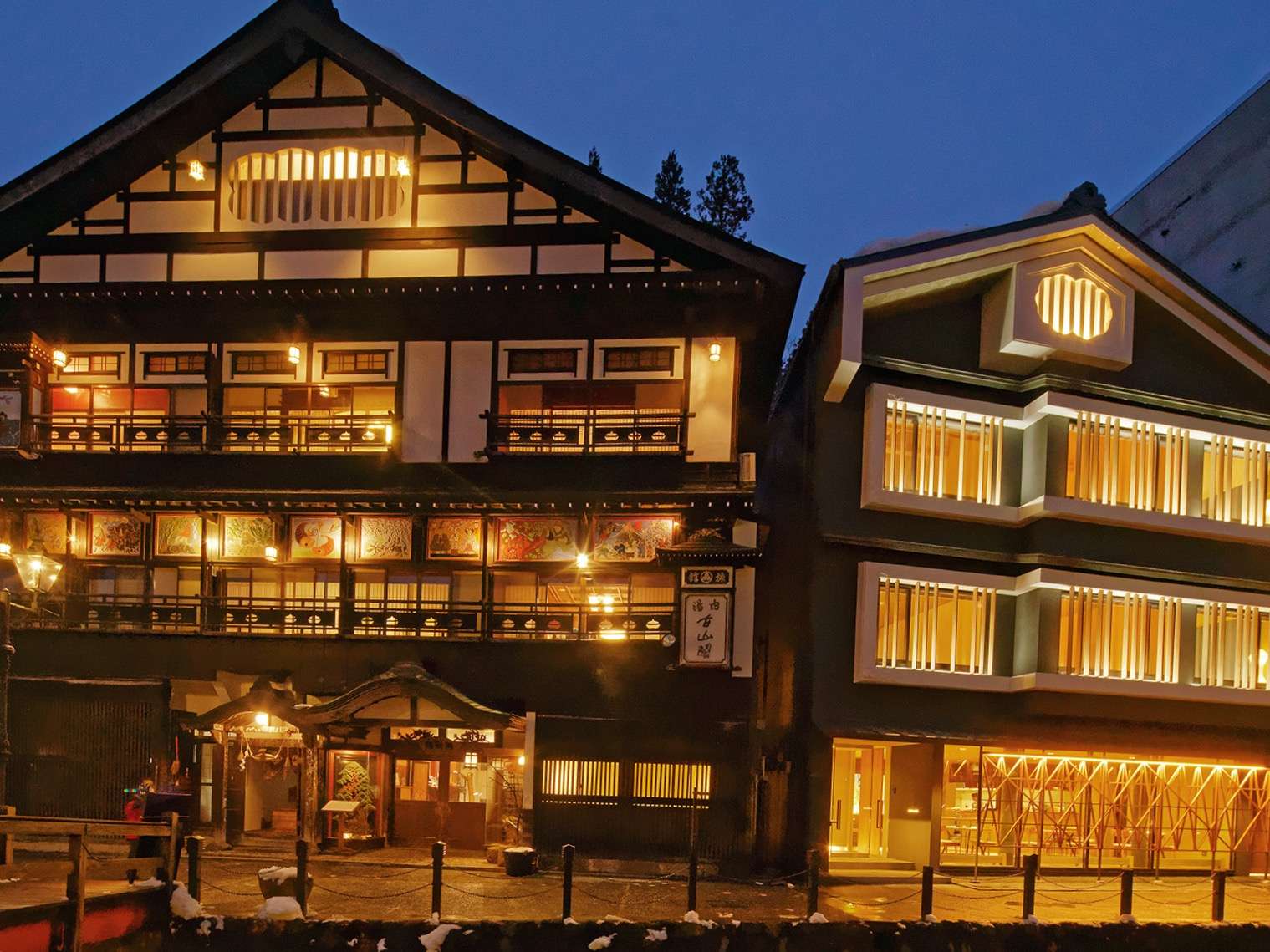
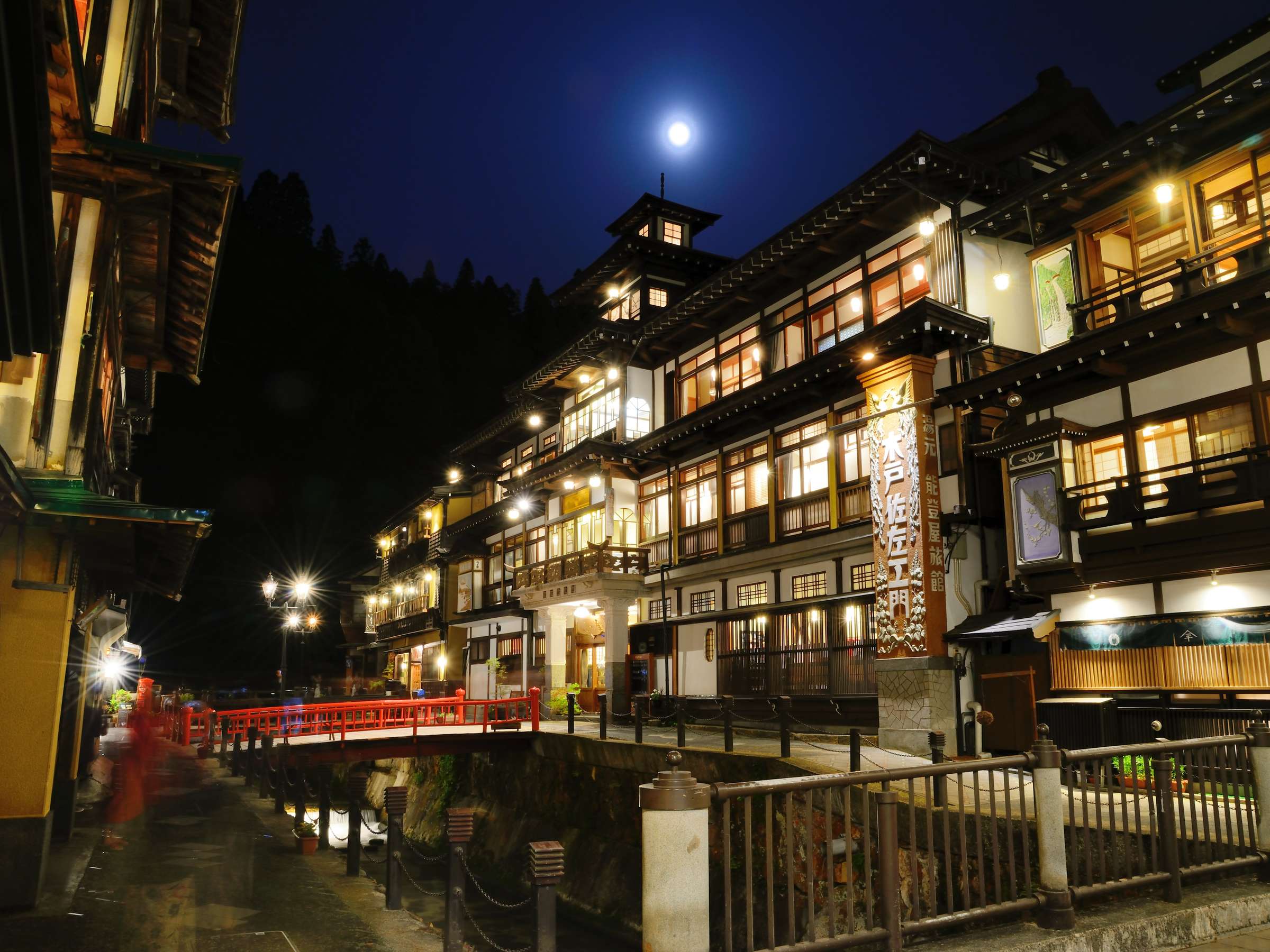
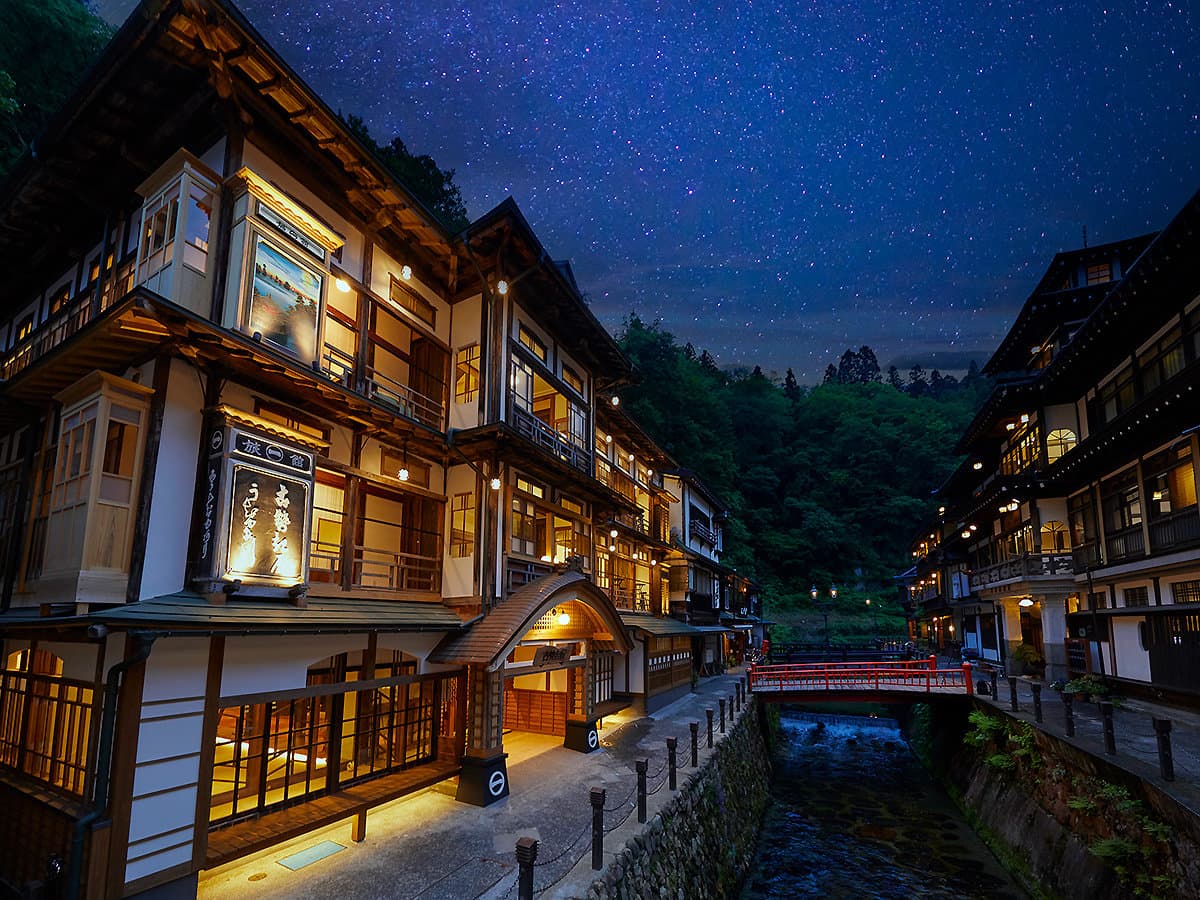
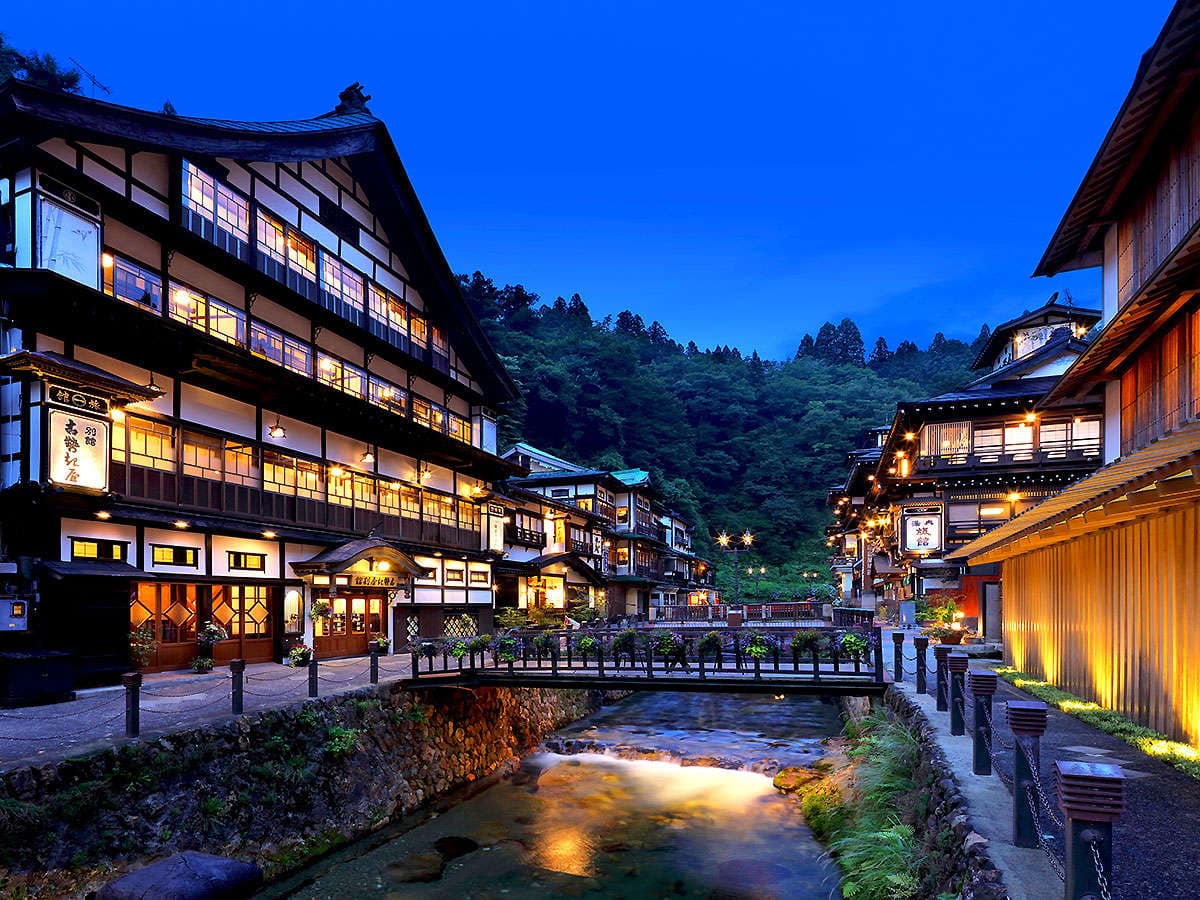
*Ginzan Onsen's iconic Takimi Bridge and ryokan row in winter — snow-covered Taisho-era architecture illuminated by gas lamps (photo: Bruno Plus / Wikimedia Commons, CC-BY 4.0)*
Introduction
The first thing that hits you isn't the cold — it's the smell of sulfur carried on mountain air, and then the amber glow. Gas lamps, real ones burning actual gas, line the riverbanks. Snow sits thick on wooden balconies. The Ginzan River runs black between two rows of Taisho-era ryokans, their paper screens lit from inside like paper lanterns. If you're weighing the best ryokans in Ginzan Onsen, you're already asking the right question — because where you stay here shapes the entire experience.
This is Ginzan Onsen — thirteen ryokans on a 300-meter cobblestone strip in the mountains of Yamagata Prefecture. In 2026, [National Geographic named Yamagata Prefecture](https://www.nationalgeographic.com/travel/best-of-the-world-2026/article/yamagata-japan) one of its Best of the World destinations, singling out Takimikan and Fujiya ryokan. The village also happens to look uncannily like the bathhouse town in *Spirited Away* — Studio Ghibli has never confirmed the connection, but the visual resemblance is hard to shake. The combination of those two facts has driven a surge of English-language interest in a village that previously flew almost entirely under the radar.
Here's the problem: most English guides describe the atmosphere and stop there. You'll get the vibe, but not the prices, not the private-versus-shared onsen breakdown, not the booking lead times, and not the honest answer to whether a given ryokan works for a solo traveler or a honeymoon couple with tattoos. This guide covers all thirteen properties with verified pricing, per-property onsen details, and a straight answer on who each one actually suits. If you're planning a trip to one of the [best onsen towns in Japan](/blog/best-onsen-towns-japan), Ginzan belongs on your shortlist — with your eyes open about what it takes to book it.
---
Why Ginzan Onsen is unlike any other ryokan village in Japan
Less than 1% of Japan's 37 million 2024 visitors made it to Yamagata Prefecture [National Geographic, 2026](https://www.nationalgeographic.com/travel/best-of-the-world-2026/article/yamagata-japan). That number is about to change. The NatGeo recognition specifically highlighted Takimikan and Fujiya ryokan as recommended stays, meaning these two properties in particular will face a step-change in demand from 2026 onward. If you're reading this after the article went viral on travel forums — which it did — winter availability is already tighter than it was a year ago.
National Geographic described Ginzan Onsen as offering "scenes more evocative of a Taisho period (1912–26) novel than a modern resort" [National Geographic Best of the World 2026](https://www.nationalgeographic.com/travel/best-of-the-world-2026/article/yamagata-japan). That framing is accurate. No competing destination in Japan replicates this particular combination of architectural preservation and working onsen infrastructure.
The village owes its existence to a silver mine. "Ginzan" means silver mountain, and the mine ran from the 16th century until it flooded in 1689. The hot springs that had been feeding the mine workers' baths stayed open. By the Taisho era (1912–1926), wealthy merchants and city workers were coming to soak, and the multi-story wooden ryokans they built line both banks of the Ginzan River to this day. A local ordinance protects the Taisho-era townscape — no modern concrete facades, no signage that breaks the period aesthetic, no cars permitted inside the hot spring area at all. What you see in photographs is what you get in person, which is rare in Japan and almost unheard of in a working onsen village. See the [Yamagata Prefecture Tourism](https://www.yamagatakanko.com/en/) site for the wider regional context.
The 300-meter strip matters for another reason: location within Ginzan Onsen is not a meaningful differentiating factor. All thirteen ryokans are within a five-minute walk of each other. What actually matters when choosing where to stay is price tier, private versus shared onsen access, English-booking ease, and meal quality. This guide is structured around those factors. For the wider context of the [best ryokans in Yamagata](/blog/best-ryokans-yamagata), Ginzan is the flagship — but the prefecture has far more to offer beyond this one valley. The [Ginzan Onsen area guide](/onsen-areas/ginzan) covers the village-level detail.
The village also shares its public bathing infrastructure. Shirogane no Yu, the public bathhouse designed by architect Kengo Kuma, is available for ¥500 per person and accessible to all guests including those at budget properties without in-house private facilities. (Note: as of research date, one of the two baths in the complex was closed — verify current status before arriving.) There's also a free riverside foot bath open year-round.
---
Quick comparison: all 13 Ginzan Onsen ryokans at a glance
All prices are per person, per night, including dinner (kaiseki multi-course) and breakfast — the standard pricing convention at Japanese ryokans. A room rate for two people is roughly double the per-person figure. USD conversions use an approximate rate of ¥145/USD (at May 2026 rates); treat dollar figures as directional. Rates vary by room type and season.
| Property | Price/Person (¥, 2 meals) | Price/Person (USD approx.) | Rooms | Private Onsen | English Booking | Booking Lead Time | Best For | |---|---|---|---|---|---|---|---| | Matsumoto Ryokan | ¥20,000–25,000 | ~$138–172 | 10 | No | Basic (3rd-party) | 6–8 wks (autumn); 3–4 mo (winter) | Budget; first-timers | | Oyado Yanadaya | From ¥18,700 | From ~$129 | 4 | Unconfirmed | Not confirmed | 3–6 mo (winter) | Couples; exclusivity | | Showakan | ¥20,000–30,000 | ~$138–207 | 13 | No | Not confirmed | 1–2 mo (summer); 3–4 mo (winter) | Families; central location | | Kozankaku | From ¥26,550 | From ~$183 | 8 | Yes (rental) | Limited | 3–6 mo (winter) | Budget; groups; cash only | | Notoya Ryokan | ¥25,300–28,600 | ~$174–197 | 15 | Yes (cave + rental) | Yes (online) | 3–6 mo (winter) | History lovers; solo | | Honkan Kosekiya | Contact property | — | 14 | No | Yes | 3–6 mo (winter) | Taisho romance | | Kosekiya Bekkan | Contact property | — | 14 | No | Yes | 3–6 mo (winter) | Central; dietary needs | | Hatago Itouya | From ¥22,000 | From ~$152 | 4 | Yes (all-private) | Japanese site only | 6–12 mo (winter) | Privacy; tattoo-friendly | | Eizawa Heihachi | From ¥22,000 | From ~$152 | 7 | Yes (outdoor rental) | Limited | 6–12 mo (winter) | Couples; winter atmosphere | | Ginzanso | ¥24,000–39,600 | ~$165–273 | 40 | Yes (deluxe rooms) | Yes | 2–3 mo (autumn); 3–6 mo (winter) | Families; groups; first-timers | | Kuranoba (Clanuova) | ¥30,000 | ~$207 | 6 | Yes | Limited; cash only | 3–6 mo (winter) | Couples; food-forward | | Takimikan | ¥26,700–42,800 | ~$184–295 | 18 | Annex only | Email workable | 3–6 mo (autumn/winter) | Foodies; views | | Fujiya Inn | ¥33,000–68,000 | ~$228–469 | 8 | Yes (5 private baths) | Yes (platforms) | 6–12 mo (winter) | Couples; design lovers; luxury |

*Aerial view of Ginzan Onsen showing the 300-meter strip of 13 ryokans on both banks of the Ginzan River (photo: Wikimedia Commons, CC-BY-SA 3.0)*
Tip
**Booking platforms:** Most properties can be reached via Trip.com, Booking.com, or Expedia — the three widest-coverage platforms for Ginzan Onsen. Trip.com generally carries the most complete Japanese ryokan inventory.
[Check rates on Trip.com](#) | [Compare on Booking.com](#) | [Search Expedia](#)
---
Budget tier (under ¥22,000 per person): best value picks
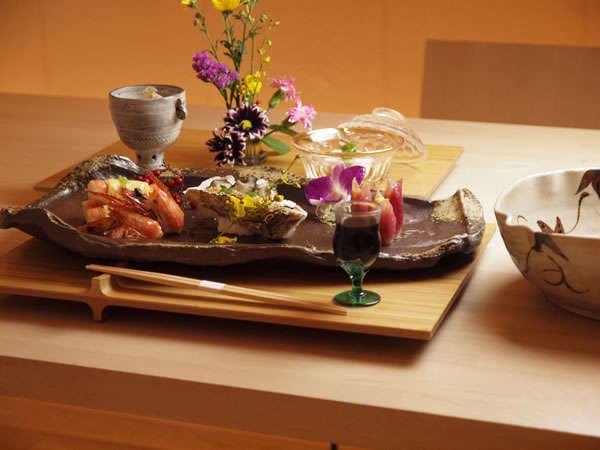
At this price point in Ginzan Onsen, "budget" is relative. You're still getting a tatami room, a multi-course kaiseki dinner featuring local Yamagata beef and mountain vegetables, breakfast, and access to genuine kakenagashi (source-flow, non-recycled) hot spring water. What you're typically trading off is a private in-room bath and, in some cases, English support at the front desk. The Shirogane no Yu public bath (¥500) fills the gap for onsen access.
Every property in this tier includes dinner — that's not a Ginzan-specific quirk, it's the nationwide ryokan standard. Guests who worry they're "only getting a budget ryokan" should know that even the most affordable property here is serving a dinner that would cost ¥8,000+ at a standalone restaurant in Yamagata City.
Matsumoto Ryokan
Matsumoto is the most affordable overnight option in Ginzan Onsen — recent traveler reports suggest around $100–$138 per person, though current 2025 pricing has likely settled around ¥20,000–25,000 per person with meals [haveyaseenjapan.com; HotelsCombined May rates]. It's a ten-room, family-run property directly beside the red bridge and riverside walking path, which puts you in the heart of the nightly gas-lamp spectacle without paying Fujiya prices. Rooms are traditional tatami with futon. Onsen access is through the surrounding shared facilities — no private bath. English booking works via Klook and Rakuten Travel. Tattoo policy for the shared baths is unconfirmed — contact the property directly. For a first-time ryokan experience where the village itself is the star, Matsumoto delivers without the premium. Book 6–8 weeks ahead for autumn; 3–4 months for winter.
Oyado Yanadaya
Four rooms, a maximum of four groups per night, and a dinner menu built around Obanazawa wagyu steak and shabu-shabu — Yanadaya is one of the quietest stays in the village. Pricing starts from ¥18,700 per person with meals [yanadaya.com, Japanese search summary, verified 2026-05-15], making it the most accessible entry point for exclusivity in Ginzan Onsen. The property provides colored yukata robes (most ryokans offer only the standard white or indigo), and the covered terrace serves onsen eggs and beverages — a small ritual that's pleasant on a cold evening. The bath configuration — whether private or shared — is not confirmed on the official site; contact Yanadaya directly before booking. Tattoo policy is also unconfirmed — worth a direct inquiry. With four rooms total, this fills faster than its price suggests. Best for couples who want the intimacy of a four-room inn, prime wagyu on the table every night, and a stay that costs significantly less than most private-bath properties.
Showakan
Showakan sits at the entrance to the main Ginzan Onsen area, which is convenient for guests arriving without ryokan shuttle coordination. Pricing runs approximately ¥20,000–30,000 per person with meals [Trip.com/Tripadvisor, approximate]. The standout feature is the 24-hour open-air bath on the second floor — gender-separated, fed directly from the spring, and open all night including during snowfall. The kaiseki dinner highlights Yamagata beef and sashimi; breakfast comes with safflower rice cooked in a kamado (traditional hearth pot), which is a regional specialty worth noting. At 13 rooms with capacity for 50, it's one of the easier budget-tier properties to actually get a reservation at. Tattoo policy for shared baths is unconfirmed — inquire directly before booking. Best for families or groups who want convenient access and an outdoor bath experience without the luxury price tag.

*Traditional Japanese winter architecture — similar aesthetic to budget-tier Ginzan Onsen ryokans in Yamagata (photo: Pexels, CC0)*
[Check Budget Ryokan Availability on Trip.com](#)
---
Mid-range tier (¥22,000–¥43,000 per person): nine properties, clear differences
This is the widest band in Ginzan Onsen — nine of the thirteen properties start within it — and where the real differentiation work happens. Private onsen access, English-booking infrastructure, meal philosophy, and room count all vary significantly across this group. The properties are ordered here from smallest to largest to make the intimacy trade-off easy to see at a glance.
Tip
**Booking lead times by season:** Winter weekends (December–February) book out 3–6 months ahead for mid-range properties, and 6–12 months for the four-room properties (Itouya); autumn foliage peak (late October–early November) books 2–3 months ahead; spring cherry blossom week (mid-April) books 4–6 weeks ahead; summer is the most forgiving at 1–2 months. The smaller the property, the faster it fills regardless of season.
Hatago Itouya
Itouya takes the private-bath principle further than any other property in the village: every bath is private, and only four groups stay per night. That's it. The in-room onsen system means no scheduling around shared bath hours, no navigating the tattoo-policy question, and no encountering other guests in the water. The snow-viewing bath on the second floor is the signature feature — a small private tub with a direct sight line to the white-covered valley below. Pricing starts from ¥22,000 per person with meals [hatago-itouya.com, verified 2026-05-15], though the per-night figure for a two-person booking will reflect the exclusive nature of the property. The kaiseki features Obanazawa beef as the main course alongside locally sourced mushrooms and fish. The website is Japanese only, which makes this one of the harder properties to book without Japanese ability or a travel agent — third-party platforms are the practical English-language route. Given four groups maximum, winter dates require booking the moment the reservation window opens. Best for couples who want maximum privacy, and for tattooed travelers who want hot spring bathing without navigating policy variations.
Eizawa Heihachi (Nagasawa Heihachi)
Seven rooms, and the highlight is a private rental outdoor onsen bath in snow conditions — a kashikiri tub under open sky in a valley that goes silent after dinner, with no shared-bath scheduling required. The Taisho-era aesthetic reads as intimate rather than grand. The exterior and outdoor bath also photograph exceptionally well in winter, which is why the property turns up repeatedly in photography guides, but that's the consequence of being good, not the reason to stay. Pricing starts from approximately ¥22,000 per person (based on ¥44,000 per night for two people) [jalan.net, verified 2026-05-15]. English support on-site is not confirmed; limited is the safer assumption. Tattoo policy for the private outdoor bath is likely accommodating — confirm directly before booking. For couples who want the intimate scale of a small property with reliable private onsen access, Eizawa Heihachi is worth the extra coordination required to book it.
Kozankaku
Kozankaku is priced from ¥26,550 per person including two meals [gltjp.com, verified 2026-05-15], but there's a critical caveat every foreign visitor needs to know upfront: Kozankaku is cash only. No credit cards accepted. Bring enough yen before leaving Yamagata City. The property is a historic wooden inn from the early Showa period, and the interior preserves the period faithfully — retro sofas, antique clocks, wooden beams that creak reassuringly. It has two shared baths (wooden bath for women, stone bath for men) plus two private baths available to all guests on a first-come basis. Tattooed guests can use the private baths [verified via tattoo-friendly.com]. English support at reception is limited — booking through a third-party platform is the easier route. Kozankaku also has one spacious suite accommodating up to eight guests, making it one of the few Ginzan options for a small group traveling together.
Notoya Ryokan
Notoya was founded in Meiji 25 — that's 1892 — and is designated a tangible cultural property of Japan [selected-ryokan.com, 2026-05-15]. Pricing runs ¥25,300–28,600 per person with meals [selected-ryokan.com, verified 2026-05-15]. The old folk-house construction uses traditional joinery techniques that haven't changed since the Meiji era, and the cave bath — said to be the original hot spring used since the founding — is now available as a kashikiri (private rental) bath. There's also an outdoor observation bath with waterfall views. Some sources specifically cite Notoya's facade as resembling the bathhouse in *Spirited Away*, though Studio Ghibli has never confirmed any connection. Notoya was also a filming location for the NHK drama *Oshin* (1983–84). English online booking is available via the official site; phone reservations are Japanese only. Tattooed guests can use the private baths; shared bath policy is unclear — confirm directly. The on-site café serving tea and light refreshments makes it a reasonable base for an afternoon in the village even if you're only day-tripping. For overnight stays, solo travelers and history enthusiasts get the most out of Notoya's atmosphere.
Kuranoba (Clanuova)
Kuranoba opened in 2017 as the new wing of the Kozankaku property, and it does something no other ryokan in Ginzan Onsen attempts: the dinner is Italian-French cuisine using Yamagata ingredients. The owner-chef trained in Tokyo before returning to the region, and the menu is built around Obanazawa beef and Kahoku Town vegetables prepared with Italian technique, paired with Yamagata and Italian wines. At only six rooms (capacity: 12), this is the most intimate property in the village by room count. Pricing is approximately ¥30,000 per person with meals [gltjp.com, verified 2026-05-15]. The private bath on the third floor of the Kozankaku building is accessible to Kuranoba guests, and the communal bath on the first floor is also available. The name blends Italian *nuovo* (new) and *classico* (classic) — the design is Western-style rooms looking out over the historic onsen street, which is an unusual combination that works. English support is limited — same caveat as Kozankaku, book via a platform. Cash-only payment applies to Kozankaku/Kuranoba — bring yen. Best for food-forward travelers and couples seeking something that doesn't feel like every other ryokan in Japan.
Takimikan
Takimikan sits at the top of the Ginzan Onsen hillside — literally the highest-elevation property in the village — and the panoramic open-air bath up there is among the best views available from any onsen in the valley. On a clear winter day you're looking out over snow-covered rooftops with nothing blocking the horizon. The property runs ¥26,700–42,800 per person with meals [selected-ryokan.com, verified 2026-05-15], placing it across both the mid-range and upper end of this band depending on room type. The signature dish is handmade soba from Obanazawa-grown buckwheat — a specific regional variety that Takimikan makes in-house, and it's legitimately good. The kaiseki also features Obanazawa beef. National Geographic's 2026 Yamagata article specifically mentioned Takimikan as a recommended stay. It also served as a filming location for the NHK drama *Oshin* (1983–84). The main building has shared baths only; the annex *Bettei Takimitate*, set at the base of Shirogane Falls, has a private onsen for annex guests. Tattoo policy for the shared baths is not confirmed — contact the property directly before booking. Email communication in English reportedly works for shuttle booking from Oishida Station, which you must arrange in advance. Best for foodies and winter-view enthusiasts.
Ginzanso
With 40 rooms and capacity for 200, Ginzanso is the largest property in Ginzan Onsen — founded around 1900, one of the oldest establishments, and a filming location for the NHK drama *Oshin* [selected-ryokan.com, verified 2026-05-15]. The scale means you get the smoothest operational experience: an English website, international booking agencies supported, and a free shuttle from JR Oishida Station. Deluxe rooms include attached open-air hot spring baths fed by three spring types (sulfur, chloride, and sulfate), and tattooed guests can use the private baths [selected-ryokan.com]. The shared communal baths are also available. Pricing runs ¥24,000–39,600 per person with meals [selected-ryokan.com, verified 2026-05-15] — the starting price sits firmly in mid-range; the upper end reflects premium river-view deluxe rooms. Ginzanso is also the property best positioned for winter side trips: Zao Snow Monster (juhyo) viewing excursions are possible January–March. It's the most practical choice for first-time ryokan visitors who want a guaranteed smooth experience, and the only property in the village that can comfortably handle larger family groups.
Honkan Kosekiya
The main Kosekiya building holds the distinction of being the first Taisho-era structure built in Ginzan Onsen, which is a meaningful claim in a village where the architecture is the entire point. The aesthetic is retro-modern: stained glass, antique furnishings, and three room types (mountain-view, river-view, and traditional Japanese-style). Pricing is currently unverified on English-language sources — check the official site or Booking.com directly for current rates. The two indoor baths rotate by gender and run from 16:00–24:00 only; there's no open-air bath in the main building, but guests can use Ginzanso's facilities. Tattoo policy for shared indoor baths is not confirmed. Honkan Kosekiya has a free shuttle from JR Oishida Station running three times daily, which simplifies the final leg from the shinkansen. Best for travelers who want to sleep inside a piece of Japanese architectural history without paying luxury prices.
Kosekiya Bekkan (Annex)
The annex sits in the center of the historic townscape and shares the same Taisho aesthetic as its parent building. At 14 rooms for 30 guests, it's slightly roomier than the main building per guest. Pricing is also currently unverified on English-language sources. The practical standouts here are operational: Kosekiya Bekkan is one of the few Ginzan properties that explicitly accepts UnionPay (useful for Chinese visitors and some Southeast Asian cardholders) and has a documented process for dietary accommodation — allergen substitutions are available for approximately ¥1,500 extra, which must be requested at booking. Free Wi-Fi throughout. Three daily shuttles from Oishida Station. Shared baths only — no private onsen access — and tattoo policy for shared baths is not stated; inquire directly. Best for travelers who need dietary flexibility or are coming from destinations where UnionPay is the primary card.
*Traditional yukata robe — standard evening wear at all Ginzan Onsen ryokans (photo: Wikimedia Commons, CC-BY-SA 3.0)*
[Check Mid-Range Ryokan Rates — Trip.com](#) | [Booking.com](#) | [Expedia](#)
---
Luxury tier (¥33,000–¥68,000 per person): Ginzan's top end
The honest case for spending at the top of Ginzan's price range: a private in-room or reserved onsen bath, a kaiseki menu at the level of standalone high-end restaurants, and a room count so small the property functions more like a private house than a hotel. Compared to luxury ryokans in Kinosaki or Hakone, Ginzan's top tier is often priced 20–30% lower for a comparable experience, partly because it hasn't been on the international radar until now.
That won't last. Book accordingly.
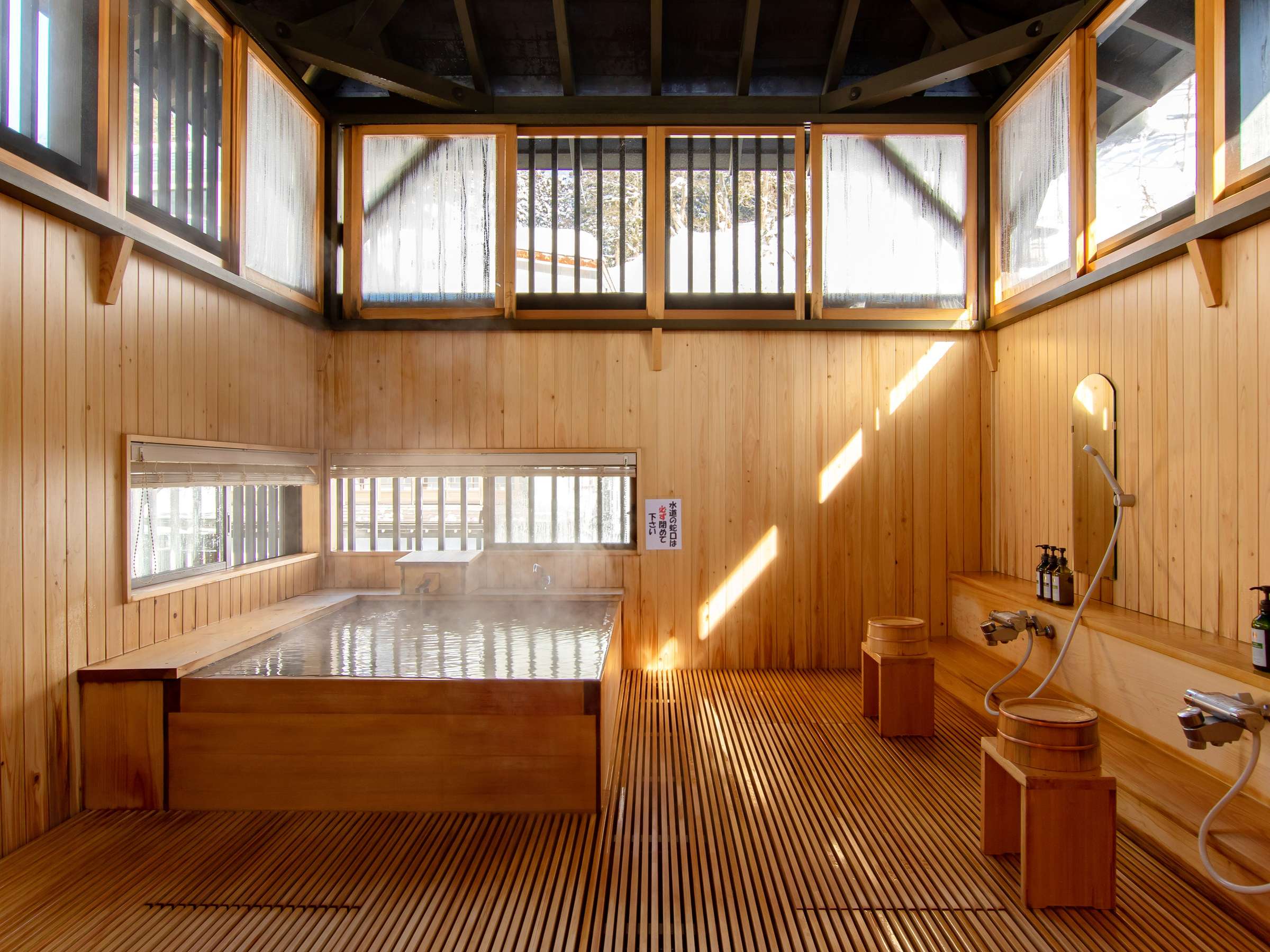
*Snow-viewing onsen bath — the quintessential winter hot spring experience at luxury Ginzan properties (photo: Unsplash, CC0)*
Fujiya Inn
Fujiya Inn is the property that most directly put Ginzan Onsen on the international map, and the [National Geographic Best of the World 2026](https://www.nationalgeographic.com/travel/best-of-the-world-2026/article/yamagata-japan) article named it explicitly. The origins trace to the Edo period, but the current building was completely redesigned in 2006 by architect Kengo Kuma — the same designer responsible for the Tokyo National Stadium and the Shirogane no Yu public bath down the street. Kuma used bamboo *sumushiko* screens and *Dalle de Verre* stained glass to create a space that feels simultaneously ancient and severe. There are only eight rooms (capacity: 21), and dinner is served in-room. The five private hot spring baths — available 24 hours, free of charge — are the entire bathing setup here; there is no shared communal bath at all. That means tattooed guests are fully unrestricted at Fujiya, which is a rare and explicit advantage. Pricing runs ¥33,000–68,000 per person with meals [selected-ryokan.com / gltjp.com, verified 2026-05-15]. The range is wide because the three room types (Type A with private bath, Type B, and Type C with covered porch) vary significantly. For winter dates, book 6–12 months ahead — this is not an exaggeration. The ryokan runs a shuttle from Oishida at approximately 13:30 and 15:30, but you must reserve in advance. Best for couples, architecture enthusiasts, and anyone who wants the Ginzan Onsen experience distilled to its most intentional form.
[Check Availability — Books Fast in Peak Season — Trip.com](#) | [Booking.com](#)
---
Which ryokan is right for you? Recommendations by traveler type
First-time ryokan guests: Go with Ginzanso. The English website, international booking infrastructure, airport-style shuttle service, and large staff make the learning curve manageable. You'll still get the full tatami-and-kaiseki experience without the communication friction that smaller properties can involve. Read the [first-time ryokan guide](/blog/first-time-ryokan-guide) before arriving.
Couples on a honeymoon or anniversary: Fujiya Inn or Hatago Itouya. Both have entirely private bathing, which removes the shared-bath social dynamic entirely. Fujiya brings Kengo Kuma architecture and a specific refinement that justifies the top-end pricing. Itouya brings the snow-viewing bath and maximum seclusion at a mid-range starting price. If budget is a factor, Eizawa Heihachi offers the same private outdoor bath intimacy for a similar starting price.
Solo travelers: Notoya Ryokan. The history is genuine (1892, designated cultural property), the pricing is reasonable at ¥25,300–28,600, and the village is small enough that solo evening strolls along the gaslit riverbank are the entire experience — which is exactly what solo travelers come here for. The cave bath is a singular detail that stays with you.
Winter photography enthusiasts: Notoya and Eizawa Heihachi for exterior architecture; Takimikan for the elevated panoramic outdoor bath with rooftop views over the snow-covered village. All three photograph differently and are within a three-minute walk of each other.
Families with children: Ginzanso. It's the only property with the room count and operational infrastructure to handle the logistics of a family stay. Confirm children's pricing and meal arrangements at booking — ryokan meal portions and formats are designed for adults, and most properties ask that you notify them in advance.
Tattooed travelers: Fujiya Inn (all baths private — unrestricted) or Hatago Itouya (all baths private — unrestricted). Ginzanso and Notoya offer private baths for tattooed guests if you can't get into the former two. Kozankaku also has private bath access for tattooed guests, but remember the cash-only payment requirement.
Food-forward travelers seeking something different: Kuranoba (Clanuova) for Italian-French kaiseki with Yamagata ingredients — the most unusual dining option in the village. Takimikan for the homemade soba from Obanazawa buckwheat. Oyado Yanadaya for wagyu steak and shabu-shabu at one of the village's smallest and most intimate properties.
---
Ginzan Onsen in winter vs other seasons: when to visit and what to book
Winter (December–February) is peak season, and the photos that circulate on Instagram every January are why. Snow on wooden rooftops, gas lamps burning amber over the frozen river, outdoor baths in falling snow — this is the Ginzan Onsen winter ryokan experience that drives most international searches. It's real, and it's worth the extra planning. The caveat: visitor management is now formal. From December 20 to March 1, day visitors are capped at 100 per hour after 5 PM; after 8 PM, only overnight guests are permitted in the village. Day-trippers must park at the Taisho Romakan visitor center (approximately 2km out) and take a paid shuttle (¥1,150) into the village. If you're staying overnight, you enter as a guest and none of this applies to you — which is the strongest possible argument for booking a room rather than day-tripping.
Booking lead time for winter: 3–6 months ahead for most mid-range properties. Fujiya Inn and Hatago Itouya: 6–12 months. Some ryokans open winter reservations approximately one year prior to the date.
Autumn foliage (September–November) is widely called the most underrated season. Fiery orange and red kaede maple leaves cover the hillsides above the ryokan strip, and the visual contrast with white plaster walls and dark timber frames is sharp. Late October through early November is peak foliage. Book 3–6 months ahead.
Spring (March–May) brings cherry blossoms along the Ginzan River — typically mid-April — and the Shirogane Falls runs at full flow after the winter thaw. Crowds are smaller than winter or autumn. The snow-viewing magic is gone, but the green valley shows a different, quieter character. Book the cherry blossom peak 4–6 weeks ahead; the rest of spring is more forgiving.
Summer (June–August) is the quiet season. The mountain location keeps temperatures noticeably cooler than urban Japan's brutal August. Easiest availability, often lowest prices. The gas lamps have less drama without snow, but the hiking trails above the village are fully open, and yukata evening strolls without winter gear are genuinely pleasant. 1–2 months' lead time is typically sufficient.
Golden Week (late April–early May) and Obon (mid-August): book 6 months ahead or reconsider your dates entirely. These national holiday windows compress the entire country into the same destination at once.
---
How to get to Ginzan Onsen from Tokyo and Yamagata
Getting here is straightforward once you know the route. The [Japan Rail Pass guide](/blog/japan-rail-pass-guide) covers the shinkansen booking side of things — the Yamagata Shinkansen is JR-operated and JR Pass holders pay no additional fare for the train portion.
From Tokyo: 1. Take the JR Yamagata Shinkansen "Tsubasa" from Tokyo Station to Oishida Station (大石田駅). Journey time approximately 200 minutes (3 hours 20 minutes); trains run every 1–2 hours. One-way fare approximately ¥13,780 without a JR Pass [selected-ryokan.com access guide, verified 2026-05-15]. 2. From Oishida Station, take the Yamagata Kotsu (山交バス) local bus to Ginzan Onsen. Journey time 35 minutes, fare ¥1,000 one-way, frequency approximately every 1–2 hours. 3. Most ryokans offer a free shuttle from Oishida Station — confirm and reserve this when booking. Total door-to-door from Tokyo: approximately 3 hours 20 minutes to 3 hours 50 minutes.
From Yamagata Airport: Direct bus to Ginzan Onsen (no reservation required): 75 minutes, ¥2,000. Shared taxi (reserve by 5 PM the prior day): 60 minutes, ¥4,800–5,300.
From Sendai: Highway bus to Obanazawa then local bus, approximately 2 hours 10 minutes, ¥2,760–2,790.
Driving in winter: Private cars cannot enter the Ginzan Onsen hot spring area from December 20 through March 1 (non-staying visitors). If you're an overnight guest, the ryokan will advise on parking — the lot is a 5–10 minute walk from the strip, and ryokans offer pickup service. Come with winter tires fitted.
---
What to expect when you arrive: ryokan etiquette for Ginzan Onsen
First-time ryokan guests sometimes spend the first hour unsure of what they're supposed to do. Here's the sequence.
- Check-in is typically between 14:00 and 15:00 (Showakan offers a later 14:00, Kozankaku from 14:30). Remove your shoes in the entryway (genkan) and you'll be led to your room in slippers. - Yukata robes are provided and are worn in your room, in common areas, and for evening walks along the riverside. This is normal and expected — you'll see everyone doing it. - Dinner is typically served between 18:00 and 19:00, either in your room or a private dining room. The meal is kaiseki-style — multiple courses arriving sequentially. Notify the ryokan of dietary restrictions at booking, not on the day. - Onsen etiquette: Wash and rinse your body thoroughly at the shower stations before entering any communal bath. Towels should not touch the water. Keep the atmosphere quiet. Most properties ask guests not to use the baths after drinking. - Check-out is typically 10:00–11:00 (Kozankaku 10:00, Showakan 12:00). Breakfast is served at 07:30–09:00 depending on property. - Payment: Most properties accept major credit cards. Kozankaku and Kuranoba (Clanuova) are cash only — bring yen. Kosekiya Bekkan accepts UnionPay.
The village itself is 300 meters long. The gas lamps ignite at dusk. After dinner, a slow walk in your yukata along the riverbank — even in temperatures well below zero — is the point of coming here.
---
Ginzan Onsen ryokan FAQs
How many ryokans are in Ginzan Onsen?
Exactly 13 ryokans operate in Ginzan Onsen, ranging from around ¥18,700 per person at the budget end to over ¥68,000 per person per night at the luxury end. All 13 line the banks of the Ginzan River along a single 300-meter strip [ginzanonsen.jp].
There's no meaningful location difference between properties — the entire strip is a five-minute walk end to end. What separates them is price, private versus shared onsen access, and English-booking ease.
What is the best ryokan in Ginzan Onsen?
For couples prioritizing privacy and design, Fujiya Inn is the standout — 8 rooms, 5 all-private hot spring baths, Kengo Kuma architecture, and a National Geographic 2026 mention. For first-time visitors wanting a smooth English-friendly experience, Ginzanso is the most practical choice. Budget travelers get honest value from Notoya, a 130-year-old designated cultural property priced from ¥25,300 per person.
No single property works for every traveler. The tattooed-traveler section and the tier breakdowns above will narrow it down faster than any ranking.
How far in advance should I book a Ginzan Onsen ryokan?
Winter weekends (December–February): 6–12 months for small luxury properties; 3–4 months for mid-range. Autumn foliage peak (late October–November): 3–6 months. Spring cherry blossoms: 4–6 weeks. Summer: 1–2 months. Golden Week and Obon: 6 months minimum.
Most properties hold 4–18 rooms. They fill faster than hotel logic suggests — the smallest places have fewer rooms than some hotel floors. Book the moment you have confirmed dates.
Do Ginzan Onsen ryokans have private onsen baths?
Several properties offer kashikiri-buro (private reserved onsen) or in-room hot spring baths. Fujiya Inn and Hatago Itouya have exclusively private baths — no shared communal bath at all, making both fully tattoo-friendly. Budget properties use shared gender-separated communal baths plus the public Shirogane no Yu (¥500).
See the comparison table above for the per-property private onsen breakdown. For tattooed travelers, the recommendations section has a dedicated subsection.
Is Ginzan Onsen worth visiting in winter?
Yes — winter is peak season for real reasons. Snow transforms the Taisho-era wooden facades into a landscape that shares an uncanny resemblance with the bathhouse town in *Spirited Away* (Studio Ghibli has never confirmed this connection). Yamagata Prefecture was named to [National Geographic's Best of the World 2026](https://www.nationalgeographic.com/travel/best-of-the-world-2026/article/yamagata-japan). Overnight guests bypass the day-visitor restrictions entirely.
The main practical caveat: winter weekends at small properties book 6–12 months ahead. Weekday stays are far less competitive and noticeably less crowded.
How do I get to Ginzan Onsen from Tokyo?
Take the JR Yamagata Shinkansen "Tsubasa" from Tokyo Station to Oishida Station (approximately 3 hours 20 minutes, ¥13,780 one-way; JR Pass valid for shinkansen portion). Then take the Yamagata Kotsu bus to Ginzan Onsen (35 minutes, ¥1,000). Most ryokans offer a free shuttle from Oishida — book it when you reserve your room [selected-ryokan.com access guide].
Driving is possible outside winter restrictions, but December 20–March 1 non-staying visitors cannot enter the onsen area by car. Overnight guests should ask their ryokan about the parking lot and pickup service.
---
Ready to book the best ryokans in Ginzan Onsen?
The best rooms at the most sought-after properties sell out 12 months in advance of peak winter dates — that's not urgency framing, it's the operational reality of a village where the largest property has 40 rooms and the smallest has four. Thirteen ryokans. One 300-meter strip. The most photographed onsen village in Japan, and as of 2026, firmly on the international radar after the National Geographic selection. Prices start below ¥20,000 per person with two meals included.

*Ginzan Onsen village — the 300-meter strip where all 13 ryokans create an unbroken Taisho-era townscape (photo: Bruno Plus / Wikimedia Commons, CC-BY 4.0)*
[Book on Trip.com](#) | [Compare on Booking.com](#) | [Search Expedia](#)
For the wider prefecture, see our guide to the [best ryokans in Yamagata](/blog/best-ryokans-yamagata) — Ginzan is the headline act, but Yamagata has a lot more onsen going on.

*겨울 긴잔온천의 상징, 타키미 다리와 료칸 거리 — 가스등으로 물든 눈 덮인 다이쇼 건축물 (사진: Bruno Plus / Wikimedia Commons, CC-BY 4.0)*
들어가며
가장 먼저 느껴지는 건 추위가 아닙니다. 산바람에 실려 오는 유황 냄새, 그리고 호박색 빛의 온기입니다. 강변을 따라 실제 가스가 타오르는 가스등이 줄지어 서 있습니다. 나무 발코니 위로 눈이 두껍게 쌓입니다. 은산천(銀山川)은 양쪽에 늘어선 다이쇼 시대 목조 료칸 사이를 흐르고, 장지문 안에서 새어 나오는 불빛이 마치 종이 등롱처럼 빛납니다. 긴잔온천(銀山溫泉)에서 어디에 묵을지를 따지고 있다면, 이미 올바른 질문을 하고 있는 겁니다. 이곳에서는 어느 료칸에 머무는지가 전체 여행의 경험을 결정하기 때문입니다.
긴잔온천은 야마가타현(山形縣) 깊은 산속, 300미터의 돌바닥 거리를 따라 13개의 료칸이 늘어선 온천 마을입니다. 2026년, [내셔널 지오그래픽이 야마가타현을 '세계 최고의 여행지'에 선정](https://www.nationalgeographic.com/travel/best-of-the-world-2026/article/yamagata-japan)하면서 타키미칸과 후지야 료칸을 특별 추천 숙소로 소개했습니다. 이 마을의 풍경은 미야자키 하야오의 애니메이션 영화 《센과 치히로의 행방불명》(일본 원제: 千と千尋の神隠し, 한국 개봉제목: 센과 치히로의 행방불명)에 등장하는 목욕탕 마을과 놀랍도록 닮아 있습니다. 스튜디오 지브리는 공식적으로 이 연관성을 인정한 적이 없지만, 시각적 유사성은 누구도 부정하기 어렵습니다. 이 두 가지 사실이 맞물리면서, 그동안 거의 알려지지 않았던 이 마을에 영어권 여행자들의 관심이 폭발적으로 쏠리기 시작했습니다.
문제는 대부분의 영어 가이드가 분위기 묘사에서 멈춘다는 점입니다. 느낌은 전달되지만, 가격, 전세탕과 공동온천의 차이, 예약 리드타임, 그리고 특정 료칸이 혼자 여행하는 사람에게 혹은 타투가 있는 신혼 커플에게 실제로 맞는지에 대한 솔직한 답변이 없습니다. 이 가이드는 전체 13개 료칸에 대해 확인된 가격, 각 숙소의 온천 상세 정보, 그리고 각 료칸이 실제로 어떤 여행자에게 적합한지를 직접적으로 안내합니다. [일본 최고의 온천 마을](/blog/best-onsen-towns-japan) 여행을 계획하고 있다면, 긴잔온천은 반드시 후보에 넣어야 합니다. 다만 예약이 쉽지 않다는 현실도 함께 알아 두시기 바랍니다.
---
긴잔온천이 일본의 다른 료칸 마을과 다른 이유
2024년 일본을 방문한 약 3,700만 명의 외국인 여행자 중 야마가타현을 찾은 비율은 1%에도 미치지 못했습니다 [내셔널 지오그래픽, 2026](https://www.nationalgeographic.com/travel/best-of-the-world-2026/article/yamagata-japan). 이 수치는 곧 크게 바뀔 것입니다. 내셔널 지오그래픽의 선정에서는 특히 타키미칸과 후지야 료칸이 추천 숙소로 명시되었으며, 이는 2026년 이후 두 곳에 대한 수요가 큰 폭으로 증가함을 의미합니다. 여행 포럼에서 기사가 바이럴된 이후에 이 글을 읽고 있다면—실제로 그렇게 됐습니다—겨울철 빈 방은 이미 1년 전보다 훨씬 줄어 있습니다.
내셔널 지오그래픽은 긴잔온천을 "현대적인 리조트보다 다이쇼 시대(1912—26년) 소설의 한 장면을 더 강하게 연상시키는 곳"이라고 표현했습니다 [내셔널 지오그래픽 2026 베스트 오브 더 월드](https://www.nationalgeographic.com/travel/best-of-the-world-2026/article/yamagata-japan). 이 표현은 정확합니다. 건축물의 보존 수준과 실제 운영 중인 온천 인프라가 이처럼 공존하는 곳은 일본 어디에도 없습니다.
긴잔온천의 기원은 은광산에 있습니다. '긴잔(銀山)'은 글자 그대로 '은의 산'이라는 뜻으로, 16세기부터 채굴이 이어지다 1689년 침수로 폐광되었습니다. 광부들이 사용하던 온천은 그 이후로도 계속 운영되었습니다. 다이쇼 시대(1912—1926년)에는 부유한 상인과 도시 노동자들이 온천욕을 즐기러 찾아들었고, 그들이 지은 다층 목조 료칸이 지금도 은산천 양쪽에 늘어서 있습니다. 지역 조례에 따라 다이쇼 시대의 거리 풍경이 엄격히 보호되고 있어, 현대식 콘크리트 외관이나 시대적 미감을 해치는 간판, 온천 구역 내 자가용 진입이 모두 금지됩니다. 사진에서 보이는 풍경이 실제와 다름없다는 것—이는 일본에서도 보기 드문 일이며, 현역 온천 마을에서는 거의 전례가 없습니다. 야마가타현의 더 넓은 관광 정보는 [야마가타현 관광 공식 사이트](https://www.yamagatakanko.com/en/)를 참고하시기 바랍니다.
300미터라는 거리에는 또 다른 의미가 있습니다. 긴잔온천에서는 숙소 위치가 사실상 차이를 만들지 않습니다. 13개 료칸 모두 서로 걸어서 5분 이내에 있기 때문입니다. 실제로 선택에 영향을 미치는 요소는 가격대, 전세탕 vs 공동온천, 영어 예약의 편의성, 식사의 질입니다. 이 가이드는 그 요소들을 중심으로 구성되어 있습니다. [야마가타현 최고의 료칸](/blog/best-ryokans-yamagata)을 더 넓게 알고 싶다면 긴잔온천은 대표격이지만, 이 하나의 계곡 너머로도 현 내에는 훨씬 많은 것이 있습니다. [긴잔온천 지역 가이드](/onsen-areas/ginzan)에서 마을 단위의 상세 정보를 확인할 수 있습니다.
마을에는 공용 목욕 시설도 있습니다. 건축가 구마 켄고가 설계한 공공 목욕탕 '시로가네노유(しろがねの湯)'는 1인 500엔(약 ₩4,700)으로, 프라이빗 시설이 없는 저가 료칸 투숙객도 이용할 수 있습니다. (참고: 조사 기준 시점에 두 욕조 중 하나가 임시 휴장 중이었습니다—도착 전 최신 운영 현황을 확인하시기 바랍니다.) 강변에는 연중 무료로 이용 가능한 족욕탕도 있습니다.
---
긴잔온천 13개 료칸 한눈에 비교
모든 가격은 1인 1박 2식(저녁 가이세키 (懐石) 다코스 요리 + 아침식사 포함) 기준입니다. 이는 일본 료칸의 표준 가격 표시 방식입니다. 2인실 요금은 대략 1인 요금의 두 배입니다. USD 환산은 2026년 5월 기준 약 145엔/달러를 적용한 것으로 참고용입니다. 가격은 객실 유형과 시즌에 따라 다릅니다. 원화 환산은 약 9엔/원을 참고 기준으로 적용했습니다.
| 료칸명 | 1인 가격 (¥, 2식 포함) | 1인 가격 (USD 약) | 객실 수 | 전세 온천 | 영어 예약 | 예약 리드타임 | 추천 대상 | |---|---|---|---|---|---|---|---| | 마츠모토 료칸 | ¥20,000—25,000 | 약 $138—172 | 10 | 없음 | 있음 (제3자 플랫폼) | 단풍 시즌: 6—8주 전; 겨울: 3—4개월 전 | 알뜰 여행; 처음 방문자 | | 오야도 야나다야 | ¥18,700~ | 약 $129~ | 4 | 미확인 | 미확인 | 겨울: 3—6개월 전 | 커플; 프라이빗 체험 | | 쇼와칸 | ¥20,000—30,000 | 약 $138—207 | 13 | 없음 | 미확인 | 여름: 1—2개월 전; 겨울: 3—4개월 전 | 가족; 교통 편의 | | 코잔카쿠 | ¥26,550~ | 약 $183~ | 8 | 있음 (전세) | 제한적 | 겨울: 3—6개월 전 | 그룹; 현금 결제만 | | 노토야 료칸 | ¥25,300—28,600 | 약 $174—197 | 15 | 있음 (동굴탕+전세) | 있음 (온라인) | 겨울: 3—6개월 전 | 역사 애호가; 혼자 여행 | | 혼칸 코세키야 | 숙소 문의 | — | 14 | 없음 | 있음 | 겨울: 3—6개월 전 | 다이쇼 낭만 애호가 | | 코세키야 베칸 | 숙소 문의 | — | 14 | 없음 | 있음 | 겨울: 3—6개월 전 | 식이 조절; 은련 카드 사용자 | | 하타고 이토우야 | ¥22,000~ | 약 $152~ | 4 | 있음 (전 객실 전세) | 일본어 사이트만 | 겨울: 6—12개월 전 | 프라이버시; 타투 가능 | | 에이자와 헤이하치 | ¥22,000~ | 약 $152~ | 7 | 있음 (노천 전세) | 제한적 | 겨울: 6—12개월 전 | 커플; 겨울 분위기 | | 긴잔소 | ¥24,000—39,600 | 약 $165—273 | 40 | 있음 (디럭스 객실) | 있음 | 단풍: 2—3개월 전; 겨울: 3—6개월 전 | 가족; 그룹; 처음 방문자 | | 쿠라노바 (CLANUOVA) | ¥30,000 | 약 $207 | 6 | 있음 | 제한적; 현금 결제만 | 겨울: 3—6개월 전 | 커플; 미식가 | | 타키미칸 | ¥26,700—42,800 | 약 $184—295 | 18 | 별관만 | 이메일 가능 | 단풍·겨울: 3—6개월 전 | 미식가; 경관 | | 후지야 인 | ¥33,000—68,000 | 약 $228—469 | 8 | 있음 (전세탕 5개) | 있음 (플랫폼) | 겨울: 6—12개월 전 | 커플; 건축 애호가; 럭셔리 |

*항공에서 바라본 긴잔온천 — 은산천 양안에 13개 료칸이 늘어선 300미터 돌바닥 거리 (사진: Wikimedia Commons, CC-BY-SA 3.0)*
Tip
**예약 플랫폼 안내:** 대부분의 숙소는 Trip.com, Booking.com, Expedia를 통해 예약할 수 있으며, 이 세 곳이 긴잔온천 커버리지가 가장 넓습니다. Trip.com은 일본 료칸 재고가 가장 풍부한 경향이 있습니다.
[Trip.com에서 요금 확인하기](#) | [Booking.com에서 비교하기](#) | [Expedia에서 검색하기](#)
---
저가 구간 (1인 ¥22,000 미만): 가성비 최고 선택지
긴잔온천에서 '저렴하다'는 것은 상대적입니다. 이 가격대에서도 다타미 (畳) 객실, 야마가타 소고기와 산채로 구성된 다코스 가이세키 요리 저녁, 아침 식사, 그리고 진정한 '가케나가시(掛け流し, 원천 직류, 비순환)' 온천수를 누릴 수 있습니다. 일반적으로 포기해야 할 것은 객실 내 전용 욕조이며, 일부의 경우 영어 프런트 대응도 없을 수 있습니다. 공공 목욕탕 '시로가네노유' (500엔)가 온천 접근성을 보완해 줍니다.
이 구간의 모든 숙소에 저녁 식사가 포함된다는 점은 긴잔온천만의 특성이 아니라 전국 료칸의 표준입니다. '저가 료칸이라서'를 걱정하는 분들께 말씀드리면, 이곳의 가장 저렴한 숙소조차 야마가타시 단독 레스토랑에서 먹으면 8,000엔(약 ₩75,000) 이상 하는 저녁을 제공합니다.
마츠모토 료칸
마츠모토는 긴잔온천에서 가장 합리적인 숙박 선택지입니다. 2식 포함 1인 ¥20,000—25,000 정도(약 ₩188,000—234,000)가 현재 시세로 보입니다 [haveyaseenjapan.com; HotelsCombined 5월 요금]. 10개 객실의 가족 경영 료칸으로, 빨간 다리 바로 옆 강변 산책로에 위치해 후지야 가격을 지불하지 않고도 매일 밤 가스등 불빛의 중심에 있을 수 있습니다. 객실은 전통적인 다타미에 이불 스타일입니다. 온천은 주변 공동 시설을 이용하며 전세탕은 없습니다. 영어 예약은 Klook과 라쿠텐 트래블을 통해 가능합니다. 공동 온천의 타투 정책은 미확인 — 숙소에 직접 문의하세요. 마을 자체가 주인공인 첫 료칸 체험을 원하는 분에게 부담 없이 그 경험을 선사합니다. 단풍 시즌은 6—8주 전, 겨울은 3—4개월 전 예약이 기준입니다.
오야도 야나다야
4개 객실, 1박 최대 4팀 수용, 오바나자와 와규 스테이크와 샤부샤부 중심의 저녁 메뉴 — 야나다야는 마을에서 가장 조용한 숙박지 중 하나입니다. 2식 포함 1인 ¥18,700~(약 ₩175,000~) [yanadaya.com, 2026-05-15 확인], 긴잔온천에서 특별한 체험을 즐길 수 있는 가장 접근하기 쉬운 입문 가격입니다. 대부분의 료칸이 흰색이나 남색 유카타 (浴衣)만 제공하는 것과 달리, 이곳은 컬러 유카타를 제공합니다. 지붕 있는 테라스에서 온천 달걀과 음료를 제공하는데, 추운 저녁의 작은 의식으로 마음에 남습니다. 욕실이 전세인지 공동인지는 공식 사이트에 명시되어 있지 않으니 예약 전 직접 문의하세요. 타투 정책도 미확인입니다. 4개 객실이기 때문에 가격 대비 빠르게 마감됩니다. 4개 객실 소규모 숙소의 친밀한 분위기, 매일 밤 최고급 와규, 전세탕 숙소보다 훨씬 합리적인 비용을 원하는 커플에게 최적입니다.
쇼와칸
쇼와칸은 긴잔온천 메인 구역 입구에 위치해 있어, 료칸 셔틀 조율 없이 도착하는 분들에게 편리합니다. 2식 포함 1인 약 ¥20,000—30,000 [Trip.com/Tripadvisor, 대략적 수치]. 가장 큰 특징은 2층의 24시간 개방 노천탕입니다 — 남녀 구분, 원천 직류, 눈 내리는 밤에도 운영합니다. 가이세키 저녁은 야마가타 소고기와 회를 중심으로 구성됩니다. 아침 식사에는 전통 가마도(かまど, 화덕 솥)에 지은 홍화 쌀밥이 제공되는데, 이 지역의 특산품입니다. 13개 객실에 정원 50명으로, 이 가격대에서 상대적으로 예약하기 쉬운 편입니다. 공동 온천 타투 정책 미확인 — 예약 전 직접 문의하세요. 럭셔리 가격 없이 접근성 좋은 위치와 노천탕 체험을 원하는 가족이나 그룹에 적합합니다.

*일본 겨울 전통 건축 — 야마가타현 긴잔온천 저가 료칸과 유사한 미학적 양식 (사진: Pexels, CC0)*
[Trip.com에서 저가 료칸 예약 가능 여부 확인하기](#)
---
중간 가격대 (1인 ¥22,000—¥43,000): 9개 료칸, 명확한 차이점
긴잔온천에서 가장 넓은 구간으로 — 13개 중 9개가 여기에 포함됩니다 — 그래서 세심하게 비교해야 합니다. 전세 온천 유무, 영어 예약 인프라, 식사 철학, 객실 수가 이 그룹에서 크게 다릅니다. 아래는 프라이버시와 규모의 트레이드오프를 한눈에 볼 수 있도록 객실 수가 적은 순서로 소개합니다.
Tip
**시즌별 예약 리드타임:** 겨울 주말 (12월—2월)은 중간 가격대 료칸 기준 3—6개월 전, 4객실 소규모 료칸(이토우야)은 6—12개월 전. 단풍 피크 (10월 하순—11월 초)는 2—3개월 전. 봄 벚꽃 주간 (4월 중순)은 4—6주 전. 여름이 가장 여유롭고 1—2개월 전이면 충분합니다. 객실 수가 적을수록 시즌과 무관하게 빠르게 마감됩니다.
하타고 이토우야
이토우야는 마을의 어느 숙소보다 철저하게 전세탕 원칙을 실현합니다. 모든 욕조가 전세이고, 1박에 최대 4팀만 묵습니다. 그게 전부입니다. 객실 내 온천 시스템은 공동욕탕 시간을 맞출 필요도 없고, 타투 정책 문제를 걱정할 필요도 없고, 물 속에서 다른 손님을 마주칠 일도 없음을 의미합니다. 2층 설경(雪景) 욕조가 핵심 시설입니다 — 눈 덮인 계곡을 내려다보는 작은 전용 욕조입니다. 2식 포함 1인 ¥22,000~(약 ₩206,000~) [hatago-itouya.com, 2026-05-15 확인]. 2인 예약 시 실제 금액은 숙소의 독점적인 성격을 반영합니다. 가이세키는 오바나자와 소고기를 메인으로 지역 산 버섯과 생선이 곁들여집니다. 웹사이트가 일본어만 제공되어 일본어 능력이나 여행사 없이는 예약이 어려운 편이라 제3자 플랫폼이 현실적입니다. 최대 4팀인 만큼, 겨울 날짜는 예약창이 열리는 순간 바로 행동해야 합니다. 최대한의 프라이버시를 원하는 커플, 그리고 정책 문제 없이 온천욕을 즐기고 싶은 타투가 있는 여행자에게 최적입니다.
에이자와 헤이하치 (에이자와 나가사와 헤이하치)
7개 객실, 그리고 설경 속 노천 전세탕이 이 숙소의 핵심입니다 — 저녁 식사 후 고요해지는 계곡 한가운데, 열린 하늘 아래의 전용 욕조에서 공동욕탕 시간을 신경 쓸 필요 없이 몸을 담글 수 있습니다. 다이쇼 시대의 미학은 웅장함보다는 친밀감으로 다가옵니다. 외관과 노천탕이 겨울에 매우 아름답게 촬영되어 사진 가이드에 자주 등장하지만, 그건 품질이 좋기 때문이지 그 자체가 방문 이유는 아닙니다. 2식 포함 1인 약 ¥22,000~(2인 ¥44,000/박 기준, 약 ₩412,000/박) [jalan.net, 2026-05-15 확인]. 현장 영어 대응은 미확인이며 제한적으로 보는 것이 안전합니다. 노천 전세탕 타투 정책은 허용 가능성이 높지만 — 예약 전 직접 확인하세요. 신뢰할 수 있는 전세 온천을 갖춘 소규모 숙소를 원하는 커플에게 예약 수고를 들일 가치가 있습니다.
코잔카쿠
코잔카쿠는 2식 포함 1인 ¥26,550~(약 ₩248,000~) [gltjp.com, 2026-05-15 확인]이지만, 외국인 방문자라면 반드시 먼저 알아야 할 중요한 사항이 있습니다: 코잔카쿠는 현금 결제만 됩니다. 신용카드 불가. 야마가타시를 떠나기 전에 충분한 엔화를 준비하세요. 쇼와 초기의 역사적인 목조 여관으로, 내부는 복고풍 소파, 앤티크 시계, 묵직하게 삐걱이는 나무 보들이 그 시대를 충실히 재현합니다. 공동 목욕탕은 여탕(목조)과 남탕(석조) 2곳이 있으며, 선착순으로 이용할 수 있는 전세탕도 2곳 있습니다. 타투가 있는 분은 전세탕 이용 가능 [tattoo-friendly.com 확인]. 프런트의 영어 지원은 제한적이라 제3자 플랫폼 예약이 편리합니다. 코잔카쿠에는 최대 8명이 머물 수 있는 넓은 스위트룸이 있어, 소규모 그룹 여행이 가능한 긴잔의 몇 안 되는 선택지 중 하나입니다.
노토야 료칸
노토야는 메이지 25년, 즉 1892년에 창업해 일본의 유형문화재로 지정되어 있습니다 [selected-ryokan.com, 2026-05-15]. 2식 포함 1인 ¥25,300—28,600 (약 ₩237,000—268,000) [selected-ryokan.com, 2026-05-15 확인]. 고민가(古民家) 구조에는 메이지 시대 이래 변하지 않은 전통 장부 기법이 사용되어 있으며, 창업 당시부터 사용했다는 동굴 온천은 현재 전세(가시키리) 욕탕으로 이용할 수 있습니다. 폭포 전망 노천 관경 욕탕도 있습니다. 일부 자료에서는 노토야의 외관이 《센과 치히로의 행방불명》의 목욕탕과 닮았다고 언급하지만 스튜디오 지브리는 공식적으로 인정한 바 없습니다. NHK 아침 드라마 《오싱》(おしん, 1983—84년)의 촬영지이기도 합니다. 영어 온라인 예약은 공식 사이트에서 가능하며, 전화 예약은 일본어만 가능합니다. 타투가 있는 분은 전세탕 이용 가능; 공동욕탕 정책은 불명확 — 직접 확인 필요. 관내 찻집에서 차와 가벼운 다과를 즐길 수 있어 당일치기 시에도 들르기 좋습니다. 숙박 시에는 혼자 여행하는 분이나 역사 애호가가 노토야의 분위기를 가장 잘 즐길 수 있습니다.
쿠라노바 (CLANUOVA)
쿠라노바는 2017년 코잔카쿠의 새 별관으로 개업했으며, 긴잔온천의 다른 어떤 료칸도 시도하지 않은 것을 합니다: 저녁 식사가 야마가타 식재료를 사용한 이탈리안-프렌치 요리입니다. 오너 셰프가 도쿄에서 수련 후 귀향해, 오바나자와 소고기와 가호쿠마치 채소를 이탈리아 기법으로 요리하고 야마가타산·이탈리아산 와인과 매칭합니다. 6개 객실(정원 12명)로 객실 수 기준 마을에서 가장 프라이빗한 숙소입니다. 2식 포함 1인 약 ¥30,000 (약 ₩281,000) [gltjp.com, 2026-05-15 확인]. 코잔카쿠 건물 3층의 전세탕과 1층 공동욕탕도 이용 가능합니다. 이름은 이탈리아어 'nuovo (새로운)'와 'classico (클래식)'의 합성어로, 역사적인 온천 거리를 내려다보는 서양식 객실이라는 독특한 조합이 의외로 잘 어울립니다. 영어 지원은 제한적이며 코잔카쿠와 마찬가지로 플랫폼 예약을 권장합니다. 코잔카쿠/쿠라노바 모두 현금 결제만 가능 — 엔화를 준비하세요. 일본의 다른 료칸과 다른 경험을 원하는 미식가 여행자와 커플에게 최적입니다.
타키미칸
타키미칸은 긴잔온천 언덕 가장 높은 곳에 위치합니다 — 말 그대로 마을에서 해발이 가장 높은 숙소로, 그곳의 파노라마 노천탕은 계곡 어느 온천보다 탁월한 전망을 자랑합니다. 맑은 겨울날에는 막힘 없이 눈 덮인 지붕들이 펼쳐집니다. 2식 포함 1인 ¥26,700—42,800 (약 ₩250,000—401,000) [selected-ryokan.com, 2026-05-15 확인], 객실 유형에 따라 중간 가격대부터 상위 가격대에 걸쳐 있습니다. 시그니처 요리는 오바나자와산 메밀로 직접 만든 수타 소바 — 타키미칸이 직접 제조하는 이 지역 특유의 품종으로, 정말 맛이 있습니다. 가이세키에도 오바나자와 소고기가 등장합니다. 내셔널 지오그래픽의 2026년 야마가타 기사에서 추천 숙소로 명시되었습니다. NHK 아침 드라마 《오싱》(1983—84년) 촬영지이기도 합니다. 본관은 공동욕탕만 있으며, 시로가네 폭포 아래 자리한 별관 '별저 타키미타테(別邸・瀧みたて)'에는 별관 투숙객 전용 전세 온천이 있습니다. 공동욕탕 타투 정책 미확인 — 예약 전 직접 문의하세요. 오이시다역 셔틀 예약은 영어 이메일로 대응 가능하다는 보고가 있으며 사전 예약이 필요합니다. 미식가와 겨울 경관을 즐기는 분에게 최적입니다.
긴잔소
40개 객실, 정원 200명의 긴잔소는 긴잔온천에서 가장 규모가 큰 료칸으로, 1900년경 창업한 역사 깊은 곳이며 NHK 아침 드라마 《오싱》의 촬영지이기도 합니다 [selected-ryokan.com, 2026-05-15 확인]. 그 규모 덕분에 가장 원활한 서비스를 받을 수 있습니다: 영어 웹사이트, 국제 예약 채널 완비, JR 오이시다역에서 무료 셔틀. 디럭스 객실에는 3종류 원천(황화물천, 염화물천, 황산염천)이 공급되는 노천 온천 욕조가 딸려 있으며, 타투가 있는 분은 전세탕 이용 가능 [selected-ryokan.com]. 공동욕탕도 이용 가능합니다. 2식 포함 1인 ¥24,000—39,600 (약 ₩225,000—371,000) [selected-ryokan.com, 2026-05-15 확인] — 시작 가격은 중간 가격대에 속하며, 상한선은 강 전망 프리미엄 디럭스 객실 가격입니다. 긴잔소는 겨울 주변 관광에도 가장 편리한 곳으로, 1월—3월에 자오 수빙(樹氷, 얼음 나무) 관광이 가능합니다. 처음 료칸을 방문하는 분이나, 대가족과 함께 여행하는 분께 마을에서 유일하게 진정으로 그 수요를 충족시킬 수 있는 선택지입니다.
혼칸 코세키야
코세키야 본관은 긴잔온천 최초로 지어진 다이쇼 시대 건물이라는 구별됩니다. 건축물 자체가 이 마을의 존재 이유인 이곳에서 그 의미는 남다릅니다. 스테인드 글라스, 앤티크 가구, 산 전망·강 전망·전통 일식 스타일 세 가지 객실 유형을 갖춘 레트로-모던한 미학이 특징입니다. 현재 영어 자료에서 가격 확인이 어려우므로 공식 사이트나 Booking.com에서 직접 확인하세요. 실내 욕탕 2곳은 남녀 교대제로 16:00—24:00에만 운영하며, 본관에는 노천탕이 없지만 긴잔소 시설을 이용할 수 있습니다. 공동 실내 욕탕 타투 정책 미확인. JR 오이시다역에서 하루 3편 무료 셔틀이 있어 신칸센 환승 후 마지막 구간을 단순화해 줍니다. 럭셔리 가격 없이 일본 건축 역사 속에서 하룻밤을 보내고 싶은 여행자에게 적합합니다.
코세키야 베칸 (별관)
별관은 역사 거리 중심부에 위치하며, 본관과 같은 다이쇼 미학을 공유합니다. 14개 객실에 30명 정원으로, 1인당 공간이 본관보다 약간 여유롭습니다. 가격은 마찬가지로 영어 자료에서 현재 확인이 어렵습니다. 실용적인 특징이 돋보이는 곳으로, 코세키야 베칸은 긴잔에서 은련(UnionPay)을 명시적으로 받는 몇 안 되는 숙소 중 하나이며(중국이나 일부 동남아시아 카드 소지자에게 유용), 식이 조절 처리 과정이 서면으로 문서화되어 있습니다 — 알레르기 대체 메뉴는 약 ¥1,500 추가(약 ₩14,100), 예약 시 신청해야 합니다. 전 객실 무료 Wi-Fi. 오이시다역에서 하루 3편 셔틀. 공동욕탕만 있으며 전세 온천은 없고 — 공동욕탕 타투 정책 미표기, 직접 문의하세요. 식이 제한이 있거나 은련이 주요 결제 수단인 지역에서 오는 여행자에게 최적입니다.
*유카타 — 긴잔온천 모든 료칸의 표준 저녁 복장 (사진: Wikimedia Commons, CC-BY-SA 3.0)*
[Trip.com에서 중간 가격대 료칸 요금 확인하기](#) | [Booking.com](#) | [Expedia](#)
---
고가 구간 (1인 ¥33,000—¥68,000): 긴잔 최상급
긴잔 최고가 구간에 투자하는 진짜 이유: 전세 온천 또는 객실 내 욕조, 독립 고급 레스토랑 수준의 가이세키, 그리고 호텔이 아닌 개인 별장처럼 기능할 만큼 적은 객실 수입니다. 키노사키나 하코네의 럭셔리 료칸에 비해, 긴잔 최상급은 유사한 체험을 20—30% 낮은 가격에 제공하는 경우가 많습니다. 지금까지 국제적인 주목을 거의 받지 못했기 때문입니다.
이 상황은 오래 지속되지 않을 것입니다. 그에 맞게 예약하세요.
*설경 온천탕 — 긴잔 럭셔리 료칸에서 누리는 정수의 겨울 온천 체험 (사진: Unsplash, CC0)*
후지야 인
후지야는 긴잔온천을 국제 지도에 올린 료칸으로, [내셔널 지오그래픽 2026 베스트 오브 더 월드](https://www.nationalgeographic.com/travel/best-of-the-world-2026/article/yamagata-japan) 기사에 명시적으로 이름이 거론됩니다. 에도 시대까지 거슬러 올라가는 기원을 갖고 있지만, 현재 건물은 2006년 건축가 구마 켄고에 의해 완전히 재설계되었습니다 — 도쿄 국립 경기장과 같은 거리의 공공 목욕탕 '시로가네노유'를 설계한 바로 그 건축가입니다. 구마 켄고는 대나무 '무시코(虫籠)' 스크린과 '달 드 베르(Dalle de Verre)' 스테인드 글라스를 사용해 동시에 고대적이고 엄격한 공간을 만들어 냈습니다. 8개 객실(정원 21명)뿐이며, 저녁 식사는 객실에서 제공됩니다. 5개의 전세 온천 욕조 — 24시간 무료 이용 — 가 이곳의 유일한 입욕 시설이며, 공동 욕탕은 전혀 없습니다. 이는 후지야에서 타투가 있는 분들이 완전히 자유롭게 이용 가능하다는 의미로, 드물고 명확한 장점입니다. 2식 포함 1인 ¥33,000—68,000 (약 ₩309,000—637,000) [selected-ryokan.com / gltjp.com, 2026-05-15 확인]. 전용 욕조가 있는 A타입, B타입, 지붕 달린 포치의 C타입 등 세 가지 객실 유형 차이가 커서 폭이 넓습니다. 겨울 날짜는 6—12개월 전 예약이 기준 — 과장이 아닙니다. 료칸은 약 13:30과 15:30에 오이시다역에서 셔틀을 운행하며 사전 예약이 필요합니다. 커플, 건축 애호가, 그리고 긴잔온천 체험을 가장 의도적인 형태로 즐기고 싶은 모든 분께 최적입니다.
[Trip.com에서 예약 가능 여부 확인하기 (피크 시즌 빠른 마감)](#) | [Booking.com](#)
---
나에게 맞는 료칸은 어디? 여행자 유형별 추천
료칸 첫 방문자: 긴잔소를 추천합니다. 영어 웹사이트, 국제 예약 인프라, 공항 수준의 셔틀 서비스, 충분한 스태프 덕분에 학습 곡선이 완만합니다. 소규모 숙소에서 발생할 수 있는 소통 장벽 없이, 다타미와 가이세키 경험을 온전히 누릴 수 있습니다. 도착 전 [료칸 처음 체험 가이드](/blog/first-time-ryokan-guide)를 읽어 두세요.
신혼 여행이나 기념일 커플: 후지야 또는 하타고 이토우야. 두 곳 모두 완전히 전세 욕탕만 있어 공동욕탕의 사회적 동선이 전혀 없습니다. 후지야는 구마 켄고 건축과 특유의 세련됨이 최상급 가격의 이유를 납득시켜 줍니다. 이토우야는 중간 가격대에서 설경 욕탕과 최대한의 독립적인 공간을 제공합니다. 예산이 중요하다면 에이자와 헤이하치가 비슷한 가격대에 동일한 프라이빗 노천탕의 친밀함을 선사합니다.
혼자 여행하는 분: 노토야 료칸. 1892년 창업의 진짜 역사(유형문화재 지정), ¥25,300—28,600이라는 합리적인 가격, 그리고 저녁 가스등이 켜진 강변을 혼자 거니는 것이 체험의 핵심이 되는 작은 마을의 특성 — 그게 바로 혼자 여행자가 이곳에 오는 이유 그 자체입니다. 동굴탕은 오래 기억에 남는 단 하나의 디테일입니다.
겨울 사진 촬영 애호가: 외관 건축은 노토야와 에이자와 헤이하치, 눈 덮인 마을을 내려다보는 고지대 파노라마 노천탕은 타키미칸이 최적입니다. 세 곳 모두 도보 3분 이내 거리에 있으며 각자 다른 피사체를 제공합니다.
자녀가 있는 가족: 긴잔소. 가족 여행의 물류를 처리할 수 있는 객실 수와 운영 인프라를 갖춘 유일한 숙소입니다. 예약 시 아동 요금과 식사 방식을 반드시 확인하세요 — 료칸 식사는 기본적으로 성인을 위해 설계되어 있으며, 대부분의 숙소에서 사전 알림을 요청합니다.
타투가 있는 여행자: 후지야 (모든 욕조 전세 — 제한 없음) 또는 하타고 이토우야 (동일). 앞선 두 곳을 예약하지 못했다면, 긴잔소와 노토야에 타투 투숙객이 이용할 수 있는 전세탕이 있습니다. 코잔카쿠도 타투 투숙객에게 전세탕 이용이 가능하지만, 현금 결제 요건을 기억하세요.
색다른 미식 체험을 원하는 여행자: 쿠라노바 (CLANUOVA)는 야마가타 식재료로 만든 이탈리안-프렌치 가이세키를 제공합니다 — 마을에서 가장 독창적인 식사 옵션입니다. 타키미칸은 오바나자와 메밀로 만든 수타 소바. 오야도 야나다야는 마을에서 가장 작고 친밀한 공간에서 와규 스테이크와 샤부샤부를 매일 밤 즐길 수 있습니다.
---
겨울과 다른 계절의 긴잔온천: 언제 방문하고 무엇을 예약할까
겨울 (12월—2월) 은 성수기이며, 매년 1월 SNS를 장식하는 사진들이 그 이유를 보여 줍니다. 목조 지붕 위의 눈, 얼어붙은 강 위로 타오르는 호박색 가스등, 눈 내리는 가운데 즐기는 노천탕 — 이것이 국제적인 검색을 이끄는 긴잔온천 겨울 료칸 체험입니다. 현실이고, 추가적인 계획을 들일 가치가 있습니다. 단, 현재 방문자 관리가 공식화되었습니다. 12월 20일부터 3월 1일까지 오후 5시 이후 당일치기 방문자는 시간당 100명으로 제한되며, 오후 8시 이후에는 숙박 투숙객만 마을에 입장할 수 있습니다. 당일치기 방문자는 다이쇼 로만칸 방문자 센터(약 2km 외곽)에 주차한 뒤 유료 셔틀(¥1,150, 약 ₩10,800)을 타고 마을로 들어가야 합니다. 숙박 투숙객이라면 이 모든 것이 적용되지 않습니다 — 당일치기 대신 숙박을 선택해야 하는 가장 강력한 이유입니다.
겨울 예약 리드타임: 대부분의 중간 가격대 숙소는 3—6개월 전. 후지야와 이토우야는 6—12개월 전. 일부 료칸은 약 1년 전부터 겨울 예약을 받기도 합니다.
가을 단풍 (9월—11월) 은 가장 저평가된 시즌이라는 평이 많습니다. 료칸 거리 위쪽 산비탈을 불태우는 주홍빛 단풍과, 흰 회벽·어두운 목재 외관의 대비가 선명합니다. 단풍 피크는 10월 하순—11월 초순. 3—6개월 전 예약이 기준입니다.
봄 (3월—5월) 에는 은산천 따라 벚꽃이 만발합니다 — 보통 4월 중순. 겨울 눈이 녹으면서 시로가네 폭포의 수량이 최대가 됩니다. 방문자 수는 겨울이나 가을보다 적습니다. 설경의 마법은 사라지지만, 초록빛 계곡은 다르고 조용한 면모를 보여 줍니다. 벚꽃 피크는 4—6주 전 예약; 봄 나머지 기간은 여유가 있는 편입니다.
여름 (6월—8월) 은 비수기입니다. 산간 위치 덕분에 기온이 도시보다 눈에 띄게 시원합니다. 공실이 가장 많고, 가격도 대체로 낮습니다. 눈 없이 켜지는 가스등은 극적인 맛이 덜하지만, 마을 위쪽 하이킹 트레일이 모두 개방되고, 겨울 장비 없이 즐기는 저녁 유카타 산책은 꽤 즐거운 경험입니다. 보통 1—2개월 전이면 충분합니다.
골든위크 (4월 말—5월 초)와 오봉 (8월 중순): 6개월 전 예약하거나 날짜를 재고하세요. 이 국가 연휴 기간에는 전국 여행자가 동시에 같은 목적지로 몰립니다.
---
도쿄·야마가타에서 긴잔온천 가는 방법
경로를 파악하면 이동 자체는 어렵지 않습니다. [일본 레일 패스 가이드](/blog/japan-rail-pass-guide)에서 신칸센 예약에 대한 자세한 설명을 볼 수 있습니다. 야마가타 신칸센은 JR 운영이므로 JR 패스 소지자는 신칸센 구간에 추가 요금을 내지 않아도 됩니다.
도쿄에서: 1. 도쿄역에서 JR 야마가타 신칸센 '쓰바사(Tsubasa)' 를 타고 오이시다역 (大石田駅) 까지. 소요 시간 약 200분(3시간 20분), 1—2시간에 1편. JR 패스 없을 경우 편도 운임 약 ¥13,780 (약 ₩129,000) [selected-ryokan.com 교통 가이드, 2026-05-15 확인]. 2. 오이시다역에서 야마가타 고통 (山交バス) 로컬 버스로 긴잔온천까지. 소요 35분, 편도 ¥1,000 (약 ₩9,400), 1—2시간에 1편 정도. 3. 대부분의 료칸이 오이시다역에서 무료 셔틀을 제공 — 예약 시 확인하고 사전 예약하세요. 도쿄에서 도어-투-도어 총 소요 시간은 약 3시간 20분—3시간 50분입니다.
야마가타 공항에서: 긴잔온천 직행 버스 (예약 불필요): 75분, ¥2,000 (약 ₩18,800). 합승 택시 (전날 오후 5시까지 예약): 60분, ¥4,800—5,300 (약 ₩45,000—49,700).
센다이에서: 고속 버스로 오바나자와까지 간 후 로컬 버스 환승, 약 2시간 10분, ¥2,760—2,790 (약 ₩25,900—26,200).
겨울 자가용 안내: 12월 20일—3월 1일, 비숙박 방문자의 차량은 긴잔온천 온천 구역에 진입할 수 없습니다. 숙박 투숙객이라면 료칸이 주차장을 안내해 드립니다. 주차장에서 거리까지 도보 5—10분이며 료칸 픽업 서비스가 있습니다. 스노우 타이어 장착 후 방문하세요.
---
도착 후의 체험: 긴잔온천 료칸 에티켓
료칸에 처음 투숙하는 분들은 첫 한 시간 동안 무엇을 해야 할지 모르는 경우가 있습니다. 순서를 정리해 드립니다.
- 체크인은 보통 14:00—15:00 사이 (쇼와칸은 14:00 이후, 코잔카쿠는 14:30부터). 현관(玄関)에서 신발을 벗으면 슬리퍼를 신고 객실로 안내됩니다. - 유카타는 비치되어 있으며 객실 안, 공용 공간, 저녁 강변 산책 시 착용합니다. 이것은 정상적이고 기대되는 문화입니다 — 모두 그렇게 입습니다. - 저녁 식사는 보통 18:00—19:00 사이에 객실 또는 개인 식사실에서 제공됩니다. 가이세키 스타일로 — 여러 코스가 순서대로 나옵니다. 식이 제한은 당일이 아닌 예약 시에 알려 주세요. - 온천 에티켓: 공동욕탕에 들어가기 전, 샤워 공간에서 전신을 꼼꼼히 씻고 헹구세요. 타월은 욕조 물에 닿지 않도록 하세요. 조용한 분위기를 유지하세요. 대부분의 숙소에서 음주 후 입욕을 삼가도록 안내합니다. - 체크아웃은 보통 10:00—11:00 (코잔카쿠 10:00, 쇼와칸 12:00). 아침 식사는 숙소에 따라 7:30—9:00 사이. - 결제: 대부분의 숙소에서 주요 신용카드를 받습니다. 코잔카쿠와 쿠라노바 (CLANUOVA)는 현금 결제만 — 엔화를 준비하세요. 코세키야 베칸은 은련(UnionPay) 사용 가능.
마을 전체 길이는 300미터입니다. 가스등은 황혼 무렵 켜집니다. 저녁 식사 후, 유카타를 입고 강변을 천천히 거니는 것 — 영하를 훨씬 밑도는 기온에서도 — 그것이 여기에 오는 이유입니다.
---
긴잔온천 료칸 자주 묻는 질문
긴잔온천에는 료칸이 몇 개 있나요?
긴잔온천에는 정확히 13개의 료칸이 영업 중입니다. 저가 구간 약 ¥18,700/인부터 럭셔리 구간 ¥68,000/인 이상까지 폭이 있습니다. 13개 모두 은산천 양안, 300미터의 돌바닥 거리에 나란히 있습니다 [ginzanonsen.jp].
숙소 위치에 따른 경험의 차이는 거의 없습니다 — 거리 전체가 도보 5분이면 끝입니다. 료칸을 나누는 것은 가격, 전세 vs 공동 온천, 그리고 영어 예약의 편의성입니다.
긴잔온천에서 가장 좋은 료칸은 어디인가요?
프라이버시와 디자인을 중시하는 커플에게는 후지야가 단연 돋보입니다 — 8개 객실, 전세탕 5개, 구마 켄고 건축, 2026 내셔널 지오그래픽 명시. 영어 대응이 원활한 첫 체험을 원하는 분께는 긴잔소가 가장 실용적입니다. 예산을 중시하는 분께는 노토야가 130년 역사를 가진 유형문화재 지정 숙소로 ¥25,300/인~의 가성비를 제공합니다.
모든 여행자에게 맞는 단 하나의 숙소는 없습니다. 타투 여행자 섹션과 각 가격대별 상세 내용이 어떤 순위보다 빠르게 선택지를 좁혀 드릴 것입니다.
긴잔온천 료칸은 얼마나 일찍 예약해야 하나요?
겨울 주말 (12월—2월): 소형 럭셔리 숙소 6—12개월 전, 중간 가격대 3—4개월 전. 단풍 피크 (10월 하순—11월): 3—6개월 전. 봄 벚꽃: 4—6주 전. 여름: 1—2개월 전. 골든위크와 오봉: 최소 6개월 전.
대부분의 숙소가 4—18개 객실입니다. 호텔 논리보다 훨씬 빠르게 마감됩니다 — 가장 작은 곳은 일부 호텔의 층 하나보다도 객실 수가 적습니다. 날짜가 확정되면 즉시 예약하세요.
긴잔온천 료칸에 전세 온천이 있나요?
여러 숙소에서 전세탕(가시키리부로 / 貸切風呂) 또는 객실 내 온천 욕조를 제공합니다. 후지야와 하타고 이토우야는 전세탕만 있어 공동욕탕이 전혀 없으므로, 두 곳 모두 타투에 완전히 열려 있습니다. 저가 숙소는 남녀 구분 공동욕탕과 공공 목욕탕 '시로가네노유' (500엔)를 이용합니다.
각 숙소별 전세 온천 상세 내용은 위의 비교표를 참고하세요. 타투 여행자 관련 안내는 추천 가이드 섹션의 전용 항목을 확인하세요.
겨울에 긴잔온천을 방문할 만한가요?
네 — 겨울이 성수기인 데는 확실한 이유가 있습니다. 눈은 다이쇼 시대 목조 건물을 《센과 치히로의 행방불명》의 목욕탕 마을과 놀랍도록 닮은 풍경으로 변모시킵니다 (스튜디오 지브리는 이 연관성을 공식적으로 인정한 적 없습니다). 야마가타현은 [내셔널 지오그래픽 2026 베스트 오브 더 월드](https://www.nationalgeographic.com/travel/best-of-the-world-2026/article/yamagata-japan)에 선정되었습니다. 숙박 투숙객은 당일치기 방문 제한을 전혀 받지 않습니다.
주요 실용적 주의사항: 소규모 숙소의 겨울 주말은 6—12개월 전부터 마감됩니다. 평일 숙박은 경쟁이 훨씬 덜하고 혼잡도가 눈에 띄게 낮습니다.
도쿄에서 긴잔온천에 어떻게 가나요?
도쿄역에서 JR 야마가타 신칸센 '쓰바사'를 타고 오이시다역까지 (약 3시간 20분, 편도 ¥13,780, 약 ₩129,000; JR 패스 신칸센 구간 유효). 그다음 야마가타 고통 버스로 긴잔온천까지 (35분, ¥1,000). 대부분의 료칸에서 오이시다역 무료 셔틀을 제공합니다 — 방문 예약 시 함께 예약하세요 [selected-ryokan.com 교통 가이드].
겨울 제한 기간(12월 20일—3월 1일) 외에는 자가용 이동도 가능하지만, 비숙박 방문자의 차량은 온천 구역에 진입할 수 없습니다. 숙박 투숙객은 주차장과 픽업 서비스에 대해 료칸에 문의하세요.
---
긴잔온천 최고의 료칸을 예약할 준비가 되셨나요?
가장 인기 있는 숙소의 최상급 객실은 겨울 성수기 피크일 12개월 전에 이미 마감됩니다 — 이것은 급박감을 조성하기 위한 표현이 아니라, 가장 큰 숙소도 40개 객실, 가장 작은 곳은 4개 객실밖에 없는 마을의 현실입니다. 13개 료칸. 300미터의 돌바닥 거리 하나. 일본에서 가장 많이 촬영되는 온천 마을이, 2026년 내셔널 지오그래픽 선정을 거쳐 이제 국제 여행자들의 레이더에 확실히 올랐습니다. 2식 포함 1인 ¥20,000 (약 ₩188,000) 미만의 가격으로 시작합니다.

*긴잔온천 — 13개 료칸이 끊김 없이 다이쇼 거리 풍경을 만들어 내는 300미터 돌바닥 (사진: Bruno Plus / Wikimedia Commons, CC-BY 4.0)*
[Trip.com에서 예약하기](#) | [Booking.com에서 비교하기](#) | [Expedia에서 검색하기](#)
야마가타현 전체 료칸을 더 알고 싶다면, [야마가타 최고의 료칸 가이드](/blog/best-ryokans-yamagata)를 확인하세요 — 긴잔온천은 야마가타의 대표 주자이지만, 이 현에는 이 계곡 너머 훨씬 더 많은 온천이 있습니다.
예약 준비되셨나요?
Find Your Ryokan
Browse our curated collection of traditional ryokans. Filter by region, price, and amenities.
탐색 시작하기