
 Pin to Pinterest
Miyajima Island is a 35-minute train-and-ferry journey from Hiroshima Station, and the ferry is covered by your JR Pass. That fact alone makes it the easiest onsen detour to add to a western Japan itinerary.
Most travelers come to Hiroshima for Peace Memorial Park and the Atomic Bomb Dome, as they should. But choosing the best ryokan near Hiroshima usually comes down to one question: do you add a night on Miyajima? What follows is more tangible than the question suggests—a ferry crossing over calm water, shrine corridors nearly to yourself after dark, and a kaiseki dinner built around oysters harvested from the same Seto Inland Sea you crossed to get there.
This guide covers 13 verified ryokans in two areas: the island itself, where you wake to the sound of deer on stone paths, and the mainland strip of Miyahama Onsen, five minutes from the ferry terminal. A third area—Onomichi, Setouchi, and the new KAI Miyajima—is included for context but is not bookable through this site.
A quick note on prices before going further: ryokan rates in Japan are quoted per person and include dinner and breakfast. Every price in this article follows that convention unless expressly stated otherwise. The per-person figure often surprises travelers accustomed to per-room hotel pricing: a budget of $350 per person means two people pay $700 for the room, including a multi-course kaiseki dinner and Japanese breakfast.
Two taxes apply in addition to the accommodation rate. A ¥100 visitor tax per person, in effect since October 2023, is collected at the ferry boarding point; JR Pass holders are not exempt. From April 1, 2026, a new Hiroshima Prefecture accommodation tax of ¥200 per person per night applies to stays costing ¥6,000 or more per person, affecting every inn on both Miyajima Island and the Miyahama mainland.
For a full inn-by-inn breakdown and photos of every island property, see our guide to the best ryokans on Miyajima Island. This article is the decision guide: where to stay, how to get there, and what each area actually offers. Unsure what to expect at a traditional inn? Our first-time ryokan guide covers the basics.
How to Get from Hiroshima to Miyajima (JR Pass, Step by Step)
The route has two legs and takes about 45–55 minutes from station to ryokan.
Leg 1: Take the JR Sanyo Line from Hiroshima Station to Miyajimaguchi Station. The journey takes about 25 minutes and costs roughly ¥420, fully covered by the Japan Rail Pass. Trains run approximately every 15–30 minutes.
Leg 2: Walk five minutes to the Miyajimaguchi ferry terminal and board the JR West Miyajima Ferry to Miyajima Pier. The crossing takes 10 minutes and costs ¥200 per person each way, also covered by the JR Pass. Before boarding, JR Pass holders must pay the separate ¥100 visitor tax at the ticket machine.
This is where people make a common mistake: two ferry companies leave from the same terminal. The JR Pass is valid only on the JR West Miyajima Ferry, not on the neighboring Matsudai Kisen service. Both crossings cost ¥200 and take 10 minutes, so the terminal signage does not make the distinction especially obvious. Look for the JR West boarding line. Check the official JR West Miyajima Ferry timetable for current schedules.
The JR ferry also runs a special route close to the otorii gate, operating approximately from 09:10 to 16:10 from Miyajimaguchi. There is no additional charge.
If you are coming directly from Peace Memorial Park rather than Hiroshima Station, the Route 2 Hiroden tram (Hiroshima Electric Railway) is a practical alternative. It runs from the Hiroshima Peace Memorial Park area to Hiroden-Miyajimaguchi Station beside the ferry terminal in about 70 minutes for roughly ¥240. It is not covered by the JR Pass, but it saves you from backtracking to Hiroshima Station after an afternoon at the memorial.
The final ferry from Miyajima back to the mainland leaves at 22:14. Overnight guests do not need to watch the clock. Day-trippers do.
| Leg | Transport | Time | Fare | JR Pass |
|---|---|---|---|---|
| Hiroshima Station → Miyajimaguchi | JR Sanyo Line | ~25 min | ~¥420 | Yes |
| Miyajimaguchi Ferry Terminal → Miyajima Pier | JR West ferry | 10 min | ¥200 + ¥100 visitor tax | Ferry: yes / Tax: no |
| Peace Park area → Miyajimaguchi | Route 2 Hiroden tram | ~70 min | ~¥240 | No |
| Total (JR route, station to ryokan) | JR + ferry + walking | ~45–55 min | ~¥620 + ¥100 tax | Mostly |
Stay on the Island, Book the Mainland, or Take a Day Trip? How to Decide
This is the question most Hiroshima itinerary guides skip entirely.
Option A: Stay overnight on Miyajima Island. The island has about 2,000 permanent residents and fills with day-trippers between roughly 09:00 and 19:00. Once the final wave of ferry visitors fades—around 19:00–20:00 in summer—you have the shrine corridors and illuminated torii nearly to yourself. That is rare in Japan. You can also check a tide calendar before arriving and time your evening walk for high tide, when the gate appears to stand in open water. Day-trippers tied to a fixed schedule cannot plan around the tide. Overnight guests can.
The tradeoff is that island inns tend to cost more and sell out months ahead during cherry-blossom and autumn-foliage seasons.
Option B: Stay at Miyahama Onsen on the mainland. Miyahama sits on the Hatsukaichi coast, about five minutes by taxi or shuttle from the Miyajimaguchi ferry terminal. You can take a morning ferry to Miyajima, spend the day there, and return without worrying about the final ferry. Prices tend to be lower. For travelers with tattoos, IBUKU offers private outdoor radon baths in each detached villa—the area’s most practical onsen setup when shared public baths are not an option.
Option C: Take a day trip only. A full day on Miyajima—including the shrine, a walk through Momijidani Park, a grilled oyster on Omotesando, and the ropeway up Mount Misen—is a substantial and worthwhile outing from Hiroshima. If you have only one night in western Japan and already booked accommodation in Hiroshima, there is nothing wrong with leaving on the last ferry.
| If this describes you | Best option |
|---|---|
| Budget above $350/person with meals + want atmosphere | Island: Iwaso, Kinsuikan, or Jukeiso |
| Budget of $150–$350/person + want a private onsen | Island: Kikunoya or Jukeiso; or Sekitei on the mainland |
| Budget below $150/person | Island: Kikunoya, Makoto, or Mikuniya Guest House |
| Have tattoos and want practical onsen access | IBUKU in mainland Miyahama: private radon baths in each villa |
| Only 1 day in the area | JR day trip: arrive early, check the tide calendar, and leave before 22:14 |
Area 1 — On Miyajima Island (the Classic Overnight Stay)
These are the best ryokans near Hiroshima located on Miyajima Island itself. All require the ferry from Miyajimaguchi, roughly 35 minutes from Hiroshima Station to the terminal plus a 10-minute crossing. All rates are per person with two meals—dinner and breakfast—unless noted otherwise. For full inn descriptions and photos, see our complete Miyajima ryokan guide.
 Pin to Pinterest
Private-Onsen Options on the Island
These four inns have private onsen on site, whether in the room, in reservable private baths, or in selected suites. They are the right choices if bathing without sharing the water is part of the plan.
Iwaso — from ~$350/person/night with meals
Iwaso sits inside Momijidani Park, and some of the maples that turn the grounds copper-red each November were planted by the inn’s original owners. The ryokan has more than 160 years of history, with roots reaching back to the mid-19th century, and the accumulated care shows: rooms in the main building, quiet detached cottages, and a separate annex. Its natural radium hot-spring baths are the draw for onsen purists. The tattoo policy is private bath only: guests with tattoos cannot use the shared baths but may use the private bathing facilities.
Kinsuikan — from ~$327/person/night with meals
Founded in 1902, Kinsuikan’s waterfront position puts it steps from Itsukushima Shrine; from some rooms, you can hear the tide. Its defining feature is the Shioyu bath, filled with actual Seto Inland Sea water rather than fresh spring water, giving it a noticeably different mineral character. Selected suites add a private onsen on a balcony above the water. Note that the five-story pagoda near the shrine has been under renovation since January 2025; do not book expecting a pagoda view from your window until you have confirmed its current status. The tattoo policy is not allowed in all onsen areas.
Miyajima Jukeiso — $280–700/person/night with meals
Jukeiso has the clearest, least obstructed torii-gate views from its sea-facing rooms, with floor-to-ceiling windows and little between you and the water. The inn provides a free shuttle from the ferry. Private onsen baths are available, but they are reservable rather than permanently attached to your room, so book your time slot at check-in. The tattoo policy is private bath only: guests with tattoos must cover them or avoid the shared public baths, but private bathing time is available.
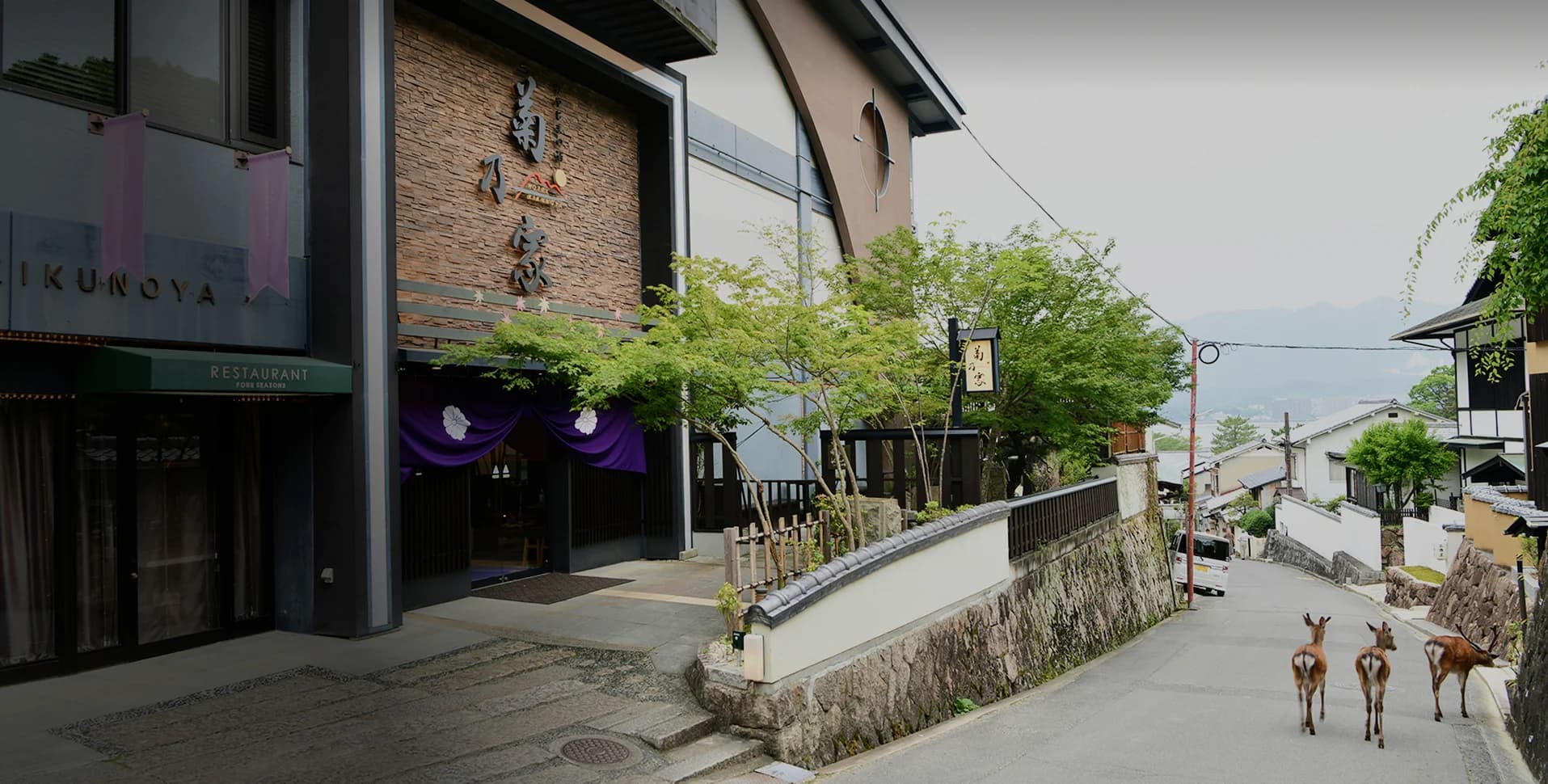
Hotel Kikunoya — from ~$114/person/night with meals
Kikunoya is the standout value among the island’s inns with private onsen. The outdoor hot spring overlooks the Seto Inland Sea, the shrine is a five-minute walk away, and at roughly 30 rooms—the Kikunoya Annex added about 8 rooms in July 2025, increasing the total from 22—it remains manageable in scale rather than hotel-like. The public footbath at the entrance is also open to nonguests, which is unusual on the island. Its tattoo policy is listed as unverified in our database, so we cannot confirm the current rules for the shared baths either way. If tattoos are a concern, contact the inn directly before booking or reserve a private bath to avoid ambiguity.
Mid-Range Options on the Island
Most of these inns have shared public or open-air baths rather than private in-room onsen, and several offer reservable private baths at no extra charge, noted where relevant. One or two are comfortable, well-located bases without an on-site hot spring; each entry makes that clear so you can decide whether bathing or location matters more.
Miyajima Grand Hotel Arimoto — $180–500/person/night with meals
With 57 rooms, Arimoto is one of the island’s larger properties and has the supporting logistics: an open-air hot spring, several dining spaces, a free ferry shuttle, and English-speaking staff. It is a three-minute walk from Itsukushima Shrine. The tattoo policy is allowed if covered for the shared baths. The tradeoff is intimacy: you get the reliability of a midsize hotel rather than the hush of a small inn. That makes it a sensible choice for families, multigenerational groups, or first-time visitors who value smooth logistics and dependable English support over boutique quiet.
Itsukushima Iroha — $200–500/person/night with meals
Iroha stands on Omotesando, the island’s main shopping street, and the convenience is real. Its top-floor baths overlook the Seto Inland Sea and the otorii gate; the modern-traditional design feels clean without becoming cold. The tattoo policy is allowed if covered. The central location makes it easy to head out early before day-trippers arrive, and that first quiet hour on the stone paths is worth planning around.
Hotel Miyarikyu — from ~$202/person/night with meals
Miyarikyu stands three minutes from the ferry terminal, with tatami rooms facing the floating gate. Its kaiseki menus follow what the Seto Inland Sea provides: oysters in winter and anago throughout the year. Note that there is no on-site hot spring, so treat it as a well-placed base near the pier rather than a bathing destination; pair it with one of the island’s public baths if the onsen ritual matters to you. The tattoo policy is unverified; contact the inn before booking if this affects your stay.
Miyajima Hotel Makoto — from ~$145/person/night with meals
Makoto is one of the island’s most-reviewed mid-range choices, with 1,039 reviews on our platform and a consistent reputation for friendly service. It has two large public baths, a sauna, and a free reservable private bath. The sauna is the unusual touch: it is uncommon among island ryokans and a genuine draw if you enjoy alternating heat, a cold rinse, and the onsen bath. Choose Makoto for dependable service backed by a substantial review history rather than intimate boutique atmosphere. The tattoo policy is unverified; confirm it with the inn.
Yamaichi Bekkan — from ~$190/person/night with meals
Four rooms. English-speaking owners. The focus here is not the onsen—the property does not have one—but the cooking, with a multi-course dinner built around Seto Inland Sea seafood: local oysters, anago, and whatever arrived that day. If the meal matters more to you than the bathing ritual, this is the island’s most personal option. An honest warning: if a hot spring is essential to your ryokan experience, stay elsewhere.
Mizuhaso — from ~$73/person/night
Five rooms near the Miyajima Public Aquarium, with two reservable private baths available to guests at no extra charge. These are shared private-use baths for which you reserve a time slot, not private in-room onsen. Dinner is a kaiseki meal made with local ingredients, and the hosts speak English. At this price on the island, it is a genuine find. The tattoo policy is unverified; contact the inn.
Budget Option on the Island
Miyajima Guest House Mikuniya — $50–150/person/night
The island’s most-reviewed budget option, with 728 reviews and a 9.3 rating that exceeds what its price category suggests. Eight rooms are divided between private tatami rooms and shared dormitories, with a Japanese garden and access to onsen baths. It is a five-minute walk from Itsukushima Shrine and Daishoin Temple, and the staff speak English. The tattoo policy is allowed if covered, the most flexible clearly stated policy in this group. It offers a reasonable entry point to an overnight stay on Miyajima without forcing a choice between the experience and your bank balance.
Area 2 — Miyahama Onsen: the Mainland Ryokan Alternative Near Hiroshima (No Ferry Pressure)
Miyahama Onsen is the closest authentic mainland onsen area to Hiroshima. It sits on the Hatsukaichi coast, about five minutes by taxi or shuttle from the Miyajimaguchi ferry terminal. Staying here means you can take the JR ferry to Miyajima for the day and return when you choose, without watching the final-ferry time. Rates tend to be slightly lower than at comparable island properties. From the Miyahama shore at sunset, the island lies directly across a narrow channel, close enough that a mainland base never feels like skipping Miyajima. Miyahama’s clearest advantage is for travelers with tattoos who want practical access to private bathing.
Sekitei and IBUKU: Miyahama’s Two Standout Ryokans
Sekitei — from ~$250/person/night with meals
Sekitei is on the Miyahama coast of the mainland, not on Miyajima Island. Its 12 detached villa-style rooms sit within a landscaped Japanese garden that looks directly across the water toward Miyajima, making the island part of the atmosphere before you even board the ferry the following morning. The kitchen is known for Setouchi-seafood kaiseki, and the property holds the SELECTED ONSEN RYOKAN designation, a curated selection requiring verified onsen quality. The staff speak English. Its tattoo policy is listed as unverified in our database; confirm it directly before booking.
Miyajima Hanare no Yado IBUKU — from ~$350/person/night
IBUKU is also on the Miyahama mainland, not on Miyajima Island. Its 10 detached hanare villas each have a private outdoor radon hot-spring bath. Miyahama Onsen is a radon, or radium, spring—a distinct type of mineral spring—and every villa’s bath is outdoors with enough privacy that communal bathing does not enter the equation. Seasonal room themes organize the design around the Japanese calendar, producing a deliberate, unhurried effect rather than simple decoration. That said, IBUKU’s tattoo policy is listed as unverified in our database; we cannot confirm a formally stated policy, and guests should check directly before booking. One important note: English support at IBUKU is limited; the property is not marked as English-friendly in our data. Keep this in mind if fluent assistance in English matters during your stay.
Farther Afield: Onomichi, Setouchi, and KAI Miyajima (Context Only)
These are worth knowing about, but they fall outside what we can book directly.
KAI Miyajima by Hoshino Resorts opened on July 23, 2026, on the Miyajimaguchi coast—the mainland side, not the island. It has 54 rooms, 30 with private open-air baths facing the otorii gate, from approximately ¥32,000 per person per night with meals. We cannot book it through this site.
The broader Onomichi and Setouchi corridor along the Seto Inland Sea has a group of small guesthouses and inns beside the cycling route, suited to travelers riding the Shimanami Kaidō. It is a different kind of trip—quieter, slower, and less focused on shrines—and worth considering if you have three or four days in the region rather than one. It lies beyond the scope of this guide.
Practical Advice: Tides, Deer, Seasonal Food, and When to Book
Getting the Tide Right: When the Torii Really Floats
The “floating” effect requires high tide. At low tide, the seabed around the otorii gate is exposed and visitors can walk out to its base—a completely different experience and equally worth seeing, but not the classic floating view. The gate is illuminated after dark throughout the year.
The overnight advantage is simple: check the tide calendar before arriving and plan your evening accordingly. A summer high tide at 19:30, after the last wave of ferry visitors has faded, can leave you at an empty shrine watching the gate rest on black water with its reflection beneath it. Day-trippers cannot plan this reliably; they arrive when their train schedule permits.
Tip
Overnight advantage Staying overnight lets you check the tide calendar before arriving and time your evening shrine walk for high tide after the final ferry crowds fade, around 19:00–20:00 in summer. Day-trippers cannot guarantee this.
Restoration of the Great Torii was completed in December 2022 after three and a half years of work. The gate is fully intact and accessible, with no scaffolding.
The Deer
Around 500 protected sika deer roam freely across Miyajima. They are regarded as sacred messengers in the Shinto tradition and are legally protected under Japanese law. They are entirely accustomed to people and will investigate bags, maps, paper, and food wrappers with stubborn persistence. Do not feed them: it reinforces this behavior, and the deer are genuinely better off without tourists’ snacks.
After the final wave of ferry visitors leaves, the deer tend to settle noticeably. Miyajima’s first morning hour—before 08:00 and before any day-trippers arrive—is the island at its quietest, with deer moving silently along the stone paths around the shrine.
What to Eat: Oysters, Anago, and Momiji Manju
 Pin to Pinterest
Hiroshima Prefecture produces approximately 70% of Japan’s farmed oysters. On Miyajima, the easiest way to eat one is at an Omotesando street stall, grilled over charcoal in its shell and served immediately. October through March is the main season, with the plumpest, most flavorful flesh from December through February. During this window, most island ryokans include oysters in some form at kaiseki dinner—one genuine reason to stay overnight rather than visit only for the day.
Anago-meshi, a box of rice topped with conger eel, is the island’s other signature dish. The most frequently cited version comes from Ueno, whose original shop has stood by Miyajimaguchi Station since 1901. It is worth picking up on the way back to Hiroshima if your ferry schedule allows.
Momiji-manju are steamed maple-leaf-shaped cakes filled with red-bean paste, custard, or chocolate—the standard souvenir in Omotesando’s shops. They are available year-round and genuinely good.
When to Book
Cherry-blossom season from late March to early April and autumn foliage from mid- to late November are the two periods when island-inn availability disappears. Booking three or four months ahead is not excessive for the best properties during these windows. Momijidani Park, where Iwaso stands, hosts evening illuminations at peak foliage, pushing demand still higher.
Golden Week from late April to early May and Obon in mid-August are equally competitive. Book early.
The winter low season from January through February has the fewest crowds and coincides with peak oyster season. Rates sometimes fall, and availability is generally better.
Every property in this guide to the best ryokans near Hiroshima is within 35–60 minutes of Hiroshima Station. An island overnight is the experience most travelers remember; mainland Miyahama is the practical choice when budget or private bathing access takes priority. Both are worthwhile if your itinerary allows.
 Pin to Pinterest
Ready to book?
Book one of these top picks
Compare live availability and prices across booking sites.

Iwaso
岩惣
Miyajima·Luxury
from US$350 · per person · per nightfrom ≈ US$700 total for 2 guests



Hotel Kikunoya
ホテル菊乃家
Miyajima·Mid-Range
from US$114 · per person · per nightfrom ≈ US$228 total for 2 guests

Miyajima Guest House Mikuniya
宮島ゲストハウス三国屋
Miyajima·Budget
from US$50 · per person · per nightfrom ≈ US$100 total for 2 guests
Booking links may earn us a commission at no extra cost to you.
For the full inn-by-inn analysis, including room photos and detailed comparisons, our guide to the best ryokans on Miyajima Island covers every property in detail.
FAQ
Frequently asked questions
How do you get from Hiroshima to Miyajima?+
Take the JR Sanyo Line from Hiroshima Station to Miyajimaguchi Station, about 25 minutes and roughly ¥420, covered by the JR Pass. Walk five minutes to the terminal and board the JR West Miyajima Ferry to Miyajima Pier, a 10-minute crossing costing ¥200 and also covered by the JR Pass. Pay the separate ¥100 visitor tax before boarding. Total travel time from station to ryokan is about 45–55 minutes by JR. The Route 2 Hiroden tram from the Peace Memorial Park area takes about 70 minutes and costs roughly ¥240, but it is not covered by the JR Pass.
Is staying overnight on Miyajima worth it?+
Yes, primarily for the atmosphere. The island empties after the usual final wave of day-trippers leaves by ferry, around 19:00–20:00 in summer, giving overnight guests near-exclusive access to the illuminated shrine and torii. You can also check the tide calendar and time your visit for an evening high tide, when the gate appears to float on dark water. Day-trippers arrive when their schedule permits, not necessarily when the tide is right.
Are there ryokans near central Hiroshima?+
Miyajima is 35–55 minutes from Hiroshima Station and is the main ryokan destination near the city. Miyahama Onsen, on the mainland coast near the same ferry departure point, provides a quieter alternative without requiring an island crossing. Few traditional ryokans operate inside Hiroshima city itself; the area’s onsen culture is concentrated along the Seto Inland Sea coast.
What is the best time to visit Miyajima?+
Autumn foliage from mid- to late November and cherry blossoms from late March to early April are the most scenic periods. Oyster season from October through March is the best culinary window. Book island inns three to four months ahead for these dates. The January–February low season brings fewer crowds and peak oysters, making winter a good time to visit deliberately.
Can you visit Miyajima with a Japan Rail Pass?+
Yes. Both the JR Sanyo Line to Miyajimaguchi and the JR West Miyajima Ferry are covered. At the terminal, make sure you board the JR West ferry rather than the Matsudai Kisen service departing from the same area. JR Pass holders must still pay the separate ¥100 visitor tax at the ticket machine before boarding.
Do Miyajima ryokans include meals?+
Most do. The standard Japanese ryokan format includes dinner and breakfast in the nightly rate, known as a two-meal plan. All prices in this guide are per person with meals unless otherwise stated. Some budget options, including Mikuniya Guest House, may offer room-only rates; confirm the meal plan when booking.
Do Miyajima onsens allow tattoos?+
Generally not in shared public baths. Most island inns require tattoos to be covered or prohibit them in communal onsen areas. A practical option for travelers with tattoos who want private bathing is IBUKU on the Miyahama mainland, where each detached villa has its own outdoor radon bath. IBUKU’s formal tattoo policy is not confirmed in our data, however, so contact the inn directly. Always verify the current policy before booking any property.
Still deciding?
Browse ryokans across JapanBooking.com

