19 min readUpdated June 2026
The word "ryokan" does a lot of heavy lifting. It covers a $35-a-night guesthouse in a converted fishing village and a $2,000-a-night hilltop villa where a private butler draws your cypress-wood bath before dinner. Both are genuine ryokans. Both are listed on Trip.com.
How much does a ryokan cost per night?
The median ryokan in Japan costs ¥44,660 per person per night (≈$290 at ¥154/USD), from our Q2 2026 re-verification of 293 published properties (n=287 with rates). The middle 50% runs ¥29,260–¥65,450; budget inns start near ¥9,240, and ultra-luxury suites exceed ¥200,000. Full dataset: download the Q2 2026 price index (CSV, 293 properties).
| Tier (per person / night) | Band | Properties |
|---|---|---|
| Budget | under ¥25,000 | 47 |
| Mid-range | ¥25,000–45,000 | 98 |
| Luxury | ¥45,000–80,000 | 100 |
| Ultra-luxury | ¥80,000+ | 42 |
That 57× gap is why the simple question — *how much does a ryokan cost?* — never has a simple answer. The headline number: the median ryokan rate across 293 properties is $290 per person per night (¥44,660 at ¥154/USD) [Japan Ryokan Guide 293-property analysis, verified 2026-06-11]. If you have ¥50,000 per head to spend, you're right in the middle of the market — not splurging, not slumming. But if your budget is $120 or $600, what you actually get looks completely different depending on which of Japan's 30 onsen areas you choose.
This article maps every area, every price tier, and the features that come with each — so your budget decision is based on real numbers, not vague impressions.
Data: 293 published ryokans across 30 onsen areas, curated rate ranges verified against Trip.com and official property sites as of Q1 2026. Rates are per person per night and include dinner and breakfast at mid and luxury tiers (see the "What the Rate Includes" section below). The middle 50% of all properties sits between $190 and $425 [Japan Ryokan Guide 293-property analysis, verified 2026-06-11].
The 60-second answer: what a ryokan costs in 2026
If you only read one table in this article, make it this one.
| Tier | Properties | Low median | Midpoint median | High median |
|---|---|---|---|---|
| Budget | 31 (13.8%) | $70 / ¥10,800 | $115 / ¥17,700 | $160 / ¥24,600 |
| Mid | 99 (44.2%) | $130 / ¥20,000 | $250 / ¥38,500 | $350 / ¥53,900 |
| Luxury | 94 (42.0%) | $280 / ¥43,100 | $450 / ¥69,300 | $600 / ¥92,400 |
[Japan Ryokan Guide 293-property analysis, verified 2026-06-11. USD/JPY: ¥154 (BOJ mid-rate proxy, May 2026). JPY figures rounded to ¥100.]
Three things to flag upfront. First, these rates are per person, not per room — a distinction every competitor article glosses over, and the main reason the same ryokan can look either expensive or cheap depending on which site you're reading. A $250 per-person rate for a couple is $500 per room — higher than a decent Shinjuku business hotel, but it includes a multi-course dinner and breakfast that would cost another $100–$200 on top at a hotel restaurant.
Second, the overall range in our database is $35 (K's House Ito Onsen, Izu) to $2,000 (Sanso Murata, Yufuin) [Japan Ryokan Guide 293-property analysis, verified 2026-06-11]. That 57× spread is not an anomaly — it reflects genuinely different categories of experience that happen to share a name.
Third, the mid-tier is where 44% of all properties live. At $250 median, it's the practical entry point for most foreign visitors: 91% of mid-tier ryokans are English-friendly, 43% include a private onsen, and a proper kaiseki dinner is standard [Japan Ryokan Guide 293-property analysis, verified 2026-06-11].
For strategies on finding the best budget deals, see our guide to budget ryokan tips.
How we built this dataset: 293 ryokans, 30 onsen areas
Before you trust a single number in this article, you should know exactly where it came from.
We built and refined a curated database of every ryokan listed on japanryokanguide.com — 293 properties, 30 onsen areas, 8 regions. Each property has a representative low and high USD nightly rate per person, manually verified against published rate cards on Trip.com and official ryokan sites. That verification was last completed in Q1 2026. For the industry-wide picture beyond price — tattoo policies, private-onsen access, ratings — see The Japan Ryokan Index 2026, our statistical analysis of 560 published inns.
What this data is: a cross-section of published price ranges for 293 specific, named ryokans. It tells you what properties actually charge — by area, by tier, by feature set.
What this data is not: a live transactional database. We don't have daily-rate scrapes tied to specific travel dates. The per-property high and low rates reflect the full published range across room types and demand periods — they're the best honest proxy for seasonal variance we can offer without a real-time scrape pipeline.
Tip
Methodology and limitations. Price figures are drawn from japanryokanguide.com's curated database of 293 published ryokans across 30 onsen areas. Each ryokan has a representative low and high USD nightly rate per person, manually verified against published rate cards (Trip.com, official sites) as of Q1 2026. These are representative published ranges, not live transaction prices — actual rates on a specific date will vary. USD/JPY conversions use ¥154/USD (BOJ Tokyo mid-rate proxy, May 2026). Areas with n≤6 (Nara n=5, Ibusuki n=5, Shirahone n=6) are flagged with an asterisk — treat their medians as indicative rather than definitive. For real-time pricing on specific dates, consult Trip.com or the ryokan's official site. Sources: Bank of Japan foreign exchange statistics | Japan Tourism Agency accommodation survey
A useful external calibration: the Japan Ryokan Association lists member ryokan rates spanning ¥5,000 to ¥119,000 per person [Japan Ryokan Association, verified 2026-05-19]. Our database runs slightly wider — $35 to $2,000 (approximately ¥5,400 to ¥308,000) — because it includes a handful of ultra-luxury non-JRA members and a few budget guesthouses that classify themselves as ryokans.
Foreign visitors now account for 14.8% of all ryokan guests, up from 9.9% in 2019 [Japan Tourism Agency inbound consumption survey 2024, via FindMyRyokan]. If you're reading this as a foreign traveler, the English-friendliness figures and the mid-tier data in this article are directly relevant to how your experience will go.
Ryokan prices by region and onsen area
The most useful thing our 293-property dataset does that no competitor article does: it gives you actual median prices for each of Japan's 30 main onsen areas — not vague labels like "affordable" or "splurge-worthy."
The range is wider than most travelers expect. Izu's average ryokan price is $531 per person per night — 3.1× Ibusuki's $170 [Japan Ryokan Guide 293-property analysis, verified 2026-06-11]. Both are genuine onsen destinations. The difference is density of luxury boutiques, proximity to major cities, and the concentration of high-end kaiseki operations. Our area-by-area price index ranks all 30 onsen regions on this exact spread so you can see where your shortlist falls.
Figure 1
Ryokan price distribution across 25 onsen areas
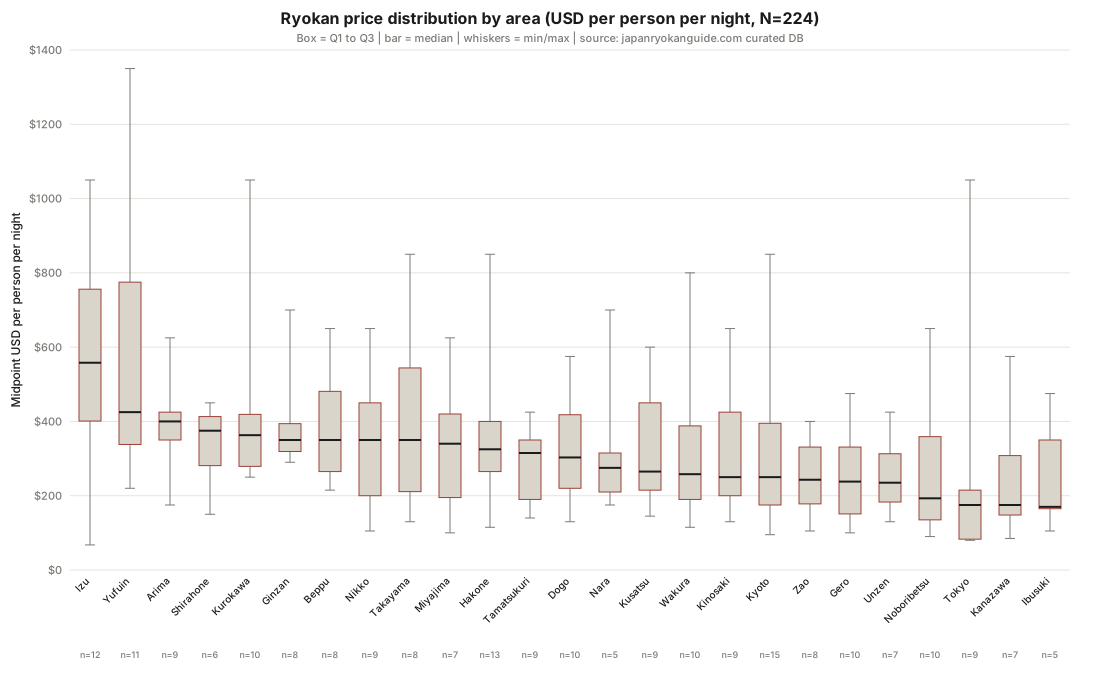
Source: japanryokanguide.com curated database — 224 properties, Q1 2026
View underlying data
| Onsen Area | Median USD | Q1 USD | Q3 USD | Min USD | Max USD |
|---|
Here's the full 30-area breakdown — the table you won't find anywhere else.
Ready to book?
Book one of these top picks
Compare live availability and prices across all three platforms.


Booking links may earn us a commission at no extra cost to you.
| Rank | Area | Region | n | Price range (USD) | Median (USD) | Median (JPY) | Tier mix (B/M/L) |
|---|---|---|---|---|---|---|---|
| 1 | Izu | Chubu | 10 | $68–$1,050 | $531 | ¥81,774 | 1/3/6 |
| 2 | Atami | Chubu | 9 | $120–$1,120 | $435 | ¥66,990 | 1/4/4 |
| 3 | Yufuin | Kyushu | 11 | $220–$1,350 | $425 | ¥65,450 | 1/5/5 |
| 4 | Arima | Kansai | 9 | $175–$625 | $400 | ¥61,600 | 1/6/2 |
| 5 | Fuji-Kawaguchiko | Chubu | 10 | $60–$1,100 | $383 | ¥58,982 | 1/5/4 |
| 6 | Shirahone* | Chubu | 6 | $150–$450 | $375 | ¥57,750 | 1/5/0 |
| 7 | Kurokawa | Kyushu | 10 | $250–$1,050 | $363 | ¥55,902 | 0/9/1 |
| 8 | Nikko | Kanto | 9 | $105–$650 | $350 | ¥53,900 | 3/4/2 |
| 9 | Ginzan | Tohoku | 8 | $290–$700 | $350 | ¥53,900 | 0/7/1 |
| 10 | Takayama | Chubu | 8 | $130–$850 | $350 | ¥53,900 | 3/2/3 |
| 11 | Miyajima | Chugoku | 7 | $100–$625 | $340 | ¥52,360 | 3/2/2 |
| 12 | Hakone | Kanto | 13 | $115–$850 | $325 | ¥50,050 | 1/10/2 |
| 13 | Tamatsukuri | Chugoku | 9 | $140–$425 | $315 | ¥48,510 | 3/6/0 |
| 14 | Dogo | Shikoku | 10 | $130–$575 | $303 | ¥46,662 | 3/6/1 |
| 15 | Beppu | Kyushu | 15 | $150–$650 | $275 | ¥42,350 | 4/7/4 |
| 16 | Nara* | Kansai | 5 | $175–$700 | $275 | ¥42,350 | 2/2/1 |
| 17 | Kusatsu | Kanto | 9 | $145–$600 | $265 | ¥40,810 | 3/4/2 |
| 18 | Wakura | Chubu | 10 | $115–$800 | $258 | ¥39,732 | 3/5/2 |
| 19 | Kyoto | Kansai | 15 | $95–$850 | $250 | ¥38,500 | 7/7/1 |
| 20 | Kinosaki | Kansai | 15 | $130–$650 | $250 | ¥38,500 | 6/7/2 |
| 21 | Zao | Tohoku | 8 | $105–$400 | $243 | ¥37,422 | 4/4/0 |
| 22 | Gero | Chubu | 16 | $100–$475 | $241 | ¥37,114 | 6/9/1 |
| 23 | Unzen | Kyushu | 7 | $130–$425 | $235 | ¥36,190 | 3/4/0 |
| 24 | Akiu | Tohoku | 11 | $95–$530 | $215 | ¥33,110 | 6/3/2 |
| 25 | Fukuoka* | Kyushu | 4 | $63–$421 | $201 | ¥30,954 | 2/2/0 |
| 26 | Noboribetsu | Hokkaido | 10 | $90–$650 | $193 | ¥29,722 | 6/2/2 |
| 27 | Tokyo | Kanto | 9 | $80–$1,050 | $175 | ¥26,950 | 7/1/1 |
| 28 | Kanazawa | Chubu | 7 | $85–$575 | $175 | ¥26,950 | 5/1/1 |
| 29 | Ibusuki* | Kyushu | 5 | $105–$475 | $170 | ¥26,180 | 3/1/1 |
| 30 | Naruko | Tohoku | 12 | $90–$305 | $145 | ¥22,330 | 11/1/0 |
*Areas with n≤6 have wider confidence intervals — treat medians as indicative. [Japan Ryokan Guide 293-property analysis, verified 2026-06-11]
Figure 2
10 most expensive vs 10 most affordable onsen areas
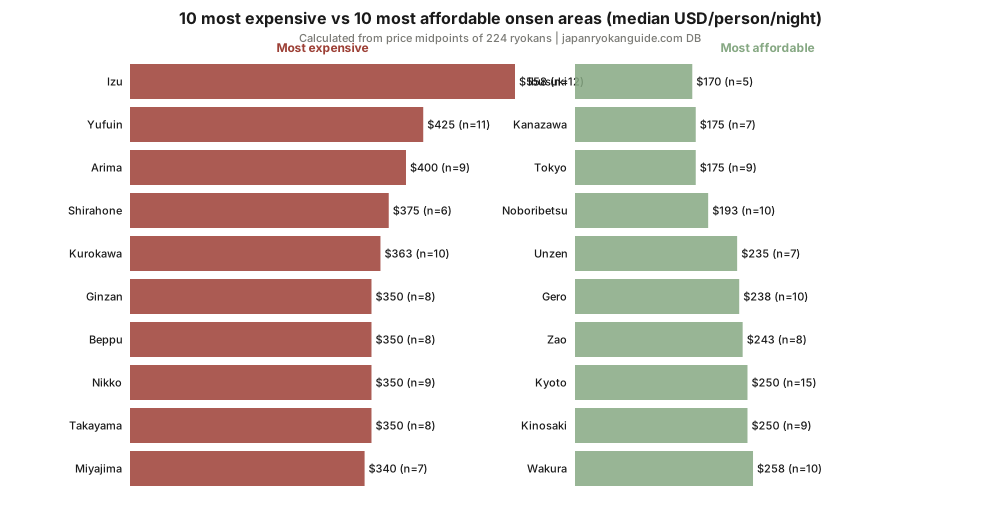
Source: japanryokanguide.com curated database — 224 properties, Q1 2026
View underlying data
| Category | Onsen Area | Median USD | n |
|---|
For a month-by-month timing guide to plan around price swings, see our guide to best season for ryokan stays.
The premium pocket: Izu, Yufuin, and Arima
These three areas account for a disproportionate share of Japan's luxury-tier ryokan inventory — and the pricing reflects it.
Izu (Shizuoka Prefecture, 2–3 hours from Tokyo) has 10 properties in our database, six of them luxury-tier. The coastal setting, direct Shinkansen access from Tokyo, and a cluster of boutique kaiseki operations have kept the average ryokan price elevated. The Hakone area guide covers the accessible alternative at rank 11 ($325 median) — 13 properties spanning a full range from $115 to $850, close enough for Tokyo day-trippers who want a shorter trip.
Yufuin (Oita Prefecture) is the sharpest contrast in the data: 11 properties, seven of them luxury-tier, with a published range of $220 to $1,350. That ceiling is the widest of any area except Tokyo's anomalous $1,050 high (driven by one ultra-luxury urban ryokan). Yufuin's art-ryokan scene — small, often architect-designed properties with seasonal menus — drives prices up while the lack of large resort-scale hotels keeps volume low.
Arima (Hyogo Prefecture, 30 minutes from Osaka) is one of the Three Ancient Springs cited in eighth-century Japanese literature [verified Visit Kobe 2026-05-19], alongside Dogo and Nanki-Shirahama. Nine properties, five luxury-tier. The proximity to Osaka and Kyoto makes it a frequent overnight add-on for international itineraries, which supports pricing above the national median.
Best value regions: Hokkaido, Tohoku, and Northern Kyushu
Budget doesn't have to mean compromise on the onsen experience. These regions offer the best price-to-experience ratio in the dataset.
Noboribetsu (Hokkaido, $193 median) is driven by large resort-style ryokans with multiple shared and semi-private bath facilities, kaiseki-style dinners at mid-tier prices, and the volcanic Jigokudani landscape nearby. Four of the top-10 widest pricing bands in the entire database are Noboribetsu properties — a signal that these big ryokans flex significantly between weekday and premium pricing. For travelers searching for cheap ryokan Japan options, Noboribetsu is the most reliable starting point in Hokkaido.
Kusatsu onsen ($265 median, rank 15) is the strongest mid-range value proposition in Kanto. Its sulfuric acid springs — among the most acidic of any onsen in Japan (pH 1.7–2.1 at the Yubatake source [verified Kusatsu Onsen Association 2026-05-19]), long attributed with medicinal properties — don't require a luxury price tag. One property, Yubatake Souan, starts at $90 and still delivers a private onsen.
Kinosaki Onsen ($250 median, rank 17) is the Kansai value pick. Seven of its nine properties are mid-tier, giving you a traditional seven-bathhouse town experience with a yukata walk between outdoor baths for well under $300 per person. It's one of the few areas where the setting — a single preserved streetscape of willow-lined canals — is entirely free to access once you're checked in.
Ryokan cost by tier: what $115, $250, and $450 per night actually gets you
The median number matters, but the feature data is where budgeting decisions actually get made.
| Feature | Budget (¥10k–¥24k) | Mid (¥20k–¥54k) | Luxury (¥43k–¥92k+) |
|---|---|---|---|
| Median low rate | $70 / ¥10,800 | $130 / ¥20,000 | $280 / ¥43,100 |
| Median midpoint rate | $115 / ¥17,700 | $250 / ¥38,500 | $450 / ¥69,300 |
| Median high rate | $160 / ¥24,600 | $350 / ¥53,900 | $600 / ¥92,400 |
| Private onsen | 10% | 43% | 81% |
| English-friendly | 65% | 91% | 84% |
| Vegetarian meals | 10% | 51% | 72% |
| Near train station | 71% | 65% | 57% |
| Halal meals | 0% | 0% | 0% |
| Avg room count | 24 rooms | 67 rooms | 41 rooms |
| Typical onsen setup | Shared large-bath | Shared + private mix | Predominantly private |
| Kaiseki style | Simplified multi-course | Full multi-course kaiseki | Multi-course kaiseki, often with local premium ingredients |
[Japan Ryokan Guide 293-property analysis, verified 2026-06-11]
A few things in this table deserve attention.
Private onsen is the feature with the steepest tier gradient: 10% at budget, 43% at mid, 81% at luxury — an 8× swing from budget to luxury [Japan Ryokan Guide 293-property analysis, verified 2026-06-11]. If a private onsen is non-negotiable, your realistic entry point is mid-tier, and even then it's not guaranteed. For properties where a private onsen is confirmed, see our dedicated list of best ryokans with private onsen.
English-friendliness peaks in mid-tier (91%), not luxury (84%) [Japan Ryokan Guide 293-property analysis, verified 2026-06-11]. This surprised us when we ran the numbers. The practical explanation: mid-tier properties in popular areas actively court international guests and invest in multilingual staff and translated menus. Many luxury ryokans — particularly the smaller boutique properties in Yufuin and Kurokawa — cater primarily to domestic high-net-worth guests and have less infrastructure for English-speaking visitors. Worth confirming before you book.
Halal meals: 0 of the 224 ryokans in our May 2026 verification [Japan Ryokan Guide 224-property analysis, verified 2026-05-19]. This is a real gap, not an oversight. The traditional kaiseki format — which uses dashi (fish-based stock) and often includes pork-based dishes — is structurally difficult to adapt. Muslim travelers should contact properties directly; some can prepare simpler vegetarian or seafood-only meals on request, but certification is not available in this dataset.
Station proximity inverts with price: budget ryokans are closest to train stations (71%), luxury are furthest (57%). Luxury properties trade transit convenience for remote valley settings — which means transport logistics for getting to and from the ryokan need to factor into your actual trip cost.
For our curated list of top luxury picks, see our luxury ryokans in Japan guide.
Figure 3
How many ryokans sit at each price point — by tier
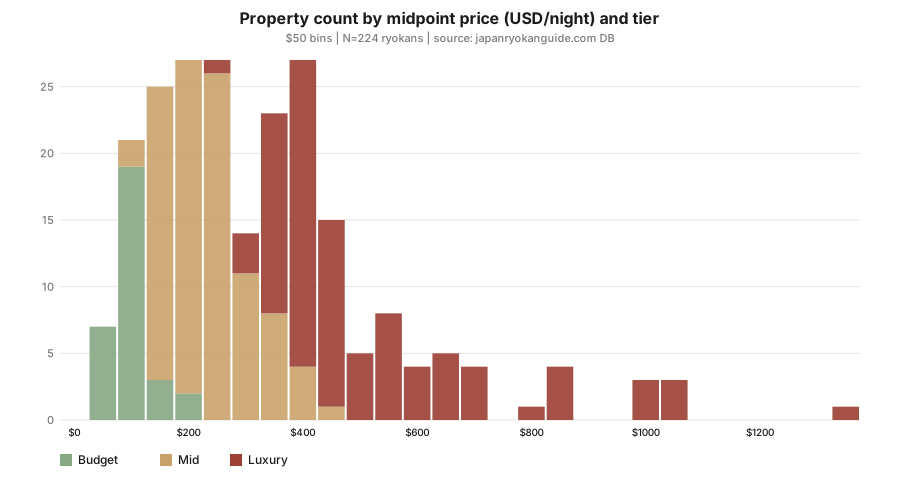
Source: japanryokanguide.com curated database — 224 properties, Q1 2026
View underlying data
| Price bin (USD) | Budget count | Mid count | Luxury count | Total |
|---|
Figure 4
Private onsen, English support, vegetarian meals, and station access — by tier
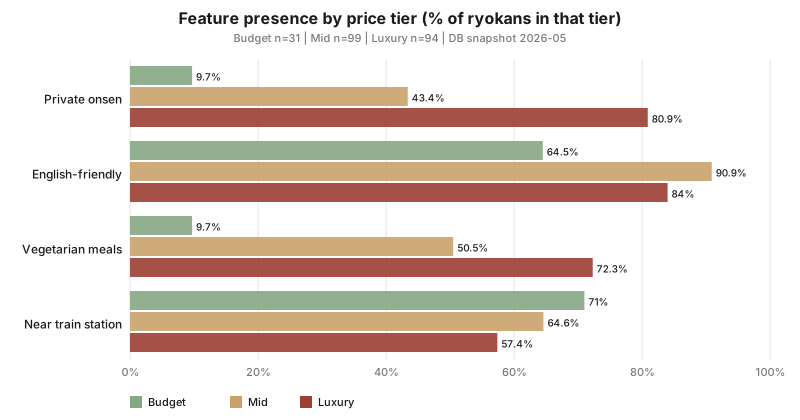
Source: japanryokanguide.com curated database — 224 properties, Q1 2026
| Feature | Budget % | Mid % | Luxury % |
|---|
A note on what the nightly rate includes
The trickiest part of comparing ryokan cost per night to hotel rates is what's inside the price. Budget tier is the variable one: some properties include a simplified multi-course dinner; others are room-only (yado-only plans). Always confirm before booking — the gap matters.
At mid and luxury tiers, the rate almost always folds in one night in a traditional tatami room with two meals — kaiseki dinner and a Japanese-style breakfast. Yukata, slippers, in-room green tea, and access to communal indoor and outdoor baths come standard. What stays *outside* the headline price varies more than you'd think — and that's what the next section covers.
Standalone kaiseki at a Kyoto restaurant runs ¥10,000–¥30,000 per person (drinks extra), and Michelin-starred kaiseki can hit ¥20,000–¥50,000+ [InsideKyoto.com kaiseki guide, verified 2026-05-19; Bespoke Discovery luxury dining guide, verified 2026-05-19]. So a mid-tier ryokan at $250/night with two kaiseki-grade meals embedded is structurally cheaper than dining out twice and paying for a hotel room separately.
Browse mid-tier ryokans on Trip.com{rel="nofollow sponsored noopener"}
How much prices swing: the per-property band (peak vs off-peak)
Figure 5
Each ryokan's low vs high rate — the per-property pricing band
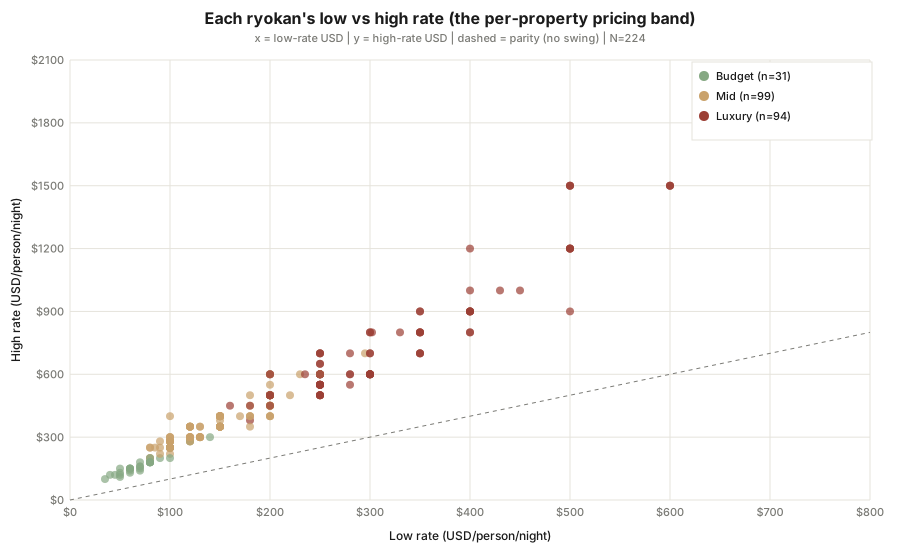
Source: japanryokanguide.com curated database — 224 properties, Q1 2026
View underlying data
| Property | Tier | Low (USD) | High (USD) | Peak premium |
|---|
Across 293 properties, the median high rate is 2.4× the low rate [Japan Ryokan Guide 293-property analysis, verified 2026-06-11]. A ryokan that starts at $130 on a quiet February weekday will typically peak at around $312 during busy periods. That ratio holds remarkably consistent across tiers: the budget-tier swing median is +130%, luxury is +120% — both tiers flex by roughly 2.2–2.4× regardless of starting price.
The widest band we measured belongs to Dogashima New Ginsui in Izu: $100 to $400, a 300% intra-property swing [Japan Ryokan Guide 293-property analysis, verified 2026-06-11]. It's a mid-tier property — large enough to run weekday rack rates, premium enough to push aggressively on holiday weekends.
That dynamic helps explain a regional pattern worth knowing: four of the top-ten widest-banded properties cluster in Noboribetsu [Japan Ryokan Guide 293-property analysis, verified 2026-06-11]. Big resort-scale ryokans flex harder than small boutiques — they hold basic weekday inventory at one price and premium banquet-season packages at another, and the gap between those two is where the spread lives. Even the most price-stable property in the database still shows an 80% peak premium — there is no flat-rate ryokan in this dataset.
The table above shows the top-10 widest swings and a sample of specific properties. The full scatter (Figure 5) plots every property's low against its high so you can see exactly where your shortlisted ryokan sits relative to the field.
Tip
Practical rule of thumb: multiply any ryokan's published low rate by 2.4 to estimate what you might pay during peak demand periods. If a property lists $200 as its starting rate, build $480 into your budget for busy periods. For a real price on your specific dates, check Trip.com directly — published ranges are a guide, not a guarantee.
Hidden costs foreigners often miss
The rate you see at booking is rarely the final bill. Here's what adds on top — with specific amounts.
National consumption tax (10%) is already included in published rates on Trip.com, Booking.com, and official ryokan sites. No surprise here — it's baked in [TravelClassroom.net Japan Accommodation Tax Guide, verified 2026-05-19].
Onsen / bathing tax (入湯税) is a municipal earmarked tax authorized under Article 701 of Japan's Local Tax Act [verified TravelClassroom 2026-05-19], typically ¥150 per person per night at most onsen towns, collected at checkout, not listed in online rates. Noboribetsu, Lake Akan, and some Izu properties charge ¥300. Yufuin charges ¥150–¥2,500 depending on the property's declared room rate. It sounds trivial — and for most stays it is — but the real surprise is that booking platforms don't mention it at all.
City and prefectural accommodation tax (宿泊税) is where the real variance hides. As of March 1, 2026, Kyoto's ryokan scene operates a five-tier system that tops out at ¥10,000 per person per night for stays of ¥100,000+ [verified Kyoto City Tourism 2026-05-19]:
| Kyoto room rate (per person) | Accommodation tax |
|---|---|
| Under ¥6,000 | ¥200 |
| ¥6,000–¥19,999 | ¥400 |
| ¥20,000–¥49,999 | ¥1,000 |
| ¥50,000–¥99,999 | ¥4,000 |
| ¥100,000+ | ¥10,000 |
[Japanspecialist.com — Kyoto hotel tax 2026, effective March 1, 2026]
At a luxury Kyoto ryokan charging ¥80,000 per person, that's ¥4,000 in accommodation tax per person per night, on top of everything else. 17 prefectures and cities now have some form of accommodation tax [MATCHA Japan Accommodation Tax Guide 2026, verified 2026-05-19]. Tokyo adds ¥100–¥200/person/night (none under ¥10,000/night); Osaka adds ¥200–¥500.
These government-set levies fund local infrastructure and you pay them on-site. The next category sits in a different bucket entirely — fees the property sets itself, not the prefecture.
Service charge is where individual ryokans have the most discretion. Many traditional ryokans add a 10–15% service charge (covering 24-hour service and the work of the room attendant, or *nakai*); ultra-luxury properties may bill 20–25%. This isn't a fixed legal rate — it varies property by property, and some budget and mid-tier ryokans fold it into the published per-person rate entirely. Confirm at booking [multiple travel publishers, industry practice consensus — not a legally mandated rate, verified 2026-05-19].
Room-upgrade supplements apply for premium rooms: detached villa, ocean-view, or oversized suite categories typically add 30–60% above the base rate. The published "from" price is the smallest room.
Drinks at dinner are almost never included in the MAP plan. Expect ¥2,000–¥5,000 per person if you order sake, beer, or shochu with your kaiseki dinner. High-end properties often charge markups on mid-market bottles.
Child pricing: children aged 3–12 typically pay 50–70% of the adult rate. Under-3 is usually free (no meals, shared futon).
Tip
Always ask the ryokan to confirm the all-inclusive total per person before booking. At luxury properties, the headline rate can understate the final bill by 20–30% once accommodation tax, service charge, and evening drinks are added. A worked example: a ¥80,000-per-person Kyoto ryokan that adds a ¥4,000 Kyoto accommodation tax, ¥150 onsen tax, and ¥10,000 separate service charge comes to ¥94,150 — 18% above the listed rate.
7 genuine bargains: private onsen + kaiseki under $120/night
As of our May 2026 verification, 7 of 224 ryokans — 3.1% — offered a private onsen for under $120 per person per night [Japan Ryokan Guide 224-property analysis, verified 2026-05-19]. These are genuinely rare. The list below is complete: there are no other properties in the database meeting this filter.
1. Hotel Otaki — Nikko, Tochigi Starting from $60 per person per night ($60–$150 published range), this is the cheapest private-onsen entry in our May 2026 verification [Japan Ryokan Guide 224-property analysis, verified 2026-05-19]. It's a budget-tier property in the temple forests of Nikko — austere rather than luxurious, but the private bath exists, the Nikko setting is one of Japan's most atmospheric, and the price-to-experience gap is real. Book well ahead for weekends.
Check rates on Trip.com{rel="nofollow sponsored noopener"}
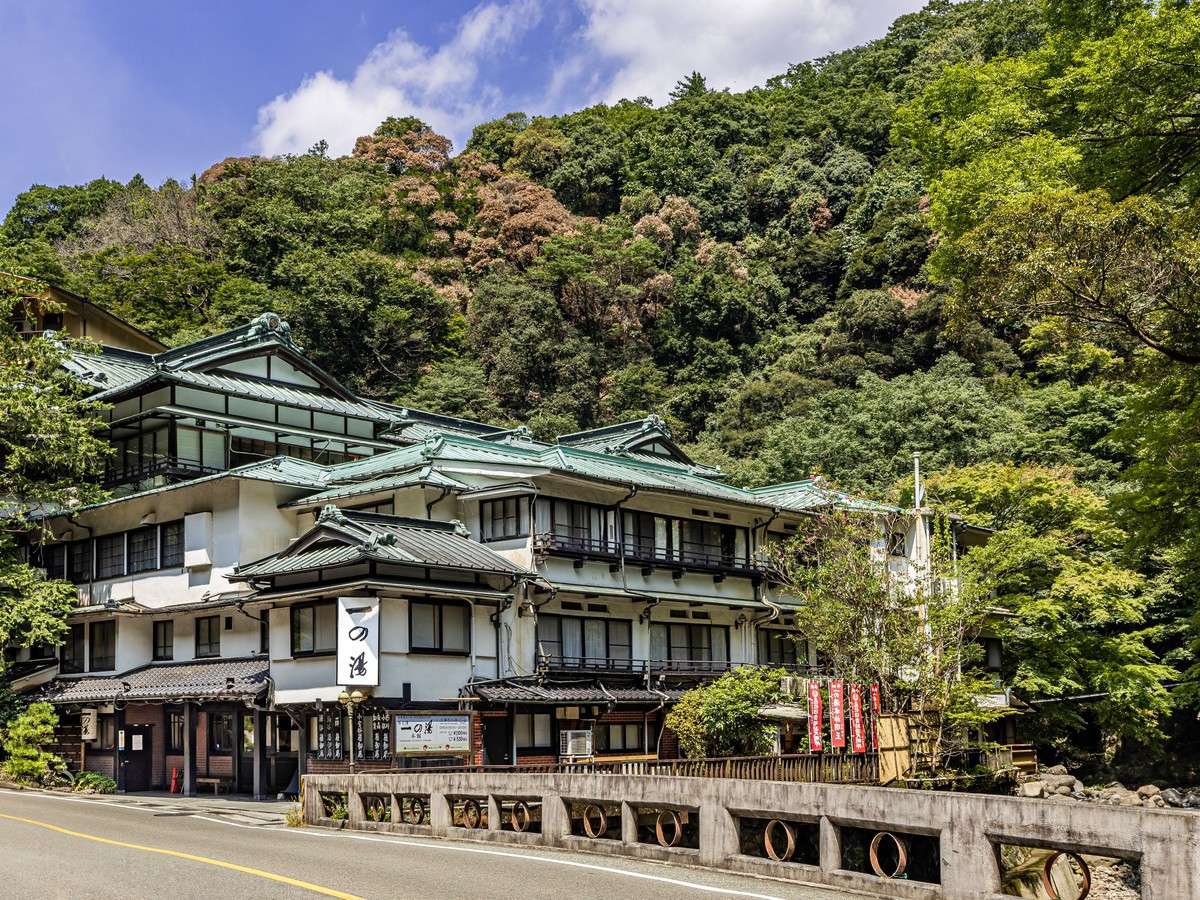
2. Ichinoyu Honkan — Hakone, Kanagawa $70–$160 per person — steps from Hakone-Yumoto station, which means you don't need a taxi from the train. Ichinoyu Honkan is a registered cultural property, founded in 1630 by Tomoyori Ogawa and still operated by the same family [verified Hakone Tourism 2026-05-19], and expanded through the Meiji era. The wooden corridors creak in exactly the way you hope they will. Private onsen here is a time-slot arrangement (kashikiri-buro), not an en-suite room, but it counts. See the full Hakone onsen town guide for context.
Check rates on Trip.com{rel="nofollow sponsored noopener"}
3. Yubatake Souan — Kusatsu, Gunma $90–$200 per person — overlooks the yubatake, the famous hot-water field at the center of Kusatsu town where hot-spring water is cooled by wooden paddles before piped distribution. Kusatsu's waters are among the most acidic in Japan (pH around 2.1), which gives them a distinctive tingling quality. Yubatake Souan puts you directly above the source. See our Kusatsu hot spring town guide for more properties.
Check rates on Trip.com{rel="nofollow sponsored noopener"}
4. Shogetsu — Gero, Gifu $120–$350 per person — riverside setting in Gero, one of Japan's three historically designated great onsen towns (alongside Arima and Kusatsu). At the low end of this range, you're paying mid-tier money for a full kaiseki dinner, private access to the Hida River views from the rotenburo, and one of the most unpretentious onsen towns in Central Honshu. A solid cheap ryokan Japan option for the Gifu region.
Check rates on Trip.com{rel="nofollow sponsored noopener"}
5. Takayama Ouan — Takayama, Gifu $120–$280 per person — Takayama's old merchant-town machiya (townhouse) aesthetic, a kaiseki menu that features Hida beef (the local wagyu), and a private onsen in the $120 low-season entry window. The old town itself is 15 minutes' walk, and the morning market near Jinya ruins sells local pickles and sake that pair well with the previous night's dinner.
Check rates on Trip.com{rel="nofollow sponsored noopener"}
6. Hoseikan — Tamatsukuri pricing tier, Shimane $120–$350 per person — Tamatsukuri Onsen in Shimane Prefecture is known as Japan's "cosmetics spring" — an alkaline sodium bicarbonate spring said to soften and smooth skin after a single soak. Whether or not you believe the cosmetic claims, the water quality is genuinely distinctive, the town is quiet, and the average ryokan price here sits well below the national median. A strong pick if you're traveling through the San'in coast. Kinosaki area is two hours north and worth adding to the same itinerary.
Check rates on Trip.com{rel="nofollow sponsored noopener"}
7. Unzen Kanko Hotel — Unzen Onsen tier, Nagasaki $120–$350 per person — the most architecturally unusual property on this list. Built in 1935 in a Swiss-chalet Western style during Unzen's era as a foreign resort destination, it was registered as a National Tangible Cultural Property in 2003 [verified Unzen Tourist Association 2026-05-19], and pairs private onsen with tatami rooms and European-style drawing rooms. The Unzen jigoku (volcanic hell vents) are a five-minute walk. Beppu is three hours north, with a $350 median but budget-range options at the lower end of its $215 floor that approach this price tier.
Check rates on Trip.com{rel="nofollow sponsored noopener"}
Tip
These 7 properties fill up fast on weekends and during peak demand periods. If your travel dates fall on a Friday or Saturday, book at least 3–4 weeks ahead. For weekday stays at budget and low-mid properties, 7–14 days lead time is usually sufficient. For tips on finding and securing cheap ryokan Japan deals, see our budget ryokan guide.
Search All Available Ryokans on Trip.com{rel="nofollow sponsored noopener"}
FAQ: ryokan prices in Japan
How much does a ryokan cost per night in Japan?
The median rate across our database of 293 ryokans is $290 per person per night (¥44,660 at ¥154/USD). Budget ryokans start from around $35–$120; mid-tier runs $130–$350; luxury is $280–$600+. The full range in our database is $35 to $2,000 per person [Japan Ryokan Guide 293-property analysis, verified 2026-06-11]. Ryokan rates are per person, not per room, and at mid and luxury tiers they typically include dinner and breakfast — which changes the value equation significantly compared to hotel pricing.
Is a ryokan more expensive than a hotel in Japan?
At the midpoint, yes — but ryokans include meals that hotel rates exclude. A $250 per-person ryokan rate covers a multi-course kaiseki dinner and a traditional Japanese breakfast. At a standalone Kyoto restaurant, a comparable kaiseki dinner costs ¥10,000–¥30,000 per person [InsideKyoto.com kaiseki guide, verified 2026-05-19]. Add breakfast and you're looking at $100–$200+ in restaurant costs on top of a hotel room rate. When you account for included meals, mid-tier ryokans are often comparable in total cost to a 4-star business hotel plus dining.
What is the cheapest ryokan in Japan with a private onsen?
Based on our database of 293 ryokans, Hotel Otaki in Nikko is the most affordable property with a private onsen — starting from around $60 per person per night. As of our May 2026 verification, 7 of 224 ryokans (3.1%) offered a private onsen for under $120/night [Japan Ryokan Guide 224-property analysis, verified 2026-05-19]. Other options under $120 include Ichinoyu Honkan in Hakone ($70+) and Yubatake Souan in Kusatsu ($90+). Availability at these three properties in particular is limited — book early, especially for weekend stays.
How much more expensive are ryokans during peak season?
Across 293 properties, the median high rate is 2.4× the low rate [Japan Ryokan Guide 293-property analysis, verified 2026-06-11]. A property starting at $150 typically peaks around $360. The widest single-property band in the database is Dogashima New Ginsui in Izu: $100 to $400, a 300% peak premium. Even the most stable properties still show an 80% peak premium — there is no flat-rate ryokan in this dataset. For exact rates on your specific dates, check Trip.com directly — published ranges are indicative, not guaranteed.
Which onsen area has the best value ryokans?
For value — quality relative to price — Kinosaki Onsen ($250 median), Gero ($241), and Noboribetsu ($193) consistently deliver mid-tier experiences below the national average. Kusatsu onsen ($265) offers famous medicinal springs for under the national median of $290. For budget travelers willing to go off the tourist trail, Ibusuki ($170 median) in Kagoshima — known for its sand baths where guests are buried in naturally volcanic-heated black sand — has the lowest area median in the entire database. The Hakone properties ($325 median) remain the best luxury-value pick for Tokyo visitors with limited travel time.
Where to go from here
So how much does a ryokan cost? The median $290 per person per night tells you where the market sits. The more useful number is the 57× spread — $35 to $2,000 — which tells you this is a genuinely stratified market where knowing your tier and your area matters more than knowing the average ryokan price. If you're anchoring to the bottom of that spread, start with the thirteen properties under ¥20,000 we'd actually book.
For most first-time foreign visitors, the mid-tier is the right starting point: $130–$350 per person, 91% of properties English-friendly, 43% with private onsen, kaiseki dinner and breakfast included. The best mid-tier value areas are Kinosaki Onsen and Kusatsu onsen if you want authentic onsen towns; Hakone if you want easy access from Tokyo.
Budget travelers: Ibusuki, Noboribetsu, and the seven private-onsen-under-$120 properties above are your entry points. Book early — especially for weekends. These represent the best cheap ryokan Japan options in the entire database.
Splurge budget: Yufuin and Izu have the highest concentration of luxury boutiques. Expect to pay $425–$531 median and up. The kaiseki at the top end of this range is genuinely exceptional — multi-course meals built around seasonal ingredients that change monthly, presented by chefs who trained for years in the kaiseki tradition. The price is real. So is the gap between that dinner and anything you'll find outside a top-tier ryokan.
As of our May 2026 verification, only 7 properties offered a private onsen under $120/night. If that combination is your priority, act early — that window closes fast.
Ready to book?
Book one of these top picks
Compare live availability and prices across all three platforms.
Booking links may earn us a commission at no extra cost to you.
FAQ
Frequently asked questions
How much does a ryokan cost per night in Japan?+
The median rate across our database of 293 ryokans is $290 per person per night (¥44,660 at ¥154/USD). Budget ryokans start from around $35–$120; mid-tier runs $130–$350; luxury is $280–$600+. The full range in our database is $35 to $2,000 per person [Japan Ryokan Guide 293-property analysis, verified 2026-06-11]. Ryokan rates are per person, not per room, and at mid and luxury tiers they typically include dinner and breakfast — which changes the value equation significantly compared to hotel pricing.
Is a ryokan more expensive than a hotel in Japan?+
At the midpoint, yes — but ryokans include meals that hotel rates exclude. A $250 per-person ryokan rate covers a multi-course kaiseki dinner and a traditional Japanese breakfast. At a standalone Kyoto restaurant, a comparable kaiseki dinner costs ¥10,000–¥30,000 per person [InsideKyoto.com kaiseki guide, verified 2026-05-19]. Add breakfast and you're looking at $100–$200+ in restaurant costs on top of a hotel room rate. When you account for included meals, mid-tier ryokans are often comparable in total cost to a 4-star business hotel plus dining.
What is the cheapest ryokan in Japan with a private onsen?+
Based on our database of 293 ryokans, Hotel Otaki in Nikko is the most affordable property with a private onsen — starting from around $60 per person per night. As of our May 2026 verification, 7 of 224 ryokans (3.1%) offered a private onsen for under $120/night [Japan Ryokan Guide 224-property analysis, verified 2026-05-19]. Other options under $120 include Ichinoyu Honkan in Hakone ($70+) and Yubatake Souan in Kusatsu ($90+). Availability at these three properties in particular is limited — book early, especially for weekend stays.
How much more expensive are ryokans during peak season?+
Across 293 properties, the median high rate is 2.4× the low rate [Japan Ryokan Guide 293-property analysis, verified 2026-06-11]. A property starting at $150 typically peaks around $360. The widest single-property band in the database is Dogashima New Ginsui in Izu: $100 to $400, a 300% peak premium. Even the most stable properties still show an 80% peak premium — there is no flat-rate ryokan in this dataset. For exact rates on your specific dates, check Trip.com directly — published ranges are indicative, not guaranteed.
Which onsen area has the best value ryokans?+
For value — quality relative to price — Kinosaki Onsen ($250 median), Gero ($238), and Noboribetsu ($193) consistently deliver mid-tier experiences below the national average. Kusatsu onsen ($265) offers famous medicinal springs for under the national median of $290. For budget travelers willing to go off the tourist trail, Ibusuki ($170 median) in Kagoshima — known for its sand baths where guests are buried in naturally volcanic-heated black sand warmed by springs reaching 50–55°C [verified Japan National Tourism Organization 2026-05-19] — has the lowest area median of our 30 onsen areas. The Hakone properties ($325 median) remain the best luxury-value pick for Tokyo visitors with limited travel time. ---