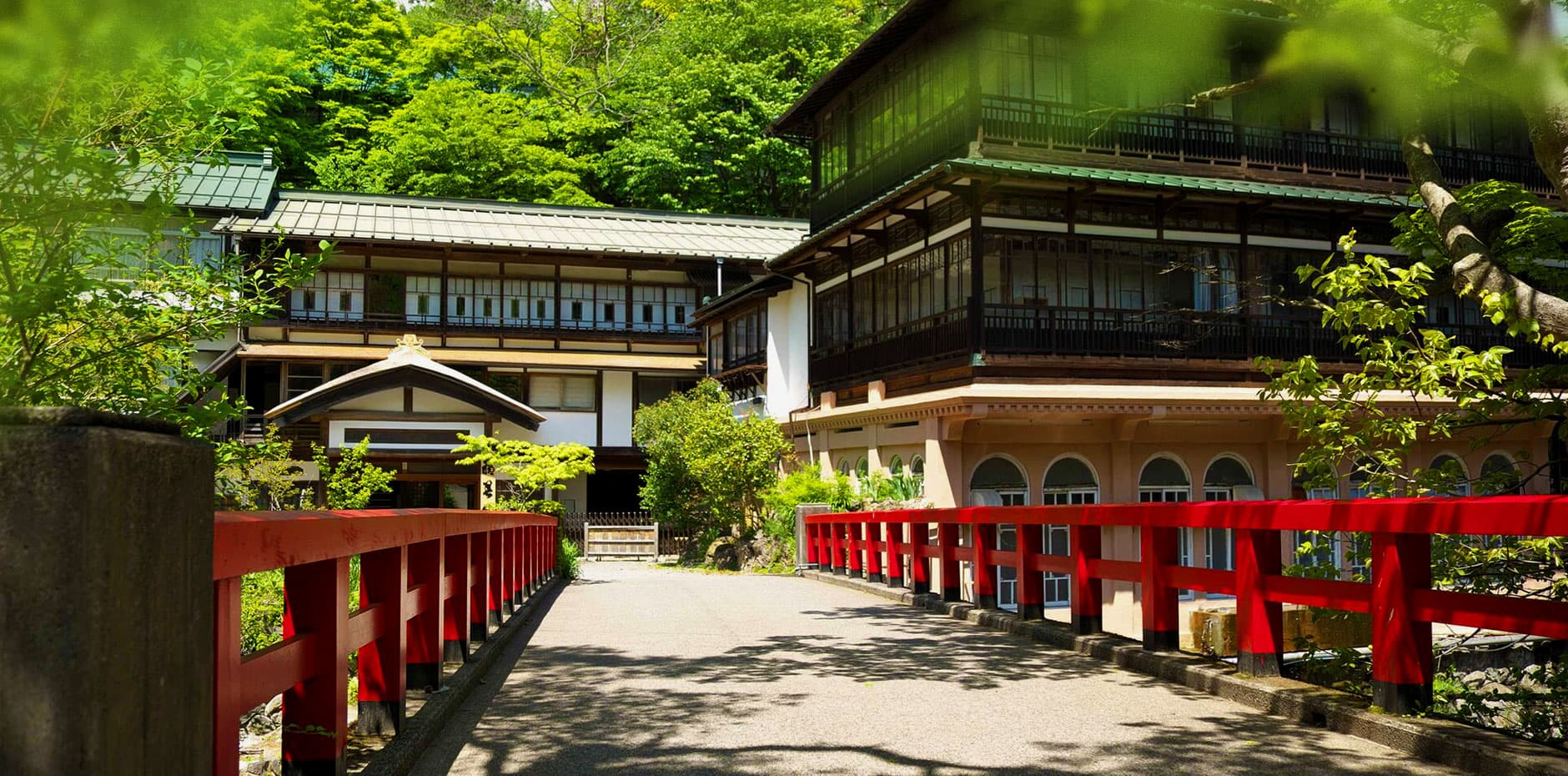
Nobody tells first-timers about the slippers. Or the particular silence of a tatami room at dusk. Or why a 14-course kaiseki sounds romantic until you're 90 minutes in and full. A first ryokan stay can rewire how you understand hospitality, rest, and the relationship between a building and the person sleeping inside it — and it is easy to make every rookie mistake in the book. This guide is what to read before you reach the genkan.
A ryokan (旅館) is a traditional Japanese inn. The word translates loosely as "travel inn," but that undersells it the way calling Carnegie Hall a concert venue undersells it. Ryokans combine tatami-floored rooms, communal or private hot-spring baths (onsen), a multi-course seasonal dinner called kaiseki, and a philosophy of hospitality — omotenashi — that prioritizes anticipating your needs before you voice them. They range from converted farmhouses charging ¥8,000 a night to 300-year imperial retreats where a room costs more than your flight. All of them operate on the same fundamental logic: slow down, take off your shoes, and let the building do the work.
This guide walks you through a typical ryokan stay in chronological order, from the 3pm check-in to the 10am checkout. We've included the sensory details most guides skip — what the bath smells like, what the tatami sounds like underfoot — because those details are the whole point. We've also flagged where first-timers consistently trip up, from Kyoto to Hakone and Kyushu. For a companion read on the mistakes side of things, see our first-time ryokan guide, or jump straight to what not to do at a ryokan if you only have time for one. For a side-by-side comparison with Western hotels, see ryokan vs. hotel.

The 3pm Arrival Ritual: Shoes Off, World Slows Down
Check-in at a ryokan is almost always between 3pm and 5pm, and dinner is typically at 6pm or 6:30pm. This is not arbitrary — it is choreographed. You arrive with time to settle in, bathe, change into your yukata (the cotton robe provided in your room), and reach a state the Japanese might call ochitsuku — settled, calm — before the first course arrives. Arriving at 5:45pm and wondering why there's no time to explore is one of the most common first-timer regrets.
The first threshold is the genkan (玄関): the raised entry step that formally separates the outside world from the inner space of the inn. You step up and remove your shoes here. This is not optional and not symbolic — it is the physical signal that you have crossed into a different mode of existing. Your shoes are often tucked away by a staff member while you're not looking, which is your first encounter with omotenashi. You will put on the slippers waiting for you at the top of the step.
From there, the greeting. At a property like Gora Kadan in Hakone's Gora district — built on the grounds of a former Imperial Family summer ryokan villa — the welcome involves a kimono-clad staff member kneeling to present your room key and escort you through the gardens. At a smaller, more accessible inn, the welcome might be the proprietor appearing from the kitchen in an apron. The register of the welcome scales with the property, but the intention is identical: you are a guest, not a customer, and your arrival matters.
The escort to your room — always in person, never just a card pointing you to an elevator — is called the nakai-san service. A nakai-san (仲居さん) is your dedicated room attendant: the person who serves your meals, prepares your futon, draws your bath at some properties, and generally orchestrates your stay from behind the scenes. At a standard mid-range inn, one nakai-san manages several rooms. At a place like Tawaraya in Kyoto — founded in 1709, operated by the same family for twelve generations — each couple has a dedicated nakai-san for the duration of their stay. The nakai-san will walk you through the room, explain every object, and leave you with a bow.
Tip
Slipper choreography: wear your room slippers everywhere in the corridors and common areas. Remove them before stepping onto tatami matting — even in hallways with tatami borders. Toilet slippers are separate and wait at the bathroom door. Wearing toilet slippers back into the hallway is the classic mistake. You will know you've done it when a staff member appears from nowhere to silently correct the situation.
Somewhere during the welcome, a cup of matcha (抹茶 — powdered green tea) will appear alongside a wagashi sweet. The wagashi changes monthly to reflect the season: sakura mochi in April, yokan jelly in summer, chestnut paste in autumn. Eat the sweet first, then drink the tea. Nobody will correct you if you do it backward, but you'll miss the design: the sweet coats your palate so the bitter tea blooms properly. This small sequence is kaiseki logic operating at the greeting stage.
Your Room: Tatami, the Tokonoma, and the Genuine Hush
A traditional ryokan room smells of straw. Not musty — more like a clean barn, vegetal and slightly sweet. That's the tatami (畳): woven rush grass (igusa) mats laid over a rice straw core , which give off a faint, dry fragrance that is most noticeable when you first enter a room that has been freshly aired. Tatami regulates humidity naturally, absorbs sound, and feels genuinely pleasant underfoot in socked feet. It has a slight give, like compressed grass.
The room itself is almost always sparer than you expect. A low wooden table (chabudai) sits at the center. Flat floor cushions (zabuton) are arranged around it. There may be a small tansu (chest of drawers) for your yukata, a wall-mounted scroll painting, and a ceramic vase with a single seasonal stem. What you notice is the absence: no television on the main wall, no minibar, no desk with a blinking router. The proportions of the room are governed by the tatami grid, which gives everything a quiet mathematical harmony.
In the alcove at one end of the room is the tokonoma (床の間): a recessed display space holding a hanging scroll (kakejiku) and a flower arrangement (ikebana). The tokonoma is the aesthetic heart of the room — the equivalent of a fireplace in a Western inn, the place your eye naturally goes. The scroll changes seasonally, and the ikebana is assembled fresh each day at serious properties. Do not place luggage in the tokonoma. It is art, not storage.
Some older ryokans — particularly mountain inns in regions like Gero or rural Nagano — have an irori (囲炉裏): a traditional hearth cut into the floor of a common room, where a fire burns and an iron kettle hangs overhead on an adjustable hook. If your inn has one, spend time there in the evening. The smell of wood smoke, the creak of the iron hook, the particular quality of firelight on cedar — these rooms hold something that is harder to find in modern properties.
The bathroom is almost always excellent and often spectacular. Even modest ryokans tend to have wooden soaking tubs (hinoki, or Japanese cypress), which fill the small room with a resinous cedar scent that deepens with steam. A note on sound: the room itself is quieter than any hotel room you've stayed in. Tatami absorbs footsteps. The shoji paper screens (traditional sliding doors made of translucent paper over a wooden lattice) diffuse rather than reflect noise. By 9pm, a quality ryokan corridor sounds like a library. One thing guidebook photos hide: at older and budget ryokans the toilet and shower may be down the corridor rather than in your room — see Do ryokans have private bathrooms? before you book.
Yukata: How to Wear It Without Embarrassment
Your room will contain a yukata (浴衣): a casual cotton robe that is your official uniform for the duration of the stay. You wear it to dinner. You wear it to the baths. At onsen towns like Kinosaki in Hyogo Prefecture or Gero in Gifu, you wear it strolling the streets between public bathhouses, with wooden sandals called geta (下駄) clacking on the stone paths. The sound of geta on nighttime stone is one of those details that lands differently in person — lighter and more percussive than you imagine.
The critical rule: always wrap the left panel over the right. The right-over-left wrapping is reserved for funeral rites and is considered deeply inauspicious . Staff will demonstrate if you ask, and a good nakai-san will notice if you've done it backward and gently offer to help — without making it a thing. The obi (sash) ties in a simple flat bow at the back for women, a loop at the front for men. The nakai-san will tie it for you on request at most properties.
Yukata patterns are seasonal and regional. Spring patterns tend toward cherry blossoms and flowing water. Summer yukata are often lightweight indigo cotton with geometric designs — originally intended to be cool, not decorative. The weight and quality of the cotton is itself an indicator of the property's tier. A high-end ryokan like Beniya Mukayu in Yamashiro Onsen, Kanazawa-area — a 16-room minimalist inn where every room has a private outdoor hot-spring bath — provides yukata of a noticeably different weight and hand feel from a mid-range property. You put it on and the difference registers immediately.
Tip
At onsen towns, yukata + geta in public is expected and charming. At city-center ryokans in places like central Kyoto, wearing yukata outside is less common — check with staff about local norms. Either way, wear it for dinner regardless.
The Bath: Onsen, Sento, Public, Private, and the Towel Rules
Two terms to know before you approach any water at a ryokan. An onsen (温泉) is a geothermally heated natural hot spring — water that has risen from volcanic rock and carries dissolved minerals specific to that location. A sento (銭湯) is a public bathhouse that uses regular heated water. The distinction matters enormously: the mineral content of onsen water gives it its specific therapeutic qualities (sulfur springs for skin, iron springs for circulation, sodium chloride springs for warming) and its particular color and smell. Kinosaki's springs have a faint iron tang; Beppu's sulfur springs smell sharply of eggs from 100 meters away; the milky white of Shirahone Onsen in Nagano comes from calcium carbonate precipitation . Walking into a genuine onsen for the first time, you smell the difference before you see the water.
Most ryokans have at least one communal bath — separate entrances for men and women (indicated by 男 for men, 女 for women, and often by blue and red curtains called noren). The better ryokans rotate which bath is men's and which is women's morning and evening, so all guests get both the indoor and outdoor experience. The rotenburo (露天風呂) — open-air outdoor bath — is the one most guests are thinking of: hot mineral water, cool night air, a view of mountains or river or cedar forest, and a silence so complete it feels pressurized.
The rules, plainly stated. Shower and scrub thoroughly at the shower stations before entering any shared bath — the bath is for soaking, never for washing. Keep your small towel (provided) out of the water; fold it on your head or the bath's edge. No swimwear, ever. Keep hair tied up and off the water surface. No photographs. No running. Enter slowly. These are not arbitrary customs — the water is communal, and the etiquette keeps it clean and the atmosphere peaceful. For a full deep-dive on onsen etiquette for first-timers, see our onsen etiquette guide for foreigners.

When to bathe: 4pm to 7pm is the magic window. The baths open around 3pm, the water has been freshened for the new guests, and the minerals are at their sharpest. After dinner (around 8:30pm), a second bath is common and worth it — the water settles and the common areas are quieter. Morning baths (6am to 9am) are excellent for the light, the cold air against your face, and the particular quality of silence in an outdoor bath before the world starts. Three sessions per day is not unusual for regulars.
A note on private baths. Many ryokans offer kashikiri-buro (貸切風呂) — private baths you reserve as a timeslot, usually 45 to 60 minutes, either at check-in or in advance. Some rooms — particularly at higher-end properties — include an in-room rotenburo on the private terrace. This is the arrangement at Hakone Kowakien Ten-yu, where every single room regardless of tier comes with a private open-air onsen on a terrace overlooking either the forest or the valley (from around $300/night ). If you have tattoos, communal baths at many ryokans still maintain a ban — private kashikiri baths typically do not apply the same restriction. Always confirm with the property directly.
Kaiseki Dinner: 8 to 14 Courses Across 90 Minutes, and the Pace Pitfalls
Dinner at a ryokan is the centerpiece of the stay. Kaiseki (懐石) is a multi-course seasonal dinner that evolved from the light meal served before tea ceremonies in feudal Japan. At a mid-range ryokan, you'll receive 8 to 10 courses; at a top-tier property, 12 to 14. The meal takes between 90 minutes and two hours and is designed to be unhurried. If you attempt to rush it, or arrive expecting to be done in 45 minutes, you will be uncomfortable in a way that isn't the ryokan's fault.
The courses arrive in a fixed sequence. It begins with a sakizuke — a single small bite that establishes the season's mood, often something cold and precise, like sesame tofu in dashi jelly or three slices of marinated duck on a ceramic leaf. Then a hassun platter representing both sea and mountain ingredients. Then a clear soup (suimono) in a lacquered lidded bowl — lift the lid slowly, the steam rising is intentional. Then seasonal sashimi. Then a simmered dish. Then a grilled course — this is usually the dramatic one, a whole charcoal-grilled sweetfish on a skewer in summer, or a wagyu preparation in winter. Then a rice, pickles, and miso trilogy that signals the home stretch. Dessert is always restrained: fruit, mochi, a small ice cream. For a full breakdown of every course with seasonal ingredient calendars, see our kaiseki guide.
What stands out: the ceramics. Each course arrives on a different vessel — bowls, plates, lacquerware, natural stone, bamboo — chosen to complement the colors and textures of the food. The aesthetic is total. By course six, you realize you've been looking at deliberate art for an hour. This is not incidental — kaiseki originated in the same cultural moment as the tea ceremony and carries the same philosophy: every object in your field of vision has been chosen.
The honest admission: a 14-course kaiseki sounds romantic until you're 90 minutes in and genuinely full, and someone arrives with the grilled course and then mentions that the rice is coming. Pacing is the skill. Take small bites. Put your chopsticks down between courses. Accept that you will finish some dishes partially — this is not rude. The nakai-san is not keeping score. What she is doing is watching the pace of the table and timing the next course accordingly, which is why eating slowly is not just comfortable, it's correct.
Dietary restrictions are the one non-negotiable. Kaiseki relies heavily on fish dashi stock as a base, and most dishes have some connection to seafood or meat. If you are vegetarian, vegan, halal, or have allergies, you must notify the ryokan at booking — not at dinner, and not at check-in. Most mid-to-high-end properties can accommodate vegetarian or halal kaiseki with one to two weeks' notice. For specific properties that specialize in dietary accommodation, see our guides on halal ryokans in Japan and vegetarian-friendly ryokans.

One structural thing to understand about ryokan pricing: the rate almost always includes both dinner and breakfast. When you see a room listed at ¥40,000 per person per night, you are paying for a room, an 8-to-10-course kaiseki dinner, and a full traditional Japanese breakfast. Comparing this to a bare-room hotel rate and concluding it's expensive requires you to subtract the cost of two restaurant meals, and suddenly the math looks different. Budget tier (¥8,000–¥15,000/person, shared onsen, simpler meal) through premium tier (¥40,000–¥80,000/person, private onsen, full kaiseki) through ultra-luxury (¥80,000+, Tawaraya and Gora Kadan territory) — each level is internally coherent.
Futons on Tatami: The Laying Ritual, the Morning Rinse, Why Not Western Beds
You will not sleep in a bed. Unless you book specifically a Western-style room or a hybrid property, you will sleep on a futon (布団) — a thick cotton-padded mattress laid directly on the tatami. This is not the thin yoga mat that the English word "futon" sometimes implies. A good ryokan futon is 10 to 15 centimeters thick, warm, and supportive in a way that is genuinely different from a hotel mattress rather than worse. Waking up on tatami with light coming through paper shoji screens is one of those experiences that improves the first morning and haunts subsequent mornings at home.
The futon is not in the room when you arrive. While you are at dinner, your nakai-san enters the room, removes the low table and cushions, and lays the futon. This is called shikifuton service. The futon appears like something conjured — gone when you return, without fanfare, without seeing it happen. The same thing happens in reverse each morning: while you're at breakfast, the futon is folded, stowed, and the room is returned to its sitting-room configuration. Both transformations feel quietly remarkable every time.
The tatami-level existence changes how you inhabit a space. Everything — sitting, dining, sleeping — happens close to the floor. There is a physical decompression in this. You stop holding your body upright in the way that furniture enforces. First-timers with knee or back concerns sometimes worry, but the floor-level posture distributes weight differently than it sounds, and the futon itself eliminates the usual concern about back support. The standard recommendation: if you have acute joint pain, book a room with a Western bed or a low platform bed. If you're simply nervous about novelty, try it.
There are no Western beds at Tawaraya, where Alfred Hitchcock, Steven Spielberg, and the Rockefellers all slept on tatami. There are none at the 540-year-old Asaba in Shuzenji, Izu, with its famous illuminated noh stage in the garden . The floor isn't a compromise — it is the architecture of the experience.
Morning Miso and Checkout: What the Breakfast Tells You
Ryokan breakfast arrives between 7:30am and 9am, depending on the property, and it is not a continental buffet. Traditional Japanese breakfast (朝食) is a meal of its own: a bowl of rice, a cup of miso soup made with the local water and seasonal ingredients, grilled fish, pickled vegetables (tsukemono), cold tofu, a soft-boiled or raw egg, nori, and usually something regional and specific — Kyoto's yudofu (hot tofu), Hakone's odawara kamaboko (fish cake), or the smoked bonito flakes from a coastal property. The whole arrangement lands on the table at once, in small dishes, and you assemble it in whatever order feels right.
The miso soup is the tell. A good ryokan's morning miso is nothing like restaurant miso — it's made with dashi specific to the region, sometimes kelp from Hokkaido, sometimes dried bonito from the local coast, sometimes both. The first sip of a really good morning miso soup is one of those moments where simplicity reveals itself as complexity. Conversely, a mediocre property's miso soup tastes like reconstituted powder, and you know immediately where you are in the pecking order. For everything that makes up a traditional Japanese breakfast and how to read what it signals about the property, see our guide to ryokan breakfast.
Checkout is typically at 10am, occasionally 11am. The goodbye at a good ryokan — called okaeri culture colloquially — involves the staff lining up at the entrance as you leave, bowing, and often staying until your car or taxi has left view. At Tawaraya, the family has done this for twelve generations. At a smaller countryside inn, it might just be the proprietor and her mother standing at the genkan, waving. The scale varies. The sincerity does not.
Tip
Do not tip. Tipping is not part of Japanese hospitality culture and can cause embarrassment. The service charge (typically 10–15%) is already included in your rate. If you wish to express exceptional gratitude, a simple "Arigatou gozaimashita" (ありがとうございました — thank you very much) at departure is entirely appropriate and genuinely received. Some guests leave a small note for the nakai-san; this is always welcomed.
Four Ryokans Worth Knowing: From Budget to Legacy
Naming specific properties is useful because "a Japanese ryokan" spans an enormous range. These four represent different entry points to the same experience:
Gora Kadan, Hakone — Built on the grounds of the Kan'in-no-miya Imperial Family summer villa, Gora Kadan is where the omotenashi is operating at something close to its theoretical maximum. The gardens are a century old. The kaiseki dinner runs to 12 courses. Select rooms have private open-air rotenburo on terraces; all guests access shared baths drawn from three on-site volcanic springs. Rates from around $660/couple/night . It is not cheap. What you are paying for is a level of attention that is genuinely different from any hotel experience — an attention that is also entirely unobtrusive.
Tawaraya, Kyoto — Founded 1709, 18 rooms, bookable only by email (info@tawaraya-kyoto.com). No online reservation system exists, and none will. The guest list across three centuries includes Alfred Hitchcock, Tom Hanks, Harrison Ford, and the Rockefellers. Rates are in the range of $1,000–$2,000+/couple/night and require confirmation by email . There is no onsen — Kyoto city center sits on no volcanic source — but the private hinoki cypress soaking baths and the gardens that make each room its own world are the correct comparison point. This is what the ryokan format at its most refined looks like. If you have the occasion and the budget, book six to twelve months ahead.
Beniya Mukayu, Yamashiro Onsen — A 16-room Relais & Châteaux member in the Kanazawa area that represents contemporary ryokan design at its most considered. The name means "richness in emptiness" — a Zen reference that is not pretentious, just accurate. Every room has a private outdoor hot-spring bath overlooking the garden. Founded 1928, family-operated, 16 rooms, and a Relais & Châteaux member . Rates from around $1,050/couple/night . If the maximalist grandeur of Gora Kadan isn't your register, Beniya Mukayu's quiet restraint almost certainly is.
Hinoharu Ryokan, Yufuin (Oita Prefecture) — Yufuin in northern Kyushu has some of the most accessible high-quality ryokan accommodation in Japan, and Hinoharu represents the honest mid-range tier: tatami rooms, shared onsen baths from the Yufuin thermal springs, and a kaiseki dinner that earns its keep without the four-figure price tag. For first-timers nervous about committing to a luxury tier, a night at a property like Hinoharu — where the fundamentals are executed well and the stakes of getting something wrong feel lower — is a perfectly reasonable way to calibrate your palate before returning for Tawaraya.
Where to Book: Your First Ryokan, Near Tokyo and Beyond
For most first-timers visiting Tokyo, the practical entry point is Hakone — about 80–90 minutes from Shinjuku by the Odakyu Romancecar express train , mountain-and-valley scenery, and a dense cluster of ryokans at every price tier. Nikko and Izu are alternatives with different landscape registers (shrine town and Pacific coastline, respectively). If you're based in Osaka or Kyoto, Kinosaki Onsen (2.5 hours north by limited express) offers the most atmospheric onsen-town experience in western Japan. For all of these options with specific property picks by tier, see our guide to the best ryokans near Tokyo.
If you have dietary requirements, the right approach is to start with properties confirmed for your needs rather than hoping a random ryokan will accommodate. Our halal ryokan guide and vegetarian-friendly ryokans guide narrow the field to properties with verified accommodation — not just vague promises. Both guides are updated for 2026.
For booking platforms: Trip.com covers most of the ryokans in our database and is the primary platform for the most complete inventory. Booking.com covers 206. For properties like Tawaraya that exist entirely outside OTA systems, direct email is the only route. Whatever platform you use, the single most important action after booking is to email the property directly to introduce yourself, confirm your dietary situation, and state any preferences or special occasions. Japanese hospitality operates best when it knows exactly who is arriving.
Tip
Book at least three to four months ahead for any popular property in any season. During cherry blossom season (late March to mid-April) and autumn foliage (October to November), the best rooms at top-tier properties can sell out six to twelve months in advance. The Hakone and Kyoto peaks are particularly unforgiving about late bookings.
Ready to book?
Book one of these top picks
Compare live availability and prices across booking sites.

from US$500 · per person · per nightfrom ≈ US$1,000 total for 2 guests




Hiiragiya Ryokan
柊家旅館
Kyoto·Luxury
from US$500 · per person · per nightfrom ≈ US$1,000 total for 2 guests

Asaba
あさば
Izu·Luxury
from US$600 · per person · per nightfrom ≈ US$1,200 total for 2 guests
Booking links may earn us a commission at no extra cost to you.
FAQ
Frequently asked questions
What exactly is a ryokan and how is it different from a hotel?+
A ryokan is a traditional Japanese inn with tatami mat rooms, communal or private hot-spring baths (onsen), a multi-course seasonal dinner (kaiseki), and a hospitality philosophy called omotenashi — anticipating guest needs before they're stated. Unlike a hotel, the rate almost always includes both dinner and breakfast, and the experience is designed around slowing down rather than efficiency. See our full ryokan vs. hotel comparison for a side-by-side breakdown.
What should I do when I arrive at a ryokan?+
Remove your shoes at the genkan (entry step) — this is non-negotiable. Wear the provided slippers in corridors and common areas, but remove them before stepping onto tatami. A staff member called a nakai-san will escort you to your room, walk you through it, and serve welcome matcha and a seasonal sweet. Dinner is typically at 6pm or 6:30pm, so aim to arrive by 5pm at the latest.
How do I wear the yukata correctly?+
Always wrap the left panel over the right. Right-over-left is reserved for funeral rites and considered deeply inauspicious. The obi (sash) ties at the back for women, the front for men. Your nakai-san will help if you ask. Wear your yukata to dinner, the baths, and — at onsen towns like Kinosaki or Gero — while strolling outside with the wooden geta sandals provided.
Do I need to shower before getting in the onsen?+
Yes — this is the most important rule. Rinse and wash thoroughly at the shower stations before entering any communal bath. The onsen is for soaking only, never for washing with soap. Keep your small towel out of the water, tie your hair up, and no swimwear. Communal baths are gender-separated; private kashikiri baths can be reserved by the hour at most properties.
What time should I bathe at a ryokan?+
The best window is 4pm to 7pm, when the baths have just been freshened and the mineral water is at its sharpest. A second bath after dinner (around 8:30pm) is pleasant and quieter. Morning baths from 6am to 9am offer beautiful light and cold air against your face in an outdoor rotenburo. Most regulars take two or three sessions per stay.
What is kaiseki and how many courses should I expect?+
Kaiseki is a multi-course seasonal dinner that evolved from feudal Japanese tea ceremony culture. Mid-range ryokans typically serve 8 to 10 courses; luxury properties offer 12 to 14. The meal takes 90 minutes to two hours and follows a fixed sequence from a single opening bite through clear soup, sashimi, a grilled course, and a restrained dessert. Pace yourself — it's easy to fill up before the grilled course arrives.
What happens to my room while I'm at dinner?+
Your nakai-san enters while you're dining and transforms the room: the low table and cushions are moved aside, and a thick futon is laid on the tatami. When you return from dinner, your sleeping space is ready. In the morning, the reverse happens during breakfast — the futon is stowed and the room becomes a sitting room again. Both transitions are invisible by design.
Can I request dietary accommodations at a ryokan?+
Yes, but you must do it at booking — not at check-in and not at dinner. Kaiseki relies heavily on fish-based dashi stock and seasonal seafood. Most mid-to-high-end ryokans can accommodate vegetarian, vegan, or halal kaiseki with one to two weeks' notice if informed in advance. Allergies should be stated clearly and confirmed by the property. See our halal ryokan guide and vegetarian-friendly ryokans guide for properties with verified accommodation.
Should I tip at a ryokan?+
No. Tipping is not part of Japanese hospitality culture and can cause embarrassment for the recipient. A service charge of 10 to 15% is already included in your room rate. The appropriate expression of gratitude is a sincere "Arigatou gozaimashita" (thank you very much) at departure. Some guests leave a handwritten note for the nakai-san, which is always appreciated.
How far in advance should I book a ryokan?+
Three to four months ahead for a standard season stay at most popular properties. During cherry blossom season (late March to mid-April) and autumn foliage (October to November), the best rooms at top-tier properties sell out six to twelve months in advance. Tawaraya in Kyoto, which takes email-only bookings, should be contacted six to twelve months ahead regardless of season.
Still deciding?
Browse ryokans across JapanBooking.com