Tap through the Yaesu South gate at Tokyo Station, walk to the Tokaido Shinkansen platforms, pick up an ekiben from the kiosk most travelers walk past, and a Kodama to Atami takes you from Tokyo concrete to ocean-view tatami in about 77 minutes door-to-door, including the bento. Last verified: May 7, 2026.
Most "ryokan from Tokyo" guides solve the wrong problem: they list ryokans inside the 23 wards as if access were trivial, or describe a Hakone day trip as if the Tozan switchback didn't exist. The honest question is logistical. I have N nights and a flight to catch — which ryokan can I actually reach from Tokyo Station, and what does it cost me in time and yen?
Schedules, fares, and platforms below are checked against JR East, Tobu, Odakyu, the JNTO train guide, Hakone Navi, and Jorudan as of 2026-05-07.
The spine of this guide is time and money, not property. The five destinations are ranked by minutes from Tokyo Station and JR Pass eligibility. The 9 in-Tokyo ryokans show up where they earn their keep: as the legitimate answer for one-night and pre-flight travelers. New to ryokan culture entirely? What to expect on your first ryokan night covers the basics so this can focus on access logistics.
Tip
TL;DR — Five ryokan destinations from Tokyo Station, fastest to slowest:
- Atami (40 min): Tokaido Shinkansen Kodama, direct, JR Pass eligible. ¥3,740 one-way. Fastest real onsen ryokan from Tokyo Station.
- Hakone (70 min): Shinkansen to Odawara + Hakone Tozan, or Romancecar direct from Shinjuku (85 min). JR Pass covers Odawara leg only — buy the Hakone Free Pass (¥6,100) instead.
- Karuizawa (70 min): Hokuriku Shinkansen direct, JR Pass eligible. ¥5,490 one-way. Summer heat-escape; resort hotels more than classic ryokan.
- Nikko (110 min): Tobu Spacia X from Asakusa (one Metro transfer). JR Pass NOT valid — buy Tobu Nikko Pass (¥4,780).
- Tokyo in-city (0–30 min): Walk or one Metro hop. Best for one-night or pre-flight stays — zero transit time lost.
JR Pass math: it only wins for week-long Kansai loops (Tokyo → Kyoto → Hiroshima), not for any single-destination ryokan trip.
Skip to the route table if you have a flight in 24 hours.
The closest real onsen ryokan to Tokyo Station is in Atami — 40 minutes by Tokaido Shinkansen, no transfer. Hakone takes 36 minutes to Odawara plus a 15-minute Hakone Tozan switchback to your ryokan town. Nikko takes 110 minutes on the Tobu Spacia X from Asakusa (a 20-minute Metro hop from Tokyo Station). For zero-transit options, nine onsen ryokans operate inside Tokyo's 23 wards, including HOSHINOYA Tokyo in Otemachi — eight minutes on foot from the Marunouchi gate.
Tip
Note: Where a tourism site or Google Maps walking time understates a route, we say so and explain why. Affiliate disclosure: this article links to Klook for two pass products (JR Pass and Hakone Free Pass) where Klook is the conversion-friendly English option. We do not accept payment for ryokan inclusion.
Quick-Compare: 5 ryokan destinations from Tokyo Station
| # | Destination | Time from Tokyo Station | Train | Cost without JR Pass | Best ryokan there | Pass break-even? |
|---|---|---|---|---|---|---|
| 1 | Atami | 40 min | Tokaido Shinkansen Kodama (direct) | ¥3,740 one-way (~$24) | Atami onsen ryokans | NO — pass loses by ¥42,000+ |
| 2 | Hakone | 70 min door-to-Yumoto | Shinkansen to Odawara + Hakone Tozan, OR Romancecar from Shinjuku | ¥3,410 to Odawara (~$22) / ¥2,330 Romancecar | See the full Hakone ryokan ranking | NO — buy Hakone Free Pass |
| 3 | Nikko | 110 min | Tobu Spacia X from Asakusa (1 Metro transfer from Tokyo) | ¥3,180 reserved seat (~$21) | Nikko ryokans we recommend | NO — JR Pass does not cover Tobu |
| 4 | Tokyo (in-city) | 0–30 min | Walk / Yamanote / Metro | ¥0–¥320 | HOSHINOYA Tokyo in Otemachi | N/A — no Shinkansen needed |
| 5 | Karuizawa | 70 min | Hokuriku Shinkansen (direct) | ¥5,490 one-way (~$36) | Hoshino Resorts area | Marginal — only with multi-leg trip |
For the wider onsen-town shortlist beyond Hakone, our best onsen towns ranked covers Kusatsu, Beppu, Kinosaki and others that fall outside this guide's 110-minute radius.
The 4 ways out of Tokyo Station to a ryokan
Tokyo Station is enormous — 28 platforms across two exit groups. From the JR ticket gates inside the station, you need a real 9–12 minutes to walk to the Tokaido Shinkansen platforms (tracks 14–19) with a suitcase. Google Maps says 4. Google Maps is wrong if you are coming off the Marunouchi side.
1. Tokaido Shinkansen (south, tracks 14–19) — your main option. Direct to Atami in 40 min; Odawara in 36 min for the Hakone transfer; Kyoto/Hiroshima/Hakata for the Kansai loop. Three classes — Nozomi (skips Atami and Odawara, JR Pass NOT valid), Hikari (skips most Atami stops), Kodama (the local — your train for a ryokan trip). Buy at the JR Ticket Office or green machines.
2. Tohoku/Hokuriku Shinkansen (north, tracks 20–23) — for Karuizawa (70 min) and onward to Nagano/Sendai/Aomori. Karuizawa is the relevant ryokan destination; everything beyond is a multi-night plan.
3. JR Yamanote / Marunouchi Metro — your in-Tokyo legs. Yamanote one stop to Kanda for Ryumeikan Honten; Marunouchi Line to Otemachi for HOSHINOYA Tokyo; Marunouchi + Hanzomon to Asakusa (~20 min) for Ryokan Asakusa Shigetsu and the Tobu departure point.
4. The Tokyo Station fallacy. For Hakone the optimal route does NOT depart from Tokyo Station — it leaves Shinjuku via the Odakyu Romancecar (85 min direct to Hakone-Yumoto, no transfer). For Nikko, Asakusa via Tobu Spacia X. The best ryokan trips from Tokyo Station sometimes start with a 15-minute Yamanote ride to a different terminal.
Tip
Last-train warning. The last Tokaido Shinkansen Kodama from Tokyo Station that stops at Atami departs at 22:54. Miss it and you sleep at Shinagawa or pay a taxi. The last Romancecar to Hakone-Yumoto leaves Shinjuku around 22:30, and the last Hakone Tozan train from Yumoto runs until ~22:00 — meaning the practical "latest you can arrive at a Hakone ryokan" is closer to 20:30. Most ryokans lock kaiseki dinner at 18:00 or 18:30 anyway, so the soft cut-off is dinner, not the train.
Time-budget scenarios: 1 night, 2 nights, a week
Pick your scenario before your ryokan. The destination follows from how many nights you have, not the other way.
One night before flying out. Stay in Tokyo or go to Atami. Both let you check in by 15:00, eat kaiseki, bathe, sleep, and reach Narita by 11:00 without panic. HOSHINOYA Tokyo is 8 minutes on foot from Tokyo Station with direct Narita Express access; Atami gives you Haneda return in ~90 minutes via Shinkansen + Keikyu. Avoid Hakone for one night — the Tozan transfer eats 90 minutes round-trip. Why a ryokan beats a Tokyo hotel for one night covers the experience case.
Two nights, no JR Pass (the sweet spot). Hakone night 1 → Atami night 2 → Tokyo. Total transit ~¥9,800 (~$65), trip cost $400–$800 depending on tier. Two contrasting onsen towns — volcanic mountain Hakone, Pacific coastal Atami — connected by a 60-minute Izuhakone Bus along the Sagami coast. Pack light: what to pack for a one-night Hakone trip doubles for two nights of yukata-and-bath rotation.
Two nights with a Mt. Fuji view ryokan. Hakone night 1 + a second night in Sengokuhara or Lake Ashi. Or — contrarian — Nikko 2 nights via Tobu Spacia X for autumn foliage. Nikko swaps volcanic onsen for cedar-and-temple territory.
A week (JR Pass territory). Tokyo → Hakone (1 night) → Kyoto (2 nights with day-trip Arima) → the Kinosaki crab-and-yukata loop (2 nights) → Tokyo. A 7-day JR Pass at ¥50,000 saves roughly ¥18,000 against individual tickets and is the one scenario in this guide where the pass mathematically wins.
Tip
Luggage logistics. The Yamato Transport (takkyubin) counter inside Tokyo Station, and the desk at every Tokyo hotel front, will forward your big suitcase to your ryokan or your next hotel for ¥2,000–¥2,500 per bag, next-day delivery . This single fact rewrites the trip. The Hakone Tozan switchback with a daypack is a different journey from the same route hauling a 25 kg suitcase up platform-3 stairs at Hakone-Yumoto. Drop the big bag at the Tokyo Station counter on outbound morning, ride the Shinkansen light, pick it up the next afternoon at your ryokan.
Top 5 ryokan destinations from Tokyo Station
Each destination below uses the same 7-line access template — time, train, departure platform, cost without JR Pass, JR Pass coverage, best ryokan there, and the trip pattern it suits. Then a paragraph of practical notes for the parts that timetables do not show.
Where a destination has a dedicated best-ryokans roundup, we link to it. Where the area page is the better landing, we link to that. The 9 in-Tokyo ryokans get their own destination block at the end.
Tip
Booking.com walking-time correction. Booking.com's "5 min walk from station" claims for Hakone properties are calculated against Hakone-Yumoto Station. Most ryokans are 10–25 minutes further by Tozan + bus or shuttle. Add 30 minutes to whatever the listing says. The cleanest workaround is the ryokan shuttle pickup — most Hakone ryokans send a van to Yumoto if you message arrival time at booking.
1. Atami — 40 min Shinkansen, no transfer (the closest real onsen)
Time from Tokyo Station 40 min platform-to-platform, ~50 min door-to-station. Train type Tokaido Shinkansen Kodama (local) — the only direct option; Hikari skips most Atami stops, Nozomi skips entirely. ~2–3 services/hour. Departure platform Tokyo Station, tracks 14–19. Cost without JR Pass ¥3,740 one-way reserved (~$24). Round-trip ¥7,480. JR Pass covers? Yes — Kodama and Hikari are fully covered. Nozomi requires a supplement. Best ryokan there Atami onsen ryokans on our area page — the area landing has the full filter set. Mid-range coastal-view properties run $150–$350 per night. Best for One-night pre-flight stay; weekend escape under $500 total.
Atami is the underrated time-saver of this whole question. Hakone gets the press; Atami solves the actual problem for one-night travelers. You can leave Tokyo Station at 11:26 a.m. and be in your yukata by 1 p.m. The trade-off is the walk. Atami's tourism site lists some ryokan as a "5-minute walk from Atami Station." That is 5 minutes downhill. The walk back up the slope to the station after checkout, with luggage, takes longer. Take the 200-yen Yu-Yu bus from the station's east exit, or pre-book the ryokan shuttle. The Haneda Airport return — Atami → Shinagawa Shinkansen + Keikyu Line — runs about 90 minutes end-to-end; this is the under-discussed reason Atami is the smartest pre-flight ryokan in the country.
Hakone vs Atami time comparison from Tokyo Station: Atami is 40 minutes by Tokaido Shinkansen with no transfer. Hakone takes ~70 minutes door-to-Yumoto including the 15-minute Tozan transfer, or 85 minutes direct from Shinjuku on the Romancecar. For travelers under 36 hours, Atami beats Hakone — 30 minutes saved each leg, no Tozan switchback, easier Haneda return.
2. Hakone — 70 min via Odawara, OR 85 min via Romancecar from Shinjuku
Time from Tokyo Station 70 minutes door-to-Yumoto via Shinkansen + Tozan, OR ~95 min via Yamanote-to-Shinjuku (15 min) + Romancecar (85 min, no transfer). Train type Tokaido Shinkansen Kodama/Hikari to Odawara (36 min) + Hakone Tozan to Hakone-Yumoto (15 min). The Shinjuku Romancecar is the experiential pick — fully reserved, panoramic glass, no transfer. Departure platform Tokyo Station tracks 14–19 for the Shinkansen route. For the Romancecar, transfer to Shinjuku via JR Yamanote Line (15 min, ¥210) and board on Odakyu platform 2 or 3. Cost without JR Pass Shinkansen route: ¥3,410 to Odawara + ¥460 Tozan = ~¥3,870 one-way. Romancecar route: ¥2,330 from Shinjuku. JR Pass covers? Partial. JR Pass covers the Shinkansen leg to Odawara only. The Hakone Tozan, Odakyu Romancecar, ropeway, cable car and pirate ship are all private operators and NOT covered. Best ryokan there The full Hakone ryokan ranking covers 20 properties from Yumoto to Lake Ashi. Mid-range $200–$450; luxury $500–$1,500. Best for Two-night first-timer trip; classic onsen-town atmosphere with Mt. Fuji view; the Hakone area landing is the bullseye.
The transfer at Hakone-Yumoto is where first-timers stumble. When the Romancecar arrives, almost everyone walks left to exit. Don't. Walk right, up the stairs, to platform 3 for the Tozan switchback to Gora. Transfer window is tight (6–8 min); luggage lockers fill by 10 a.m. on weekends. The Tozan train switchbacks four times up the mountain — the driver and conductor swap ends at each reversal. As of May 2026 the switchback is fully operational; the Owakudani ropeway runs subject to volcanic-gas levels — check Hakone Navi the day before.
Tattoo and tattoo-cover rules are more accommodating in Hakone than most onsen towns — about a third of our recommended ryokans operate kashikiri (private-bath) bookings that sidestep the question.
Tip
Hakone Free Pass math. The Odakyu Hakone Free Pass 2-day from Shinjuku is ¥6,100; from Odawara it is ¥4,600. It covers the Tozan train, cable car, ropeway, lake boat, and most local buses. If you are doing the loop (Tozan + cable car + ropeway + pirate ship + back), it pays off. If you are going straight to your ryokan and back with no loop, the pass costs more than two one-way Romancecar tickets. Run your own routing on Jorudan before you buy. If you do go for it, get the Hakone Free Pass from Tokyo covers the same product on Klook in English.
3. Nikko — 110 min Tobu Spacia X (the 2023 train that changed the math)
Time from Tokyo Station 110–130 min door-to-Tobu-Nikko (20 min Metro to Asakusa + 1h45 Spacia X). The Spacia X cuts ~25 min off the older Spacia. Train type Tobu Spacia X — modernized in July 2023, six-car luxury limited express. Seat classes range from Standard Seat (¥3,180 reserved) to Cockpit Lounge at the front of car 1 (¥3,940). Departure platform Asakusa Station, Tobu side, platforms 4–5. Reach Asakusa from Tokyo Station via the Marunouchi Line (Tokyo → Otemachi, 1 min) + Hanzomon or Ginza Line to Asakusa (~18 min). Cost without JR Pass ¥3,180 reserved seat one-way (~$21). Round-trip ¥6,360. JR Pass covers? No. The Tobu Spacia X is a private operator. JR Pass is irrelevant for this route. Buy a Tobu Nikko Pass (¥4,780) instead if you want bus + temple-area coverage included. Best ryokan there Shrine-town ryokans near Tobu Nikko Station covers nine properties across Kinugawa, Chūzenji and Yumoto. Most pair Spacia X with Kinugawa ryokans (one stop further on Tobu Kinugawa). Best for Cultural-and-onsen 2-night trip; autumn foliage second week of November; visitors who want UNESCO temples plus mountain onsen.
Korean travelers know this route better than most English guides — the ICN→NRT short-haul plus Spacia X has been a viral Naver-blog itinerary since the 2023 launch. The Cockpit Lounge at the front of car 1 is the Instagram seat, but it sells out two weeks ahead and bakes in summer. The quieter, equally scenic pick is a right-side window in car 6 (Standard Seat), facing Mt. Nantai as the train climbs past Shimo-Imaichi. Browse Nikko area landing for the wider context.
Sleep up high for onsen — the contrarian Nikko rule. Yumoto sits 1,478 m inside Nikko National Park with sulfur water; Kinugawa is the easier transfer, Yumoto is the better onsen.
Tip
Tobu Spacia X booking tip. The Cockpit Lounge sells out 2–4 weeks ahead in October and November (autumn foliage is the peak). Book on the Tobu Railway English site directly — the JR Pass does not cover this train, and Klook resells the standard reserved seat at the same price. If you cannot get the Cockpit Lounge, the right-side window in car 6 has the climbing-mountain view nobody talks about.
4. Stay-in-Tokyo ryokans — 0 to 30 min (no train at all)
Time from Tokyo Station 0–30 min — walk, taxi, or one Metro hop. Train type Mostly none. HOSHINOYA Tokyo is an 8-min walk; Ryumeikan Honten is 3 min. Yuen Shinjuku is 25 min by Yamanote; Asakusa Shigetsu is 20 min via Marunouchi + Ginza. Cost without JR Pass ¥0–¥320 in transit. JR Pass covers? N/A — local rides are IC card or cash; the JR Pass is overkill for in-city movement. Best ryokan there HOSHINOYA Tokyo for ultra-luxury (~$600–$1,500), the Michelin-listed Ryumeikan Honten for heritage mid-range ($130–$300), Ryokan Asakusa Shigetsu for hinoki-bath authenticity ($85–$250), Sawanoya in Yanaka for budget under $110. Best for Pre-flight overnight; first-time visitors with packed Tokyo itineraries; travelers who refuse to lose half a day to transit.
The "is a Tokyo ryokan a real ryokan?" question is a translation artifact. The Japan Ryokan & Hotel Association registers urban properties, and several on this list — HOSHINOYA Tokyo in Otemachi (shoes-off at street level), Ryumeikan Honten (Michelin-listed, est. 1899), Ryokan Asakusa Shigetsu (hinoki bath with Skytree view), Yuen Shinjuku (rooftop onsen), Sawanoya (Yanaka, family-run since 1949) — all qualify. At HOSHINOYA Tokyo, shoes come off right at street level, at the genkan. Shoes go into a tatami-floored shoebox; the rest of the building is barefoot.
For budget travelers, Andon Ryokan in Minowa and Katsutaro Ryokan in Yanaka run $40–$120. They use heated tap, not mineral water — but futon-on-tatami in a family-run wooden building five minutes from a Yamanote stop is the budget version of the same experience. The full Tokyo ryokan list covers all nine.
Tip
In-Tokyo onsen reality. Of the 9 "Tokyo ryokans" in our database, only three serve real onsen-licensed mineral water: HOSHINOYA Tokyo (deep-well sourced), Onsen Ryokan Yuen Shinjuku (rooftop open-air bath, hauled-in source water), and Yuen Bettei Daita in Setagaya. The other six use heated tap or city bathwater — still legitimate ryokan experiences (futon, tatami, kaiseki, omotenashi), but not technically onsen. If "onsen" is non-negotiable, those three are the picks.
5. Karuizawa — 70 min Hokuriku Shinkansen (cool-summer alternative)
Time from Tokyo Station 70 min direct, no transfer. Train type Hokuriku Shinkansen Asama or Hakutaka. Departure platform Tokyo Station tracks 20–23 (north Shinkansen complex). Different gate from the Tokaido — note this on your ticket. Cost without JR Pass ¥5,490 one-way reserved (~$36). Round-trip ¥10,980. JR Pass covers? Yes — the Hokuriku Shinkansen is fully covered. Best ryokan there Mostly resort hotels rather than traditional ryokan — Hoshino Resorts' Hoshinoya Karuizawa and Hotel Bleston Court are the headline names. Not in our 9-ryokan Tokyo DB. Best for July–August heat escape (Karuizawa runs 5–8°C cooler than Tokyo); cyclists; foreign residents priced out of Hakone weekends.
Karuizawa is the contrarian summer answer. When Tokyo hits 35°C and 80% humidity, Karuizawa runs low-20s with larch shade. The trade-off is property type — Karuizawa skews design-resort hotel rather than kaiseki ryokan. If you want the full tatami-and-yukata format, prioritize Atami or Hakone. If you want hot-spring bathing in a cool-summer setting and a resort-hotel format works, Karuizawa is the only 70-minute Shinkansen answer.
Premise correction: where you actually depart from
Three of the five destinations above involve a step that surprises first-time travelers, so it is worth making explicit.
For Hakone, depart from SHINJUKU, not Tokyo Station. The Odakyu Romancecar runs Shinjuku → Hakone-Yumoto in 85 min with no transfer, panoramic front car, ¥2,330 — cheaper than the Shinkansen + Tozan combination and less stressful with luggage. The Yamanote from Tokyo Station to Shinjuku is 15 min (¥210). Total time matches the Shinkansen route within 10 minutes; total cost beats it by ¥1,500.
For Nikko, depart from ASAKUSA. The Tobu Spacia X is a private train; it does not exist on the JR network. From Tokyo Station, ride the Marunouchi Line one stop to Otemachi, then Hanzomon or Ginza Line to Asakusa (~18 min total), and board Spacia X at Asakusa platform 4 or 5. The JR Pass is useless here. Buy the Tobu Nikko Pass (¥4,780) for bus + temple coverage instead.
For Atami and Karuizawa, Tokyo Station IS the right answer. Tokaido Shinkansen for Atami, Hokuriku Shinkansen for Karuizawa, both direct. These are the two destinations where the search query and the optimal route line up cleanly.
Internalize this before you book passes you do not need.
JR Pass calculator: when it's worth it from Tokyo Station
Is the JR Pass worth it for a ryokan trip from Tokyo Station? Only for week-long itineraries that reach Kansai (Kyoto, Hiroshima, Kinosaki). For a single Hakone or Atami trip, the pass loses by ¥40,000+ — single tickets or the Hakone Free Pass are dramatically cheaper. The pass is useless for Nikko via Tobu Spacia X (private train).
The math, with the post-October-2023 price hike (¥50,000 for the 7-day Ordinary):
| Trip Pattern | Round-trip ¥ | 7-day JR Pass ¥50,000? | Verdict |
|---|---|---|---|
| Tokyo ↔ Atami only (1 night) | ¥7,480 | LOSE by ¥42,520 | Skip pass — buy single tickets |
| Tokyo ↔ Hakone (Odawara) only | ¥6,820 | LOSE by ¥43,180 | Buy Hakone Free Pass (¥6,100) instead |
| Tokyo ↔ Nikko via Tobu Spacia X | ¥6,360 | LOSE — JR Pass doesn't cover Tobu | Buy Tobu Nikko Pass (¥4,780) |
| Tokyo → Hakone → Atami → Tokyo (2 nt) | ¥9,800 | LOSE by ¥40,200 | Skip pass |
| Tokyo ↔ Kinosaki (round trip) | ¥29,640 | LOSE by ¥20,360 | Skip pass; consider Kansai-Wide Pass |
| Tokyo → Kyoto → Kinosaki → Tokyo (5 nt) | ¥41,200 | LOSE by ¥8,800 | Marginal — only worth it for flexibility |
| Tokyo → Kyoto → Hiroshima → Kinosaki → Tokyo (7 nt) | ¥68,400 | WIN by ¥18,400 | Buy 7-day JR Pass |
The rule that survives this table: the 7-day JR Pass only beats individual tickets when your trip from Tokyo Station includes both Kansai (Kyoto/Hiroshima) AND a return ryokan stop in either direction. Anything shorter and the pass is ¥30,000–¥45,000 of insurance against tickets you would not have bought. If you do qualify, you can book the 7-day JR Pass on Klook. For broader pricing context, how much one ryokan night actually costs breaks down kaiseki-and-onsen rates so you can size the rest of the budget.
Tip
JR Pass card-tap. If you bought the IC-style JR Pass (post-2023), tap it at the automated gate like a Suica. If you have the old-style paper voucher, you must use the manned gate at the far left of every JR ticket gate row — the green-uniformed staff stamps it. Stand in the wrong lane and the gate will buzz at you.
Tobu Spacia X, Romancecar, Shinkansen: which train for which trip
Three premium trains, three different ryokan destinations, easy to confuse.
Tokaido Shinkansen Kodama / Hikari — JR network, JR Pass valid. Goes to Atami (40 min) and Odawara (36 min, Hakone access). Three classes per train. Run by JR East / JR Central. Reserve seats at the JR Ticket Office or via the JR East Train Reservation app.
Odakyu Romancecar — private network, JR Pass NOT valid. Shinjuku to Hakone-Yumoto, 85 minutes direct, no transfer. The fare is ¥2,330 reserved. The front-car panoramic seats are the sought-after pick — book on the Odakyu official site two weeks ahead for weekend dates.
Tobu Spacia X — private network, JR Pass NOT valid. Asakusa to Tobu-Nikko, 1h45 direct. Six seat classes ranging from Standard Seat (¥3,180) to Cockpit Lounge (¥3,940) and Compartments (¥4,510 for groups of 4–6). Launched July 2023 — the X is the modernization tag separating it from the older Spacia.
The rule of thumb that prevents the most common mistake: JR Pass = JR trains only. Romancecar and Spacia X are owned by private railway companies and operate on entirely separate track networks. If your route is Hakone or Nikko, the pass is irrelevant for those legs, and your money is better spent on a Hakone Free Pass or a Tobu Nikko Pass that covers what you actually need.
9 in-Tokyo ryokans worth knowing about
These are the nine ryokans in our database operating inside Tokyo's 23 wards, listed by walking time from Tokyo Station, then by tier.
Walking distance from Tokyo Station (under 10 min):
- Ryumeikan Honten — 3-min walk, Yaesu side. Michelin-listed, established 1899, 9 rooms, $130–$300. The closest legitimate ryokan to Tokyo Station.
- HOSHINOYA Tokyo — 8-minute walk to Otemachi. Ultra-luxury 17-floor tower, 84 rooms, $600–$1,500. Open-air rooftop onsen with deep-well source water.
- Hotel 1899 Tokyo — 8-minute walk to Shimbashi. Tea-culture themed boutique by the Ryumeikan group, 63 rooms, $100–$250. Ryokan-adjacent rather than full ryokan.
One transfer (15–30 min):
- Onsen Ryokan Yuen Shinjuku — Yamanote 25 min. Modern onsen ryokan with rooftop open-air bath, 193 rooms, $120–$300.
- ONSEN RYOKAN YUEN Bettei Daita — Odakyu 25 min. Luxury small-scale, 35 rooms, $200–$600. Real onsen water in Setagaya.
- Ryokan Asakusa Shigetsu — Marunouchi + Ginza, 20 min. Steps from Senso-ji with hinoki baths overlooking Tokyo Skytree, 20 rooms, $85–$250.
- Sawanoya Ryokan — Yamanote to Nippori, 20 min. Family-run since 1949 in Yanaka, 12 rooms, $50–$110. The legendary budget pick.
- Andon Ryokan — Hibiya Line to Minowa, 25 min. Design-forward minimalist, 20 rooms, $40–$120.
- Katsutaro Ryokan — Chiyoda Line to Sendagi, 30 min. Small family-run in Yanaka, 7 rooms, $45–$120.
The pre-flight argument for staying in Tokyo over going to Hakone is that you do not lose two hours of your last day to a return transfer. Ryumeikan Honten checks both boxes — you sleep ryokan-style three minutes from where the Narita Express boards the next morning.
5 steps to plan a ryokan trip from Tokyo Station
The five-step plan that converts a search query into a booking.
Step 1 — Decide your trip length. 1 night = Tokyo or Atami (40 min). 2 nights = Hakone + Atami loop (no JR Pass). 1 week = Kansai loop (Kyoto + Kinosaki) where the JR Pass mathematically wins.
Step 2 — Pick your departure platform. Tokaido Shinkansen tracks 14–19 (south) for Atami, Odawara/Hakone, Kansai loop. Hokuriku Shinkansen tracks 20–23 (north) for Karuizawa. For Hakone via Romancecar, Yamanote to Shinjuku (15 min). For Nikko, Marunouchi + Ginza Line to Asakusa (20 min).
Step 3 — Decide on the JR Pass. Worth it for the Kansai-loop week. Not worth it for any single-destination ryokan trip from Tokyo. Buy the Hakone Free Pass for Hakone or the Tobu Nikko Pass for Nikko instead. Run your specific route through Jorudan before paying.
Step 4 — Book the ryokan and reserve seats. Reserve Shinkansen and Spacia X seats one month ahead during sakura (late March–early April) and koyo (mid-November). Most ryokans honor 15:00 check-in; arrange takkyubin from the Tokyo Station Yamato counter if riding the Tozan or transferring through Asakusa with a big bag. How to book a ryokan from abroad covers the booking-platform side.
Step 5 — Plan the last-mile transfer. Hakone: Odawara → Hakone-Yumoto (Tozan) → ryokan shuttle or local bus. Nikko: Tobu-Nikko Station → ryokan shuttle (Kinugawa is 10 min further). Atami: Yu-Yu bus or shuttle, not the uphill walk. In-Tokyo ryokans: walk or one Metro hop. Confirm shuttle pickup 48 hours before arrival.
Booking.com vs reality: walking-time and last-train traps
Three discrepancies between listings and on-the-ground reality, in the order they cost travelers time.
Walking time at Tokyo Station. Booking.com listings near Tokyo Station typically claim "5 minutes" to the property. With a suitcase, coming off the wrong gate (Marunouchi vs Yaesu — 600 m apart through the underground concourse), it is closer to 12 minutes. Add a buffer or take a taxi for the final leg.
Hakone walking-time fiction. Booking.com's "5 min from station" for Hakone properties is calculated against Hakone-Yumoto, but most ryokans are 10–25 minutes further by Tozan + bus. Add 30 minutes to whatever the listing claims. The cleanest workaround is the ryokan shuttle pickup — most Hakone ryokans send a van to Yumoto if you message arrival time at booking.
Last-train cutoffs. The last Kodama stopping at Atami leaves Tokyo Station at 22:54. The last Romancecar from Shinjuku to Hakone-Yumoto is around 22:30, and the last Tozan from Yumoto runs until ~22:00 — practical "latest arrival at a Hakone ryokan" is 20:30. Kaiseki dinner usually locks at 18:00–18:30 anyway, so the soft cut-off is dinner, not the train. A 14:00 Narita arrival gives you a 4-hour window to a Hakone ryokan with no slack.
Tip
Ekiben on platform 14, not at the famous shop. Skip the concourse-level Ekibenya Matsuri inside Tokyo Station — it is the famous one, but the line can be long at lunch. Platform 14–15 has a smaller ekiben kiosk stocking the same Hokkaido ikura-don and Yonezawa gyu-meshi at the same price, with no line. Eat the bento on the train; ekiben culture is the only acceptable place in Japan to eat a hot meal at a fold-down seat-back tray.
Tokyo Station ryokan-access FAQ
How long does it take to get from Tokyo Station to a ryokan? Atami: 40 min door-to-station. Hakone: ~70 min including the Tozan transfer. Tokyo-area: 0–30 min by Yamanote or Metro. Nikko: 110 min via Tobu Spacia X (one Asakusa transfer). Karuizawa: 70 min by Hokuriku Shinkansen.
Can I use the JR Pass to get to Hakone? Partially. JR Pass covers the Shinkansen leg to Odawara (36 min). It does NOT cover the Hakone Tozan, Odakyu Romancecar, cable car, ropeway, or pirate ship. The Hakone Free Pass (¥6,100 from Shinjuku, ¥4,600 from Odawara) is the relevant product for a Hakone ryokan trip.
What is the closest real onsen ryokan to Tokyo Station? Atami at 40 minutes by Tokaido Shinkansen Kodama. To stay inside Tokyo, HOSHINOYA Tokyo (8-min walk) and Onsen Ryokan Yuen Shinjuku (25 min by Yamanote) are the two licensed-onsen options.
Is there an onsen ryokan inside Tokyo? Yes — nine in our database, three of which serve real onsen-licensed mineral water (HOSHINOYA Tokyo, Yuen Shinjuku, Yuen Bettei Daita). The other six use heated tap but still deliver the futon-tatami-kaiseki format.
Tobu Spacia X vs Romancecar? Spacia X is Tobu's Asakusa → Nikko luxury limited express (modernized July 2023). Romancecar is Odakyu's Shinjuku → Hakone-Yumoto limited express (no transfer, panoramic front cars). Both are private trains; neither is covered by JR Pass.
Can I do a ryokan as a day trip from Tokyo Station? Technically yes — higaeri onsen day trips work for Hakone and Atami — but you skip kaiseki dinner, morning bath, and the post-dinner stroll, which is most of the experience. For the full format, plan at least one overnight.
Which ryokan can I reach without changing trains? Atami via Tokaido Shinkansen Kodama is the only single-seat option. Karuizawa via Hokuriku Shinkansen is the second. Hakone, Nikko and most other onsen towns require at least one transfer.
Hakone Free Pass or JR Pass for one ryokan night? Hakone Free Pass + a Romancecar ticket is dramatically cheaper than a 7-day JR Pass for any one- or two-night Hakone trip. The JR Pass only wins for week-long Tokyo + Kansai itineraries with long Shinkansen legs.
Final thoughts: pick the trip your luggage can survive
Tip
Three ryokans reachable from Tokyo Station in under 2 hours — with JR Pass math:
- Atami (40 min, JR Pass eligible): Tokaido Shinkansen Kodama, direct. Pacific-view onsen ryokans from $150/night. Browse Atami ryokans — round-trip ¥7,480 without pass.
- Hakone (70 min, partial JR Pass): Shinkansen to Odawara (JR Pass valid) + Hakone Tozan (private, not covered). The Hakone Free Pass (¥6,100) is the smarter buy for a Hakone ryokan trip. See Hakone ryokan picks.
- Nikko (110 min, JR Pass NOT valid): Tobu Spacia X from Asakusa. Private train — buy the Tobu Nikko Pass (¥4,780) for rail + bus coverage. Explore Nikko ryokan recommendations.
For travelers staying inside Tokyo: HOSHINOYA Tokyo (8-min walk from the Marunouchi gate) and Ryumeikan Honten (3-min walk, Yaesu side) cover the zero-transit pre-flight case.
The case for a ryokan from Tokyo Station is structural, not aspirational. You do not need a week. You need 36 hours, an honest read on how many transfers your suitcase can handle, and the willingness to learn that the optimal trip sometimes does not depart from Tokyo Station at all.
For one night before flying out: Ryumeikan Honten (3-min walk from Tokyo Station) or Atami (40-min Shinkansen). Both leave you a stress-free morning to the airport.
For two nights, no JR Pass: Hakone night 1 + Atami night 2. The single best 2-night plan in this guide.
For Mt. Fuji or autumn foliage: Hakone or Nikko via Tobu Spacia X. Book seats four weeks ahead in October and November.
For a week with the JR Pass: Tokyo → Hakone → Kyoto → Kinosaki → Tokyo. The one scenario where the pass mathematically wins.
If this is one stop in a longer Japan loop, the floating-torii overnight at Miyajima covers the Setouchi side of the same trip. For travelers landing in Tokyo with no ryokan booked yet, how to book a ryokan from abroad is the next click. All schedules, prices, and platform assignments verified 2026-05-07. Confirm same-day before travel — Japanese rail timetables update twice yearly (March and October).
Ready to book?
Book one of these top picks
Compare live availability and prices across booking sites.

from US$500 · per person · per nightfrom ≈ US$1,000 total for 2 guests




from US$400 · per person · per nightfrom ≈ US$800 total for 2 guests
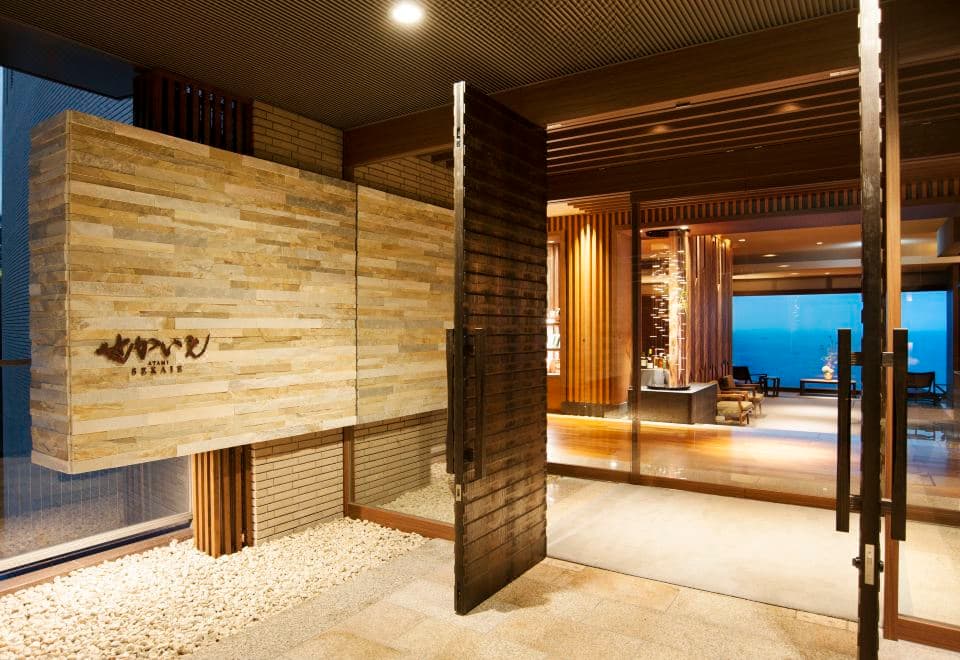
Atami Sekaie
ATAMI せかいえ
Atami·Luxury
from US$232 · per person · per nightfrom ≈ US$464 total for 2 guests
Booking links may earn us a commission at no extra cost to you.
FAQ
Frequently asked questions
How long does it take to get from Tokyo Station to a ryokan?+
Atami is the fastest real onsen destination — 40 minutes by Tokaido Shinkansen Kodama, no transfer, ¥3,740 one-way. Hakone takes approximately 70 minutes via Shinkansen to Odawara plus Hakone Tozan transfer, or 85 minutes on the Odakyu Romancecar from Shinjuku (not Tokyo Station). Nikko reaches Tobu-Nikko in 110 minutes from Asakusa (20-minute Metro hop). Karuizawa is 70 minutes direct by Hokuriku Shinkansen. In-Tokyo ryokans like HOSHINOYA Tokyo are 8 minutes on foot from the station.
Which train do I take from Tokyo Station to Hakone?+
Two options, and the starting station matters. From Tokyo Station: Tokaido Shinkansen Kodama or Hikari to Odawara (36 minutes, ¥3,740), then Hakone Tozan train to Hakone-Yumoto (15 minutes). Total: ~70 minutes. From Shinjuku: Odakyu Romancecar direct to Hakone-Yumoto (85 minutes, ¥2,330 + ¥1,290 seat fee) — no transfer, panoramic front car available. Most travelers prefer the Romancecar for comfort; the Shinkansen route is faster only if you are already at Tokyo Station with luggage.
Is the JR Pass worth buying for a ryokan trip from Tokyo?+
Not for most ryokan-focused trips. A 7-day JR Pass costs approximately ¥50,000 and only breaks even if you are covering Kyoto, Hiroshima, and multiple Shinkansen legs. For Atami alone (¥3,740 one-way), the pass loses by over ¥40,000. For Hakone, the Odakyu Hakone Free Pass (¥6,100, 2 days from Shinjuku) covers the Romancecar, Hakone Tozan train, cable car, ropeway, lake boat, and buses — dramatically more practical. For Nikko via Tobu Spacia X, the JR Pass provides zero coverage.
Can I take luggage to a ryokan by train from Tokyo?+
Yes, but managing large suitcases on crowded Shinkansen is uncomfortable. The practical solution is takkyubin (luggage forwarding): Yamato Transport counters inside Tokyo Station and at any hotel front desk will ship your bag directly to the ryokan for ¥2,000–¥3,000, arriving next-day. Ship it the morning you check out of your Tokyo hotel, travel to the ryokan with a daypack, and your bag is waiting in your room. Most ryokans are experienced receiving forwarded luggage from guests.
What is the cheapest way to get from Tokyo to a ryokan?+
Highway bus is the cheapest option to Hakone and Atami, running 10–40% less than Shinkansen, but adds 30–60 minutes travel time with traffic variability. For Hakone specifically, the Odakyu Hakone Free Pass at ¥6,100 for 2 days (from Shinjuku) often beats the cost of individual train tickets if you plan to use the ropeway and lake boat. For Atami, the Tokaido Shinkansen at ¥3,740 one-way is already reasonable and the time saving over bus is 45+ minutes.
What time should I leave Tokyo Station to arrive at a ryokan by check-in?+
Most ryokans open check-in at 15:00 and serve kaiseki dinner at 18:00–19:00, with some properties confirming your exact dinner slot at check-in. For an 18:00 dinner at a Hakone ryokan, leave Tokyo no later than 15:30, accounting for 70 minutes travel plus 20 minutes transfer time at the property. For Atami, a 16:30 departure gives comfortable arrival. Note: the last Tokaido Shinkansen stopping at Atami departs Tokyo Station at 22:54 — missing it means sleeping in Tokyo.
Is it possible to visit Nikko's ryokans from Tokyo in a day?+
Day trips to Nikko shrines are common, but day-use ryokan visits are more difficult — most Kinugawa and Yumoto area ryokans do not prominently advertise day-use bath plans, and the 110-minute journey each way consumes most of a day. A one-night stay is the practical minimum for Nikko area ryokans. The Tobu Spacia X from Asakusa (20-minute Metro from central Tokyo) makes the journey comfortable, with Cockpit Lounge seating available for ¥3,180–¥5,000 per seat depending on class.
Still deciding?
Browse ryokans across JapanBooking.com