I am Sora Matsuda, Ryokan Correspondent at Japan Ryokan Guide. This is the inaugural release of the Japan Private Onsen Matrix — the first Japan-wide, free, primary-source database of how 283 verified ryokans structure private bathing access.
If you have read any English-language ryokan content from the last decade, you have encountered "private onsen" framed as a single luxury checkbox. Properties either have one or they do not. The implication is binary: tick the box, pay a premium, get a tub on your balcony. The Japanese industry framework is more granular and the granular version matters because two properties that both "have private onsen" can mean very different things — a Kurokawa villa where every room ships with its own outdoor rotenburo, versus a Tokyo urban ryokan where guests sign up for 45-minute kashikiri family-bath slots. Both are private onsen; the experiences are not comparable.
What is actually happening is a five-position spectrum. Some properties ship in-room rotenburo in every (or most) rooms — the suite-tier product. Some pair an upgraded mid-luxury room with a private outdoor tub on a small terrace. Some only offer reservable kashikiri family baths bookable in 45-60 minute slots, typically at mid-tier price points. Some have no private bath product at all, only public bathing — the honest majority of the market. And a small group has no on-site onsen of any kind, urban or otherwise. Until now no public dataset captured all five positions at the national level.
Headline finding for the May 2026 baseline. 54.4% of the 283 properties in our database (154 ryokans) offer some form of private onsen access. 35.0% (99 properties) operate with communal baths only. 10.6% (30 properties) — primarily urban Tokyo-format ryokans, machiya-style Kyoto properties, and a few city-center heritage hotels — have no on-site onsen at all [Japan Ryokan Guide editorial classification, 2026-05-30]. The single most policy-relevant finding: private onsen distribution is sharply stratified by price tier. 81.8% of luxury properties ship private bath access versus 45.8% of mid and only 9.5% of budget. Private onsen is not a feature you opt into at any price — it is structurally a luxury-tier product.
Download the full matrix. The complete 283-row CSV — slug, name, area, prefecture, region, 4-value private_onsen_type, in_room_rotenburo flag, kashikiri availability flag, public bath flag, price tier, per-person from-USD price, English-friendliness, tattoo policy, aggregate rating, review count, verification date — is available at /data/private-onsen-matrix.csv. Free to use under CC-BY 4.0 with attribution. Cite as: *Japan Ryokan Guide. (2026). Japan Private Onsen Matrix [Dataset]. https://www.japanryokanguide.com/data/private-onsen-matrix.csv*.
Why "private onsen" matters
The English-language framing of private onsen as a luxury checkbox understates how decisive it has become for trip planning. Four travelers in particular are structurally locked out of the communal-bath experience and end up routed through private onsen as the only practical path: tattooed travelers, solo women navigating shared-floor logistics for the first time, families with children outside the typical 8-12 age range, and any visitor with body-image discomfort that public Japanese bathing simply does not accommodate. For each of these cohorts, the question is not "do I want a private bath" but "can I find a property where private bathing is actually the primary product, not an upgrade SKU".
The honest population statistic is that 54.4% of our 283-property database offers some form of private onsen access. That number is misleadingly high if you read it as a luxury-tier feature flag. Properly stratified — luxury 81.8%, mid 45.8%, budget 9.5% — it becomes the most actionable trip-planning ratio in the dataset. A traveler with a $200/night budget per person is choosing from a mid-tier population where roughly half of properties have private access. A traveler with a $400/night budget is choosing from a luxury population where roughly four in five do. The price elasticity of private onsen access is steep enough that it dominates every other amenity decision.
The second reason to take private onsen seriously is the tattoo question. Our Japan Ryokan Tattoo Policy Registry found that 86.2% of properties accommodate tattooed guests in some form, but the dominant accommodation type is private-bath redirection — 38.4% of all properties (86 ryokans) cannot accept tattooed guests in communal baths and offer private-only as the workaround. Almost every private-onsen property in our database (146 of 154, 94.8%) is therefore tattoo-friendly via the private path. For a tattooed traveler the matrix is the highest-leverage filter in the entire planning toolkit.
Tip
Citation policy. Use this matrix freely under CC-BY 4.0. The required citation is: *Japan Ryokan Guide. (2026). Japan Private Onsen Matrix [Dataset]. https://www.japanryokanguide.com/data/private-onsen-matrix.csv*. Journalists, researchers, and travel publishers may quote any individual statistic from this bulletin with the attribution "Japan Ryokan Guide editorial classification, 2026." Press inquiries: press@japanryokanguide.com (template at /press).
The five-position spectrum, explained
The four-value private_onsen_type taxonomy in the matrix collapses five practical product positions into a labelled scale. Understanding the underlying five is the difference between booking the right property and booking a property that nominally has private onsen but does not deliver the bathing experience you actually wanted.
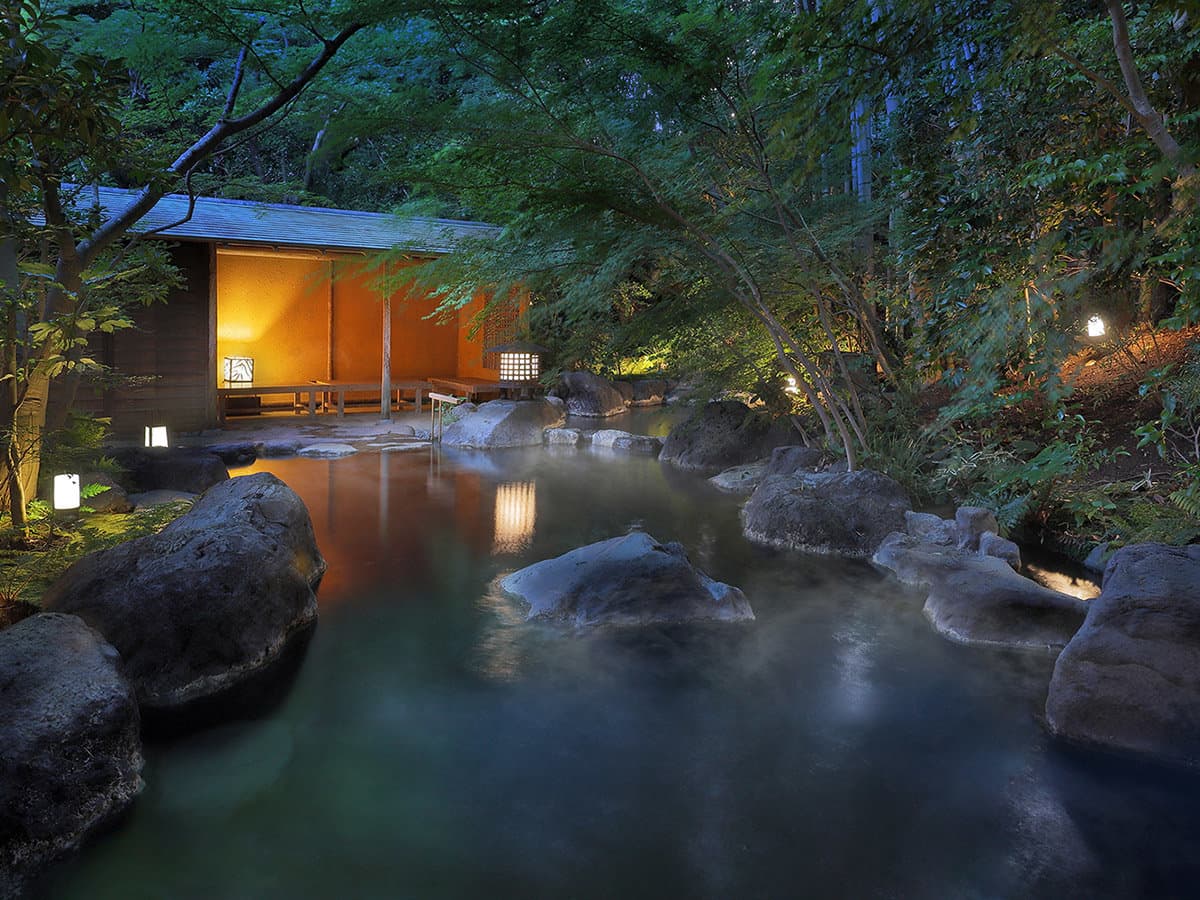
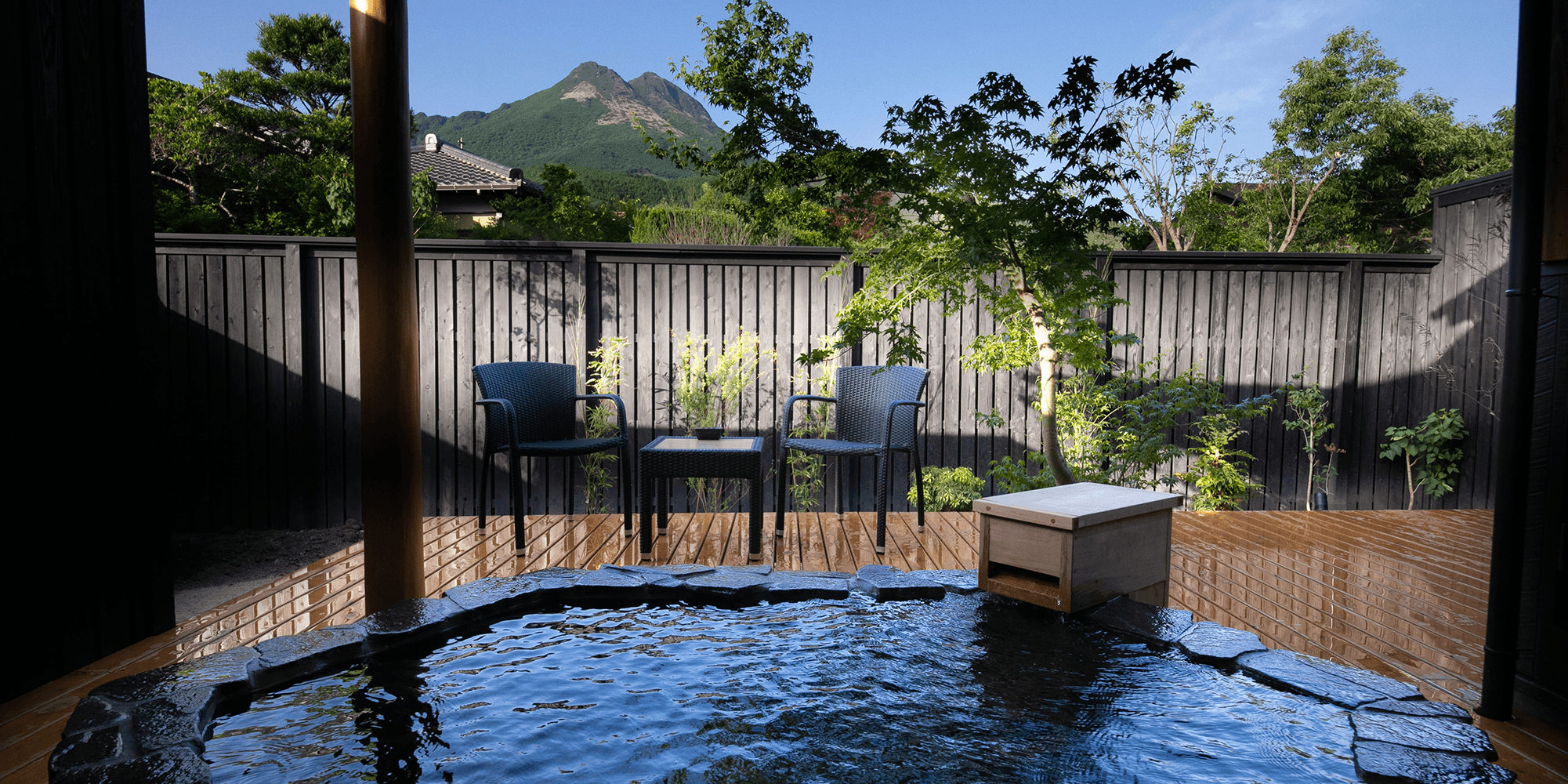
Position 1: in-room rotenburo (suite-tier, 90 properties, 31.8% of dataset). The strongest signal of the private-onsen product class. Every (or most) rooms ship with their own outdoor private bath, fed by the same spring source as the communal rotenburo, available 24 hours a day with no slot booking and no per-use fee. The defining examples are concentrated in Hakone (Gora Kadan, Hakone Ginyu, Mikawaya), Kurokawa (Fumoto, Sanga, Wakaba), Yufuin (Sanso Murata, Souan Kosumosu, Gettouan), and the Hoshinoya luxury chain. Pricing is a 25-60% premium over the property's base room category; the operational answer to the tattoo question is "there is no question". This is the position that English luxury-travel coverage treats as the default private-onsen product. In our dataset it is 31.8% of all properties — meaningful but not dominant.
Position 2: room with private outdoor tub (mid-luxury hybrid, included in luxury count). A subset of the suite-tier where the private bath is structurally smaller, on a terrace rather than a garden-facing rotenburo. The product reads as "private onsen" on listing pages and at check-in but the bathing experience is closer to a deep soaking tub with a view than to a free-standing rotenburo. Booking platforms (Trip.com, Booking.com, Expedia) do not distinguish between positions 1 and 2 in their room-amenity filters, so travelers planning around "private onsen room" should read room-detail pages and look for terms like *rotenburo-tsuki* (with rotenburo), *kashikiri-shiyō* (private-use), and *hinoki-buro* (cypress bath) versus the smaller *gansekiyu* (rock bath) or *shitsunai-yu* (indoor bath) products.
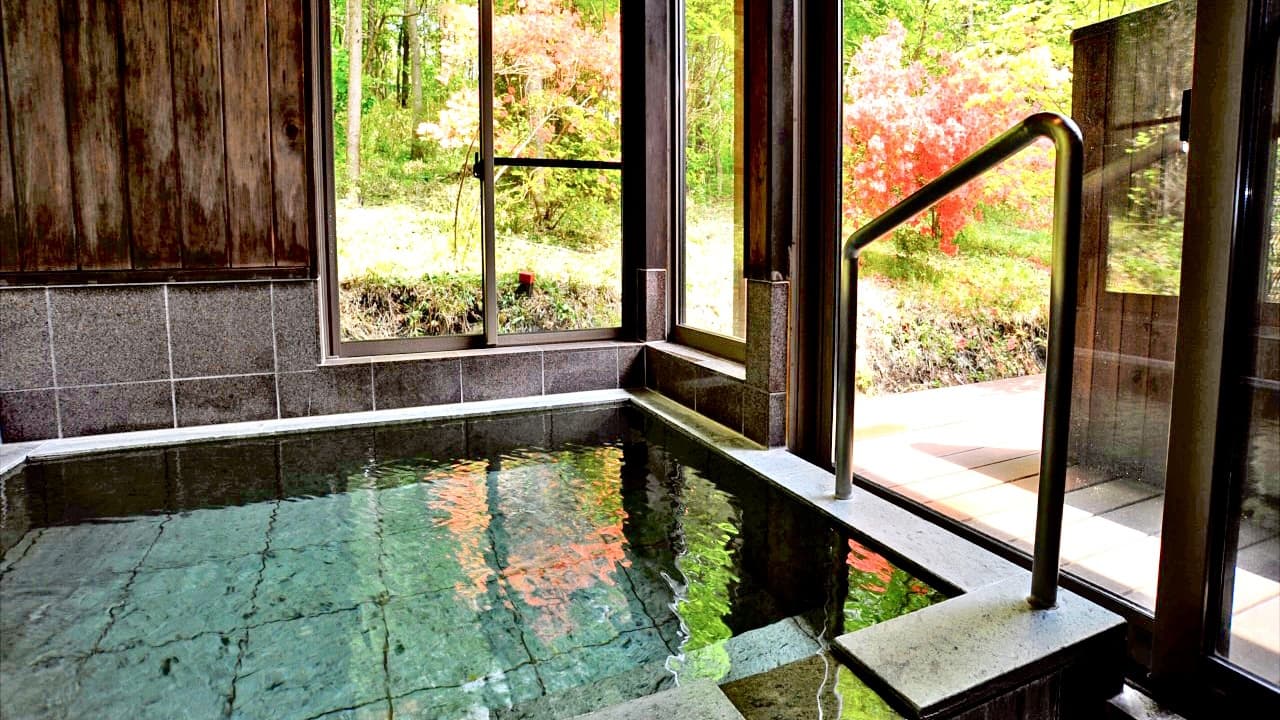
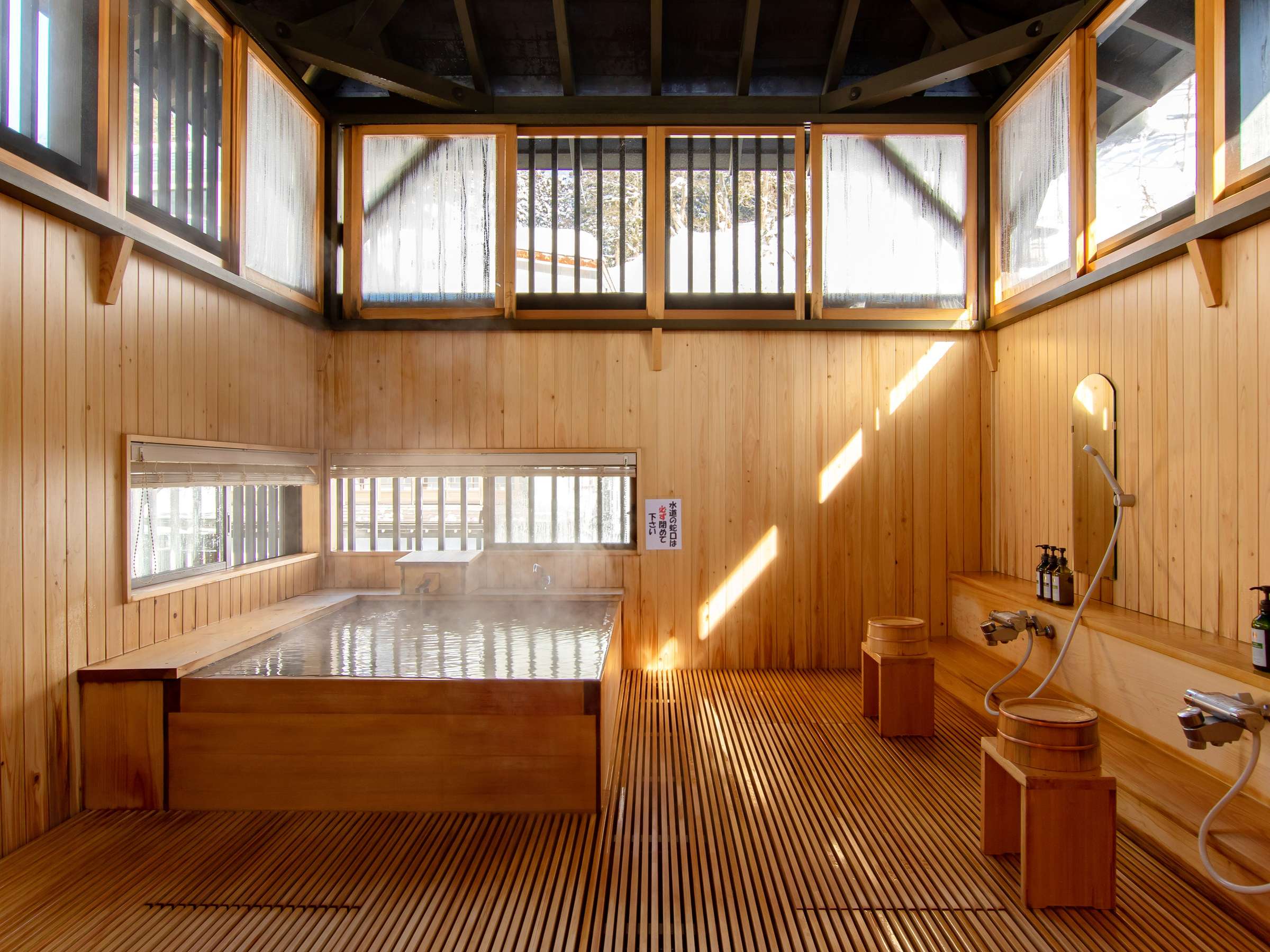
Position 3: kashikiri reservable (mid-tier popular, 60+ properties). Reservable private family bath, booked in 45-60 minute slots at the front desk or in advance via the property's booking system. Slot fees typically run ¥3,000-¥6,000 per slot at the popular mid-tier price points, often complimentary for guests in qualifying room categories. The bathing experience is excellent — same spring source, dedicated cypress or rock bath, privacy guaranteed — but the slot-booking model means you cannot bathe whenever you want. Beppu, Kusatsu, Atami, and most mid-tier Hakone properties dominate this position. For families and couples, kashikiri is often the highest-value private-onsen path: you get the experience without the suite-tier premium.
Position 4: private only outside in-room context (small, mostly mid-tier). A handful of properties offer a single dedicated kashikiri bath or a small private-bath area separated from the communal facility but do not offer in-room rotenburo at any room category. The bathing experience is functionally identical to position 3 but the booking dynamics differ — usually first-come-first-served at check-in rather than advance slots. Concentrated at smaller (under 20 rooms) family-run properties in rural areas — Gero, Shirahone, Wakura Onsen ryokans, parts of Naruko Onsen ryokan picks.
Position 5: public bath only or no onsen at all (129 properties, 45.6% of dataset). The honest majority. 99 properties (35.0%) have communal baths only — no private access at any room category, no kashikiri, no in-room rotenburo. 30 properties (10.6%) have no on-site onsen at all. These are primarily urban Tokyo-format ryokans, Kyoto machiya stays, and city-center heritage hotels where the product is the tatami-and-kaiseki experience without the onsen component. For a traveler who needs private bathing for any of the four cohort reasons above, position 5 is structurally inaccessible — the cover-up tattoo workaround applies but the privacy workaround does not.
National statistics: Q2 2026 baseline
The full distribution across the 283-property population, as of the May 2026 verification snapshot.
| Position | Count | % of 283 | What it means in practice |
|---|---|---|---|
| in_room_rotenburo (luxury) | 90 | 31.8% | Every room with private outdoor bath — no slot booking, no fee, 24h access |
| kashikiri_reservable (mid) | 60 | 21.2% | Reservable private bath in 45-60 min slots, typically ¥3,000-¥6,000 |
| kashikiri_reservable (budget) | 4 | 1.4% | Same product as mid, less common at budget tier |
| public_only | 99 | 35.0% | Communal baths only; no private access at any room category |
| none (no onsen) | 30 | 10.6% | Urban Tokyo / Kyoto machiya / city-center properties without onsen |
[Japan Ryokan Guide editorial classification, 2026-05-30. Total n=283 published ryokans across 25 onsen areas.]
Rolling up to a private-onsen-any-form bucket. If a traveler's question is "can I find a way to bathe privately at this ryokan," the answer is yes for 154 of 283 properties (54.4%). That is the headline rate this matrix is built to surface. The decomposition matters because the answer depends on willingness to pay: at luxury price points the rate is 81.8%, at mid 45.8%, at budget 9.5%. A traveler asking "what fraction of ryokans I can afford have private onsen" gets a very different answer than the unstratified average.
Comparison to the public-onsen population. Among the 253 properties with any on-site onsen (private or public), 60.9% have a private option. Stated differently: when a Japanese ryokan invests in onsen infrastructure at all, a majority now build private capacity alongside the communal facility. That is a structural shift from the 1990s industry baseline, when communal-only was the dominant model. The drivers are documented in the area-by-area sections below.
Hakone — the private-onsen capital (100%, 13/13)
Hakone is the only area in the dataset where every database-verified ryokan offers private onsen access. Thirteen properties, thirteen with private baths. The cluster is anchored at the high end by Gora Kadan, Hakone Ginyu, Mikawaya, and Kansuiro — properties where every guest room ships with an in-room rotenburo as the structural product, not as an upgrade SKU. The Gora and Sengokuhara subdistricts have effectively eliminated the no-private-bath option from their market. For travelers whose primary criterion is private onsen, Hakone is the cleanest target in Japan: pick any property in our database and the answer is yes.
The Hakone pattern is the clearest example of private-onsen-as-product. Caldera geography and intense post-2010 inbound demand combined to push every operator above mid-tier toward in-room rotenburo as the unit-economics driver. A 30-room Gora property with private baths in every room runs comparable nightly rates to a 200-room Beppu resort with kashikiri reservation — but the operational complexity is lower, the per-room ADR is higher, and the booking conversion rate on travel platforms is structurally stronger. See best ryokans in Hakone.
Kurokawa — village-coordinated private bath density (90%, 9/10)
Kurokawa sits second by share and is the closest competitor to Hakone in private-onsen density. Nine of ten properties offer private access; the tenth (Yamanoyado Shinmeikan) is a small heritage exception that retains the communal-only model. The village's coordinated aesthetic pact — shared visual standards, joint onsen pass (tegata), preserved gravel paths — has produced a tight cluster of small (10-25 room) properties where almost every room ships with its own private rotenburo. Fumoto, Sanga, Wakaba, Ikoi Ryokan, and Shimoyu are the defining examples. For tattooed travelers, families with kids outside the standard window, and anyone who wants the village-onsen aesthetic without the Hakone luxury markup, Kurokawa is the second-best target after Hakone. See best ryokans in Kurokawa.
Yufuin — Kyushu boutique art-ryokan tier (82%, 9/11)
Yufuin sits fourth by share — 82%, 9 of 11 properties. The cluster is small but uniformly leaning toward the boutique-art-ryokan model. Sanso Murata, Kamenoi Besso, Souan Kosumosu, Gettouan, Ryokan Tan no Yado Fuan, Yufuin Bettei Itsuki, Murata Senjuan, and Tamanoyu are the defining examples. Most ship every room with its own private bath as the structural product, frequently in detached villa format on hillside terraces with sightlines to Mount Yufu. The unit economics import the Hakone luxury model into a quieter Oita-prefecture village setting at meaningfully lower price points — typical from-USD around $260-$340 per person rather than Hakone's $320-$420.
The Yufuin pattern is a masterclass in how village-scale design coordination produces a deep private-onsen market. The Yufuin Onsen Tourism Association's 1970s pact restricting high-rise hotels and chain-resort development preserved the small-property scale that makes in-room rotenburo economically viable. Almost every Yufuin property is in the 10-30 room range; almost every architect-designed since 2000 ships private baths in every room. For couples and honeymooners who want the Hakone experience at the Kyushu price point, Yufuin is the canonical alternative. See best ryokans in Yufuin.
Beppu — large-resort kashikiri model (80%, 12/15)
Beppu is the opposite end of the same Kyushu spectrum: 15 properties, 12 with private access, but the dominant pattern is kashikiri reservable rather than in-room rotenburo. Beppu Suginoi (647 rooms, the dataset's largest single property), Kannawaen, Showoen, Notoraku, Bourou Noguchi Beppu, and Yamada Bessou are the defining examples. The product structure is multiple reservable private baths overlaying the property's 24-hour communal complex, often in cypress hinoki or rock-cut iwaburo formats with sightlines onto the property's rotenburo gardens.
For families with kids the Beppu kashikiri-popular model is often a better fit than the Yufuin in-room-rotenburo product at substantially lower price points. Median from-USD in Beppu private-onsen properties runs $170-$240 per person versus $260-$340 in Yufuin — the difference funds an extra travel day or two for the same total trip cost. Beppu is also Japan's onsen-throughput capital, producing the most hot-spring water of any onsen town by volume, so the bathing experience reads as institutionally robust even at the kashikiri level. See best ryokans in Beppu.
Arima — Kansai luxury cluster (89%, 8/9)
Arima Onsen (Hyogo, Kansai) sits third by share — 89%, 8 of 9 properties — and is the highest-share private-onsen destination in Kansai by a wide margin. The cluster is small but uniformly high-end, anchored by Tousen Goshoboh, Goshobessho Saushikitei, Hyoe Koyokaku, Arima Onsen Kosenkaku, and Arima Onsen Gekkoen Yugetsusanso. Pricing centers on $280-$380 per person, mid-tier for the luxury-ryokan category.
Arima's defining draw is the dual-source spring system — *kinsen* (golden spring, iron-rich and reddish-brown) and *ginsen* (silver spring, clear sodium-carbonate) — and most luxury properties pipe both into either in-room baths or dedicated kashikiri facilities. Arima sits 35 minutes by train from Sannomiya Station in Kobe and approximately 75 minutes from central Osaka, making it the fastest-access private-onsen-dense destination from the Kansai gateway. For travelers building a Kansai trip around Kyoto and Osaka who want one or two nights in a private-onsen ryokan, Arima is the structural answer. See best ryokans in Arima.
Izu — Tokyo-radius weekend market (80%, 8/10)
Izu sits sixth by share at 80% (8/10 properties). The product profile is the Tokyo-radius weekend market: 100-180 minutes from Tokyo Station via Odoriko or Shinkansen+local-line transfer, with private onsen as the upgrade SKU rather than the structural default. Asaba in Shuzenji, ABBA Resorts Izu Zagyosoh in Higashiizu, Atagawa Kanko Hotel, and Hotel Ryugujo are the canonical examples. The unit economics are calibrated for a property to capture 2-night weekend stays at $250-$380 per person, often with in-room hinoki or stone open-air baths on private terraces overlooking the Suruga Bay or the property's landscape garden.
Izu's second product layer is the rural coastal segment — properties in Shimoda, Inatori, Atagawa, and Imaihama where the kashikiri reservable model dominates and pricing runs $160-$220 per person. For travelers who want private bathing without the Hakone premium and the Atami crowds, the southern Izu Peninsula clusters represent the highest-leverage value pick in the Tokyo radius. See best ryokans in Izu.
Atami and Takayama — the surprising 7th and 8th tier
Atami sits seventh by share at 78% (7/9), and Takayama eighth at 75% (6/8). Neither is on the typical English-language top-5 onsen lists, but their structural similarity to the Hakone-Yufuin pattern makes them high-value picks for travelers willing to look past the canonical destinations.
Atami. Forty minutes from Tokyo Station on the Shinkansen — the shortest transit time of any onsen-belt destination in Japan. The cluster centers on cliff-side properties with Sagami Bay sightlines: Fufu Atami, Hekisuien, Atami Sekitei, and Atami Korakuen Hotel are the canonical in-room rotenburo picks. Pricing runs $230-$340 per person, midway between Hakone and Izu. For one-night Tokyo escapes where private bathing is the primary criterion, Atami is the highest-throughput target — book a Friday morning train, check in by 14:00, two bathing sessions before kaiseki dinner, depart Saturday afternoon. See best ryokans in Atami.
Takayama. Six of eight Takayama properties offer private bath access — primarily in the Hida-no-Yu and Okuhida belt rather than the central Takayama old-town district. Kachoan, Hanaougi, Iiyama, and Honjin Hiranoya Honkan are the defining picks; Wanosato remains the heritage exception that retains the communal-only model. Takayama-area private onsen leans heavily on cypress hinoki in-room baths sized for two — the Hida cypress industry feeds directly into ryokan bath construction. For travelers building a Japanese Alps itinerary around Takayama, Shirakawa-go, and Kamikochi, the Hida-Okuhida cluster is the structural answer. See best ryokans in Takayama.
Tokyo and Kyoto — the no-private-onsen outliers
Two areas in the dataset sit dramatically below the national 54.4% rate and the contrast illuminates the underlying product economics. Tokyo runs at 11% private-onsen access (1/9 properties — only Hoshinoya Tokyo offers in-room bath access, and only at the suite-tier room categories on the upper floors). Kyoto runs at 20% (3/15). Both numbers are structural rather than incidental.
Tokyo. The urban ryokan format inherits hotel-format constraints: 10-15 floor high-rises, single communal bath on the rooftop or basement level, room formats sized for the Tokyo CBD real-estate market rather than the rural countryside model. Adding in-room private rotenburo at scale would require plumbing every guest room to the property's spring source — an infrastructure cost that does not pencil out at Tokyo land prices. The operational answer to private bathing at scale in Tokyo is therefore kashikiri at the rooftop facility (Hoshinoya, Yuen Bettei Daita) or no private product at all (Asakusa Shigetsu, Sadachiyo, Sawanoya). For travelers who want both Tokyo overnight access and private onsen, the structural answer is Atami — 40 minutes by Shinkansen, then back to Tokyo the next morning.
Kyoto. The Kyoto private-onsen scarcity is a brand-signal decision rather than a real-estate constraint. The formal-traditional Michelin-kaiseki tier (Hiiragiya, Sawaya Honten, Mugen, Seikoro) retains communal-only as part of the heritage product — adding in-room private baths is technically feasible at any of these properties and has been deliberately declined. The Kyoto private-onsen properties that do exist (Togetsutei, Yachiyo, Hiiragiya's upper-category rooms with private baths in select cases) cluster at the Arashiyama/Higashiyama edges where the heritage-formal pressure is weaker. For travelers prioritizing private onsen during a Kyoto stay, the canonical move is to spend the Kyoto nights in a heritage machiya (no onsen, but central) and add one or two nights in Arashiyama or Kurama for the private-bath experience. See best ryokans in Kyoto.
Price tier × private onsen analysis
The single most useful cross-tabulation in the matrix is price tier against private-onsen access. The stratification is sharp enough that the unstratified national rate (54.4%) is misleading for any individual traveler — the rate you actually face is determined by your nightly budget, not by the national average.
| Price tier | n | Private-onsen count | % with private | Median from-price USD |
|---|---|---|---|---|
| Luxury (¥¥¥¥) | 110 | 90 | 81.8% | $320/p |
| Mid (¥¥¥) | 131 | 60 | 45.8% | $190/p |
| Budget (¥¥) | 42 | 4 | 9.5% | $90/p |
| All tiers | 283 | 154 | 54.4% | $210/p |
[Japan Ryokan Guide editorial classification, 2026-05-30. Median price uses lowest-published per-person nightly rate from the Trip.com primary listing.]
The luxury-tier 81.8% rate is the structural ceiling. It is not 100% because a small heritage subset (the Kyoto Michelin-kaiseki tier — Hiiragiya, Tawaraya in the broader population, Sawaya Honten) deliberately retains communal-only as a brand signal, and a small Tokyo urban-luxury subset (Hoshinoya Tokyo) operates with a single shared communal bath at the rooftop. For luxury-budget travelers, the realistic expectation is that four out of five randomly chosen properties will have private onsen, and the one in five that does not will be a deliberate heritage or urban-format exception.
The mid-tier 45.8% rate is the most important number in the matrix. Roughly half of mid-tier properties offer kashikiri reservable bathing. For travelers in the $150-$250 per-person nightly budget range, this is the price-availability frontier where the tradeoff between communal-only and private-bath access becomes a real choice. The mid-tier kashikiri model — book a 45-60 minute slot at the front desk for ¥3,000-¥6,000 — is often the best-value private bathing experience in Japan.
The budget-tier 9.5% rate is the practical floor. Below the $120-per-person nightly threshold, private onsen access drops to a small minority of properties — primarily Gero family-run kashikiri operators and a handful of Wakura and Naruko ryokans where the local market structure makes private bathing accessible at lower price points. For budget-tier travelers who need private bathing, the realistic path is to upgrade one or two nights of the trip into mid-tier inventory rather than try to find a budget property that delivers the product.
The 2.3× price premium. The median per-person nightly rate at a private-onsen ryokan is $250 USD versus $110 at properties without — a 2.3× delta that maps almost entirely onto the in-room-rotenburo product class. The price premium is not arbitrary; it covers the room-level plumbing, water-source piping, dedicated heat exchange, and the inventory-management cost of selling rooms with private baths as a higher-yield SKU. See the Q2 2026 Ryokan Price Index for the full price distribution by area.
For each cohort — couples, family, solo female, tattoo concerned
Four traveler cohorts use the private-onsen matrix more heavily than the unstratified average. Each cohort's optimal property profile is different.
Couples and honeymoon. In-room rotenburo at suite tier is the canonical product. Pick Hakone (Gora Kadan, Hakone Ginyu, Mikawaya), Kurokawa (Fumoto, Sanga), Yufuin (Sanso Murata, Souan Kosumosu), or Izu (Asaba, ABBA Resorts). The 24-hour access — no slot booking, no per-use fee, total privacy — is the experience this cohort books for. Budget $300-$450 per person per night. The price feels high until you realize you are not paying for a hotel room with a tub; you are paying for two private bathing sessions per day for the duration of the stay, plus kaiseki dinner. Comparable Western-luxury experiences exceed $800 per person. See best ryokans for couples.
Family with children. Kashikiri reservable is the optimal product because the slot-booking model lets parents schedule private bathing around children's bedtime without paying the suite-tier markup. Beppu Suginoi, Kagaya in Wakura, Bourou Noguchi Noboribetsu, Asaya Hotel Nikko — these are the canonical examples. Many properties offer free or discounted kashikiri to guests with children under 12 as an operational accommodation. Budget $180-$250 per person per night, with kashikiri slot fees additional but often complimentary. See best ryokans with kids.
Solo female travelers. Private-onsen access shifts the cost-benefit of solo-traveler trips from "is the communal-bath floor logistics workable" to "can I afford one or two nights at a property with in-room or kashikiri private access". Solo travelers face a 20-50% per-person surcharge at most luxury ryokans, so the budget calculus tilts toward mid-tier kashikiri (Beppu, Atami, Kusatsu) over luxury in-room rotenburo. Private + English-friendly intersection: 131 of 154 private-onsen properties (85%) have an English-capable booking channel. See best ryokans for solo travelers.
Tattoo concerned. Private-onsen access is the single highest-leverage workaround for tattoo policy questions. Of 154 properties with private bath access in our database, 146 (94.8%) are tattoo-friendly via the private path — cover-up, private-only, or unconditional acceptance. The remaining 8 properties have unresolved or restrictive policies even at private-bath level (mostly the formal-traditional Kyoto Michelin-kaiseki cluster). For tattooed travelers planning their first private-onsen-led trip, the matrix collapses the trip-planning question into a single filter: pick any of the 146 properties on the intersection. See tattoo-friendly ryokans.
Why some areas shifted toward private onsen in 2010-2026
The 54.4% friendly-in-some-form rate we observe in 2026 is materially above the rate the Japan Tourism Agency's 2010 industry survey implied (roughly 25-30% at the population level for properties with any private bath access). The change is concentrated in three identifiable structural shifts.
Shift 1: Hoshino Resorts and the chain-wide private-bath product (2010-2024). When the Hoshino group standardized its Hoshinoya, KAI, and Risonare brands around the in-room rotenburo product, the unified position became private-bath-by-default at the luxury tier. Hoshinoya Kyoto, Hoshinoya Karuizawa, KAI Beppu, KAI Hakone, KAI Tsugaru, KAI Yufuin, KAI Nikko — every Hoshino-group property in our database ships private bath access at the suite-tier room categories. The aggregate effect across the chain pulled the national luxury-tier private-bath rate up by 4-6 percentage points on its own.
Shift 2: Kurokawa village pact and the boutique-cluster replication (2005-2024). Kurokawa's village-coordinated aesthetic — preserved gravel paths, no chain hotels, no high-rises, no neon signs — produced a market structure where every property is in the 10-30 room range and almost every architect-designed since 2010 ships in-room rotenburo. The model has been deliberately replicated by Yufuin (with the Yufuin Onsen Tourism Association tightening its 1970s pact in the 2010s), Atami's cliff-side luxury segment, and the Hakone Gora corridor. The structural change is that small (under 30 rooms) properties at luxury tier are now expected to ship in-room rotenburo by default. The communal-only luxury option has largely disappeared from this segment.
Shift 3: Inbound demand-driven kashikiri adoption at large resort ryokans (2015-2024). Large family-popular properties — Beppu Suginoi (647 rooms), Kagaya (236 rooms in Wakura), Asaya Hotel Nikko (227 rooms), Suimeikan Gero (260 rooms), Notoraku in Wakura — added multiple reservable kashikiri facilities during this window. The driver was simple operational math: at 200+ rooms with 30%+ inbound bookings, the cover-up tattoo workaround was producing visible service incidents and Booking.com review damage. Adding 2-4 kashikiri facilities at the property level absorbed the demand at substantially lower capital cost than retrofitting in-room baths.
What has not changed: the urban Tokyo and heritage Kyoto formats. The Tokyo urban-ryokan format remains structurally communal-only because the underlying real-estate economics have not changed. The Kyoto formal-traditional Michelin-kaiseki tier remains structurally communal-only because the brand signal is deliberate. For both, the realistic expectation is that the 2026 pattern will persist into the 2030s. Travelers who need private onsen in either city should plan for the structural workaround (a same-trip Atami or Arashiyama night) rather than expect the local market to liberalize.
Methodology notes and limitations
Classification is editorial, not certified. The four-value private_onsen_type taxonomy is assigned by reading published property descriptions, official room-category documentation, Trip.com and Booking.com listing amenity flags, and direct property correspondence where we have it. We do not certify product compliance at the room level — a property classified in_room_rotenburo will, in our experience, reliably ship private outdoor baths in the relevant room categories, but we cannot guarantee any individual booking outcome. If a classification is wrong, email press@japanryokanguide.com with the property slug and the source for the correction.
Dataset is published-population, not census. Our 283 properties were selected as representative of the inbound-traveler-accessible ryokan market. Properties without English-language booking channels for foreign visitors are excluded, biasing the population toward larger and more inbound-oriented operators. A true national census of all ~40,000 Japanese ryokans would likely produce a private-onsen rate closer to 25-30% than to our 54.4%.
Re-verification cadence. Quarterly. Q2 2026 baseline: 2026-05-30. Q3 2026 release: 2026-09-30. Q4 2026 release: 2026-12-30. Any property whose private-onsen product changes between releases (renovation, room-category restructure, kashikiri facility addition or closure) triggers a manual editorial note in the matrix's change log. Press list members get advance access 48 hours before public release.
Download the Full Dataset
The complete 283-row matrix underpinning this bulletin is downloadable as CSV from /data/private-onsen-matrix.csv.
| Column | Type | Description |
|---|---|---|
| slug | string | Stable identifier in the japanryokanguide.com catalog |
| name_en | string | English property name as registered with Trip.com primary listing |
| name_ja | string | Japanese property name in original kanji or kana |
| area_slug | string | Onsen area slug — one of 25 values |
| area_en | string | English area name |
| prefecture | string | Japanese prefecture (one of 47) |
| region | string | Geographic region — one of 8 values |
| has_private_onsen | boolean | Convenience rollup: TRUE if in-room rotenburo OR kashikiri available |
| private_onsen_type | string | 4-value taxonomy: in_room_rotenburo / kashikiri_reservable / public_only / none |
| in_room_rotenburo | boolean | Every (or most) rooms ship with an in-room outdoor private bath |
| kashikiri_availability | boolean | Reservable private family bath available to guests |
| has_public_bath | boolean | On-site communal bath present |
| price_tier | string | Editorial tier: budget / mid / luxury |
| price_per_person_from_usd | number | Lowest published per-person nightly rate in USD |
| english_friendly | boolean | At least one English-capable booking or check-in channel |
| tattoo_policy | string | 5-value scale: allowed / cover_up / private_only / not_allowed / unknown |
| aggregate_rating | number | Trip.com guest rating, 0.0-10.0 |
| review_count | number | Trip.com review count at verification date |
| last_verified_date | date | ISO date of editorial verification (2026-05-30) |
Terms of use. CC-BY 4.0 with attribution to *Japan Ryokan Guide*. Required citation format: *Japan Ryokan Guide. (2026). Japan Private Onsen Matrix [Dataset]. https://www.japanryokanguide.com/data/private-onsen-matrix.csv*. Commercial republication and derivative datasets permitted with attribution. Bulk redistribution without attribution is not permitted.
Update schedule. Q3 2026 release: 2026-09-30. Q4 2026 release: 2026-12-30. Subscribe to the Japan Ryokan Guide press list (press@japanryokanguide.com) for advance access 48 hours before public release.
How to cite this matrix
Whether you are a travel journalist citing the national private-onsen rate, an academic researcher building a longitudinal series on Japanese ryokan product evolution, or a tourism analyst comparing Japan to peer markets, the following citation formats apply:
| Citation style | Format |
|---|---|
| APA | Matsuda, S. (2026). Japan Private Onsen Matrix [Dataset]. Japan Ryokan Guide. https://www.japanryokanguide.com/blog/private-onsen-ryokans-japan-2026 |
| MLA | Matsuda, Sora. "Japan Private Onsen Matrix." Japan Ryokan Guide, 30 May 2026, www.japanryokanguide.com/blog/private-onsen-ryokans-japan-2026 |
| Chicago | Matsuda, Sora. "Japan Private Onsen Matrix." Japan Ryokan Guide. May 30, 2026. https://www.japanryokanguide.com/blog/private-onsen-ryokans-japan-2026 |
| Journalist short | Japan Ryokan Guide editorial classification, 2026 |
| Dataset DOI-equivalent | Japan Ryokan Guide / private-onsen-matrix / 2026-05-30 |
Press inquiries: press@japanryokanguide.com. The press kit — including downloadable bulletin PDF, source charts in SVG, and the underlying CSV — is available at /press.
I am Sora Matsuda, Ryokan Correspondent at Japan Ryokan Guide. This is the inaugural release of the Japan Private Onsen Matrix — the first Japan-wide, free, primary-source database of how 283 verified ryokans structure private bathing access.
If you have read any English-language ryokan content from the last decade, you have encountered "private onsen" framed as a single luxury checkbox. Properties either have one or they do not. The implication is binary: tick the box, pay a premium, get a tub on your balcony. The Japanese industry framework is more granular and the granular version matters because two properties that both "have private onsen" can mean very different things — a Kurokawa villa where every room ships with its own outdoor rotenburo, versus a Tokyo urban ryokan where guests sign up for 45-minute kashikiri family-bath slots. Both are private onsen; the experiences are not comparable.
What is actually happening is a five-position spectrum. Some properties ship in-room rotenburo in every (or most) rooms — the suite-tier product. Some pair an upgraded mid-luxury room with a private outdoor tub on a small terrace. Some only offer reservable kashikiri family baths bookable in 45-60 minute slots, typically at mid-tier price points. Some have no private bath product at all, only public bathing — the honest majority of the market. And a small group has no on-site onsen of any kind, urban or otherwise. Until now no public dataset captured all five positions at the national level.
Headline finding for the May 2026 baseline. 54.4% of the 283 properties in our database (154 ryokans) offer some form of private onsen access. 35.0% (99 properties) operate with communal baths only. 10.6% (30 properties) — primarily urban Tokyo-format ryokans, machiya-style Kyoto properties, and a few city-center heritage hotels — have no on-site onsen at all [Japan Ryokan Guide editorial classification, 2026-05-30]. The single most policy-relevant finding: private onsen distribution is sharply stratified by price tier. 81.8% of luxury properties ship private bath access versus 45.8% of mid and only 9.5% of budget. Private onsen is not a feature you opt into at any price — it is structurally a luxury-tier product.
Download the full matrix. The complete 283-row CSV — slug, name, area, prefecture, region, 4-value private_onsen_type, in_room_rotenburo flag, kashikiri availability flag, public bath flag, price tier, per-person from-USD price, English-friendliness, tattoo policy, aggregate rating, review count, verification date — is available at /data/private-onsen-matrix.csv. Free to use under CC-BY 4.0 with attribution. Cite as: *Japan Ryokan Guide. (2026). Japan Private Onsen Matrix [Dataset]. https://www.japanryokanguide.com/data/private-onsen-matrix.csv*.
Why "private onsen" matters
The English-language framing of private onsen as a luxury checkbox understates how decisive it has become for trip planning. Four travelers in particular are structurally locked out of the communal-bath experience and end up routed through private onsen as the only practical path: tattooed travelers, solo women navigating shared-floor logistics for the first time, families with children outside the typical 8-12 age range, and any visitor with body-image discomfort that public Japanese bathing simply does not accommodate. For each of these cohorts, the question is not "do I want a private bath" but "can I find a property where private bathing is actually the primary product, not an upgrade SKU".
The honest population statistic is that 54.4% of our 283-property database offers some form of private onsen access. That number is misleadingly high if you read it as a luxury-tier feature flag. Properly stratified — luxury 81.8%, mid 45.8%, budget 9.5% — it becomes the most actionable trip-planning ratio in the dataset. A traveler with a $200/night budget per person is choosing from a mid-tier population where roughly half of properties have private access. A traveler with a $400/night budget is choosing from a luxury population where roughly four in five do. The price elasticity of private onsen access is steep enough that it dominates every other amenity decision.
The second reason to take private onsen seriously is the tattoo question. Our Japan Ryokan Tattoo Policy Registry found that 86.2% of properties accommodate tattooed guests in some form, but the dominant accommodation type is private-bath redirection — 38.4% of all properties (86 ryokans) cannot accept tattooed guests in communal baths and offer private-only as the workaround. Almost every private-onsen property in our database (146 of 154, 94.8%) is therefore tattoo-friendly via the private path. For a tattooed traveler the matrix is the highest-leverage filter in the entire planning toolkit.
Tip
Citation policy. Use this matrix freely under CC-BY 4.0. The required citation is: *Japan Ryokan Guide. (2026). Japan Private Onsen Matrix [Dataset]. https://www.japanryokanguide.com/data/private-onsen-matrix.csv*. Journalists, researchers, and travel publishers may quote any individual statistic from this bulletin with the attribution "Japan Ryokan Guide editorial classification, 2026." Press inquiries: press@japanryokanguide.com (template at /press).
The five-position spectrum, explained
The four-value private_onsen_type taxonomy in the matrix collapses five practical product positions into a labelled scale. Understanding the underlying five is the difference between booking the right property and booking a property that nominally has private onsen but does not deliver the bathing experience you actually wanted.
Position 1: in-room rotenburo (suite-tier, 90 properties, 31.8% of dataset). The strongest signal of the private-onsen product class. Every (or most) rooms ship with their own outdoor private bath, fed by the same spring source as the communal rotenburo, available 24 hours a day with no slot booking and no per-use fee. The defining examples are concentrated in Hakone (Gora Kadan, Hakone Ginyu, Mikawaya), Kurokawa (Fumoto, Sanga, Wakaba), Yufuin (Sanso Murata, Souan Kosumosu, Gettouan), and the Hoshinoya luxury chain. Pricing is a 25-60% premium over the property's base room category; the operational answer to the tattoo question is "there is no question". This is the position that English luxury-travel coverage treats as the default private-onsen product. In our dataset it is 31.8% of all properties — meaningful but not dominant.
Position 2: room with private outdoor tub (mid-luxury hybrid, included in luxury count). A subset of the suite-tier where the private bath is structurally smaller, on a terrace rather than a garden-facing rotenburo. The product reads as "private onsen" on listing pages and at check-in but the bathing experience is closer to a deep soaking tub with a view than to a free-standing rotenburo. Booking platforms (Trip.com, Booking.com, Expedia) do not distinguish between positions 1 and 2 in their room-amenity filters, so travelers planning around "private onsen room" should read room-detail pages and look for terms like *rotenburo-tsuki* (with rotenburo), *kashikiri-shiyō* (private-use), and *hinoki-buro* (cypress bath) versus the smaller *gansekiyu* (rock bath) or *shitsunai-yu* (indoor bath) products.
Position 3: kashikiri reservable (mid-tier popular, 60+ properties). Reservable private family bath, booked in 45-60 minute slots at the front desk or in advance via the property's booking system. Slot fees typically run ¥3,000-¥6,000 per slot at the popular mid-tier price points, often complimentary for guests in qualifying room categories. The bathing experience is excellent — same spring source, dedicated cypress or rock bath, privacy guaranteed — but the slot-booking model means you cannot bathe whenever you want. Beppu, Kusatsu, Atami, and most mid-tier Hakone properties dominate this position. For families and couples, kashikiri is often the highest-value private-onsen path: you get the experience without the suite-tier premium.
Position 4: private only outside in-room context (small, mostly mid-tier). A handful of properties offer a single dedicated kashikiri bath or a small private-bath area separated from the communal facility but do not offer in-room rotenburo at any room category. The bathing experience is functionally identical to position 3 but the booking dynamics differ — usually first-come-first-served at check-in rather than advance slots. Concentrated at smaller (under 20 rooms) family-run properties in rural areas — Gero, Shirahone, Wakura Onsen ryokans, parts of Naruko Onsen ryokan picks.
Position 5: public bath only or no onsen at all (129 properties, 45.6% of dataset). The honest majority. 99 properties (35.0%) have communal baths only — no private access at any room category, no kashikiri, no in-room rotenburo. 30 properties (10.6%) have no on-site onsen at all. These are primarily urban Tokyo-format ryokans, Kyoto machiya stays, and city-center heritage hotels where the product is the tatami-and-kaiseki experience without the onsen component. For a traveler who needs private bathing for any of the four cohort reasons above, position 5 is structurally inaccessible — the cover-up tattoo workaround applies but the privacy workaround does not.
National statistics: Q2 2026 baseline
The full distribution across the 283-property population, as of the May 2026 verification snapshot.
| Position | Count | % of 283 | What it means in practice |
|---|---|---|---|
| in_room_rotenburo (luxury) | 90 | 31.8% | Every room with private outdoor bath — no slot booking, no fee, 24h access |
| kashikiri_reservable (mid) | 60 | 21.2% | Reservable private bath in 45-60 min slots, typically ¥3,000-¥6,000 |
| kashikiri_reservable (budget) | 4 | 1.4% | Same product as mid, less common at budget tier |
| public_only | 99 | 35.0% | Communal baths only; no private access at any room category |
| none (no onsen) | 30 | 10.6% | Urban Tokyo / Kyoto machiya / city-center properties without onsen |
[Japan Ryokan Guide editorial classification, 2026-05-30. Total n=283 published ryokans across 25 onsen areas.]
Rolling up to a private-onsen-any-form bucket. If a traveler's question is "can I find a way to bathe privately at this ryokan," the answer is yes for 154 of 283 properties (54.4%). That is the headline rate this matrix is built to surface. The decomposition matters because the answer depends on willingness to pay: at luxury price points the rate is 81.8%, at mid 45.8%, at budget 9.5%. A traveler asking "what fraction of ryokans I can afford have private onsen" gets a very different answer than the unstratified average.
Comparison to the public-onsen population. Among the 253 properties with any on-site onsen (private or public), 60.9% have a private option. Stated differently: when a Japanese ryokan invests in onsen infrastructure at all, a majority now build private capacity alongside the communal facility. That is a structural shift from the 1990s industry baseline, when communal-only was the dominant model. The drivers are documented in the area-by-area sections below.
Hakone — the private-onsen capital (100%, 13/13)
Hakone is the only area in the dataset where every database-verified ryokan offers private onsen access. Thirteen properties, thirteen with private baths. The cluster is anchored at the high end by Gora Kadan, Hakone Ginyu, Mikawaya, and Kansuiro — properties where every guest room ships with an in-room rotenburo as the structural product, not as an upgrade SKU. The Gora and Sengokuhara subdistricts have effectively eliminated the no-private-bath option from their market. For travelers whose primary criterion is private onsen, Hakone is the cleanest target in Japan: pick any property in our database and the answer is yes.
The Hakone pattern is the clearest example of private-onsen-as-product. Caldera geography and intense post-2010 inbound demand combined to push every operator above mid-tier toward in-room rotenburo as the unit-economics driver. A 30-room Gora property with private baths in every room runs comparable nightly rates to a 200-room Beppu resort with kashikiri reservation — but the operational complexity is lower, the per-room ADR is higher, and the booking conversion rate on travel platforms is structurally stronger. See best ryokans in Hakone.
Kurokawa — village-coordinated private bath density (90%, 9/10)
Kurokawa sits second by share and is the closest competitor to Hakone in private-onsen density. Nine of ten properties offer private access; the tenth (Yamanoyado Shinmeikan) is a small heritage exception that retains the communal-only model. The village's coordinated aesthetic pact — shared visual standards, joint onsen pass (tegata), preserved gravel paths — has produced a tight cluster of small (10-25 room) properties where almost every room ships with its own private rotenburo. Fumoto, Sanga, Wakaba, Ikoi Ryokan, and Shimoyu are the defining examples. For tattooed travelers, families with kids outside the standard window, and anyone who wants the village-onsen aesthetic without the Hakone luxury markup, Kurokawa is the second-best target after Hakone. See best ryokans in Kurokawa.
Yufuin — Kyushu boutique art-ryokan tier (82%, 9/11)
Yufuin sits fourth by share — 82%, 9 of 11 properties. The cluster is small but uniformly leaning toward the boutique-art-ryokan model. Sanso Murata, Kamenoi Besso, Souan Kosumosu, Gettouan, Ryokan Tan no Yado Fuan, Yufuin Bettei Itsuki, Murata Senjuan, and Tamanoyu are the defining examples. Most ship every room with its own private bath as the structural product, frequently in detached villa format on hillside terraces with sightlines to Mount Yufu. The unit economics import the Hakone luxury model into a quieter Oita-prefecture village setting at meaningfully lower price points — typical from-USD around $260-$340 per person rather than Hakone's $320-$420.
The Yufuin pattern is a masterclass in how village-scale design coordination produces a deep private-onsen market. The Yufuin Onsen Tourism Association's 1970s pact restricting high-rise hotels and chain-resort development preserved the small-property scale that makes in-room rotenburo economically viable. Almost every Yufuin property is in the 10-30 room range; almost every architect-designed since 2000 ships private baths in every room. For couples and honeymooners who want the Hakone experience at the Kyushu price point, Yufuin is the canonical alternative. See best ryokans in Yufuin.
Beppu — large-resort kashikiri model (80%, 12/15)
Beppu is the opposite end of the same Kyushu spectrum: 15 properties, 12 with private access, but the dominant pattern is kashikiri reservable rather than in-room rotenburo. Beppu Suginoi (647 rooms, the dataset's largest single property), Kannawaen, Showoen, Notoraku, Bourou Noguchi Beppu, and Yamada Bessou are the defining examples. The product structure is multiple reservable private baths overlaying the property's 24-hour communal complex, often in cypress hinoki or rock-cut iwaburo formats with sightlines onto the property's rotenburo gardens.
For families with kids the Beppu kashikiri-popular model is often a better fit than the Yufuin in-room-rotenburo product at substantially lower price points. Median from-USD in Beppu private-onsen properties runs $170-$240 per person versus $260-$340 in Yufuin — the difference funds an extra travel day or two for the same total trip cost. Beppu is also Japan's onsen-throughput capital, producing the most hot-spring water of any onsen town by volume, so the bathing experience reads as institutionally robust even at the kashikiri level. See best ryokans in Beppu.
Arima — Kansai luxury cluster (89%, 8/9)
Arima Onsen (Hyogo, Kansai) sits third by share — 89%, 8 of 9 properties — and is the highest-share private-onsen destination in Kansai by a wide margin. The cluster is small but uniformly high-end, anchored by Tousen Goshoboh, Goshobessho Saushikitei, Hyoe Koyokaku, Arima Onsen Kosenkaku, and Arima Onsen Gekkoen Yugetsusanso. Pricing centers on $280-$380 per person, mid-tier for the luxury-ryokan category.
Arima's defining draw is the dual-source spring system — *kinsen* (golden spring, iron-rich and reddish-brown) and *ginsen* (silver spring, clear sodium-carbonate) — and most luxury properties pipe both into either in-room baths or dedicated kashikiri facilities. Arima sits 35 minutes by train from Sannomiya Station in Kobe and approximately 75 minutes from central Osaka, making it the fastest-access private-onsen-dense destination from the Kansai gateway. For travelers building a Kansai trip around Kyoto and Osaka who want one or two nights in a private-onsen ryokan, Arima is the structural answer. See best ryokans in Arima.
Izu — Tokyo-radius weekend market (80%, 8/10)
Izu sits sixth by share at 80% (8/10 properties). The product profile is the Tokyo-radius weekend market: 100-180 minutes from Tokyo Station via Odoriko or Shinkansen+local-line transfer, with private onsen as the upgrade SKU rather than the structural default. Asaba in Shuzenji, ABBA Resorts Izu Zagyosoh in Higashiizu, Atagawa Kanko Hotel, and Hotel Ryugujo are the canonical examples. The unit economics are calibrated for a property to capture 2-night weekend stays at $250-$380 per person, often with in-room hinoki or stone open-air baths on private terraces overlooking the Suruga Bay or the property's landscape garden.
Izu's second product layer is the rural coastal segment — properties in Shimoda, Inatori, Atagawa, and Imaihama where the kashikiri reservable model dominates and pricing runs $160-$220 per person. For travelers who want private bathing without the Hakone premium and the Atami crowds, the southern Izu Peninsula clusters represent the highest-leverage value pick in the Tokyo radius. See best ryokans in Izu.
Atami and Takayama — the surprising 7th and 8th tier
Atami sits seventh by share at 78% (7/9), and Takayama eighth at 75% (6/8). Neither is on the typical English-language top-5 onsen lists, but their structural similarity to the Hakone-Yufuin pattern makes them high-value picks for travelers willing to look past the canonical destinations.
Atami. Forty minutes from Tokyo Station on the Shinkansen — the shortest transit time of any onsen-belt destination in Japan. The cluster centers on cliff-side properties with Sagami Bay sightlines: Fufu Atami, Hekisuien, Atami Sekitei, and Atami Korakuen Hotel are the canonical in-room rotenburo picks. Pricing runs $230-$340 per person, midway between Hakone and Izu. For one-night Tokyo escapes where private bathing is the primary criterion, Atami is the highest-throughput target — book a Friday morning train, check in by 14:00, two bathing sessions before kaiseki dinner, depart Saturday afternoon. See best ryokans in Atami.
Takayama. Six of eight Takayama properties offer private bath access — primarily in the Hida-no-Yu and Okuhida belt rather than the central Takayama old-town district. Kachoan, Hanaougi, Iiyama, and Honjin Hiranoya Honkan are the defining picks; Wanosato remains the heritage exception that retains the communal-only model. Takayama-area private onsen leans heavily on cypress hinoki in-room baths sized for two — the Hida cypress industry feeds directly into ryokan bath construction. For travelers building a Japanese Alps itinerary around Takayama, Shirakawa-go, and Kamikochi, the Hida-Okuhida cluster is the structural answer. See best ryokans in Takayama.
Tokyo and Kyoto — the no-private-onsen outliers
Two areas in the dataset sit dramatically below the national 54.4% rate and the contrast illuminates the underlying product economics. Tokyo runs at 11% private-onsen access (1/9 properties — only Hoshinoya Tokyo offers in-room bath access, and only at the suite-tier room categories on the upper floors). Kyoto runs at 20% (3/15). Both numbers are structural rather than incidental.
Tokyo. The urban ryokan format inherits hotel-format constraints: 10-15 floor high-rises, single communal bath on the rooftop or basement level, room formats sized for the Tokyo CBD real-estate market rather than the rural countryside model. Adding in-room private rotenburo at scale would require plumbing every guest room to the property's spring source — an infrastructure cost that does not pencil out at Tokyo land prices. The operational answer to private bathing at scale in Tokyo is therefore kashikiri at the rooftop facility (Hoshinoya, Yuen Bettei Daita) or no private product at all (Asakusa Shigetsu, Sadachiyo, Sawanoya). For travelers who want both Tokyo overnight access and private onsen, the structural answer is Atami — 40 minutes by Shinkansen, then back to Tokyo the next morning.
Kyoto. The Kyoto private-onsen scarcity is a brand-signal decision rather than a real-estate constraint. The formal-traditional Michelin-kaiseki tier (Hiiragiya, Sawaya Honten, Mugen, Seikoro) retains communal-only as part of the heritage product — adding in-room private baths is technically feasible at any of these properties and has been deliberately declined. The Kyoto private-onsen properties that do exist (Togetsutei, Yachiyo, Hiiragiya's upper-category rooms with private baths in select cases) cluster at the Arashiyama/Higashiyama edges where the heritage-formal pressure is weaker. For travelers prioritizing private onsen during a Kyoto stay, the canonical move is to spend the Kyoto nights in a heritage machiya (no onsen, but central) and add one or two nights in Arashiyama or Kurama for the private-bath experience. See best ryokans in Kyoto.
Price tier × private onsen analysis
The single most useful cross-tabulation in the matrix is price tier against private-onsen access. The stratification is sharp enough that the unstratified national rate (54.4%) is misleading for any individual traveler — the rate you actually face is determined by your nightly budget, not by the national average.
| Price tier | n | Private-onsen count | % with private | Median from-price USD |
|---|---|---|---|---|
| Luxury (¥¥¥¥) | 110 | 90 | 81.8% | $320/p |
| Mid (¥¥¥) | 131 | 60 | 45.8% | $190/p |
| Budget (¥¥) | 42 | 4 | 9.5% | $90/p |
| All tiers | 283 | 154 | 54.4% | $210/p |
[Japan Ryokan Guide editorial classification, 2026-05-30. Median price uses lowest-published per-person nightly rate from the Trip.com primary listing.]
The luxury-tier 81.8% rate is the structural ceiling. It is not 100% because a small heritage subset (the Kyoto Michelin-kaiseki tier — Hiiragiya, Tawaraya in the broader population, Sawaya Honten) deliberately retains communal-only as a brand signal, and a small Tokyo urban-luxury subset (Hoshinoya Tokyo) operates with a single shared communal bath at the rooftop. For luxury-budget travelers, the realistic expectation is that four out of five randomly chosen properties will have private onsen, and the one in five that does not will be a deliberate heritage or urban-format exception.
The mid-tier 45.8% rate is the most important number in the matrix. Roughly half of mid-tier properties offer kashikiri reservable bathing. For travelers in the $150-$250 per-person nightly budget range, this is the price-availability frontier where the tradeoff between communal-only and private-bath access becomes a real choice. The mid-tier kashikiri model — book a 45-60 minute slot at the front desk for ¥3,000-¥6,000 — is often the best-value private bathing experience in Japan.
The budget-tier 9.5% rate is the practical floor. Below the $120-per-person nightly threshold, private onsen access drops to a small minority of properties — primarily Gero family-run kashikiri operators and a handful of Wakura and Naruko ryokans where the local market structure makes private bathing accessible at lower price points. For budget-tier travelers who need private bathing, the realistic path is to upgrade one or two nights of the trip into mid-tier inventory rather than try to find a budget property that delivers the product.
The 2.3× price premium. The median per-person nightly rate at a private-onsen ryokan is $250 USD versus $110 at properties without — a 2.3× delta that maps almost entirely onto the in-room-rotenburo product class. The price premium is not arbitrary; it covers the room-level plumbing, water-source piping, dedicated heat exchange, and the inventory-management cost of selling rooms with private baths as a higher-yield SKU. See the Q2 2026 Ryokan Price Index for the full price distribution by area.
For each cohort — couples, family, solo female, tattoo concerned
Four traveler cohorts use the private-onsen matrix more heavily than the unstratified average. Each cohort's optimal property profile is different.
Couples and honeymoon. In-room rotenburo at suite tier is the canonical product. Pick Hakone (Gora Kadan, Hakone Ginyu, Mikawaya), Kurokawa (Fumoto, Sanga), Yufuin (Sanso Murata, Souan Kosumosu), or Izu (Asaba, ABBA Resorts). The 24-hour access — no slot booking, no per-use fee, total privacy — is the experience this cohort books for. Budget $300-$450 per person per night. The price feels high until you realize you are not paying for a hotel room with a tub; you are paying for two private bathing sessions per day for the duration of the stay, plus kaiseki dinner. Comparable Western-luxury experiences exceed $800 per person. See best ryokans for couples.
Family with children. Kashikiri reservable is the optimal product because the slot-booking model lets parents schedule private bathing around children's bedtime without paying the suite-tier markup. Beppu Suginoi, Kagaya in Wakura, Bourou Noguchi Noboribetsu, Asaya Hotel Nikko — these are the canonical examples. Many properties offer free or discounted kashikiri to guests with children under 12 as an operational accommodation. Budget $180-$250 per person per night, with kashikiri slot fees additional but often complimentary. See best ryokans with kids.
Solo female travelers. Private-onsen access shifts the cost-benefit of solo-traveler trips from "is the communal-bath floor logistics workable" to "can I afford one or two nights at a property with in-room or kashikiri private access". Solo travelers face a 20-50% per-person surcharge at most luxury ryokans, so the budget calculus tilts toward mid-tier kashikiri (Beppu, Atami, Kusatsu) over luxury in-room rotenburo. Private + English-friendly intersection: 131 of 154 private-onsen properties (85%) have an English-capable booking channel. See best ryokans for solo travelers.
Tattoo concerned. Private-onsen access is the single highest-leverage workaround for tattoo policy questions. Of 154 properties with private bath access in our database, 146 (94.8%) are tattoo-friendly via the private path — cover-up, private-only, or unconditional acceptance. The remaining 8 properties have unresolved or restrictive policies even at private-bath level (mostly the formal-traditional Kyoto Michelin-kaiseki cluster). For tattooed travelers planning their first private-onsen-led trip, the matrix collapses the trip-planning question into a single filter: pick any of the 146 properties on the intersection. See tattoo-friendly ryokans.
Why some areas shifted toward private onsen in 2010-2026
The 54.4% friendly-in-some-form rate we observe in 2026 is materially above the rate the Japan Tourism Agency's 2010 industry survey implied (roughly 25-30% at the population level for properties with any private bath access). The change is concentrated in three identifiable structural shifts.
Shift 1: Hoshino Resorts and the chain-wide private-bath product (2010-2024). When the Hoshino group standardized its Hoshinoya, KAI, and Risonare brands around the in-room rotenburo product, the unified position became private-bath-by-default at the luxury tier. Hoshinoya Kyoto, Hoshinoya Karuizawa, KAI Beppu, KAI Hakone, KAI Tsugaru, KAI Yufuin, KAI Nikko — every Hoshino-group property in our database ships private bath access at the suite-tier room categories. The aggregate effect across the chain pulled the national luxury-tier private-bath rate up by 4-6 percentage points on its own.
Shift 2: Kurokawa village pact and the boutique-cluster replication (2005-2024). Kurokawa's village-coordinated aesthetic — preserved gravel paths, no chain hotels, no high-rises, no neon signs — produced a market structure where every property is in the 10-30 room range and almost every architect-designed since 2010 ships in-room rotenburo. The model has been deliberately replicated by Yufuin (with the Yufuin Onsen Tourism Association tightening its 1970s pact in the 2010s), Atami's cliff-side luxury segment, and the Hakone Gora corridor. The structural change is that small (under 30 rooms) properties at luxury tier are now expected to ship in-room rotenburo by default. The communal-only luxury option has largely disappeared from this segment.
Shift 3: Inbound demand-driven kashikiri adoption at large resort ryokans (2015-2024). Large family-popular properties — Beppu Suginoi (647 rooms), Kagaya (236 rooms in Wakura), Asaya Hotel Nikko (227 rooms), Suimeikan Gero (260 rooms), Notoraku in Wakura — added multiple reservable kashikiri facilities during this window. The driver was simple operational math: at 200+ rooms with 30%+ inbound bookings, the cover-up tattoo workaround was producing visible service incidents and Booking.com review damage. Adding 2-4 kashikiri facilities at the property level absorbed the demand at substantially lower capital cost than retrofitting in-room baths.
What has not changed: the urban Tokyo and heritage Kyoto formats. The Tokyo urban-ryokan format remains structurally communal-only because the underlying real-estate economics have not changed. The Kyoto formal-traditional Michelin-kaiseki tier remains structurally communal-only because the brand signal is deliberate. For both, the realistic expectation is that the 2026 pattern will persist into the 2030s. Travelers who need private onsen in either city should plan for the structural workaround (a same-trip Atami or Arashiyama night) rather than expect the local market to liberalize.
Methodology notes and limitations
Classification is editorial, not certified. The four-value private_onsen_type taxonomy is assigned by reading published property descriptions, official room-category documentation, Trip.com and Booking.com listing amenity flags, and direct property correspondence where we have it. We do not certify product compliance at the room level — a property classified in_room_rotenburo will, in our experience, reliably ship private outdoor baths in the relevant room categories, but we cannot guarantee any individual booking outcome. If a classification is wrong, email press@japanryokanguide.com with the property slug and the source for the correction.
Dataset is published-population, not census. Our 283 properties were selected as representative of the inbound-traveler-accessible ryokan market. Properties without English-language booking channels for foreign visitors are excluded, biasing the population toward larger and more inbound-oriented operators. A true national census of all ~40,000 Japanese ryokans would likely produce a private-onsen rate closer to 25-30% than to our 54.4%.
Re-verification cadence. Quarterly. Q2 2026 baseline: 2026-05-30. Q3 2026 release: 2026-09-30. Q4 2026 release: 2026-12-30. Any property whose private-onsen product changes between releases (renovation, room-category restructure, kashikiri facility addition or closure) triggers a manual editorial note in the matrix's change log. Press list members get advance access 48 hours before public release.
Download the Full Dataset
The complete 283-row matrix underpinning this bulletin is downloadable as CSV from /data/private-onsen-matrix.csv.
| Column | Type | Description |
|---|---|---|
| slug | string | Stable identifier in the japanryokanguide.com catalog |
| name_en | string | English property name as registered with Trip.com primary listing |
| name_ja | string | Japanese property name in original kanji or kana |
| area_slug | string | Onsen area slug — one of 25 values |
| area_en | string | English area name |
| prefecture | string | Japanese prefecture (one of 47) |
| region | string | Geographic region — one of 8 values |
| has_private_onsen | boolean | Convenience rollup: TRUE if in-room rotenburo OR kashikiri available |
| private_onsen_type | string | 4-value taxonomy: in_room_rotenburo / kashikiri_reservable / public_only / none |
| in_room_rotenburo | boolean | Every (or most) rooms ship with an in-room outdoor private bath |
| kashikiri_availability | boolean | Reservable private family bath available to guests |
| has_public_bath | boolean | On-site communal bath present |
| price_tier | string | Editorial tier: budget / mid / luxury |
| price_per_person_from_usd | number | Lowest published per-person nightly rate in USD |
| english_friendly | boolean | At least one English-capable booking or check-in channel |
| tattoo_policy | string | 5-value scale: allowed / cover_up / private_only / not_allowed / unknown |
| aggregate_rating | number | Trip.com guest rating, 0.0-10.0 |
| review_count | number | Trip.com review count at verification date |
| last_verified_date | date | ISO date of editorial verification (2026-05-30) |
Terms of use. CC-BY 4.0 with attribution to *Japan Ryokan Guide*. Required citation format: *Japan Ryokan Guide. (2026). Japan Private Onsen Matrix [Dataset]. https://www.japanryokanguide.com/data/private-onsen-matrix.csv*. Commercial republication and derivative datasets permitted with attribution. Bulk redistribution without attribution is not permitted.
Update schedule. Q3 2026 release: 2026-09-30. Q4 2026 release: 2026-12-30. Subscribe to the Japan Ryokan Guide press list (press@japanryokanguide.com) for advance access 48 hours before public release.
How to cite this matrix
Whether you are a travel journalist citing the national private-onsen rate, an academic researcher building a longitudinal series on Japanese ryokan product evolution, or a tourism analyst comparing Japan to peer markets, the following citation formats apply:
| Citation style | Format |
|---|---|
| APA | Matsuda, S. (2026). Japan Private Onsen Matrix [Dataset]. Japan Ryokan Guide. https://www.japanryokanguide.com/blog/private-onsen-ryokans-japan-2026 |
| MLA | Matsuda, Sora. "Japan Private Onsen Matrix." Japan Ryokan Guide, 30 May 2026, www.japanryokanguide.com/blog/private-onsen-ryokans-japan-2026 |
| Chicago | Matsuda, Sora. "Japan Private Onsen Matrix." Japan Ryokan Guide. May 30, 2026. https://www.japanryokanguide.com/blog/private-onsen-ryokans-japan-2026 |
| Journalist short | Japan Ryokan Guide editorial classification, 2026 |
| Dataset DOI-equivalent | Japan Ryokan Guide / private-onsen-matrix / 2026-05-30 |
Press inquiries: press@japanryokanguide.com. The press kit — including downloadable bulletin PDF, source charts in SVG, and the underlying CSV — is available at /press.
FAQ
Frequently asked questions
How many Japanese ryokans actually have private onsen in 2026?+
Across 283 verified ryokans in our database, 154 properties (54.4%) offer some form of private onsen access — in-room rotenburo at luxury tier, reservable kashikiri at mid tier, or both. 99 (35.0%) have communal baths only and 30 (10.6%) have no on-site onsen at all [Japan Ryokan Guide editorial classification, 2026-05-30].
What is the difference between in-room rotenburo and kashikiri?+
In-room rotenburo is a private outdoor bath inside (or attached to) your guest room, available 24 hours a day with no booking and no fee — the suite-tier luxury product. Kashikiri is a reservable private family bath in a separate facility, booked in 45-60 minute slots typically for ¥3,000-¥6,000 per slot (sometimes complimentary). In-room rotenburo dominates the luxury tier; kashikiri dominates the mid tier [Japan Ryokan Guide editorial classification, 2026-05-30].
How much does a private-onsen ryokan cost on average?+
Median per-person nightly rate is $250 USD at private-onsen ryokans versus $110 at properties without — a 2.3× premium that maps onto the in-room-rotenburo product class. Luxury private-onsen properties cluster at $320/person median; mid-tier kashikiri at $190/person median. See the Q2 2026 Ryokan Price Index for the full price distribution [Japan Ryokan Guide editorial classification, 2026-05-30].
Which onsen area has the most private-onsen ryokans?+
Hakone, at 100% private-onsen access (13 of 13 properties in our database). Kurokawa is second (90%, 9/10), Arima third (89%, 8/9), Yufuin fourth (82%, 9/11), and Beppu fifth (80%, 12/15). Hakone is also the largest absolute cluster — every property has private bath access of some form [Japan Ryokan Guide editorial classification, 2026-05-30].
Are private-onsen ryokans tattoo-friendly?+
Yes — overwhelmingly. Of 154 private-onsen properties in our database, 146 (94.8%) accommodate tattooed guests via the private path (cover-up, private-only, or unconditional). The private-bath workaround is the single highest-leverage path for tattooed travelers. See the Japan Ryokan Tattoo Policy Registry for the full breakdown [Japan Ryokan Guide editorial classification, 2026-05-30].
Can budget travelers find ryokans with private onsen?+
Possible but uncommon — only 4 of 42 budget-tier ryokans (9.5%) in our database offer private bath access, primarily in Gero, Wakura, and Naruko. For budget travelers who need private bathing, the realistic path is to upgrade one or two nights of the trip into mid-tier inventory (45.8% private-bath rate) rather than try to find a budget property that delivers the product [Japan Ryokan Guide editorial classification, 2026-05-30].
Can journalists and researchers cite this matrix freely?+
Yes. The dataset is CC-BY 4.0 with attribution. Required citation: *Japan Ryokan Guide. (2026). Japan Private Onsen Matrix [Dataset]. https://www.japanryokanguide.com/data/private-onsen-matrix.csv*. Press inquiries and advance access to the next quarterly release: press@japanryokanguide.com.
How often is this matrix updated?+
Quarterly. Q2 2026 baseline verified 2026-05-30. Q3 release scheduled 2026-09-30. Q4 release scheduled 2026-12-30. Any property whose private-onsen product changes between releases triggers a manual editorial note in the change log. Press list members get advance access 48 hours before public release [Japan Ryokan Guide release calendar, 2026].
How many Japanese ryokans actually have private onsen in 2026?+
Across 283 verified ryokans in our database, 154 properties (54.4%) offer some form of private onsen access — in-room rotenburo at luxury tier, reservable kashikiri at mid tier, or both. 99 (35.0%) have communal baths only and 30 (10.6%) have no on-site onsen at all [Japan Ryokan Guide editorial classification, 2026-05-30].
What is the difference between in-room rotenburo and kashikiri?+
In-room rotenburo is a private outdoor bath inside (or attached to) your guest room, available 24 hours a day with no booking and no fee — the suite-tier luxury product. Kashikiri is a reservable private family bath in a separate facility, booked in 45-60 minute slots typically for ¥3,000-¥6,000 per slot (sometimes complimentary). In-room rotenburo dominates the luxury tier; kashikiri dominates the mid tier [Japan Ryokan Guide editorial classification, 2026-05-30].
How much does a private-onsen ryokan cost on average?+
Median per-person nightly rate is $250 USD at private-onsen ryokans versus $110 at properties without — a 2.3× premium that maps onto the in-room-rotenburo product class. Luxury private-onsen properties cluster at $320/person median; mid-tier kashikiri at $190/person median. See the Q2 2026 Ryokan Price Index for the full price distribution [Japan Ryokan Guide editorial classification, 2026-05-30].
Which onsen area has the most private-onsen ryokans?+
Hakone, at 100% private-onsen access (13 of 13 properties in our database). Kurokawa is second (90%, 9/10), Arima third (89%, 8/9), Yufuin fourth (82%, 9/11), and Beppu fifth (80%, 12/15). Hakone is also the largest absolute cluster — every property has private bath access of some form [Japan Ryokan Guide editorial classification, 2026-05-30].
Are private-onsen ryokans tattoo-friendly?+
Yes — overwhelmingly. Of 154 private-onsen properties in our database, 146 (94.8%) accommodate tattooed guests via the private path (cover-up, private-only, or unconditional). The private-bath workaround is the single highest-leverage path for tattooed travelers. See the Japan Ryokan Tattoo Policy Registry for the full breakdown [Japan Ryokan Guide editorial classification, 2026-05-30].
Can budget travelers find ryokans with private onsen?+
Possible but uncommon — only 4 of 42 budget-tier ryokans (9.5%) in our database offer private bath access, primarily in Gero, Wakura, and Naruko. For budget travelers who need private bathing, the realistic path is to upgrade one or two nights of the trip into mid-tier inventory (45.8% private-bath rate) rather than try to find a budget property that delivers the product [Japan Ryokan Guide editorial classification, 2026-05-30].
Can journalists and researchers cite this matrix freely?+
Yes. The dataset is CC-BY 4.0 with attribution. Required citation: *Japan Ryokan Guide. (2026). Japan Private Onsen Matrix [Dataset]. https://www.japanryokanguide.com/data/private-onsen-matrix.csv*. Press inquiries and advance access to the next quarterly release: press@japanryokanguide.com.
How often is this matrix updated?+
Quarterly. Q2 2026 baseline verified 2026-05-30. Q3 release scheduled 2026-09-30. Q4 release scheduled 2026-12-30. Any property whose private-onsen product changes between releases triggers a manual editorial note in the change log. Press list members get advance access 48 hours before public release [Japan Ryokan Guide release calendar, 2026].
예약 준비되셨나요?
Find Your Ryokan
Browse our curated collection of traditional ryokans. Filter by region, price, and amenities.
탐색 시작하기