Quick Comparison
10 picks| Ryokan | From | Rating | Book |
|---|---|---|---|
 | from US$64/person/night≈ US$128 for 2 | 9.2 148 reviews | Book on Trip.com |
 | from US$128/person/night≈ US$256 for 2 | 9.1 63 reviews | Book on Booking.com |
 | from US$238/person/night≈ US$476 for 2 | 9.0 64 reviews | Book on Trip.com |
 | from US$93/person/night≈ US$186 for 2 | 8.6 188 reviews | Book on Agoda |
 | from US$140/person/night≈ US$280 for 2 | 8.7 58 reviews | Book on Agoda |
 | from US$84/person/night≈ US$168 for 2 | 8.8 106 reviews | Book on Trip.com |
 | from US$130/person/night≈ US$260 for 2 | 8.6 59 reviews | Book on Agoda |
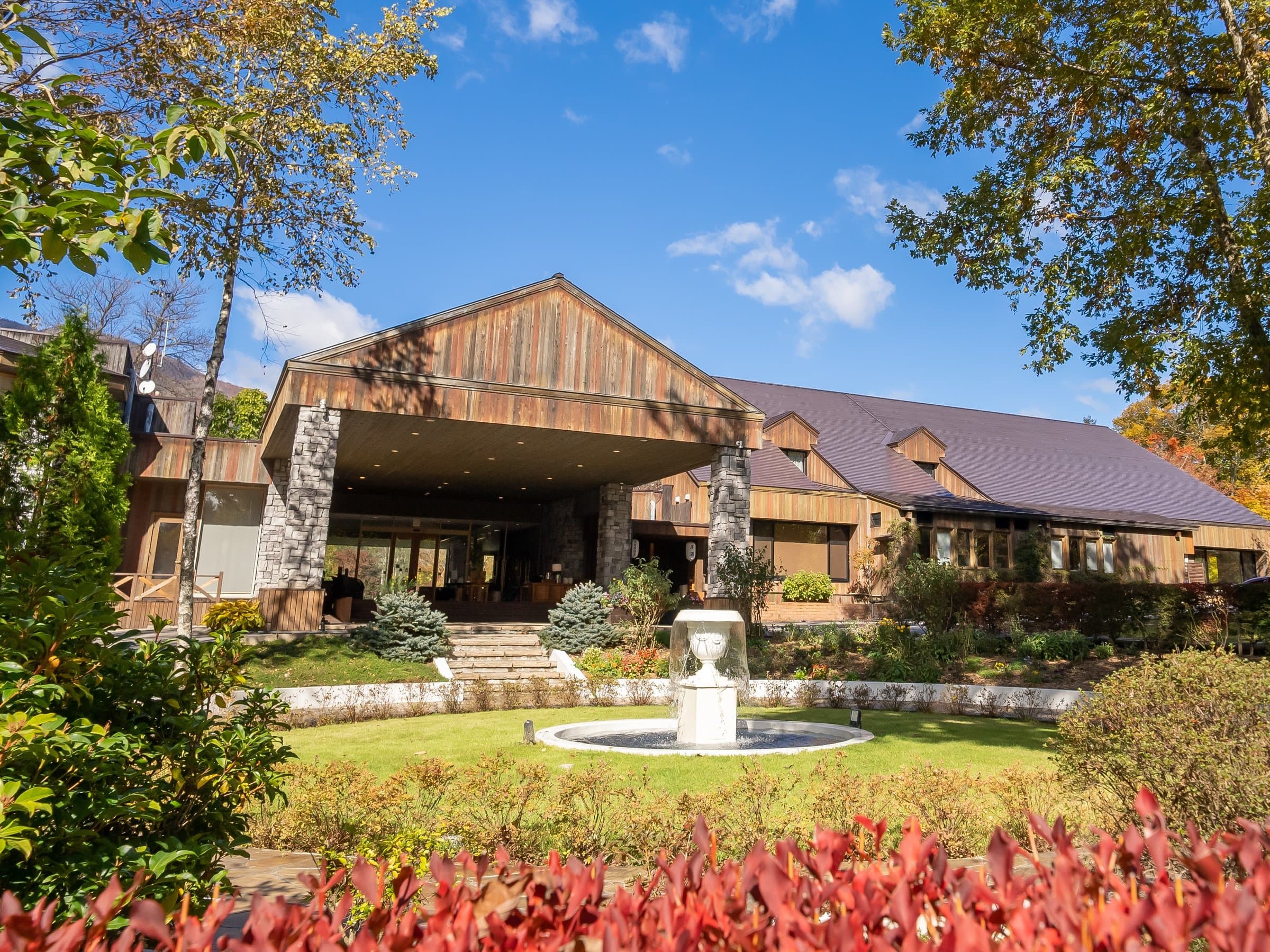 | from US$118/person/night≈ US$236 for 2 | 9.1 101 reviews | Book on Agoda |
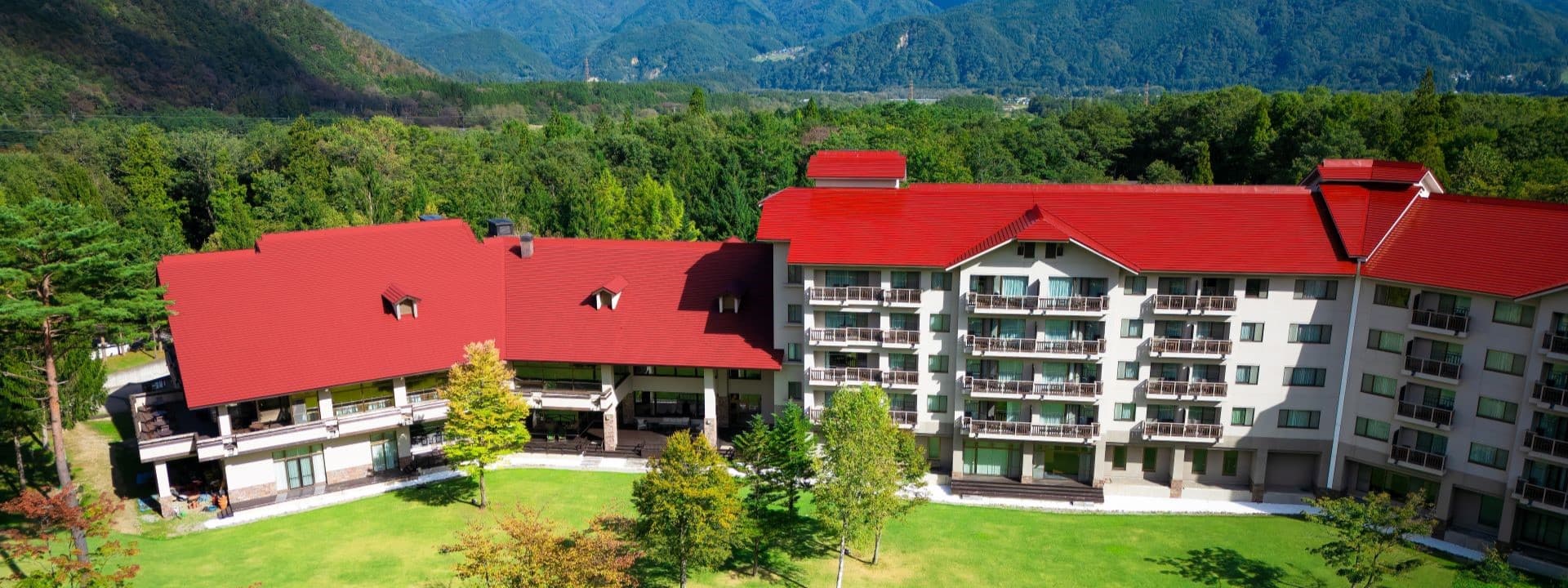 | from US$163/person/night≈ US$326 for 2 | 9.2 562 reviews | Book on Agoda |
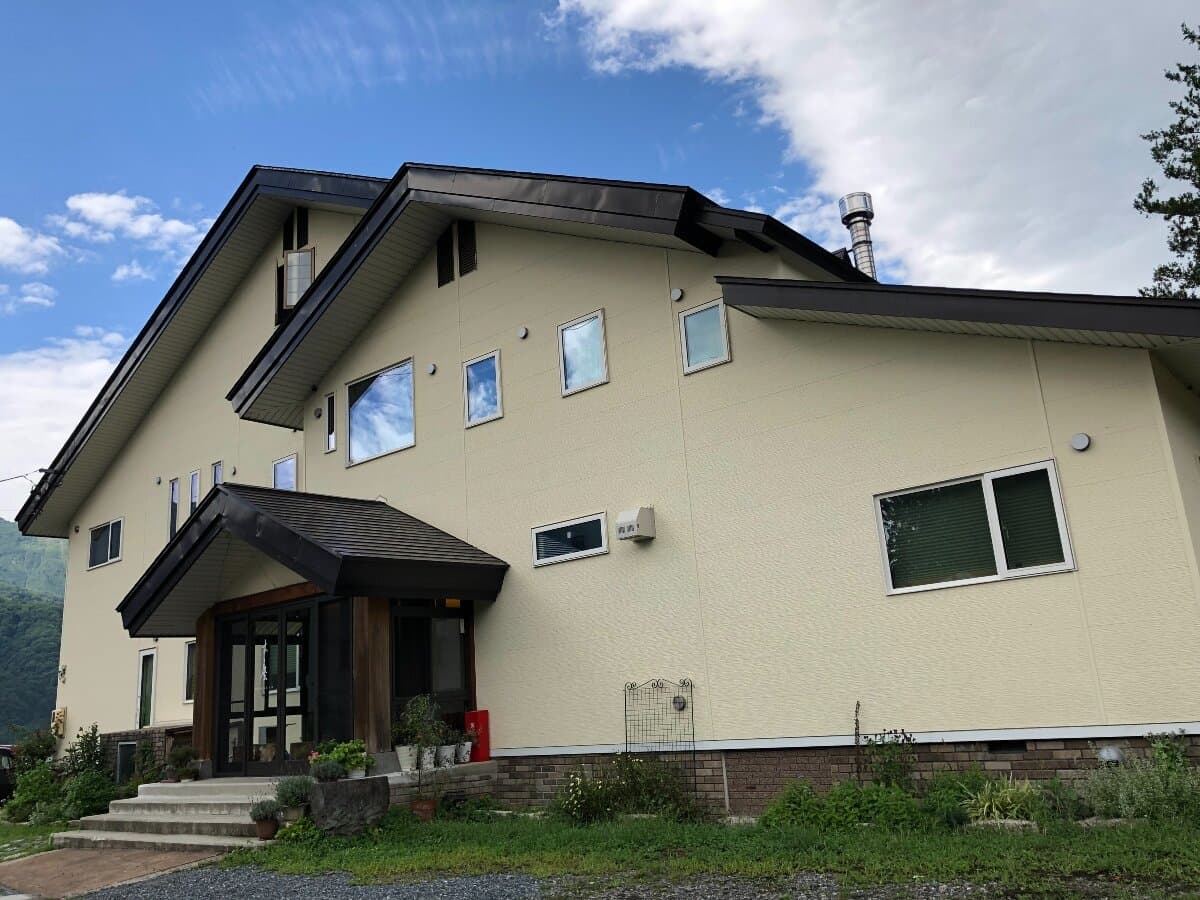 | from US$100/person/night≈ US$200 for 2 | 9.0 61 reviews | Book on Agoda |
Oomukou Ryokan
Hakuba
Ryokan Furuya
Hakuba
Matsunoki-tei
Hakuba
Hotel Cerulean Alpen
Hakuba
Hakuba Tokyu Hotel
Hakuba
Ryokan Mokuzin
Hakuba
Prices shown are approximate starting rates per person per night. We may earn a commission on bookings.

You ski a metre of overnight powder down Happo-One's front face, your thighs burning by the final groomed run-out. At 4pm you strip your boots at the ryokan door, pad to the changing room in the provided yukata, and lower yourself into water that feels almost soapy — silky enough that the sensation registers before the heat does. This is what the best ryokans in Hakuba were designed to deliver. The spring beneath Happo Village is pH 11.2 alkaline hydrogen — Japan's only confirmed natural hydrogen hot spring, flowing from serpentine rock deep under the Northern Alps. By the time kaiseki dinner is served at 6:30pm, your legs have stopped aching.
That sequence — hard skiing, alkaline soak, multi-course dinner — is the reason skiers choose a ryokan over a lodge. It is not nostalgia. It is the most effective post-ski recovery stack available at this mountain, and for what you get — source-fed alkaline water, tatami, kaiseki — the value is hard to match at a Western ski hotel.
Hakuba Valley in Nagano Prefecture is Japan's flagship ski destination for international visitors. In the 2025-26 winter season, HAKUBAVALLEY TOURISM DMO recorded 1.925 million total visitors — a decade high — with 925,000 international visitors making up 48% of that figure, up 17% year-on-year [travelvoice.jp]. This is not a quiet insider's spot. It is a fully functioning international ski resort that also happens to sit on a pH 11.2 alkaline hydrogen spring that ranks among the most distinctive in Japan.
This guide covers the 10 published ryokans in our Hakuba area database, ranked by ski-access tier rather than price or star rating. Skiers comparing all of Japan's ski-onsen destinations can find the national picture at best ryokans near ski resorts in Japan; this guide goes deep on Hakuba specifically. Every property profile below answers five questions: lift proximity, onsen type, tattoo reality, English support, and price. Kaiseki dinner at 6–7pm is fully compatible with a full ski day — and we explain exactly how. Tattoo policy gets a per-property answer, not a blanket claim.
The same ryokans work as summer hiking bases from June through October. This guide is written for skiers.
How We Chose These 10 Hakuba Ryokans — and How to Read This Guide
Every property here is live in the Japan Ryokan Guide database for the Hakuba area, with verified affiliate booking links across Agoda, Trip.com, and Booking.com. The selection is not editorial curation from a single visit — it is the complete set of published Hakuba ryokans in the DB, cross-checked against official property sites, major OTA listings, and specialist Japan ski travel agents.
No facts have been invented. Room counts, onsen types, and lift distances are sourced from official property sites, Japanese booking platforms (Jalan.net, Snownavi), and international ski specialists. Where a fact could not be verified, this guide says so explicitly.
Each property verdict covers five axes:
1. Ski Access — tier and distance to nearest lift (under 10 min walk = Tier 1; complimentary shuttle = Tier 2) 2. Onsen — water type and whether a private bath is available 3. Tattoo — per-property honest answer; only one property in this guide has a confirmed solution. For tattoo-friendly ryokans in Japan, private baths (kashikiri-buro) are always the safest route 4. English — front-desk reality, not just OTA listing presence 5. Price — per person per night with meals where applicable; verified prices use exact figures, unverified use an approximate (~) prefix
The tier system: Tier 1 = under 10 minutes on foot to a lift or slope base. Tier 2 = complimentary shuttle, typically 4–15 minutes. All 10 properties have either walk or shuttle access — no taxis required to reach a lift.
Pricing note: the verified prices quoted (Marukin, Shirouma-so, Hifumi) are shoulder-to-mid-season rates. January–February peak powder season typically adds a 20–40% premium on top of these figures.
Hakuba Valley Zones and the Ski-Access Tier Framework
Nagano prefecture has two very different ryokan worlds — the temple-city inns of Nagano city (the shinkansen hub and gateway to Jigokudani Monkey Park, for travellers also visiting snow monkey country) and the ski-mountain inns of Hakuba Valley. They share little except their prefecture. Understanding which zone of Hakuba you're booking into matters more than almost any other decision you'll make.
The valley has four distinct personalities:
Happo Village and Wadano is the international hub — the densest concentration of ryokans, restaurants, après-ski bars, and ski rental shops. Happo-One ski resort, the largest in the valley and the venue for alpine speed events at the 1998 Nagano Winter Olympics [Wikipedia], anchors this zone. Walk to the gondola in your ski boots. This is where the most Tier 1 properties sit.
Echoland runs along the main highway through Hakuba village — more nightlife-focused, with bars and international restaurants, plus shuttle access to the slopes. Quieter than Happo Village at first light, louder after 5pm.
Goryu-Iimori / Hakuba 47 is mid-valley, calmer terrain — ideal for families and beginner-intermediate skiers. Hakuba 47 and Goryu are one connected resort with gentler runs than Happo-One's upper face. The crowd profile here skews younger and family-oriented.
Tsugaike Kogen and Cortina (Otari village) sits at the northern end of the valley. This is where Siberian snowfall dumps first — the northernmost ridgeline catches Japan Sea Effect snow before any other zone. Quieter, fewer restaurants, but the deepest powder and some of the best tree skiing in Japan. Trade-off: 45 minutes back to Happo Village nightlife.
Getting to Hakuba from Tokyo
Three options, each with a different calculus:
- Shinkansen to Nagano + Alpico bus (~3 hours total): The fastest combination. JR Hokuriku/Nagano Shinkansen to Nagano Station (~90 min), then Alpico bus from East Exit Bus Stop #26 to Hakuba Happo Bus Terminal (~1h 40min). Approximately ¥14,500–¥15,500 one-way [thehakubacollection.com]. 13 services per day in winter. This is the most reliable option and drops you directly at the centre of Happo Village. - Direct highway bus from Shinjuku (~5 hours): Cheapest at ¥6,400–¥7,800 [tokyocheapo.com]. Note: ski and snowboard equipment is not permitted on the Alpico overnight trunk service. One suitcase only. If you're travelling with gear, use takkyubin (luggage forwarding) from your Tokyo accommodation to your ryokan a day ahead. - JR Azusa express via Matsumoto (~3h 40min): Approximately ¥8,270 [thehakubacollection.com]. Skis and boards can be loaded. Slower than the shinkansen combination but gear-friendly and scenic through the Matsumoto basin.
Once in Hakuba, the free HAKUBAVALLEY shuttle links all major resorts through ski season — essential if you're staying at a Tier 2 property and want multi-resort access.
At a Glance: All 10 Hakuba Ryokans Compared
Use the table to match your tier preference first, then read the full profile. Private baths sidestep public-bath tattoo restrictions at any property that offers them.
| Property | Zone / Location | Tier | Nearest Lift | Onsen Type | Private Bath? | Tattoo OK? | English | Price Band (pp/night) | Best For |
|---|---|---|---|---|---|---|---|---|---|
| Hakuba Marukin Ryokan | Happo Village | 1 – walk | 300m to Nakiyama slope | Happo Onsen pH 11.2 | No (unconfirmed) | Unconfirmed — ask | Moderate | from ¥9,900 pp (room only, 28 Oct 2026 stay) | Value with authentic Happo onsen |
| Hakuba Onsen Ryokan Shirouma-so | Happo Village | 1 – walk | 5–7 min to Nakiyama | Happo Onsen, source-fed | Yes (rental) | Unconfirmed — ask | Strong | from ¥18,000 with breakfast | First-time ryokan visitors |
| Yamanosato Hotel Hakuba Hifumi | Happo Village | 1 – walk | 8 min to gondola | Happo Onsen pH 11.2 | Yes (6 private rotenburo) | Yes — private rooms only | Strong | ¥23,100–¥34,100 with meals | Couples, tattooed guests |
| Oomukou Ryokan | Happo Village | 1 – walk | 450m to slopes | Happo Onsen thermal | No (unconfirmed) | Unconfirmed — ask | Strong (Yuko-san) | ~¥14,000/night | Budget, solo skiers |
| Ryokan Furuya | Happo Village | 1 – walk | 6 min to slopes | Happo Onsen alkaline | No (unconfirmed) | Unconfirmed — ask | Limited | ~¥14,000–21,000/night | Traditional tatami, mid-budget |
| Matsunoki-tei | Tsugaike (Otari) | 1 – slope-to-door | Steps from Oya-no-hara | On-site hot bath (NOT natural onsen) | Possible (unconfirmed) | Unconfirmed — ask | Moderate | Contact property (~$84 JRG) | Powder chasers, Tsugaike/Cortina |
| Hotel Cerulean Alpine (also listed as Alpen) | Tsugaike (Otari) | 1 – walk | 3 min to Tsugaike | Himekawa natural spring | No (unconfirmed) | Unconfirmed — ask | Limited | ~$130/night (approx) | Budget Tsugaike base |
| Hotel Sierra Resort Hakuba | Kitashiro (forest) | 2 – shuttle | 5 min shuttle to Tsugaike | Mizubasho source, sodium bicarbonate | Yes (3 private baths) | Unconfirmed — private baths available | Strong | from ¥18,240 pp (breakfast) | Special occasions, luxury |
| Hakuba Tokyu Hotel | Happo Village area | 2 – shuttle | Multi-resort shuttle | Happo Onsen pH 11.2, 4 baths | No (unconfirmed) | Unconfirmed — ask | Strongest | ~¥27,000–37,000/night (approx) | Groups, families, chain reliability |
| Ryokan Mokuzin | Kamishiro (~5.7km from Happo) | 2 – shuttle | 4 min to Goryu | Hot spring on-site (source unconfirmed) | No (unconfirmed) | Unconfirmed — ask | Limited | ~$100/night (approx) | Families, quiet retreat, Goryu terrain |
Tier 1 — Walk to the Lifts: Happo Village Ryokans
Tier 1 in Happo Village means 300m to 600m of flat village street between you and either the Nakiyama slope base or the Happo-One gondola — a walk you will do in ski boots, possibly holding coffee. No shuttle dependency, no timing anxiety, no waiting in a cold car park.
Happo Village is the most self-contained ski base in the valley: ski rental shops, international restaurants, the occasional bar showing Australian Rules Football at 7am. You pay a small location premium for all of this. For skiers who want to maximise slope time and avoid shuttle dependency, the premium is usually worth it.
Hakuba Marukin Ryokan — The Classic, 300m from the Slopes
Marukin has been doing this since 1949, making it the oldest operating ryokan in our Hakuba database. The building has been updated over the decades but the rhythm has not: guests arrive, remove boots at the entrance, change into yukata, and settle into an inn that feels genuinely old rather than styled to feel old. Thirty rooms — 23 tatami, 7 Japanese-Western hybrid — sleep up to 100 guests, which means it can handle ski groups without feeling empty and couples without feeling institutional.
The 300m to Nakiyama slope is the closest walk-to-lift distance of any ryokan in this guide. First chair at 8am is realistic without an alarm set before 7am. The Happo Onsen bath is source-fed directly from the same pH 11.2 alkaline hydrogen spring as the public Happo-no-Yu bathhouse — the water that leaves your skin smooth enough to notice in the changing room. Owner-grown rice appears at dinner alongside local Shinshu mountain vegetables and whatever is seasonal. Lunch rice balls (¥870) are available for those who need something to carry to the gondola.
What Marukin does not offer: a confirmed private rental bath, and dedicated English-speaking staff. The inn is listed on Booking, Agoda, and international platforms, but communication works better in writing before you arrive than verbally at the front desk.
Check current rates and availability for Hakuba Marukin Ryokan — booking early is essential for January stays.
Verdict — Hakuba Marukin: Ski Access ★★★★★ | Onsen: Happo pH 11.2, shared | Tattoo: unconfirmed — contact inn before booking | English: moderate | Price: from ¥9,900 per person per night (room only, official site, for a 28 October 2026 stay, checked 8 October 2026) | Best For: value-seekers who want authentic Happo Village onsen at the closest walk-to-lift ryokan in the valley
Hakuba Onsen Ryokan Shirouma-so — Modern Comfort at the Slope Base
Shirouma-so is the easiest ryokan on this list to book if you have never stayed in one before. The English website does what few Japanese inns bother to do: it publishes prices clearly, explains room types, runs a reservation system in English, and accepts Visa, Mastercard, Amex, and UnionPay [shiroumaso.com/english/]. For a first-time ryokan guest arriving from Australia or Canada, that transparency removes most of the booking anxiety.
The location sits at the base of Happo-One ski area — 5 to 7 minutes on foot to the Nakiyama slope, 10 minutes to the main gondola, with the bus terminal steps from the front door. Guests can buy discounted Happo-One day lift tickets directly at the inn, skipping the resort ticket queue on busy powder mornings — ask the inn for its current rate (the resort's own 2026-27 high-season adult 1-day ticket is ¥9,800, per its official price list).
The shared baths are Happo Onsen source-fed, with picture-window mountain views — the kind of bath where you crane your neck to watch skiers come down the piste while you soak. A private rental bath is available by reservation, which is useful for guests who prefer privacy regardless of any tattoo consideration.
The con: Shirouma-so's modern aesthetic — clean lines, contemporary touches — works against guests seeking deep-traditional atmosphere. This is a ryokan by format (tatami, futon, kaiseki-style dinner options), not by feeling.
Check current rates for Hakuba Onsen Ryokan Shirouma-so — the English booking system makes it straightforward to compare room plans and dinner add-ons before confirming.
Verdict — Shirouma-so: Ski Access ★★★★★ | Onsen: Happo source, shared + private rental | Tattoo: unconfirmed — private bath available | English: strong (full English site) | Price: from ¥18,000–¥20,400/person with breakfast; dinner add ¥4,800 | Best For: first-time ryokan visitors, solo travellers, anyone who wants the onsen-discount-ticket combination sorted before they land
Yamanosato Hotel Hakuba Hifumi — 6 Private Rotenburo Rooms, the Couples Pick
Hifumi is the only property in this guide where we can give you a direct answer on the tattoo question: the six private outdoor rotenburo rooms explicitly accommodate tattooed guests. Selected-ryokan.com notes the private onsen rooms for "(For couple, family, tattoo)" — a rare concrete statement in a category full of evasion. For tattooed guests in Japan, booking one of these six rooms sidesteps the public-bath question entirely. The public shared bath policy remains unconfirmed — do not assume it extends there.
With only 10 rooms total (6 with private open-air rotenburo on the terrace, plus 1 shared rental indoor bath available in 60-minute slots from 2pm–11pm and 6am–11am), Hifumi is the most private inn on this list. The trade-off is availability: 10 rooms book out fast. For January, plan to reserve 9 to 12 months ahead.
The walk to the Happo-One gondola is 8 minutes, which is perfectly manageable. The Happo Bus Terminal is 2 minutes away for days when you want to shuttle to Goryu or another resort. The standard plan includes a full kaiseki dinner and Japanese breakfast — the most complete meal package of any Tier 1 Happo Village ryokan in this guide.
At ¥23,100–¥34,100 per person with meals, Hifumi sits at the premium end of the Happo Village tier. The private rotenburo, the intimacy, and the tattoo solution justify the price for the right guest — specifically, couples where one or both have visible ink and have been turned away from public baths elsewhere in Japan.
Check current availability for Yamanosato Hotel Hakuba Hifumi — the six private rotenburo rooms go first, so confirm your room type at booking.
Verdict — Hifumi: Ski Access ★★★★☆ | Onsen: Happo pH 11.2, 6 private outdoor rotenburo + 1 shared rental | Tattoo: confirmed OK in private rotenburo rooms only | English: strong (English site, Japan Ski Experience agent) | Price: ¥23,100–¥34,100/person with meals | Best For: couples, tattooed guests booking private-bath rooms, honeymoon and anniversary stays
Oomukou Ryokan — The Budget Pick with an English-Speaking Host
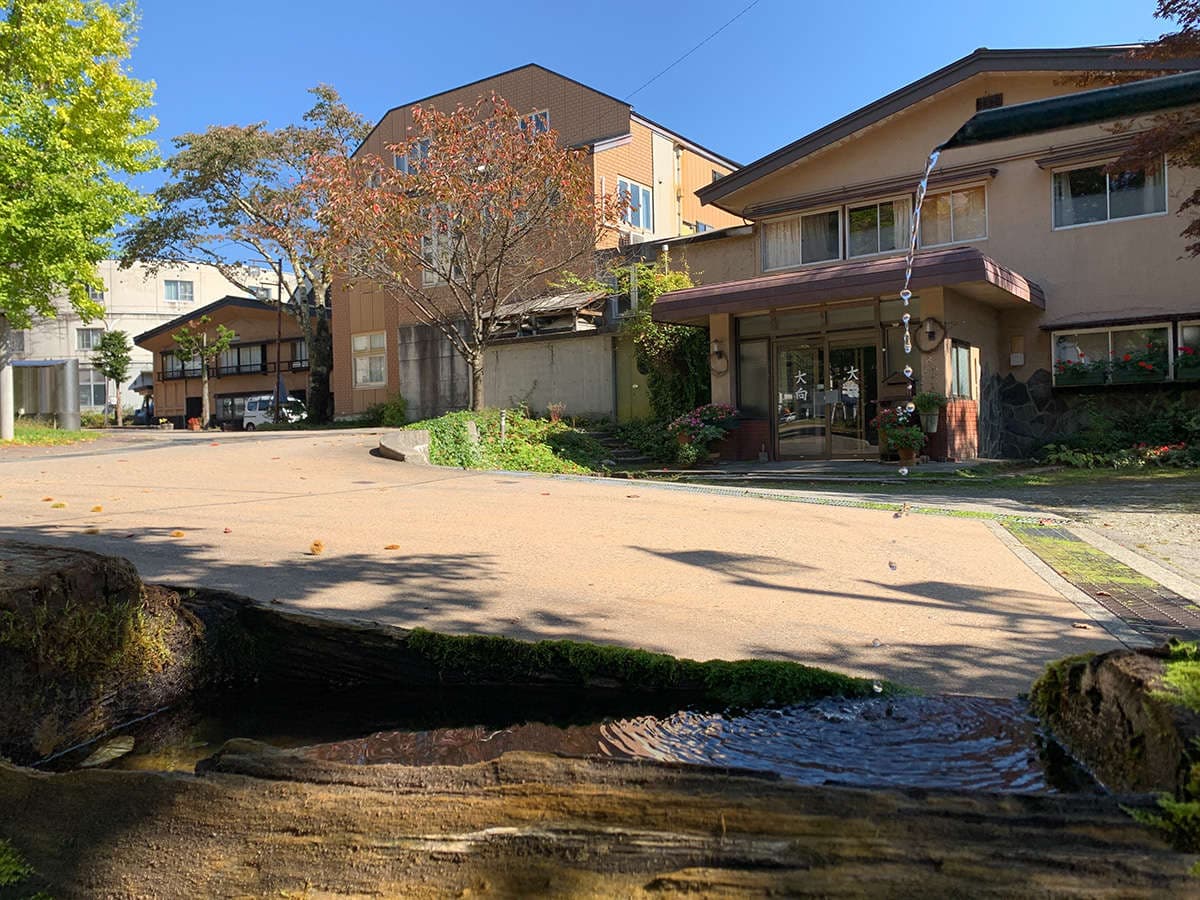
The honest pitch for Oomukou: it is the cheapest way to stay 450m from Happo-One's slope base with an English speaker at the front desk. Most budget ryokans in Japan require a confidence threshold to book — no English website, Japanese-only communication, uncertain check-in logistics. Oomukou removes that barrier through Yuko-san, the host, whose English is praised across multiple guest reviews. That matters more than it sounds when you arrive off a five-hour night bus with ski gear and no ability to read the check-in form.
The inn has approximately 10 rooms (some OTAs list only its 4 currently bookable units), is family-run, and sits 290m from the Happo Bus Terminal — useful for catching the inter-resort shuttle on days you want to ski Goryu or Tsugaike. The on-site Happo Onsen bath is alkaline thermal source-fed. Free parking is rare in Happo Village and makes Oomukou the natural pick for groups driving in from Matsumoto or Nagano city. Ski gear storage is on-site.
At roughly ¥14,000 per night based on the JRG display price ($93/night — unverified exact peak rate), Oomukou is the budget anchor of the Happo Village tier. Traditional Japanese breakfast is confirmed; check dinner availability when booking — it is not guaranteed as a standard inclusion.
Booking.com is the primary channel. No dedicated official website exists — do not try to find one.
Check rates and availability for Oomukou Ryokan on Booking.com — availability is tight at approximately 10 rooms.
Verdict — Oomukou: Ski Access ★★★★★ | Onsen: Happo thermal bath | Tattoo: unconfirmed — ask directly | English: strong (Yuko-san) | Price: ~¥14,000/night (approx, unverified) | Best For: solo budget skiers, small groups wanting authentic family hospitality with English communication
Ryokan Furuya — Mid-Budget Happo Onsen with Tatami Rooms
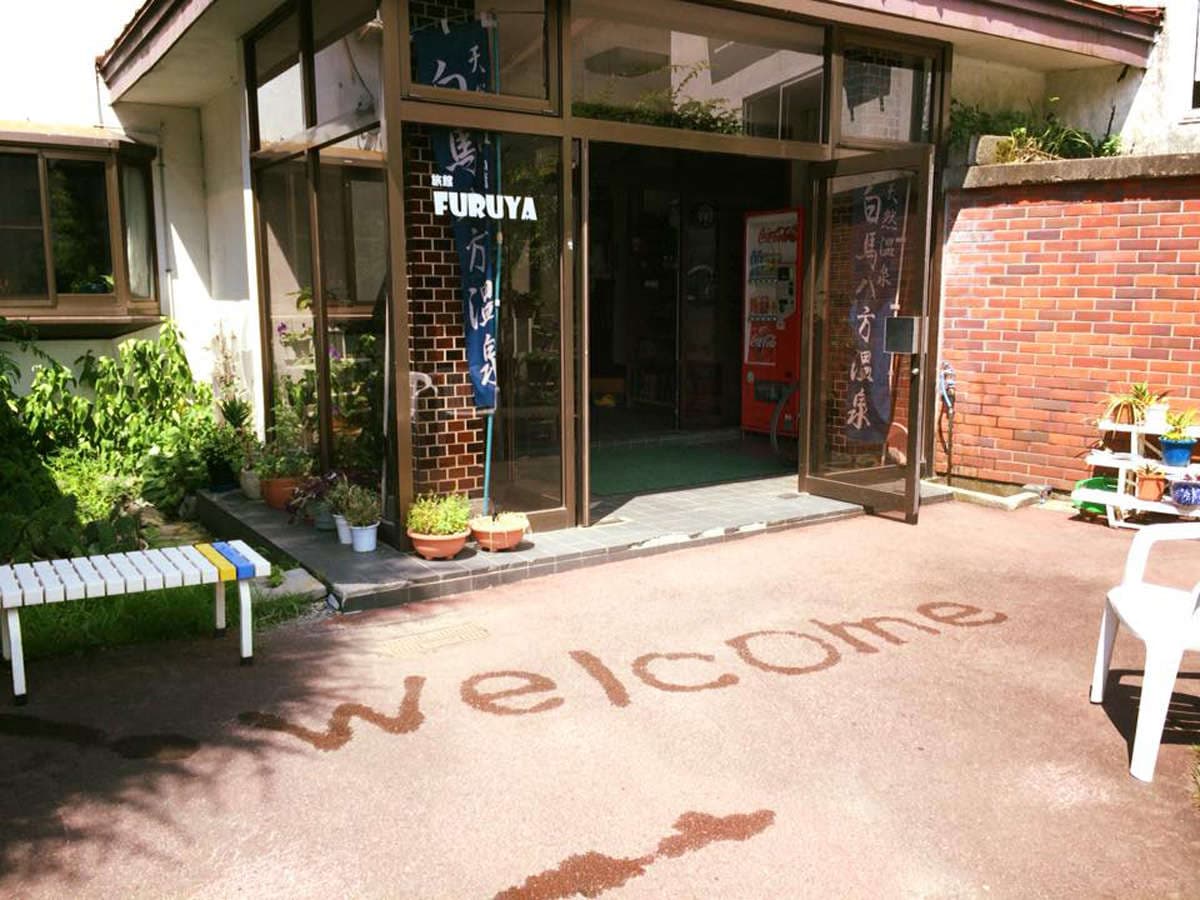
Furuya fills the gap between Oomukou's budget pricing and Hifumi's premium tier — 16 rooms, natural alkaline Happo Onsen baths, tatami floors with futon, 6 minutes on foot to the Happo-One slopes and 2 minutes to the bus stop. Some room types pair a private spa bath alongside the tatami and futon setup — an unusual configuration at this price point, since most Happo Village ryokans in the ¥14,000–¥21,000 range ask you to choose between traditional format and a private soak, not offer both. At a similar mid-budget level, Oomukou has the English advantage and Shirouma-so the full English booking infrastructure; Furuya's differentiator is that tatami-plus-private-tub room type.
The main constraint is English. Furuya has no dedicated English website — international OTA listings are the booking entry point, and front-desk communication in English appears limited. For guests who want to clarify meal plans, onsen schedules, or ski storage arrangements before arriving, an email before booking (via the OTA message system) is strongly recommended.
OTA rates start around ¥7,500 off-peak but expect closer to ¥20,000+ in ski season, based on the JRG display price ($140/night — unverified at the official site level). Japanese meals are available; confirm the dinner plan and schedule at booking since it does not appear to be universally included.
Check current ski-season rates for Ryokan Furuya — confirm the dinner plan and meal schedule by message before arrival.
Verdict — Furuya: Ski Access ★★★★★ | Onsen: Happo natural alkaline, shared | Tattoo: unconfirmed — ask directly | English: limited (OTA listings — confirm details by email before booking) | Price: ~¥14,000–21,000/night ski season (approx, unverified) | Best For: traditional tatami experience on a mid-budget; guests comfortable handling self-sufficient booking logistics
Tier 1 — Walk to the Lifts: Tsugaike and Otari Base
The northern end of Hakuba Valley operates on different snow physics. Tsugaike Kogen and Cortina sit closest to the Sea of Japan — Siberian air dumps its moisture here first, before the warmer valley air can rob it of its dryness. The ryokans at this base have genuine slope-side access, fewer restaurants within walking distance, and a quiet that Happo Village cannot match after 7pm.
The trade-off is real: you are 45 minutes from Happo-One's après-ski scene. If powder depth and slope-side convenience matter more than nightlife, this is the end of the valley for you.
Matsunoki-tei — Ski-to-Door on Oya-no-hara, Tsugaike's Deepest Powder Base
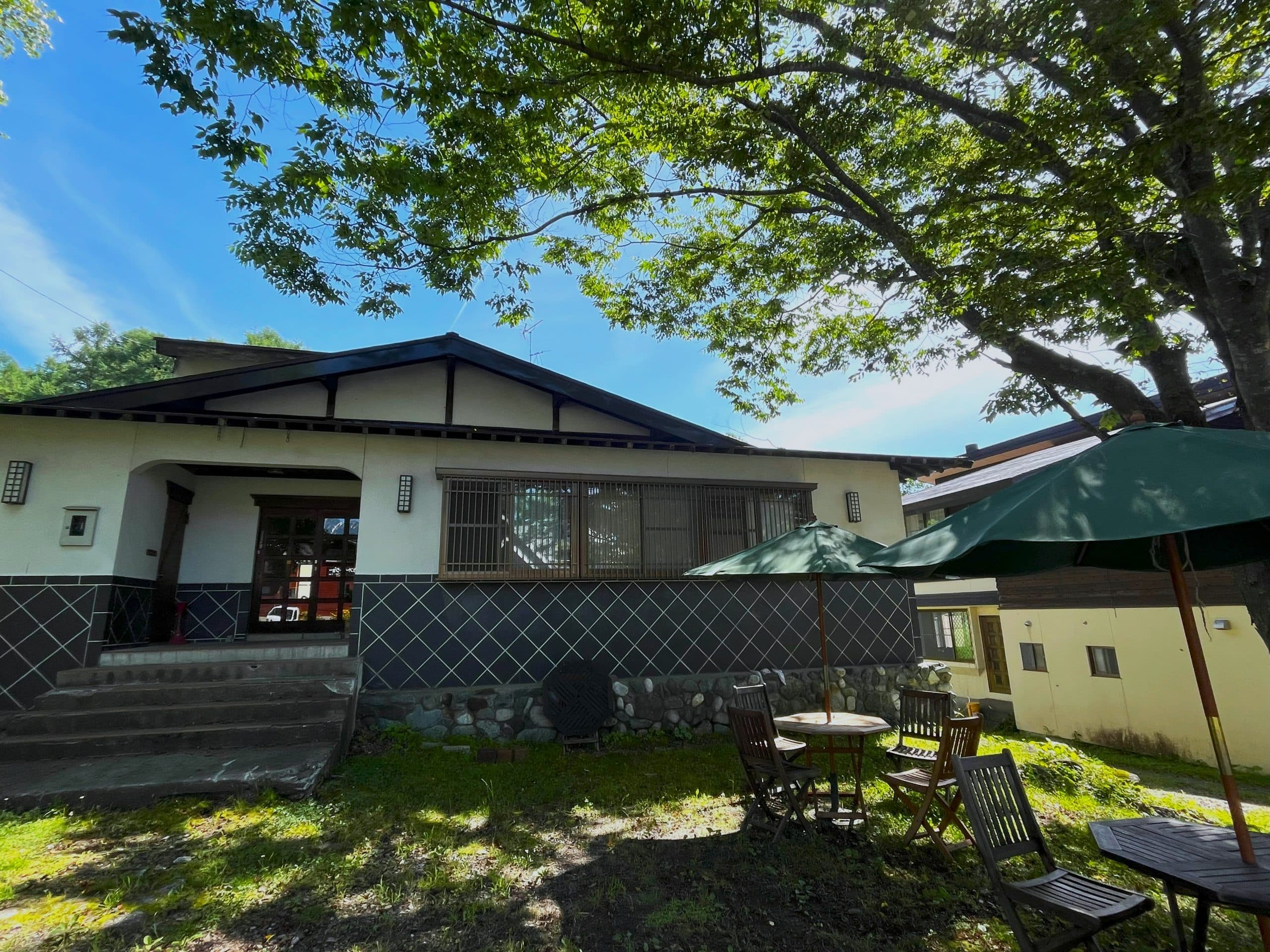
The access claim at Matsunoki-tei is the strongest in this guide: steps from the Oya-no-hara slope at Tsugaike Kogen, 4 minutes on foot to the Tsugaike Gondola 'Eve'. No property in this database puts you closer to snow. For powder-focused skiers and snowboarders targeting Tsugaike and Cortina terrain, this is the answer before you look at any other criterion.
The inn occupies Otari village at the northern end of the Hakuba valley, with 15 guest rooms in the main building plus a private chalet called Irori. The Irori chalet has no meals included — flag this if you are booking it. Main building guests get homemade dinners built on local Shinshu ingredients: shabu-shabu, sukiyaki, fresh mountain vegetables, regional meats. Breakfast is included in the standard plan. The official site confirms English and basic Chinese support, which makes logistics manageable for non-Japanese speakers.
One important clarification on the baths: the JRG area page explicitly notes "No natural onsen" for Matsunoki-tei. The inn has an on-site hot bath and the website references it as an amenity, but no spring quality data appears in available sources. Do not book Matsunoki-tei expecting the Happo Onsen experience — you are here for the powder access, and the soak is a comfort addition, not the draw.
Price is contact-direct from the official site; the JRG display shows approximately $84/night (unverified). Cortina resort is also accessible from this base, giving advanced skiers tree runs that rarely appear in the Happo-One conversation.
Contact Matsunoki-tei directly for current rates and availability — the official site does not list prices online.
Verdict — Matsunoki-tei: Ski Access ★★★★★ (slope-to-door) | Bath: on-site hot bath (not a natural onsen) | Tattoo: unconfirmed — ask directly | English: moderate (English site) | Price: contact property directly (~$84 JRG approximate, unverified) | Best For: powder-obsessed skiers targeting Tsugaike and Cortina; couples in the Irori chalet wanting maximum slope access
Hotel Cerulean Alpine — Tsugaike Base with Himekawa Natural Onsen
A name note first: this property appears on international OTAs as "Hotel Cerulean Alpine" and on some Japanese platforms as "Alpen." Same inn, same Tsugaike address — Hotel Cerulean Alpine (also listed as Alpen).
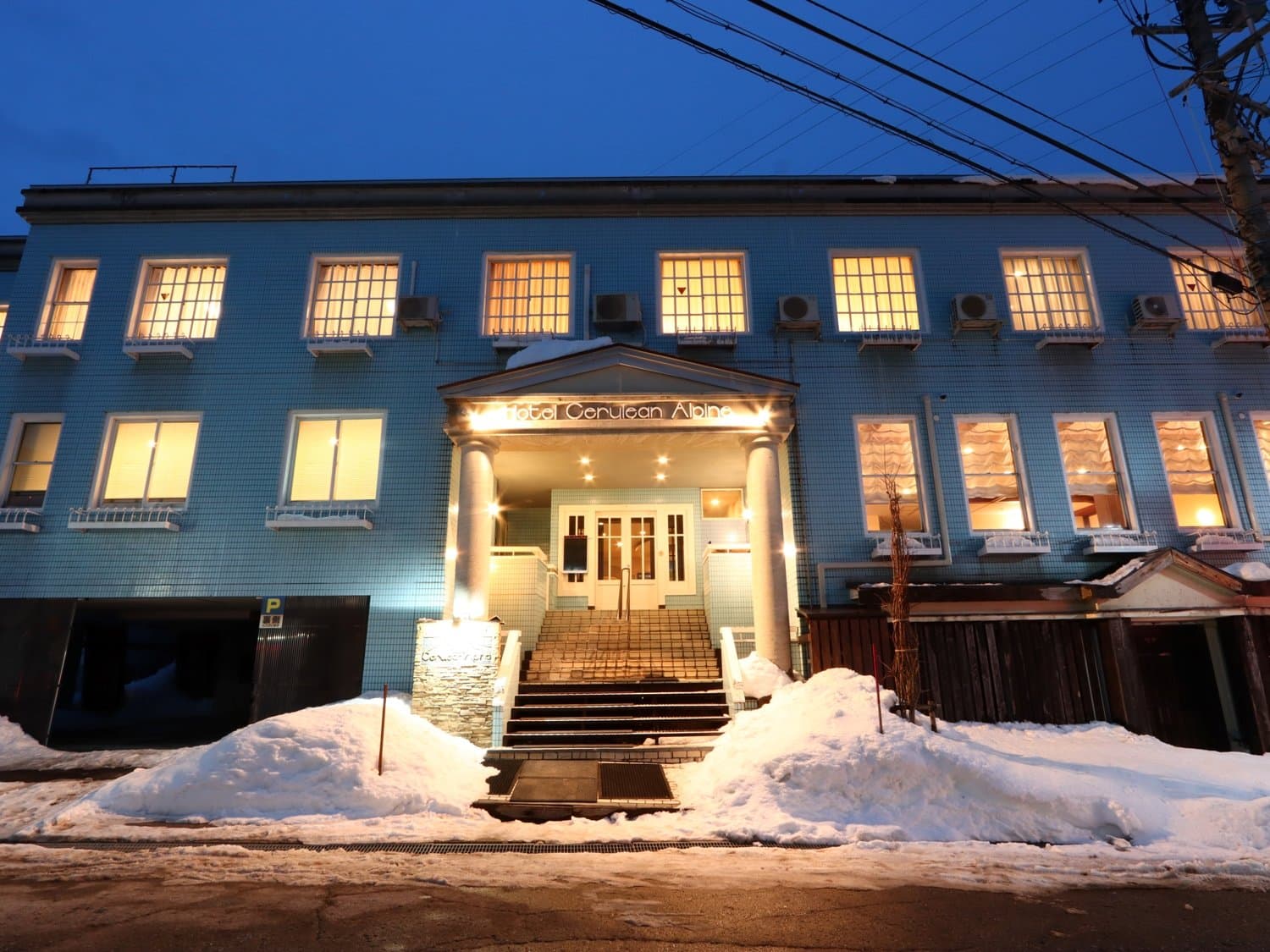
Three minutes on foot to Tsugaike Kogen Ski Area. That single fact earns it a place on this list. Tsugaike's lower mountain is wide-open beginner and family terrain — forgiving runs where you can find your ski legs after a long flight; the upper mountain, where the Japan Sea storm cycles pile their moisture first, is where powder accumulates to thigh depth on the right morning. Cerulean Alpine sits at the bottom of all of it, with a ski rental shop next door so you can arrive in Otari village without gear and be on snow the same afternoon.
The property runs 25 rooms — 21 Western-style (5 singles, 14 twins, 2 others), 2 Japanese-style, 2 Japanese-Western mixed — which makes it the largest property at the Tsugaike base in this guide and also the most hotel-like. This is its main honest limitation: with only 2 tatami rooms, Cerulean Alpine is the least traditionally Japanese property in the entire guide. If you are choosing Hakuba for the ryokan experience — tatami floors, futon, kaiseki — book elsewhere.
The Hakuba Himekawa Onsen is a genuine natural spring, one of the valley's five named sources serving the Otari area rather than the Happo Village cluster. Two indoor baths, one per gender — that is the full setup. No outdoor rotenburo, no sauna, nothing to linger over at dusk watching snow fall on the mountains. It is a simpler bath than anything in Happo Village, but it is spring-fed natural water after a day in the powder, which is a different proposition than a hotel bath.
Discount lift tickets at the front desk. English support is limited — book via Klook or international OTAs and use the message function to confirm meal plan details. One more thing to factor: Tsugaike is a 50-minute drive from Happo-One. Stay here and you are committing to the northern end of the valley for the week. That suits powder-chasers targeting Tsugaike and Cortina terrain; it does not suit skiers who want multi-resort variety every day.
At approximately $130/night (JRG display, unverified), Cerulean Alpine is the most affordable natural-onsen walk-to-lift property in this guide.
Check current rates for Hotel Cerulean Alpine on Klook or international OTAs — confirm meal plan availability when booking.
Verdict — Cerulean Alpine: Ski Access ★★★★★ | Onsen: Himekawa natural spring, 2 indoor baths, no rotenburo | Tattoo: unconfirmed — ask directly | English: limited (Klook + OTAs) | Price: ~$130/night (approx, unverified) | Best For: budget powder-chasers committed to Tsugaike/Cortina terrain; skiers who want an adjacent rental shop and walk-to-gondola access without paying Happo Village prices
Tier 2 — Free Shuttle: Premium and Mid-Range Hakuba Ryokans
A complimentary shuttle to the slopes changes the calculus in one important way: it frees you from carrying skis on foot across icy village cobbles. Tier 2 properties are typically set further from the village street grid — quieter surroundings, often more resort-like amenities, and frequently multi-resort shuttle coverage that the Happo Village walk-to-lift cluster cannot match.
The con is schedule dependency. Shuttles run on timetables, and missing the last one back means a taxi. Check shuttle hours at booking, particularly for days when you want to ski until the last run.
Hotel Sierra Resort Hakuba — Private Spring Source, French Dining, Forest Retreat
Sierra Resort sits in a private birch forest in Hakuba's Kitashiro area, 10 minutes by car from JR Hakuba Station. The complimentary luxury van shuttle covers Tsugaike and Iwatake in 5 minutes, Happo-One in 10 — not walk-to-lift, but a quiet, warm ride that makes the distance feel deliberate rather than inconvenient.
The onsen here is entirely different from anything else in this guide. Hakuba Mizubasho Onsen (白馬みずばしょう温泉) is a sodium bicarbonate (重曹泉) spring exclusive to Sierra Resort — the property's own private source, flowing at 200+ litres per minute, 100% undiluted [sierraresort.jp]. The main bath, Kominka no Yu, occupies a 150-year-old kominka timber bath house with a large indoor pool, a cypress outdoor bath, and a rocky outdoor rotenburo. Opening hours run 6:00–11:00 and 13:00 through 2:00am — long enough that you will not miss your window after skiing.
Three private rental baths are available for guests: a Japanese-style room, a Thermae Romae-themed tub, and a five-right-emon (五右衛門風呂) traditional wooden tub. Reservations open from 13:50 each afternoon. These private baths are a practical solution regardless of tattoo policy, though Sierra's public-bath tattoo policy is unconfirmed — contact the property directly if this matters to your group.
The dining here is the most distinctive in the guide: award-winning chef, full-course French and Nouvelle cuisine dinner. Jacuzzis in every room; heated floors throughout. The property sits across twin, double, and junior suite room categories — intimate layout, not disclosed total room count.
Rates start from ¥18,240 per person per night (breakfast, official site, checked October 2026), and the spread is wide across seasons. This is the luxury tier — book it for an anniversary, a honeymoon, or the kind of powder week you have been planning for two years.
Check current rates for Hotel Sierra Resort Hakuba — rates vary across the season, and peak January pricing sits toward the higher end.
Verdict — Sierra Resort: Ski Access ★★★☆☆ (shuttle) | Onsen: private Mizubasho source, sodium bicarbonate, 3 private baths + large shared kominka bath | Tattoo: unconfirmed for public bath — 3 private baths available | English: strong (full English site, Japan Specialists listed) | Price: from ¥18,240 per person per night (breakfast, official site, checked October 2026) | Best For: special occasions, honeymoons, travellers who prize unique onsen water and French dining over slope proximity
Hakuba Tokyu Hotel — Full-Service Chain, Happo Onsen, Multi-Resort Shuttle
For groups and families who want certainty — chain-level booking infrastructure, multiple restaurants, and a shuttle that covers more resorts than any other property in this guide — Hakuba Tokyu Hotel is the answer. It is not a traditional ryokan. The building reads as a full-service hotel with tatami-room options and an onsen wing, which is exactly what a large group booking six rooms for a week actually needs.
The Happo Onsen here is the same pH 11.2 alkaline hydrogen spring source as the Happo Village ryokans, with four baths: two large indoor (gender-separated), two outdoor rotenburo (gender-separated), and a sauna in the men's section. Day-use is available 13:00–16:00 at ¥1,500 per adult — useful if you are meeting non-staying friends or family. Operating hours run 5:00–11:00 and 13:00 through 1:00am.
The shuttle covers Happo-One, Goryu and 47, and Tsugaike Kogen — the widest multi-resort coverage of any property in this guide. Discounted lift tickets for Happo-One and Goryu & 47 are sold at the front desk. The restaurant options include French (Chamonix), Japanese (Manyo), and buffet service — more dining variety under one roof than any other property here.
English support is the strongest in this guide: the official site runs in English, Korean, Simplified Chinese, and Traditional Chinese [tokyuhotels.co.jp], backed by the Tokyu Hotels chain infrastructure. Solo travellers who want a reliable English-language experience with onsen access and multi-resort flexibility will find everything they need without negotiating language gaps.
The honest con: if you are booking Hakuba for the ryokan experience — tatami room, intimate family-run feel, chef's kaiseki dinner — Tokyu Hotel will feel like a detour from that purpose. It is excellent at what it is; what it is, is a hotel with good onsen.
Check current rates for Hakuba Tokyu Hotel — the chain booking system handles group room blocks reliably.
Verdict — Hakuba Tokyu Hotel: Ski Access ★★★☆☆ (multi-resort shuttle) | Onsen: Happo pH 11.2, 4 baths including 2 outdoor rotenburo | Tattoo: unconfirmed — ask at booking | English: strongest in guide | Price: ~¥27,000–37,000/night (approx, unverified) | Best For: groups, families, travellers prioritising chain reliability and the widest multi-resort shuttle coverage
Ryokan Mokuzin — Quiet Kamishiro Base, Goryu Access, 9.6/10 Rating
The highest guest satisfaction rating in our Hakuba database — 9.6 out of 10 from 61 reviews [Booking.com / travelated.com] — belongs to a 10-room inn in Kamishiro that most Hakuba guides do not mention at all. That rating deserves an explanation, because Mokuzin does not have a walk-to-lift location, a famous onsen source, or a sleek English website.
What Mokuzin has is a location in Kamishiro, approximately 5.7km from central Happo Village, within 4 minutes' drive of Hakuba Goryu ski area. The free shuttle to Goryu is confirmed — Happo-One is 15 minutes by car, possible as a day trip but not the primary access. Book Mokuzin for Goryu and Hakuba 47 terrain, not for Happo-One first-chair convenience.
The property: 10 rooms, traditional Japanese setting with a small Japanese garden, wooden heated floors, and on-site hot spring baths. The spring source here is unconfirmed in available English sources — Kamishiro's location means it may draw from a different spring than the Happo Onsen cluster. Do not assume Happo Onsen water; the character of the bath may be different.
The family proposition is the clearest differentiator: free kids meals are included, special diet meals available on request, and the quiet Kamishiro setting away from Echoland nightlife creates the kind of retreat feel that relaxes a family rather than stimulating them. Traditional Japanese dinner and breakfast are included in the standard plan.
English support is limited — no dedicated website. The 9.6/10 rating across 61 reviews suggests that hospitality transcends the language barrier here, but confirm key logistics (shuttle times, dinner schedule, dietary needs) before arrival via OTA messaging.
Price: approximately $100/night per the JRG display (unverified; some OTA listings show package rates at ¥47,783 — likely a per-party multi-night figure rather than per-person per-night).
Check current rates and availability for Ryokan Mokuzin — confirm shuttle times and meal plan details via the OTA message system before booking.
Verdict — Mokuzin: Ski Access ★★★☆☆ (shuttle to Goryu) | Onsen: on-site hot spring (source unconfirmed) | Tattoo: unconfirmed — ask directly | English: limited | Price: ~$100/night (approx, unverified) | Best For: families wanting quiet away from village noise; Goryu and Hakuba 47 terrain enthusiasts; travellers who prioritise guest satisfaction over amenity checklists
Practical Tips: Making the Most of a Hakuba Ryokan Ski Trip
Booking Lead Times
For January and February — the peak powder window — book 6 to 12 months ahead. Compact inns like Hifumi (10 rooms) and Oomukou (approximately 10 rooms) fill first; book those by May or June for a January stay. For Chinese New Year (late January to early February), 9 months minimum is realistic for any Tier 1 Happo Village ryokan.
March is the value window. Snow is typically still excellent — Hakuba averages 655 cm of cumulative snowfall per season [onthesnow.com] — and crowds thin from mid-March onward. Expect prices 20 to 40% below peak January-February rates for equivalent properties. March stays can usually be booked 3 to 6 months out.
For a broader primer on the ryokan format and how it fits ski travel, the first-time ryokan guide covers the cultural context in more depth.
The Kaiseki Schedule on a Ski Day
Kaiseki dinner is typically set between 6pm and 7pm at Hakuba ryokans — and this is not a problem once you plan around it. Leave the mountain by 3:30–4pm (last gondola is typically around 4:30–5pm depending on the day), check in and change, soak in the onsen for 20–30 minutes (most large baths open their afternoon session from around 5pm), and you arrive at the dining room relaxed rather than rushed. The onsen window between skiing and dinner is the point of the whole exercise.
Some properties allow flexible dinner timing — ask at booking whether a 7pm or later seating is possible if you prefer a longer afternoon on the mountain.
Tattoo Reality
Only Hifumi has a confirmed solution: six private outdoor rotenburo rooms explicitly accommodate tattooed guests. Hotel Sierra Resort's three private rental baths are a practical alternative at any property regardless of public-bath policy. For all tattoo-friendly ryokan questions about public shared baths at the other eight properties, the honest answer is to contact the inn directly before booking — none of their public-bath policies are confirmed in publicly available sources.
Private baths (kashikiri-buro) sidestep the public-bath restriction at any property that offers them. Reserve a property with a private rental bath option (Shirouma-so, Sierra Resort) and the question becomes moot.
Peak Season Pricing
The prices in this guide are shoulder-to-mid-season reference points. January and February in Happo Village command a 20–40% premium on top of base rates. Budget ¥30,000–¥50,000 per person per night for a mid-range Happo Village ryokan with meals in peak powder season. Lift tickets are extra: Happo-One's 2026-27 adult 1-day ticket is ¥9,800 in high season (December 19, 2026 – March 22, 2027) at the resort's ticket windows (official price list). No fixed opening day has been announced — expect the season to start around December, snow permitting.
Gear Logistics
Most Happo Village ryokans have ski and board storage and a dedicated boot room — confirm at booking. Tier 2 shuttle properties also handle gear pickup. For travellers arriving by highway bus with gear restrictions, luggage forwarding (takkyubin) from a Tokyo accommodation to your ryokan a day ahead is the standard solution. Yamato Transport is the most reliable service.
Ready to Book Your Hakuba Ryokan?
The decision comes down to three filters: tier, onsen, and occasion.
For lift access, Tier 1 Happo Village ryokans (Marukin, Shirouma-so, Hifumi, Oomukou, Furuya) put you closest to Happo-One without a shuttle. Tsugaike base properties (Matsunoki-tei, Cerulean Alpine) offer the same walk-to-lift convenience in the valley's deepest powder zone. Tier 2 shuttle properties (Sierra, Tokyu, Mokuzin) trade proximity for quieter surroundings, multi-resort coverage, or — in Sierra's case — a genuinely exceptional onsen and dining experience.
For onsen water, Happo Onsen's pH 11.2 alkaline hydrogen spring flows through most Happo Village properties and Tokyu. Sierra Resort offers something entirely different — the private Mizubasho sodium bicarbonate source. Cerulean Alpine draws from Himekawa in the Otari valley.
Book early — 6 to 12 months for January and February. March remains excellent snow with meaningfully lower prices.
Browse all 10 Hakuba ryokans and check live availability, or explore the wider Nagano prefecture if your itinerary extends beyond the valley.

Ready to book?
Book one of these top picks
Compare live availability and prices across booking sites.
Hakuba Marukin Ryokan
白馬八方温泉 丸金旅館
Hakuba·Mid-Range
from US$64 · per person · per nightfrom ≈ US$128 total for 2 guests


Hakuba Onsen Ryokan Shirouma-so
信州白馬八方温泉 しろうま荘
Hakuba·Mid-Range
from US$128 · per person · per nightfrom ≈ US$256 total for 2 guests

Yamanosato Hotel Hakuba Hifumi
白馬八方温泉 山の郷ホテル 白馬ひふみ
Hakuba·Luxury
from US$238 · per person · per nightfrom ≈ US$476 total for 2 guests
Oomukou Ryokan
八方温泉 大向旅館
Hakuba·Budget
from US$93 · per person · per nightfrom ≈ US$186 total for 2 guests
Ryokan Furuya
旅館FURUYA
Hakuba·Mid-Range
from US$140 · per person · per nightfrom ≈ US$280 total for 2 guests
Matsunoki-tei
松ノ木亭
Hakuba·Budget
from US$84 · per person · per nightfrom ≈ US$168 total for 2 guests
Hotel Cerulean Alpen
ホテルセルリアンアルペン
Hakuba·Budget
from US$130 · per person · per nightfrom ≈ US$260 total for 2 guests
Hotel Sierra Resort Hakuba
白馬みずばしょう温泉 ホテル シェラリゾート白馬
Hakuba·Luxury
from US$118 · per person · per nightfrom ≈ US$236 total for 2 guests
Hakuba Tokyu Hotel
白馬東急ホテル
Hakuba·Mid-Range
from US$163 · per person · per nightfrom ≈ US$326 total for 2 guests
Ryokan Mokuzin
旅館もくじん
Hakuba·Mid-Range
from US$100 · per person · per nightfrom ≈ US$200 total for 2 guests
Booking links may earn us a commission at no extra cost to you.
FAQ
Frequently asked questions
Can you stay at a ryokan and still ski all day in Hakuba?+
Yes — the kaiseki dinner format at Hakuba ryokans is typically set between 6pm and 7pm, which sits naturally at the end of a full ski day. The practical sequence is: leave the slopes by 4pm, change at the inn, soak in the onsen for 20–30 minutes, and arrive at dinner relaxed. Most large bath facilities open their afternoon session around 5pm, fitting this rhythm without any planning required. Some ryokans allow flexible dinner times — ask at booking if you prefer a later seating. The onsen recovery session between skiing and dinner is one of the main reasons to choose a ryokan over a lodge in the first place.
Which Hakuba ryokans accept tattooed guests?+
Yamanosato Hotel Hakuba Hifumi explicitly accommodates tattooed guests in its six private outdoor rotenburo rooms — this is noted on selected-ryokan.com as "(For couple, family, tattoo)." Hotel Sierra Resort has three private rental baths which sidestep public-bath restrictions regardless of policy. For all other properties in this guide — Marukin, Shirouma-so, Oomukou, Furuya, Matsunoki-tei, Cerulean Alpine, Tokyu, and Mokuzin — tattoo policies in public shared baths are unconfirmed. Contact each property directly before booking. Private baths (kashikiri-buro) are always the safest option at any Japanese onsen property [selected-ryokan.com].
What type of onsen water is in Hakuba?+
Hakuba has multiple distinct spring sources. The most famous, Hakuba Happo Onsen (白馬八方温泉), is a strongly alkaline pH 11.2 natural hydrogen spring from serpentine rock — Japan's only confirmed natural hydrogen hot spring, known as "bijin no yu" (beauty water) [hakuba-happo-onsen.jp/english/]. Most Happo Village ryokans use this source: Marukin, Hifumi, Shirouma-so, Oomukou, Furuya, and Tokyu. Hotel Sierra Resort has its own exclusive private source — Mizubasho Onsen, a sodium bicarbonate (重曹泉) spring flowing at 200+ litres per minute. Hotel Cerulean Alpine in Tsugaike uses Hakuba Himekawa Onsen, one of the valley's five named springs.
When is the best time for powder skiing in Hakuba?+
Late January through mid-February delivers the most consistent powder. Hakuba averages 655 cm of cumulative snowfall per season, driven by the Japan Sea Effect — Siberian cold air crossing the Sea of Japan picks up moisture and dumps it as snow when hitting the Northern Alps [onthesnow.com]. January peak week at Hakuba 47 typically brings approximately 86 cm of snowfall. Chinese New Year (late January to early February) is simultaneously the peak powder period and the busiest tourist window — book 9+ months ahead for these dates. March is quieter with lower prices and typically still-excellent snow.
How far in advance should I book a Hakuba ryokan for January or February?+
Book 6 to 12 months ahead for peak powder season. Small inns like Hifumi (10 rooms) and Oomukou (approximately 10 rooms) fill up earliest — aim for 9 months ahead for those. Book by June for any mid-winter stay; September at the absolute latest. Chinese New Year (late January to early February) is the single busiest period and requires 9+ months of lead time. March stays can typically be booked 3 to 6 months out [hikariski.com].
How do I get from Tokyo to Hakuba?+
Three main options: (1) Shinkansen to Nagano Station (~90 min) then Alpico bus to Hakuba Happo Bus Terminal (~1h 40min) — fastest at approximately 3 hours total, approximately ¥14,500–¥15,500 one-way [thehakubacollection.com]. (2) Direct highway bus from Shinjuku — cheapest at approximately 5 hours, ¥6,400–¥7,800; ski and snowboard equipment is not permitted on the Alpico overnight trunk service [tokyocheapo.com]. (3) JR Azusa express via Matsumoto — scenic, approximately 3 hours 40 minutes, approximately ¥8,270, gear-friendly [thehakubacollection.com]. Shinkansen plus bus is the most popular choice for international visitors.
What is the price range for a ryokan in Hakuba with meals?+
Budget options start around ¥9,900–¥14,000 per person per night (Marukin from ¥9,900 per person per night, room only, official site, for a 28 October 2026 stay, checked 8 October 2026; Oomukou approximately ¥14,000 with meals). Mid-range runs ¥18,000–¥34,100 per person with meals (Shirouma-so from ¥18,000–¥20,400 with breakfast; Hifumi ¥23,100–¥34,100 with meals). Sierra Resort, the luxury pick, starts from ¥18,240 per person per night (breakfast, official site, checked October 2026). January–February peak powder season adds a 20–40% premium on top of shoulder rates.
Which Hakuba area is best for ski access — Happo Village or Tsugaike?+
Both have walk-to-lift properties, but the terrain is different. Happo Village is the base for Happo-One — Hakuba's largest resort, with the most facilities and the venue for alpine speed events at the 1998 Nagano Winter Olympics [Wikipedia]. Choose Happo Village if après-ski variety, resort facilities, and a wide range of runs matter. Tsugaike and Otari (where Matsunoki-tei and Cerulean Alpine sit) offer access to some of the valley's deepest powder terrain, a quieter atmosphere, and Cortina resort — choose this base if powder depth and slope-side quiet are the priority over nightlife and resort scale.
Are Hakuba ryokans open in summer for hiking?+
Yes — most operate year-round. June through October is the green season: the Happo-One gondola runs for hikers (the Happo Pond alpine trail is famous for July wildflowers), Tsugaike Kogen has nature walks, and paragliding and mountain biking are popular across the valley. Expect quieter ryokans, lower prices, and a more relaxed pace than ski season. Confirm individual property open dates when booking — a small number close during the spring shoulder period.
What is a kaiseki dinner and what time is it served at Hakuba ryokans?+
Kaiseki is a traditional Japanese multi-course dinner — typically 8 to 12 dishes moving through seasonal appetisers, sashimi, a hot pot or grilled main, and rice with pickles. At Hakuba ryokans, dinner is usually set between 6pm and 7pm. Ingredients skew local: Shinshu mountain vegetables, freshwater fish, regional meats, and whatever the season produces. For skiers, the timing works naturally around a full mountain day — leave the slopes by 4pm, soak in the onsen, and you arrive at dinner without rushing. Ask your ryokan at check-in whether a later seating is possible if you want more afternoon mountain time.
Still deciding?
Browse ryokans across JapanBooking.comTravelling this season?
See Booking.com's current deals on staysBooking.com