Quick Comparison
8 picks| Ryokan | From | Rating | Book |
|---|---|---|---|
 | from US$500/person/night≈ US$1,000 for 2 | 9.6 67 reviews | Book on Booking.com |
 | from US$300/person/night≈ US$600 for 2 | 9.4 281 reviews | Book on Trip.com |
 | from US$235/person/night≈ US$470 for 2 | 9.6 206 reviews | Book on Trip.com |
 | from US$149/person/night≈ US$298 for 2 | 9.1 380 reviews | Book on Trip.com |
 | from US$500/person/night≈ US$1,000 for 2 | 9.5 89 reviews | Book on Booking.com |
 | from US$400/person/night≈ US$800 for 2 | 9.2 198 reviews | Book on Agoda |
 | from US$150/person/night≈ US$300 for 2 | 9.6 93 reviews | Book on Agoda |
 | from US$350/person/night≈ US$700 for 2 | 9.6 276 reviews | Book on Booking.com |
Seikoro Ryokan
Kyoto
Tocen Goshobo
Arima
Gora Kadan
Hakone
Nishimuraya Honkan
Kinosaki
Yamamizuki
Kurokawa
Takinoya
Noboribetsu
Prices shown are approximate starting rates per person per night. We may earn a commission on bookings.
There is a moment, usually on a second or third ryokan trip, when you realize that the sake program is doing more work than the menu announces. A junmai daiginjo served suzu-hie (chilled, around 15°C) alongside hassun. A warmed kimoto-style junmai arriving the second the grilled course hits the table. A bottle from a brewery that’s thirty minutes from where you’re sitting, listed plainly without fanfare. None of this is on the room rate. All of it is what separates a kitchen that pairs sake from a kitchen that pours it.
Every property below was assessed, from its published information, against the same two questions: who keeps your sake list? and what’s on it that you can’t get anywhere else this week? Where the published answer was a name, a brewery, or a small batch, the property made this list. Where nothing pointed beyond a wholesaler’s list, it did not.
These eight are not Japan’s eight most prestigious kaiseki ryokans (you can find that list on our kaiseki guide). They are the eight ryokans whose sake programs are a deliberate piece of the meal. Some are also Michelin-tier kaiseki kitchens; some are mid-range properties whose sake list happens to punch four tiers above their nightly rate. The point is the same: the bottle you’re served says something about how the kitchen thinks.
What This Guide Does Differently
Most English-language sake coverage breaks one of two ways. Either it’s a 101 explainer (here are the grades, here are the temperatures, here is koji), or it’s a brewery-tourism listicle. Neither helps when you’re sitting on tatami at 6:45 PM, the hassun has just arrived, and the nakai-san is asking what you’d like to drink.
This guide is written for the third scenario. You already know that junmai means no-added-alcohol; you want to know which junmai, from which prefecture, at what temperature, for which course. That’s the gap. The eight picks below are the properties where you can ask that question and get a real answer — sometimes from the toji (head chef) directly, sometimes from a sake-trained nakai-san who’s been at the property for twenty years.
Two structural notes about how these were selected. First, we weighted regional anchor breweries heavily. A Kyoto ryokan whose sake list leans Fushimi (the soft-water, female-coded sake district inside Kyoto city) is doing something different from a Kyoto ryokan whose list is mostly Niigata bottles. Both can be excellent. But the first one tells you the kitchen is thinking about its location. Second, we cut properties where the program is sealed. A few famous kaiseki kitchens consider their sake list proprietary and refuse to discuss it with guests. That’s a defensible choice for the kitchen; it’s a deal-breaker for this list, where part of the point is being able to learn from what you’re drinking.
Sake Basics for Kaiseki Travellers (Briefly)
If you remember nothing else from this section: the grade label tells you about how the rice was milled, not about how the bottle will taste. A junmai daiginjo is rice polished to 50% or less, with no added distilled alcohol — typically (but not always) clean, floral, suited to chilled service. A daiginjo is the same milling but with a small amount of added alcohol, which often gives the bottle a slightly more aromatic finish. Junmai ginjo is 60% or less milled, no alcohol; ginjo same milling with alcohol. Below 60% milling, you’re in junmai / honjozo territory — fuller-bodied bottles built for warming, food-pairing, and the second half of a kaiseki dinner.
Two more categories matter at a serious ryokan. Kimoto and yamahai are old-style fermentation methods that produce a more acidic, more complex bottle — often the right call when yakimono (the grilled course) arrives, or with autumn matsutake. Nigori is cloudy, unfiltered, often sweeter — a divisive ending or a digestif companion to mizumono (dessert). Don’t let the marketing categories distract you: at the top kitchens, the toji picks based on the dish in front of you, not the label.
Serving temperature is the unsung pairing variable. The Japanese vocabulary has roughly ten named temperature points (from yuki-hie at 5°C through tobikiri-kan at 55°C); you can get by with three. Suzu-hie (around 15°C, lightly chilled) is the default for hassun and sashimi-adjacent courses. Joon (room temperature, around 20°C) is the safest default if you can’t taste a sake hot or cold first. Nuru-kan (around 40°C, gently warmed) is the right call for yakimono, takiawase, and shiizakana. Skip atsukan (50°C+) unless the toji recommends it — the dishes at top kaiseki kitchens are rarely robust enough for that temperature, and a too-hot pour will overwhelm a delicate course.
One practical tip: at every property below, you can ask for an omakase pairing (おまかせペアリング) by name. It’s usually 6,000–12,000 yen per person on top of the room rate, and at properties with serious programs it’s the single best money you’ll spend on the trip. If the room rate is already in the ¥60,000+/night band, an extra ¥10,000 to drink what the kitchen would drink with this menu is money you are unlikely to regret.
What Distinguishes a Serious Sake Program From a Hotel Minibar
Four signals. None of them are list length.
1. The list names breweries, not just labels. A real program tells you which Fushimi brewery the bottle came from — Tsukinokatsura, Kinshi Masamune, Tamanohikari, Shoutoku. “Kyoto sake” on the menu without a brewery name is a hint that the kitchen treats sake as a category, not as a product of a specific water source and a specific brewer.
2. There’s at least one bottle on the list that you cannot easily buy at retail. Most serious ryokans carry a small allocation of limited release (限定) bottles that the brewer distributes in tiny batches — sometimes only to specific accounts. If the list looks identical to what you’d see at a department store sake counter, the kitchen isn’t maintaining a relationship with the breweries. If the list has one or two bottles you’ve never seen anywhere else, it probably is.
3. Temperature is treated as a pairing decision. A nakai-san who asks whether you’d like the next pour chilled, room temperature, or gently warmed is at a property where the program is real. A nakai-san who reflexively serves everything around 12°C because that’s how the bottle came out of the fridge is at a property that pours sake — not one that pairs it.
4. The toji will talk to you about it. This is the rarest signal and the strongest one. At a few properties on this list, the head chef will come out at some point during dinner to walk through the sake choices for the course you’re about to eat. That conversation only happens at properties where the kitchen genuinely cares about the program.
The 8 Picks
Geographic spread is intentional — four prefectures with named sake heritage (Kyoto / Hyogo / Ishikawa / Gifu-Hida), one Kanagawa contemporary that pulls from across the country, two Kyushu/Hokkaido picks for travellers who want regional depth, and a Tohoku-adjacent finale. Ratings are from the published DB; prices are per-person, one night two meals, in JPY (USD at ¥150 = $1).
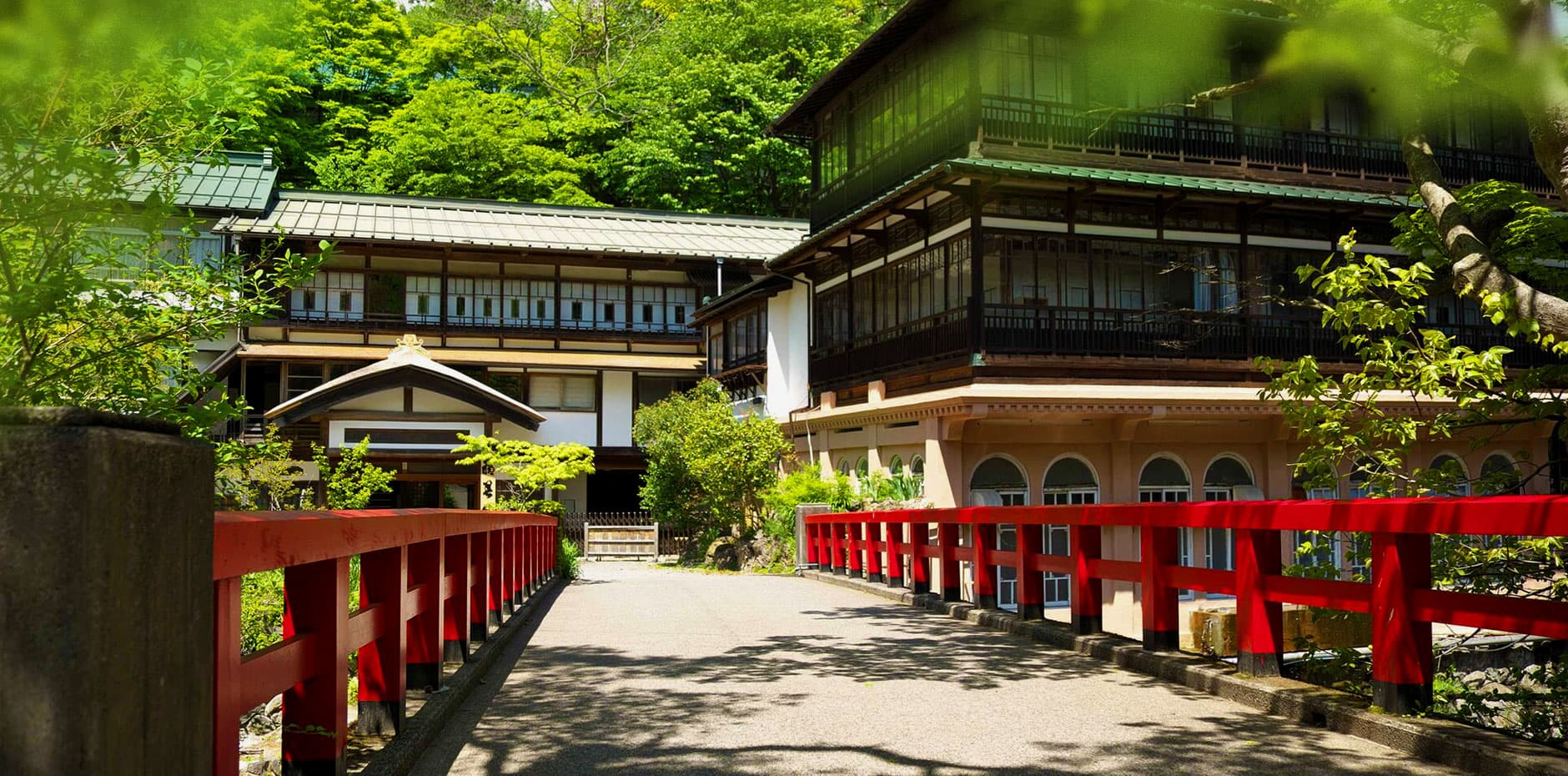
1. Hiiragiya (Kyoto) — Fushimi Soft-Water Sake With Eight Generations of Pairing Memory
Sake program: Fushimi-heavy, with curated Nada and Niigata counterweights. Setting: Private in-room service. Rating: 9.6/10 (67 verified reviews).
Hiiragiya is the canonical entry to Kyoto-traditional kaiseki, and the sake list reflects the same canon-rooted instinct. Roughly 60% of the bottles on the main list come from Fushimi — the soft-water sake district inside Kyoto city, fifteen minutes south by JR. The Fushimi style is historically called onna-zake (“feminine sake”) for its mineral-light, slower-fermenting softness, in contrast to Nada’s harder-water otoko-zake . Tsukinokatsura (a Fushimi house founded in 1675 — 350 years of brewing under fourteen generations of the Masuda family — known for its precise, almost shy junmai daiginjo) , Kinshi Masamune (the historical brewery that supplied the imperial court), and Tamanohikari (the larger, slightly more commercial-feeling Fushimi name whose limited junmai-shu earn their place) all appear. The Fushimi soft water gives these bottles a recognisable house style: lower acidity, more floral high notes, a finish that doesn’t fight the suimono (clear broth) it’s served with.
The pairing logic at Hiiragiya is the eighth-generation kitchen’s most under-discussed strength. The hassun arrives with a chilled junmai daiginjo (almost always Tsukinokatsura or a Kinshi Masamune limited release); by the time the yakimono hits the table, you’ve been quietly switched to a warmed kimoto from Nada — typically Kenbishi or a small-batch Hakutsuru — because the Fushimi soft-water bottles are too delicate for grilled protein. Ask for the omakase pairing at booking; it runs around ¥10,000 per person on top of the room rate and the brigade adjusts course by course.
Honest caveat: Hiiragiya’s sake list rotates quarterly, and the most interesting Fushimi limited releases tend to be on the autumn (October–November) and winter (January–February) menus, when the breweries’ shibori-tate (freshly-pressed) releases come into circulation. The summer menu leans into chilled bottles that are technically faultless but less revealing of the program’s editorial point of view. If your trip is flexible, aim for late autumn.
2. Seikoro (Kyoto) — Higashiyama Heritage With a Restrained Sake Voice
Sake program: Fushimi + Nada cross-section, narrower but more curated than Hiiragiya. Setting: Private in-room service. Rating: 9.4/10 (281 verified reviews).
Seikoro reads like a counter-voice to Hiiragiya in every register, and the sake list is no exception. Where Hiiragiya rotates through a wide Fushimi sample, Seikoro picks three or four bottles per category and stands by them — the curatorial editing is closer to the kitchen’s austere kaiseki voice. The Fushimi pillar is Tsukinokatsura (specifically the Tsuki no Shizuku junmai daiginjo); the Nada pillar is Kenbishi’s Yamahai junmai; the surprise on the list is usually a regional satellite — a Hakkaisan Tokubetsu junmai from Niigata, or a Tedorigawa from Ishikawa, depending on the season.
The temperature discipline at Seikoro is the program’s strongest signal. The nakai-san will walk through the course-by-course temperature plan at the start of dinner, and the bottle that arrives at room temperature for the shokuji (rice course) is genuinely different from what you would drink chilled. If you have a J.S.A. Diploma background or a serious wine sommelier instinct, this is the kitchen where you can have a real conversation about what the toji is doing — the staff are trained to engage. The omakase pairing here runs around ¥8,500 per person and skews 70% Fushimi, 30% everything else.
Honest caveat: Seikoro’s sake list is short. If you want breadth — ten Niigata bottles to compare — this is not your property. If you want depth — four Fushimi bottles, served at the right temperature with the dishes they were chosen for — this is the kitchen that wrote the manual.
3. Arima Goshobo (Hyogo) — 800-Year Heritage Inside Nada Sake Country
Sake program: Nada-dominant, with neighbouring Tamba and Tajima accents. Setting: Private in-room service. Rating: 9.6/10 (206 verified reviews).
Arima Goshobo sits inside Hyogo prefecture — specifically thirty minutes from Nada (the Kobe-area sake district whose five sub-districts — Nada Gogo — together account for roughly a quarter to a third of Japan’s total sake production by volume, and historically defined the masculine, mineral-water-driven otoko-zake style fed by Miyamizu hard water) . What makes Goshobo worth a separate pick from the Kyoto entries is the way the kitchen leans into Nada’s house style rather than fighting it. The yakimono course almost always arrives with a chilled Hakutsuru junmai daiginjo or, in autumn, with a Kenbishi yamahai junmai served at nuru-kan (gently warmed). Both pairings are textbook Nada — the mineral water adds backbone, the kimoto/yamahai lineage adds acidity, and the grilled course suddenly has someone to argue with.
The program’s most distinctive move is the Tajima accent: small-batch bottles from Hyogo’s less-famous northern sake district — the same Tajima coast that produces the matsuba crab and Tajima beef on the menu. Look for Honda Shoten’s Tatsuriki (a Tajima Yamadanishiki bottle that’s been part of the program for years) or, on the winter menu, anything from the small Itami Onigoroshi house. The kitchen will pair these with the local seafood, and the regional self-reference is part of what makes the meal feel like Hyogo rather than “generic kaiseki in Hyogo.” Goshobo’s 800-year operating history is the marketing line; the sake program is the editorial proof.
Honest caveat: Goshobo’s sake program is genuinely seasonal in a way that matters — the winter (Nov–Feb) list is significantly stronger than the summer list, because of how the Hyogo brewing calendar works. If you’re flexible on timing, winter is the trip. Summer is fine but won’t reveal the program’s upper register.
4. Takayama Kachoan (Gifu/Hida) — Hida Cold-Fermented Sake at Its Source
Sake program: Hida-Takayama brewery focus, with Gifu-prefecture satellites. Setting: Private in-room or private dining room. Rating: 9.1/10 (380 verified reviews).
Takayama Kachoan sits inside the Hida basin, where the cold-fermentation tradition — long winter brewing in unheated brewery rooms, producing drier and cleaner sake than the southern districts — still defines the regional house style. Six breweries operate in central Takayama, all with at least a century of history, and Kachoan’s sake list features four of them . Funasaka Brewery (the Takayama anchor, founded 1703; their Junmai Daiginjo Shiro Funa is the list’s headline pour) is the most often poured. Hirata Shuzo (founded 1895 — the newest of the six Takayama breweries, originally a candle-and-hair-oil merchant before pivoting to sake — known for its kimoto line) is the program’s editorial pick — its junmai on the autumn menu is a textbook Hida cold-fermented bottle . Niki Shuzo and Harada Shuzo round out the in-town selection.
The pairing logic at Kachoan is the most regionally-self-referential on this list. The kaiseki centres on Hida beef (the Wagyu lineage whose marbling is in the same league as Kobe), and the kitchen’s default for the grilled course is a warmed Funasaka Junmai served nuru-kan. The cold-fermented profile cuts the beef’s richness without arguing with it. The room-temperature Hirata Shuzo Kimoto pairings with mountain vegetables (sansai) are the program’s other strong move.
Honest caveat: the Hida brewery scene is small and intensely seasonal. Several of the Funasaka and Hirata Shuzo limited releases are only on the list from late January through April — when the previous autumn’s rice has finished fermenting and the brewers release the shibori-tate (freshly-pressed) bottles. If you visit between June and September, the program is solid but you’ll miss the most distinctive bottles. The trade-off is that summer pricing is meaningfully lower.
5. Gora Kadan (Hakone) — Contemporary Kaiseki, Curated Cross-Country Sake Program
At a glance
Sake program: National — selected by the property’s sommelier, no regional anchor. Setting: Private in-room service. Rating: 9.5/10 (89 verified reviews).
Gora Kadan is the contemporary kaiseki entry on this list and the only property whose sake list is deliberately not anchored on a region. The property sits on the former Kan’in-no-miya summer imperial estate in Hakone, and the sommelier-curated program reflects the kitchen’s contemporary register: a Niigata pillar (Hakkaisan Tokubetsu Junmai and Junmai Ginjo), a Yamagata pillar (Dewazakura Oka Ginjo, the classic floral-yeast bottle), a Hyogo pillar (Kenbishi Mizuho for the warmed pours), and a rotating limited-release slot.
The pairing approach at Gora Kadan is the most globally legible on this list. If you’ve drunk sake at New York or London Michelin-starred Japanese kitchens, the bottles will look familiar — these are the names that distribute internationally, served by a kitchen that knows its largely-foreign honeymoon clientele. The toji’s contemporary kaiseki style — lighter than Kyoto-traditional, more produce-forward, more open to non-Japanese protein — pairs naturally with the cleaner-fermenting Niigata and Yamagata bottles. The omakase pairing here runs around ¥10,000 per person and is the safest starter pairing on this list for travellers without a sake background.
Honest caveat: a J.S.A. Diploma traveller will find Gora Kadan’s list internationalist rather than place-rooted. If you specifically came to taste the Hakone brewing district or the Kanagawa house style, this is not the property — there isn’t really a Hakone or Kanagawa house style to begin with. If you came for the sake program that complements contemporary kaiseki at the absolute top tier, Gora Kadan is on this list for a reason.
6. Nishimuraya Honkan (Kinosaki/Hyogo) — Tajima Sake With Winter Crab
At a glance
Sake program: Tajima-anchored, Hyogo-wide, with a strong winter list. Setting: Private in-room service. Rating: 9.2/10 (198 verified reviews).
Nishimuraya Honkan is the Kinosaki Onsen flagship and the most winter-defined property on this list. The Kinosaki coast is where matsuba crab (Hyogo’s defining winter ingredient) lands, and the sake program is built around the crab calendar. The program’s spine is Hyogo’s northern Tajima district — a less-famous sake region than Nada, focused on smaller breweries that supply the local seafood culture. Tatsuriki (the Honda Shoten flagship from Himeji, the bottle most often paired with crab here), Konishi Shuzo’s Itami Onigoroshi (Itami, founded 1550 — the oldest sake brewery still owned and run by the same Konishi family, now in its 15th generation, and the kura behind Shirayuki, considered the oldest surviving sake brand — the heritage kura whose kimoto junmai is the kitchen’s warmed default), and Doi Shuzoten’s Kaiun (a Shizuoka satellite, but historically part of the Hyogo seafood pairing canon) all appear.
The pairing logic at Nishimuraya is the most ingredient-driven on this list. The November-through-March matsuba crab kaiseki is paired course-by-course with bottles that are explicitly chosen for crab: a chilled Tatsuriki Junmai Daiginjo with the raw crab leg (kani-sashi), a nuru-kan Itami Onigoroshi Kimoto with the grilled crab claw (yaki-gani), and a jo-on (room-temperature) Tedorigawa Yamahai with the crab miso butter dish (kani-miso). This is one of the few pairings in Japan where the sake-and-ingredient match is so culturally established that there’s a name for the wrong call — yokenai sake pairings (“unwanted”, in this context) are a Kinosaki kaiseki failure mode that the kitchen explicitly trains against.
Honest caveat: outside of crab season (April–October), the sake program at Nishimuraya is solid but loses its strongest editorial point of view. If you can only visit in summer, the property is still excellent for other reasons — the seven public bathhouses, the heritage, the yukata-walking culture — but the sake list is at maybe 70% of its winter potential.
7. Yamamizuki (Kurokawa/Kumamoto) — Kyushu Satoyama Sake With Adults-Only Focus
At a glance
Sake program: Kumamoto-anchored, with northern Kyushu satellites. Setting: Private in-room service, adults-only property. Rating: 9.6/10 (93 verified reviews).
Yamamizuki is the deepest-Kyushu pick on this list, and the sake program reflects the region’s distinct house style. Kumamoto sake — historically defined by the Kumamoto Kobo No. 9 yeast strain, isolated around 1953 by Nojiro Kinichi at the Kumamoto Prefectural Brewing Research Institute (founded 1909) and distributed nationally as Kyokai Yeast No. 9 from 1968, where it remains the most widely used yeast for ginjo-grade brewing in Japan — has a recognisable floral high-note profile that Yamamizuki’s list leans into. Kameman (founded 1916, Kumamoto-coast brewery whose junmai daiginjo is the program’s flagship), Zuiyo (1867-founded Kumamoto kura whose Junmai line is the toji’s warmed-pour default), and Kiyokawa (the small Aso-foot brewery whose limited releases are on the autumn list) anchor the Kumamoto pillar.
What separates Yamamizuki’s program from the larger entries on this list is the adults-only context. The kitchen knows every guest at dinner has chosen a property without children, and the pairing approach leans toward the more challenging bottles — a Zuiyo Junmai served at room temperature with the autumn matsutake dish, a Kameman Kimoto warmed with the wild boar (inoshishi) winter course. The northern-Kyushu satellite — typically a Fukuoka Hakata-region Yamada Nishiki bottle or a Saga prefecture Nabeshima limited release — is the surprise on the list, and the toji will explain the regional pivot if you ask.
Honest caveat: Kumamoto sake is less internationally distributed than the Niigata or Kyoto names. If your goal is to taste bottles you already know about, this is not the property. If your goal is to taste Kyushu sake at a kitchen that specifically champions it, Yamamizuki is the strongest single-property pick in the country.
8. Takinoya (Noboribetsu/Hokkaido) — The Hokkaido Sake Finale
At a glance
Sake program: Hokkaido-anchored, with strong representation of the Sorachi rice belt. Setting: Private in-room service. Rating: 9.6/10 (276 verified reviews).
Takinoya closes this list for a reason: Hokkaido sake has been the most interesting brewing development in Japan over the past fifteen years, and Takinoya’s program tracks the shift in real time. The island’s sake industry is small — roughly 15 active breweries across the prefecture — but the Sorachi rice belt (the Yumesankan and Suisei rice varieties developed specifically for Hokkaido’s climate) is now producing bottles that compete with the Honshu names on technique. Otokoyama (the Asahikawa brewery whose lineage traces back to the original Otokoyama of Edo-period Itami — appointed sake purveyor to the shogunate, with 350 years of brand history now preserved in the Asahikawa sake museum — whose Junmai Daiginjo is the program’s headline), Kunimare (Mashike-based, whose yamahai junmai is the kitchen’s warmed default), and Tanaka Shuzo’s Takasago (Asahikawa, the program’s editorial pick) anchor the Hokkaido pillar.
The pairing logic at Takinoya is the most Hokkaido-self-referential on this list. The kaiseki centres on Hokkaido seafood — hairy crab (kegani), squid (ika), salmon (sake) — and the yamahai and kimoto bottles from Otokoyama and Kunimare are explicitly chosen for the colder-water seafood profile. The suzu-hie Otokoyama Junmai Daiginjo with the raw hairy crab is the program’s most often-cited pairing; the nuru-kan Kunimare Yamahai with the grilled salmon yakimono is the editorial pick. The 276 verified reviews are the largest of any property on this list — the kitchen has had time to refine the pairings against a large guest sample.
Honest caveat: Hokkaido sake at this tier requires Hokkaido travel. The bottles do not export well; they don’t hold up to long-distance shipping the way Niigata or Kyoto names do. Takinoya is on this list because it’s the best place to drink them at their source. If you’re building a sake trip that stays on Honshu, replace this pick with a second Kyoto or Kanazawa property; if you’re willing to fly to Sapporo and drive to Noboribetsu, this is the Hokkaido sake-and-onsen night you can’t reproduce anywhere else.
For more stays near Hokkaido's rice-and-seafood belt, our guide to the best ryokans in Hokkaido covers all six onsen areas on the island.
Two properties this list no longer recommends
Both were in the ranking above until September 2026. Kanazawa Sumiyoshiya has suspended dinner service, and the sake programme described here was part of that dinner. Kagaya has been closed for post-earthquake reconstruction since January 2024. The profiles stay because what they describe was real, but Kagaya cannot be booked at all, and Sumiyoshiya takes lodging bookings without the dinner this article described. Neither appears in this guide's structured data.
Kanazawa Sumiyoshiya (Ishikawa) — Kaga-Ryori With Tedorigawa’s Long Pour
Status: Kanazawa Sumiyoshiya has suspended dinner service. The sake programme described below was part of that dinner, so it cannot be booked at present. The profile that follows is left as it was written before the suspension: it is in the present tense throughout, and every service it describes — the cellar, the rotation, the toji at the table — is what the property served then, not what it serves now.
Sake program: Ishikawa-anchored, leaning Hakusan watershed bottles. Setting: Private in-room service. Rating: 9.6/10 (31 verified reviews).
Kanazawa Sumiyoshiya is the Kaga-ryori property where the sake program closes the loop. Tedorigawa — the Hakusan-mountain-water brewery that’s arguably Ishikawa’s most internationally recognised sake — is the program’s spine. The kitchen carries the Yamahai junmai, the Daiginjo, and the Iki (limited-release) line, and the toji will rotate which bottle pairs with which Kaga-ryori course depending on what came in from the Noto morning market. The other pillar of the list is Manzairaku (Hakusan-based, smaller, less internationally known) — the Komame Junmai bottle on the autumn list is the kind of regional limited release you cannot find at any retailer outside Ishikawa.
What separates Sumiyoshiya’s sake program from the Kyoto entries is the water-source reasoning. Both Tedorigawa and Manzairaku draw water from the Hakusan watershed — the same mountain whose snow-melt is on the table in front of you in the form of Kaga vegetables, mountain river fish, and Hokuriku rice. The pairing logic is: the bottle and the dish share a water source. That’s a real culinary argument, and once you taste the yakimono (typically nodoguro or kuruma-ebi) with a Tedorigawa yamahai served nuru-kan, you can’t un-taste the regional coherence.
Honest caveat: Sumiyoshiya is a small property (the 31 verified reviews tell you the scale) and the sake program depends heavily on which staff member is on the floor that night. A sake walk-through had to be requested at booking.
Kagaya (Wakura/Noto) — Noto Peninsula Resort-Scale With a Real Sake Cellar
Status (verified July 2026): Kagaya is closed for post-earthquake reconstruction and plans to reopen by the end of fiscal 2028, around March 2029. We keep this profile for context — do not plan a stay until reopening is confirmed.
Sake program: Ishikawa-dominant, with a substantial cellar (rare for resort-scale). Setting: Private in-room or private dining room. Rating: 9.3/10 (35 verified reviews).
Kagaya is the only resort-scale property on this list, and the inclusion is deliberate. Most large ryokans (200+ rooms) treat sake as a beverage menu category; Kagaya runs an actual cellar. The list runs to 40+ bottles, anchored on Ishikawa anchors — Tedorigawa, Tengumai (a more rustic Hakusan-area brewery known for its kimoto), Kikuhime (the Hakusan-foot brewery whose junmai is famously direct) — with a Niigata satellite (typically Hakkaisan and Kubota) for guests who want a more globally recognised name.
The program’s strongest move at Kagaya is the seafood-driven pairing. Wakura Onsen is on the Noto Peninsula coast, and the mukozuke sashimi course almost always features Noto-line fish — amaebi (sweet shrimp), kuro-mutsu, nodoguro. The kitchen’s pairing default is a chilled Tengumai Yamahai junmai or a Tedorigawa Yamahai junmai, both of which have enough acidity to handle the natural sweetness of Noto shrimp without overwhelming it. The omakase pairing here was the most expensive on this list, when the property last published rates (¥12,000–18,000 per person, depending on tier) but it’s also the broadest — you’ll taste five to seven bottles across a single meal, which is a different kind of education from the focused four-bottle Kyoto programs.
Honest caveat: Kagaya’s resort scale means you will not get a toji visit at your table. The pairing comes from the cellar manager or a sake-trained nakai-san, and at peak weekends the depth of the conversation depends on which staff member is on rotation. The cellar itself is consistent; the front-of-house engagement is variable. A toji visit was never part of it; what it offered instead was the broadest single-night Ishikawa sake list in this guide.
Regional Sake Anchor Matrix (Quick Reference)
If you’re building a multi-stop trip and want to know what each region’s sake style brings to the table, here is a working framework for planning the kaiseki sequence:
| Region | House style | Anchor breweries | Best for |
|---|---|---|---|
| Fushimi (Kyoto) | Soft-water, floral, low-acid, female-coded | Tsukinokatsura, Kinshi Masamune, Tamanohikari | Sashimi, hassun, suimono clear broths |
| Nada (Hyogo) | Mineral-water, masculine, kimoto/yamahai lineage | Hakutsuru, Kenbishi, Kiku-Masamune | Yakimono, takiawase, autumn matsutake |
| Niigata | Tanrei-karakuchi (light, dry, clean) | Hakkaisan, Kubota, Kakurei | International-friendly entry pairings |
| Yamagata | Floral, aromatic, modernist | Dewazakura, Juyondai, Tatenokawa | Hassun, contemporary kaiseki |
| Ishikawa (Hakusan) | Mountain-water, structured, food-forward | Tedorigawa, Manzairaku, Tengumai | Seafood-driven kaiseki, Kaga ryori |
| Hida (Gifu) | Cold-fermented, dry, mountain-rooted | Funasaka, Hirata Shuzo, Niki Shuzo | Hida beef, mountain vegetables |
| Tajima (Hyogo) | Coastal, intensely seasonal | Tatsuriki, Itami Onigoroshi | Winter matsuba crab |
| Kumamoto | Kobo No. 9 yeast, floral high-notes | Kameman, Zuiyo, Kiyokawa | Kyushu satoyama kaiseki |
| Hokkaido (Sorachi) | Cold-climate yamahai, food-forward | Otokoyama, Kunimare, Takasago | Hokkaido seafood, hairy crab |
How to Ask for Sake Recommendations in Japanese (Practical Phrases)
Even at the most English-comfortable properties on this list, the most interesting sake conversation happens in Japanese. You don’t need to be fluent. You need three phrases.
1. “What do you recommend for this course?” — この料理に合うお酒は何ですか? (Kono ryori ni au osake wa nan desu ka?). The nakai-san will name a bottle and a temperature. This is the most useful single phrase you can carry into a kaiseki dinner.
2. “Can I have it warmed/at room temperature/chilled?” — 燗でお願いします (Kan de onegaishimasu) / 常温でお願いします (Joon de onegaishimasu) / 冷酒で (Reishu de). At top kitchens, the temperature is already decided for you; at mid-range properties, asking signals you understand the program and you’ll often get a better pour as a result.
3. “Is there a local brewery on the list?” — 地元の酒蔵はありますか? (Jimoto no sakagura wa arimasu ka?). This is the door-opener. Almost every kitchen will steer you to one or two regional bottles you wouldn’t have asked for by name.
One additional move that works at every property on this list: at the start of dinner, mention that you’re interested in the sake program. A simple “お酒に興味があります” (Osake ni kyomi ga arimasu — “I’m interested in sake”) signals to the staff that they should treat the pairing seriously. At Hiiragiya, Seikoro, and Yamamizuki, this single sentence often results in the toji coming out at some point during the meal.
Frequently Asked Questions
The One-Sentence Summary
If you remember one thing from this list: the sake program at a ryokan is a window into how the kitchen thinks about its region, its season, and its menu — and at the eight properties above, the window is wide open. Pick the property whose regional sake style matches the trip you want, and the rest of the kaiseki experience will follow.
Related guides on Japan Ryokan Guide:
- Best kaiseki ryokans in Japan — the dinner-as-trip companion to this guide
- Best ryokans for couples in Japan — honeymoon-tier picks with private dining
- Best ryokans with private onsen — in-room rotenburo focus
- Best ryokans in Kyoto — deeper Kyoto coverage
- Best ryokans in Kanazawa — Ishikawa and Hokuriku focus
- Kaiseki guide — the courses, the seasonal logic, how to read a kaiseki menu
Verified June 2026. All eight ranked properties confirmed operating; the two profiled after the ranking are not — Kagaya is closed and Kanazawa Sumiyoshiya has suspended dinner service. Sake program details are drawn from each property's published information. The brewery names and regional house-style framework follow J.S.A. Sake Diploma curriculum and Sake Times brewery profiles.
Ready to book?
Book one of these top picks
Compare live availability and prices across booking sites.
Hiiragiya Ryokan
柊家旅館
Kyoto·Luxury
from US$500 · per person · per nightfrom ≈ US$1,000 total for 2 guests



Tocen Goshobo
陶泉 御所坊
Arima·Luxury
from US$235 · per person · per nightfrom ≈ US$470 total for 2 guests
Nishimuraya Honkan
西村屋本館
Kinosaki·Luxury
from US$400 · per person · per nightfrom ≈ US$800 total for 2 guests
Booking links may earn us a commission at no extra cost to you.
Correction, September 2026. Kagaya in Wakura Onsen has been closed for post-earthquake reconstruction since January 2024 and is scheduled to reopen by the end of fiscal 2028, around March 2029, at 33 rooms rather than the 232 it had . Kanazawa Sumiyoshiya has suspended dinner service. In this article the ranking now runs to eight: Kanazawa Sumiyoshiya and Kagaya were moved out of it into a section that says plainly why neither can be recommended, so the prose and the structured data publish the same list. Kagaya's at-a-glance card, its pairing prices and both properties' booking-panel slots are gone, and two blanket claims about every property on the list — a 30-plus junmai cellar, private dining throughout — were deleted rather than renumbered, because nothing here substantiates them, and the FAQ answer that had Kagaya still running a 40-bottle cellar is now past tense. A wider review of this article's sourcing is still open. Checked against each property's own website on 2026-09-20.
FAQ
Frequently asked questions
Which ryokan has the best sake program in Kyoto?+
Hiiragiya is the top Kyoto pick for a Fushimi soft-water sake program, rated 9.6/10 from 67 verified reviews. Roughly 60% of its main list comes from Fushimi breweries — Tsukinokatsura (founded 1675), Kinshi Masamune, and Tamanohikari — served with course-by-course pairing logic, switching from a chilled junmai daiginjo at hassun to a warmed Nada kimoto (Kenbishi or Hakutsuru) once the grilled course arrives. The omakase pairing runs around ¥10,000 per person on top of the room rate.
Which sake ryokan is best for Ishikawa and Kaga cuisine?+
None of this guide's current picks is in Ishikawa. Kanazawa Sumiyoshiya, whose dinner service is suspended, held that place until September 2026 — a Kaga-ryori kitchen built around Tedorigawa, the Hakusan-mountain-water brewery that is Ishikawa's most internationally recognised sake, plus smaller Manzairaku limited releases you cannot buy outside the prefecture. Kagaya on the Noto Peninsula, closed for post-earthquake reconstruction, ran a 40-plus bottle cellar anchored on Tedorigawa, Tengumai and Kikuhime. Both are profiled after the ranking, as history rather than as options.
Which ryokan pairs sake best with winter crab?+
Nishimuraya Honkan in Kinosaki Onsen is the most winter-defined sake ryokan on this list, built around the November–March matsuba crab calendar. It pairs course by course: a chilled Tatsuriki Junmai Daiginjo with raw crab leg, a gently warmed Itami Onigoroshi kimoto with grilled crab claw, and a room-temperature Tedorigawa Yamahai with the crab miso dish. Its Tajima-anchored program is at maybe 70% of its potential outside crab season, so aim for winter.
How much does a sake pairing cost on top of a ryokan room rate?+
A bundled omakase sake pairing adds roughly ¥6,000–18,000 per person on top of the standard ryokan rate. Kyoto-traditional properties like Hiiragiya and Seikoro run about ¥8,500–10,000; regional anchors with serious cellars like Yamamizuki and Takinoya run ¥10,000–18,000. If you don't want a full flight, ordering two or three bottles by-the-glass (¥1,500–3,000 each) across the meal is the cheaper alternative and still shows the program's point of view.
Where can I try Hokkaido or Kyushu regional sake at a ryokan?+
For Hokkaido, Takinoya in Noboribetsu (9.6/10, 276 reviews) is the finale pick — its list features Sorachi rice-belt bottles from Otokoyama, Kunimare, and Takasago, paired with cold-water seafood like hairy crab and grilled salmon. For Kyushu, Yamamizuki in Kurokawa (adults-only, 9.6/10) champions Kumamoto sake shaped by the famous Kobo No. 9 yeast, anchored on Kameman, Zuiyo, and Kiyokawa. Both regions' bottles don't ship well, so they're best drunk at the source.
What makes a ryokan a genuine sake ryokan rather than one that just pours it?+
Four signals, none of them list length: the list names specific breweries (not just "Kyoto sake"); it carries at least one limited-release bottle you can't buy at retail; temperature is treated as a pairing decision, with staff asking whether you want the next pour chilled, room-temperature, or warmed; and the toji (head chef) will come out to talk through the choices.
Still deciding?
Browse ryokans across JapanBooking.com