Quick Comparison
8 picks| Ryokan | From | Rating | Book |
|---|---|---|---|
 | from US$250/person/night≈ US$500 for 2 | 8.9 512 reviews | Book on Trip.com |
 | from US$220/person/night≈ US$440 for 2 | 9.3 577 reviews | Book on Booking.com |
 | from US$150/person/night≈ US$300 for 2 | 9.6 93 reviews | Book on Agoda |
 | from US$150/person/night≈ US$300 for 2 | 9.3 35 reviews | Book on Trip.com |
 | from US$500/person/night≈ US$1,000 for 2 | 9.5 89 reviews | Book on Booking.com |
 | from US$107/person/night≈ US$214 for 2 | 8.4 247 reviews | Book on Agoda |
| from US$75/person/night≈ US$150 for 2 | 7.9 76 reviews | Book on Trip.com | |
 | from US$700/person/night≈ US$1,400 for 2 | 9.4 10 reviews | Book on Trip.com |
Nishimuraya Hotel Shogetsutei
Kinosaki
Onishiya Suishoen
Kinosaki
Oku no Yu
Kurokawa
Gora Kadan
Hakone
Kusatsu Onsen Boun
Kusatsu
Prices shown are approximate starting rates per person per night. We may earn a commission on bookings.
 Pin to Pinterest
Introduction
The question comes up in every group trip planning thread: can we actually do a ryokan as a mixed bunch of friends, or is it really just for couples? The short answer is yes — but there are about six things you need to understand first, and every single one of them is answered here.
This article covers the best ryokans for groups of friends in Japan: five areas ranked by group-friendliness, eight DB-verified inns with honest group angles, and the practical mechanics — from how ryokan costs work per night and kashikiri bath booking to the adjacent-room email template and curfew realities. If one person in your group has a tattoo, if you're a mix of men and women, if your budget is genuinely uncertain — those are all answered here too.
Skim onsen etiquette for foreigners before you arrive. Don't let nerves about getting it wrong talk your group out of what will likely be the most memorable night of your Japan trip.
Is a Ryokan Right for a Friend Group? The Two Things to Know First
The price is per person — here is what that means for 6 friends
Western hotels charge by the room. Japanese ryokans charge by the person, per night, and the rate almost always includes dinner and breakfast — the ippaku-nishoku model (one night, two meals). A listing that says ¥25,000 means ¥25,000 per head, not per door.
For a group of six at a mid-tier inn, that becomes ¥150,000 per night total. Before that number shocks anyone out of the group chat: subtract two restaurant meals you won't be paying for separately. A kaiseki dinner and a proper Japanese breakfast at a decent Tokyo restaurant run ¥5,000–¥12,000 per person combined. The net accommodation cost drops considerably, and you're eating better than you would at any restaurant on the street.
The ryokan cost per night breakdown covers all three pricing tiers if you want to run the full math before pitching this to eight friends with different budgets.
Tattoos and mixed-gender bathing: the kashikiri solve
Two concerns come up immediately when friend groups consider ryokans. The first is communal nudity in gender-segregated baths — meaning your male and female friends will be in separate pools for the public onsen sessions. The second is tattoos: a Japan Tourism Agency survey found 56% of onsen facilities banned tattooed guests from public baths outright.
Both problems have the same solution: kashikiri, a private bath you rent for 45–60 minutes exclusively for your group. Your whole party — mixed gender, any tattoo situation — gets the rotenburo to yourselves. Prices run ¥1,000–¥5,000 per slot. At the right inns, this isn't a luxury upgrade — it's the default strategy for a mixed friend group.
For a more thorough walkthrough of what inns allow and how to navigate policy, see tattoo-friendly ryokans in Japan and ryokans with private onsen.
How Ryokan Pricing Works for a Group: A Cost-Split Example
The ippaku-nishoku formula: one night, two meals
The ryokan rate you see on any booking platform is per-person, per-night, inclusive of kaiseki dinner and a Japanese breakfast. The median ryokan price across Japan is ¥44,660 per person per night [Japan Ryokan Guide Q2 2026 dataset].
The Japan Ryokan Guide Q2 2026 dataset maps the market into four tiers:
- Budget: ¥10,000–¥18,000/pp ($67–$120) — includes dinner and breakfast
- Mid: ¥18,000–¥35,000/pp ($120–$235) — kaiseki dinner and breakfast
- Upper-mid: ¥35,000–¥60,000/pp ($235–$400)
- Luxury: ¥60,000–¥150,000+/pp ($400–$1,000+)
All rates are per person at approximately ¥150 to the dollar. Add ¥150–¥500 per person per night in onsen tax, paid at checkout.
Cost-split worked example: group of 6 across three tiers
| Tier | Rate/pp/night | Group of 6, 1 night | Group of 6, 2 nights |
|---|---|---|---|
| Budget | ¥14,000 (~$93) | ¥84,000 (~$560) | ¥168,000 (~$1,120) |
| Mid | ¥25,000 (~$167) | ¥150,000 (~$1,000) | ¥300,000 (~$2,000) |
| Upper-mid | ¥50,000 (~$333) | ¥300,000 (~$2,000) | ¥600,000 (~$4,000) |
Both dinner and breakfast are included across all tiers. At mid and above, dinner becomes a multi-course kaiseki meal that typically runs two hours and is the centerpiece of the evening. See ryokan meal plans explained for what each course tier includes.
Rooms for a Group: Tatami Zashiki, Adjacent Rooms, and the Fusuma Trick
How many friends fit in one tatami room?
A standard 10-tatami room is roughly 17–22m² and sleeps three to five guests on futons. A 12-tatami room can accommodate up to six. Unlike Western hotel rooms where beds are fixed, tatami rooms flex — staff add futons based on how many guests are registered. A group of five can genuinely share one large zashiki room if the inn allows it, cutting both cost and the logistical hassle of splitting the group.
Many inns also have fusuma — sliding interior doors connecting two adjacent rooms. Open the fusuma and you have a flowing semi-suite where the group can move freely between spaces. This is different from a connecting room in a Western hotel: it's a cultural feature of how traditional ryokan rooms were designed for large gatherings.
Adjacent rooms: why OTAs fail and how to book correctly
No OTA — Booking.com, Agoda, Trip.com, Expedia — can guarantee that the two rooms you book end up on the same floor, let alone next to each other. The fix is simple but requires an extra step: email the inn directly after booking, referencing your booking number and making the request in plain English.
Tip
When emailing the inn to request adjacent rooms, use this phrasing: "We are a group of [X] friends travelling together. Could you please ensure our rooms are adjacent or on the same floor? We would be grateful if you could confirm this at the time of booking." Most English-friendly inns will accommodate this with advance notice.
Booking email template: how to request adjacent rooms in English
Subject: Adjacent Room Request — Booking Reference [YOUR BOOKING NUMBER]
Dear [Ryokan Name] Team,
Thank you for our upcoming reservation on [DATES].
We are a group of [X] friends travelling together and would greatly appreciate it if our rooms could be placed adjacent to each other, or at minimum on the same floor. Our booking references are [REF 1] and [REF 2].
Please let us know if this can be confirmed.
With thanks, [Your Name]
Send this within 24 hours of booking. Call to confirm if you don't hear back within a week.
Kashikiri Explained: The Private Bath That Solves Everything
What is kashikiri and why friend groups need it
Kashikiri (貸切風呂) is a reserved private bath — the entire rotenburo or indoor bath space is yours alone for 45–60 minutes. No other guests can enter. You decide who gets in.
For a friend group, this is less of a perk and more of a necessity. Most ryokan public baths are gender-segregated, which fractures the social experience for a mixed group. Kashikiri keeps everyone together. For the full decision framework on tattoo policy, read tattoo-friendly ryokans in Japan.
For inns where every room already has a private rotenburo, kashikiri is less critical — see ryokans with private onsen.
How much it costs and how to reserve a slot
Expect to pay ¥1,000–¥5,000 per session. Some inns — including Kusatsu Boun, with four private baths on a first-come basis — offer complimentary kashikiri. At inns where you pay per slot, a session for your group of six costs no more than ¥830 per person at the top of that range.
Tip
Evening kashikiri slots (around 8–9 pm) fill fastest. Send one person to the front desk immediately on arrival to secure your preferred time. If the inn offers complimentary first-come slots like Kusatsu Boun, that person needs to move quickly.
Best Areas for a Group Ryokan Trip: Ranked
#1 Kinosaki — Japan's best group onsen town
Kinosaki wins for friend groups because the architecture of the town itself is a group activity. Seven soto-yu (public baths) sit within walking distance of each other along a willow-lined canal, and most ryokan stays include a complimentary town bath pass. Your group puts on yukata after check-in and spends the evening hopping between baths, grabbing skewers from the shotengai stalls, and arguing about which rotenburo had the best view. Social time with structure, running until around 11 pm when most public baths close.
Tip
Kinosaki's seven soto-yu are included in most ryokan stays via a complimentary bath pass. Your group can spend an entire evening bath-hopping in yukata at no extra cost.
See best ryokans in Kinosaki for the full area guide.
#2 Kurokawa — tegata bath-hopping and mid-luxury scale
Kurokawa's signature group offering is the tegata bath pass: ¥1,500 buys admission to three outdoor rotenburo at participating inns, valid for six months. About 30 inns participate. Your group buys tegata at your own inn's front desk and spends a day visiting two or three neighbouring inns' outdoor baths. Kurokawa is smaller than Kinosaki, which makes it better for four to six than a group of ten. Transport is the main trade-off: the area is in Kumamoto Prefecture and requires a transfer-heavy journey or a domestic flight.
See best ryokans in Kurokawa for transport specifics.
#3 Kusatsu — budget-friendly with town-wide bathing culture
Kusatsu mirrors Kinosaki's town-bath model at a lower price point. The Yubatake — a central hot spring field that flows visibly through the middle of town — is the social anchor. Seven public baths, the free yumomi hot-water-stirring cultural performance at Netsu-no-Yu, and a dense concentration of ryokan within walking distance make Kusatsu viable without the premium price tag of Hakone. The journey from Tokyo takes a few hours via express bus with a transfer.
See best ryokans in Kusatsu for full details.
#4 Hakone — closest to Tokyo, luxury anchor
Hakone's group case is built on convenience and quality. From Shinjuku, 90 minutes by Romancecar gets you there, and properties like Gora Kadan (42 rooms, natural hot spring in every room) operate at the top of the market. The social infrastructure for groups is thinner than Kinosaki or Kusatsu — there's no town bath-hopping culture — so Hakone suits a group that values quality and access over group street life. See how to get to a ryokan from Tokyo Station for the transport logistics.
See best ryokans in Hakone for detailed inn options.
#5 Naruko — best for larger groups on a budget
Naruko in Miyagi Prefecture has Ooedo Onsen Monogatari Kounkaku: a 116-room chain ryokan that is by far the most group-scalable inn on this entire list. If your group is ten people and your budget is tight, Naruko is your answer. The journey from Tokyo adds an hour or two over Hakone or Kusatsu — factor that in.
Skip: Ginzan is not a group destination
Ginzan Onsen is one of the most photographed onsen towns in Japan, and the photographs are accurate — the Taisho-era wooden inn facades reflecting in the river are genuinely striking. But its five inns are all very small: Fujiya has 8 rooms, Notoya has 15. Groups of four to ten will struggle to find availability across multiple rooms, and peak-date bookings require six to twelve months advance notice. Go to Ginzan with a partner. Come back to this article for your friend-group trip.
The 8 Best Ryokans for Groups in Japan
1. Nishimuraya Hotel Shogetsutei — Kinosaki (best overall for groups)
 Pin to Pinterest
Shogetsutei is the strongest group pick in our database because of what it has, not what it feels like. Three distinct private kashikiri baths — the Japanese-style Gingetsu, the Balinese-style FU-RO, and the Chinese-style Rinsen — mean your group can try a different atmosphere each session. The FU-RO Balinese bath is the one to book first if your group skews toward novelty over tradition — six can soak at once in a space that feels nothing like a standard rotenburo. Private dining rooms branded "Sora" keep your kaiseki dinner together rather than scattered across separate room trays. At 98 rooms (the largest ryokan in Kinosaki, with 200+ capacity), banquet halls, and a shuttle from Kinosaki Station, it handles groups the way a good event venue handles a function.
The trade-off: it lacks the intimate hand-crafted feel of a 10-room boutique. For a social trip with eight friends who want things to run smoothly, that's a feature, not a flaw.
Price band: mid-to-upper-mid (¥25,000–¥60,000/pp estimated; crab-kaiseki plans run higher; confirm current rates directly). Note: Nishimuraya Honkan is under renovation until late August 2026 — book Shogetsutei specifically.
2. Onishiya Suishoen — Kinosaki (best mid-scale pick)
Suishoen offers the midpoint between Shogetsutei's volume and a boutique inn's intimacy. Thirty-plus rooms — most sleeping up to five guests — a large dining hall, and a lounge where the group can gather after the public bath circuit. Visit Kinosaki's large-groups guide specifically calls it out for parties wanting a more personal feel without compromising on group-viable scale. You can fit a six-person party across just one or two rooms, and the dining hall means your kaiseki dinner happens together.
Price band: mid (estimated ¥18,000–¥35,000/pp — unverified current rate; confirm direct).
3. Kurokawaonsen Yamamizuki — Kurokawa (best luxury group splurge)
 Pin to Pinterest
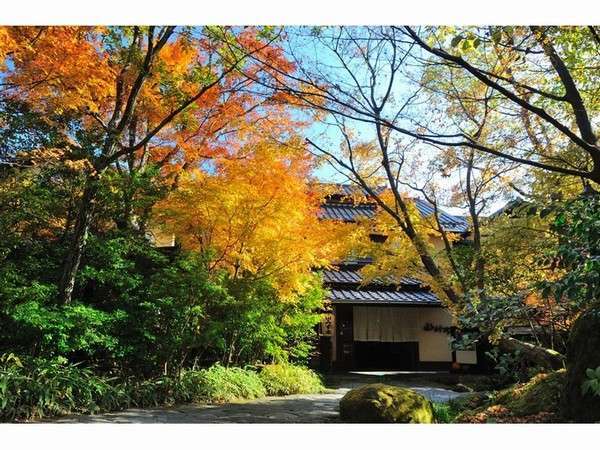
Twenty-one rooms, rated 9.6 from 93 reviews, with eight rooms that have their own semi-open-air private baths and a riverside location that puts the forest-and-steam aesthetic right outside the window. Step into one of those riverside rotenburo at dusk and the sound is almost entirely water and wind — the kind of quiet that a group of six actually needs after a week of city noise. Private dining alcoves keep group kaiseki from spilling into a shared hall. Buy the tegata passes at the front desk and spend a morning visiting two neighbouring inns' outdoor baths.
Price: $250–$385 per person per night (Booking.com, May 2026). At the lower end, a group of four pays around $1,000 per night combined — for a ryokan rated 9.6 in one of Japan's best onsen valleys.
4. Oku no Yu — Kurokawa (best for bath variety and size)
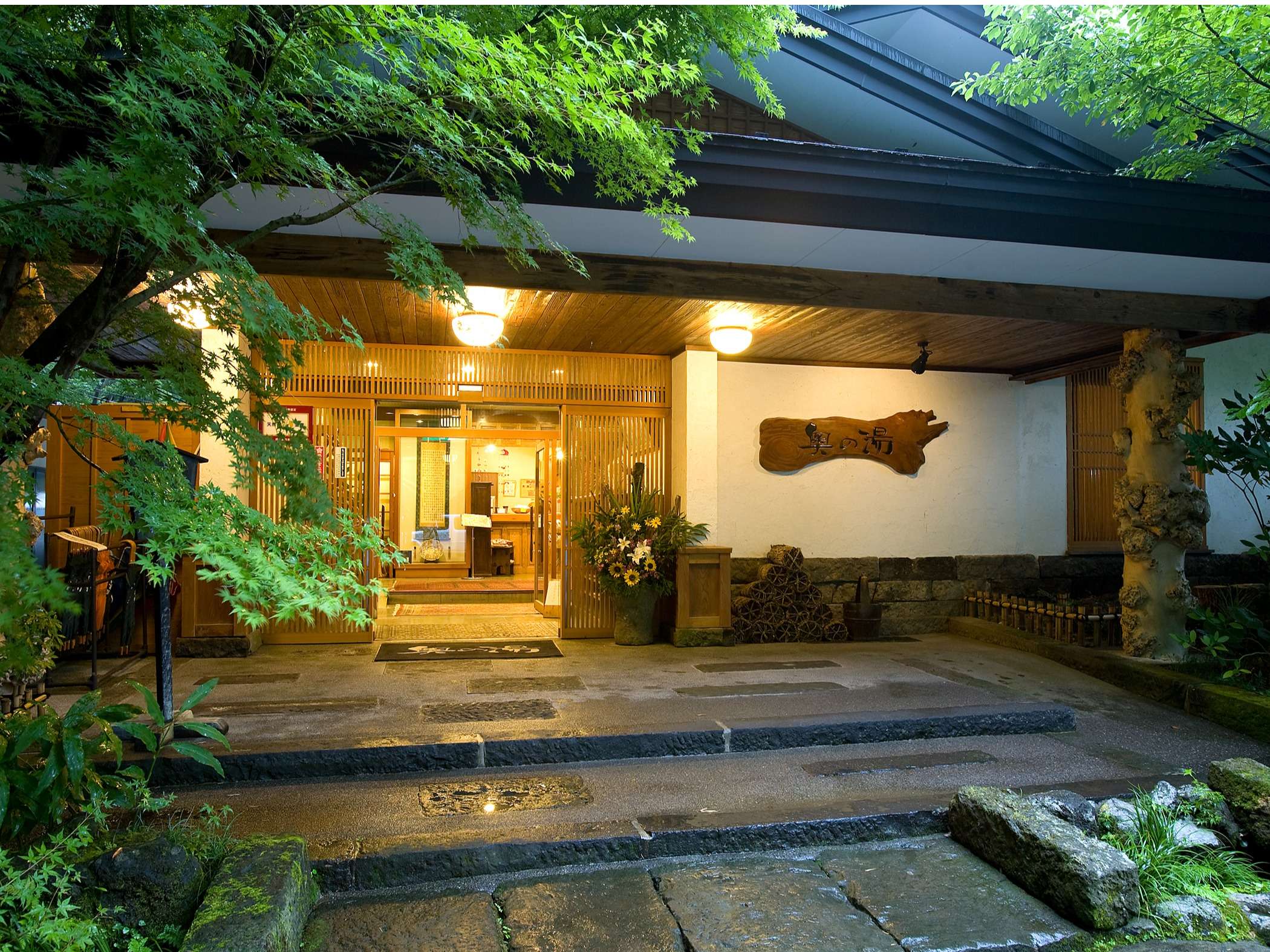
With 26 rooms, Oku no Yu is the largest ryokan in Kurokawa's verified inventory. The real draw for groups is the bath menu: nine distinct bath types across 1.6 acres of grounds, including a stone sauna and a mixed-gender hot spring pool. A two-night group stay can rotate through different baths morning and evening without repeating. The sheer variety gives a first-time onsen group a sense of exploration that single-bath inns simply can't replicate.
Price band: mid (estimated $95–$260/pp — unverified current rate; treat this as a general Kurokawa mid-tier band and confirm on booking).
5. Gora Kadan — Hakone (best luxury, closest to Tokyo)
Gora Kadan sits on a former imperial estate, 42 rooms, with a natural hot spring accessible from every room. Ninety minutes from Shinjuku by Romancecar means you can do this as a one-night luxury splurge without a full travel day. The group books two or three rooms, requests the private dining room when emailing in, and lets Hakone's mountain setting do the work. The estate atmosphere suits four to six friends better than a loud party of ten — read the inn before you book.
Price band: luxury (¥60,000+/pp — confirm current rates directly or via best ryokans in Hakone).
6. Kusatsu Onsen Ryokan Boun — Kusatsu (best heritage pick)
Boun was founded in 1598 — one of the oldest operational inns in Japan — and its four private baths are free of charge on a first-come basis. The wooden structure has absorbed four centuries of Kusatsu's characteristically strong sulfuric water, and you feel that age in the grain of the beams and the faint mineral sharpness in the air before you even reach the bath. The appeal is low-friction: an inn running since 1598 where your group can rotate through four private baths without booking a slot or paying a supplement. Send someone to the front desk on arrival, hold a time window for your group, and you've secured a complimentary private session that would cost ¥1,000–¥5,000 at most other inns. Three minutes from Yubatake, so your group is in the middle of town's evening activity without planning around it. The 8.4 rating from 247 reviews reflects an inn that handles guests reliably.
Price band: mid-to-upper-mid (unverified current rate — confirm via best ryokans in Kusatsu or hotelboun.com).
7. Ooedo Onsen Monogatari Kounkaku — Naruko (best for larger groups on a budget)
116 rooms means Kounkaku absorbs a large group without friction — no sold-out floors, no staff scrambling to honour an adjacent-room request they can't fill. Buffet dining with free drinks handles a large group far more smoothly than per-room kaiseki trays. Chain ryokan means you won't get the handcrafted detail of a boutique inn; what you get instead is logistics reliability — group bookings processed correctly, staff experienced with large parties, predictable execution. For a group of eight to ten that's primarily there for the shared experience, that's the right trade.
Price band: budget-to-mid (chain pricing typically ¥15,000–¥25,000/pp estimated — confirm current rates on booking).
8. Sanso Murata — Yufuin (best for small groups who want the whole inn)
Sanso Murata has 12 rooms total. Its largest room, the Meiji suite at 165m², sleeps up to eight adults, and bookings are capped at eight per stay. Every room has a private onsen — no kashikiri logistics, no public bath queues, no gender-separation considerations at all. Walking into your own rotenburo at whatever hour you like, with no other inn guests visible from your terrace — that is the private-group experience this place is built for.
The honest caveat: Yufuin lacks the social street life of Kinosaki. This is an inn-grounds experience.
Price: ~$830–$1,095/room/night (KAYAK, 2026). For 4–6 guests sharing two rooms, divide accordingly.
Dinner for 6–10: How Kaiseki Works for a Friend Group
In-room vs private dining hall vs shared hall: what to expect
Kaiseki dinner is typically served in one of three configurations. Small boutique inns serve dinner in your room, which separates a group of six across two rooms. Mid-to-large inns often have a shared dining hall with assigned tables. The premium option at group-capable inns — Shogetsutei, Gora Kadan, Boun — is a private dining room for your whole party.
A kaiseki dinner runs two to three hours and is a slow, sequenced affair: 10 to 12 courses served one at a time. Plan your evening around it, not through it.
Tip: request a private dining room when booking
Not every inn has private dining rooms, and those that do fill them first. When you email the inn to request adjacent rooms, add a line: "We are a group of [X] and would love to request a private dining space for our kaiseki dinner if one is available."
Evening Reality: Curfews, Onsen Town Social Life, and In-Room Drinking
Quiet hours are real: plan your evening accordingly
Most ryokans enforce quiet hours from 10 pm, with some properties having formal entry curfews closer to midnight. Thin wooden walls and paper screens mean that what sounds like a moderate conversation in a tatami room carries clearly to the next room. Groups that want to stay up late talking loudly will have a bad time in a boutique inn.
The practical response is to plan your evening with the timeline in mind. Arrive, check in, reserve your kashikiri slot, get into yukata, do the town bath circuit between 5 and 9 pm. Dinner runs 6–9 pm. That leaves the 9–10 pm window for the private bath and the post-dinner sake session.
Kinosaki's 7 public baths are your best nightlife option
In Kinosaki, most of the seven public baths stay open until 10 or 11 pm. Your group in yukata, bath pass around your wrists, working through the seven baths across an evening — that's legitimately great social time. It's not a late-night bar crawl, but it's structured fun that solo travel or a couples onsen simply isn't.
See best ryokans in Kinosaki for bath opening hours and which soto-yu to prioritise.
The in-room sake strategy
The ryokan tradition of ordering room service sake, beer, or local shochu and drinking cross-legged on the tatami with the sliding doors open to the night garden is not a workaround — it's a genuine part of the culture. Most inns will bring drinks to your room until 10 pm or later. Stock up from a convenience store on the way in if you want more options and lower prices. The correct configuration: one large tatami room, eight people on zabuton cushions, yukata on, sake poured.
Moving 8 Suitcases: Transport and Takuhaibin for Groups
Station shuttles: most ryokans offer them — always ask
The majority of ryokans not directly on a train line run a shuttle bus from the nearest station. For Kurokawa and Naruko, a shuttle from the nearest bus terminal or train station is standard — but needs to be booked in advance. Email your shuttle request with your arrival time when you send the adjacent-room email.
See how to get to a ryokan from Tokyo Station for the route specifics from Tokyo.
Takuhaibin (luggage forwarding): ¥2,000–¥3,000 per bag
Tip
For a group of 6 with 6 bags, takuhaibin forwarding runs ¥12,000–¥18,000 total (Yamato, July 2026). Ask the ryokan front desk to arrange collection — cut-off is typically 10–11 am, with next-day delivery to your next stop. Arrange this the evening before you check out.
This is one of the genuine practical advantages of a ryokan trip: you travel light between destinations while your luggage moves separately, and the ryokan handles the logistics.
Ryokan Etiquette for Friend Groups: The Non-Negotiables
See onsen etiquette for foreigners for the full guide. For groups specifically:
- Corridors and common areas: Yukata in the corridors is correct. Keep voices conversational — not bar-volume — in hallways and outdoor walkways.
- Onsen rules: Shower before entering any bath. No towels in the water. Hair tied back or fully up in the bath. These are not suggestions.
- Check-in/out: Ryokan check-in is typically 3–4 pm. Checkout is 10–11 am. Groups that arrive expecting early check-in without pre-arranging it create problems for staff.
- Quiet hours: If someone in your group is a noise risk after 10 pm, that person needs to know the rule before you arrive, not after.
How to Book a Group Ryokan Stay: Timing and Tactics
How far in advance should you book?
Three to six months is the standard recommendation for a mid-tier inn in any of the five areas covered here. For Kinosaki during crab season (November–March), Golden Week (late April–early May), or autumn foliage peak (mid-October–mid-November), push that to six months or earlier. Shogetsutei's private dining rooms and kashikiri baths fill for peak weekends months in advance.
Yufuin's Sanso Murata, with only 12 rooms, warrants the same advance timeline regardless of season.
OTA vs direct booking for groups
OTAs are fine for the initial room booking, especially for price comparison. The problem for groups is in the gaps OTAs cannot fill: adjacent room requests, kashikiri timing, private dining confirmation, shuttle booking, and dietary requirements. Use an OTA to confirm availability and price, then email the inn directly with your group requirements. Keep your OTA booking in place until the direct-booking confirmation comes through.
Tattoo policy: how to check before you arrive
Email the inn directly and ask plainly: "Do you have a private kashikiri bath available? We have a guest with a tattoo." A yes/no answer will come back. If the answer is yes to kashikiri but no to public baths, that's a workable situation — your tattooed member uses kashikiri sessions. If the answer is no to both, look at a different inn. See tattoo-friendly ryokans in Japan for a fuller breakdown.
Frequently Asked Questions
One Last Thing Before You Book
A ryokan trip with friends is a different proposition than everything else you'll do in Japan. The meals slow you down in the best way. The yukata strips out the usual visual noise. The bath circuit gives the group something to do together that isn't just standing at a tourist attraction.
Pick your area first — Kinosaki if you want the full group social experience, Kurokawa for mid-luxury in a valley, Kusatsu if budget is a real constraint. Then pick the inn based on group size and dining setup. Email for adjacent rooms. Book your kashikiri slot on arrival. The rest figures itself out.
The best ryokans for groups of friends in Japan aren't the most famous or the most photographed — they're the ones with the right room count, the private dining option, and the infrastructure to let eight people arrive and immediately feel like they're doing this right. The eight inns above all clear that bar.
 Pin to Pinterest
Looking for more? Browse our full collection of best ryokans in Kinosaki and best ryokans in Kurokawa for deeper per-inn detail on the two top group areas.
Ready to book?
Book one of these top picks
Compare live availability and prices across booking sites.
Nishimuraya Hotel Shogetsutei
西村屋ホテル招月庭
Kinosaki·Luxury
from US$250 · per person · per nightfrom ≈ US$500 total for 2 guests



Onishiya Suishoen
大西屋 水翔苑
Kinosaki·Luxury
from US$220 · per person · per nightfrom ≈ US$440 total for 2 guests
from US$150 · per person · per nightfrom ≈ US$300 total for 2 guests
Oku no Yu
奥の湯
Kurokawa·Mid-Range
from US$150 · per person · per nightfrom ≈ US$300 total for 2 guests
from US$500 · per person · per nightfrom ≈ US$1,000 total for 2 guests
Kusatsu Onsen Boun
望雲
Kusatsu·Luxury
from US$107 · per person · per nightfrom ≈ US$214 total for 2 guests

Ooedo Onsen Monogatari Kounkaku
大江戸温泉物語 幸雲閣
Naruko·Budget
from US$75 · per person · per nightfrom ≈ US$150 total for 2 guests
Sanso Murata
山荘 無量塔
Yufuin·Luxury
from US$700 · per person · per nightfrom ≈ US$1,400 total for 2 guests
Booking links may earn us a commission at no extra cost to you.
FAQ
Frequently asked questions
How does ryokan pricing work when splitting between 6 or 8 people?+
Ryokan rates are quoted per person per night and include dinner and breakfast. A listing at ¥25,000/pp means a group of six pays ¥150,000 per night total with dinner and breakfast included. See the ryokan cost per night guide for full tier breakdowns.
Can mixed-gender friends use the onsen together?+
Public baths at most ryokans are gender-segregated. The solution is kashikiri: rent a private bath for your whole group, typically ¥1,000–¥5,000 for a 45–60 minute session. Yamabiko Ryokan in Kurokawa (slug: kurokawa-yamabiko) is one of the few inns in Kurokawa with a confirmed konyoku (mixed-gender) outdoor bath, according to the Kurokawa area guide.
What is kashikiri and how do we book a private bath for the whole group?+
Kashikiri (貸切風呂) is a reserved private bath session where no other guests can enter. Reserve at the front desk within 30 minutes of check-in — evening slots fill first. Costs ¥1,000–¥5,000 per session. Some inns offer complimentary kashikiri on a first-come basis (Kusatsu Boun has four free private baths). See ryokans with private onsen.
Which ryokan areas are best for a group of friends?+
Kinosaki is the top pick: seven public baths on a walkable street included with most stays, and Japan's largest group-scale inns. Kurokawa is second for mid-luxury groups; Kusatsu for budget-friendly town bathing; Hakone for closest luxury access from Tokyo; Naruko for large groups (8+) on a budget. Ginzan is not suitable for groups of four or more.
Can we book multiple rooms next to each other at a ryokan?+
OTAs cannot guarantee adjacent room placement. Book via OTA, then email the inn directly referencing your booking numbers and requesting adjacent rooms or same-floor placement. Use the email template in the "Rooms for a Group" section above.
Do ryokans have a curfew? What if we want to go out after dinner?+
Quiet hours typically begin at 10 pm, and some inns have formal entry curfews around midnight. The social solution for a group is planning: the bath circuit and dinner fill the evening through 9–10 pm. In Kinosaki, the seven public baths stay open until 10–11 pm. In-room sake ordering is part of the ryokan culture and fine at most properties.
What if some of our group have tattoos — will we be turned away from the onsen?+
A Japan Tourism Agency survey found 56% of onsen facilities ban tattooed guests from public baths. The practical solution is kashikiri — a private session where your group has the bath exclusively. See tattoo-friendly ryokans in Japan for a detailed decision framework.
How far in advance do we need to book a group ryokan stay?+
Three to six months for standard dates. Six months or more for Golden Week, autumn foliage peak, or crab season in Kinosaki. Sanso Murata in Yufuin (12 rooms total) warrants the same long lead time year-round. Adjacent-room requests and kashikiri timing should be sorted at booking, not on arrival. ---
Still deciding?
Browse ryokans across JapanBooking.com