60分钟阅读更新于 2026年6月
*Rates and programs verified for the 2026–2027 New Year period.*
At 11 PM on December 31, a tray arrives at your door: a lacquered bowl of toshikoshi soba, the broth still steaming. Somewhere below, on the river, you can hear it — the low, rhythmic toll of a temple bell beginning its count toward 108. The outdoor rotenburo is calling. The snow is already on the pines. Choosing the best ryokan for New Year in Japan is a different decision from a standard onsen booking — the season has its own rituals, its own meal structure, and its own booking timeline that catches most travelers off guard. Most travel articles about Japan during New Year tell you to stay away — the crowds, the closed restaurants, the inflated prices. That advice misses the point entirely. If you have a ryokan booked, Oshogatsu is not an obstacle. It is the experience. Every cultural thread of the holiday period — the bells, the ceremonial food, the first sunrise, the shrine visit — runs directly through the ryokan stay. This guide is for travelers who have already decided they want to be in Japan for New Year and are now working out where to go and which ryokan to book. You'll find seven specific properties across six onsen areas, with honest scorecards covering price, English support, tattoo policy, and shrine access. You'll also find a hatsumode table, a realistic booking timeline, and a rescue plan if December 31 inventory is already gone. These picks are drawn from a verified database of 293 ryokan across 30 onsen areas in Japan — the same properties that populate this site's the best season to visit a ryokan. New Year availability moves fast; check each property's booking page directly for current plans. ---
What Actually Happens at a Japanese Ryokan During New Year
If you're searching for the best ryokan for New Year in Japan, knowing what the holiday actually looks like inside a property is the first step. Oshogatsu — Japan's New Year — runs from January 1 through 3, with the lead-up period from December 28 onward treated as year-end preparation. For Japanese families, this is the most significant holiday of the year, a time of ritual, rest, and returning home. Foreigners sometimes experience it as a logistical complication. At a well-run ryokan, it unfolds as something else: a slow, structured ceremony you get to inhabit. Toshikoshi soba arrives on December 31, typically served in the evening before midnight. The tradition dates to the mid-Edo period — surveys show roughly 70% of Japanese people eat buckwheat noodles on New Year's Eve (Just One Cookbook). The noodles are long and thin, symbolizing longevity; their ease of cutting symbolizes leaving the year's difficulties behind. One thing to know: finishing the bowl matters. Leaving noodles is considered bad luck. Then comes joya no kane. Temple bells across Japan ring 108 times on New Year's Eve — 107 strikes before midnight and one final toll to ring in the New Year (Wikipedia — Joya no Kane). The 108 rings represent the 108 earthly desires in Buddhist teaching, each stroke a small act of purification. Whether you hear this from your outdoor bath or walk to a nearby temple depends on the onsen area you choose — and that choice is worth making deliberately. Nikko is the standout: three separate temples begin their ceremonies at 11 PM on December 31. New Year's morning opens with osechi-ryori — the tiered lacquered boxes (jubako) that are one of Japan's oldest New Year food traditions. Each compartment carries meaning: kuromame (black soybeans) represent hard work and good health; kazunoko (herring roe) signals fertility and family prosperity; datemaki (sweet rolled omelette) symbolizes learning; ebi (shrimp) wishes long life (Japanese Cultural Center of Hawaii). The flavors skew sweet, preserved, and briny — quite different from kaiseki. As a foreign traveler, treat osechi as a cultural tasting flight, not your main meal. Your full kaiseki dinner the night before remains the centerpiece. Alongside the osechi arrives ozoni — a mochi rice-cake soup whose ingredients shift by region — and otoso, a spiced sake served at breakfast that Kinnotake Resort in Hakone, among others, includes automatically without extra charge. Displayed somewhere in the lobby or dining room you'll spot the kagami mochi: two round rice cakes stacked with a bitter orange on top, their circular shape referencing the sacred mirror of Shinto tradition. If you're staying in Hakone on January 2 or 3, walk to the roadside and watch the Hakone Ekiden relay race pass through — one of Japan's most-watched New Year sports events, run annually since 1920. For a deeper primer on ryokan etiquette and what to expect on your first stay, see the first-time ryokan guide.

---
Hatsumode by Onsen Area: Which Town Gets You Closest to a Famous Shrine
Hatsumode — the first shrine or temple visit of the New Year, traditionally made sometime between January 1 and 3 — is one of those rituals that sounds simple and lands hard. Meiji Jingu in Tokyo draws approximately 3 million visitors in three days, with queue times of up to three hours to reach the main shrine (Activity Japan). Hatsumode at an onsen town shrine takes twenty minutes and feels like it belongs to you. The ritual for visitors is the same as for Japanese worshippers: toss a coin into the offertory box, bow twice, clap twice, bow once. Shrines are open to all visitors regardless of religious background. Omikuji fortune slips (¥100–200) and omamori protective charms (¥500–1,000) are sold at stalls and are culturally appropriate for anyone to take home. Both are cash-only.
| Onsen Area | Nearest Shrine / Temple | Distance / Transport | Key New Year Event | Joya no Kane | Notes |
|---|---|---|---|---|---|
| Hakone | Hakone Jinja — lakeside torii on Lake Ashi; 1,250+ years old | 10–20 min taxi or shuttle from most ryokan | ~1,000 midnight fireworks reflected on Lake Ashi | Heard from many ryokan; attend at Gora-area temples | Strong English signage; fireworks shuttle from Hakone Yumoto Station |
| Nikko | Nikko Toshogu (UNESCO WH) + Futarasan-jinja + Rinnoji | 15–30 min bus or taxi from Yumoto/Kinugawa Onsen | 6 AM Jan 1 prayer service at Toshogu; complimentary sake at Futarasan | Three separate temple ceremonies begin 11 PM Dec 31 | Most layered joya no kane experience of any onsen area |
| Kinosaki | Onsenji Temple — reached via Mt. Daishi ropeway | 15 min walk + ropeway from town center | Dezomeshiki fire brigade parade early January | Community bells at Onsenji | Visit Kinosaki official site fully in English |
| Kusatsu | Kusatsu Jinja within the onsen town | 5–10 min walk from all ryokan | Yumomi ceremony at Netsunoyu — 6x daily, ¥700, year-round including New Year | Komakino-do Temple in town | Less English signage on the street than Hakone |
| Arima | Local Arima Tenjin Shrine; Sumiyoshi Taisha (Osaka) 30 min | 5 min walk local; 30 min by train to Sumiyoshi | Proximity to major Kansai hatsumode sites; Taiko no Yu ¥500 NYE surcharge Jan 1–3 | Local community bells | Strong option for Kansai-based travelers |
| Noboribetsu | Noboribetsu Kumano Shrine in town; Hokkaido Shrine (Sapporo) 1 hr | Local shrine 5 min walk; Sapporo 1 hr by JR | Edo-period New Year Festival at Date Jidaimura Jan 1–3: free sake, lion dances, traditional games | Local community bells | Town is domestically focused; English at major hotels only |
| Ginzan | Small local shrines in Obanazawa (40 min by bus) | 40 min bus to Oishida Station area | Snow-town atmosphere is the main draw; no major hatsumode shrine nearby | Local community bells | Book via international platform; limited English on-site |
Tip
Timing tip: Mid-morning on January 1 or anytime on January 2 are the sweet spots for onsen-town hatsumode. Avoid the midnight rush on December 31 unless you specifically want the electric atmosphere — at major shrines, it's shoulder-to-shoulder from 10 PM onward. January 2 is meaningfully quieter and the shrines are still fully dressed for the New Year.
---
The 7 Best Ryokans for New Year in Japan
These picks span roughly $120–$900 per person per night at normal-season rates and cover travelers based in Tokyo (Hakone, Kusatsu, Nikko), Kansai (Arima, Kinosaki), Hokkaido (Noboribetsu), and Tohoku/Nagano (Ginzan). New Year plans carry a surcharge on top of base rates — the only verified figure from a named property's official booking page is Hakone Ginyu's +¥14,300 per person on top of the standard nightly rate for December 31–January 3. Use that as your reference point; other properties will vary. Each pick below includes a scorecard so you can compare at a glance. New Year inventory for the most popular properties opens in September–October and sells out within weeks. Booking via Trip.com, Booking.com, or Expedia gives non-Japanese speakers English-language customer support and clear cancellation terms — advantages worth having at these price points. ---
Hakone Ginyu (箱根吟遊) — Hakone, Best for Tokyo-Based Travelers

Scorecard - Area: Hakone, Kanagawa — Explore Hakone ryokans - Normal-season price: $400–$900 per person per night (inc. two meals) - New Year surcharge: +¥14,300 per person on top of C-rate nightly price for Dec 31–Jan 3 [verified, Hakone Ginyu official reservation page] - New Year program: Toshikoshi soba Dec 31; osechi-ryori Jan 1 breakfast; otoso sake; hatsumode transport arrangements - English-friendly: Yes - Tattoo policy: All 20 rooms have private open-air baths — communal-bath tattoo restrictions are irrelevant - Onsen type: Multiple spring types; private open-air baths in every room - Nearest hatsumode: Hakone Shrine on Lake Ashi (~20 min taxi); midnight fireworks visible from the lake - Rating: 9.3/10 (124 reviews) Hakone Ginyu sits on a cliff face above the Hayakawa Valley, about three minutes from Miyanoshita Station, with every one of its 20 rooms arranged so the private rotenburo faces the valley and, on clear mornings, Mount Fuji. The property works for New Year specifically because of geography: Hakone Shrine's midnight fireworks — around 1,000 shells launched over Lake Ashi at the stroke of midnight, reflected on the water — are accessible by shuttle from Hakone Yumoto Station without a car. Then on January 2 and 3, the Hakone Ekiden relay race passes through the area, one of Japan's most-watched New Year sports events and something you can watch roadside before returning to soak. The surcharge here — the only property in this guide with a verified, named figure — is ¥14,300 per person on top of the base rate. That covers the New Year meal program and cultural activities. For context: Kinnotake Resort, a nearby Hakone ryokan with a documented New Year program, charges ¥2,000 per person for optional activities like calligraphy and hanetsuki, ¥7,000 for a hakama photo session, and includes mochi-pounding and Ekiden TV viewing at no extra cost [Kinnotake Resort official New Year page]. These figures give you a reference for what "New Year programming" actually costs to produce. The honest downside: with only 20 rooms and a strong reputation among repeat guests, Hakone Ginyu books out fast. If you're reading this in November, check availability immediately.
---
Nishimuraya Honkan (西村屋本館) — Kinosaki Onsen, Best for Snow-Crab Kaiseki
Scorecard - Area: Kinosaki Onsen, Hyogo — Explore Kinosaki ryokans - Normal-season price: $400–$900 per person per night (inc. two meals) - New Year plan: Carries a seasonal premium; verify current program and pricing on booking page - New Year program: Winter kaiseki centered on matsuba-gani (snow crab) and Tajima beef; access to all seven public soto-yu bathhouses; osechi on Jan 1 - English-friendly: Yes - Tattoo policy: Private open-air bath available in the Honjin-no-Ma suite; confirm public bathhouse policy before booking - Onsen type: Sodium chloride spring; plus passes to 7 distinct public soto-yu - Nearest hatsumode: Onsenji Temple via Mt. Daishi ropeway, 15 min walk + ropeway from town center - Rating: 9.2/10 (198 reviews) Nishimuraya Honkan was founded in 1860, making it one of the older operating ryokan in the Kansai region. It's also a Relais & Châteaux member and Michelin-recommended — the kind of property that earns both labels without needing to remind you. What makes it the right New Year pick is the timing: matsuba-gani, the local name for snow crab caught off the Sea of Japan coast, peaks exactly in winter. A kaiseki course built around matsuba-gani in January at Kinosaki is about as good as Japanese hot-spring dining gets. Kinosaki's infrastructure strengthens the case. The town's seven public bathhouses (soto-yu) all operate year-round, and guests of Nishimuraya Honkan receive a free meguri pass to visit all of them. Walking the bathhouse circuit in a ryokan yukata and hanten jacket through falling snow, wooden geta clacking on the stone paths along the Otani River, is one of those experiences that earns its cliché. January averages 126 cm of snowfall in Kinosaki — the scenery is not guaranteed, but it's reliably likely [Visit Kinosaki — official]. In early January, the Dezomeshiki fire brigade parade moves through town, firefighters in traditional gear performing a water hose display over the river. It's a photogenic local ritual, not a tourist production. Getting there from Osaka or Kyoto is direct — the Konotori limited express takes about 2.5 to 3 hours.
---
Naraya (奈良屋) — Kusatsu Onsen, Best for Japan's Most Acidic Healing Waters
Scorecard - Area: Kusatsu Onsen, Gunma — Explore Kusatsu ryokans - Normal-season price: $350–$700 per person per night (inc. two meals) - New Year plan: Carries a seasonal premium; verify on booking page — no verified English-language New Year package program confirmed at time of writing - New Year program: Toshikoshi soba and osechi standard at most Kusatsu ryokan; Yumomi ceremony at Netsunoyu runs 6x daily year-round (¥700) [Deep Japan — verified] - English-friendly: Yes - Tattoo policy: Semi-open-air private baths available in the Sen'yutei wing - Onsen type: Strongly acidic sulfur spring, pH 2.0 — among Japan's most concentrated natural hot springs - Nearest hatsumode: Kosenji Temple steps from the Yubatake hot-spring field; Kusatsu Jinja 5–10 min walk - Rating: 9.0/10 (310 reviews) Naraya has been drawing water from the Shirahata-no-Yu source — Kusatsu's oldest — since 1877. The Sen'yutei wing's maisonette rooms sit above the steaming Yubatake, the wide open-air hot-spring field at the center of town, making Naraya the only lodging in Kusatsu with that particular view. A dedicated yumori artisan tends the spring daily, which is a title that exists at exactly the number of properties you'd expect it to: very few. Kusatsu's spring chemistry is the real draw here. At pH 2.0, the sulfur water is among the most acidic naturally occurring hot springs in Japan — noticeably different to soak in, with a tingling quality that regular onsen travelers describe as intensely clean-feeling. At Netsunoyu, the covered performance space near the Yubatake, the Yumomi ceremony runs six times daily throughout New Year: women in traditional dress paddle long wooden boards through the water to cool it before bathing, accompanied by folk songs. Admission is ¥700 and remains available through the holiday period. One practical note: Kusatsu has no direct Shinkansen connection. Getting there from Tokyo takes about three hours via JR and bus. During the New Year transport crunch (December 29–January 4, Shinkansen and long-distance buses are heavily booked), plan this leg carefully and book train tickets alongside the ryokan.
---
Tocen Goshobo (陶泉 御所坊) — Arima Onsen, Best for Kansai-Based Travelers
Scorecard - Area: Arima Onsen, Hyogo — Explore Arima ryokans - Normal-season price: $235–$600 per person per night (inc. two meals) - New Year plan: Carries a seasonal premium; verify on booking page - New Year program: Osechi-ryori, toshikoshi soba Dec 31, Kobe beef kaiseki dinner; Taiko no Yu nearby adds ¥500 surcharge per person Jan 1–3 [Hankyu Railway — verified] - English-friendly: Yes - Tattoo policy: Private bathing options available; confirm communal-bath policy directly - Onsen type: Two spring types — kinsen (iron-rich golden water) and ginsen (radium/carbonic acid silver water) - Nearest hatsumode: Yunojinja Shrine and Onsenji Temple in Arima's old town lanes (5 min walk); Sumiyoshi Taisha (Osaka, 30 min by train) - Rating: Not yet rated in database Tocen Goshobo is one of the oldest ryokan in Japan, with over 800 years of history beside the Taki River in Arima — referenced in historical records that place Arima's hot springs among the oldest in Japan, first documented in the Nihon Shoki in 720 AD. The property has 20 rooms and something that most ryokan brochures can't quite convey: a sense of scale that actually fits the narrow stone lanes of old Arima town. Walking from the gate to the entrance takes about thirty seconds, with the Taki River audible below. The building settles into its surroundings rather than announcing itself. Those waters are what make Arima distinctive in the Kansai region. Kinsen, the golden spring, gets its amber color from dissolved iron and salt — the same minerals that stain the stonework around the baths a deep ochre over time. You notice the color before you notice the warmth. Ginsen, the silver spring, runs colorless and rich in radium and carbonic acid, producing a lighter, slightly effervescent sensation that sits in contrast to kinsen's dense heat. Finding both spring characters at the same property is rare; most onsen destinations commit to one type and build around it. The honest caveat for Tocen Goshobo: rooms in the older sections of the building can feel their age relative to what the nightly rate suggests. The cultural weight and spring quality are real, but guests expecting a fully renovated luxury interior — the kind you'd find at FUFU Nikko or Hakone Ginyu — may want to manage expectations. For Kansai-based travelers, the location holds. Thirty minutes from Kobe, easily reachable from Osaka and Kyoto, and with Sumiyoshi Taisha — one of Japan's most significant hatsumode sites — accessible by train in 30 minutes. The local Yunojinja Shrine is five minutes on foot when you want something quieter. ---
Dai-ichi Takimotokan (第一滝本館) — Noboribetsu, Hokkaido Winter at a Manageable Price

Scorecard - Area: Noboribetsu Onsen, Hokkaido — Explore Noboribetsu ryokans - Normal-season price: $120–$350 per person per night (inc. two meals) — lowest price tier in this guide - New Year plan: Carries a seasonal premium; verify on booking page - New Year program: Osechi and toshikoshi soba standard; Noboribetsu Date Jidaimura Edo New Year Festival Jan 1–3 nearby — free sake, amazake, lion dances, tosenkyo game [LIVE JAPAN — verified] - English-friendly: Yes (listed on international platforms) - Tattoo policy: Large communal baths — confirm tattoo policy directly with the property before booking - Onsen type: 35 pools across 1,500 sqm fed by multiple natural spring types (sulfur, iron, salt, and alum among them) - Nearest hatsumode: Yukake Jizo shrine in onsen town (5 min); Hokkaido Shrine in Sapporo (1 hr by JR) - Rating: Not yet rated in database In January, with Hokkaido snow blanketing the valley, the contrast between the sulfurous grey steam rising from Jigokudani and the white snowpack directly below is striking — and it's visible from the property grounds. Dai-ichi Takimotokan has been operating since 1858 and grown into something closer to an onsen resort complex than a traditional ryokan: 393 rooms, a 1,500-square-meter bathing floor, 35 pools fed by multiple distinct spring types. It sits at the edge of Jigokudani, the "hell valley" geothermal crater where steam vents year-round. If your criterion is Hokkaido winter at a manageable price, Dai-ichi is the answer. Normal-season rates start around $120 per person per night including meals — meaningfully lower than the Hakone and Kinosaki luxury tier. New Year plans carry a premium above that base, but the starting point makes it accessible for travelers who want deep Hokkaido winter without the Hakone price tag. The tradeoff is scale: with 393 rooms, Dai-ichi Takimotokan is large enough that the experience feels more resort than intimate inn. The communal baths are where the money is spent. The Noboribetsu Date Historic Village (Jidaimura), a five-minute walk from most ryokan in town, runs an Edo-period New Year Festival from January 1 through 3 with free sake, amazake, lion dances, and tosenkyo (traditional fan-tossing). This is a low-key, well-curated cultural program that most foreign visitors completely miss. ---
FUFU Nikko (ふふ 日光) — Nikko, Best for UNESCO World Heritage Hatsumode
Scorecard - Area: Nikko, Tochigi — Explore Nikko ryokans - Normal-season price: $400–$900 per person per night (inc. two meals) - New Year plan: Carries a seasonal premium; verify on booking page - New Year program: Toshikoshi soba Dec 31; osechi-ryori Jan 1 breakfast; otoso sake; proximity to Toshogu 6 AM prayer service Jan 1 and three temple joya no kane Dec 31 - English-friendly: Yes - Tattoo policy: Every suite has a private in-room hot-spring bath — communal-bath tattoo policy is a non-issue - Onsen type: Private in-room onsen baths in all 24 suites; alkaline simple spring (Yumoto-type waters nearby) - Nearest hatsumode: Nikko Toshogu Shrine — UNESCO World Heritage, 6 AM New Year prayer service Jan 1 [Nikko Official Guide — verified] - Rating: 9.1/10 (310 reviews) FUFU Nikko is an all-suite luxury property (24 suites), adjacent to the Tamozawa Imperial Villa and within walking distance of the UNESCO World Heritage shrine complex that makes Nikko one of Japan's most architecturally dense sites. Each suite has a private hot-spring bath — which matters for New Year when you want the option of soaking at 11:30 PM in silence before the bells start. What separates Nikko from the other areas in this guide is the sheer density of New Year ritual. Three separate temples begin their joya no kane ceremonies at 11 PM on December 31: Nikkosan Rinnoji, Nikkosan Chuzenji, and Nikkosan Onsenji [Nikko Official Guide]. You can attend one, walk to another, or listen from your ryokan as the bells overlap across the valley. At Nikko Futarasan-jinja, complimentary local sake is offered during New Year prayers. At 6 AM on January 1, the Toshogu Shrine opens its New Year prayer service — probably the most historically significant hatsumode in eastern Japan after Meiji Jingu, with a fraction of the crowds. The practical note: Nikko is about two hours from Tokyo by Tobu Limited Express. English support at smaller inns in the area is limited; FUFU Nikko's listing on international platforms gives you the support infrastructure for a high-stakes booking. See our broader guide on winter onsen stays for context on the Kanto-area options. ---
Notoya Ryokan (能登屋旅館) — Ginzan Onsen, the Snow-Globe Pick
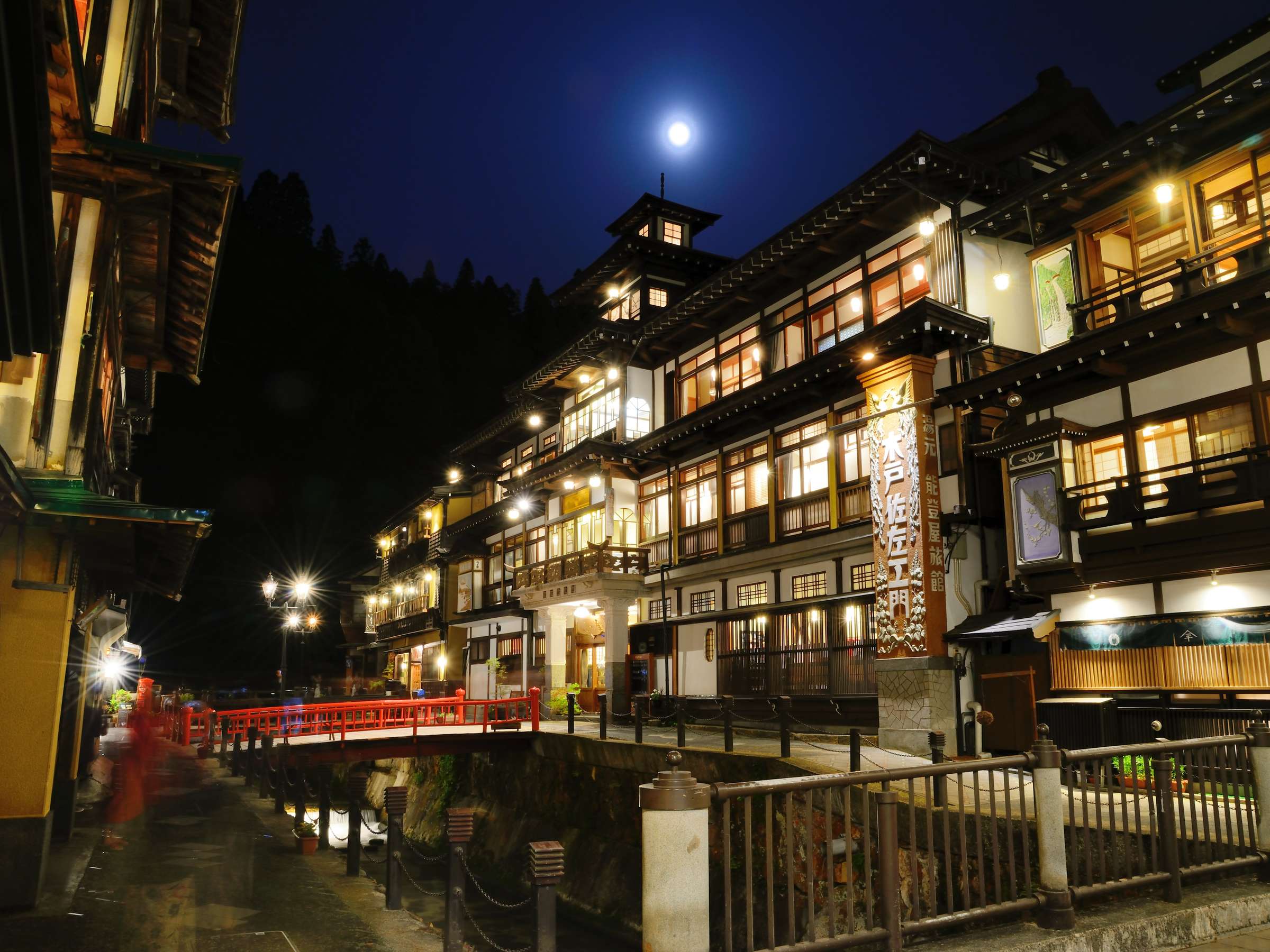
Scorecard - Area: Ginzan Onsen, Yamagata — Explore Ginzan ryokans - Normal-season price: $250–$500 per person per night (inc. two meals) - New Year plan: Carries a seasonal premium; verify on booking page - New Year program: Osechi-ryori and toshikoshi soba standard; atmospheric gas-lit riverfront snow scenery is the main event - English-friendly: No — book via an English-language booking platform (Trip.com, Booking.com); expect limited English on-site - Tattoo policy: Reservable private family bath available; ask about communal-bath policy at time of booking - Onsen type: Sodium chloride sulfate spring; three indoor/outdoor baths plus reservable family bath - Nearest hatsumode: Small local shrines in Obanazawa (40 min by bus); no major shrine nearby - Rating: Not yet rated in database Notoya Ryokan is the most photographed building at Ginzan Onsen — its ornate, six-story Taisho-era wooden facade rising above the gas-lit riverfront is the image most people associate with "quintessential Japanese onsen town in winter." That recognition is earned. The building is a registered tangible cultural property, and it looks exactly like what it is: over a century of continuous ryokan history, built in an architectural style that peaked in the 1920s and was never repeated at this scale. January is Ginzan's peak snow month, with deep, reliable winter snowfall blanketing the narrow valley. The town has no chain hotels, no souvenir shops selling keyrings, and virtually no tourist infrastructure beyond the ryokan and a handful of eating spots. At New Year, when the rest of Japan is navigating the Oshogatsu crowds, Ginzan is quiet in a way that feels specific. Gas lanterns reflect on the river ice. The bells you hear come from local village shrines, not the amplified ceremony of a major temple. The tradeoff is practical: English is limited on-site. Getting here requires a 40-minute bus ride from Oishida Station, itself a JR journey from major Tohoku cities. There is no major hatsumode shrine within easy reach. This is the pick for travelers who want the snow-town atmosphere over the cultural-ritual density — and who are comfortable navigating a Japanese-language environment for the duration of their stay. ---
How to book the best New Year ryokan in Japan (and what happens if you wait)
The hard truth: December 31 check-in at a quality ryokan is effectively sold out 2–4 months in advance. For the 2027 New Year period, the booking window opens roughly June–September 2026. Most Jalan.net and Rakuten Travel New Year plans post in September–October, and the most reviewed properties on those platforms fill within days [Japan Travel Pros; Tripadvisor Japan Travel Forum community consensus]. For non-Japanese speakers using Trip.com, Booking.com, or Expedia, inventory typically becomes visible three to six months out. Set a search alert and check regularly in September — don't wait for October. The price premium at New Year is real and worth understanding clearly. The only verified surcharge figure from a named property's official booking page is Hakone Ginyu: +¥14,300 per person on top of the standard C-rate nightly price for December 31 through January 3 [Hakone Ginyu official reservation page]. That covers the New Year meal program and cultural activities. Saturday and national holiday rates across all ryokan categories already run 20–40% above midweek base rates [Ryokan Finder 2026 Cost Guide]; New Year stacks a further premium on top of that. What the premium buys you concretely: toshikoshi soba, osechi-ryori at breakfast, otoso sake, cultural activities (calligraphy, mochi-pounding), and enhanced kaiseki courses. Avoid any source that quotes a 2x–3x multiplier without citing a specific property — that figure is not property-verified.
Tip
Cancellation risk: Many premium ryokan charge 50–100% cancellation fees from 7 to 30 days before arrival. At ¥50,000+ per person, this is a meaningful sum. Book with a credit card that includes trip cancellation protection, or purchase a standalone travel insurance policy that specifically covers non-refundable accommodation. The cancellation terms are displayed on Trip.com and Booking.com before you confirm — read them before paying.
Book transport at the same time as the ryokan. Shinkansen and limited express trains are heavily booked December 29 through January 4. For Kusatsu especially (no direct Shinkansen), secure the JR + bus leg the moment the ryokan is confirmed. For more on ryokan booking windows generally, see ryokan booking tips.
准备好预订了吗?
从这些精选旅馆中预订
比较三个预订平台的实时可用性和价格。
通过预订链接可能产生佣金,但不会增加您的费用。
---
Already too late? What to do if New Year plans are sold out
If you're reading this in November or December and the December 31 inventory is gone at your target properties, you have more options than the sold-out screen suggests. Shift dates. December 30 check-in is the insider move. You arrive before the crowds, the onsen is noticeably quieter on the 30th, and you're already in position for the bells on December 31 and the full January 1 program. December 30 is often available when December 31 is fully booked, and at a lower rate. You still get everything: toshikoshi soba that evening, joya no kane, osechi on New Year's morning, hatsumode on January 1.
Tip
December 30 check-in is the insider move: you arrive before the crowds, the onsen is at its quietest, and you're already in place for everything that follows.
Try onsen towns with less competitive New Year inventory. Nikko, for instance, has less international demand than Hakone or Kinosaki and still delivers the densest joya no kane experience of any area in this guide. Ginzan Onsen in Yamagata is particularly overlooked by international travelers — the snow-town atmosphere is the main event, not the shrine access. These are not consolation prizes; they're different experiences, each with a genuine New Year character. Watch for cancellations. Cancellations at major ryokan do appear, sometimes two to four weeks out as guests revise plans. Check Trip.com's "last available" filters. If you read Japanese, set an alert on Jalan.net. The window is narrow but real. Extend to January 2–3 check-in. After the midnight peak, January 2 inventory opens up considerably. You still receive osechi-ryori, hatsumode access, and much quieter onsen conditions. Rates for January 2–3 tend to be 20–30% lower than the December 31 peak night. City ryokan as a hybrid. When onsen towns are fully booked, a Tokyo or Kyoto machiya inn near a major shrine gives you hatsumode access on foot and the ryokan experience without the transport scramble. Yasaka Shrine in Kyoto holds the Okera Mairi ceremony on New Year's Eve — visitors light a hemp rope from the sacred fire and carry it home to start their New Year's ozoni. It's a uniquely atmospheric experience for a city-based stay. For broader seasonal booking advice, see best season to visit a ryokan and when to book your Japan trip. ---
What to pack for a New Year ryokan stay
The ryokan supplies yukata (light cotton robe) and a hanten (padded jacket) for wearing around the property and into town. Wear the left side over the right — right-over-left is the funeral convention and staff will gently correct you, but it's worth knowing before you walk through the lobby. - Slip-on sandals or slippers — ryokan provides geta (wooden clogs) or zori, but your own lightweight slip-ons make late-night rotenburo trips easier in snow and ice - Warm base layers — air temperature in January at Hakone, Kinosaki, or Ginzan can drop well below freezing; you'll want thermal underlayers for outdoor onsen, where the water may be 40°C while the air is −3°C - Cash for hatsumode — omikuji fortune slips (¥100–200), omamori protective charms (¥500–1,000), and ema wooden wishing plaques (¥500–1,000) are sold at shrine stalls and are cash-only; ATMs at convenience stores are the easiest source - Small daypack — for carrying hatsumode items, a thermos, and a camera on shrine visits - Charged phone — for the midnight countdown; also useful for translation apps at shrines with limited English signage A note on onsen rules: shower fully at the washing station before entering any communal bath, keep hair pinned up and away from the water, and leave phones and cameras at the edge. If your property has a communal bath and you have tattoos, verify the policy before arrival — it's listed in each scorecard above, and the tattoo-friendly ryokans guide covers this in more depth.
Tip
The outdoor rotenburo at midnight on December 31 is one of the more surreal experiences available to travelers in Japan. Ask your ryokan whether they keep it open past 11 PM on New Year's Eve — most do, but hours vary.
---
Finding the best ryokan for New Year in Japan rewards planning — and it rewards picking the area before you pick the property. Tokyo-based travelers default to Hakone, with Kusatsu or Nikko as strong alternatives. Kansai-based travelers choose between Arima (closer, more accessible) and Kinosaki (more immersive, better snow). Hokkaido in winter belongs to Noboribetsu. The snow-town experience without the crowds points to Ginzan in Yamagata. All seven properties here are drawn from a verified database of 293 ryokan across 30 onsen areas — browse the full inventory for each area to find availability that matches your dates and budget.
*价格及活动方案已针对2026–2027年新年期间核实。*
12月31日晚上11点,一只托盘悄然送至你的门口:漆碗里盛着还冒着热气的跨年荞麦面(toshikoshi soba)。楼下河边隐隐传来浑厚、悠长的寺庙钟声,一下一下地敲向108响。室外露天风吕在等你,松枝上已积了雪。选择日本新年最佳旅馆(ryokan),与平日预订温泉旅宿截然不同——这个季节有其专属仪式、独特的餐食体系,以及一套让大多数旅人猝不及防的预订时间窗口。 大多数关于日本新年的旅游文章都劝你避开——人潮拥挤、餐厅关门、价格飞涨。这些建议完全偏离了重点。如果你已预订旅馆,正月(Oshogatsu)根本不是障碍,它本身就是体验。节日期间所有的文化脉络——寺庙钟声、礼仪性的食物、元旦的第一缕日出、参拜神社——都在旅馆住宿中一一展开。 本指南面向已决定在新年期间前往日本、正在考虑去哪里、该订哪家旅馆的旅人。你将看到分布于六大温泉区域的七处具体旅馆,附带涵盖价格、英文服务、纹身政策及神社距离的诚实评分卡。此外还有一份初诣(hatsumode,新年首次参拜)对照表、切实可行的预订时间线,以及12月31日库存已售罄时的应急方案。 这些推荐来自经过核实的旅馆数据库,涵盖日本30个温泉区域共293家旅馆——也就是本站旅馆最佳出行季节页面所收录的同一批旅宿。新年库存消耗极快,请直接前往各旅馆预订页面确认当前方案。 ---
日本旅馆里的新年,究竟是什么体验
如果你正在寻找日本新年最佳旅馆,首先要了解节日在旅馆里的真实面貌。正月(Oshogatsu)——日本新年——从1月1日持续至3日,12月28日起即进入年末准备期。对日本家庭而言,这是一年中最重要的节日,充满仪式感、休养与团聚。外国人有时将其视为出行的麻烦。但在一家运营有序的旅馆里,它会呈现为另一番模样:一场缓慢而有序的仪式,你可以从容地置身其中。 跨年荞麦面(toshikoshi soba)在12月31日送达,通常于午夜前的傍晚供应。这一传统可追溯至江户时代中期——调查显示约70%的日本人会在除夕吃荞麦面(Just One Cookbook)。荞麦面细长,象征长寿;易于切断,则寓意告别这一年的烦恼。有一点值得注意:最好吃完碗里的面,剩下被认为不吉利。 接下来是除夕钟声(joya no kane)。每年除夕,日本各地寺庙的大钟共敲108响——午夜前敲107下,最后一响迎接新年(Wikipedia — Joya no Kane)。108响对应佛教中的108种烦恼,每一声钟鸣都是一次小小的净化。你是在露天风吕中聆听,还是步行前往附近寺庙,取决于你所选择的温泉区域——这个选择值得认真考量。日光是其中的佼佼者:三座寺庙分别于12月31日晚11点开始举行除夕钟声仪式。 元旦清晨,日式新年料理 osechi(御节料理)登场——叠放在漆木方盒(重箱 jubako)中的节日菜肴,是日本最古老的新年饮食传统之一。每一格都有其含义:黑豆(kuromame)代表勤劳与健康;鲱鱼卵(kazunoko)象征子孙繁盛;伊达卷(datemaki,甜味厚蛋卷)寓意学业进步;虾(ebi)祝愿长寿(Japanese Cultural Center of Hawaii)。整体口味偏甜、腌制味浓,与怀石料理风格迥异。作为外国旅客,不妨将御节料理视为一次文化性的品鉴体验,而非正餐。前一晚的全套怀石晚餐才是重头戏。御节之外,还有雑煮(ozoni)——一种放有年糕的汤,配料因地区而异——以及屠苏酒(otoso),一种在早餐时饮用的香料清酒。箱根的金乃竹(Kinnotake Resort)等旅馆会在不额外收费的情况下自动提供屠苏酒。 大堂或餐厅某处,你会看到镜饼(kagami mochi):两个圆形年糕叠放,顶上置一枚苦橙,圆形造型呼应神道传统中的神圣铜镜。如果你在1月2日或3日住在箱根,不妨走到路边,亲眼看一看每年吸引无数观众的箱根驿传接力赛(Hakone Ekiden)——这一赛事自1920年起每年举办。 关于旅馆礼仪及初次入住须知,请参阅初次入住旅馆指南。

---
各温泉区域初诣指南:哪个小镇离著名神社最近
初诣(hatsumode)——新年首次参拜神社或寺庙,传统上在1月1日至3日之间进行——听起来简单,体验却震撼人心。东京明治神宫三天内约迎来300万参拜者,排队等候进入主殿的时间可达三小时(Activity Japan)。在温泉小镇的神社初诣只需二十分钟,那份专属感难以言传。 参拜仪式与日本本地人相同:向供奉箱投入硬币,鞠躬两次,拍手两次,再鞠躬一次。神社对所有参拜者开放,无论宗教背景。神签(omikuji,¥100–200,约合人民币5–10元)和御守护身符(omamori,¥500–1,000,约合25–50元)在摊位有售,带回家完全合乎文化礼仪。两者均为现金支付。
| 温泉区域 | 最近神社/寺庙 | 距离/交通方式 | 新年特色活动 | 除夕钟声 | 备注 |
|---|---|---|---|---|---|
| 箱根 | 箱根神社——芦之湖畔鸟居,历史超1,250年 | 多数旅馆乘出租车或接驳车10–20分钟 | 约1,000枚烟花映照芦之湖水面 | 多数旅馆可听闻;可前往强罗地区寺庙参与 | 英文指示牌完善;箱根汤本站有烟花专用接驳车 |
| 日光 | 日光东照宫(世界遗产)+ 二荒山神社 + 轮王寺 | 从汤元/鬼怒川温泉乘巴士或出租车15–30分钟 | 1月1日清晨6点东照宫新年祈祷仪式;二荒山神社赠送屠苏酒 | 三座寺庙分别于12月31日晚11点开始 | 本指南中除夕钟声体验最为丰富的温泉区域 |
| 城崎 | 温泉寺——经大师山索道到达 | 从镇中心步行15分钟+乘索道 | 一月初出初式消防游行 | 温泉寺社区钟声 | 城崎官方网站提供完整英文介绍 |
| 草津 | 草津神社,位于温泉镇内 | 所有旅馆步行5–10分钟 | 热乃汤汤揉表演——每日6场,¥700,全年包括新年期间 | 镇内小松之堂寺庙 | 街道上英文指示牌少于箱根 |
| 有马 | 当地有马天神社;住吉大社(大阪)30分钟 | 步行5分钟至本地神社;乘电车30分钟至住吉 | 毗邻关西主要初诣场所;太閤の湯1月1–3日每人加收¥500 | 本地社区钟声 | 关西出发的旅客的优选 |
| 登别 | 镇内登别熊野神社;北海道神宫(札幌)1小时 | 本地神社步行5分钟;乘JR至札幌1小时 | 登别伊达时代村江户新年祭1月1–3日:免费清酒、舞狮、传统游戏 | 本地社区钟声 | 小镇以国内游客为主;仅主要酒店提供英文服务 |
| 银山 | 大石田地区小型本地神社(巴士40分钟) | 乘巴士40分钟至大石田站附近 | 雪乡氛围是最大看点;附近无大型初诣神社 | 本地社区钟声 | 请通过国际平台预订;现场英文服务有限 |
Tip
时间建议: 1月1日上午中段或1月2日全天,是温泉小镇初诣的最佳时间窗口。除非你特别想感受那种人潮涌动的气氛,否则请避开12月31日午夜的高峰——主要神社从晚10点起就已是人挤人。1月2日明显更清静,神社依然保留着完整的新年装饰。
---
日本新年最佳旅馆:7家精选推荐
这7家旅馆的正常季节价格约为每人每晚$120–$900(¥870–¥6,500),覆盖以东京为出发地(箱根、草津、日光)、关西出发(有马、城崎)、北海道出发(登别)以及东北/信州出发(银山)的旅客。新年方案会在基础价格之上收取附加费——本指南中唯一来自旅馆官方预订页面的核实数字是:箱根吟游(Hakone Ginyu)12月31日至1月3日每人在标准房价基础上加收¥14,300。请以此作为参考;其他旅馆金额各有不同。以下每家推荐均附有评分卡,供你一目了然地对比。 最受欢迎旅馆的新年库存通常在9月至10月开放,几周内即告售罄。通过Trip.com、Booking.com或Expedia预订,非日语旅客可享有英文客服支持及清晰的取消条款——在这个价位区间,这一点尤为重要。 ---
箱根吟游(Hakone Ginyu,箱根吟遊)——箱根,东京出发旅客首选

评分卡 - 区域: 箱根,神奈川县 — 探索箱根旅馆 - 正常季节价格: 每人每晚$400–$900(含两餐) - 新年附加费: 12月31日至1月3日每人在C档夜间房价基础上加收¥14,300 [已核实,箱根吟游官方预订页面] - 新年方案: 12月31日跨年荞麦面;1月1日日式新年料理早餐;屠苏酒;初诣交通安排 - 英文服务: 是 - 纹身政策: 全部20间客房均设私人露天风吕——共用澡堂纹身限制一概不适用 - 温泉类型: 多种泉质;每间客房均设私人露天温泉 - 最近初诣: 芦之湖畔箱根神社(约20分钟出租车);午夜烟花可从湖边观赏 - 评分: 9.3/10(124条评价) 箱根吟游坐落于早川溪谷上方的崖壁之上,距宫之下车站约三分钟,全部20间客房均经过精心布局,私人露天温泉面朝溪谷,晴天清晨还能眺望富士山。旅馆之所以特别适合过新年,源于其地理优势:箱根神社午夜烟花——约1,000枚烟花在午夜零时凌空绽放于芦之湖上,倒影映入水面——可从箱根汤本站乘接驳车前往观赏,无需自驾。此后1月2日和3日,箱根驿传接力赛途经此地,这是日本最受关注的新年体育赛事之一,看完就能回旅馆泡汤。 这里的附加费——本指南中唯一来自旅馆官方页面的核实数字——是每人在基础价格之上加收¥14,300,涵盖新年餐饮方案及文化活动。作为参照:同在箱根的金乃竹(Kinnotake Resort)官方新年页面显示,书法和羽根突等可选活动收费¥2,000/人,和服拍摄¥7,000/人,而捣年糕和驿传电视观看则不额外收费。这些数字让你对「新年项目」的实际成本有了直观认识。 如实说一句不足:仅有20间客房,加之口碑卓著、回头客众多,箱根吟游预订极快。如果你在11月才看到这篇文章,请立即查看库存。
---
西村屋本馆(Nishimuraya Honkan,西村屋本館)——城崎温泉,松叶蟹怀石首选
评分卡 - 区域: 城崎温泉,兵库县 — 探索城崎旅馆 - 正常季节价格: 每人每晚$400–$900(含两餐) - 新年方案: 设有季节性附加费;请在预订页面确认当前方案及价格 - 新年项目: 以松叶蟹(matsuba-gani,雪蟹)和但马牛为主角的冬季怀石料理;可免费通行城崎全部七处外汤浴场;1月1日供应御节料理 - 英文服务: 是 - 纹身政策: 本陣の间套房设有私人露天风吕;预订前请确认公共浴场政策 - 温泉类型: 含盐化钠泉;另附七处各具特色外汤通行证 - 最近初诣: 温泉寺——经大师山索道到达,从镇中心步行15分钟+乘索道 - 评分: 9.2/10(198条评价) 西村屋本馆创建于1860年,是关西地区历史最为悠久的旅馆之一,同时也是Relais & Châteaux成员及米其林推荐旅馆——能同时获得两项荣誉,本身就已说明一切。它成为新年首选的原因在于时节:松叶蟹,即当地对日本海捕捞雪蟹的称呼,恰好在冬季达到最佳状态。一月在城崎品尝以松叶蟹为主角的怀石套餐,是日本温泉餐饮体验中难以企及的境界。 城崎本身的配套也加分不少。七处外汤全年开放,西村屋本馆的住客可凭免费通行证逐一探访。穿着旅馆的浴衣和半缠(棉袄),踏着木屐走在大谷川石板路上,伴随雪花飘落,木屐声声回响——这样的体验已成为经典,但经典是有道理的。城崎一月平均降雪量约126厘米,虽不能保证大雪,但大概率如此(来源:Visit Kinosaki官方网站)。 一月初,城崎的出初式消防游行(Dezomeshiki)穿镇而过,消防员身着传统服装,在河面上展示水龙表演。这是充满本土气息的仪式,而非专门为游客打造的表演。从大阪或京都前往可乘直达列车——山陰本線的"こうのとり"特快约需2.5至3小时。
---
奈良屋(Naraya,奈良屋)——草津温泉,日本最强酸性疗愈温泉首选
评分卡 - 区域: 草津温泉,群马县 — 探索草津旅馆 - 正常季节价格: 每人每晚$350–$700(含两餐) - 新年方案: 设有季节性附加费;请在预订页面确认——撰稿时尚未核实英文版新年套餐详情 - 新年项目: 大多数草津旅馆标配跨年荞麦面和御节料理;热乃汤汤揉表演全年每日6场(¥700)(来源:Deep Japan,已核实) - 英文服务: 是 - 纹身政策: 泉游亭(Sen'yutei)厢房设有半露天私人浴池 - 温泉类型: 强酸性硫磺泉,pH值2.0——属日本浓度最高的天然温泉之列 - 最近初诣: 距汤畑温泉广场几步之遥的光泉寺;草津神社步行5–10分钟 - 评分: 9.0/10(310条评价) 奈良屋自1877年起便从草津最古老的泉源——白旗之汤(Shirahata-no-Yu)——取水。泉游亭厢房的复式客房俯瞰城镇中央喷雾弥漫的汤畑温泉广场,这是草津唯一能欣赏到这一特殊景观的住宿。每天都有专职汤守(yumori)艺人精心维护泉源,这个职称在同类旅馆中极为罕见。 草津的泉质才是真正的核心卖点。pH值2.0的硫磺泉是日本酸性最强的天然温泉之一——泡起来的感受与普通温泉截然不同,有一种爽麻感,资深温泉爱好者形容为「透彻干净」。汤畑旁的热乃汤,是一处有顶棚的表演空间,汤揉表演在新年期间每日六场持续上演:身着传统服装的女性用长木板搅动泉水降温,伴随民谣歌声。入场费¥700,节假日期间依然正常开放。 实用提示:草津无直达新干线。从东京出发需乘JR加巴士,全程约三小时。新年交通高峰期(12月29日至1月4日,新干线及长途巴士一票难求),务必提前安排这段行程,与旅馆预订同步购买火车票。
---
陶泉御所坊(Tocen Goshobo,陶泉 御所坊)——有马温泉,关西出发旅客首选
评分卡 - 区域: 有马温泉,兵库县 — 探索有马旅馆 - 正常季节价格: 每人每晚$235–$600(含两餐) - 新年方案: 设有季节性附加费;请在预订页面确认 - 新年项目: 御节料理、12月31日跨年荞麦面、神户牛怀石晚餐;附近太閤の湯1月1–3日每人加收¥500(来源:阪急电铁,已核实) - 英文服务: 是 - 纹身政策: 设有私人浴室选项;请直接确认共用澡堂政策 - 温泉类型: 两种泉质——含铁金泉(kinsen,黄金色矿泉)和含镭碳酸银泉(ginsen,银泉) - 最近初诣: 有马老街小巷内的汤神社和温泉寺(步行5分钟);住吉大社(大阪,乘电车30分钟) - 评分: 数据库中暂无评分 陶泉御所坊是日本最古老的旅馆之一,在有马的泷川河畔已有逾800年历史——史料中记载,有马温泉早在公元720年成书的《日本书纪》中便已有记载,属日本最古老的温泉之列。旅馆共20间客房,有一种大多数旅馆宣传册难以传达的特质:建筑规模与有马老街狭窄石板巷弄的尺度浑然契合。从旅馆大门走到入口,不过三十秒,泷川流水之声在脚下轻鸣。整座建筑不是在宣示自身,而是融入了周遭环境。 正是这里的泉水,使有马在关西地区独树一帜。金泉因溶入铁和盐分而呈琥珀色——同样的矿物质在浴室石材上留下深赭色的积淀,你先感受到颜色,才感受到温度。银泉则色泽透明,富含镭和碳酸,入浴时有一种轻盈、微微起泡的感觉,与金泉浓郁的热度形成鲜明对比。同一旅馆同时拥有两种截然不同的泉质,实属罕见;大多数温泉地只专注于一种类型。 关于陶泉御所坊,有一点需如实说明:旧馆部分的客房,与夜间房价相比,可能会让人感受到岁月的痕迹。文化底蕴和泉质是货真价实的,但期待全面翻新的奢华内饰——如同FUFU日光或箱根吟游那种风格——的旅客,请提前调整预期。对于关西出发的旅客而言,地理位置依然出色:距神户30分钟,从大阪、京都均可轻松到达,住吉大社——日本重要的初诣圣地之一——乘电车30分钟即达。若想要更幽静的参拜体验,步行5分钟即可到达当地汤神社。 ---
第一滝本馆(Dai-ichi Takimotokan,第一滝本館)——登别,北海道冬日,价格亲民之选

评分卡 - 区域: 登别温泉,北海道 — 探索登别旅馆 - 正常季节价格: 每人每晚$120–$350(含两餐)——本指南中价格最低的档次 - 新年方案: 设有季节性附加费;请在预订页面确认 - 新年项目: 标配御节料理和跨年荞麦面;登别伊达时代村江户新年祭1月1–3日:免费清酒、甘酒、舞狮、投扇兴游戏(来源:LIVE JAPAN,已核实) - 英文服务: 是(上架国际平台) - 纹身政策: 大型共用澡堂——请预订前直接向旅馆确认纹身政策 - 温泉类型: 1,500平方米浴场内设35个浴池,由多种天然泉质供水(含硫磺、铁、盐、明矾等) - 最近初诣: 温泉镇内的汤掛地藏(步行5分钟);北海道神宫(札幌,乘JR约1小时) - 评分: 数据库中暂无评分 一月,北海道大雪覆盖整个溪谷,地狱谷(Jigokudani)地热喷口腾起的硫磺灰烟与脚下白色积雪之间的对比格外震撼——从旅馆庭院即可欣赏这一景象。第一滝本馆自1858年开业,如今已发展成一座规模更接近温泉度假综合体而非传统旅馆的建筑:393间客房,1,500平方米的浴场,35个由多种不同泉质供水的浴池。旅馆紧邻地狱谷,这片地热喷口全年烟雾不散。 如果你的标准是「在可接受的价格范围内体验北海道冬日」,第一滝本馆便是答案。正常季节每人每晚含餐约$120起——远低于箱根或城崎的奢华档次。新年方案在此基础上加收附加费,但起点价格使它对于想体验纯正北海道冬日、又不必负担箱根价位的旅客而言颇具吸引力。代价是规模:393间客房让这里更像度假村而非精品旅馆。共用澡堂才是这里真正值得花费的地方。 旅馆步行五分钟可达的登别伊达时代村(Jidaimura),1月1日至3日举行江户风格新年祭,提供免费清酒、甘酒、舞狮表演及投扇兴游戏。这是一项低调而精心策划的文化体验,大多数外国游客完全不知晓。 ---
FUFU日光(FUFU Nikko,ふふ 日光)——日光,世界遗产初诣首选
评分卡 - 区域: 日光,栃木县 — 探索日光旅馆 - 正常季节价格: 每人每晚$400–$900(含两餐) - 新年方案: 设有季节性附加费;请在预订页面确认 - 新年项目: 12月31日跨年荞麦面;1月1日御节料理早餐;屠苏酒;步行即达东照宫1月1日清晨6点新年祈祷仪式;12月31日三处寺庙除夕钟声 - 英文服务: 是 - 纹身政策: 全部24间套房均设客房内私人温泉浴室——共用澡堂纹身政策完全不适用 - 温泉类型: 全部24间套房均设私人客室温泉;碱性单纯泉(附近汤元类型的泉水) - 最近初诣: 日光东照宫——世界文化遗产,1月1日清晨6点新年祈祷仪式(来源:日光官方指南,已核实) - 评分: 9.1/10(310条评价) FUFU日光是一家纯套房制奢华旅馆(24间套房),紧邻田母沢御用邸,步行即可到达使日光成为日本建筑文化最密集地点之一的世界遗产神社群。每间套房均设私人温泉浴室——这在新年时尤为重要,午夜零时前你或许只想在寂静中独自泡汤,静候钟声响起。 日光在本指南所有区域中独一无二之处,在于新年仪式的密度。12月31日晚11点,三处寺庙分别敲响除夕钟声:日光山轮王寺、日光山中禅寺,以及日光山温泉寺(来源:日光官方指南)。你可以前往其中一处,再步行至另一处,或者就在旅馆里聆听钟声在山谷间交叠回响。在日光二荒山神社,新年祈祷期间赠送当地免费清酒。1月1日清晨6点,东照宫开启新年祈祷仪式——大概是东日本继明治神宫之后历史分量最重的初诣,却只有其极小一部分的人流。 实用提示:从东京乘东武特快约两小时即达日光。该地区部分小型旅馆英文支持有限;FUFU日光上架国际平台,为高价预订提供了必要的支持体系。关于关东地区选项的更多背景,请参阅冬季温泉住宿指南。 ---
能登屋旅馆(Notoya Ryokan,能登屋旅館)——银山温泉,雪国明信片之选
评分卡 - 区域: 银山温泉,山形县 — 探索银山旅馆 - 正常季节价格: 每人每晚$250–$500(含两餐) - 新年方案: 设有季节性附加费;请在预订页面确认 - 新年项目: 御节料理和跨年荞麦面为标配;煤气灯映照的雪中河岸氛围才是主角 - 英文服务: 无——请通过英文预订平台(Trip.com、Booking.com)预订;现场英文服务有限 - 纹身政策: 可预约家庭包间浴室;预订时请咨询共用澡堂政策 - 温泉类型: 含硫酸钠氯化物泉;设三处室内外浴池及可预约家庭浴室 - 最近初诣: 大石田(巴士40分钟)附近小型本地神社;附近无大型神社 - 评分: 数据库中暂无评分 能登屋旅馆是银山温泉最常被拍摄的建筑——精雕细琢的六层大正时代木造外观,耸立于煤气灯照映的河岸之上,是大多数人心目中「冬日日本温泉小镇」的代名词。这份名气实至名归。建筑本身是国家登录有形文化财,外观与其历史如出一辙:超过一个世纪的旅馆经营史,以一种1920年代才有、此后再未在同等规模上重现的建筑风格所建造。 一月是银山积雪最深的月份,厚实而可靠的白雪覆盖着整个狭长谷地。镇上没有连锁酒店,没有卖钥匙扣的纪念品商店,旅馆与寥寥几处饮食小店之外几乎没有任何旅游基础设施。新年时节,当日本其他地方都在应对正月人潮时,银山自有一种独特的宁静。煤气灯的光芒倒映在结冰的河面上。耳边传来的钟声,来自附近村落的小神社,而非大型寺庙那种经过扩音的庄严仪式。 实际情况不可不提:现场英文服务有限。前往此地需从大石田站乘40分钟巴士,而大石田站本身也需从东北主要城市乘JR前往。附近没有可轻松到达的大型初诣神社。这是专为在意雪乡氛围、胜过在意文化仪式密度的旅客而设的选择——以及愿意在整个旅程中应对日语环境的旅客。 ---
如何预订日本最佳新年旅馆(以及等待的后果)
说在前面:12月31日入住的优质旅馆,通常提前2至4个月便已售罄。 针对2027年新年,预订窗口大约在2026年6月至9月开启。Jalan.net及乐天旅游上的大多数新年套餐在9月至10月上线,这些平台上评价最多的旅馆往往在几天内便告售罄(来源:Japan Travel Pros;Tripadvisor Japan Travel Forum社区共识)。 使用Trip.com、Booking.com或Expedia的非日语旅客,库存通常在三至六个月前开放。请设置搜索提醒,从9月起定期查看——不要等到10月。 新年的价格附加费是真实存在的,值得清楚了解。本指南中唯一来自旅馆官方预订页面的核实数字是箱根吟游:12月31日至1月3日每人在标准C档夜间房价基础上加收¥14,300(来源:箱根吟游官方预订页面)。这覆盖了新年餐饮方案和文化活动。所有旅馆的周六及法定节假日夜间基础价本已比平日高出20–40%(来源:Ryokan Finder 2026 Cost Guide);新年附加费在此之上再度叠加。附加费的具体回报是:跨年荞麦面、御节料理早餐、屠苏酒、文化活动(书法、捣年糕)以及升级版怀石套餐。请对那些未引用具体旅馆、却声称价格达「2至3倍」的来源保持警惕——该数字未经旅馆官方核实。
Tip
取消风险: 许多高端旅馆在入住前7至30天内取消将收取50–100%的违约金。每人¥50,000以上的住宿,这是一笔相当可观的金额。建议使用附带旅行取消保障的信用卡预订,或购买明确涵盖不可退款住宿的独立旅行保险。Trip.com和Booking.com在确认订单前会显示取消条款——付款前务必仔细阅读,而非事后查看。
请在预订旅馆的同时订好交通。新干线和特快列车在12月29日至1月4日期间极为拥挤。草津尤其要注意(无直达新干线),旅馆一经确认,立刻锁定JR加巴士的行程。 关于旅馆预订窗口的更多内容,请参阅旅馆预订攻略。
准备好预订了吗?
从这些精选旅馆中预订
比较三个预订平台的实时可用性和价格。
通过预订链接可能产生佣金,但不会增加您的费用。
---
已经太晚了?新年套餐售罄后怎么办
如果你在11月或12月才看到这篇文章,目标旅馆的12月31日库存已经没了,实际上你还有不少选择。 调整日期。 12月30日入住是内行人的做法。你提前在人潮到来前抵达,30日的温泉明显更安静,并且已经就位,等待31日的钟声和1月1日的全套新年节目。12月31日往往全部售罄时,30日常有余量,而且价格更低。该有的一切你都不会错过:当晚的跨年荞麦面、除夕钟声、新年清晨的御节料理、1月1日的初诣。
Tip
12月30日入住是内行人的做法: 人潮到来前就已到位,温泉最为清静,之后所有的仪式你都在场。
试试竞争没那么激烈的温泉区域。 比如日光,国际需求远不如箱根或城崎热门,却依然能带来本指南中除夕钟声体验最为丰富的感受。山形县的银山温泉则是国际旅客最容易忽视的目的地之一——雪乡氛围本身就是主角,神社参拜并非卖点。这些不是安慰奖,而是各具特色的体验,每一处都有其真实的新年面貌。 守候取消名额。 大型旅馆偶有取消名额出现,有时在出发前两至四周。请关注Trip.com的「最后可订」筛选。如果你能阅读日语,可在Jalan.net设置提醒。窗口期虽短,但确实存在。 将入住日期延至1月2至3日。 午夜高峰过后,1月2日的库存明显增多。御节料理、初诣参拜和更安静的温泉体验,一样都不会少。1月2至3日的价格通常比12月31日高峰夜低20–30%——对于箱根驿传观赛和悠闲的御节早餐,依然值得。 城市旅馆作为混合方案。 当温泉区域全面售罄时,东京或京都靠近大型神社的町家旅馆,可步行完成初诣,同时保留旅馆体验,省去长途交通的周折。京都八坂神社在除夕举行おけら詣り(Okera Mairi)仪式——参拜者从圣火上点燃苎麻绳,带回家点燃元旦的雜煮炉火。这是城市住宿所能提供的独特而意境十足的体验。 关于季节性预订建议的更多内容,请参阅旅馆最佳出行季节及日本旅行预订攻略。 ---
新年旅馆之旅:行李清单
旅馆会提供浴衣(轻棉和服)和半缠(棉袄),供你在旅馆内及走入小镇时穿着。穿着时请记住左衽压右衽——右衽压左衽是葬礼的穿法,工作人员会温和地为你纠正,但事先知道总归是好的。 - 便于穿脱的拖鞋 — 旅馆会提供木屐(geta)或草履(zori),但在雪地和冰面上,自备一双轻便拖鞋能让深夜前往露天风吕更为方便 - 保暖内衣 — 箱根、城崎或银山一月的气温可能大幅低于零度;在露天温泉泡汤时,水温可达40°C,而气温可能只有-3°C,务必备好保暖内层 - 现金用于初诣 — 神签(¥100–200)、御守护身符(¥500–1,000)及绘马许愿牌(¥500–1,000)均在神社摊位出售,仅收现金;便利店ATM是最方便的取款途径 - 小型背包 — 用于携带初诣战利品、保温杯和相机 - 充满电的手机 — 用于跨年倒计时;在英文指示较少的神社,翻译软件也派上用场 关于温泉礼仪:进入任何共用浴池前须在冲洗处彻底淋浴,头发束起避免落入水中,手机和相机留在浴池边缘。如果旅馆设有共用浴场且你有纹身,请在入住前确认政策——以上各评分卡均有注明,纹身友好型旅馆指南亦有深入介绍。
Tip
12月31日午夜在露天风吕中泡汤,是日本旅行中体验感最为奇妙的时刻之一。 请向旅馆确认除夕夜晚11点后是否维持开放——大多数旅馆会开放,但具体时间各有不同。
---
找到日本新年最佳旅馆,需要提前规划——也需要先选好区域,再选旅馆。以东京为出发地的旅客首选箱根,草津或日光是有力替代方案。以关西为出发地的旅客在有马(更近、更便捷)和城崎(更沉浸、雪更大)之间做出选择。北海道冬日属于登别。若想要无人打扰的雪乡体验,山形的银山是最佳答案。以上七家旅馆均来自经过核实的30个温泉区域293家旅馆数据库——请浏览各区域完整库存,寻找符合你日期和预算的房源。
FAQ
常见问题
Are ryokan onsen open on New Year's Day?+
Yes — most onsen at ryokan remain open throughout the New Year period, December 31 through January 3. Hours may shift slightly on January 1 (opening at 8 AM instead of 6 AM to allow staff time for their own New Year rituals), and outdoor rotenburo hours vary by property. Ask your specific ryokan about late-night hours on December 31 if you plan an after-midnight soak. Convenience stores nationwide stay open 24/7 if you need anything during the holiday.
How much more expensive is a ryokan during New Year?+
The premium varies significantly by property. The only verified figure from a named property's official booking page is Hakone Ginyu: +¥14,300 per person on top of the standard nightly rate for December 31–January 3 [Hakone Ginyu official]. Normal-season rates already carry a 20–40% surcharge on Saturday and national holiday nights [Ryokan Finder 2026]; New Year stacks further on top. What the premium buys is tangible: osechi-ryori, toshikoshi soba, otoso sake, and cultural programming (calligraphy, mochi-making). Avoid any source quoting a blanket "2x–3x" multiplier without citing a specific property — that figure is not property-verified.
What is osechi-ryori and will I actually enjoy it?+
Osechi-ryori is a set of traditional New Year dishes served in tiered lacquered boxes (jubako). Each item carries symbolic meaning: black soybeans (kuromame) for hard work and health, herring roe (kazunoko) for family prosperity, sweet rolled omelette (datemaki) for learning, shrimp (ebi) for long life [Japanese Cultural Center of Hawaii]. The flavors lean sweet, preserved, and briny — quite different from kaiseki. You will not go hungry: your full kaiseki dinner the night before remains the main meal. Treat osechi as a cultural tasting experience rather than breakfast.
How far in advance do I need to book?+
Top ryokan December 31 plans sell out 2–4 months in advance. October and November may already be too late for the most popular Hakone and Kinosaki properties. But good inventory remains in areas with lower international demand — Nikko, Ginzan — where December 30 check-in is often available when December 31 is sold out and delivers the full cultural experience. See the "Already Too Late?" section above.
Which area is best for New Year based in Tokyo?+
Hakone is the default: 90 minutes by Romancecar from Shinjuku, Mt. Fuji views on clear mornings, midnight fireworks over Lake Ashi, and the Hakone Ekiden race on January 2 and 3. Kusatsu Onsen is the alternative for spring-quality obsessives (about 3 hours via JR and bus) — no Shinkansen, so book transport early. Nikko rewards travelers who prioritize the hatsumode experience: UNESCO Toshogu Shrine's 6 AM January 1 prayer service and three temple bell ceremonies on December 31.
Which area is best for New Year based in Kyoto or Osaka?+
Arima Onsen is the closest option (30 minutes from Kobe, easy from Osaka and Kyoto) with the bonus of unique kinsen and ginsen spring chemistry and proximity to Sumiyoshi Taisha — one of Japan's most significant hatsumode sites — by train in 30 minutes. Kinosaki Onsen is the more immersive choice: a direct limited express of 2.5 to 3 hours from Osaka or Kyoto, seven public bathhouses, heavy snow in January, and matsuba crab at peak season.
Can I attend joya no kane (temple bell ringing)?+
It depends on the area. Nikko is the clear standout: three separate temples begin their ceremonies at 11 PM on December 31 — Nikkosan Rinnoji, Nikkosan Chuzenji, and Nikkosan Onsenji [Nikko Official Guide]. You can walk between them. In Kinosaki, the community bell at Onsenji Temple is walkable from all ryokan. In Kusatsu, Komakino-do Temple rings within the town. Many ryokan pipe in the NHK national broadcast so you can hear the bells from your room or the common area.
Can I do hatsumode from an onsen town?+
Yes — every area in this guide has at least one shrine or temple within walking distance. The advantage over city hatsumode is dramatic: Meiji Jingu in Tokyo sees 3 million visitors in three days with queue times up to three hours [Activity Japan]. Hatsumode at Hakone Shrine or Kinosaki's Onsenji takes 20 to 30 minutes. See the hatsumode table above for specifics per area.
What if I have tattoos?+
Tattoo policies vary per property and are noted in each scorecard. The clearest solution: any property with a private in-room bath effectively removes the communal-bath question. Four of the seven picks in this guide — Hakone Ginyu, Nishimuraya Honkan (Honjin-no-Ma suite), FUFU Nikko, and Tocen Goshobo — have private bathing options. For comprehensive tattoo policy guidance across all ryokan, see the tattoo-friendly ryokans guide. Never assume — verify before booking.
Do ryokan have English-speaking staff during New Year?+
Properties listed on Trip.com, Booking.com, and Expedia generally have at least basic English communication capability. Dedicated English-speaking staff varies. Hakone, Kinosaki, and Nikko (FUFU) have the strongest English infrastructure in this guide. Noboribetsu is more limited outside major hotels. Notoya Ryokan at Ginzan has limited English on-site — book via an English-language platform and use translation apps for in-person communication. The scorecards above note each property's English-friendliness rating.
Is it safe to book a ¥50,000+ per person stay with strict cancellation policies?+
The risk is real. Many premium ryokan charge 50–100% cancellation fees from 7 to 30 days before arrival. At ¥50,000+ per person for two people, you are potentially risking ¥100,000 or more. Mitigation: book with a credit card that includes trip cancellation protection, or purchase a standalone travel insurance policy that covers non-refundable accommodation. Cancellation terms are displayed on Trip.com and Booking.com before you confirm — read the policy carefully at booking, not after.
Which nights matter most culturally?+
December 31 is the peak cultural night (toshikoshi soba, joya no kane, the midnight moment) and carries the highest surcharge. January 1 delivers osechi, otoso, hatsumode, and the quieter first-morning-of-the-year atmosphere. December 30 is the insider move: you settle in before the crowds, the onsen is at its quietest, and you're in place for everything that follows. If you can only do one night beyond December 31, add December 30 rather than January 2. January 2 and 3 are calmer and often 20–30% cheaper than the peak night — still worth it for the Hakone Ekiden viewing and lingering osechi breakfasts.
What does a typical New Year's Day at a ryokan look like?+
Wake early for the first onsen soak of the New Year. New Year's breakfast arrives with osechi-ryori, ozoni mochi soup, and otoso spiced sake. Mid-morning: walk or shuttle to the nearest shrine for hatsumode — toss a coin, pull an omikuji fortune slip, consider an omamori charm. Return to the ryokan. A second onsen soak in the afternoon. Evening: full kaiseki dinner. In Hakone on January 2 and 3, roadside Ekiden race viewing replaces the afternoon soak as the activity. The pace is deliberately slow. That's the point. ---
旅馆温泉在元旦是否开放?+
是的——大多数旅馆温泉在12月31日至1月3日的新年期间全程开放。1月1日的开放时间可能略有调整(如改为早8点而非早6点,为员工保留参与自身新年仪式的时间),室外露天风吕的开放时间因旅馆而异。如计划在午夜后泡汤,请提前询问旅馆12月31日的深夜开放安排。便利店全国24小时营业,节日期间需要补给可随时前往。
新年期间旅馆价格贵多少?+
附加费因旅馆差异明显。本指南中唯一来自旅馆官方预订页面的核实数字是箱根吟游:每人加收¥14,300,叠加于12月31日至1月3日的标准夜间房价之上(来源:箱根吟游官方)。正常季节的周六及法定节假日夜间本已比平日高出20–40%(来源:Ryokan Finder 2026);新年附加费在此基础上再次叠加。附加费换来的实惠是切实可见的:御节料理、跨年荞麦面、屠苏酒以及文化活动(书法、捣年糕)。请对那些未引用具体旅馆便声称价格「翻2至3倍」的信息来源保持警惕——该数字未经旅馆官方核实。
御节料理是什么?我真的会喜欢吗?+
御节料理(日式新年料理 osechi)是盛放于漆木重箱(jubako)中的传统新年菜肴套组。每道菜均有象征意义:黑豆(kuromame)寓意勤劳与健康,鲱鱼卵(kazunoko)祈愿家族繁荣,伊达卷(datemaki,甜味厚蛋卷)象征学业进步,虾(ebi)祝愿长寿(来源:Japanese Cultural Center of Hawaii)。整体口味偏甜、腌制味重、带咸鲜——与怀石料理风格迥异。放心,你不会饿肚子:前一晚的全套怀石晚餐才是正餐。请将御节料理当作一次文化品鉴,而非早餐。
需要提前多久预订?+
顶级旅馆的12月31日套餐通常在2至4个月前售罄。10月和11月对于最受欢迎的箱根和城崎旅馆来说可能已经太晚。不过,在国际需求较低的区域——日光、银山——依然有好的选择;12月30日入住通常比31日更易抢到,而且同样能带来完整的文化体验。请参阅上文「已经太晚了?」章节。
以东京为出发地,哪个区域过新年最好?+
箱根是首选:从新宿乘浪漫特快(Romancecar)约90分钟,晴天可眺望富士山,午夜有芦之湖烟花,1月2日和3日有箱根驿传赛事。草津温泉是泉质控的替代方案(乘JR加巴士约3小时)——无直达新干线,请提前订好交通。日光适合优先考虑初诣体验的旅客:世界遗产东照宫1月1日清晨6点新年祈祷仪式,以及12月31日三处寺庙的除夕钟声。
以京都或大阪为出发地,哪个区域过新年最好?+
有马温泉是最近的选项(距神户30分钟,从大阪、京都均可轻松到达),加上独特的金泉银泉双泉质,以及乘电车30分钟可达的住吉大社——日本重要的初诣圣地之一。城崎温泉则体验更为沉浸:从大阪或京都乘直达特快约2.5至3小时,七处外汤,一月降雪量大,正是松叶蟹的当季盛期。
能参加除夕钟声仪式(撞钟)吗?+
这取决于你所在的区域。日光是明显最佳之选:12月31日晚11点,三处寺庙分别开始仪式——日光山轮王寺、日光山中禅寺和日光山温泉寺(来源:日光官方指南)。三处寺庙之间可步行往来。城崎的温泉寺社区钟声从镇内各旅馆步行即可到达。草津镇内的小松之堂寺庙也会鸣钟。很多旅馆会播放NHK全国直播,让你在客房或公共区域就能听到钟声。
能从温泉小镇出发做初诣吗?+
可以——本指南所有区域都有至少一处步行可达的神社或寺庙。与城市初诣相比,优势非常明显:东京明治神宫三天内迎来300万参拜者,排队时间长达三小时(来源:Activity Japan)。箱根神社或城崎温泉寺的初诣只需20至30分钟。各区域具体信息请参阅上方初诣对照表。
有纹身怎么办?+
纹身政策因旅馆而异,每份评分卡均有注明。最清晰的解决方案:设有客室内私人浴室的旅馆,可完全回避共用澡堂的问题。本指南七家推荐中有四家——箱根吟游、西村屋本馆(本陣の间套房)、FUFU日光和陶泉御所坊——均设有私人浴室选项。所有旅馆的纹身政策全面指南,请参阅纹身友好型旅馆指南。切勿假设,务必预订前确认。
新年期间旅馆是否有英文服务人员?+
上架Trip.com、Booking.com和Expedia的旅馆,通常至少具备基本英文沟通能力。专职英文服务人员各有不同。箱根、城崎和日光(FUFU)在本指南中英文配套最为完善。登别在大型酒店以外英文支持较为有限。银山温泉的能登屋旅馆现场英文服务极为有限——请通过英文平台预订,现场沟通借助翻译软件。上方各评分卡均已注明英文友好程度。
以每人¥50,000以上且含严格取消条款的旅馆,预订安全吗?+
风险是真实存在的。许多高端旅馆在入住前7至30天取消须支付50–100%的违约金。两人合住,每人¥50,000以上,你潜在的风险达到¥100,000甚至更多。降低风险的做法:使用附带旅行取消保障的信用卡预订,或购买明确涵盖不可退款住宿的独立旅行保险。Trip.com和Booking.com在确认订单前会显示取消条款——请在付款前仔细阅读,而非事后查看。
文化上最重要的哪几个夜晚?+
12月31日是文化分量最重的夜晚(跨年荞麦面、除夕钟声、午夜时刻),附加费也最高。1月1日带来御节料理、屠苏酒、初诣以及新年第一个清晨的静谧氛围。12月30日是内行人的选择:在人潮到来前安顿下来,温泉最为清静,之后所有的仪式你都在场。如果在12月31日之外只能多订一晚,选30日胜过2日。1月2日和3日更为安静,价格通常比12月31日高峰夜低20–30%——欣赏箱根驿传和悠享御节早餐依然值得。
元旦在旅馆里是什么体验?+
清早起身,在旅馆泡新年第一缕温泉。新年早餐端上御节料理、雜煮年糕汤和屠苏酒。上午中段,步行或乘接驳车前往最近的神社初诣——投入硬币,抽一支神签,考虑请一枚御守护身符。返回旅馆。午后再泡一次温泉。傍晚:全套怀石晚餐。在箱根,1月2日和3日下午可以到路边观赏箱根驿传比赛,取代午后的泡汤。节奏刻意放慢,这正是旅馆之旅的精髓所在。 ---