Quick Comparison
7 picks| Ryokan | From | Rating | Book |
|---|---|---|---|
 | from US$460/person/night≈ US$920 for 2 | 9.7 51 reviews | Book on Agoda |
 | from US$235/person/night≈ US$470 for 2 | 9.6 206 reviews | Book on Trip.com |
 | from US$197/person/night≈ US$394 for 2 | 9.4 55 reviews | Book on Agoda |
 | from US$86/person/night≈ US$172 for 2 | 9.6 18 reviews | Book on Agoda |
 | from US$200/person/night≈ US$400 for 2 | 9.4 167 reviews | Book on Trip.com |
 | from US$400/person/night≈ US$800 for 2 | 9.2 198 reviews | Book on Agoda |
 | from US$318/person/night≈ US$636 for 2 | 9.5 93 reviews | Book on Agoda |
Tocen Goshobo
Arima
Hotel Hanakoyado
Arima
Nishimuraya Honkan
Kinosaki
Sumihei Bettei Tokitotoki
Kinosaki
Prices shown are approximate starting rates per person per night. We may earn a commission on bookings.
You have one onsen night, a Kansai itinerary that is mostly sorted, and a browser tab open for each town. Tripadvisor is not helping — every thread ends in "both are great, depends on what you like!" That is not an answer.
Here is the honest version, backed by data from our verified database of 23 Arima ryokans and 33 Kinosaki ryokans — all rated on a /10 scale with real review counts. The core tension is this: Arima offers uniquely rare mineral water and is under an hour from Osaka, while Kinosaki offers the deeper onsen town atmosphere with tattoo-friendly public bathhouses and a crab season that changes the dinner entirely. If this is your first ryokan night and you are unsure what you are getting into, our first-time ryokan guide is worth a quick read before you commit.
The verdict is below, by scenario.
 Pin to Pinterest
Arima Onsen vs Kinosaki Onsen: Side-by-Side
The table below covers the decisions that actually matter. Detailed explanations of each row follow in the sections below.
| Factor | Arima Onsen | Kinosaki Onsen |
|---|---|---|
| Distance from Osaka | 60 min (direct bus, ~¥1,400) | ~2 hr 40 min (JR Limited Express Kounotori, ~¥6,140) |
| Distance from Kyoto | 70 min (highway bus, ~¥1,850) | ~2.5 hr (JR direct, ~¥5,170–5,770) |
| Water type | Kinsen (iron/salt, brown) + Ginsen (radium/carbonate, clear) — unique in Japan | Sodium chloride (restorative, standard) |
| Public bathhouses (sotoyu) | 2 (Kin no Yu, Gin no Yu) | 7 celebrated bathhouses; 5 currently open (6 from November 2026) |
| Tattoo policy — public baths | Mostly banned; private-bath rooms available at select ryokans | All 7 sotoyu accept tattooed guests (town-wide policy) |
| Price range (per person, 2 meals) | ~¥20,000–35,000 budget; ~¥35,000–65,000 mid; ~¥70,000–120,000+ luxury | ~¥15,000–25,000 budget; ~¥25,000–50,000 mid; ~¥60,000–90,000+ luxury |
| Signature food draw | Kobe/Tajima beef year-round | Matsuba crab (Nov 6–Mar 20) + Tajima beef |
| Day trip viability | Yes — genuine day trip possible | Technically possible; overnight guests get roughly 60% more of the actual experience |
| Town atmosphere | Upscale mountain village; mix of traditional inns and modern hotels | Preserved 1,300-year-old canal town; yukata street culture |
| Best season | Year-round; peak Oct–Nov (Mt. Rokko foliage) | Nov–Mar (crab); Apr (cherry blossom); summer is fine but quieter |
| English friendliness | Good at select ryokans; limited street-level signage | English signage throughout; strong tourism infrastructure |
| Itinerary pairing | Kobe day trip natural add-on | Genbudo Cave, Tajima coast, or Tottori as extensions |
Arima Onsen in Depth
Arima makes a case that no other onsen town in Japan can make: it sits within an hour of Osaka and Kobe, yet it holds two completely different mineral spring types that occur together nowhere else on earth. If that sounds like marketing language, step into the Kin no Yu public bath and watch the water come out of the pipe. It is clear. By the time it fills the tub it has turned the color of rust. That is not a filter or a dye — it is iron oxidizing on contact with air, the same process that happens when you leave a nail in the rain. Arima's kinsen is that unusual, and feeling it is worth the trip alone.
Kinsen and Ginsen: Arima's Two Waters Explained
 Pin to Pinterest
Kinsen (gold spring) is an iron and sodium chloride spring. The water emerges colorless from the ground and oxidizes on contact with air to that unmistakable reddish-brown. Salty mineral smell, genuinely warming, and it leaves a slight residue on the skin that guests either love or find unusual. The public Kin no Yu bath uses kinsen only.
Ginsen (silver spring) is a blend of carbonate and radium springs. It stays clear, feels lighter, has a faint carbonation tingle, and is gentler on the skin than kinsen. The public Gin no Yu uses ginsen only.
Both types spring from ancient seawater deposited roughly six million years ago under the Mt. Rokko fault system — the same geological structure behind the 1995 Kobe earthquake. You will not find this combination anywhere else in Japan. That geological uniqueness is the single strongest argument for choosing Arima over any other onsen town, including Kinosaki. Arima is also one of Japan's Three Ancient Springs alongside Dogo and Shirahama, with documented imperial visits dating to Emperor Jomei's three-month stay in 631 AD.
At Arima's public baths, admission is charged separately from your ryokan rate: Kin no Yu runs ¥800 (¥650 on weekdays), Gin no Yu runs ¥700 (¥550 on weekdays), with a combination ticket available for ¥1,200.
Best Ryokans in Arima Onsen
Three picks across different traveler types — all drawn from our verified database, all confirmed to have private kinsen baths. For tattooed guests, Arima's communal public baths are off-limits, but every inn below offers the private-bath workaround.
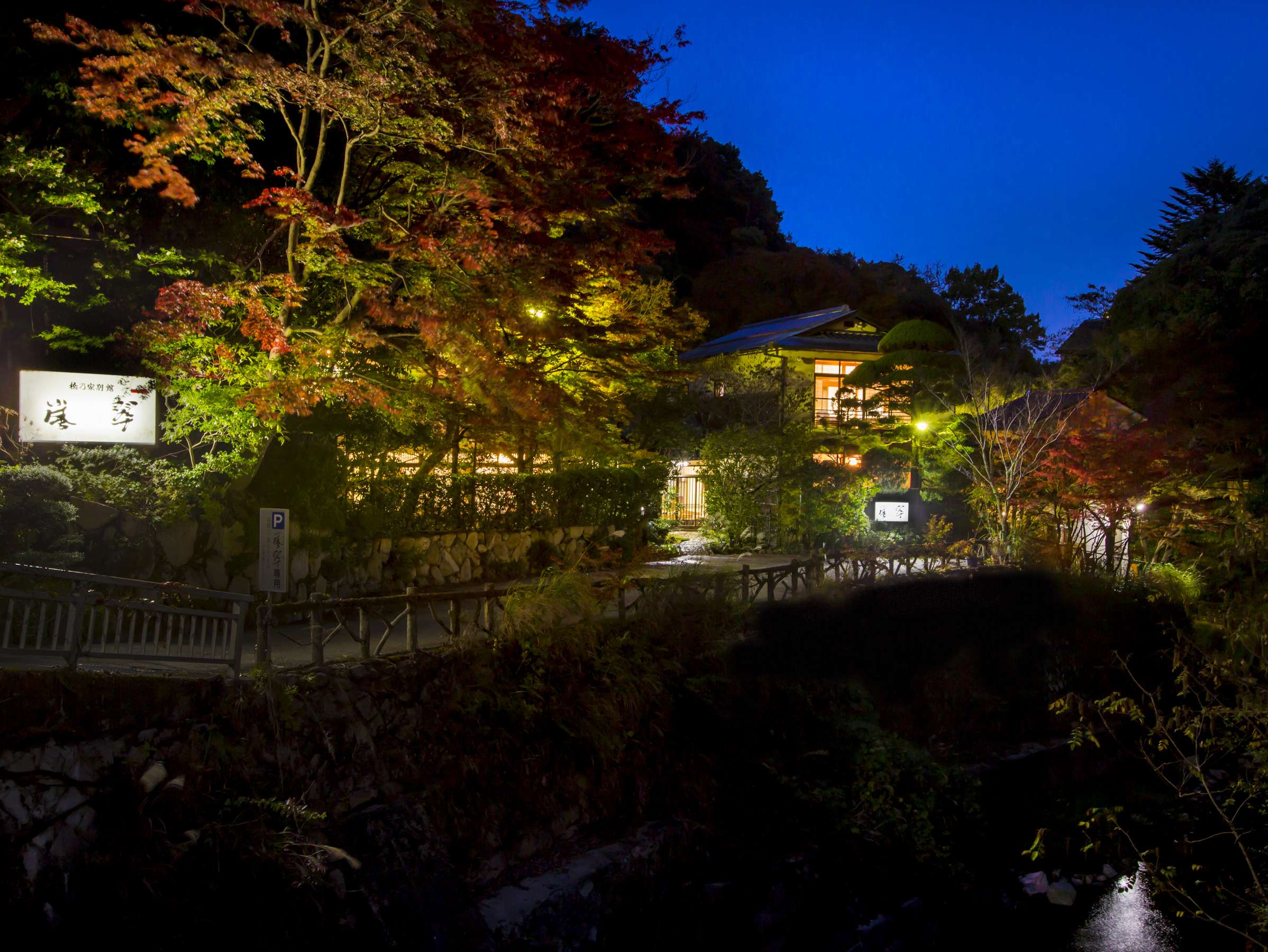
Hashinoya Bekkan Ransui (橋乃家別館 嵐翠) — rated 9.7/10 across 51 reviews in our database — is a nine-room Meiji-era villa converted into a ryokan. The wooden beams and shoji screens are original; the kinsen private rotenburo in the Takikawa garden is not. This is the clearest pick for first-time visitors who are nervous about language: confirmed English-speaking staff is listed as an amenity, which is rarer than you might expect in Arima. Tattoo policy is private-only, but with a private cypress rotenburo that books quickly given the small room count, it is a real option rather than a workaround. Rates fall in the upper-mid range — approximately ¥50,000–90,000 per person with two meals.
Tocen Goshobo (陶泉 御所坊) — 9.6/10 across 206 reviews — was founded in 1191 during the Kamakura period and has operated for 16 generations. The name "Gosho" (imperial palace) comes from Shogun Ashikaga Yoshimitsu's patronage in the fourteenth century; novelist Junichiro Tanizaki was a later regular. If historical weight in an inn matters to you, nothing in Arima competes. The dinner is Kobe beef kaiseki, sourced from Tajima cattle. Plans start from approximately ¥30,000 per person with meals for entry-level rooms, with full Kobe-beef kaiseki plans reaching ¥70,000–80,000 or more.
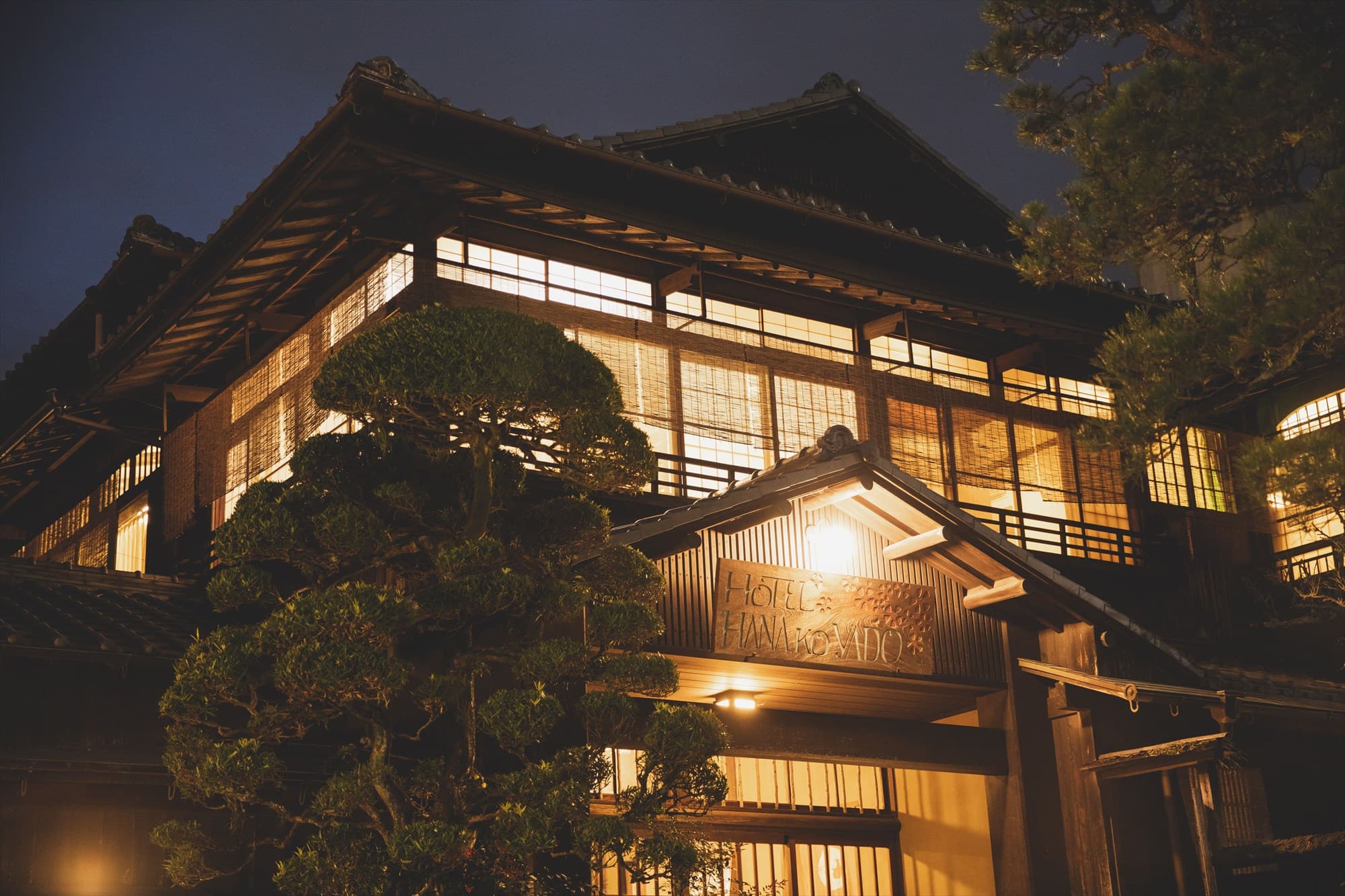
Hotel Hanakoyado (ホテル花小宿) — 9.4/10 across 55 reviews — is the tattoo-clearest option in Arima for a specific reason: it has no communal bath at all. Only two 24-hour private kinsen baths named Tsutabasu and Kaedero, available first-come-first-served. This Taisho-era nine-room property is a sister inn to Goshobo, operated by the same family, and it positions as the more accessible mid-range option. OTA rates suggest approximately ¥40,000–70,000 per person with two meals (not independently verified; treat as directional).
For the complete list of all 23 Arima ryokans in our database, see our full guide to Arima Onsen ryokans.
Pairing Arima with a Kobe Day
The Shinki Bus express runs from Kobe Sannomiya directly to Arima Onsen in approximately 25 minutes for ¥600 — roughly hourly. That proximity makes the classic Arima day structure effortless: Kobe Harbor or the Kitano Ijinkan foreign-residence district in the morning, bus to Arima by 2pm for check-in, dinner in-room, morning bath before check-out, bus back to Kobe or on to Kyoto.
Alternatively, use Arima as a night add-on after a full Kobe day — Nunobiki Ropeway up to Kitano Herb Garden, Meriken Park along the harbor, a proper Kobe beef dinner in the city, then the bus up the mountain for the onsen night. Either way, no shinkansen ticket needed, no reserved seat scramble.
If your base is Osaka rather than Kobe, a highway bus from Hankyu Umeda or JR Osaka Station reaches Arima in around 60 minutes for ¥1,400. See our best onsen ryokans near Osaka for more options in that radius.
Kinosaki Onsen in Depth
Kinosaki does one thing that no other onsen town in Japan replicates at scale: it puts seven public bathhouses within walking distance of each other, gives every overnight guest a free all-access pass, and sets the whole circuit on a canal lined with willow trees and stone bridges. When people picture a Japanese onsen town — the lanterns, the yukata, the street crowded with guests carrying small towel bags from bath to bath — they are picturing Kinosaki.
The town is 1,300 years old, founded in 738 AD when Buddhist monk Dochi Shonin prayed for a thousand days at what became Onsenji Temple. The temple still stands on Mount Daishi above town; historically, visitors paid their respects there before bathing. The bathing culture has not changed that much.
The Seven Bathhouses: What Sotoyu Actually Means
 Pin to Pinterest
Every overnight guest at a Kinosaki ryokan receives a Yumepa pass at check-in — free, valid for all seven public sotoyu bathhouses during your stay. Day visitors pay ¥1,500 for the same pass. The seven bathhouses each have different architecture, different opening hours, and a different feeling:
Ichi-no-Yu — the most photographed facade in town, a cave-entrance structure right on the main canal. Open 7:00–23:00, closed Wednesdays.
Gosho-no-Yu — the largest, with garden pools and multiple bath types. Open 7:00–23:00, closed Thursdays.
Mandara-yu — intimate and retro wooden interior, smallest-feeling of the active sotoyu. Opens 15:00, closed Wednesdays.
Jizo-yu — by the station, the first one most arriving guests hit. Named for the guardian deity of children. Open 7:00–23:00, closed Mondays.
Yanagi-yu — the least crowded, a neighborhood-scale bathhouse that locals prefer. Opens 15:00, closed Thursdays.
Kono-yu — hilltop location with views over town, accessed by ropeway or on foot. Closed for safety renovation May 11 through October 30, 2026 (planned).
Sato-no-Yu — the newest and largest, with panoramic outdoor baths. Closed since April 2024 for long-term reconstruction after asbestos was found during demolition. No reopening date has been published.
In practical terms: as of publication in August 2026, five sotoyu are open, with a sixth (Kono-yu) returning after October 30, 2026 (planned). The Yumepa pass covers all seven as town policy, so tattooed guests are welcome at all five currently active bathhouses. Your ryokan will give you the week's rotation schedule at check-in — one bathhouse closes each day.
For the official pass and tattoo policy, see the Kinosaki Onsen sotoyu pass information.
Crab Season: Kinosaki's Ace Card (Nov 6–Mar 20)
Matsuba crab — male snow crab hauled from Sea of Japan fishing ports about 30 minutes from town — is the reason to come to Kinosaki in winter. The season opens on November 6 when the first boats land their catch, with ryokans typically serving the inaugural crab dinners from November 7 onward see [official crab season schedule]. The fishing season for male crab closes on March 20 (Hamasaka fisheries cooperative); some ryokans' crab plans may continue into late March.
A full kani kaiseki progresses through the crab in every plausible form: raw sashimi, grilled over charcoal, shabu-shabu in a clear broth, crab miso extracted from the shell and caramelized over a burner. For reference, full crab kaiseki plans at Kinosaki ryokans run from approximately ¥39,300 per person in 2026, with shoulder pricing in early November and late March lower than peak December-February.
Arima offers Tajima beef — the regional wagyu from Hyogo's Tajima cattle — year-round. It is excellent. It is not seasonal, and it does not create the same booking urgency.
Tip
Crab-season weekends fill up 2-3 months ahead. If your dates fall November through March, book as soon as your itinerary is confirmed — mid-week slots open later and often cost less.
Best Ryokans in Kinosaki Onsen
Three picks spanning different priorities — all from our database of 33 verified Kinosaki ryokans. The sotoyu pass covers the public bathhouses regardless of which inn you choose; these picks distinguish themselves by their in-house facilities.
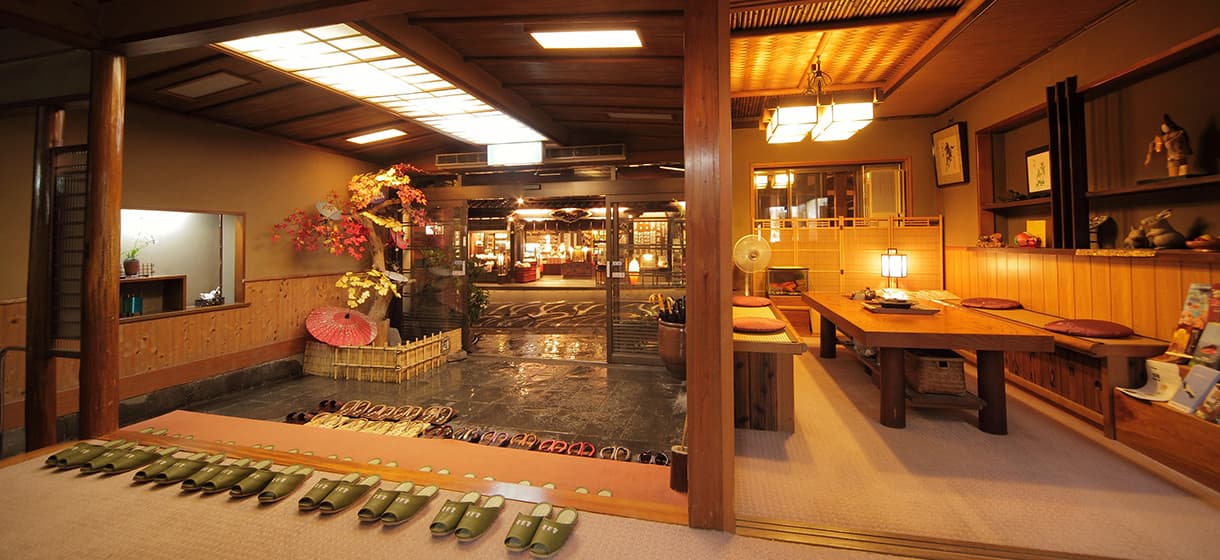
Morizuya (森津屋) — 9.6/10 across 18 reviews — has been run by the same family for eight generations. It sits on Kinosaki's main street with front-row canal views, and it has eleven rooms. The differentiation is the cave bath: an open-air tub carved directly into the natural bedrock of the slope behind the building. There is nothing else like it in Kinosaki. Two private baths are free and available afternoons and evenings without reservation. Tattoo policy is private-only for in-house baths, but the sotoyu pass covers the five open public bathhouses without restriction. OTA data suggests approximately ¥25,000–45,000 per person with two meals (not independently verified).
 Pin to Pinterest
The photo above shows Goshono-yu, the largest of the sotoyu currently open — a sense of the stone and timber interior that defines the bathhouse circuit all overnight guests share.
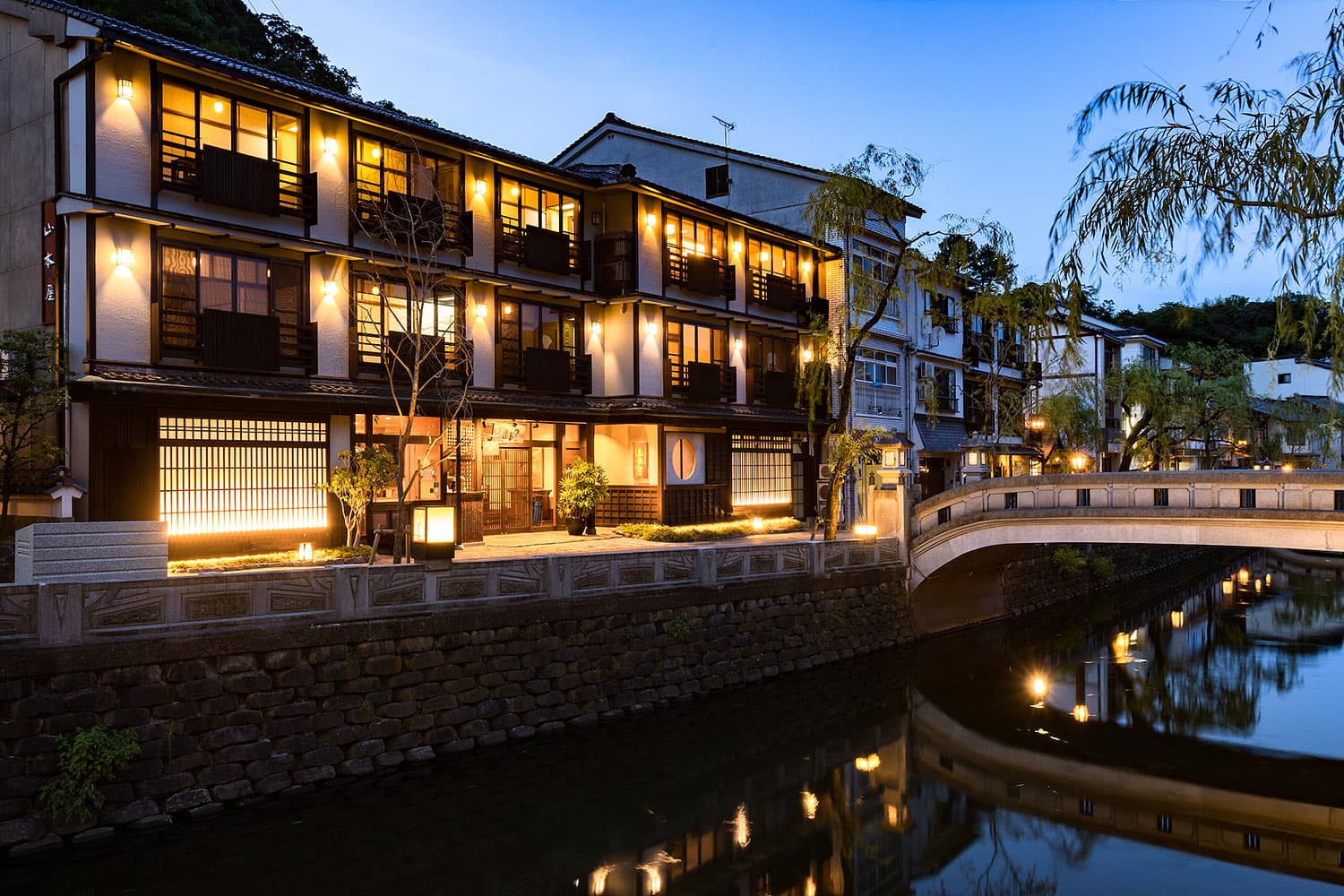
Yamamotoya (山本屋) — 9.4/10 across 167 reviews in our database — is 350 years old, renovated in 2024, and the only mid-to-upper tier Kinosaki ryokan with fully tattoo-allowed in-house communal baths. That is a database-verified `tattoo_policy = allowed`, not a marketing claim. For guests with visible tattoos who want to use in-house baths without restriction, this is the answer. The riverside location on the Otani River gives it canal views, and the property runs its own craft-beer micro-brewery — four beers including a Red Ale formulated to pair with crab, complimentary for weekday guests. Rates typically run ¥45,000–¥75,000 per person with two meals [Ryokan Retreat editorial source, 2026].
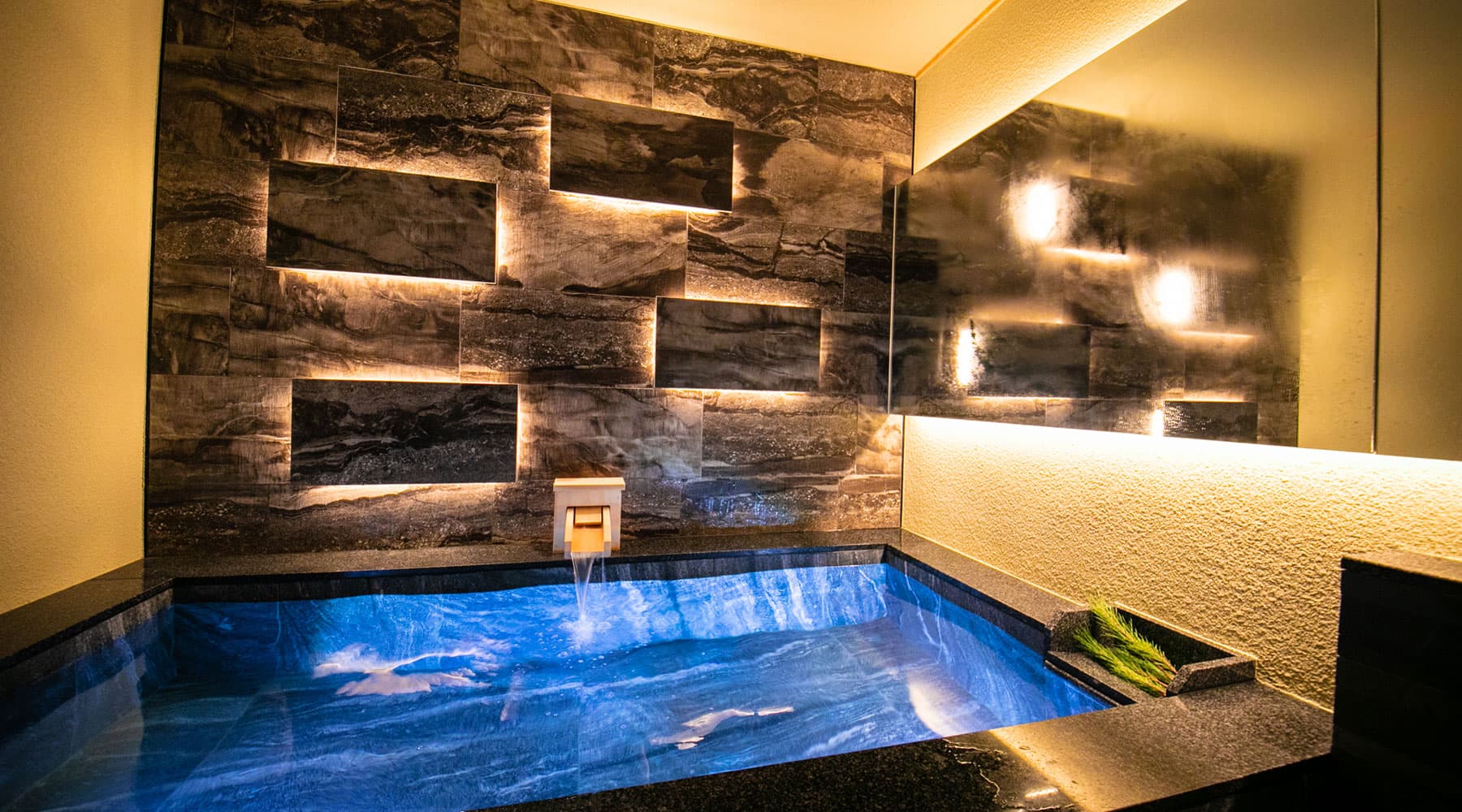
Nishimuraya Honkan (西村屋本館) — 9.2/10 across 198 reviews — is Kinosaki's luxury crown. Established during the Ansei era of the Edo period and carried on for more than six generations, it holds 2 Michelin Keys (2024–25) and is a Relais & Châteaux member — the only one in Kinosaki. The property has 29 rooms, all Japanese style, with seven rooms offering private open-air hot spring baths. Tattoo policy is private-only for in-house baths; the sotoyu pass covers the public circuit. Expect ¥60,000–120,000+ per person with two meals for luxury plans (directional; official pricing requires contacting the property). Booking note: Nishimuraya Honkan reopens August 29, 2026 after summer renovation — if you are reading this before that date, the nearest equivalent currently available is Sumihei Bettei Tokitotoki (six all-suite annex, 9.5/10), which is bookable now via its property page.
For the full list of all 33 Kinosaki ryokans we track, see our full guide to Kinosaki Onsen ryokans.
Tattoo Policy: The Real Picture for Both Towns
This is the question that generates the most Tripadvisor anxiety, and it deserves a direct answer rather than hedging.
Kinosaki: All seven public sotoyu accept tattooed guests — this is official policy set by the Kinosaki Onsen Ryokan Association and stated explicitly on the town's tourism site. The town-wide stance makes Kinosaki one of the very few onsen destinations in Japan where the communal public bath circuit is fully open to tattooed visitors. Among the ryokans themselves, policies vary: Yamamotoya is the standout with `tattoo_policy = allowed` across in-house baths; Morizuya and Nishimuraya Honkan are private-only for their in-house facilities, but the sotoyu pass covers you for the five open public bathhouses in any case.
Arima: The two public bathhouses — Kin no Yu and Gin no Yu — do not allow tattoos. This is the standard policy at Japanese communal public baths, and Arima's are no exception. The workaround that actually works: book a ryokan with a private reservable bath (kashikiri). Hotel Hanakoyado has no communal bath at all — only two 24-hour private kinsen baths where tattooed guests are explicitly welcome. Hashinoya Bekkan Ransui offers a private cypress rotenburo with no tattoo restriction. You trade the public bath-hopping experience for a more intimate private session.
The verdict is clean: if the shared-bath sotoyu circuit is central to your plan, Kinosaki wins this category outright. If you prefer private baths anyway — and many guests do, especially couples — Arima's policy is entirely manageable. For broader coverage across Japan, our guide to tattoo-friendly ryokans in Japan is the next read.
Day Trip vs Overnight: What You Actually Miss
Arima as a day trip is legitimate. An hourly highway bus from Hankyu Umeda reaches Arima in about 60 minutes for ¥1,400. You can use both public baths, walk the shopping street, have lunch at one of the restaurants near Kin no Yu, and be back in Osaka by evening. What you miss: the in-room kaiseki dinner, the private bath atmosphere at night when the day visitors have left, and the quiet morning when the town is briefly yours. For an itinerary that genuinely cannot hold an overnight, Arima is worth a day.
Kinosaki as a day trip is technically possible — the JR Limited Express Kounotori takes about two hours and forty minutes from Osaka, and the last return train leaves around 9pm — but the math works against you. Day visitors get the Yumepa pass for ¥1,500 but cannot stay for the evening atmosphere. The canal lanterns come on at dusk. The yukata-clad crowds are overnight guests who collected their ryokan-provided kimono at check-in. Mandara-yu and Yanagi-yu do not even open until 3pm. You would arrive around noon, manage two or three sotoyu, eat a crab lunch, and leave before the town becomes itself. That is roughly 40% of what Kinosaki actually is.
Tip
Kinosaki appears on JR Pass itineraries as a logical segment stop, which is why many travelers float it as a day detour. Resist that plan. The pass saves nothing on the bathing experience that matters — the Yumepa sotoyu circuit is included in your ryokan rate, not the rail fare — and a day visitor is gone by the hour Mandara-yu and Yanagi-yu finally open their doors.
The rule: if you are day-tripping, go to Arima. If you are going to Kinosaki at all, stay overnight.
What Does a Night Actually Cost? (Both Towns, Honest Numbers)
One clarification before the numbers: Japanese ryokan rates are quoted per person and include dinner (kaiseki) and breakfast. When you see a room rate on an OTA, divide by the number of guests and that is the per-person-with-meals figure. Western travelers often underestimate the total cost because they see a room price and forget meals are built in.
Arima pricing tiers:
Budget: approximately ¥20,000–35,000 per person with two meals (properties like Kamiobo on Yumotozaka)
Mid-range: approximately ¥35,000–65,000 per person (Hotel Hanakoyado, entry-level Goshobo plans)
Upper-mid: approximately ¥50,000–90,000 per person (Hashinoya Bekkan Ransui, upper Goshobo plans)
Luxury: approximately ¥70,000–120,000+ per person (Arimasansoh Goshobessho, premium plans)
Arima skews higher than Kinosaki overall — fewer genuine budget options exist, and the mountain location commands a premium. The public baths (Kin no Yu, Gin no Yu) are charged separately at ¥650–800 per adult per visit, which Kinosaki does not require.
Kinosaki pricing tiers:
Budget: approximately ¥15,000–25,000 per person with two meals (Kawaguchiya Honkan, Kinosaki-no-Yado)
Mid-range: approximately ¥25,000–50,000 per person (Morizuya, Yamamotoya, Onishiya Suishoen)
Luxury: approximately ¥60,000–90,000+ per person (Nishimuraya Honkan, Sumihei Bettei Tokitotoki)
The sotoyu pass (all seven bathhouses) is included in the ryokan rate for overnight guests — no additional admission charge. During matsuba crab season, kaiseki plans typically add approximately ¥5,000–15,000 per person over standard off-season rates; full crab course plans from ¥39,300 per person were available in the 2026 season.
Best Time to Visit Each Town
 Pin to Pinterest
Kinosaki has a clear seasonal peak: November through March, when matsuba crab season runs and cooler air makes the hot spring soaks feel earned. Snow on the canal banks and paper lanterns reflecting in the water is the scene most associated with the town. April brings cherry blossom along the canal — quieter than crab season, and genuinely lovely. Summer is humid and perfectly fine but the crab-season energy is absent. Avoid Obon (mid-August) and Golden Week (late April–early May) for both crowds and pricing.
Arima is genuinely good year-round. Its mountain location means summer temperatures are cooler than Osaka and Kobe, making it popular as a weekend escape even in July and August. The peak visual appeal is October through mid-November, when Mt. Rokko's forests turn and the foliage frames the town. Winter at Arima is mild compared to Kinosaki, which sits on the Sea of Japan side of the mountains and gets real winter weather.
The shorthand: if your dates fall November 6 through March 20, lean toward Kinosaki and the crab decision settles itself. Outside that window, the seasonal distinction collapses and the factors that matter become access, atmosphere preference, and tattoo policy. For routing from Kyoto, see best onsen ryokans near Kyoto for more options in that radius.
Both towns fill on national holiday weekends — book 2-3 months ahead for Golden Week, Obon, and any December weekend regardless of your choice.
How to Slot Each Town Into a Kansai Trip
Arima in a Kansai itinerary works best as an Osaka or Kobe overnight on day two or three. The classic structure: arrive Osaka, Osaka day, bus to Arima overnight, Kobe morning, Kyoto (or reverse). No reserved-seat train required; the highway bus from Osaka or the Shinki Bus from Kobe Sannomiya handles the logistics.
Kinosaki in a Kansai itinerary works best as a dedicated detour from Kyoto or Osaka. The JR Limited Express Kinosaki runs direct from Kyoto Station in approximately two and a half hours; the Kounotori from Osaka takes about two hours and forty minutes — both are JR Pass-covered. The classic routing: Kyoto two or three nights, then Kinosaki overnight (ideally two), then back to Kyoto or onward to Hiroshima. Optional extensions from Kinosaki: Genbudo Cave is 30 minutes away; Tottori Sand Dunes are about an hour by local train — useful if you are building a Sea of Japan coastal loop.
Can you do both on one trip? Yes, but they point in opposite directions from Kansai — Arima southwest toward Kobe, Kinosaki northwest toward the Sea of Japan — so connecting them requires backtracking through Osaka or Kyoto. In a trip of ten days or more, both are achievable: Arima as an early onsen stop near Kobe, Kinosaki as a later dedicated detour. For a seven-day Kansai trip, pick one.
 Pin to Pinterest
The Verdict: Which Onsen Town Wins?
Neither town is the wrong answer. But here is where each one earns its recommendation.
Arima wins if:
You have one night and are based in Osaka, Kobe, or Kyoto
You want mineral water that exists nowhere else in Japan (kinsen + ginsen)
You prefer private bath exclusivity over public bath-hopping
Your travel dates fall outside November–March
Kinosaki wins if:
You want the full onsen town immersion — yukata, canal, bathhouse circuit after dark
Crab season falls within your dates (November through March)
You have tattoos and want to use public baths without restriction
You can dedicate two nights rather than one
If you are genuinely agonizing between them, your trip is probably seven days or fewer — pick Arima. It is closer, easier to fold into any Kansai itinerary, and still a proper ryokan experience with water that no other town can offer. Save Kinosaki for when you can give it two nights and, ideally, the crab season window.
Frequently Asked Questions
Ready to book?
Book one of these top picks
Compare live availability and prices across booking sites.
Hashinoya Bekkan Ransui
橋乃家別館 嵐翠
Arima·Luxury
from US$460 · per person · per nightfrom ≈ US$920 total for 2 guests



Tocen Goshobo
陶泉 御所坊
Arima·Luxury
from US$235 · per person · per nightfrom ≈ US$470 total for 2 guests
Hotel Hanakoyado
ホテル花小宿
Arima·Luxury
from US$197 · per person · per nightfrom ≈ US$394 total for 2 guests
Morizuya
森津屋
Kinosaki·Mid-Range
from US$86 · per person · per nightfrom ≈ US$172 total for 2 guests
Yamamotoya
山本屋
Kinosaki·Mid-Range
from US$200 · per person · per nightfrom ≈ US$400 total for 2 guests
Nishimuraya Honkan
西村屋本館
Kinosaki·Luxury
from US$400 · per person · per nightfrom ≈ US$800 total for 2 guests
Booking links may earn us a commission at no extra cost to you.
FAQ
Frequently asked questions
Is Arima Onsen or Kinosaki Onsen better?+
It depends on your priorities. Arima is better if you want unique mineral water — the kinsen gold spring found nowhere else in Japan — easy access from Osaka in under an hour, and a private onsen experience. Kinosaki is better if you want the full onsen town atmosphere: seven public bathhouses, yukata canal walks, and matsuba crab season in winter. Neither is objectively superior; the answer changes based on your dates, how much you care about tattoo access, and how much travel time your itinerary can absorb.
Can you do Kinosaki Onsen as a day trip from Kyoto?+
Technically yes, but you will miss most of what makes Kinosaki worth visiting. The canal lantern atmosphere and yukata crowds begin at dusk; Mandara-yu and Yanagi-yu do not open until 3pm; the sotoyu all-access Yumepa pass only comes free with an overnight stay. A day visit — arrive noon, manage two or three sotoyu, eat a crab lunch, leave by 9pm — gets you roughly 40% of the actual experience. Stay overnight if you make the journey.
Is Kinosaki Onsen tattoo friendly?+
Yes — all seven public sotoyu bathhouses in Kinosaki accept tattooed guests. This is official town-wide policy, making Kinosaki one of the few onsen destinations in Japan where the communal public bath circuit is fully open without restriction. Note that as of August 2026, five of the seven sotoyu are currently open (Kono-yu is closed until October 30, 2026, planned; Sato-no-Yu is under long-term reconstruction with no published reopening date). Among ryokans, policies vary: Yamamotoya allows tattoos in all in-house baths; most others are private-bath-only for in-house facilities.
What is the difference between kinsen and ginsen in Arima Onsen?+
Kinsen (gold spring) is an iron and salt spring whose water turns reddish-brown on contact with air — warming, mineral-rich, and the characteristic image of Arima. Ginsen (silver spring) is a radium and carbonate spring that stays clear and feels lighter on the skin, with a faint carbonation tingle. Most Arima ryokans have access to one or both. Both spring types come from ancient seawater deposited roughly six million years ago under the same Mt. Rokko fault system that produced the 1995 Kobe earthquake — and they occur together only in Arima. That combination is found nowhere else in Japan.
How far is Arima Onsen from Osaka?+
Arima Onsen is approximately 60 minutes from Osaka by highway bus. The most direct option is the Hankyu Bus or JR Bus from Hankyu Umeda or JR Osaka Station, running roughly ¥1,400 one way, 1-2 departures per hour. From Shin-Osaka, the journey is around 50 minutes at approximately ¥1,250. An alternative route goes via the Kobe subway to Tanigami Station and then the Kobe Electric Railway to Arima-Onsen Station, adding a connection but no additional cost. Either way, the total journey is under an hour.
How far is Arima Onsen from Kyoto?+
About 70 minutes by direct highway bus from Kyoto Station, costing around ¥1,850. The bus is not covered by the JR Pass. Coming from Osaka instead, the ride drops to roughly an hour (~¥1,400) with one or two departures per hour, which is why most travelers slot Arima into the Osaka–Kobe leg of a Kansai trip rather than the Kyoto leg.
How far is Kinosaki Onsen from Osaka?+
Approximately 2 hours 40 minutes on the JR Limited Express Kounotori from Osaka Station or Shin-Osaka, costing around ¥6,140 reserved seat. The train runs six times daily and seat reservation is required. The JR Pass (national) covers the full fare including the limited express supplement.
When is crab season at Kinosaki Onsen?+
The fishing season for male matsuba crab (snow crab) runs November 6 to March 20 (Hamasaka fisheries cooperative); some ryokans' crab plans may continue into late March. The first boats land their catch on the night of November 5–6; ryokans typically serve the inaugural crab kaiseki courses from November 7 onward. During this window, kaiseki dinners feature whole crab courses — sashimi, grilled over charcoal, shabu-shabu, and crab miso — sourced same-day from Sea of Japan fishing ports roughly 30 minutes from town. December weekend bookings fill out 2-3 months ahead; mid-week and shoulder-season (early November, March) slots open with shorter lead times.
How much does a ryokan cost in Kinosaki Onsen?+
Kinosaki ryokan rates run approximately ¥15,000–25,000 per person at budget properties, ¥25,000–50,000 at mid-range, and ¥60,000–90,000+ at luxury properties like Nishimuraya Honkan. All rates include two meals (kaiseki dinner and Japanese breakfast). The sotoyu all-bathhouse pass is included in the overnight rate at no extra charge. Crab-season kaiseki plans typically add roughly ¥5,000–15,000 per person over standard off-season rates; full crab courses started from ¥39,300 per person in the 2026 season.
Which is easier to visit without speaking Japanese — Arima or Kinosaki?+
Kinosaki has English signage throughout the town and strong tourism infrastructure built for international visitors — wayfinding, sotoyu instructions, and most ryokan websites are available in English. Arima's street-level signage is more limited, but select ryokans bridge the gap: Hashinoya Bekkan Ransui lists English-speaking staff as a confirmed amenity, making it the clearest Arima pick for guests with language concerns.
Can you visit both Arima and Kinosaki on the same trip?+
Yes, but they point in opposite directions from Osaka and Kyoto — Arima to the southwest, Kinosaki to the northwest — so connecting them means backtracking. In a trip of ten days or more, both are manageable: Arima as an early stop tied to a Kobe day, Kinosaki as a later detour toward the Sea of Japan coast. For a seven-day Kansai trip, we recommend choosing one. Our preference: Kinosaki if crab season is available and you can give it two nights; otherwise Arima for its proximity and the mineral water you will not find anywhere else.
Still deciding?
Browse ryokans across JapanBooking.com