Quick Comparison
10 picks| Ryokan | From | Rating | Book |
|---|---|---|---|
 | from US$400/person/night≈ US$800 for 2 | 9.2 198 reviews | Book on Agoda |
 | from US$250/person/night≈ US$500 for 2 | 8.9 512 reviews | Book on Trip.com |
 | from US$300/person/night≈ US$600 for 2 | 9.1 165 reviews | Book on Trip.com |
 | from US$220/person/night≈ US$440 for 2 | 9.3 577 reviews | Book on Booking.com |
 | from US$200/person/night≈ US$400 for 2 | 9.4 167 reviews | Book on Trip.com |
 | from US$150/person/night≈ US$300 for 2 | 9.0 88 reviews | Book on Booking.com |
 | from US$130/person/night≈ US$260 for 2 | 8.4 220 reviews | Book on Agoda |
 | from US$120/person/night≈ US$240 for 2 | 8.3 142 reviews | Book on Trip.com |
 | from US$100/person/night≈ US$200 for 2 | 8.1 176 reviews | Book on Agoda |
 | from US$130/person/night≈ US$260 for 2 | 8.4 340 reviews | Book on Trip.com |
Nishimuraya Hotel Shogetsutei
Kinosaki
Mikiya
Kinosaki
Onishiya Suishoen
Kinosaki
Kobayashiya
Kinosaki
Tajimaya
Kinosaki
Tsutaya Ryokan
Kinosaki
Tsukimotoya
Kinosaki
Prices shown are approximate starting rates per person per night. We may earn a commission on bookings.
On a February night in Kinosaki, the river along the Otani-gawa goes glassy after dark. The willows are lit from underneath in that strange green-gold glow you only see in Kinosaki between October and March. The geta clack on the stone bridge is the soundtrack of this town, as guests in different ryokan-pattern yukata walk the same loop between the bathhouses. Last verified: May 24, 2026.
That is the actual reason to book a ryokan in Kinosaki Onsen. The town runs on one unbroken ritual: check in by 3 PM, bathe briefly in the uchiyu (your ryokan's private bath), change into the yukata your ryokan provides, and walk between the seven public bathhouses (the sotoyu) until your fingertips go pruney. The ryokan is the costume room; the town is the stage. That model has held since the priest Dochi Shonin reportedly summoned the waters at what is now Mandara-yu in 720 A.D. .
Kinosaki is also the most tattoo-progressive onsen town in Japan — every operating public sotoyu allows tattoos with no cover-up requirement — and the crab capital of the Kansai onsen circuit. The fishing season for male matsuba-gani (snow crab) runs November 6 to March 20, and most ryokans serve whole-crab kaiseki plans that deliver serious seafood for serious money.
This is the expanded 2026 edition: fourteen picks (up from nine), with a crab-season pricing table, tattoo policy matrix, full sotoyu breakdown, and a How to Choose section by trip purpose. New to ryokans? Our first-time ryokan guide covers the basics so this article can focus on what makes Kinosaki specifically different.
The best ryokan in Kinosaki Onsen is Nishimuraya Honkan — a 165-year-old Relais & Châteaux property with two natural hot-spring baths, matsuba-gani and Tajima-beef kaiseki, and a level of okami-led service the other inns rarely match. For resort-scale luxury with a private rotenburo, Nishimuraya Hotel Shogetsutei is unmatched in the town. Mikiya wins on literary and cultural-property heritage. The best fully tattoo-friendly pick on the list is Yamamotoya — 350 years old with a riverside location and its own craft-beer brewery. Budget travelers should book Kinosaki-no-Yado under $180 with the free yumepa sotoyu pass included.
Tip
Disclosure: Japan Ryokan Guide earns a commission when you book through partner links. We don't accept payment from ryokans for inclusion or placement — every property here was selected on merit. Prices shown are per-room per-night, two people, half-board (dinner + breakfast), based on published rack rates as of May 2026; crab-season supplements are additional.
Quick-Compare: 14 Kinosaki Ryokans at a Glance
| # | Ryokan | Tier | From (USD) | Walk to Station | Best For |
|---|---|---|---|---|---|
| 1 | Nishimuraya Honkan | Luxury ¥¥¥¥ | $400 | 7 min | Milestone luxury + Relais & Châteaux |
| 2 | Nishimuraya Hotel Shogetsutei | Luxury ¥¥¥¥ | $250 | Shuttle | Resort-scale + private rotenburo |
| 3 | Mikiya | Luxury ¥¥¥ | $300 | 4 min | Literary heritage (Shiga Naoya) |
| 4 | Onishiya Suishoen | Luxury ¥¥¥¥ | $220 | 5 min | Noh-stage central garden |
| 5 | Yamamotoya | Mid ¥¥¥ | $200 | 3 min | 350-year river inn + fully tattoo-friendly |
| 6 | Kobayashiya | Mid ¥¥ | $150 | 3 min | 3 private baths in a 9-room inn |
| 7 | Tajimaya | Mid ¥¥ | $130 | 5 min | Best mid-range crab + wagyu kaiseki |
| 8 | Tsutaya Ryokan | Mid ¥¥ | $120 | 8 min | Bakumatsu history under $280 |
| 9 | Sennen-no-Yu Koman | Mid ¥¥ | $100 | 6 min | Founding-family lineage since 717 A.D. |
| 10 | Tsukimotoya | Mid ¥¥ | $130 | 5 min | Michelin-noted quiet-center ryokan |
| 11 | Sensui | Mid ¥¥ | $150 | 7 min | 3 free private open-air baths |
| 12 | Koyado En | Mid ¥¥ | $140 | 3 min | Adults-only auberge + Tajima beef |
| 13 | Kawaguchiya Honkan | Budget-mid ¥–¥¥ | $90 | 4 min | Budget riverside with kaiseki |
| 14 | Kinosaki-no-Yado | Budget ¥ | $80 | 5 min | Budget floor: kaiseki + yumepa included |
Why Kinosaki is different: the town that bathes together
Kinosaki Onsen is a 1,300-year-old hot-spring town in northern Hyogo where ryokan guests walk between seven public bathhouses (sotoyu) in yukata and geta, eating kaiseki at the inn and bathing across the whole town — all on the same included pass. No other Japanese onsen destination is structured this way. In Hakone and Kusatsu, the ryokan competes with the town for your evening; in Kinosaki, the ryokan deliberately outsources the bathing to the town.
JNTO ranks Kinosaki among the top onsen destinations of the Kansai region . The town is one kilometer end to end, walkable in fifteen minutes, built around the Otani River canal. Every ryokan on this list issues a yumepa at check-in, valid until 1 PM on departure day, for free entry to all currently operating sotoyu. The pass alone retails for ¥1,500 — included with every booking regardless of room rate. This is why even the most expensive ryokan in town has modest in-house baths: you're meant to use the uchiyu briefly, then put on the yukata and go out like everyone else.
Kinosaki is also the most tattoo-progressive onsen town in Japan: all public sotoyu allow tattoos of any size, no cover-up required . Against Japan's best onsen towns, Kinosaki runs 10–15% below Hakone luxury rates and offers a town experience no other destination replicates. For a Kansai itinerary with Kyoto — which has no natural hot springs — Kinosaki at 2h 30m by direct Limited Express is the natural onsen extension.
Tip
The post-checkout bath trick. The yumepa pass is valid until 1 PM on the day you leave, not 10 AM as most blogs claim. After breakfast, drop your bag at the front desk, change back into the yukata one last time, and hit one or two final sotoyu before catching the noon Konotori back to Osaka. Most guests miss this entirely and leave hours of paid bathing on the table.
How we verified these 14 ryokans
We screened every operating ryokan in Kinosaki against five criteria: station walking distance, in-house bath quality and tattoo policy, kaiseki strength (especially the matsuba-gani winter menu), English-accessible booking, and value at each tier. Fourteen properties made the final list, from luxury to budget. No ryokan paid to be included. Properties are drawn from our database of vetted ryokans.
Properties are verified through published sources and booking-platform checks conducted in May 2026. Prices shown are per-room per-night, two people, half-board (dinner + breakfast), May 2026 rack rates. Crab-season supplements are additional. For broader pricing context, how Kinosaki compares nationally is worth reading before you book.
1. Nishimuraya Honkan — Best for milestone luxury and Relais & Châteaux service
Best for Couples on a milestone trip — okami-led service is theatrical, kaiseki is the best food experience in northern Hyogo. ¥¥¥¥
At a glance 34 rooms · ~$400–$900 USD · 165 years · 7-min walk from station · 2-min to Goshono-yu and Mandara-yu.
- Relais & Châteaux membership confirmed
- Two in-house hot-spring baths plus one reservable kashikiri private bath
- Tattoo policy: private bath only; communal baths require cover-up
- Matsuba-gani kaiseki plan in crab season (from Nov 6); whole-crab supplement from ¥25,000 per person
- Yumepa included; 7-min walk to Goshono-yu (largest outdoor rotenburo in the sotoyu network)
If you care about the drinking side of the meal, read how Nishimuraya's pours are matched course-by-course to the matsuba-gani. Book eight months ahead for November opening-weekend dates.
Honest trade-off: Base-rate rooms lack private bathroom facilities in the heritage layout. Confirmed at booking.
Tip
Honkan's matsuba-gani-season rooms book out eight months ahead. If you can't get them, ask about Nishimuraya Hotel Shogetsutei's forest-garden resort (same family, 5-min shuttle, private rotenburo available).
2. Nishimuraya Hotel Shogetsutei — Best for resort-scale luxury with private spa rooms
Best for Travelers who want luxury Kinosaki with in-room rotenburo and resort amenities — pool, spa, gym — that the heritage ryokans cannot offer. ¥¥¥¥
At a glance 98 rooms · ~$250–$600 USD · 50,000 sqm forest-garden · 5-min shuttle from station.
- Large public baths plus suites with private rotenburo overlooking the forest garden
- Tattoo policy: private bath only; communal baths require cover-up
- Pool, spa, gym, and three dining venues — formal kaiseki, modern à la carte, lobby lounge
- Free shuttle to canal-core sotoyu cluster; yumepa included
- The only Kinosaki ryokan with a complete onsen evening possible without leaving the property
For guests who want private outdoor soaking without Honkan's per-night premium, Shogetsutei's suite-with-rotenburo at $250–$350 is the value case. Elderly guests, families with young children, and mobility-restricted travelers benefit most from the resort infrastructure.
Honest trade-off: Shuttle dependency makes the sotoyu feel like an excursion rather than a front-door walk. Central-location seekers should look at Kobayashiya.
3. Mikiya — Best for literary heritage and 300-year cultural property charm
Best for Readers and travelers who want to sleep inside a registered cultural property where Japanese literary history was made. ¥¥¥
At a glance 16 rooms · ~$300–$700 USD · 300+ years · Registered cultural property · 4-min from station · 1-min to Ichino-yu.
- Two indoor baths plus one kashikiri private bath; hot-spring source from the same feed as the sotoyu
- Tattoo policy: cover-up in communal; allowed in private kashikiri bath
- Shiga Naoya wrote At Kinosaki (城の崎にて, 1917) recovering at this inn — foundational Japanese modernist text
- Matsuba-gani plan from November 6 among the strongest mid-luxury crab kaiseki in town
- Private dining rooms with views into the inner garden
Honest trade-off: 300-year-old buildings have cold drafts in the bathrooms. That's the point — but not for everyone.
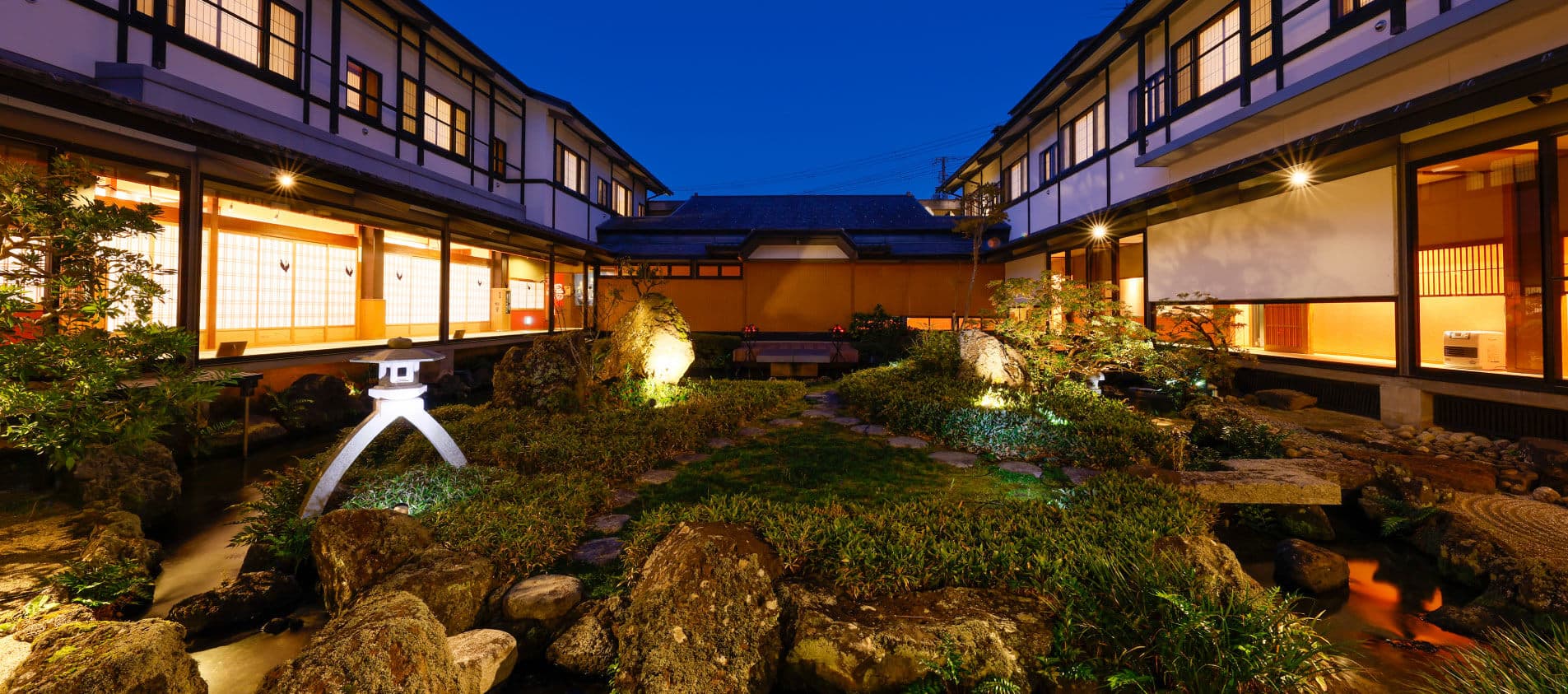
4. Onishiya Suishoen — Best for Noh-stage garden and theatrical aesthetic
Best for Travelers seeking a dramatic central garden with torchlit Noh stage — a theatrical aesthetic different from the heritage-corridor inns. ¥¥¥¥
At a glance ~30 rooms · ~$220–$500 USD · 5-min from station · Noh-stage garden · indoor and outdoor in-house baths.
- Central garden with stone stream, torches, and Noh performance stage — most visually striking interior in Kinosaki
- Indoor and outdoor in-house baths; free station shuttle; free WiFi and parking
- Full kaiseki service; matsuba-gani plan in crab season (from November 6); Tajima wagyu year-round
- Rated 4.8 stars on Visit Kinosaki's official platform
- Tattoo policy: check in-house bath policy directly before booking
English reviews are sparser than the Nishimuraya properties.
Honest trade-off: Confirm tattoo policy and current availability directly by email before booking.
5. Yamamotoya — Best for 350-year riverside heritage and full tattoo-friendly access
Best for Tattooed travelers who want full communal-bath access in a historically significant mid-upper canal-side inn with its own craft-beer brewery. ¥¥¥
At a glance ~26 rooms · ~$200–$450 USD · 350+ years · riverside canal location · 3-min from station.
- Fully tattoo-friendly in all in-house baths — the only mid-upper ryokan on this list with no cover-up requirement
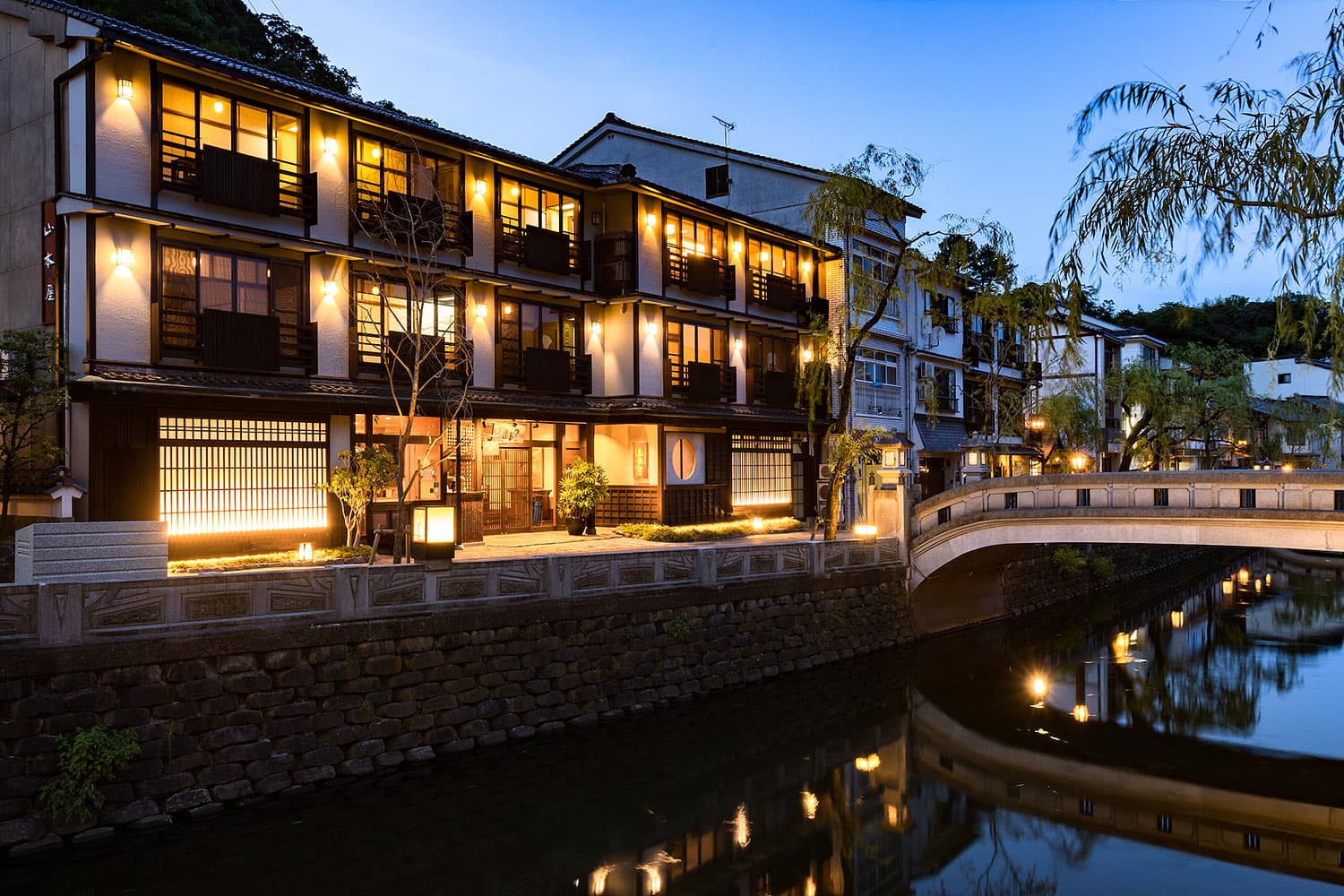
- Otani River-facing rooms with willow-canal views; direct canal-side position
- On-site craft-beer micro-brewery: four styles including a Red Ale formulated for matsuba-gani pairing
- Full kaiseki service; matsuba-gani plan November 6; Tajima beef year-round; yumepa included
The riverside rooms — facing the illuminated willows directly — are the best sleeping position in Kinosaki for the canal-at-night experience.
Honest trade-off: Rooms aren't as architecturally distinguished as Mikiya. The USP is location + full tattoo access + brewery.
6. Kobayashiya — Best for boutique mid-range with three private baths
Best for Couples who want cultural-property heritage at a mid-range price with three reservable private baths in a 9-room inn. ¥¥
At a glance 9 rooms · ~$150–$350 USD · Renovated registered cultural property · 3-min from station · 2-min to Mandara-yu.
- Three reservable kashikiri private baths — highest private-bath-to-room ratio on this list (1 per 3 rooms)
- Tattoo policy: private baths universally accessible; communal bath requires cover-up
- Artisan communal bath in lacquered wood; hot-spring source-fed
- Modern-leaning kaiseki with fortnightly rotating menu; matsuba-gani plan from November competitively priced
Nine rooms means the okami knows your dinner preference before you sit down. The three private baths — two indoor, one small rotenburo — give a genuinely private hot-spring soak even if the communal bath requires cover-up.
Honest trade-off: Nine rooms means near-zero availability if you book late — two months ahead minimum even for weekdays.
Tip
When booking matsuba-gani plans, request the kani-suki (crab sukiyaki) variant rather than the standard sashimi-grill-hotpot. The broth at the end — rich with crab roe and dashi — is the best part of the meal, and it's what the town's okami eat when they eat together.
7. Tajimaya — Best for crab-and-Tajima-beef kaiseki on a mid-range budget
Best for Food-first travelers who want serious matsuba-gani and Tajima beef at the same table without paying Honkan rates. ¥¥
At a glance 22 rooms · ~$130–$300 USD · Canal-side · 5-min from station · 1-min to Ichino-yu.
- Tattoo policy: cover-up in communal; kashikiri private bath available
- Two in-house baths plus one reservable private bath; hot-spring source-fed; yumepa included
- Tajima-gyu wagyu sourcing documented by Visit Hyogo — the foundation lineage for Kobe, Matsusaka, and Omi beef
- Canal-side location; 1-min walk to Ichino-yu cave bath
The crab and the beef arriving together at mid-range price is the best-value meal on this list.
Honest trade-off: The building is comfortable but not architecturally special — the kaiseki is the reason.
8. Tsutaya Ryokan — Best for Bakumatsu history at a mid-range price
Best for History travelers who want to sleep where Bakumatsu-era political refugees once hid, at the lowest mid-tier price. ¥¥
At a glance 16 rooms · ~$120–$280 USD · Wooden three-story · Bakumatsu-era heritage · 8-min from station · 3-min to Yanagi-yu.
- Tattoo policy: cover-up in communal and private baths; sotoyu accessible via yumepa
- One in-house indoor bath plus one kashikiri bath; hot-spring source-fed
- Honest kaiseki: Tajima beef and Sea-of-Japan seafood; matsuba-gani plan from November
- Katsura Kogoro (Kido Takayoshi), architect of the Meiji Restoration, reportedly hid here during Bakumatsu-era pursuit
Three-story wooden construction, low-beam corridors, and the Bakumatsu backstory create a sense of historical weight the mid-range price doesn't telegraph. Yanagi-yu at 3 minutes is one of the quieter sotoyu on the circuit.
Honest trade-off: 8-minute walk is fine for the circuit but slightly isolating. In-house bath is modest.
9. Sennen-no-Yu Koman — Best for the founding-family story since 717 A.D.
Best for Travelers who want to stay with the family that, by tradition, founded Kinosaki Onsen — at a mid-range price. ¥¥
At a glance 28 rooms · ~$100–$250 USD · Sukiya-style architecture · lineage to 717 A.D. · 6-min from station · 2-min to Mandara-yu.
- Tattoo policy: cover-up in communal baths; private family bath available
- Two large in-house baths plus one reservable family bath; men's outdoor rotenburo among the largest in-house baths here
- Full kaiseki with Sea-of-Japan emphasis — winter monkfish (anko nabe), spring firefly squid (hotaru-ika), matsuba-gani plan from November
- 28 rooms — good availability year-round except crab-season weekends
Koman quietly leans on its own bath rather than pushing guests outward — the men's outdoor rotenburo is genuinely large. The founding-717-A.D. narrative and the in-house bath scale are the twin USPs.
Honest trade-off: Sukiya aesthetic is subtle — don't book expecting heritage-building drama. Narrative and bath size are the selling points.
10. Tsukimotoya — Best for Michelin-noted quiet-center ryokan at a mid-range price
Best for Travelers who want a Michelin-noted traditional ryokan at a mid-range price without the theatrical overhead of a Relais & Châteaux property. ¥¥
At a glance ~18 rooms · ~$130–$300 USD · Michelin Guide Hyogo 2016 'Pleasant Lodging' · 5-min from station · central-town location.
- Tattoo policy: verify in-house bath policy directly; sotoyu accessible via yumepa
- 100% hot-spring source water in in-house bath; open 6 AM–midnight
- Full kaiseki service; matsuba-gani plan from November; Tajima beef year-round
- Central-but-quiet location: one street back from the Otani-gawa canal crowds
The Michelin "Pleasant Lodging" signal: not a luxury spectacle, not a budget compromise — a well-run traditional inn doing the fundamentals (food, bath, service) at a very high level. Guest reviews consistently highlight kaiseki quality relative to price.
Honest trade-off: No age, literary, or founding narrative. The USP is quality-to-price ratio.
11. Sensui — Best for three complimentary private open-air baths
Best for Guests who want maximum private open-air bath access — three free kashikiri rotenburo — without paying Shogetsutei suite rates. ¥¥
At a glance ~20 rooms · ~$150–$350 USD · 7-min from station · free station shuttle · three private open-air baths.
- Three free private open-air baths — highest complimentary private-bath count on this list
- Tattoo policy: private baths accessible; verify communal bath policy directly
- Two communal baths plus three free private rotenburo; hot-spring source-fed throughout; free shuttle
- Full kaiseki; matsuba-gani plan in crab season (from November 6)
Sensui solves a specific problem: private outdoor soaking in natural hot-spring water without booking a luxury suite. Three private baths free to use (no time-based surcharge at most hours) is unusual in mid-range Kinosaki, where most ryokans charge for kashikiri access.
Honest trade-off: 7-min walk is farthest from the sotoyu core for this price tier; architecture is functional rather than heritage.
12. Koyado En — Best adults-only auberge with Tajima-beef focus
Best for Couples or adult travelers who want an adults-only atmosphere with premium Tajima-beef kaiseki and private bath intimacy. ¥¥
At a glance 8 rooms · ~$140–$350 USD · Adults-only (13+) · 3-min from station · private hot-spring baths.
- Adults-only policy — the only explicitly adults-only ryokan on this list
- Tattoo policy: private baths accessible for tattooed guests
- Premium Tajima-beef course dinner as the dining flagship — focused on fewer preparations of higher-grade meat
- Afternoon happy hour with sparkling plum wine and sake; café and restaurant dining format
Koyado En opened in 2013 as an explicit counter-proposal to the large-ryokan format: eight rooms, no children's noise, premium beef program, private baths for intimacy. It functions like a French auberge that has absorbed ryokan DNA. For couples uncomfortable in large communal onsen settings, this is the structural solution.
Honest trade-off: Eight rooms means very limited availability — book three months ahead minimum for any weekend.
13. Kawaguchiya Honkan — Best budget-mid pick with riverside location
Best for Budget-minded travelers who want kaiseki included and a canal-side location at prices that undercut most mid-range picks above. ¥–¥¥
At a glance ~25 rooms · ~$90–$220 USD · 4-min from station · free station pick-up · Otani River-side location.
- Tattoo policy: cover-up required; sotoyu accessible via yumepa
- Free station pick-up — useful for guests arriving with luggage on crab-season weekends
- Half-board kaiseki plans from ~$140–$180; matsuba-gani plan from November
- Practical laundry facilities — one of the few Kinosaki ryokans catering structurally to longer stays
- English-friendly booking; consistent positive reviews on Expedia and Booking.com
The $90–$120 rack-rate rooms don't include dinner, but half-board plans from ~$140 are solid value. Free station pick-up is a practical differentiator for heavy-luggage arrivals.
Honest trade-off: Building is comfortable but not architecturally notable. Rooms go early in crab season.
14. Kinosaki-no-Yado — Best budget pick under $180 with kaiseki and yumepa included
Best for Solo travelers and budget-first couples who came for the sotoyu and the yukata walk, not for in-room kaiseki theater. ¥
At a glance 12 rooms · ~$80–$180 USD · 5-min from station · half-board kaiseki and yumepa included at base rate.
- Tattoo policy: cover-up in in-house bath; full sotoyu access via yumepa
- Genuine half-board kaiseki at base rate — not a buffet: three to five Tajima-region courses, a hotpot or grilled main, rice and miso
- Yumepa included — the same pass Nishimuraya Honkan guests get; the most expensive perk in town, free regardless of room rate
- Matsuba-gani whole-crab plan available November–March at a supplement smaller than mid-range ryokans
The financial logic: the yumepa that Nishimuraya Honkan charges $400/night to include is included here at $80. The kaiseki is a fraction of Mikiya's, but it's real kaiseki, plated properly.
Honest trade-off: 12 rooms means extremely limited availability; book 2–3 months ahead even for weekdays in crab season. Rooms are basic and small.
The 7 sotoyu bath ritual: how to plan your bathhouse circuit
Kinosaki has seven public bathhouses (sotoyu), each with a different theme and architecture: Satono-yu, Ichino-yu, Goshono-yu, Mandara-yu, Yanagi-yu, Jizo-yu, and Kono-yu. Ryokan guests receive a free yumepa pass valid from check-in until 1 PM on departure day. The full circuit is roughly 2 km — a leisurely 90-minute walk excluding bathing time.
Critical 2026 update: Satono-yu has been closed since 2024 for renovation, with no public reopening date . Kono-yu is also closed for repairs until October 30, 2026 (planned), per the Kinosaki Onsen Tourism Association, so five sotoyu are open until it reopens and six after that. Competing blogs still say "all seven" — they're wrong.
Ichino-yu — the most photographed sotoyu, with a famous cave bath carved into rock. Longest lines 7–9 PM weekends; go after 9 PM.
Goshono-yu — Imperial-Palace-style bath with the largest outdoor rotenburo in the network. Best before 7 PM or after 9:30 PM.
Mandara-yu — the spiritual birthplace of Kinosaki (Dochi Shonin, 720 A.D.). Two minutes from Goshono-yu, smaller, quieter, almost always uncrowded. Start here.
Yanagi-yu — the willow-themed short-soak bath. Best for a quick 20-minute stop between longer soaks.
Jizo-yu — family-friendly sotoyu near the station cluster. Gentler temperatures, most accessible from the station-end ryokans.
Kono-yu — far north end of town, near the ropeway. Closed for repairs until October 30, 2026 (planned); once it reopens it joins Ichino-yu, Goshono-yu and Jizo-yu as one of the sotoyu that open at 7:00; Mandara-yu and Yanagi-yu open at 15:00 (Visit Kinosaki opening hours). For a final soak before a morning checkout, pick one of the 7:00 baths.
For the full bathing etiquette primer, our onsen etiquette guide covers the complete protocol. Japan Tourism Agency documents Onsenji Temple as Kinosaki's official guardian temple .
Tip
Optimal first-night sotoyu circuit: Skip Goshono-yu (peak crowds 7–9 PM) and start with Mandara-yu (the spiritual origin, uncrowded). Walk to Yanagi-yu for a short soak. Then circle back to Ichino-yu after 9 PM for the cave bath without the weekend line. Three baths, 2 km of yukata walking, done by 10:30 PM.
Kani-kaiseki seasonal pricing: crab season tiers and which ryokan serves which
The fishing season for male matsuba-gani (snow crab) runs November 6 to March 20 (Hamasaka fisheries cooperative); female seko-gani are fished only from November 6 to December 31. Some ryokans' crab plans may run into late March, so confirm the plan dates with the inn. JNTO confirms that male snow crabs are landed at Tajima-region ports including Kasumi . Most ryokans offer whole-crab multi-course kaiseki at ¥18,000–¥30,000 per person supplement on top of room rate.
| Crab Type | Season | Supplement (per person) | Which Ryokans |
|---|---|---|---|
| Matsuba-gani (snow crab) | Nov 6–Mar 20 (fishing season) | ¥18,000–¥30,000 | All 14 ryokans on this list |
| Tarabagani (king crab) | Year-round (imported) | ¥25,000–¥45,000 | Honkan, Shogetsutei |
| Beni-zuwai-gani (red snow crab) | Oct–Nov + Mar–Apr | ¥10,000–¥15,000 | Select mid-range in shoulder season |
Price math: A $250 base-rate Kobayashiya room becomes ~$650–$700 for two with the matsuba-gani upgrade (¥18,000–¥20,000 per person). Honkan at $400 + ¥25,000 supplement reaches $950–$1,100 for two.
Best value window: Early-to-mid November — full-grade crabs, ryokan rates 10–20% below February peak, lighter crowds. Target the second weekend in November. For atmosphere — snow on willows, still canal reflections — target mid-January after the New Year surcharge (December 29–January 4) ends. Outside crab season, Tajima beef is the headliner — pair with best winter onsen or a private-onsen stay.
Tattoo policy matrix: which Kinosaki ryokans allow tattoos where
Kinosaki is one of Japan's most tattoo-progressive onsen towns. The public sotoyu are universally open to tattooed guests — no cover-up required at any operating sotoyu . Ryokan in-house policies vary.
| Ryokan | Communal In-House Bath | Private Kashikiri Bath | Sotoyu via Yumepa |
|---|---|---|---|
| Nishimuraya Honkan | Cover-up required | Allowed | Fully allowed |
| Nishimuraya Shogetsutei | Cover-up required | Allowed | Fully allowed |
| Mikiya | Cover-up required | Allowed | Fully allowed |
| Onishiya Suishoen | Confirm directly | Confirm directly | Fully allowed |
| Yamamotoya | Fully allowed | Fully allowed | Fully allowed |
| Kobayashiya | Cover-up required | Allowed | Fully allowed |
| Tajimaya | Cover-up required | Allowed | Fully allowed |
| Tsutaya Ryokan | Cover-up required | Cover-up required | Fully allowed |
| Sennen-no-Yu Koman | Cover-up required | Allowed | Fully allowed |
| Tsukimotoya | Confirm directly | Confirm directly | Fully allowed |
| Sensui | Confirm directly | Allowed | Fully allowed |
| Koyado En | N/A | Allowed | Fully allowed |
| Kawaguchiya Honkan | Cover-up required | Cover-up required | Fully allowed |
| Kinosaki-no-Yado | Cover-up required | N/A | Fully allowed |
Key takeaway: Yamamotoya is the only mid-upper ryokan with confirmed full communal-bath tattoo access. Every ryokan issues a yumepa, so the full sotoyu circuit is accessible regardless of in-house policy. For national context, our tattoo-friendly ryokans guide benchmarks Kinosaki against Hakone, Beppu, and Kusatsu.
If tattoos or shyness rule out the sotoyu, browse Kinosaki inns with in-room private onsen — you can still bathe without an audience.
How to choose your Kinosaki ryokan: by trip purpose, budget, and season
Milestone couples: Nishimuraya Honkan for theatrical okami service. Shogetsutei for private rotenburo suite. Mikiya for intimate literary heritage. Koyado En for adults-only auberge with wagyu and wine.
First-time Japan travelers: Kobayashiya (9 rooms, high staff-to-guest ratio, three private baths) or Sennen-no-Yu Koman (28 rooms, large in-house bath, lower-pressure environment).
Families with children: Nishimuraya Hotel Shogetsutei (resort scale, pool, shuttle) or Sennen-no-Yu Koman (family kashikiri bath for four).
Crab focus (Nov–Mar): Nishimuraya Honkan for the definitive kaiseki experience; Tajimaya for mid-range crab-and-wagyu; Kinosaki-no-Yado for crab on a budget. Book about three months ahead for November opening weekend.
Tattooed travelers: Yamamotoya for full communal-bath access. Any pick on this list for full sotoyu access — the public baths are universally tattoo-friendly.
Budget under $200 with kaiseki: Kinosaki-no-Yado ($80–$180) or Kawaguchiya Honkan ($90–$220). Both include yumepa. Step up to Koman ($100–$250) for more rooms and a larger bath.
Kinosaki vs Hakone: Kinosaki for Kansai itineraries — unique sotoyu structure, crab season, tattoo-friendly public baths, 2h 30m from Kyoto. Hakone for Tokyo itineraries — 1h 30m from Shinjuku, higher luxury ceiling, Mt. Fuji views. See our Hakone guide for the direct comparison and Arima Onsen for the Kobe-region alternative.
Yukata, geta, and sozoro-aruki: the town as a stage
Kinosaki's signature ritual, sozoro-aruki ("leisurely strolling with no destination"), is the town's official guest experience: every shop, bar, and restaurant welcomes guests in ryokan-issued yukata . This is not a costume hour — it is the dress code from check-in to checkout.
Your ryokan provides a yukata (sized small/medium/large — ask at check-in), a haori outer jacket for cold evenings, and wooden geta sandals. Mikiya and Tsutaya offer a choice of three or four yukata patterns. Walk heel-to-toe like sneakers and you'll crack a toe within 200 meters; shuffle with weight on the ball of the foot and the rhythm becomes automatic by night two.
The town formalized the walk with a Bunya stamp campaign: participating Yunosato-dori shops issue a small lapel-stamp when you stop in wearing yukata — collect five and get a souvenir at the tourism office. The willow-lined Otani-gawa with night illumination runs late October through late March, dusk to about 11 PM — the signature Kinosaki photograph.
Tip
Geta walking. Wear the tabi socks your ryokan provides — barefoot geta on cold November stone causes blisters within 200 meters. Pack thin merino socks if you have wide feet (ryokan tabi run small). New geta benefit from a ten-minute breaking-in walk on tatami before the first stone-street outing.
Getting to Kinosaki: Konotori Limited Express, JR Pass, and the last train
Take the JR Limited Express Konotori from Shin-Osaka to Kinosaki Onsen Station — about 2 hours 40 minutes, ¥6,140 unreserved, JR Pass valid. From Kyoto, the Limited Express Hashidate/Kinosaki runs directly in about 2 hours 30 minutes for ¥4,500 unreserved, also JR Pass valid. From Tokyo, Shinkansen to Kyoto then transfer — total roughly 4 hours. The JR Kansai Wide Pass covers the Konotori and all Limited Express trains in Kansai for a flat fee — ideal for Kyoto + Osaka + Kinosaki combinations.
Four steps from Shin-Osaka:
1. Board the JR Limited Express Konotori (こうのとり) bound for Kinosaki Onsen — ~2h 40m, JR Pass valid, runs roughly hourly. 2. Reserve your seat the morning of arrival in Japan at any Midori-no-madoguchi — in crab season, trains sell out 3 days ahead on weekends. 3. Arrive at Kinosaki Onsen Station — the platform exits directly onto the canal-walking street. 4. Walk to your ryokan. Kobayashiya is 3 minutes; Honkan is 7 minutes. Shogetsutei and Sensui run free shuttles if you call ahead.
The last evening Konotori back to Shin-Osaka leaves around 18:30 — the #1 logistical surprise. Kinosaki is structurally a one- or two-night commitment. Japan welcomed a record 42.7 million international visitors in 2025 — book ryokans 6–8 months ahead for any Saturday in November–February.
Tip
JR Pass timing. The Konotori from Shin-Osaka is JR Pass and JR Kansai Wide Pass valid, but the last train back is around 18:30 — meaning a Kinosaki stay is structurally a one- or two-night commitment, not a day trip. Book the return leg before you arrive.
Catching the last Konotori? Pick from Kinosaki inns near the station so the walk with luggage stays short.
Best time of year to visit Kinosaki Onsen
Mid-November for matsuba-gani opening week. The 2026–27 season opens November 6 — value sweet spot: full-grade crabs, willow lights on, rates 10–20% below February, lighter crowds. Book about three months ahead for the second-November weekend.
Mid-January after New Year week. January 5–25 is atmospherically the best time in Kinosaki — snow on willows, still canal, post-holiday crowd lull. Avoid December 29–January 4 (holiday surcharges).
Late February for peak crab season. Biggest crabs, deepest snow, highest prices, longest lines. Book six months ahead for any Saturday.
Late March to mid-July for Tajima beef and shoulder pricing. Cheapest, quietest stretch. Combine with a day trip to Izushi castle town or Genbudo Cave.
Avoid late July through early September — Sea-of-Japan humidity makes the bath circuit unpleasant, willow lighting is off. Avoid Golden Week (May 3–5) for holiday surcharges. Check the Kinosaki area guide when picking exact dates.
Kinosaki Onsen ryokan FAQ
Which is the best ryokan in Kinosaki Onsen?
Nishimuraya Honkan — Relais & Châteaux, 165 years, the best kaiseki in northern Hyogo. Mid-range: Mikiya for literary heritage, Kobayashiya for three private baths. Fully tattoo-friendly: Yamamotoya. Under $180 with kaiseki and yumepa: Kinosaki-no-Yado.
Are tattoos allowed at Kinosaki Onsen?
Yes — every operating sotoyu permits tattoos of any size with no cover-up, making Kinosaki the most tattoo-friendly onsen town in Japan . Yamamotoya allows tattoos in its in-house communal baths too. Other ryokans require cover-up in communal baths but allow tattoos in private kashikiri baths. See the tattoo matrix above for the full per-ryokan breakdown.
When is crab season at Kinosaki?
The fishing season for male matsuba-gani runs November 6 to March 20; some ryokans’ crab plans may continue into late March. Best value: early-to-mid November — full-grade crabs, prices 10–20% below February peak, lighter crowds. Book opening week about three months ahead.
Do I need to leave my ryokan to use the sotoyu?
Yes — the sotoyu are public townhouses separate from your ryokan's in-house bath. Every ryokan issues a yumepa for free entry. Satono-yu remains closed for renovation, and Kono-yu is closed for repairs until October 30, 2026 (planned) — plan your circuit around the five open sotoyu until then, six after Kono-yu reopens.
Kinosaki vs Hakone — which is better?
Kinosaki for Kansai itineraries: unique 7-sotoyu structure, crab season, tattoo-friendly public baths, 2h 30m from Kyoto. Hakone for Tokyo itineraries: 1h 30m from Shinjuku, higher luxury ceiling, Mt. Fuji views. See our Hakone guide.
Cheapest Kinosaki ryokan with private onsen?
Kobayashiya ($150–$350) with three reservable private baths. Sensui ($150–$350) with three free private open-air baths. Koyado En ($140–$350) for adults-only private-bath access.
How long should I stay in Kinosaki?
One night covers kaiseki and three or four sotoyu. Two nights covers every operating bath, two different kaiseki menus, and the post-checkout morning soak. Three nights makes sense in matsuba-gani season or combined with Izushi castle town.
Can I do Kinosaki as a day trip?
Technically yes — the sotoyu cost ¥1,500 each for day visitors. But the last Konotori back to Shin-Osaka leaves around 18:30, before the most atmospheric sotoyu hours. One night minimum is the practical recommendation.
Final thoughts: fourteen ryokans in a town one kilometer long
The case for a Kinosaki ryokan is structural rather than aspirational. The town is one kilometer long, the operating sotoyu form a single circuit, the yumepa turns every booking into a town-wide bath ticket, and the entire commercial district expects you in the yukata your ryokan loaned you. Choosing where to sleep is how you choose which Kinosaki you see.
Honkan for milestone luxury. Shogetsutei for private rotenburo. Mikiya for literary heritage. Onishiya Suishoen for the Noh-stage garden. Yamamotoya for 350-year canal-side + full tattoo access. Kobayashiya for three private baths at mid-range. Tajimaya for crab-and-wagyu. Tsutaya for Bakumatsu history. Koman for the founding-family story. Tsukimotoya for Michelin-noted quiet-center value. Sensui for three free private open-air baths. Koyado En for adults-only auberge. Kawaguchiya Honkan for budget-mid riverside. Kinosaki-no-Yado for the budget floor with kaiseki and yumepa included.
Remember the post-checkout window: the yumepa is valid until 1 PM on departure day — a final two-bath morning loop most guides will let you forget. See the full Kinosaki Onsen area guide when you're ready to book. All prices, hours, and access details verified May 24, 2026.
Kinosaki is the natural onsen extension for Kyoto and Osaka itineraries (and pairs well with a Kanazawa stop for travelers building a Hokuriku → San'in loop). Kyoto has no natural hot springs — Kinosaki at 2h 30m direct is the closest full onsen-town experience for a Kansai trip. Pair one Kyoto city night with one or two Kinosaki ryokan nights for the canonical Kansai extension. See our Kyoto ryokan guide, best ryokans for couples, luxury private onsen, and Japan onsen by region to position Kinosaki in your wider itinerary.
Every other ryokan we list here
9 listed| Ryokan | From | Rating | Book |
|---|---|---|---|
 | from US$89/person/night≈ US$178 for 2 | 9.6 41 reviews | Book on Trip.com |
 | from US$576/person/night≈ US$1,152 for 2 | 9.5 49 reviews | Book on Booking.com |
 | from US$95/person/night≈ US$190 for 2 | 9.2 38 reviews | Book on Agoda |
 | from US$194/person/night≈ US$388 for 2 | 9.0 2,797 reviews | Book on Agoda |
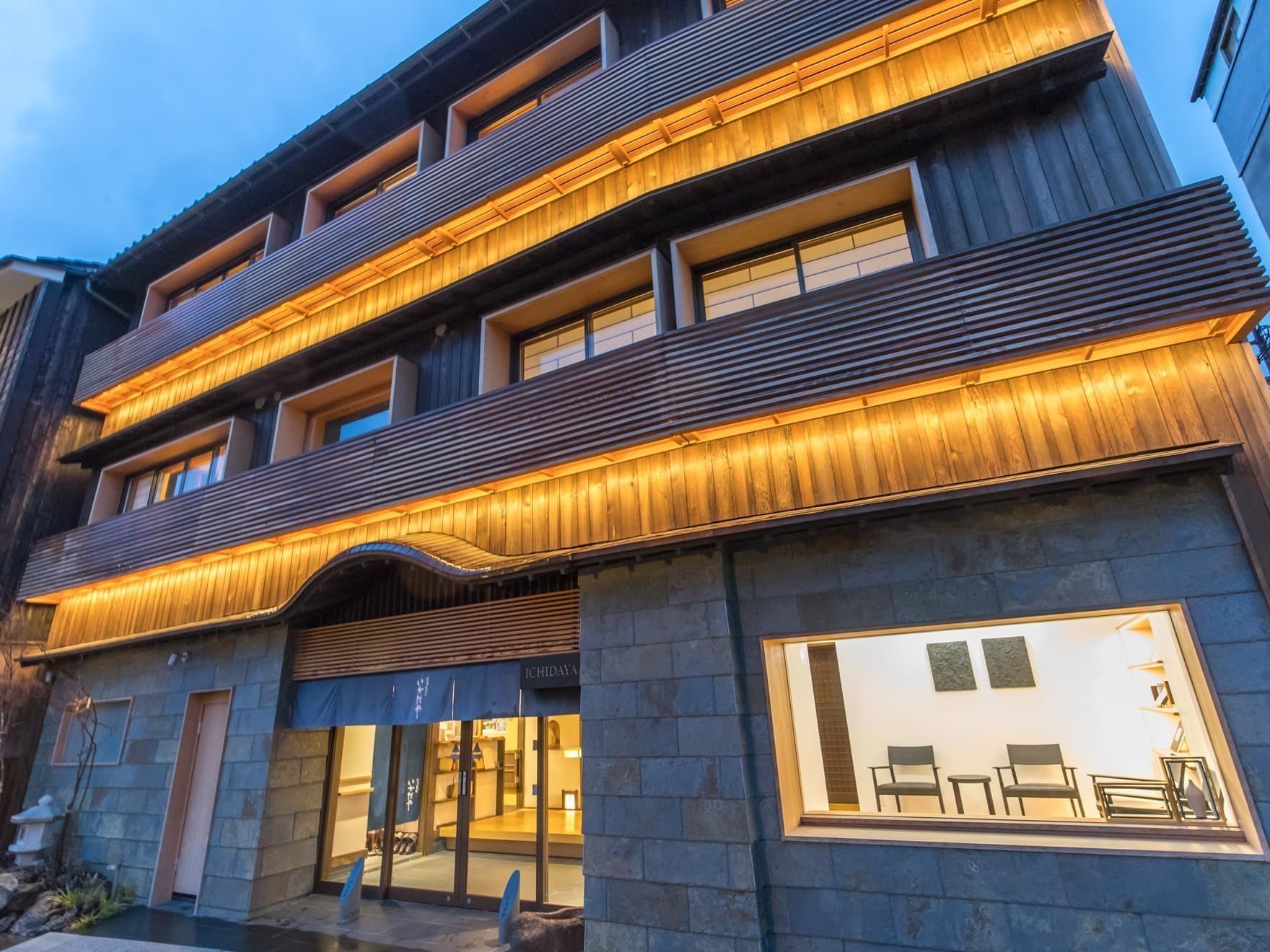 | from US$187/person/night≈ US$374 for 2 | 9.0 51 reviews | Book on Trip.com |
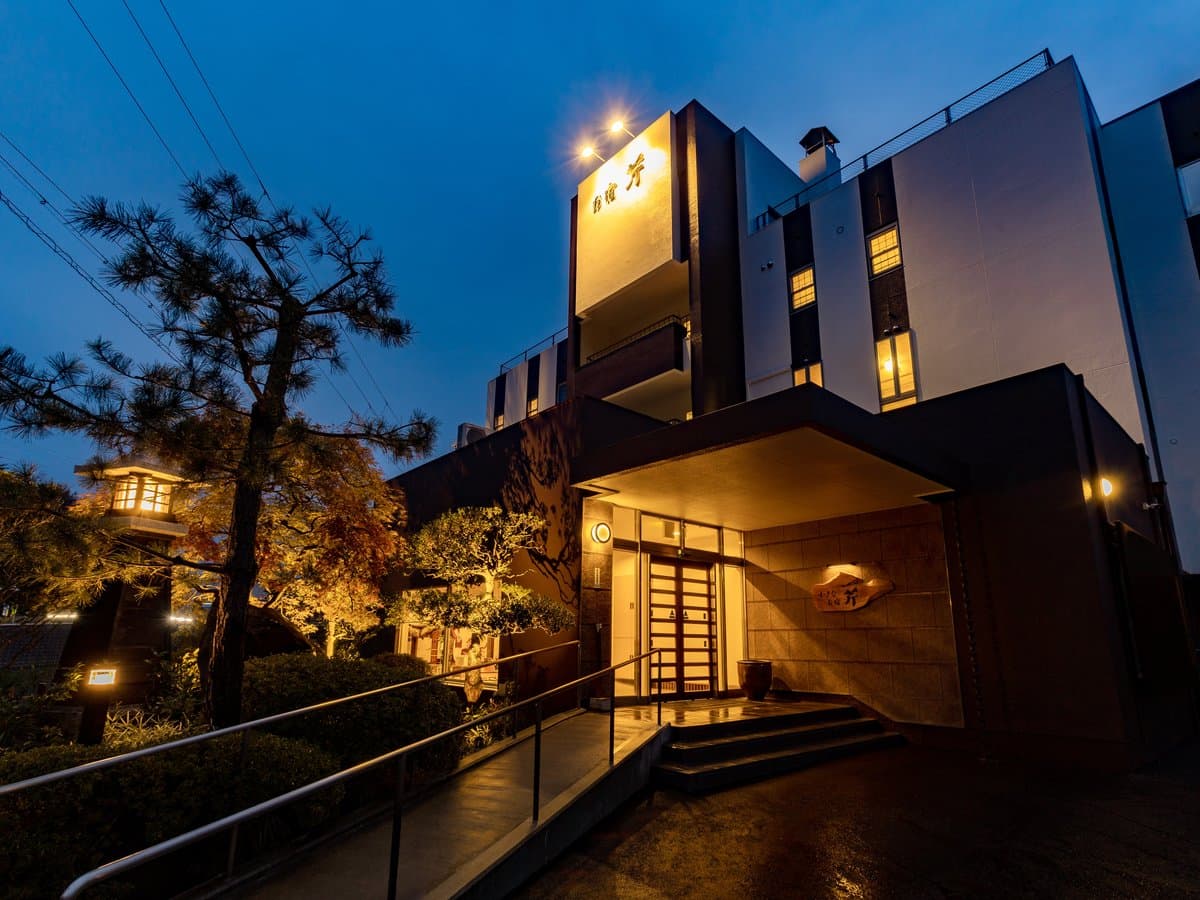 | from US$156/person/night≈ US$312 for 2 | 9.0 13 reviews | Book on Agoda |
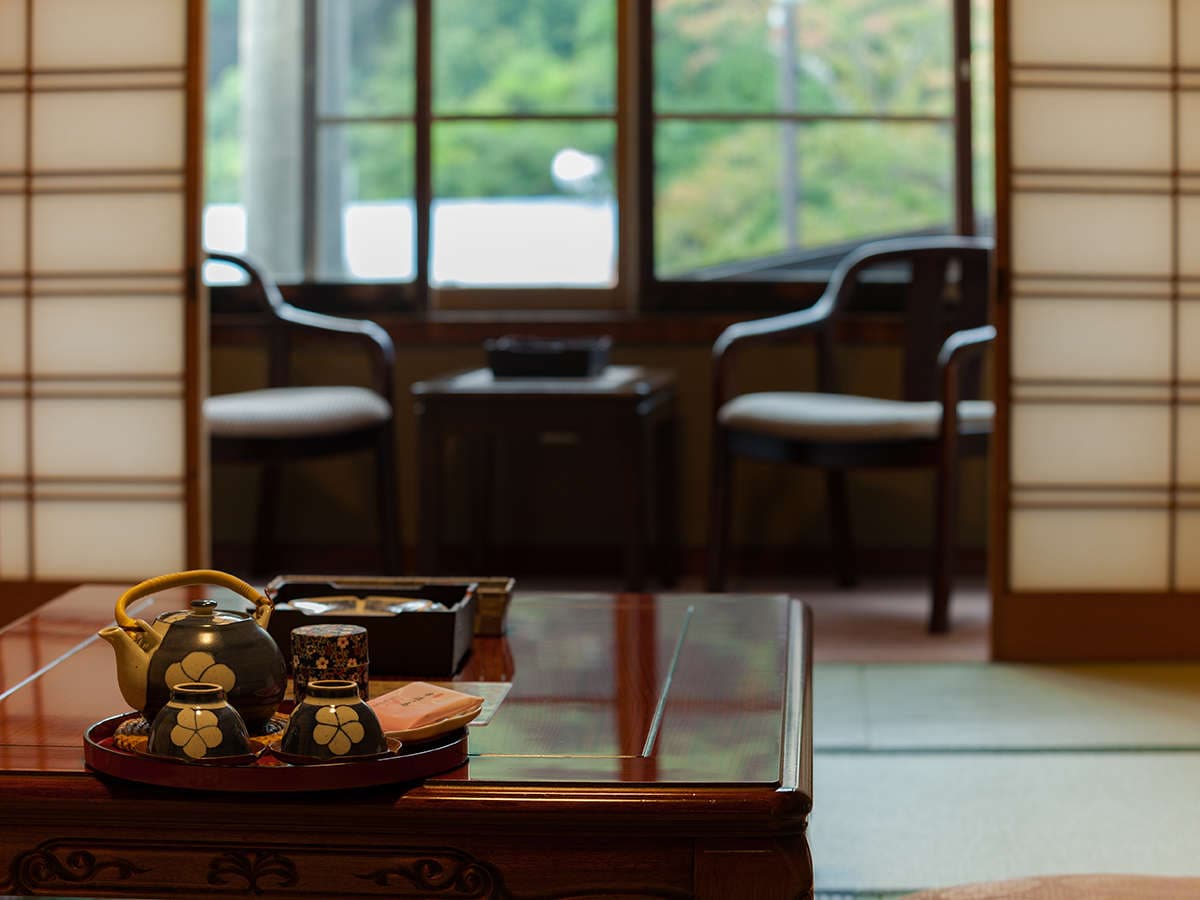 | from US$61/person/night≈ US$122 for 2 | 8.8 173 reviews | Book on Booking.com |
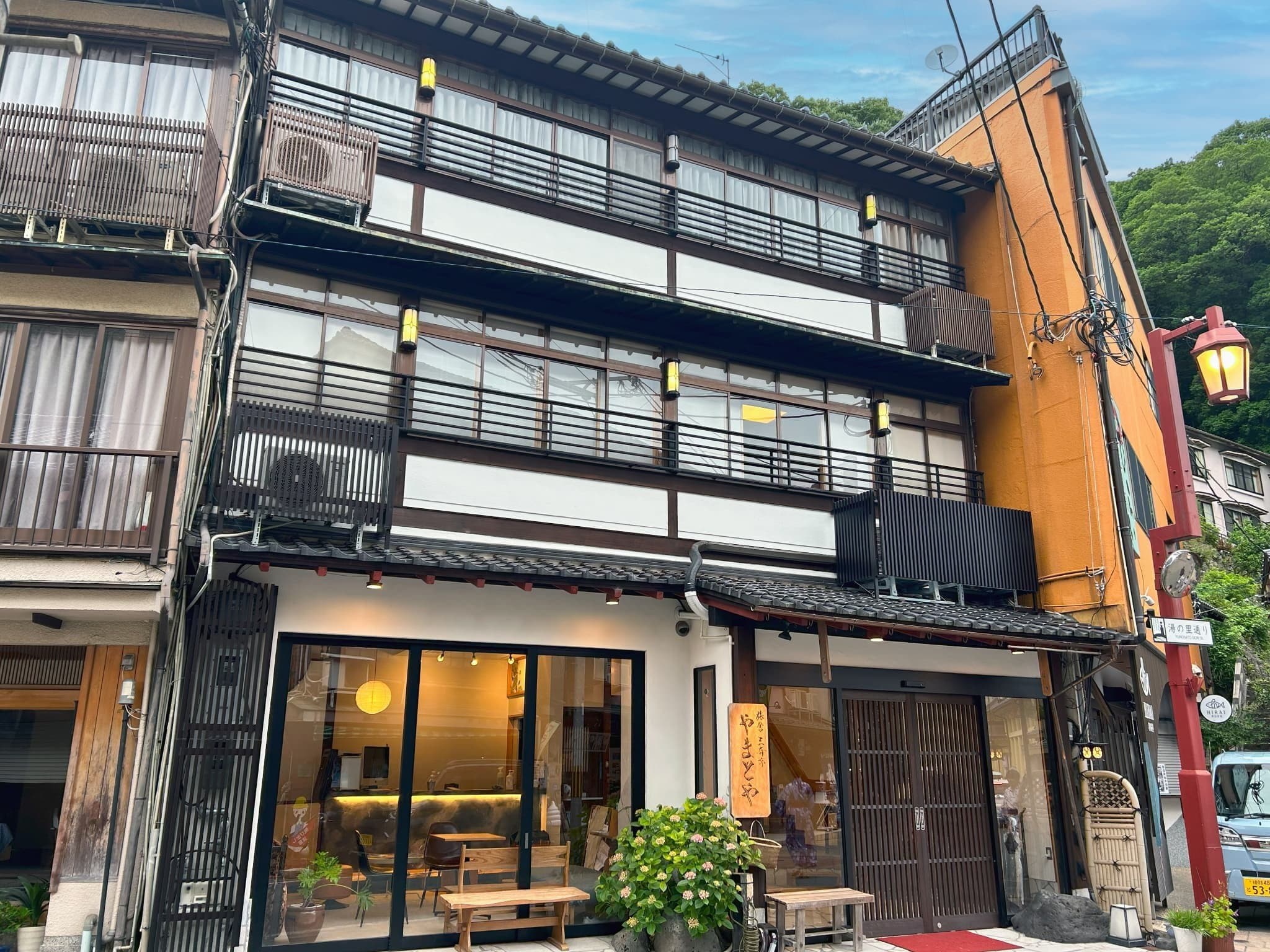 | from US$119/person/night≈ US$238 for 2 | 8.6 168 reviews | Book on Agoda |
 | from US$140/person/night≈ US$280 for 2 | 7.6 17 reviews | Book on Agoda |
Shinzan Kinosaki
Kinosaki
Kinosaki Onsen Kiraku
Kinosaki
Yuraku Kinosaki Spa & Gardens
Kinosaki
Kinosaki Onsen Oyado Seri
Kinosaki
Yamatoya
Kinosaki
Prices shown are approximate starting rates per person per night. We may earn a commission on bookings.
Ready to book?
Book one of these top picks
Compare live availability and prices across booking sites.
Nishimuraya Honkan
西村屋本館
Kinosaki·Luxury
from US$400 · per person · per nightfrom ≈ US$800 total for 2 guests



Yamamotoya
山本屋
Kinosaki·Mid-Range
from US$200 · per person · per nightfrom ≈ US$400 total for 2 guests
Mikiya
三木屋
Kinosaki·Luxury
from US$300 · per person · per nightfrom ≈ US$600 total for 2 guests
Booking links may earn us a commission at no extra cost to you.
FAQ
Frequently asked questions
Which is the best ryokan in Kinosaki Onsen?+
Nishimuraya Honkan is the top pick — a Relais & Châteaux property with 165 years of history, two natural hot-spring baths, and the best matsuba-gani and Tajima-beef kaiseki in town. For mid-range, Mikiya for literary heritage or Kobayashiya for three private baths. For fully tattoo-friendly, Yamamotoya. Under $180 with kaiseki and yumepa, Kinosaki-no-Yado.
Are tattoos allowed at Kinosaki Onsen's public baths?+
Yes — every currently operating sotoyu permits tattoos of any size with no cover-up requirement, making Kinosaki the most tattoo-friendly onsen town in Japan (verified May 2026). Yamamotoya ryokan also allows tattoos in its in-house communal baths. Other ryokans require cover-up in communal baths but allow tattoos in private kashikiri baths. See the full tattoo policy matrix in the article.
When is matsuba-gani (crab) season in Kinosaki Onsen?+
The fishing season for male matsuba-gani runs November 6 to March 20; some ryokans’ crab plans may continue into late March. The best value window is early-to-mid November — full-grade crabs, prices 10-20% below February peak, lighter crowds. February has the largest crabs and the most atmospheric snow but also the highest prices. Book November opening week at least three months ahead.
Are all 7 sotoyu currently open in Kinosaki?+
No. Satono-yu has been closed since 2024 for renovation, and Kono-yu is closed for repairs until October 30, 2026 (planned), per the Kinosaki Onsen Tourism Association. Until then five are open — Ichino-yu, Goshono-yu, Mandara-yu, Yanagi-yu, and Jizo-yu — and six once Kono-yu reopens. Most competing articles still claim all seven are open; that is incorrect for any 2026 trip.
How much does a ryokan in Kinosaki Onsen cost per night?+
Budget half-board from $80 (Kinosaki-no-Yado), mid-range $100-$350 (Tsutaya, Tajimaya, Kobayashiya, Koman, Tsukimotoya, Sensui), mid-upper $140-$450 (Yamamotoya, Koyado En, Kawaguchiya), luxury $220-$900 (Honkan, Shogetsutei, Mikiya, Onishiya Suishoen). Crab season adds $120-$200 per person supplement — turning a $250 base rate into roughly $700 for two.
Can I do Kinosaki Onsen as a day trip from Osaka or Kyoto?+
Technically possible but not recommended. The last Konotori back to Shin-Osaka leaves around 18:30 — before the most atmospheric sotoyu hours. The kaiseki dinner is a 2-3 hour sit-down. The yukata-walking and willow-lit canal experience is primarily an evening event. One night minimum is strongly recommended; two nights lets you cover every operating sotoyu comfortably.
What is sozoro-aruki?+
Sozoro-aruki (ぶらり歩き) means 'leisurely strolling with no destination' — the formal name for the yukata-and-geta canal walk that is the defining Kinosaki guest experience. Every ryokan issues yukata, haori jacket, and geta at check-in. Every shop and restaurant along Yunosato-dori is set up for yukata-wearing guests. It is not optional; it is the town's operating system.
Is Kinosaki or Hakone better for a first onsen trip?+
Kinosaki for Kansai-based itineraries (Osaka/Kyoto): unique 7-sotoyu structure, lower base prices, crab season, tattoo-friendly public baths. Hakone for Tokyo-based itineraries: 1h 30m from Shinjuku, higher luxury ceiling, Mt. Fuji views, more properties. Both are excellent first onsen destinations. For luxury couples from Tokyo, Hakone; for first-time ryokan travelers wanting the fullest town-culture experience, Kinosaki.
Still deciding?
Browse ryokans across JapanBooking.com