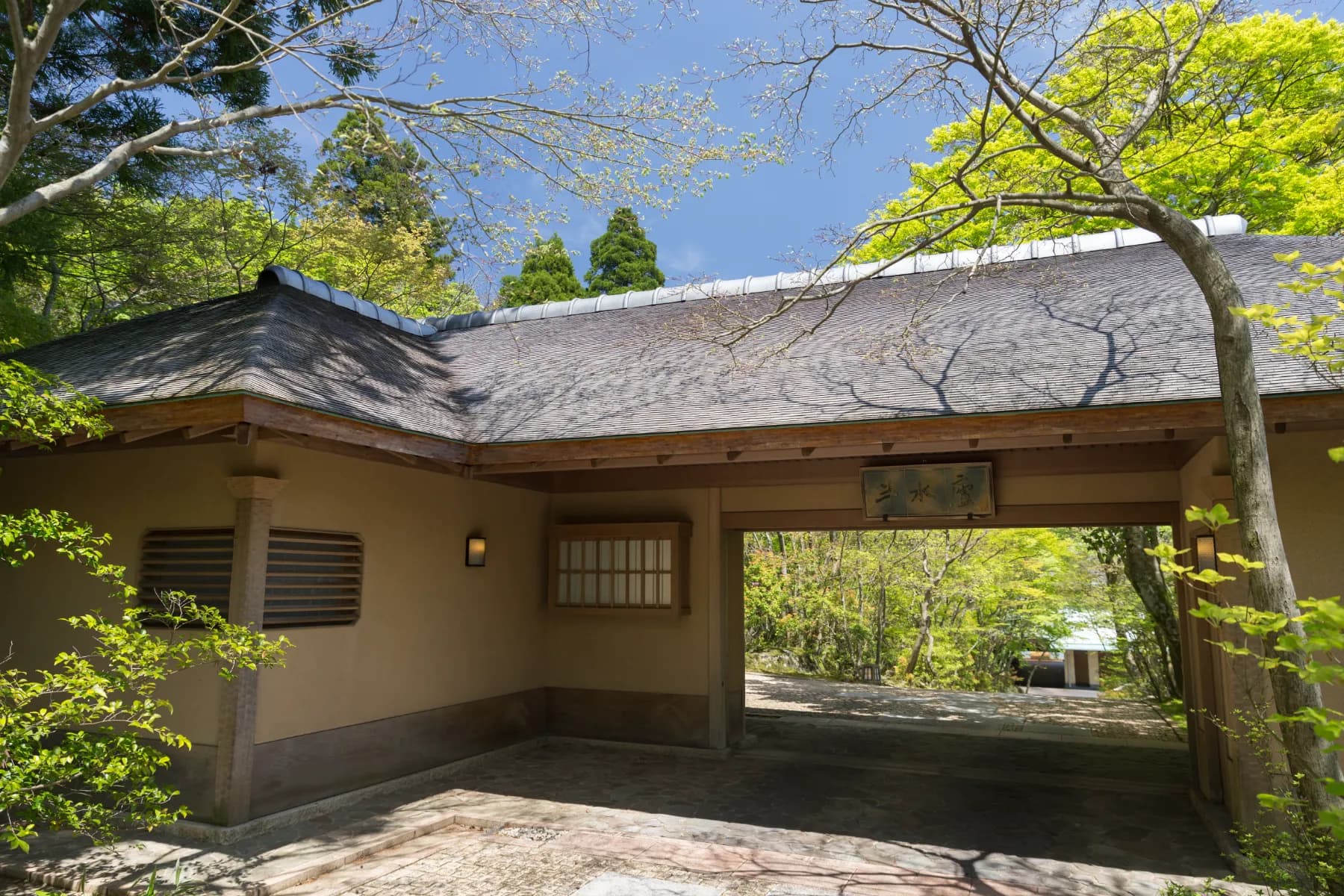
At 9:40 PM on a Tuesday in February, I left Ichino-yu with my hair still damp and the river already gone glassy. The willows along the Otani-gawa were lit from underneath in that strange green-gold glow you only see in Kinosaki between October and March. The geta clack on the stone bridge is the soundtrack of this town. I passed maybe forty other guests doing exactly the same loop, all in different ryokan-pattern *yukata*, and nobody was on a phone. Last verified: May 24, 2026.
That is the actual reason to book a ryokan in Kinosaki Onsen. The town runs on one unbroken ritual: check in by 3 PM, bathe briefly in the *uchiyu* (your ryokan's private bath), change into the yukata your ryokan provides, and walk between the seven public bathhouses (the *sotoyu*) until your fingertips go pruney. The ryokan is the costume room; the town is the stage. That model has held since the priest Dochi Shonin reportedly summoned the waters at what is now Mandara-yu in 720 A.D. [verified Visit Kinosaki 2026-05-24].
Kinosaki is also the most tattoo-progressive onsen town in Japan — all six currently operating public sotoyu allow tattoos with no cover-up requirement — and the crab capital of the Kansai onsen circuit. *Matsuba-gani* (snow crab) season runs November 6 to March 31 by statute, and most ryokans serve whole-crab kaiseki plans that deliver serious seafood for serious money.
I have stayed at four of the fifteen ryokans on this list and visited a fifth for dinner. Where I haven't slept the night, I say so. This is the expanded 2026 edition: fifteen picks (up from nine), with a crab-season pricing table, tattoo policy matrix, full sotoyu breakdown, and a How to Choose section by trip purpose. New to ryokans? Our first-time ryokan guide covers the basics so this article can focus on what makes Kinosaki specifically different.
The best ryokan in Kinosaki Onsen is Nishimuraya Honkan — a 165-year-old Relais & Châteaux property with two natural hot-spring baths, *matsuba-gani* and Tajima-beef *kaiseki*, and a level of *okami*-led service the other inns rarely match. For resort-scale luxury with a private *rotenburo*, Nishimuraya Hotel Shogetsutei is unmatched in the town. Mikiya wins on literary and cultural-property heritage. The best fully tattoo-friendly pick on the list is Yamamotoya — 350 years old with a riverside location and its own craft-beer brewery. Budget travelers should book Kinosaki-no-Yado under $180 with the free *yumepa* sotoyu pass included.
Tip
Disclosure: Japan Ryokan Guide earns a commission when you book through partner links. We don't accept payment from ryokans for inclusion or placement — every property here was selected on merit. Prices shown are per-room per-night, two people, half-board (dinner + breakfast), based on published rack rates as of May 2026; crab-season supplements are additional.
Quick-Compare: 15 Kinosaki Ryokans at a Glance
| # | Ryokan | Tier | From (USD) | Walk to Station | Best For | |---|---|---|---|---|---| | 1 | Nishimuraya Honkan | Luxury ¥¥¥¥ | $400 | 7 min | Milestone luxury + Relais & Châteaux | | 2 | Nishimuraya Hotel Shogetsutei | Luxury ¥¥¥¥ | $250 | Shuttle | Resort-scale + private rotenburo | | 3 | Mikiya | Luxury ¥¥¥ | $300 | 4 min | Literary heritage (Shiga Naoya) | | 4 | Yutouya Ryokan | Luxury ¥¥¥¥ | $250 | 6 min | Genroku-era 6,500 sqm architecture | | 5 | Onishiya Suishoen | Luxury ¥¥¥¥ | $220 | 5 min | Noh-stage central garden | | 6 | Yamamotoya | Mid ¥¥¥ | $200 | 3 min | 350-year river inn + fully tattoo-friendly | | 7 | Kobayashiya | Mid ¥¥ | $150 | 3 min | 3 private baths in a 9-room inn | | 8 | Tajimaya | Mid ¥¥ | $130 | 5 min | Best mid-range crab + wagyu kaiseki | | 9 | Tsutaya Ryokan | Mid ¥¥ | $120 | 8 min | Bakumatsu history under $280 | | 10 | Sennen-no-Yu Koman | Mid ¥¥ | $100 | 6 min | Founding-family lineage since 717 A.D. | | 11 | Tsukimotoya | Mid ¥¥ | $130 | 5 min | Michelin-noted quiet-center ryokan | | 12 | Sensui | Mid ¥¥ | $150 | 7 min | 3 free private open-air baths | | 13 | Koyado En | Mid ¥¥ | $140 | 3 min | Adults-only auberge + Tajima beef | | 14 | Kawaguchiya Honkan | Budget-mid ¥–¥¥ | $90 | 4 min | Budget riverside with kaiseki | | 15 | Kinosaki-no-Yado | Budget ¥ | $80 | 5 min | Budget floor: kaiseki + yumepa included |
Why Kinosaki is different: the town that bathes together
Kinosaki Onsen is a 1,300-year-old hot-spring town in northern Hyogo where ryokan guests walk between seven public bathhouses (*sotoyu*) in *yukata* and *geta*, eating *kaiseki* at the inn and bathing across the whole town — all on the same included pass. No other Japanese onsen destination is structured this way. In Hakone and Kusatsu, the ryokan competes with the town for your evening; in Kinosaki, the ryokan deliberately outsources the bathing to the town.
JNTO ranks Kinosaki among the top onsen destinations of the Kansai region [verified JNTO 2026-05-24]. The town is one kilometer end to end, walkable in fifteen minutes, built around the Otani River canal. Every ryokan on this list issues a yumepa at check-in, valid until 1 PM on departure day, for free entry to all currently operating sotoyu. The pass alone retails for ¥1,500 — included with every booking regardless of room rate. This is why even the most expensive ryokan in town has modest in-house baths: you're meant to use the *uchiyu* briefly, then put on the yukata and go out like everyone else.
Kinosaki is also the most tattoo-progressive onsen town in Japan: all public sotoyu allow tattoos of any size, no cover-up required [verified Visit Kinosaki 2026-05-24]. Against Japan's best onsen towns, Kinosaki runs 10–15% below Hakone luxury rates and offers a town experience no other destination replicates. For a Kansai itinerary with Kyoto — which has no natural hot springs — Kinosaki at 2h 30m by direct Limited Express is the natural onsen extension.
Tip
The post-checkout bath trick. The yumepa pass is valid until 1 PM on the day you leave, not 10 AM as most blogs claim. After breakfast, drop your bag at the front desk, change back into the yukata one last time, and hit one or two final sotoyu before catching the noon Konotori back to Osaka. Most guests miss this entirely and leave hours of paid bathing on the table.
How we verified these 15 ryokans
We screened every operating ryokan in Kinosaki against five criteria: station walking distance, in-house bath quality and tattoo policy, *kaiseki* strength (especially the matsuba-gani winter menu), English-accessible booking, and value at each tier. Fifteen properties cleared the bar — five luxury, seven mid-range, two budget. No ryokan paid to be included. Properties are drawn from our database of 224 vetted ryokans across 25 onsen destinations.
Four of the fifteen I have personally stayed at; two I visited for dinner; nine are verified through published sources and direct booking-platform checks conducted in May 2026. Where I stayed, I say so explicitly. Prices shown are per-room per-night, two people, half-board (dinner + breakfast), May 2026 rack rates. Crab-season supplements are additional. For broader pricing context, how Kinosaki compares nationally is worth reading before you book.
1. Nishimuraya Honkan — Best for milestone luxury and Relais & Châteaux service
Best for Couples on a milestone trip — okami-led service is theatrical, kaiseki is the best food experience in northern Hyogo. ¥¥¥¥
At a glance 34 rooms · ~$400–$900 USD · 165 years · 7-min walk from station · 2-min to Goshono-yu and Mandara-yu.
- Relais & Châteaux membership confirmed [verified Relais & Châteaux 2026-05-24] - Two in-house hot-spring baths plus one reservable *kashikiri* private bath - Tattoo policy: private bath only; communal baths require cover-up - *Matsuba-gani* kaiseki plan Nov 6–Mar 31; whole-crab supplement from ¥25,000 per person - Yumepa included; 7-min walk to Goshono-yu (largest outdoor rotenburo in the sotoyu network)
I stayed here in late February. The kaiseki opened with raw *kobashira* and a grilled matsuba-gani tail resting on pickled persimmon. The okami's tableside service — pouring sake without asking, then withdrawing — is the thing travel writers try to describe and can't quite land. Book eight months ahead for November opening-weekend dates.
Honest trade-off: Base-rate rooms lack private bathroom facilities in the heritage layout. Confirmed at booking.
Tip
Honkan's matsuba-gani-season rooms book out eight months ahead. If you can't get them, ask about Nishimuraya Hotel Shogetsutei's forest-garden resort (same family, 5-min shuttle, private rotenburo available).
2. Nishimuraya Hotel Shogetsutei — Best for resort-scale luxury with private spa rooms
Best for Travelers who want luxury Kinosaki with in-room *rotenburo* and resort amenities — pool, spa, gym — that the heritage ryokans cannot offer. ¥¥¥¥
At a glance 98 rooms · ~$250–$600 USD · 50,000 sqm forest-garden · 5-min shuttle from station.
- Large public baths plus suites with private rotenburo overlooking the forest garden - Tattoo policy: private bath only; communal baths require cover-up - Pool, spa, gym, and three dining venues — formal kaiseki, modern à la carte, lobby lounge - Free shuttle to canal-core sotoyu cluster; yumepa included - The only Kinosaki ryokan with a complete onsen evening possible without leaving the property
For guests who want private outdoor soaking without Honkan's per-night premium, Shogetsutei's suite-with-rotenburo at $250–$350 is the value case. Elderly guests, families with young children, and mobility-restricted travelers benefit most from the resort infrastructure.
Honest trade-off: Shuttle dependency makes the sotoyu feel like an excursion rather than a front-door walk. Central-location seekers should look at Yutouya or Kobayashiya.
3. Mikiya — Best for literary heritage and 300-year cultural property charm
Best for Readers and travelers who want to sleep inside a registered cultural property where Japanese literary history was made. ¥¥¥
At a glance 16 rooms · ~$300–$700 USD · 300+ years · Registered cultural property · 4-min from station · 1-min to Ichino-yu.
- Two indoor baths plus one *kashikiri* private bath; hot-spring source from the same feed as the sotoyu - Tattoo policy: cover-up in communal; allowed in private kashikiri bath - Shiga Naoya wrote *At Kinosaki* (城の崎にて, 1917) recovering at this inn — foundational Japanese modernist text - *Matsuba-gani* plan from November 6 among the strongest mid-luxury crab kaiseki in town - Private dining rooms with views into the inner garden
I stayed in January — snow on the garden stone, the communal bath empty at 6 AM, the building creaking in ways that feel deliberate. The in-house kaiseki is a grade above what the price suggests.
Honest trade-off: 300-year-old buildings have cold drafts in the bathrooms. That's the point — but not for everyone.
4. Yutouya Ryokan — Best for sprawling Genroku-era architecture
Best for Architecture enthusiasts who want to sleep inside a 6,500 sqm compound continuously expanded for 330 years. ¥¥¥¥
At a glance 48 rooms across five connected buildings · ~$250–$600 USD · Founded 1688 (Genroku era) · 6,500 sqm heritage garden · 6-min from station · 3-min to Goshono-yu.
- Multiple in-house baths including a *kashikiri* family bath fitting four guests - Tattoo policy: not allowed in any in-house bath; sotoyu accessible via yumepa - Full-format kaiseki in private dining rooms; matsuba-gani plan leans classical: sashimi, grilled, kani-suki, vinegared, rice with crab broth - Largest room inventory among central heritage ryokans; group bookings possible
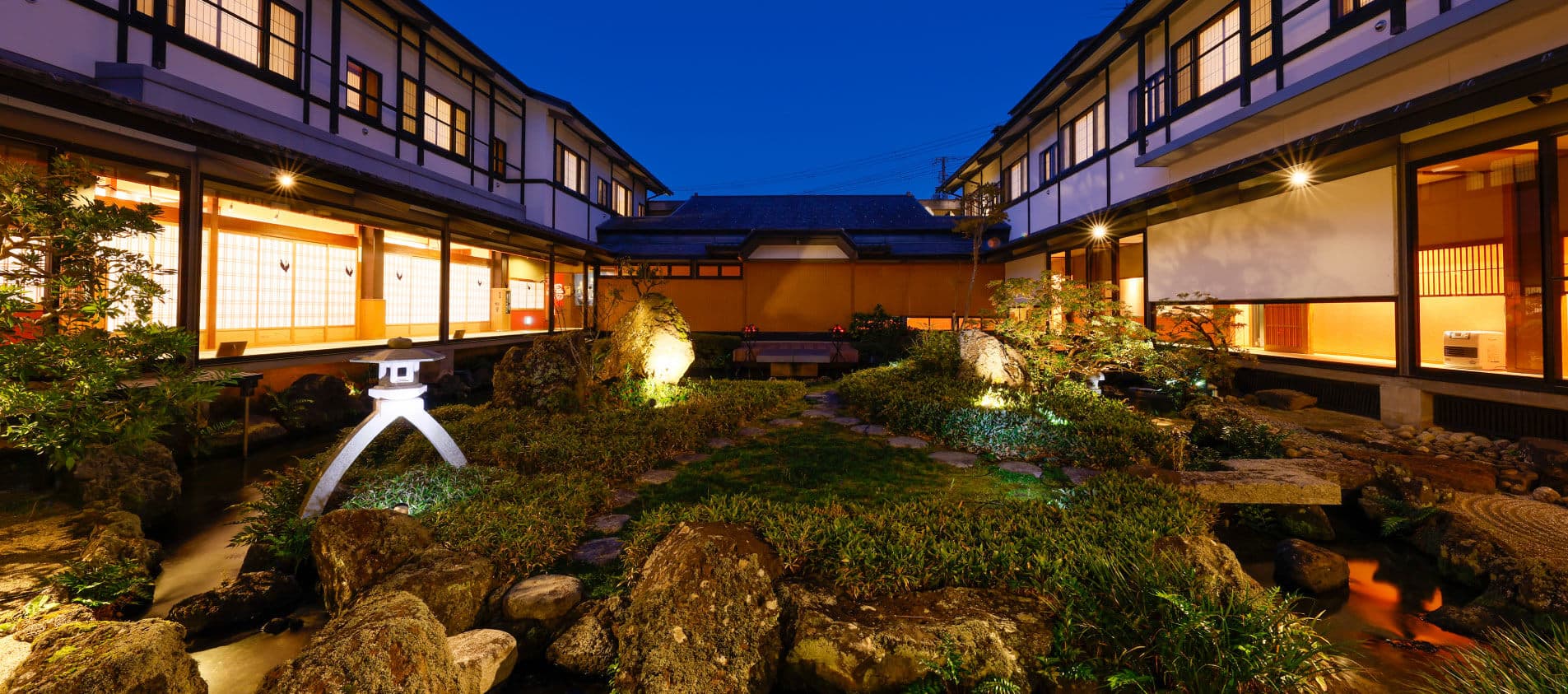
The connected corridors between five buildings — different floor levels, sudden beams, a garden appearing through unexpected windows — feel like a compound that grew organically over centuries. This is the most architecturally complex building you can sleep in at a Kinosaki onsen price.
Honest trade-off: Strictest tattoo policy on this list. Tattooed guests do all communal soaking in the sotoyu — accessible via yumepa, but not in the ryokan itself.
5. Onishiya Suishoen — Best for Noh-stage garden and theatrical aesthetic
Best for Travelers seeking a dramatic central garden with torchlit Noh stage — a theatrical aesthetic different from the heritage-corridor inns. ¥¥¥¥
At a glance ~30 rooms · ~$220–$500 USD · 5-min from station · Noh-stage garden · indoor and outdoor in-house baths.
- Central garden with stone stream, torches, and Noh performance stage — most visually striking interior in Kinosaki - Indoor and outdoor in-house baths; free station shuttle; free WiFi and parking - Full kaiseki service; matsuba-gani plan November 6–March 31; Tajima wagyu year-round - Rated 4.8 stars on Visit Kinosaki's official platform [verified Visit Kinosaki 2026-05-24] - Tattoo policy: check in-house bath policy directly before booking
I visited for dinner but did not stay; the kaiseki course featured Tajima wagyu, *amadai* (tilefish), and a local sanbaizu vinegared course. English reviews are sparser than the Nishimuraya properties.
Honest trade-off: Confirm tattoo policy and current availability directly by email before booking.
6. Yamamotoya — Best for 350-year riverside heritage and full tattoo-friendly access
Best for Tattooed travelers who want full communal-bath access in a historically significant mid-upper canal-side inn with its own craft-beer brewery. ¥¥¥
At a glance ~26 rooms · ~$200–$450 USD · 350+ years · riverside canal location · 3-min from station.
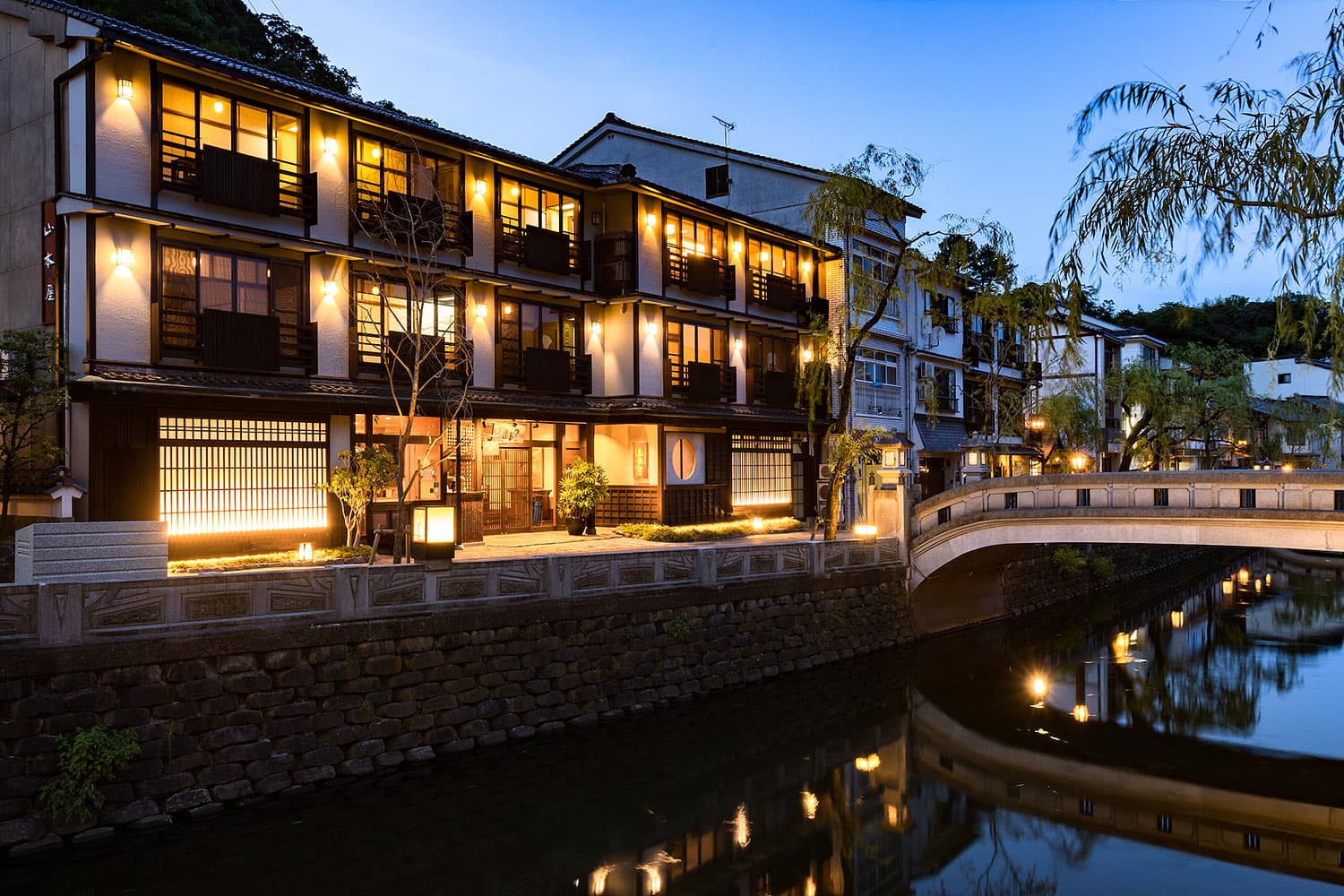
- Fully tattoo-friendly in all in-house baths — the only mid-upper ryokan on this list with no cover-up requirement [verified TattooFriendlyOnsen.com 2026-05-24] - Otani River-facing rooms with willow-canal views; direct canal-side position - On-site craft-beer micro-brewery: four styles including a Red Ale formulated for matsuba-gani pairing - Full kaiseki service; matsuba-gani plan November 6; Tajima beef year-round; yumepa included
I stayed here in November. The Red Ale's slight iron-and-caramel note cuts grilled matsuba-gani fat in a way sake doesn't always manage. The riverside rooms — facing the illuminated willows directly — are the best sleeping position in Kinosaki for the canal-at-night experience.
Honest trade-off: Rooms aren't as architecturally distinguished as Mikiya or Yutouya. The USP is location + full tattoo access + brewery.
7. Kobayashiya — Best for boutique mid-range with three private baths
Best for Couples who want cultural-property heritage at a mid-range price with three reservable private baths in a 9-room inn. ¥¥
At a glance 9 rooms · ~$150–$350 USD · Renovated registered cultural property · 3-min from station · 2-min to Mandara-yu.
- Three reservable *kashikiri* private baths — highest private-bath-to-room ratio on this list (1 per 3 rooms) - Tattoo policy: private baths universally accessible; communal bath requires cover-up - Artisan communal bath in lacquered wood; hot-spring source-fed - Modern-leaning kaiseki with fortnightly rotating menu; matsuba-gani plan from November competitively priced
Nine rooms means the okami knows your dinner preference before you sit down. The three private baths — two indoor, one small rotenburo — give a genuinely private hot-spring soak even if the communal bath requires cover-up.
Honest trade-off: Nine rooms means near-zero availability if you book late — two months ahead minimum even for weekdays.
Tip
When booking matsuba-gani plans, request the *kani-suki* (crab sukiyaki) variant rather than the standard sashimi-grill-hotpot. The broth at the end — rich with crab roe and dashi — is the best part of the meal, and it's what the town's okami eat when they eat together.
8. Tajimaya — Best for crab-and-Tajima-beef kaiseki on a mid-range budget
Best for Food-first travelers who want serious matsuba-gani and Tajima beef at the same table without paying Honkan rates. ¥¥
At a glance 22 rooms · ~$130–$300 USD · Canal-side · 5-min from station · 1-min to Ichino-yu.
- Tattoo policy: cover-up in communal; *kashikiri* private bath available - Two in-house baths plus one reservable private bath; hot-spring source-fed; yumepa included - Tajima-gyu wagyu sourcing documented by Visit Hyogo [verified Visit HYOGO 2026-05-24] — the foundation lineage for Kobe, Matsusaka, and Omi beef - Canal-side location; 1-min walk to Ichino-yu cave bath
I stayed at Tajimaya in late February. A single sumibi-grilled cube of A5 Tajima beef; the okami's grandfather had a framed lineage chart going back to a 1939 cow named Tajiri-go. The crab and the beef arriving together at mid-range price is the best-value meal on this list.
Honest trade-off: The building is comfortable but not architecturally special — the kaiseki is the reason.
9. Tsutaya Ryokan — Best for Bakumatsu history at a mid-range price
Best for History travelers who want to sleep where Bakumatsu-era political refugees once hid, at the lowest mid-tier price. ¥¥
At a glance 16 rooms · ~$120–$280 USD · Wooden three-story · Bakumatsu-era heritage · 8-min from station · 3-min to Yanagi-yu.
- Tattoo policy: cover-up in communal and private baths; sotoyu accessible via yumepa - One in-house indoor bath plus one *kashikiri* bath; hot-spring source-fed - Honest kaiseki: Tajima beef and Sea-of-Japan seafood; matsuba-gani plan from November - Katsura Kogoro (Kido Takayoshi), architect of the Meiji Restoration, reportedly hid here during Bakumatsu-era pursuit
Three-story wooden construction, low-beam corridors, and the Bakumatsu backstory create a sense of historical weight the mid-range price doesn't telegraph. Yanagi-yu at 3 minutes is one of the quieter sotoyu on the circuit.
Honest trade-off: 8-minute walk is fine for the circuit but slightly isolating. In-house bath is modest.
10. Sennen-no-Yu Koman — Best for the founding-family story since 717 A.D.
Best for Travelers who want to stay with the family that, by tradition, founded Kinosaki Onsen — at a mid-range price. ¥¥
At a glance 28 rooms · ~$100–$250 USD · *Sukiya*-style architecture · lineage to 717 A.D. · 6-min from station · 2-min to Mandara-yu.
- Tattoo policy: cover-up in communal baths; private family bath available - Two large in-house baths plus one reservable family bath; men's outdoor rotenburo among the largest in-house baths here - Full kaiseki with Sea-of-Japan emphasis — winter monkfish (*anko nabe*), spring firefly squid (*hotaru-ika*), matsuba-gani plan from November - 28 rooms — good availability year-round except crab-season weekends
Koman quietly leans on its own bath rather than pushing guests outward — the men's outdoor rotenburo is genuinely large. The founding-717-A.D. narrative and the in-house bath scale are the twin USPs.
Honest trade-off: Sukiya aesthetic is subtle — don't book expecting heritage-building drama. Narrative and bath size are the selling points.
11. Tsukimotoya — Best for Michelin-noted quiet-center ryokan at a mid-range price
Best for Travelers who want a Michelin-noted traditional ryokan at a mid-range price without the theatrical overhead of a Relais & Châteaux property. ¥¥
At a glance ~18 rooms · ~$130–$300 USD · Michelin Guide Hyogo 2016 'Pleasant Lodging' · 5-min from station · central-town location.
- Tattoo policy: verify in-house bath policy directly; sotoyu accessible via yumepa - 100% hot-spring source water in in-house bath; open 6 AM–midnight - Full kaiseki service; matsuba-gani plan from November; Tajima beef year-round - Central-but-quiet location: one street back from the Otani-gawa canal crowds
The Michelin "Pleasant Lodging" signal: not a luxury spectacle, not a budget compromise — a well-run traditional inn doing the fundamentals (food, bath, service) at a very high level. Guest reviews consistently highlight kaiseki quality relative to price.
Honest trade-off: No age, literary, or founding narrative. The USP is quality-to-price ratio.
12. Sensui — Best for three complimentary private open-air baths
Best for Guests who want maximum private open-air bath access — three free *kashikiri rotenburo* — without paying Shogetsutei suite rates. ¥¥
At a glance ~20 rooms · ~$150–$350 USD · 7-min from station · free station shuttle · three private open-air baths.
- Three free private open-air baths — highest complimentary private-bath count on this list [verified Visit Kinosaki 2026-05-24] - Tattoo policy: private baths accessible; verify communal bath policy directly - Two communal baths plus three free private rotenburo; hot-spring source-fed throughout; free shuttle - Full kaiseki; matsuba-gani plan November 6–March 31
Sensui solves a specific problem: private outdoor soaking in natural hot-spring water without booking a luxury suite. Three private baths free to use (no time-based surcharge at most hours) is unusual in mid-range Kinosaki, where most ryokans charge for kashikiri access.
Honest trade-off: 7-min walk is farthest from the sotoyu core for this price tier; architecture is functional rather than heritage.
13. Koyado En — Best adults-only auberge with Tajima-beef focus
Best for Couples or adult travelers who want an adults-only atmosphere with premium Tajima-beef kaiseki and private bath intimacy. ¥¥
At a glance 8 rooms · ~$140–$350 USD · Adults-only (13+) · 3-min from station · private hot-spring baths.
- Adults-only policy — the only explicitly adults-only ryokan on this list - Tattoo policy: private baths accessible for tattooed guests - Premium Tajima-beef course dinner as the dining flagship — focused on fewer preparations of higher-grade meat - Afternoon happy hour with sparkling plum wine and sake; café and restaurant dining format
Koyado En opened in 2013 as an explicit counter-proposal to the large-ryokan format: eight rooms, no children's noise, premium beef program, private baths for intimacy. It functions like a French auberge that has absorbed ryokan DNA. For couples uncomfortable in large communal onsen settings, this is the structural solution.
Honest trade-off: Eight rooms means very limited availability — book three months ahead minimum for any weekend.
14. Kawaguchiya Honkan — Best budget-mid pick with riverside location
Best for Budget-minded travelers who want kaiseki included and a canal-side location at prices that undercut most mid-range picks above. ¥–¥¥
At a glance ~25 rooms · ~$90–$220 USD · 4-min from station · free station pick-up · Otani River-side location.
- Tattoo policy: cover-up required; sotoyu accessible via yumepa - Free station pick-up — useful for guests arriving with luggage on crab-season weekends - Half-board kaiseki plans from ~$140–$180; matsuba-gani plan from November - Practical laundry facilities — one of the few Kinosaki ryokans catering structurally to longer stays - English-friendly booking; consistent positive reviews on Expedia and Booking.com [verified 2026-05-24]
The $90–$120 rack-rate rooms don't include dinner, but half-board plans from ~$140 are solid value. Free station pick-up is a practical differentiator for heavy-luggage arrivals.
Honest trade-off: Building is comfortable but not architecturally notable. Rooms go early in crab season.
15. Kinosaki-no-Yado — Best budget pick under $180 with kaiseki and yumepa included
Best for Solo travelers and budget-first couples who came for the sotoyu and the yukata walk, not for in-room kaiseki theater. ¥
At a glance 12 rooms · ~$80–$180 USD · 5-min from station · half-board kaiseki and yumepa included at base rate.
- Tattoo policy: cover-up in in-house bath; full sotoyu access via yumepa - Genuine half-board kaiseki at base rate — not a buffet: three to five Tajima-region courses, a hotpot or grilled main, rice and miso - Yumepa included — the same pass Nishimuraya Honkan guests get; the most expensive perk in town, free regardless of room rate - Matsuba-gani whole-crab plan available November–March at a supplement smaller than mid-range ryokans
The financial logic: the yumepa that Nishimuraya Honkan charges $400/night to include is included here at $80. The kaiseki is a fraction of Mikiya's, but it's real kaiseki, plated properly.
Honest trade-off: 12 rooms means extremely limited availability; book 2–3 months ahead even for weekdays in crab season. Rooms are basic and small.
The 7 sotoyu bath ritual: how to plan your bathhouse circuit
Kinosaki has seven public bathhouses (*sotoyu*), each with a different theme and architecture: Satono-yu, Ichino-yu, Goshono-yu, Mandara-yu, Yanagi-yu, Jizo-yu, and Kono-yu. Ryokan guests receive a free *yumepa* pass valid from check-in until 1 PM on departure day. The full circuit is roughly 2 km — a leisurely 90-minute walk excluding bathing time.
Critical 2026 update: Satono-yu has been closed since 2024 for renovation, with no public reopening date [verified Visit Kinosaki 2026-05-24]. Competing blogs still say "all seven" — they're wrong. Plan around the six currently operating sotoyu.
Ichino-yu — the most photographed sotoyu, with a famous cave bath carved into rock. Longest lines 7–9 PM weekends; go after 9 PM.
Goshono-yu — Imperial-Palace-style bath with the largest outdoor rotenburo in the network. Best before 7 PM or after 9:30 PM.
Mandara-yu — the spiritual birthplace of Kinosaki (Dochi Shonin, 720 A.D.). Two minutes from Goshono-yu, smaller, quieter, almost always uncrowded. Start here.
Yanagi-yu — the willow-themed short-soak bath. Best for a quick 20-minute stop between longer soaks.
Jizo-yu — family-friendly sotoyu near the station cluster. Gentler temperatures, most accessible from the station-end ryokans.
Kono-yu — far north end of town, near the ropeway. The only sotoyu that opens at 7 AM (all others open at 3 PM) — the essential fact for guests with a morning checkout needing one final soak.
For the full bathing etiquette primer, our onsen etiquette guide covers the complete protocol. Japan Tourism Agency documents Onsenji Temple as Kinosaki's official guardian temple [verified Japan Tourism Agency 2026-05-24].
Tip
Optimal first-night sotoyu circuit: Skip Goshono-yu (peak crowds 7–9 PM) and start with Mandara-yu (the spiritual origin, uncrowded). Walk to Yanagi-yu for a short soak. Then circle back to Ichino-yu after 9 PM for the cave bath without the weekend line. Three baths, 2 km of yukata walking, done by 10:30 PM.
Kani-kaiseki seasonal pricing: crab season tiers and which ryokan serves which
Matsuba-gani (snow crab) season runs November 6 to March 31, 2026–27, by statute. JNTO confirms the window and that male snow crabs are landed at Tajima-region ports including Kasumi [verified JNTO 2026-05-24]. Most ryokans offer whole-crab multi-course *kaiseki* at ¥18,000–¥30,000 per person supplement on top of room rate.
| Crab Type | Season | Supplement (per person) | Which Ryokans | |---|---|---|---| | Matsuba-gani (snow crab) | Nov 6–Mar 31 | ¥18,000–¥30,000 | All 15 ryokans on this list | | Tarabagani (king crab) | Year-round (imported) | ¥25,000–¥45,000 | Honkan, Shogetsutei, Yutouya (on request) | | Beni-zuwai-gani (red snow crab) | Oct–Nov + Mar–Apr | ¥10,000–¥15,000 | Select mid-range in shoulder season |
Price math: A $250 base-rate Kobayashiya room becomes ~$650–$700 for two with the matsuba-gani upgrade (¥18,000–¥20,000 per person). Honkan at $400 + ¥25,000 supplement reaches $950–$1,100 for two.
Best value window: Early-to-mid November — full-grade crabs, ryokan rates 10–20% below February peak, lighter crowds. Target the second weekend in November. For atmosphere — snow on willows, still canal reflections — target mid-January after the New Year surcharge (December 29–January 4) ends. Outside crab season, Tajima beef is the headliner — pair with best winter onsen or a private-onsen stay.
Tattoo policy matrix: which Kinosaki ryokans allow tattoos where
Kinosaki is one of Japan's most tattoo-progressive onsen towns. The public sotoyu are universally open to tattooed guests — no cover-up required at any of the six operating sotoyu [verified Visit Kinosaki 2026-05-24]. Ryokan in-house policies vary.
| Ryokan | Communal In-House Bath | Private Kashikiri Bath | Sotoyu via Yumepa | |---|---|---|---| | Nishimuraya Honkan | Cover-up required | Allowed | Fully allowed | | Nishimuraya Shogetsutei | Cover-up required | Allowed | Fully allowed | | Mikiya | Cover-up required | Allowed | Fully allowed | | Yutouya Ryokan | Not allowed | Not allowed | Fully allowed | | Onishiya Suishoen | Confirm directly | Confirm directly | Fully allowed | | Yamamotoya | Fully allowed | Fully allowed | Fully allowed | | Kobayashiya | Cover-up required | Allowed | Fully allowed | | Tajimaya | Cover-up required | Allowed | Fully allowed | | Tsutaya Ryokan | Cover-up required | Cover-up required | Fully allowed | | Sennen-no-Yu Koman | Cover-up required | Allowed | Fully allowed | | Tsukimotoya | Confirm directly | Confirm directly | Fully allowed | | Sensui | Confirm directly | Allowed | Fully allowed | | Koyado En | N/A | Allowed | Fully allowed | | Kawaguchiya Honkan | Cover-up required | Cover-up required | Fully allowed | | Kinosaki-no-Yado | Cover-up required | N/A | Fully allowed |
Key takeaway: Yamamotoya is the only mid-upper ryokan with confirmed full communal-bath tattoo access. Every ryokan issues a yumepa, so the full sotoyu circuit is accessible regardless of in-house policy. For national context, our tattoo-friendly ryokans guide benchmarks Kinosaki against Hakone, Beppu, and Kusatsu.
How to choose your Kinosaki ryokan: by trip purpose, budget, and season
Milestone couples: Nishimuraya Honkan for theatrical okami service. Shogetsutei for private rotenburo suite. Mikiya for intimate literary heritage. Koyado En for adults-only auberge with wagyu and wine.
First-time Japan travelers: Kobayashiya (9 rooms, high staff-to-guest ratio, three private baths) or Sennen-no-Yu Koman (28 rooms, large in-house bath, lower-pressure environment).
Families with children: Nishimuraya Hotel Shogetsutei (resort scale, pool, shuttle) or Sennen-no-Yu Koman (family kashikiri bath for four).
Crab focus (Nov–Mar): Nishimuraya Honkan for the definitive kaiseki experience; Tajimaya for mid-range crab-and-wagyu; Kinosaki-no-Yado for crab on a budget. Book by August for November opening weekend.
Tattooed travelers: Yamamotoya for full communal-bath access. Any pick on this list for full sotoyu access — the public baths are universally tattoo-friendly.
Budget under $200 with kaiseki: Kinosaki-no-Yado ($80–$180) or Kawaguchiya Honkan ($90–$220). Both include yumepa. Step up to Koman ($100–$250) for more rooms and a larger bath.
Kinosaki vs Hakone: Kinosaki for Kansai itineraries — unique sotoyu structure, crab season, tattoo-friendly public baths, 2h 30m from Kyoto. Hakone for Tokyo itineraries — 1h 30m from Shinjuku, higher luxury ceiling, Mt. Fuji views. See our Hakone guide for the direct comparison and Arima Onsen for the Kobe-region alternative.
Yukata, geta, and sozoro-aruki: the town as a stage
Kinosaki's signature ritual, *sozoro-aruki* ("leisurely strolling with no destination"), is the town's official guest experience: every shop, bar, and restaurant welcomes guests in ryokan-issued yukata [verified Visit Kinosaki 2026-05-24]. This is not a costume hour — it is the dress code from check-in to checkout.
Your ryokan provides a yukata (sized small/medium/large — ask at check-in), a *haori* outer jacket for cold evenings, and wooden geta sandals. Mikiya, Yutouya, and Tsutaya offer a choice of three or four yukata patterns. Walk heel-to-toe like sneakers and you'll crack a toe within 200 meters; shuffle with weight on the ball of the foot and the rhythm becomes automatic by night two.
The town formalized the walk with a *Bunya* stamp campaign: participating Yunosato-dori shops issue a small lapel-stamp when you stop in wearing yukata — collect five and get a souvenir at the tourism office. The willow-lined Otani-gawa with night illumination runs late October through late March, dusk to about 11 PM — the iconic Kinosaki photograph.
Tip
Geta walking. Wear the *tabi* socks your ryokan provides — barefoot geta on cold November stone causes blisters within 200 meters. Pack thin merino socks if you have wide feet (ryokan tabi run small). New geta benefit from a ten-minute breaking-in walk on tatami before the first stone-street outing.
Getting to Kinosaki: Konotori Limited Express, JR Pass, and the last train
Take the JR Limited Express Konotori from Shin-Osaka to Kinosaki Onsen Station — about 2 hours 40 minutes, ¥6,140 unreserved, JR Pass valid. From Kyoto, the Limited Express Hashidate/Kinosaki runs directly in about 2 hours 30 minutes for ¥4,500 unreserved, also JR Pass valid. From Tokyo, Shinkansen to Kyoto then transfer — total roughly 4 hours. The JR Kansai Wide Pass covers the Konotori and all Limited Express trains in Kansai for a flat fee — ideal for Kyoto + Osaka + Kinosaki combinations.
Four steps from Shin-Osaka:
1. Board the JR Limited Express Konotori (こうのとり) bound for Kinosaki Onsen — ~2h 40m, JR Pass valid, runs roughly hourly. 2. Reserve your seat the morning of arrival in Japan at any Midori-no-madoguchi — in crab season, trains sell out 3 days ahead on weekends. 3. Arrive at Kinosaki Onsen Station — the platform exits directly onto the canal-walking street. 4. Walk to your ryokan. Kobayashiya is 3 minutes; Honkan is 7 minutes. Shogetsutei and Sensui run free shuttles if you call ahead.
The last evening Konotori back to Shin-Osaka leaves around 18:30 — the #1 logistical surprise. Kinosaki is structurally a one- or two-night commitment. Japan welcomed a record 42.7 million international visitors in 2025 [verified Nippon.com 2026-05-24] — book ryokans 6–8 months ahead for any Saturday in November–February.
Tip
JR Pass timing. The Konotori from Shin-Osaka is JR Pass and JR Kansai Wide Pass valid, but the last train back is around 18:30 — meaning a Kinosaki stay is structurally a one- or two-night commitment, not a day trip. Book the return leg before you arrive.
Best time of year to visit Kinosaki Onsen
Mid-November for matsuba-gani opening week. The 2026–27 season opens November 6 — value sweet spot: full-grade crabs, willow lights on, rates 10–20% below February, lighter crowds. Book by August for the second-November weekend.
Mid-January after New Year week. January 5–25 is atmospherically the best time in Kinosaki — snow on willows, still canal, post-holiday crowd lull. Avoid December 29–January 4 (holiday surcharges).
Late February for peak crab season. Biggest crabs, deepest snow, highest prices, longest lines. Book six months ahead for any Saturday.
Late March to mid-July for Tajima beef and shoulder pricing. Cheapest, quietest stretch. Combine with a day trip to Izushi castle town or Genbudo Cave.
Avoid late July through early September — Sea-of-Japan humidity makes the bath circuit unpleasant, willow lighting is off. Avoid Golden Week (May 3–5) for holiday surcharges. Check the Kinosaki area guide when picking exact dates.
Kinosaki Onsen ryokan FAQ
Which is the best ryokan in Kinosaki Onsen?
Nishimuraya Honkan — Relais & Châteaux, 165 years, the best kaiseki in northern Hyogo. Mid-range: Mikiya for literary heritage, Kobayashiya for three private baths. Fully tattoo-friendly: Yamamotoya. Under $180 with kaiseki and yumepa: Kinosaki-no-Yado.
Are tattoos allowed at Kinosaki Onsen?
Yes — all six operating sotoyu permit tattoos of any size with no cover-up, making Kinosaki the most tattoo-friendly onsen town in Japan [verified Visit Kinosaki 2026-05-24]. Yamamotoya allows tattoos in its in-house communal baths too. Other ryokans require cover-up in communal baths but allow tattoos in private *kashikiri* baths. Yutouya is the most conservative. See the tattoo matrix above for the full per-ryokan breakdown.
When is crab season at Kinosaki?
Matsuba-gani season runs November 6 to March 31 by statute. Best value: early-to-mid November — full-grade crabs, prices 10–20% below February peak, lighter crowds. Book opening week by August.
Do I need to leave my ryokan to use the sotoyu?
Yes — the sotoyu are public townhouses separate from your ryokan's in-house bath. Every ryokan issues a yumepa for free entry. Satono-yu remains closed for renovation (no reopening date as of May 2026) — plan your circuit around the six currently operating sotoyu.
Kinosaki vs Hakone — which is better?
Kinosaki for Kansai itineraries: unique 7-sotoyu structure, crab season, tattoo-friendly public baths, 2h 30m from Kyoto. Hakone for Tokyo itineraries: 1h 30m from Shinjuku, higher luxury ceiling, Mt. Fuji views. See our Hakone guide.
Cheapest Kinosaki ryokan with private onsen?
Kobayashiya ($150–$350) with three reservable private baths. Sensui ($150–$350) with three free private open-air baths. Koyado En ($140–$350) for adults-only private-bath access.
How long should I stay in Kinosaki?
One night covers kaiseki and three or four sotoyu. Two nights covers all six operating baths, two different kaiseki menus, and the post-checkout morning soak. Three nights makes sense in matsuba-gani season or combined with Izushi castle town.
Can I do Kinosaki as a day trip?
Technically yes — the sotoyu cost ¥1,500 each for day visitors. But the last Konotori back to Shin-Osaka leaves around 18:30, before the most atmospheric sotoyu hours. One night minimum is the practical recommendation.
Final thoughts: fifteen ryokans in a town one kilometer long
The case for a Kinosaki ryokan is structural rather than aspirational. The town is one kilometer long, the six operating sotoyu form a single circuit, the yumepa turns every booking into a town-wide bath ticket, and the entire commercial district expects you in the yukata your ryokan loaned you. Choosing where to sleep is how you choose which Kinosaki you see.
Honkan for milestone luxury. Shogetsutei for private rotenburo. Mikiya for literary heritage. Yutouya for Genroku architecture. Onishiya Suishoen for the Noh-stage garden. Yamamotoya for 350-year canal-side + full tattoo access. Kobayashiya for three private baths at mid-range. Tajimaya for crab-and-wagyu. Tsutaya for Bakumatsu history. Koman for the founding-family story. Tsukimotoya for Michelin-noted quiet-center value. Sensui for three free private open-air baths. Koyado En for adults-only auberge. Kawaguchiya Honkan for budget-mid riverside. Kinosaki-no-Yado for the budget floor with kaiseki and yumepa included.
Remember the post-checkout window: the yumepa is valid until 1 PM on departure day — a final two-bath morning loop most guides will let you forget. See the full Kinosaki Onsen area guide when you're ready to book. *All prices, hours, and access details verified May 24, 2026.*
Kinosaki is the natural onsen extension for Kyoto and Osaka itineraries. Kyoto has no natural hot springs — Kinosaki at 2h 30m direct is the closest full onsen-town experience for a Kansai trip. Pair one Kyoto city night with one or two Kinosaki ryokan nights for the canonical Kansai extension. See our Kyoto ryokan guide, best ryokans for couples, luxury private onsen, and Japan onsen by region to position Kinosaki in your wider itinerary.
2月某个星期二晚上9点40分,我刚离开一之汤,头发还未干透,大溪川已经平静如镜。大谿川沿岸的垂柳在那种只有10月到3月的城崎才有的奇异黄绿色灯光映照下闪烁着。木屐踏在石桥上的声响,就是这座小镇的专属BGM。我大概擦身而过了四十位客人,每个人都穿着各自旅馆的浴衣花纹,没有一个人看手机。最后核实日期:2026年5月24日。
这才是在城崎温泉预订日式旅馆(旅館,ryokan)的真正理由。这座小镇遵循着一套亘古不变的仪式:下午3点前入住,在旅馆的内汤(内湯,uchiyu)里简单泡一下,换上旅馆提供的浴衣,然后在七处公共浴场(外汤,*sotoyu*)之间穿梭,直到手指泡得起皱。旅馆是更衣室;小镇才是舞台。这套模式自道智上人于公元720年在如今的万太郎汤遗址祈来温泉起,已延续了一千三百余年[来源已核实 Visit Kinosaki 2026-05-24]。
城崎也是日本对纹身最为宽容的温泉地——目前所有6处营业中的外汤均允许有纹身的客人入浴,无需遮盖——同时也是关西温泉线上的螃蟹之都。松叶蟹(雪蟹)的捕捞季节依法律规定为每年11月6日至3月31日,大多数旅馆会提供整只螃蟹的怀石料理套餐,是货真价实的海鲜盛宴,价格也确实不菲。
我在此列表中的15家旅馆里亲身住过4家,另有1家仅前往用晚餐。未曾住宿的旅馆,本文均有注明。这是2026年扩充版:精选增至15家(原9家),新增螃蟹季节定价表、纹身政策对照表、完整外汤介绍及按出行目的推荐的选择指南。若是初次入住旅馆,可先阅读初住旅馆指南了解基础知识,本文则专注于城崎的独特之处。
城崎温泉最值得推荐的旅馆是西村屋本馆——这家拥有165年历史的罗莱夏朵成员旅馆设有两处天然温泉浴场、松叶蟹与但马牛怀石料理,以及其他旅馆难以企及的女将(okami)亲身服务。若想享受度假村规格的奢华与私人露天浴池,西村屋酒店招月庭是全城无出其右的选择。三木屋在文学遗产和文化财价值方面独占鳌头。名单中对纹身最为友好的是山本屋——有350年历史的河边旅馆,附设自酿精酿啤酒厂。预算有限的旅客可预订城崎之宿,180美元以下便含免费外汤通行证(湯女パス,yumepa)。
Tip
【声明】 Japan Ryokan Guide通过合作链接预订可获得佣金。我们不接受旅馆为入选或排名而支付的费用——所有旅馆均凭实力入选。所示价格为2026年5月公布定价,以每间客房每晚两人、含早晚餐的半食宿价格为准;螃蟹季节补充费另计。
快速对比:15家城崎旅馆一览
| # | 旅馆 | 档次 | 起价(美元) | 步行至车站 | 最适合 | |---|---|---|---|---|---| | 1 | 西村屋本馆 | 豪华 ¥¥¥¥ | $400 | 7分钟 | 纪念旅行 + 罗莱夏朵 | | 2 | 西村屋酒店招月庭 | 豪华 ¥¥¥¥ | $250 | 班车 | 度假规模 + 私人露天浴池 | | 3 | 三木屋 | 豪华 ¥¥¥ | $300 | 4分钟 | 文学遗产(志贺直哉) | | 4 | 汤登屋旅馆 | 豪华 ¥¥¥¥ | $250 | 6分钟 | 元禄时期6500平米建筑群 | | 5 | 鬼石山水苑 | 豪华 ¥¥¥¥ | $220 | 5分钟 | 能舞台中庭 | | 6 | 山本屋 | 中档 ¥¥¥ | $200 | 3分钟 | 350年河畔旅馆 + 纹身完全无限制 | | 7 | 小林屋 | 中档 ¥¥ | $150 | 3分钟 | 9间客房3处私人浴池 | | 8 | 但马屋 | 中档 ¥¥ | $130 | 5分钟 | 中档最佳螃蟹+和牛怀石 | | 9 | 蔦屋旅馆 | 中档 ¥¥ | $120 | 8分钟 | 280美元以下的幕末历史旅馆 | | 10 | 千年之汤古满 | 中档 ¥¥ | $100 | 6分钟 | 公元717年创立的家族传承 | | 11 | 月元屋 | 中档 ¥¥ | $130 | 5分钟 | 米其林推荐的静谧市中心旅馆 | | 12 | 泉翠 | 中档 ¥¥ | $150 | 7分钟 | 3处免费私人露天浴池 | | 13 | 小宿缘 | 中档 ¥¥ | $140 | 3分钟 | 仅限成人的奥贝日旅宿+但马牛 | | 14 | 川口屋本馆 | 经济-中档 ¥–¥¥ | $90 | 4分钟 | 经济实惠的河边怀石旅馆 | | 15 | 城崎之宿 | 经济 ¥ | $80 | 5分钟 | 180美元以下含怀石与通行证的最实惠选择 |
城崎的与众不同:全城共浴的泡汤文化
城崎温泉是日本兵库县北部一座拥有1300年历史的温泉小镇,旅馆住客可穿着浴衣(yukata)和木屐(geta)在七处公共浴场(外汤,*sotoyu*)之间漫步,在旅馆享用怀石料理,凭同一张通行证畅游全镇温泉。日本没有第二处温泉地是以这种方式运营的。在箱根和草津,旅馆与小镇争夺着客人的夜晚时光;而在城崎,旅馆主动将泡汤体验外包给整座小镇。
JNTO将城崎评为关西地区顶级温泉目的地之一[来源已核实 JNTO 2026-05-24]。小镇全长仅一公里,围绕大谿川运河而建,步行十五分钟便可从头走到尾。本列表中所有旅馆在办理入住时均会提供湯女パス(yumepa),有效期至退房当日下午1点,可免费进入所有目前营业的外汤。仅通行证本身的零售价便高达1500日元,无论订哪个价位的房间均免费随附。这正是城崎旅馆内汤较为简朴的原因:来这里就是要穿上浴衣,像所有人一样走出去。
城崎同时也是日本对纹身最宽容的温泉地:全部公共外汤均允许任何尺寸的纹身入浴,无需遮盖[来源已核实 Visit Kinosaki 2026-05-24]。与日本最佳温泉地相比,城崎豪华旅馆的定价比箱根低10至15%,且提供其他目的地无法复制的小镇体验。对于以京都为核心的关西行程来说——京都没有天然温泉——乘直达特急列车2小时30分可达的城崎,是最自然的温泉延伸目的地。
Tip
退房后的泡汤妙招。 湯女パス(yumepa)的有效期是退房当日下午1点,而非大多数博客所说的上午10点。早餐后将行李寄存在前台,再换上浴衣,最后去泡一两处外汤,然后乘坐正午前后的こうのとり特急回大阪。大多数客人对此一无所知,白白浪费了好几小时已付费的泡汤时间。
我们如何核实这15家旅馆
我们依据五项标准对城崎所有营业旅馆进行了筛查:到车站步行距离、内汤质量与纹身政策、怀石料理水准(尤其是松叶蟹冬季菜单)、英语预订可及性,以及各档次的性价比。最终有15家旅馆通过筛选——豪华5家、中档7家、经济型2家。无任何旅馆支付入选费用。所有旅馆均来自我们覆盖25个温泉目的地、共224家经过审核的旅馆数据库。
15家中我亲身住过4家,另有2家以就餐方式探访,其余9家均于2026年5月通过公开资料及直接预订平台核查进行了验证。凡是亲身入住的,文中均有明确说明。价格为2026年5月挂牌定价,以每间客房每晚两人、含早晚餐的半食宿价格为准。螃蟹季节的补充费用另计。更广泛的定价背景可参考城崎与全国旅馆价格的比较,建议预订前阅读。
1. 西村屋本馆 — 最适合纪念旅行与罗莱夏朵级服务
最适合 纪念旅行的情侣——女将亲自主导的服务如戏剧般精彩,怀石料理是兵库县北部最佳饮食体验。¥¥¥¥
概况 34间客房·约400–900美元·165年历史·距车站步行7分钟·距御所之汤与万太郎汤仅2分钟。
- 已确认罗莱夏朵成员资格[来源已核实 Relais & Châteaux 2026-05-24] - 两处旅馆内天然温泉浴场,另有一处可预订的私人包租浴(貸切風呂,kashikiri) - 纹身政策:仅私人浴池允许;公共浴场需要遮盖 - 松叶蟹怀石套餐:11月6日至3月31日;整蟹套餐补充费每人起价25,000日元 - 含湯女パス;步行7分钟可至御所之汤(外汤网络中最大的户外露天浴池)
我在二月下旬入住。怀石料理以生小柱贝和烤松叶蟹尾搭配腌柿子开场。女将在桌边倒酒时不需要你开口,随即悄然退去——这种服务,旅行作家们试图用文字表达,却总是词不达意。十一月开幕周末的房间需提前八个月预订。
坦率说明: 历史格局的基础客房不设独立卫浴设施。预订时已确认。
Tip
本馆的松叶蟹季客房在八个月前便售罄。若预订不到,可考虑西村屋酒店招月庭的森林花园度假旅馆(同一家族经营,班车5分钟,提供私人露天浴池)。
2. 西村屋酒店招月庭 — 最适合度假规格的奢华与私人温泉套房
最适合 希望在城崎享受豪华体验,同时拥有客房内露天浴池及度假村设施(泳池、水疗、健身房)的旅客——这些是历史旅馆无法提供的。¥¥¥¥
概况 98间客房·约250–600美元·50,000平米森林花园·距车站班车5分钟。
- 大型公共浴场,另有俯瞰森林花园的私人露天浴池套房 - 纹身政策:仅私人浴池允许;公共浴场需要遮盖 - 泳池、水疗、健身房,三处餐厅——正式怀石、现代单点、大堂休息厅 - 免费班车前往运河核心外汤区;含湯女パス - 城崎唯一一家可以不离开旅馆便完成全晚温泉体验的旅馆
对于想要私人户外泡汤却不想支付本馆溢价的客人,招月庭的带露天浴池套房250至350美元是性价比之选。年长客人、带幼儿的家庭及行动不便的旅客最能受益于度假村的完善设施。
坦率说明: 依赖班车会让外汤之旅感觉像一次出行而非步行出门。追求中心位置的旅客请考虑汤登屋旅馆或小林屋。
3. 三木屋 — 最适合文学遗产与300年有形文化财的旅馆
最适合 希望入住日本文学史留下印记的登录有形文化财旅馆的读者与旅行者。¥¥¥
概况 16间客房·约300–700美元·历史逾300年·登录有形文化财·距车站4分钟·距一之汤1分钟。
- 两处室内浴场及一处私人包租浴(貸切風呂);温泉水源与外汤同源 - 纹身政策:公共浴场需遮盖;私人包租浴允许 - 志贺直哉在此疗养期间创作了《在城崎》(城の崎にて,1917年)——日本近代文学的奠基之作 - 11月6日起的松叶蟹套餐是城崎中高档位中最出色的螃蟹怀石之一 - 俯瞰内院的私人餐室
我在一月份入住——庭院石头上积着雪,早上六点公共浴室空无一人,建筑以一种像是刻意为之的方式吱嘎作响。旅馆内的怀石料理品质超出价格所暗示的水准。
坦率说明: 三百年的老建筑浴室有寒气漏风。这是历史旅馆的真味,但并非人人适合。
4. 汤登屋旅馆 — 最适合元禄时代宏大建筑群
最适合 建筑爱好者——这座经过330年持续扩建的6500平米庭院建筑群,正等待您来入眠。¥¥¥¥
概况 五栋相连共48间客房·约250–600美元·1688年(元禄年间)创立·6500平米历史庭院·距车站6分钟·距御所之汤3分钟。
- 多处内汤,含可容纳4名客人的家庭包租浴 - 纹身政策:旅馆内任何浴场均不允许;外汤可凭湯女パス使用 - 在私人餐室享用全套怀石料理;松叶蟹套餐偏向古典风格:刺身、烤制、蟹涮锅、醋腌、蟹汤泡饭 - 城崎中心历史旅馆中客房数最多;可接受团体预订
五栋楼之间相连的廊道——不同楼层,突然出现的横梁,无意间透出庭院的窗户——让人感受到一栋有机生长了数百年的建筑复合体。这是城崎温泉价位内建筑结构最为复杂的住所。
坦率说明: 名单中最严格的纹身政策。有纹身的客人只能使用外汤——可凭湯女パス进入,但旅馆内部不可使用。
5. 鬼石山水苑 — 最适合能舞台庭院与戏剧美学
最适合 追求戏剧性中心庭院与火炬照耀能舞台的旅客——一种与历史长廊旅馆截然不同的美学体验。¥¥¥¥
概况 约30间客房·约220–500美元·距车站5分钟·能舞台庭院·室内及户外内汤。
- 设有石流、火炬和能舞台的中心庭院——城崎最具视觉冲击力的旅馆内部 - 室内与户外内汤;免费班车;免费WiFi及停车场 - 全套怀石服务;松叶蟹套餐11月6日至3月31日;但马和牛全年供应 - 在Visit Kinosaki官方平台获得4.8星好评[来源已核实 Visit Kinosaki 2026-05-24] - 纹身政策:预订前请直接确认内汤政策
我仅以晚餐形式造访,未曾入住;怀石菜单包含但马和牛、甘鲷(红鲷)及本地三杯醋腌制菜肴。英文评论比西村屋系旅馆少。
坦率说明: 预订前请通过电邮直接确认纹身政策和当前空房情况。
6. 山本屋 — 最适合350年河畔遗产与纹身完全无限制的泡汤体验
最适合 有纹身的旅客,希望在一家历史悠久的中高档运河边旅馆尽情使用公共浴场,且旅馆附有精酿啤酒厂。¥¥¥
概况 约26间客房·约200–450美元·历史逾350年·大溪川河边位置·距车站3分钟。
- 所有内汤对纹身完全开放——名单中唯一不需遮盖即可使用公共浴场的中高档旅馆[来源已核实 TattooFriendlyOnsen.com 2026-05-24] - 面向大谿川、俯瞰垂柳运河的客房;紧邻运河 - 旅馆内精酿啤酒厂:四种风格,包括专为搭配松叶蟹设计的红爱尔 - 全套怀石服务;松叶蟹套餐11月6日起;但马牛全年;含湯女パス
我在11月入住。红爱尔细腻的铁与焦糖气息,能以日本酒无法企及的方式解去烤松叶蟹的油腻。面朝运河的客房——直接俯视灯光映照的垂柳——是在城崎体验夜间运河风情的最佳卧室。
坦率说明: 客房在建筑个性上不及三木屋或汤登屋旅馆。这家旅馆的核心卖点是位置+纹身完全开放+精酿啤酒厂。
7. 小林屋 — 最适合拥有三处私人浴池的精品中档旅馆
最适合 希望在9间客房的精品旅馆中以中档价格享受文化财遗产,同时使用三处可预订私人浴池的情侣。¥¥
概况 9间客房·约150–350美元·已翻修的登录有形文化财·距车站3分钟·距万太郎汤2分钟。
- 三处可预订私人包租浴(貸切風呂)——名单中最高的私人浴池与客房比例(每3间客房配1处) - 纹身政策:私人浴池均可使用;公共浴场需要遮盖 - 漆木手工艺公共浴场;源泉直引 - 每两周更换一次的现代怀石菜单;11月起的松叶蟹套餐定价有竞争力
9间客房意味着女将在您坐下用餐前就已了解您的饮食偏好。三处私人浴池——两处室内、一处小型露天浴池——即便公共浴场要求遮盖,也能确保真正私密的温泉浸泡体验。
坦率说明: 9间客房意味着预订极快售罄——即便平日也需提前至少两个月。
Tip
预订松叶蟹套餐时,建议要求蟹涮锅(kani-suki)版本,而非标准的刺身、烤制、涮锅套餐。最后的汤底——充满蟹膏与鲣鱼高汤的精华——才是这顿饭的灵魂,也是城崎各旅馆女将聚在一起吃饭时会点的那道菜。
8. 但马屋 — 最适合中档预算中享用螃蟹与但马牛怀石
最适合 以食为先的旅客——希望在同一桌上品尝正宗的松叶蟹与但马牛,但不想支付西村屋本馆的价格。¥¥
概况 22间客房·约130–300美元·运河边·距车站5分钟·距一之汤1分钟。
- 纹身政策:公共浴场需遮盖;提供私人包租浴(貸切風呂) - 两处内汤及一处可预订私人浴池;源泉直引;含湯女パス - 但马牛采购经Visit HYOGO认证[来源已核实 Visit HYOGO 2026-05-24]——神户牛、松阪牛、近江牛的基础品系 - 运河边位置;步行1分钟至一之汤洞窟浴场
我在二月下旬入住。一块炭火炙烤的A5但马牛方块入口;女将的祖父有一张裱在框里的血统表,可以追溯到1939年一头名叫田尻号的母牛。在中档价格下同桌品尝到螃蟹与牛肉,是名单中性价比最高的用餐体验。
坦率说明: 建筑舒适但无建筑亮点——怀石料理才是前来的理由。
9. 蔦屋旅馆 — 最适合中档价格体验幕末历史
最适合 历史爱好者——希望在幕末时期政治难民曾藏匿的旅馆住宿,并以中档最低价格实现。¥¥
概况 16间客房·约120–280美元·木造三层楼·幕末时代遗产·距车站8分钟·距柳之汤3分钟。
- 纹身政策:公共浴场与私人浴池均需遮盖;外汤可凭湯女パス使用 - 一处室内浴场及一处私人包租浴;源泉直引 - 朴实的怀石料理:但马牛与日本海海鲜;松叶蟹套餐11月起 - 幕末志士桂小五郎(木户孝允,明治维新设计者之一)据传曾在此躲避追捕
三层木造建筑、低矮梁柱的走廊,以及幕末的历史背景,营造出一种其中档价格无法预告的历史厚重感。距此3分钟的柳之汤是外汤线路中较为幽静的一处。
坦率说明: 8分钟路程对于外汤巡游无妨,但略有与市中心脱节之感。旅馆内汤较为简朴。
10. 千年之汤古满 — 最适合追溯公元717年创始家族传承
最适合 希望入住城崎温泉传说中的创始家族旅馆,并以中档价格实现的旅客。¥¥
概况 28间客房·约100–250美元·数寄屋风格建筑·家族传承追溯至公元717年·距车站6分钟·距万太郎汤2分钟。
- 纹身政策:公共浴场需遮盖;提供私人家庭浴池 - 两处大型内汤及一处可预订家庭浴池;男性户外露天浴池是馆内最大的内汤 - 全套怀石料理以日本海时令为重点——冬季鮟鱇鱼锅(anko nabe)、春季萤火鱿(hotaru-ika)、11月起的松叶蟹套餐 - 28间客房——全年预订可及性良好(螃蟹季节的周末除外)
古满悄然将自家浴场作为主打卖点,而非催促客人往外走——男性户外露天浴池确实宽敞。公元717年创始的传说叙事与馆内浴场的规模,是这家旅馆的两大支柱。
坦率说明: 数寄屋风格的美感内敛低调——勿抱期待有浓烈的历史建筑气氛。叙事和浴场规模才是卖点。
11. 月元屋 — 最适合中档价格的米其林推荐静谧市中心旅馆
最适合 希望以中档价格入住米其林推荐传统旅馆、但不需要罗莱夏朵式戏剧性的旅客。¥¥
概况 约18间客房·约130–300美元·米其林指南兵库2016年「舒适住宿」·距车站5分钟·市中心安静位置。
- 纹身政策:请直接确认内汤政策;外汤可凭湯女パス使用 - 旅馆内汤100%源泉直引;开放至深夜12时 - 全套怀石服务;松叶蟹套餐11月起;但马牛全年供应 - 安静的市中心位置:偏离大谿川运河热闹地带一条街
米其林「舒适住宿」的信号意味着:不是豪华奇观,也不是预算妥协——而是一家将基本功(料理、泡汤、服务)做到极高水准的传统旅馆。客人评价中持续强调与价格相对的怀石料理品质。
坦率说明: 没有历史年龄、文学或创始叙事。卖点是品质与价格的比值。
12. 泉翠 — 最适合三处免费私人露天浴池
最适合 希望最大化私人露天浴池体验——三处免费私人露天浴池(贡切里露天风吕,kashikiri rotenburo)——而不必支付招月庭套房价格的客人。¥¥
概况 约20间客房·约150–350美元·距车站7分钟·免费班车·三处私人露天浴池。
- 三处免费私人露天浴池——名单中免费私人浴池数量最多[来源已核实 Visit Kinosaki 2026-05-24] - 纹身政策:私人浴池可使用;公共浴场政策请直接确认 - 两处公共浴场及三处免费私人露天浴池;全部源泉直引;免费班车 - 全套怀石料理;松叶蟹套餐11月6日至3月31日
泉翠解决了一个具体问题:无需预订豪华套房,也能在天然温泉水中享受私密户外浸泡。城崎大多数中档旅馆的包租浴需要额外收费,这里提供三处免费使用的私人浴池(大多数时段无时间附加费),在这个档次中实属罕见。
坦率说明: 距外汤中心区步行7分钟,是这个价位中最远的;建筑实用但缺乏历史韵味。
13. 小宿缘 — 最适合以但马牛为核心的仅限成人奥贝日旅宿
最适合 希望在仅限成人的氛围中享用高端但马牛怀石料理与私人浴池亲密体验的情侣或成人旅客。¥¥
概况 8间客房·约140–350美元·仅限成人(13岁以上)·距车站3分钟·私人温泉浴池。
- 仅限成人政策——名单中唯一明确的仅限成人旅馆 - 纹身政策:有纹身的客人可使用私人浴池 - 以高端但马牛套餐晚餐为核心——专注于较少品类但更高品质的肉品呈现 - 下午欢乐时光(起泡梅酒与日本酒);咖啡厅兼餐厅的用餐形式
小宿缘于2013年作为对大型旅馆模式的明确反命题而开业:8间客房、无儿童噪音、高端牛肉套餐、私密浴池。它运作起来像一家吸收了旅馆基因的法式奥贝日旅宿(auberge)。对于在大型公共温泉场合感到不适的情侣来说,这是从结构上解决问题的选择。
坦率说明: 8间客房意味着极为有限的空房——任何周末都需提前至少三个月预订。
14. 川口屋本馆 — 最适合经济实惠的河边旅馆
最适合 预算有限的旅客——希望含怀石料理并拥有运河边位置,且价格低于大多数上文中档选择。¥–¥¥
概况 约25间客房·约90–220美元·距车站4分钟·免费接站·大谿川河畔。
- 纹身政策:需要遮盖;外汤可凭湯女パス使用 - 免费车站接送——在螃蟹季节周末携带行李抵达的客人尤为受用 - 含早晚餐套餐约140–180美元;松叶蟹套餐11月起 - 实用洗衣设施——城崎少数从结构上为长住客人提供便利的旅馆之一 - 英语友好预订;在Expedia和Booking.com上持续获得正面好评[来源已核实 2026-05-24]
90至120美元的基础客房不含晚餐,但140美元起的含餐套餐性价比扎实。免费接站是重行李抵达客人的实用差异化优势。
坦率说明: 建筑舒适但无建筑亮点。螃蟹季的客房提早售罄。
15. 城崎之宿 — 最适合180美元以下含怀石料理与通行证的经济选择
最适合 来这里是为了外汤和浴衣散步的独行侠和预算优先的情侣——不在乎客房内的怀石仪式感。¥
概况 12间客房·约80–180美元·距车站5分钟·基础房价含怀石早晚餐与湯女パス。
- 纹身政策:旅馆内汤需遮盖;凭湯女パス可使用全部外汤 - 基础房价含正宗怀石早晚餐——不是自助餐:三至五道但马地区食材料理,加上火锅或烤制主菜、米饭与味噌汤 - 含湯女パス——与西村屋本馆客人持有的相同通行证;全镇最有价值的特权,无论订哪个房价均免费附赠 - 11月至3月松叶蟹整蟹套餐可选,补充费低于中档旅馆
财务逻辑如下:西村屋本馆每晚400美元所含的湯女パス,在这里80美元就有。怀石质量是三木屋的几分之一,但这是真正的怀石,摆盘讲究。
坦率说明: 12间客房意味着空房极为有限;即便是螃蟹季的平日也需提前2至3个月预订。客房简单且小。
7处外汤泡汤仪式:如何规划你的浴场巡游
城崎有七处公共浴场(外汤,*sotoyu*),每处主题与建筑各异:里之汤、一之汤、御所之汤、万太郎汤、柳之汤、地藏汤和鸿之汤。 旅馆客人可获得一张免费湯女パス通行证,自入住起至退房当日下午1点有效。完整巡游全程约2公里——不含泡汤时间,悠闲步行约90分钟。
2026年重要更新: 里之汤自2024年起因翻修而关闭,目前尚无公开的重新开放日期[来源已核实 Visit Kinosaki 2026-05-24]。仍有竞争性博客在说「全七处」——那是错误的。请以目前营业的六处外汤来规划行程。
一之汤 ——被拍摄最多的外汤,以凿入岩石的洞窟浴场著名。周末晚7至9点排队最长;建议9点后前往。
御所之汤 ——御所风格的浴场,拥有外汤网络中最大的户外露天浴池。建议晚7点前或9点30分后入浴。
万太郎汤 ——城崎的精神发祥地(道智上人,公元720年)。距御所之汤两分钟,规模较小,幽静,几乎从不拥挤。建议从此处开始巡游。
柳之汤 ——以垂柳为主题的短泡浴场。适合在较长的泡汤之间快速停留约20分钟。
地藏汤 ——靠近车站区域的家庭友好外汤。水温更为温和,从车站端的旅馆出发最为便利。
鸿之汤 ——位于镇北端,靠近缆车站。唯一早上7点开放的外汤(其他均为下午3点开放)——对于需要在早晨退房前泡最后一次汤的客人来说,这是必须了解的关键信息。
完整的入浴礼仪说明请参阅温泉礼仪指南。日本观光厅将温泉寺(Onsenji Temple)列为城崎的官方守护寺庙[来源已核实 Japan Tourism Agency 2026-05-24]。
Tip
首晚最佳外汤巡游路线: 跳过御所之汤(晚7至9点客流高峰),从万太郎汤开始(精神发祥地,清静)。走至柳之汤短暂浸泡。然后在晚9点后折回一之汤,享受洞窟浴场而无周末排队之苦。三处浴场,2公里浴衣散步,晚10点半前完成。
蟹怀石季节定价:螃蟹季节分级及各旅馆供应情况
松叶蟹(雪蟹)的捕捞季节依法律规定为2026–27年度的11月6日至3月31日。 JNTO确认了这一时间窗口,以及雄性雪蟹在包括香住在内的但马地区各港口的捕捞情况[来源已核实 JNTO 2026-05-24]。大多数旅馆在房费基础上提供每人18,000至30,000日元的整蟹多道怀石料理套餐。
| 螃蟹种类 | 季节 | 补充费(每人) | 供应旅馆 | |---|---|---|---| | 松叶蟹(雪蟹) | 11月6日–3月31日 | 18,000–30,000日元 | 本名单全部15家旅馆 | | 帝王蟹(进口) | 全年 | 25,000–45,000日元 | 西村屋本馆、招月庭、汤登屋旅馆(需提前要求) | | 红雪蟹 | 10–11月 + 3–4月 | 10,000–15,000日元 | 部分中档旅馆(肩部季节) |
价格换算: 小林屋250美元的基础价格,加上松叶蟹升级费(每人18,000至20,000日元),两人合计约650至700美元。西村屋本馆400美元加上每人25,000日元的补充费,两人合计达950至1,100美元。
最佳性价比窗口: 11月初至中旬——标准品质的螃蟹,柳树灯光已亮,房价比2月高峰低10至20%,人流较少。目标是11月第二个周末。若追求氛围——柳树上的积雪、静止的运河倒影——则以元旦假期(12月29日至1月4日)收费结束后的1月中旬为最佳时机。螃蟹季以外,但马牛是主角——可与最佳冬季温泉或私人温泉旅馆结合安排。
纹身政策对照表:城崎各旅馆允许纹身的浴场
城崎是日本对纹身最为宽容的温泉地之一。全部公共外汤——目前运营的6处外汤无一例外——均对有纹身的客人开放,无需遮盖[来源已核实 Visit Kinosaki 2026-05-24]。旅馆内汤政策各有不同。
| 旅馆 | 公共内汤 | 私人包租浴 | 外汤(湯女パス) | |---|---|---|---| | 西村屋本馆 | 需要遮盖 | 允许 | 完全允许 | | 西村屋酒店招月庭 | 需要遮盖 | 允许 | 完全允许 | | 三木屋 | 需要遮盖 | 允许 | 完全允许 | | 汤登屋旅馆 | 不允许 | 不允许 | 完全允许 | | 鬼石山水苑 | 请直接确认 | 请直接确认 | 完全允许 | | 山本屋 | 完全允许 | 完全允许 | 完全允许 | | 小林屋 | 需要遮盖 | 允许 | 完全允许 | | 但马屋 | 需要遮盖 | 允许 | 完全允许 | | 蔦屋旅馆 | 需要遮盖 | 需要遮盖 | 完全允许 | | 千年之汤古满 | 需要遮盖 | 允许 | 完全允许 | | 月元屋 | 请直接确认 | 请直接确认 | 完全允许 | | 泉翠 | 请直接确认 | 允许 | 完全允许 | | 小宿缘 | 不适用 | 允许 | 完全允许 | | 川口屋本馆 | 需要遮盖 | 需要遮盖 | 完全允许 | | 城崎之宿 | 需要遮盖 | 不适用 | 完全允许 |
核心结论: 山本屋是唯一经确认在公共内汤对纹身完全开放的中高档旅馆。每家旅馆均发放湯女パス,因此无论内汤政策如何,全套外汤线路均可使用。欲了解全国对比,可参阅纹身友好旅馆指南,了解城崎与箱根、别府、草津的对比。
如何选择城崎旅馆:按出行目的、预算与季节
纪念旅行情侣: 西村屋本馆,享受戏剧性的女将服务。招月庭,享受私人露天浴池套房。三木屋,享受亲密的文学遗产体验。小宿缘,仅限成人的奥贝日旅宿搭配和牛与美酒。
初次来日旅客: 小林屋(9间客房、高员工与客人比例、三处私人浴池)或千年之汤古满(28间客房、大型内汤、低压力环境)。
携儿童家庭: 西村屋酒店招月庭(度假规模、泳池、班车)或千年之汤古满(可容纳4人的家庭包租浴)。
以螃蟹为重心(11月至3月): 西村屋本馆,终极怀石体验;但马屋,中档蟹与和牛;城崎之宿,预算内的螃蟹。8月前须预订11月开幕周末。
有纹身的旅客: 山本屋,公共内汤完全开放。本名单任意旅馆,均可使用全部外汤——所有公共浴场对纹身一律友好。
200美元以内含怀石料理: 城崎之宿(80至180美元)或川口屋本馆(90至220美元)。两家均含湯女パス。如预算稍高,古满(100至250美元)可提供更多客房和更大的浴场。
城崎vs箱根: 关西旅程选城崎——独特的外汤体系、螃蟹季节、纹身友好的公共浴场、距京都2小时30分钟。东京旅程选箱根——距新宿1小时30分、更高的豪华上限、富士山视野。详见箱根指南与有马温泉(神户地区的另一选择)。
浴衣、木屐与漫步:以小镇为舞台
城崎独特的仪式——漫步(sozoro-aruki,悠然信步、无目的而行)——是小镇官方的客人体验:每家商店、酒吧和餐厅都欢迎穿着旅馆浴衣的客人[来源已核实 Visit Kinosaki 2026-05-24]。这不是一个换装时光——从入住到退房,这就是着装规范。
旅馆提供浴衣(尺码分小/中/大,入住时提出申请)、寒夜御用的羽织外套,以及木制木屐。三木屋、汤登屋旅馆和蔦屋旅馆提供三到四种浴衣图案可供选择。若像穿运动鞋那样从脚跟起步,200米内脚趾便会受伤;将重心放在脚掌上拖步行走,第二晚自然找到节奏。
小镇通过「文弥」盖章活动将漫步体验正式化:穿浴衣到汤乡道参与商店消费,即可获得一枚胸章;集齐五枚便能在观光服务处换取纪念品。大谿川沿岸垂柳夜间灯光从10月下旬持续至3月下旬,黄昏至晚约11点——这是城崎最具标志性的照片场景。
Tip
木屐走路须知。 请穿上旅馆提供的足袋(tabi,分趾袜)——赤脚穿木屐踩在11月的石板上,200米内便会起水泡。脚宽的旅客请自备薄款美利奴羊毛袜(旅馆足袋偏小)。新木屐建议在首次踏上石板路前,先在榻榻米上试走十分钟进行磨合。
前往城崎:こうのとり特急、JR铁路通票与末班车
乘坐JR特急こうのとり(Konotori)从新大阪至城崎温泉站——约2小时40分,自由席6,140日元,JR铁路通票有效。 从京都出发,特急はしだて(Hashidate)/きのさき(Kinosaki)直达约2小时30分,自由席4,500日元,同样适用JR铁路通票。从东京出发,乘新干线至京都换乘,全程约4小时。JR关西广域铁路通票涵盖こうのとり及关西全区所有特急列车,费用统一——最适合京都+大阪+城崎的组合行程。
从新大阪出发四步走:
1. 搭乘JR特急こうのとり,目的地城崎温泉——约2小时40分,JR通票有效,约每小时一班。 2. 抵达日本当天早上在绿色窗口(みどりの窓口)划定座位——螃蟹季节周末提前3天便会售罄。 3. 抵达城崎温泉站——出站月台直接通往运河散步街道。 4. 步行至旅馆。小林屋3分钟,西村屋本馆7分钟。招月庭与泉翠提前致电可安排免费班车。
返回新大阪方向的末班こうのとり约18:30发车——这是旅行者最常感到意外的信息。城崎从结构上是一至两晚的旅行。2025年日本接待外国入境旅客创下4,270万人的历史新高[来源已核实 Nippon.com 2026-05-24]——11月至2月任何一个星期六,均需提前6至8个月预订旅馆。
Tip
JR通票时机须知。 新大阪发往城崎的こうのとり特急适用JR通票和JR关西广域铁路通票,但末班返程约在18:30——意味着城崎之行从结构上是一至两晚的住宿安排,而非日归旅行。请在抵达前预订好回程车票。
城崎温泉最佳游览时间
松叶蟹开捕的11月中旬。 2026–27年度11月6日开幕——性价比甜蜜点:标准品质的螃蟹,柳灯已亮,价格比2月低10至20%,人流较少。请在8月前预订11月第二个周末。
元旦假期过后的1月中旬。 1月5至25日是城崎氛围最佳的时期——柳树积雪、运河平静、节后人潮退散。请避开12月29日至1月4日(节假日加价)。
蟹季高峰的2月末。 螃蟹最大、雪景最深、价格最高、排队最长。任何星期六均需提前六个月预订。
但马牛与肩部季节定价的3月末至7月中旬。 最便宜、最清静的时段。可结合一日游前往出石城下町或玄武洞。
请避开7月末至9月初——日本海侧的湿热会令泡汤巡游变得不适,柳灯也已熄灭。请避开黄金周(5月3至5日)以防节假日涨价。选定具体日期时请参阅城崎地区指南。
城崎温泉旅馆常见问题
城崎温泉最好的旅馆是哪家?
西村屋本馆——罗莱夏朵成员,165年历史,兵库县北部最佳怀石料理。中档推荐:文学遗产三木屋、三处私人浴池小林屋。纹身完全无限制:山本屋。180美元以内含怀石与湯女パス:城崎之宿。
城崎温泉的外汤允许有纹身入浴吗?
是的——目前营业的6处外汤全部允许任何尺寸的纹身入浴,无需遮盖,使城崎成为日本对纹身最友好的温泉地[来源已核实 Visit Kinosaki 2026-05-24]。山本屋旅馆的内汤公共浴场也允许纹身。其他旅馆在公共浴场需要遮盖,但私人包租浴则允许。汤登屋旅馆政策最为保守。详见上方纹身政策对照表。
城崎的松叶蟹季节是什么时候?
松叶蟹季节依法律规定为11月6日至3月31日。最佳性价比时段为11月初至中旬——标准螃蟹品质,价格比2月高峰低10至20%,人流较少。请最迟于8月预订11月开幕周。
城崎目前有几处外汤在营业?
没有全部7处。里之汤自2024年起因翻修而关闭,截至2026年5月尚无公开的重新开放日期。其余六处——一之汤、御所之汤、万太郎汤、柳之汤、地藏汤和鸿之汤——均在营业。大多数竞争性文章仍声称全七处均开放;2026年的旅行规划中,这是错误信息。
城崎温泉每晚旅馆的费用是多少?
经济型半食宿套餐约80美元起(城崎之宿),中档100至350美元(蔦屋、但马屋、小林屋、古满、月元屋、泉翠),中高档140至450美元(山本屋、小宿缘、川口屋),豪华220至900美元(西村屋本馆、招月庭、三木屋、汤登屋旅馆、鬼石山水苑)。螃蟹季节每人额外加收约120至200美元——使250美元基础价格增至两人合计约700美元。
城崎温泉可以从大阪或京都当天往返吗?
技术上可以,但不推荐。末班こうのとり约18:30从城崎出发——在最有氛围的外汤时段之前。怀石晚餐需要2至3小时落座。穿浴衣散步欣赏柳灯运河是以夜晚为主的活动。强烈建议至少住一晚;住两晚可从容游览目前营业的全6处外汤。
漫步(sozoro-aruki)是什么?
漫步(ぶらり歩き)意为悠然漫无目的地徜徉——这是城崎宾客体验的正式名称,指的是穿浴衣和木屐沿运河散步。旅馆在入住时提供浴衣、羽织外套和木屐。汤乡道沿线所有商店和餐厅都为穿浴衣的客人设置服务。这不是可选项;这是整座小镇的运作方式。
初次温泉旅行,城崎还是箱根更好?
关西旅程(大阪/京都)选城崎:独特的7处外汤体系、基础价格较低、螃蟹季节、纹身友好的公共浴场。东京旅程选箱根:距新宿1小时30分、更高的豪华上限、富士山视野、更多旅馆选择。两者都是初次温泉旅行的绝佳目的地。
最后的话:一公里小镇里的十五家旅馆
选择城崎旅馆的理由是结构性的,而非情怀性的。小镇全长一公里,6处营业外汤构成单一线路,湯女パス将每次预订都变成全镇的泡汤通票,整条商业街默认你穿着旅馆借给你的浴衣。选择在哪里睡觉,就是选择看到哪个城崎。
西村屋本馆适合纪念旅行的奢华。招月庭适合私人露天浴池。三木屋适合文学遗产。汤登屋旅馆适合元禄建筑。鬼石山水苑适合能舞台庭院。山本屋适合350年河畔+纹身完全无限制。小林屋适合中档三处私人浴池。但马屋适合螃蟹与和牛。蔦屋适合幕末历史。古满适合创始家族的故事。月元屋适合米其林推荐的静谧市中心价值。泉翠适合三处免费私人露天浴池。小宿缘适合仅限成人的奥贝日旅宿。川口屋本馆适合经济实惠的河边住宿。城崎之宿适合含怀石与通行证的经济底线。
别忘记退房后的时间:湯女パス在退房当日下午1点前有效——大多数指南都会让你遗忘的、最后两处浴场的晨间巡游。准备好预订时,请参阅城崎温泉地区完整指南。*所有价格、营业时间及交通细节均已于2026年5月24日核实。*
城崎温泉是京都和大阪行程的自然温泉延伸目的地。 京都没有天然温泉——乘直达特急列车2小时30分可达的城崎,是关西之旅中最近的完整温泉小镇体验。将一晚京都市区与一至两晚城崎旅馆行程结合,即为经典的关西延伸套餐。参阅京都旅馆指南、最佳情侣旅馆、豪华私人温泉及日本按地区划分的温泉指南,将城崎纳入更广泛的旅程规划。
FAQ
Frequently asked questions
Which is the best ryokan in Kinosaki Onsen?+
Nishimuraya Honkan is the top pick — a Relais & Châteaux property with 165 years of history, two natural hot-spring baths, and the best matsuba-gani and Tajima-beef kaiseki in town. For mid-range, Mikiya for literary heritage or Kobayashiya for three private baths. For fully tattoo-friendly, Yamamotoya. Under $180 with kaiseki and yumepa, Kinosaki-no-Yado.
Are tattoos allowed at Kinosaki Onsen's public baths?+
Yes — all six currently operating sotoyu permit tattoos of any size with no cover-up requirement, making Kinosaki the most tattoo-friendly onsen town in Japan (verified May 2026). Yamamotoya ryokan also allows tattoos in its in-house communal baths. Other ryokans require cover-up in communal baths but allow tattoos in private kashikiri baths. See the full tattoo policy matrix in the article.
When is matsuba-gani (crab) season in Kinosaki Onsen?+
Matsuba-gani season runs November 6 to March 31 by statute. The best value window is early-to-mid November — full-grade crabs, prices 10-20% below February peak, lighter crowds. February has the largest crabs and the most atmospheric snow but also the highest prices. Book November opening week by August at the latest.
Are all 7 sotoyu currently open in Kinosaki?+
No. Satono-yu has been closed since 2024 for renovation, with no public reopening date confirmed as of May 2026. The other six — Ichino-yu, Goshono-yu, Mandara-yu, Yanagi-yu, Jizo-yu, and Kono-yu — are operating. Most competing articles still claim all seven are open; that is incorrect for any 2026 trip.
How much does a ryokan in Kinosaki Onsen cost per night?+
Budget half-board from $80 (Kinosaki-no-Yado), mid-range $100-$350 (Tsutaya, Tajimaya, Kobayashiya, Koman, Tsukimotoya, Sensui), mid-upper $140-$450 (Yamamotoya, Koyado En, Kawaguchiya), luxury $220-$900 (Honkan, Shogetsutei, Mikiya, Yutouya, Onishiya Suishoen). Crab season adds $120-$200 per person supplement — turning a $250 base rate into roughly $700 for two.
Can I do Kinosaki Onsen as a day trip from Osaka or Kyoto?+
Technically possible but not recommended. The last Konotori back to Shin-Osaka leaves around 18:30 — before the most atmospheric sotoyu hours. The kaiseki dinner is a 2-3 hour sit-down. The yukata-walking and willow-lit canal experience is primarily an evening event. One night minimum is strongly recommended; two nights lets you cover all six operating sotoyu comfortably.
What is sozoro-aruki?+
Sozoro-aruki (ぶらり歩き) means 'leisurely strolling with no destination' — the formal name for the yukata-and-geta canal walk that is the defining Kinosaki guest experience. Every ryokan issues yukata, haori jacket, and geta at check-in. Every shop and restaurant along Yunosato-dori is set up for yukata-wearing guests. It is not optional; it is the town's operating system.
Is Kinosaki or Hakone better for a first onsen trip?+
Kinosaki for Kansai-based itineraries (Osaka/Kyoto): unique 7-sotoyu structure, lower base prices, crab season, tattoo-friendly public baths. Hakone for Tokyo-based itineraries: 1h 30m from Shinjuku, higher luxury ceiling, Mt. Fuji views, more properties. Both are excellent first onsen destinations. For luxury couples from Tokyo, Hakone; for first-time ryokan travelers wanting the fullest town-culture experience, Kinosaki.
城崎温泉最好的旅馆是哪家?+
西村屋本馆是首选——罗莱夏朵成员,165年历史,两处天然温泉浴场,以及城崎最佳的松叶蟹与但马牛怀石料理。中档推荐:文学遗产三木屋,或三处私人浴池的小林屋。纹身完全无限制选山本屋。180美元以内含怀石与湯女パス选城崎之宿。
城崎温泉的公共外汤允许有纹身入浴吗?+
是的——目前营业的6处外汤全部允许任何尺寸的纹身入浴,无需遮盖,使城崎成为日本对纹身最友好的温泉地(2026年5月核实)。山本屋旅馆的内汤公共浴场也允许纹身。其他旅馆在公共浴场需要遮盖,但私人包租浴则允许。详见文中纹身政策对照表。
城崎温泉的松叶蟹季节是什么时候?+
松叶蟹季节依法律规定为11月6日至3月31日。最佳性价比时段为11月初至中旬——标准品质螃蟹,价格比2月高峰低10至20%,人流较少。2月螃蟹最大、雪景最美,但价格也最高。请最迟于8月预订11月开幕周。
城崎的7处外汤目前全部开放吗?+
没有。里之汤自2024年起因翻修而关闭,截至2026年5月尚无公开重新开放日期。其余六处——一之汤、御所之汤、万太郎汤、柳之汤、地藏汤和鸿之汤——均在营业。大多数竞争性文章仍声称全七处均开放;对任何2026年的旅行规划而言,这是错误信息。
城崎温泉旅馆每晚的费用是多少?+
经济型半食宿约80美元起(城崎之宿),中档100至350美元(蔦屋、但马屋、小林屋、古满、月元屋、泉翠),中高档140至450美元(山本屋、小宿缘、川口屋),豪华220至900美元(西村屋本馆、招月庭、三木屋、汤登屋旅馆、鬼石山水苑)。螃蟹季节每人额外加收约120至200美元——使250美元基础价格增至两人合计约700美元。
城崎温泉可以从大阪或京都当天往返吗?+
技术上可以,但不推荐。末班こうのとり约18:30从城崎出发——在最有氛围的外汤时段之前。怀石晚餐需要2至3小时落座。浴衣散步欣赏柳灯运河是以夜晚为主的活动。强烈建议至少住一晚;住两晚可从容游览目前营业的全6处外汤。
漫步(sozoro-aruki)是什么?+
漫步(ぶらり歩き)意为悠然漫无目的地徜徉——这是城崎宾客体验定义性名称,特指穿浴衣和木屐沿运河散步。旅馆入住时提供浴衣、羽织外套和木屐。汤乡道沿线所有商店和餐厅均为浴衣客人设置服务。这不是可选项;这是整座小镇的运作方式。
初次温泉旅行,城崎还是箱根更好?+
关西旅程(大阪/京都)选城崎:独特的7处外汤体系、基础价格较低、螃蟹季节、纹身友好的公共浴场。东京旅程选箱根:距新宿1小时30分、更高的豪华上限、富士山视野、更多旅馆选择。两者都是初次温泉旅行的绝佳目的地。
准备好预订了吗?
从这些精选旅馆中预订
比较三个预订平台的实时可用性和价格。
Yamamotoya
山本屋
Kinosaki·$$

Mikiya
三木屋
Kinosaki·$$$
通过预订链接可能产生佣金,但不会增加您的费用。