19分鐘閱讀更新於 2026年6月
快速比較
精選3家| 旅館 | 起價 | 評分 | 特色 | 預訂 |
|---|---|---|---|---|
![]() Gora Kadan Hakone | $500起 | 9.5 89則評價 | 英語OK包租溫泉 | 在Trip.com預訂 |
![]() Hiiragiya Ryokan Kyoto | $500起 | 9.6 67則評價 | 英語OK包租溫泉 | 在Trip.com預訂 |
![]() Asaba Izu | $600起 | 9.4 13則評價 | 英語OK包租溫泉 | 在Trip.com預訂 |

Gora Kadan
Hakone

Hiiragiya Ryokan
Kyoto

Asaba
Izu
顯示價格為每人每晚的起價(約值)。透過本站預訂,我們可能獲得佣金。
Travelers planning their first trip to Japan often use ryokan and onsen interchangeably. They are not the same thing. One is a place you sleep. The other is a kind of water you bathe in. They overlap so often that the confusion is forgivable — but if you book the wrong combination, you can end up with a ryokan that has no hot-spring bath at all, or paying for an onsen day-pass when the inn next door includes one in the room rate.
This guide draws a clean line between the two, explains where they overlap, and gives you the booking-side language to find exactly the configuration you want. It is written for first-time visitors, but the reservation tactics at the end are the same ones I use myself after eight years inside Japanese hospitality.
TL;DR — The 30-Second Answer
- A ryokan (旅館) is a *traditional Japanese inn* — tatami floors, futon bedding, kaiseki dinner, multi-generation family operation. It is the lodging. - An onsen (温泉) is a *natural mineral hot-spring bath* — fed from a volcanic source, regulated under Japan's 1948 Onsen Act, classified into 11 mineral types. It is the water. - Most luxury ryokans HAVE an onsen on premises, but not all do — central-Kyoto historic ryokans like Hiiragiya famously do not. A Kyoto ryokan stay typically uses a hinoki cypress bath with regular hot water, not an onsen. - Onsens exist independently of ryokans: public day-use baths (sento-style onsen), municipal bathhouses (Beppu has 100+), and ski-resort onsens have no lodging attached. - The booking question that disambiguates: "Does this property have an onsen 源泉 (onsen source) on premises, or is it a sento-style heated bath?" The Japanese-speaking front desk will give you a straight answer.
What Is a Ryokan?
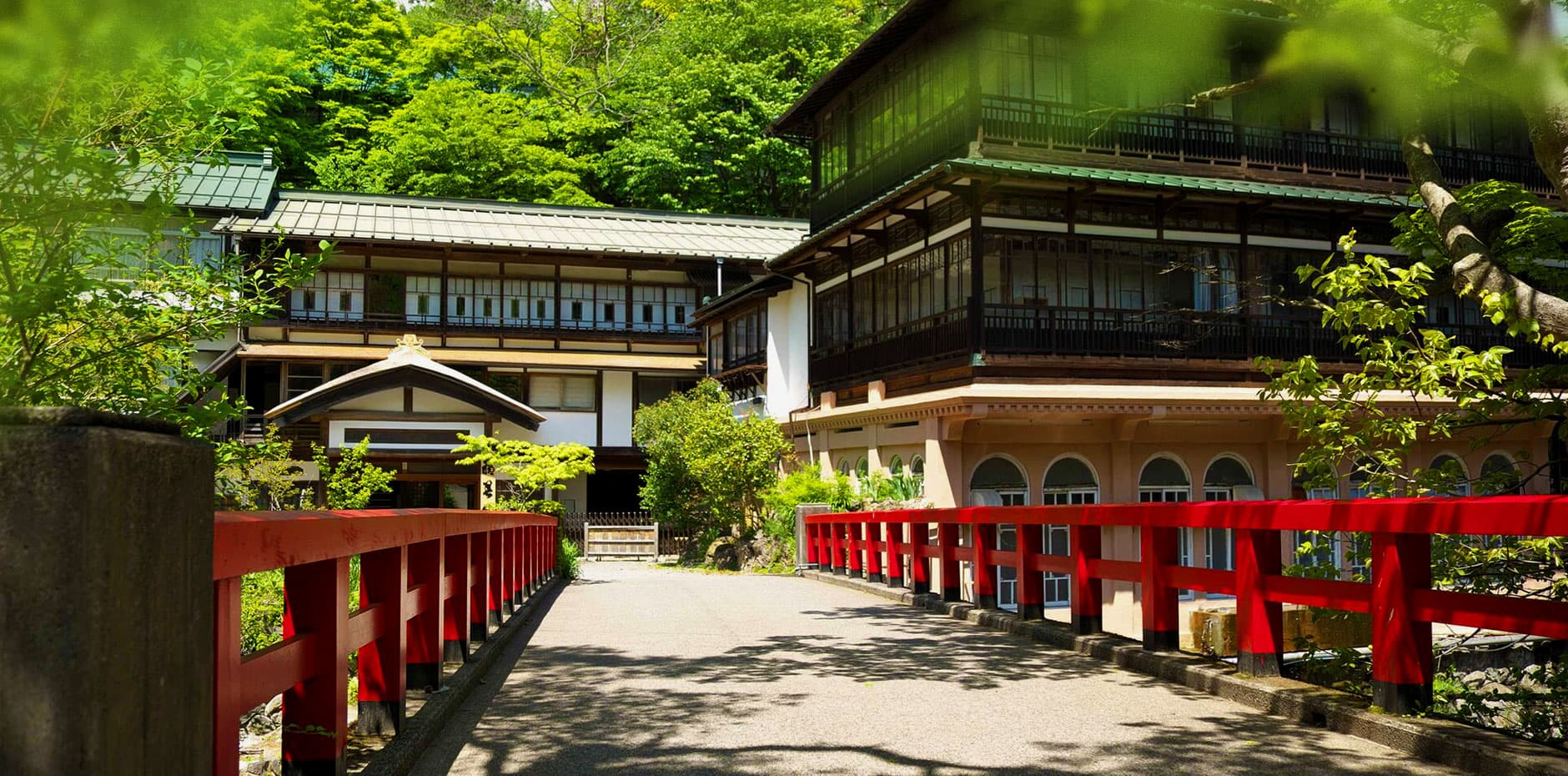
A ryokan is a traditional Japanese inn — the lodging itself. The defining features have been stable for roughly four centuries: tatami-mat floors, sliding shoji paper doors, futon bedding laid out each evening (not a Western bed), a multi-course kaiseki dinner served in the room or a private dining alcove, a Japanese breakfast in the morning, and a small number of rooms — typically 8 to 40 — operated by a single family or small institution across multiple generations.
The oldest continuously operating ryokan in Japan is Nishiyama Onsen Keiunkan in Yamanashi, founded in 705 A.D. — over 1,300 years of continuous operation. The form is older than the modern Japanese language. What you book at a ryokan is not just a room: it is an 18-hour choreographed sequence — arrival, yukata change, bath, dinner, sleep, morning bath, breakfast, departure — that has been refined over centuries.
A ryokan can exist anywhere in Japan: in central Tokyo (rare), in Kyoto's historic districts, in mountain villages, on the coast. It does not require a hot spring. A ryokan in Kyoto's Gion district that draws its bath water from the municipal supply is still a ryokan — it just isn't an onsen ryokan.
For the full sequence of what happens during a ryokan stay, our Japanese ryokan experience guide for 2026 walks through every step from check-in to checkout.
What Is an Onsen?
An onsen is a natural hot-spring bath. The word literally means "warm spring" (温 = warm, 泉 = spring). Under the 1948 Onsen Act, the legal definition requires that the water emerge from the ground at 25°C (77°F) or higher, OR contain at least one of 19 designated mineral components above a regulated threshold. This is not marketing language — it is the same standard the Ministry of Health, Labour and Welfare uses to certify onsen properties.
Japan has roughly 3,000 registered onsen sources spread across 27,000 individual bathing facilities, by far the densest hot-spring concentration on Earth. The water is classified into 11 mineral types (sulfur, sodium chloride, sulfate, iron, carbonate, acidic, alkaline, radon, hydrogen sulfide, simple thermal, and miscellaneous), each with its own bathing tradition and reputed therapeutic profile.
An onsen can exist in many forms: as the bath inside a ryokan, as a public day-use facility you pay ¥500–¥1,500 to enter, as a municipal bathhouse (Beppu in Kyushu operates over 100 public onsens for residents), or as a ski-resort facility you visit after a day on the slopes. The lodging is independent of the water source. Japan has 25 designated onsen towns — Hakone, Kusatsu, Beppu, Kinosaki, Kurokawa, and 20 others where you can soak across multiple properties on a single visit. The full list with regional context is in our Japan onsen by region guide.
For the bathing rules — what to do with the small towel, how the wash-down ritual works, the tattoo question — see our onsen etiquette guide for foreigners before your first soak.
Can You Have One Without the Other?
Yes, in both directions, and this is the cleanest way to see why the two terms aren't synonyms.
A ryokan without an onsen. Most Kyoto city-center ryokans — Hiiragiya, Tawaraya, Seikoro — are historic inns that draw bath water from the regular municipal supply, often heated and softened in a hinoki cypress tub. There is no volcanic onsen source under Kyoto's city center. These properties are unambiguously ryokans (centuries-old, family-operated, kaiseki cuisine, tatami floors) but they are not onsen ryokans. Their value is in the architecture, the cuisine, and the personal service — not the water chemistry.
An onsen without a ryokan. Public day-use onsen facilities (called *higaeri onsen* or *sento-style onsen*) operate across every onsen town. Beppu's seven "hells" district has dozens of municipal bathhouses where you pay ¥200–¥500 for a soak and have no lodging tied to the visit. Hokkaido's Noboribetsu has a famous *Sagiriyu* public bath. Kusatsu's *Sai-no-Kawara Roten-buro* outdoor bath is open to anyone with a day ticket. Ski resorts in Niseko, Hakuba, and Zao operate after-ski onsens with locker rooms but no rooms upstairs.
The common case — and the source of most confusion — is the onsen ryokan: a ryokan that has an onsen on premises (or piped from the local source) and includes bathing in the room rate. This is what most Western travelers picture when they hear either word. It is the configuration most travel guides recommend, and it is the one our best ryokans with private onsen pillar focuses on.
Tip
The booking-side question that disambiguates: ask the property whether the bath is kakenagashi 掛け流し (free-flowing onsen, continuously replenished from the source — the gold standard) or junkan 循環 (recirculated, possibly heated, possibly from non-onsen water). Kakenagashi confirms a genuine onsen source. Junkan does not necessarily disqualify a property — central Tokyo onsen hotels often use junkan because the source is too deep to cost-effectively pipe to a high-rise — but the answer tells you what you are actually getting.
How to Find a Ryokan With an Onsen
Once you know you want both — the traditional inn AND the natural hot-spring bath — the search becomes much narrower. There are three reliable shortcuts I use myself:
1. Book inside one of the 25 onsen towns. Hakone, Kusatsu, Beppu, Yufuin, Kurokawa, Kinosaki, Noboribetsu, Ginzan, Shirahone, Zao, Atami, Ibusuki, Naruko, Arima, Nikko, Wakura, Dogo, Tamatsukuri, Unzen, Akiu, Gero, Ginzan-Onsen, Izu (Shuzenji + Atagawa), and a few others. Virtually every ryokan inside these town boundaries is an onsen ryokan — the entire town's economy is built on the spring. If your accommodation is in one of these places, you can assume onsen unless the listing specifically says otherwise.
2. Filter for "private onsen" if you want an in-room or reservable bath. The most luxurious configuration is kashikiri-buro (private reservable bath, typically free for 45 minutes at a time) or an in-room rotenburo (an open-air private bath attached to your guest room). These properties are the premium tier — Gora Kadan in Hakone, Asaba in Izu Shuzenji, Yamamizuki in Kurokawa — and they explicitly list the feature in their booking listings. Our best ryokans with private onsen pillar audits 15 of the strongest options across multiple onsen towns, with kakenagashi confirmation per property.
3. Check the water-type classification. If the chemistry matters to you — sulfur for skin, iron for circulation, alkaline for the silky "bijin-no-yu" ("beauty water") feel — our onsen by water type guide groups 30+ ryokans by the 11 official mineral categories. This is the question a J.S.A. Sake Diploma palate trains you to ask about water; the same precision applies to mineral baths.
If you are still unsure which town fits your trip, the best onsen towns in Japan guide compares the top 14 by access, ambiance, and cost.
Etiquette Differences
The lodging side and the bathing side have separate sets of customs, and travelers sometimes conflate them. Here is the honest split.
Ryokan-side etiquette is about the space and the staff. You remove your shoes at the entrance (*genkan*) and switch to provided slippers. You change into a yukata (cotton robe) — wrap left-over-right; right-over-left is reserved for the dead. You greet your nakai-san (room attendant) when they bring tea. You sit seiza-style or cross-legged for the kaiseki dinner. You do not eat or drink in your room outside of meal times unless invited. You leave a small tip in an envelope only at the highest-tier properties (most ryokans explicitly refuse tips — when in doubt, don't).
Onsen-side etiquette is about the water. You wash your body thoroughly at the wash-down stations BEFORE entering the bath — soap and shampoo never enter the soaking water. Your small towel never touches the water — fold it on top of your head, or set it on the rim. You enter naked; gender-segregated changing rooms make swimsuits irrelevant. You do not splash, do not swim, do not put your hair in. Tattoos are still partially restricted at many properties — see our onsen etiquette for foreigners guide and our tattoo-friendly ryokans 2026 registry for the current policy landscape across 224 properties.
The two etiquette systems are independent. You can violate ryokan etiquette without breaking onsen rules (e.g., wearing your yukata backwards at dinner — embarrassing but harmless). You can violate onsen etiquette without breaking ryokan rules (e.g., dunking your towel into the water at a public day-use bath where there is no ryokan attached). Knowing which set applies to which situation prevents the most common first-time mistakes.
Putting It Together
If you remember nothing else: the ryokan is the building and the service; the onsen is the water source. They overlap in roughly 70% of cases — most ryokans inside onsen towns are onsen ryokans, and most onsen-town accommodation options are ryokans — but the other 30% is where travelers get burned by booking the wrong configuration.
If you want both, book inside a recognized onsen town and confirm "kakenagashi" before paying. If you want the historic-Kyoto ryokan experience without expecting onsen water, that is a perfectly valid choice — just don't be surprised when the bath is a heated cypress tub rather than a volcanic spring. If you only want the bath and not the multi-night ryokan structure, day-use onsens in any of the 25 towns will give you the soak for under ¥1,500.
The terminology stops being confusing once you separate the building from the water. Once you can do that, you can book the exact experience you actually want.
首次規劃日本之旅的旅客經常把旅館和溫泉混用。它們不是同一件事。一個是睡覺的地方,另一個是泡澡的水。它們重疊的場景太多了,混淆可以理解——但如果預訂錯誤組合,你可能會住進完全沒有溫泉的旅館,或為隔壁飯店室價已含的入浴付日間通行費。
本文清楚區分兩者,說明重疊之處,並提供預訂所需精確組合的語言。
30秒答案
- 旅館(旅館)是*日本傳統旅店*——榻榻米地板、被褥鋪床、懷石晚餐、家族多代經營。是住宿本身。 - 溫泉(温泉)是*天然礦物溫泉浴*——火山源頭,1948 年溫泉法規範,分為 11 種礦物類型。是水本身。 - 多數高級旅館配備溫泉,但並非全部。京都市中心的歷史旅館(如柊家)就沒有溫泉。 - 溫泉與旅館獨立存在:日間公共浴場、市營浴場(別府有 100 多家)、滑雪場溫泉等。 - 預訂時的決定性問題:"是源泉掛流(掛け流し)還是循環式?"日語流利的櫃台會直接告訴你。
什麼是旅館?
旅館是日本傳統旅店本身。榻榻米地板、紙拉門、傍晚鋪設的被褥、多道懷石料理、日式早餐、8 到 40 間客房、家族多代經營——這些特徵穩定了大約四個世紀。日本現存最古老的旅館是山梨縣的西山溫泉慶雲館,創立於 705 年,連續經營已超過 1,300 年。
旅館可以存在於日本任何地方——東京市中心(罕見)、京都的歷史街區、山間村落、海岸邊。它不要求溫泉。京都祇園的旅館從市政供水獲取浴水,依然是旅館——只是不是溫泉旅館。
旅館住宿的完整流程,請參閱2026 年日本旅館體驗指南。
什麼是溫泉?
溫泉是天然礦物溫泉。1948 年的《溫泉法》要求水從地下湧出時溫度達 25°C 以上,或含有 19 種指定礦物成分之一達到規定閾值。這是厚生勞動省的法定標準。
日本約有3,000 個登記的溫泉源和 27,000 個浴場,是世界上溫泉密度最高的國家。水按 11 種礦物類型分類(硫黃、氯化物、硫酸鹽、鐵、碳酸氫鹽、酸性、鹼性、氡、硫化氫、單純泉、其他)。
溫泉可以在旅館內部、獨立的日間設施(你支付 ¥500–¥1,500 入場)、市政浴場(別府有 100 多家公共溫泉)或滑雪場設施中。25 個指定溫泉鎮的比較見我們的日本溫泉地區指南。
一方沒有另一方的情況
兩個方向都成立。
沒有溫泉的旅館:京都市中心的歷史旅館(柊家、俵屋、晴鴨樓等)沒有溫泉浴。京都市中心地下沒有火山源。這些顯然是旅館,但不是"溫泉旅館"。
沒有旅館的溫泉:日間公共溫泉設施在所有 25 個溫泉鎮營運。別府的地獄區有數十家市營浴場(¥200–¥500),無需住宿即可使用。草津的西之河原露天風呂對持日票者開放。
最常見的情形是溫泉旅館——配備溫泉、入浴費含於室價的旅館。擁有私湯的最佳旅館審視了 15 家強力選項。
Tip
預訂時的決定性問題:浴場是源泉掛流(掛け流し)還是循環式(循環)?源泉掛流意味著真正的溫泉。循環式不一定差(東京市中心溫泉飯店常用循環式,因為源泉太深),但答案能告訴你實際情況。
如何找到帶溫泉的旅館
想要兩者兼得時的 3 個可靠捷徑:
1. 在 25 個溫泉鎮之一預訂——箱根、草津、別府、由布院、黑川、城崎、登別、銀山、白骨、藏王、熱海、指宿、鳴子、有馬、日光、和倉、道後、玉造、雲仙、秋保、下呂、銀山溫泉、伊豆等。這些鎮內的旅館幾乎都是溫泉旅館。
2. 篩選"私人溫泉"或"客房露天風呂"——最豪華的配置是包租浴場(45 分鐘預約制,通常免費)或客房附屬的露天浴。箱根強羅花壇、伊豆修善寺淺羽、黑川山みずき。
3. 查泉質分類——硫黃、鐵、鹼性"美人湯"。按水類型的日本溫泉指南按 11 種官方礦物類別整理了 30+ 家旅館。
禮儀差異
住宿側和洗浴側是兩套獨立的習俗。
旅館禮儀:在玄關脫鞋換室內拖鞋,浴衣是左襟在上(右襟在上是給逝者的),向中居致意,懷石按時進餐,房外不飲食,原則上不付小費。
溫泉禮儀:進入浴池前徹底洗淨身體,小毛巾絕不入水(折在頭頂或放邊緣),男女分浴室全裸,不戲水、不游泳、不浸頭髮。許多設施仍部分限制紋身——參閱外國人溫泉禮儀指南和2026 紋身友善旅館登記。
歸納總結
如果只記一件事:旅館是建築和服務,溫泉是水源。兩者在約 70% 的情況下重疊,但其餘 30% 是旅客預訂錯誤的重災區。
兩者都想要,就在指定溫泉鎮內預訂並確認"源泉掛流"。想要京都歷史旅館體驗就不要期待溫泉水。只想要泡浴,25 個溫泉鎮任一處的日間溫泉都能以 ¥1,500 以下提供。把建築和水分開思考,術語混淆就消失了。
FAQ
Frequently asked questions
Is a ryokan the same as an onsen?+
No. A ryokan is a traditional Japanese inn (the lodging), while an onsen is a natural mineral hot-spring bath (the water). They overlap frequently — most ryokans inside Japan's 25 designated onsen towns have onsen baths on premises — but they are not synonyms. A ryokan in central Kyoto, for example, typically uses a hinoki cypress bath with regular hot water, not an onsen.
Do all ryokans have an onsen?+
No. Many famous ryokans, especially historic ones in central Kyoto like Hiiragiya, Tawaraya, and Seikoro, do not have onsen baths because there is no volcanic spring source under the city center. These properties are still unambiguously ryokans — centuries-old, family-operated, kaiseki cuisine, tatami floors — but they should be described as 'ryokans without onsen' rather than onsen ryokans.
Can I visit an onsen without staying at a ryokan?+
Yes. Every one of Japan's 25 onsen towns operates public day-use baths (higaeri onsen) that charge ¥200–¥1,500 for entry with no lodging required. Beppu has over 100 municipal bathhouses; Kusatsu's Sai-no-Kawara is open to anyone with a day ticket; ski resorts in Niseko, Hakuba, and Zao operate after-ski onsens with no rooms attached. Day-use onsens are an excellent option if you only want the bathing experience.
What is the difference between kakenagashi and junkan onsen?+
Kakenagashi (掛け流し) means free-flowing — the bath water is continuously replenished from the natural spring source and not recirculated. This is the gold standard and the configuration most luxury onsen ryokans advertise. Junkan (循環) means recirculated — the water is filtered and reheated rather than continuously replaced. Junkan is not necessarily inferior (central Tokyo onsen hotels often use it because the source is impractically deep), but kakenagashi confirms you are getting genuine, source-fresh onsen water.
How do I find a ryokan that has an onsen?+
Three reliable shortcuts: (1) book inside one of Japan's 25 designated onsen towns (Hakone, Kusatsu, Beppu, Kinosaki, Kurokawa, Yufuin, etc.) — virtually every ryokan inside their boundaries is an onsen ryokan; (2) filter for 'private onsen' or 'in-room rotenburo' if you want a kashikiri (reservable) or in-room bath; (3) confirm the property advertises 'kakenagashi' to guarantee genuine source-fed water. Our best-ryokans-private-onsen pillar audits 15 of the strongest options.
Is onsen etiquette the same as ryokan etiquette?+
No — they are two separate systems. Ryokan etiquette governs the indoor space and the staff interaction: shoes off at the entrance, yukata worn left-over-right, in-room dining at set times, no tipping. Onsen etiquette governs the bath itself: full wash-down before entering, never put soap or towel in the water, gender-segregated nudity, no splashing or swimming. You can violate one set without violating the other. Both sets are well-codified and easy to learn before your first stay.
旅館和溫泉是同一件事嗎?+
不是。旅館是日本傳統旅店(住宿),溫泉是天然礦物溫泉浴(水)。兩者經常重疊——日本 25 個指定溫泉鎮內多數旅館都配有溫泉——但它們不是同義詞。京都市中心的旅館通常使用檜木浴缸裡的普通熱水,不是溫泉。
所有旅館都有溫泉嗎?+
不是。許多著名旅館,尤其是京都市中心的歷史旅館如柊家、俵屋、晴鴨樓,沒有溫泉浴,因為城市中心地下沒有火山源。這些仍然明顯是旅館,但應描述為"無溫泉的旅館"。
不入住旅館能否使用溫泉?+
可以。日本 25 個溫泉鎮都營運日間公共浴場(higaeri onsen),入場費 ¥200–¥1,500,無需住宿。別府有 100 多家市政浴場;草津的西之河原對所有持日票者開放;新雪谷、白馬、藏王的滑雪場都營運無客房的滑雪後溫泉。
源泉掛流和循環式溫泉的差別是?+
源泉掛流(掛け流し)意為自由流——浴水持續從自然源頭補充而不循環。這是黃金標準。循環式(循環)意為再循環——水經過濾和再加熱。循環式不一定差(東京市中心溫泉飯店常用,因為源泉過深),但源泉掛流確認你獲得的是真正的源頭新鮮溫泉水。
如何找到帶溫泉的旅館?+
三個可靠捷徑:(1) 在 25 個指定溫泉鎮內預訂;(2) 篩選"私人溫泉"或"客房露天風呂";(3) 確認"源泉掛流"以保證真正的源頭水。我們的最佳私人溫泉旅館審視了 15 家強力選項。
溫泉禮儀和旅館禮儀相同嗎?+
不同——它們是兩套獨立的系統。旅館禮儀規範室內空間和與員工的互動(玄關脫鞋、浴衣左襟在上、定時房內用餐、不付小費)。溫泉禮儀規範浴場(入浴前徹底洗淨、毛巾不入水、男女分浴全裸、不戲水)。兩套都易學且獨立。