On my third trip up the Route 292 switchbacks above 1,000 metres, I started recognising the sulfur a full minute before the bus pulled into Naganohara-Kusatsuguchi. The cabin air shifts somewhere on the climb, and by the time you drag a suitcase out at Kusatsu Bus Terminal it is unmistakable — a clean, mineral, slightly burnt-match note that locals stop noticing by day two. The smell signals that you have arrived in the most acidic onsen town in Japan, and that the ryokan you have booked will be your shelter from a hot spring strong enough to corrode an iron nail in nine days.
In the year ending March 2025, Kusatsu welcomed a record 4,019,418 visitors — its first time over four million [verified Kusatsu Town Authority via Essential Japan 2026-05-07]. That number tells you the town is busy, but not how to choose between a 1598-founded heritage inn, an all-suite retreat with private open-air baths in every room, and a Meiji-era townhouse converted into a budget room-only stay. Last verified: May 2026.
Over four visits across five years — twice in deep winter with skis, once in summer, once in autumn — I have stayed at three of the nine ryokans on this list and toured the rest. The picks below reflect that direct experience. This is the sixth installment of our best-ryokans-by-area series after Hakone, Kyoto, Takayama, Yufuin and [Miyajima](/en/blog/best-ryokans-miyajima).
This guide ranks nine Kusatsu ryokans across luxury, mid-range and budget tiers — with honest weaknesses for each, the post-5pm sotoyu window most guides miss, and the silver-jewellery warning that no English content explains in full. If you are new to ryokan culture, our [first-time ryokan guide](/en/blog/first-time-ryokan-guide) covers the basics so this article can focus on what makes Kusatsu specifically different.
Best Ryokans in Kusatsu Onsen: the 50-word answer
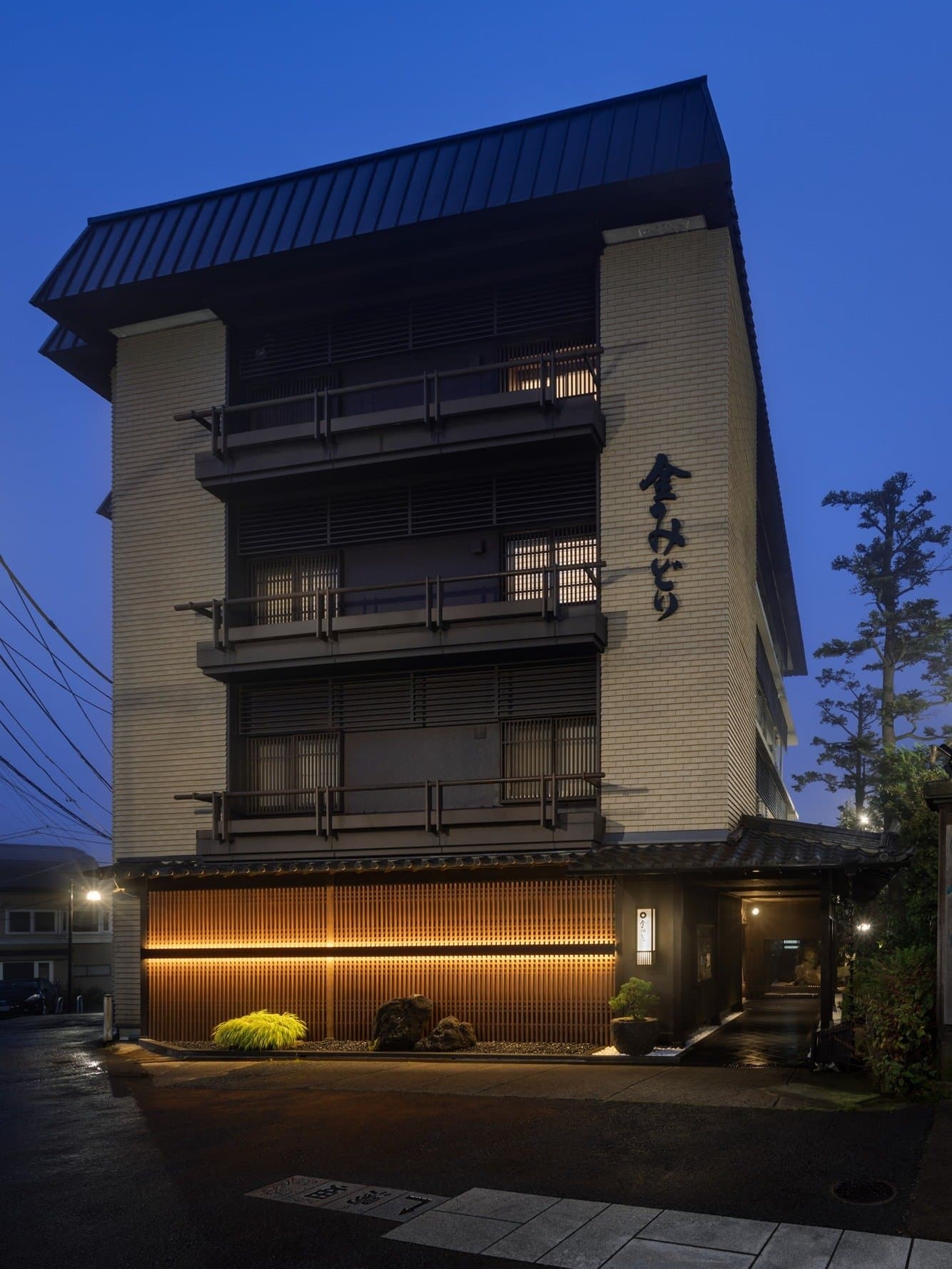
The best ryokan in Kusatsu Onsen overall is [Tsutsujitei](/en/ryokans/kusatsu-tsutsujitei) — a 10-room ultra-luxury retreat hidden within 5,000 tsubo of private woodland, with kaiseki served in private dining rooms. For all-suite stays with a private open-air bath in every room, [Yuyado Tokinoniwa](/en/ryokans/kusatsu-tokinoniwa); for heritage luxury, the 1598-founded [Kusatsu Onsen Boun](/en/ryokans/kusatsu-boun); for the original Kusatsu source water, [Naraya](/en/ryokans/kusatsu-naraya); for Yubatake-front mid-range, [Hotel Ichii](/en/ryokans/kusatsu-ichii); for the cheapest stylish budget pick, [Yubatake Souan](/en/ryokans/kusatsu-souan).
Tip
**Disclosure:** Japan Ryokan Guide earns a commission when you book through partner links. We do not accept payment from ryokans for inclusion or placement — every property here was selected on merit. The commission keeps the directory free in six languages.
Tip
**Pack tip:** Leave silver, brass and pearl-mounted jewelry in your hotel safe in Tokyo. Kusatsu's pH 2.0 sulfur water tarnishes silver in a single soak, and even walking past a steam plume on the village street exposes any silver you are wearing to trace hydrogen sulfide. Stainless steel, gold, platinum and titanium are the safe bets.
Quick-Compare: 9 Kusatsu ryokans at a glance
| # | Ryokan | Tier | From (USD) | Min to Yubatake | Best For | |---|---|---|---|---|---| | 1 | [Tsutsujitei](/en/ryokans/kusatsu-tsutsujitei) | Luxury | $400 | Shuttle | Couples wanting ultra-private 10-room seclusion | | 2 | [Yuyado Tokinoniwa](/en/ryokans/kusatsu-tokinoniwa) | Luxury | $300 | Shuttle | Suite stays with in-room private open-air bath | | 3 | [Kusatsu Onsen Boun](/en/ryokans/kusatsu-boun) | Luxury | $250 | 3 min | Heritage seekers — founded 1598, two source waters | | 4 | [Naraya](/en/ryokans/kusatsu-naraya) | Luxury | $350 | 1 min | Connoisseurs of Kusatsu's oldest source (Shirahata) | | 5 | [Hotel Ichii](/en/ryokans/kusatsu-ichii) | Mid | $120 | 0 min | Yubatake-front rooms with illumination views | | 6 | [Osakaya](/en/ryokans/kusatsu-osakaya) | Mid | $150 | 1 min | Yubatake-source water at mid-range price | | 7 | [Kusatsu Hotel 1913](/en/ryokans/kusatsu-hotel) | Mid | $130 | 5 min | Taisho-era wooden architecture lovers | | 8 | [Oyado Konoha](/en/ryokans/kusatsu-konoha) | Mid | $180 | Shuttle | Ski combo and 23-bath access via Tokinoniwa | | 9 | [Yubatake Souan](/en/ryokans/kusatsu-souan) | Budget | $90 | 1 min | Boutique room-only Meiji townhouse stays |
Why stay overnight in Kusatsu Onsen
Yes — staying overnight in Kusatsu is the single biggest upgrade you can make to a Gunma trip. The three free sotoyu close to non-guests around 5pm, the last bus to Naganohara leaves at roughly 4:50pm, and the Yubatake illumination only switches on at sunset and runs until midnight. A day-tripper literally cannot see the iconic Kusatsu photo, and cannot enter the sotoyu after the local shift change.
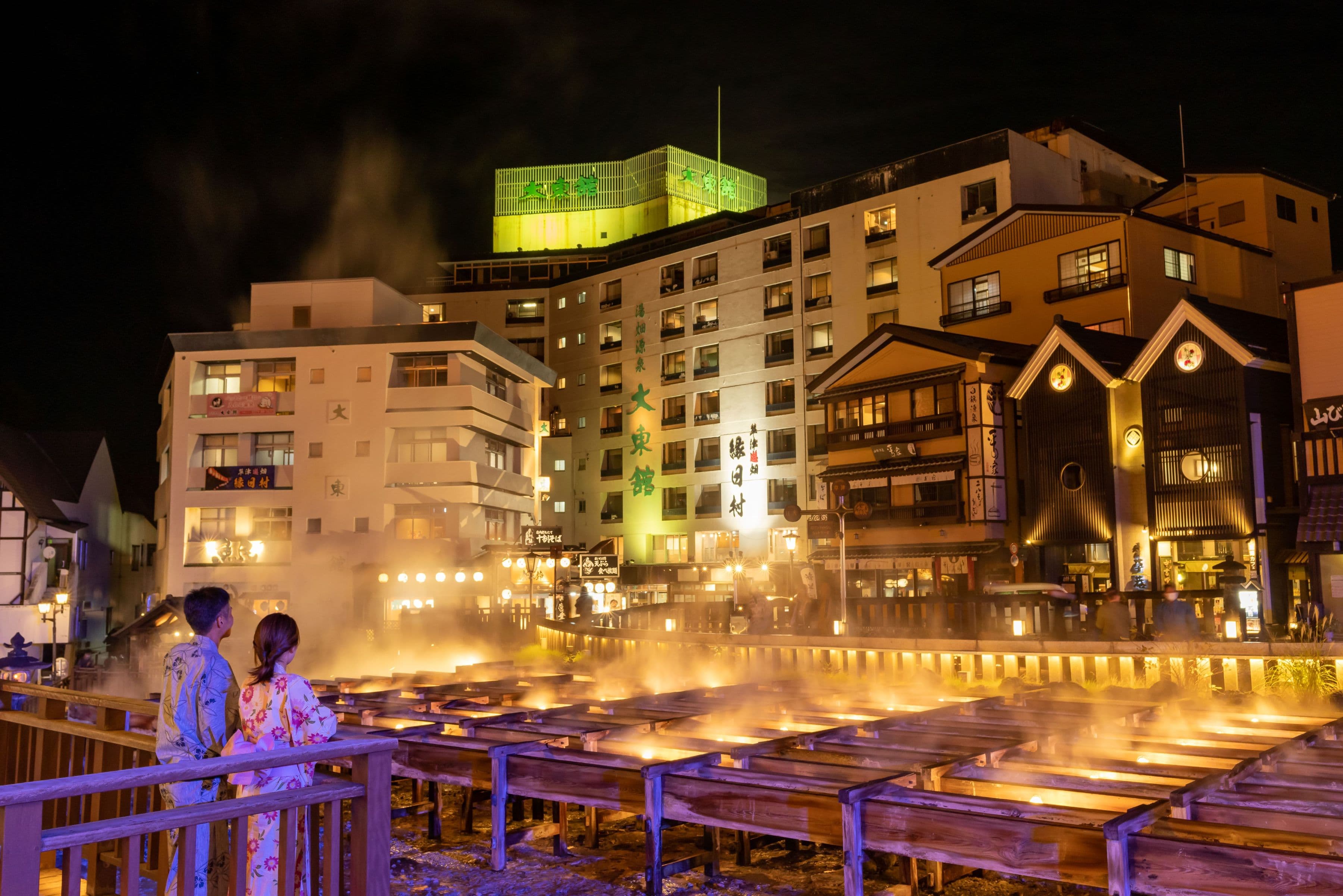
Kusatsu sits at 1,200 metres at the eastern foot of Mount Kusatsu-Shirane, an active volcano whose hydrothermal system produces the most prolific natural hot-spring flow in Japan — over 32,300 litres per minute across six named sources [verified Nippon.com 2026-05-07]. The Yubatake (湯畑) at the centre of town is not a pond as most photos suggest; it is a 60-metre wooden sluice cooling source water from roughly 70°C down to bath temperature. The sound is constant — like a small rapids — and the steam rolls northeast on most evenings because of the prevailing katabatic flow off the mountain.
The structural difference between sleeping in Kusatsu and day-tripping is the night Yubatake at 11:30pm — illuminated, half-empty and audibly alive — which exists only for guests who already have a futon waiting somewhere in town.
How we picked these 9 ryokans
We screened every operating ryokan in Kusatsu against five criteria: walking minutes to Yubatake, source-water access (which of Kusatsu's six springs feeds the bath), private-bath availability, kaiseki centred on Joshu wagyu and Gunma mountain produce, and English-readable booking. Nine properties cleared the bar — four luxury, four mid-range and one budget — and these are the nine we recommend without hedging.
No ryokan on this list paid to be included. Properties are drawn from our database of 224 vetted ryokans across 25 onsen destinations, ranked by lived experience and amenity data. For broader context, our [full Kusatsu directory](/en/area/kusatsu) lists every open ryokan in town, and [how a ryokan compares to a hotel](/en/blog/ryokan-vs-hotel) covers the dinner-included pricing model that confuses most first-timers.
A quick orientation on the price tiers below. Kusatsu ryokans range from about $90 per night for a stylish room-only Meiji townhouse at Yubatake Souan to roughly $800 per night for the top suites at Tsutsujitei. Mid-range traditional ryokans with kaiseki and onsen typically cost $150–$350 per person per night with two meals included. For a deeper breakdown of [how much a ryokan costs per night](/en/blog/ryokan-cost-per-night) across Japan, our pricing guide has the full picture.
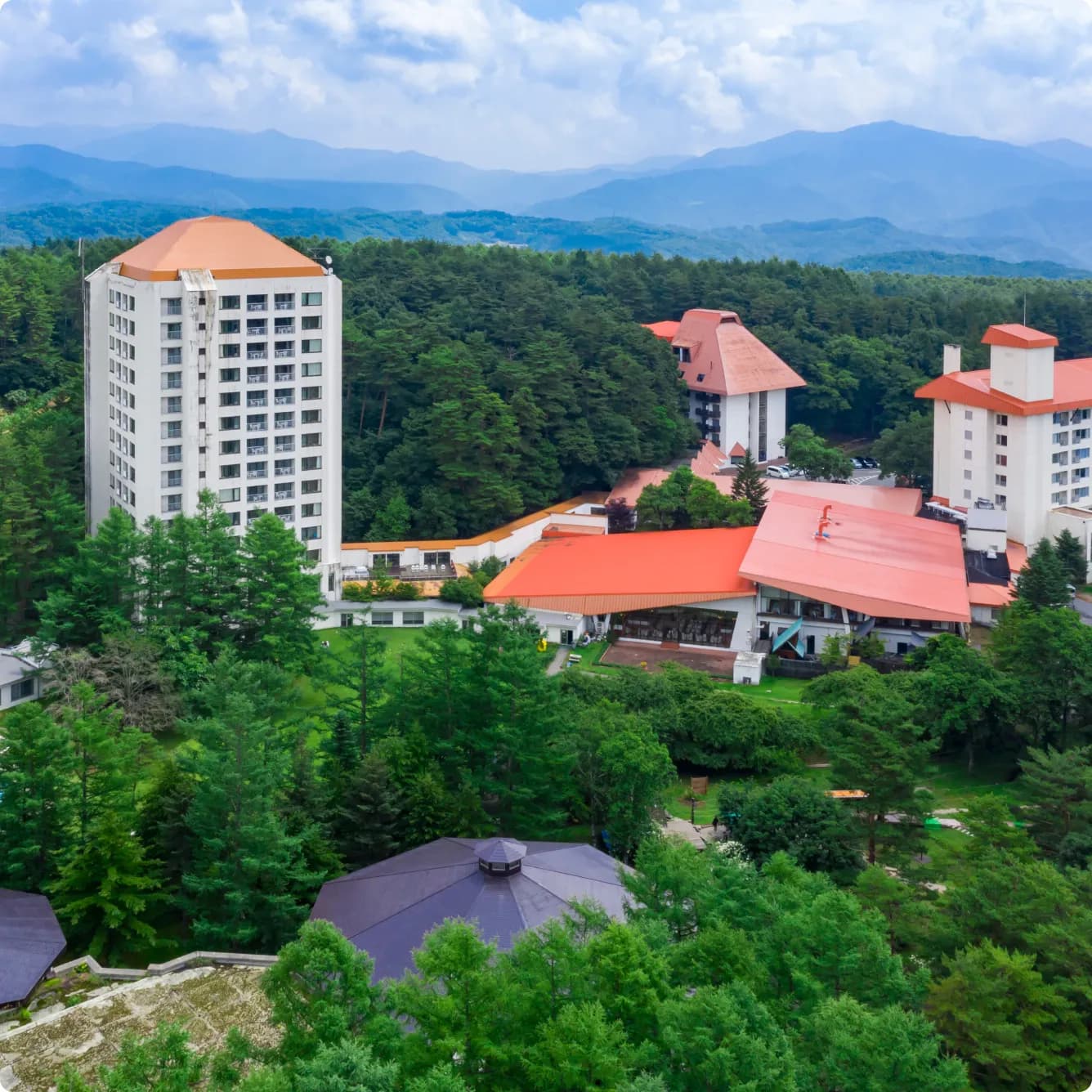
1. Tsutsujitei — Best ultra-luxury hideaway
Best for: Couples on a milestone trip who want 10 rooms, 5,000 tsubo of private forest, and zero crossover with day-tripper Kusatsu.
At a glance: 10 rooms · ~$400–$800 USD · Private woodland a short shuttle from Yubatake.
The onsen: Source water piped privately into communal stone baths and in-room private open-air rotenburo on the higher-tier suites. Sulfur intensity is full Kusatsu strength (pH 1.6–2.1) [verified Onsenista 2026-05-07], softened slightly by the awase-yu cooling pattern.
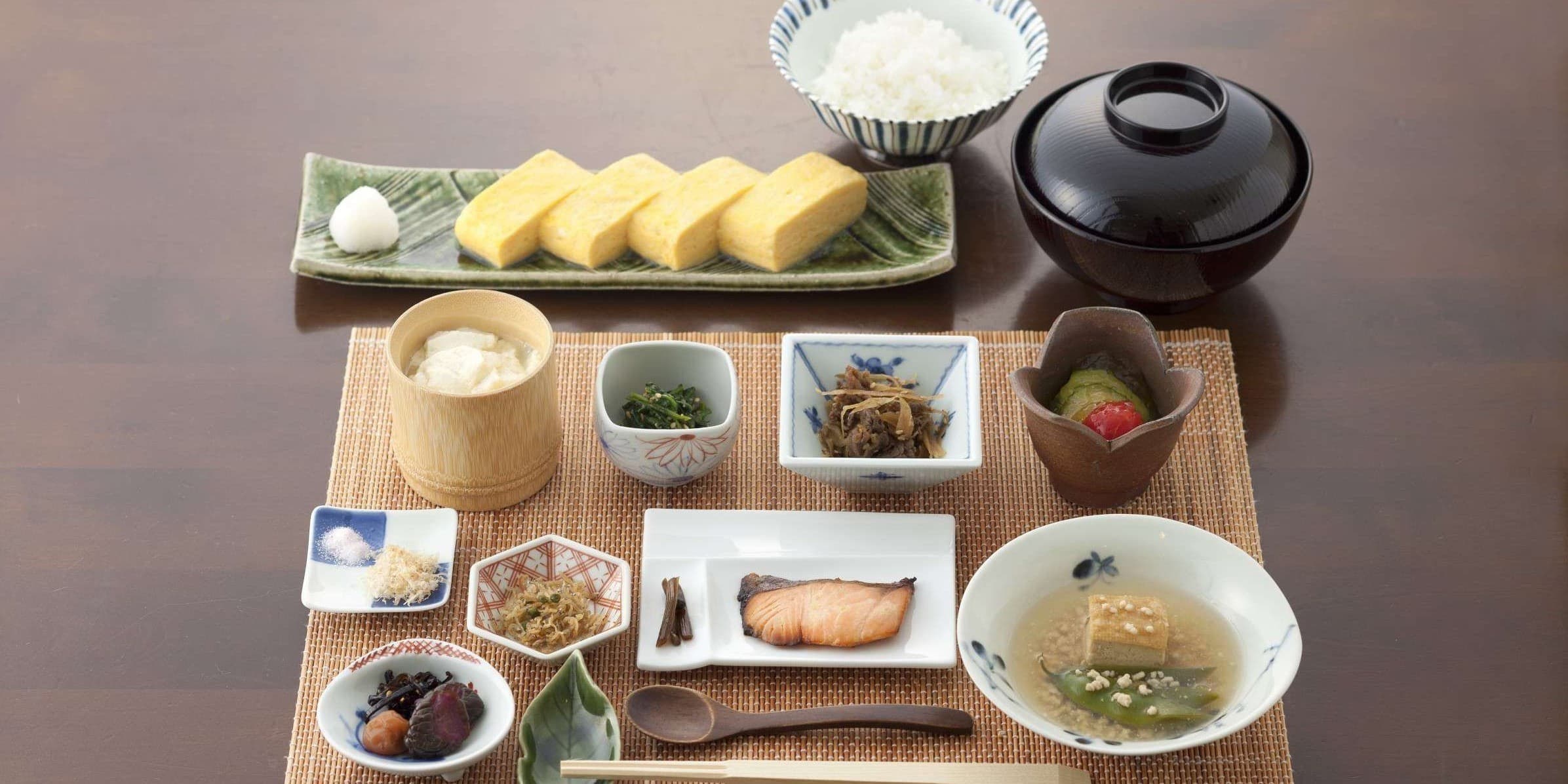
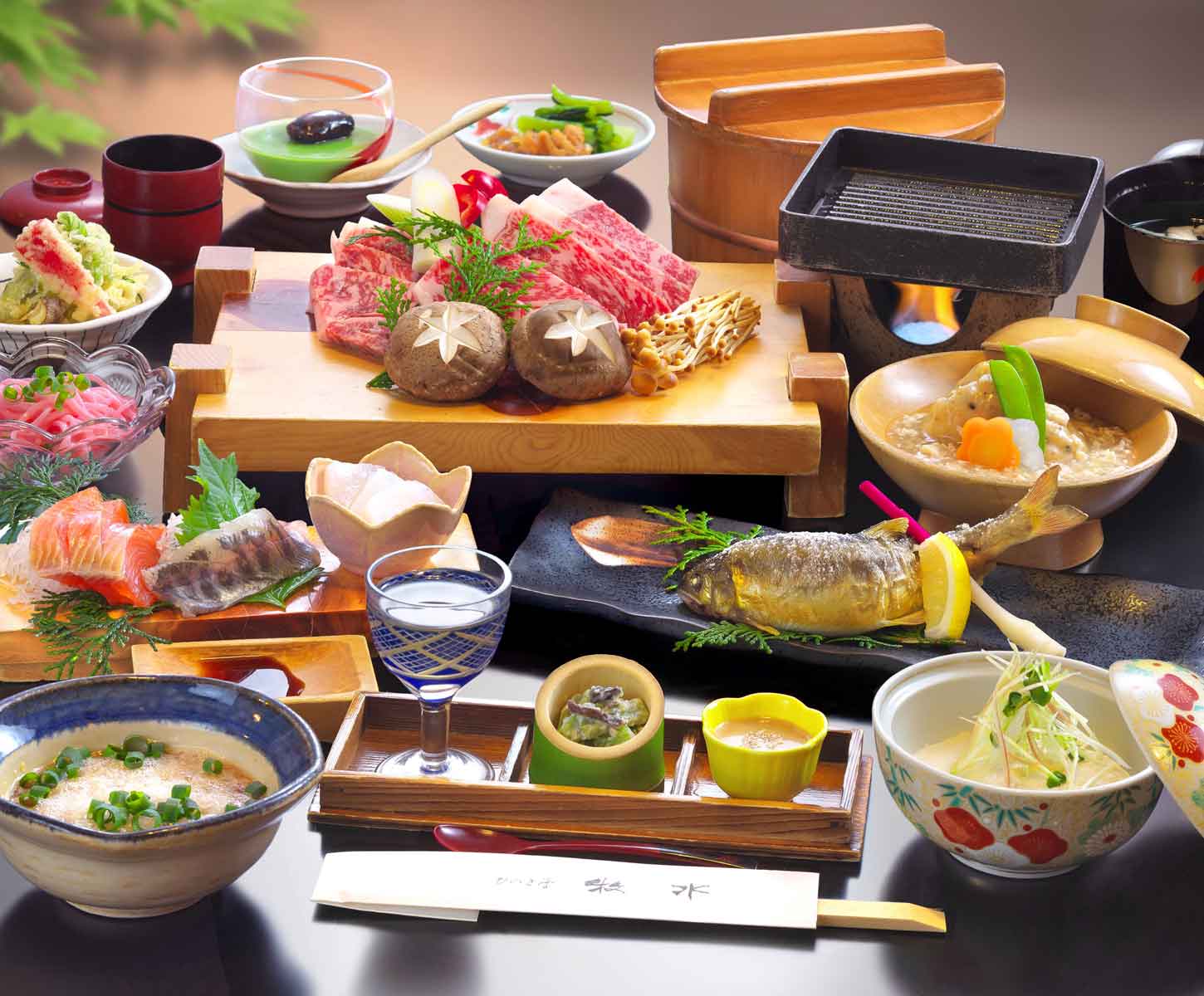
The kaiseki: Full-course kaiseki served in private dining rooms — never a communal hall. Joshu wagyu features prominently, alongside Agatsuma river fish, mountain vegetables foraged seasonally and Gunma rice. Breakfast is a multi-tray Japanese spread served the same way.
Standout detail: This is the only Kusatsu ryokan that puts genuine physical distance between you and the town. Walk five minutes from your room and you are in cedar forest, not in a yukata stroll past souvenir shops. Our [nationwide luxury ryokan rankings](/en/blog/luxury-ryokans-japan) make a natural companion read.
Honest trade-off: You give up Yubatake walking access. The shuttle solves most evenings, but if yukata-strolling under the illumination at 11pm is the priority, Naraya or Hotel Ichii will fit better. Rates run $400–$800 per person per night with two meals [approximate; verify current availability]. You can [book a room at Tsutsujitei](/en/ryokans/kusatsu-tsutsujitei) on our directory.
2. Yuyado Tokinoniwa — Best all-suite with private open-air bath
Best for: Couples and tattooed travellers who want a private rotenburo in every single room — no kashikiri reservation, no public-bath anxiety.
At a glance: 56 rooms · ~$300–$600 USD · Hillside, shuttle to Yubatake · Sister property to Oyado Konoha (shared 23-bath complex).
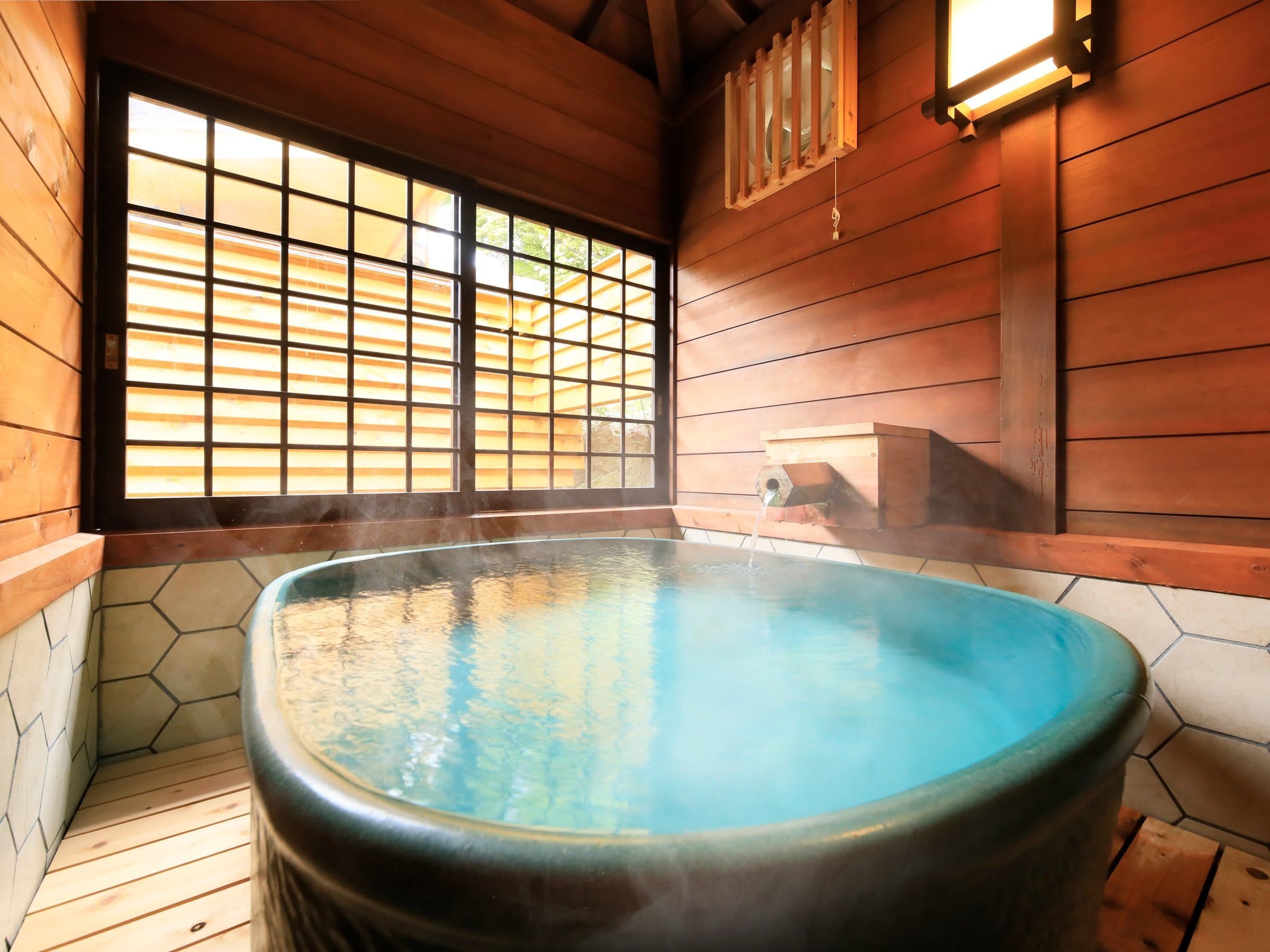
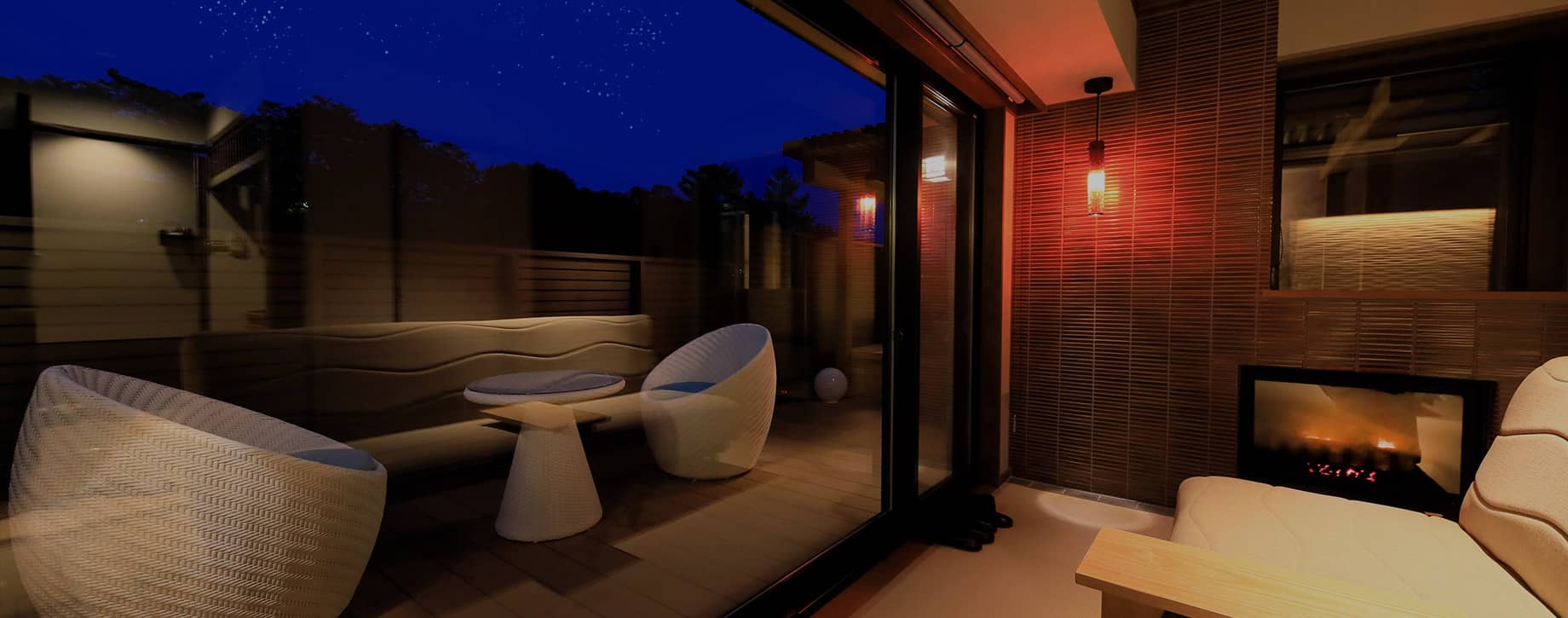
The onsen: Every guest room has a private open-air bath fed by the property's own source. On top of that, the 23 communal bath types (rotenburo, indoor stone, cypress, awase-yu cooling tubs and themed baths) form one of the largest onsen complexes in Kusatsu.
The kaiseki: Half-board kaiseki centred on Joshu wagyu, river trout (yamame) and mountain vegetable hassun courses. Dining is in private alcoves rather than guest rooms — slightly less intimate than Tsutsujitei but still well above hotel standards.
Standout detail: With 23 communal baths plus an in-room rotenburo, a two-night stay rotates without repeating a single bath. For tattooed travellers this is the most frictionless property in town — your private bath is genuinely yours, not a queue-managed kashikiri slot.
Honest trade-off: You are not on the Yubatake. The shuttle solves most evenings, but you will not stumble down to the illumination in slippers. If yukata walks under the lamps is the trip's headline image, book Naraya or Ichii instead. Rates run $300–$600 per person per night with two meals [approximate; verify current availability]. You can [see Yuyado Tokinoniwa's all-suite floor plan](/en/ryokans/kusatsu-tokinoniwa) on our directory.
Tip
**Booking tip:** Tokinoniwa and its sister property Oyado Konoha share the same 23-bath complex via a free internal shuttle. Booking the cheaper Konoha and using the shuttle gives you the same bath access for roughly 40% less per night — a tactic the front desk will confirm but that no English review surfaces.
3. Kusatsu Onsen Boun — Best heritage luxury (founded 1598)
Best for: Repeat Japan travellers who want the oldest continuously operating ryokan on this list, alternating between two named source waters.
At a glance: 42 rooms · ~$250–$550 USD · 3-minute walk from Yubatake · Founded 1598 — over 425 years of continuous operation.
The onsen: Six free-flowing kakenagashi baths fed by two named natural spring sources (Bandaiko and Wataya). Indoor and outdoor sections, plus reservable family kashikiri baths. No in-room private rotenburo — the bath story here is the heritage of the source.
The kaiseki: Honest Joshu kaiseki centred on Gunma beef, Agatsuma river fish and seasonal mountain vegetables. Breakfast is a proper multi-tray Japanese set in the dining hall. Service is the unhurried, deeply trained welcome only properties that have been doing this for four centuries deliver.
Standout detail: Two distinct sources mean two distinct bathing experiences in one stay — Bandaiko is the more characterful, slightly hotter source; Wataya is softer and easier on first-time bathers. Front-desk staff briefed me on the difference at check-in with a printed diagram, complete with a towel-on-head trick for managing blood-pressure shifts at 1,200 metres elevation.
Honest trade-off: Not a modern boutique. Some corridors show their age, and rooms vary widely by wing — specify a refurbished room at booking if interior aesthetics matter. Rates run $250–$550 per person per night with two meals [approximate; verify current availability]. You can [check rates at Kusatsu Onsen Boun](/en/ryokans/kusatsu-boun) on our directory.
4. Naraya — Best for the original Kusatsu source water
Best for: Onsen connoisseurs who came to Kusatsu for the water chemistry — Naraya draws Shirahata-no-yu, the oldest of Kusatsu's six sources.
At a glance: 36 rooms · ~$350–$700 USD · 1-minute walk from Yubatake · Established 1877.
The onsen: Three indoor and three outdoor baths fed by Shirahata source — the most acidic of the six Kusatsu springs and the one Tokugawa-era visitors travelled here for. The water is full pH 1.6–1.8 strength, antibacterial, and stings if you have shaved in the past 12 hours. Reservable in-room private baths are available on higher tiers.
The kaiseki: Refined Joshu kaiseki in private dining rooms — Joshu wagyu shabu-shabu, Agatsuma yamame trout, seasonal hassun and a sake list curated specifically against the local water. Breakfast is one of the best on this list.
Standout detail: I forgot to remove a thin silver band before my first soak at Sainokawara on a previous trip — eight minutes of water, twelve hours of patina, and the ring went from polished to gunmetal grey. The front desk at Naraya keeps a small lacquer tray of forgotten jewellery behind the counter and a printed sign in four languages. That the warning is multilingual at a luxury property tells you exactly how strong the water is.
Honest trade-off: The price step from Boun is real, and the 'oldest source' premium is partly intangible — if you cannot taste a pH difference, the spend is hard to rationalise. Rates run $350–$700 per person per night with two meals [approximate; verify current availability]. The full breakdown lives on [Naraya's Shirahata-no-Yu page](/en/ryokans/kusatsu-naraya).
Tip
**Source tip:** Naraya draws from Shirahata-no-yu, the oldest of Kusatsu's six named sources. Ask the front desk for the gensen-meguri (源泉巡り) map — it shows which named source feeds each bath in town. Boun draws Bandaiko and Wataya; Osakaya draws Yubatake-gen-sen; Hotel Ichii draws directly from the Yubatake itself. Treat it like wine terroir.
5. Hotel Ichii — Best right on Yubatake
Best for: First-time visitors and photographers who want their bedroom window to look directly over the steaming Yubatake.
At a glance: 110 rooms · ~$120–$300 USD · 0-minute walk — the property faces Yubatake directly · 300-year-old institution.
The onsen: A large indoor and outdoor public bath complex fed directly from the Yubatake source, plus reservable kashikiri family baths. No in-room private rotenburo, but the public baths are the largest of any mid-range Kusatsu property.
The kaiseki: Half-board kaiseki served in private dining rooms (premium tiers) or a communal hall (standard tiers). Joshu wagyu, river fish, seasonal vegetables. Breakfast is a multi-dish Japanese set with a small Western corner for kids who refuse rice in the morning.
Standout detail: Of the 110 rooms, 23 face Yubatake directly. Booking one means you wake to the steam columns at sunrise and watch the illumination from your window at 9pm. From the southwest-facing rooms you can shoot at f/2.8 in the 30 minutes after sunset and frame the steam against the lamps — the angle most iconic Kusatsu photos use.
Honest trade-off: The 110-room scale shows. Service is professional rather than personal, and check-in can queue at peak hours. Specify a yubatake-gawa (湯畑側) room at booking — without that explicit request, you may end up back-facing at the same rate. Rates run $120–$300 per person per night with two meals [approximate; verify current availability]. You can [see Hotel Ichii's Yubatake-view rooms](/en/ryokans/kusatsu-ichii) on our directory.
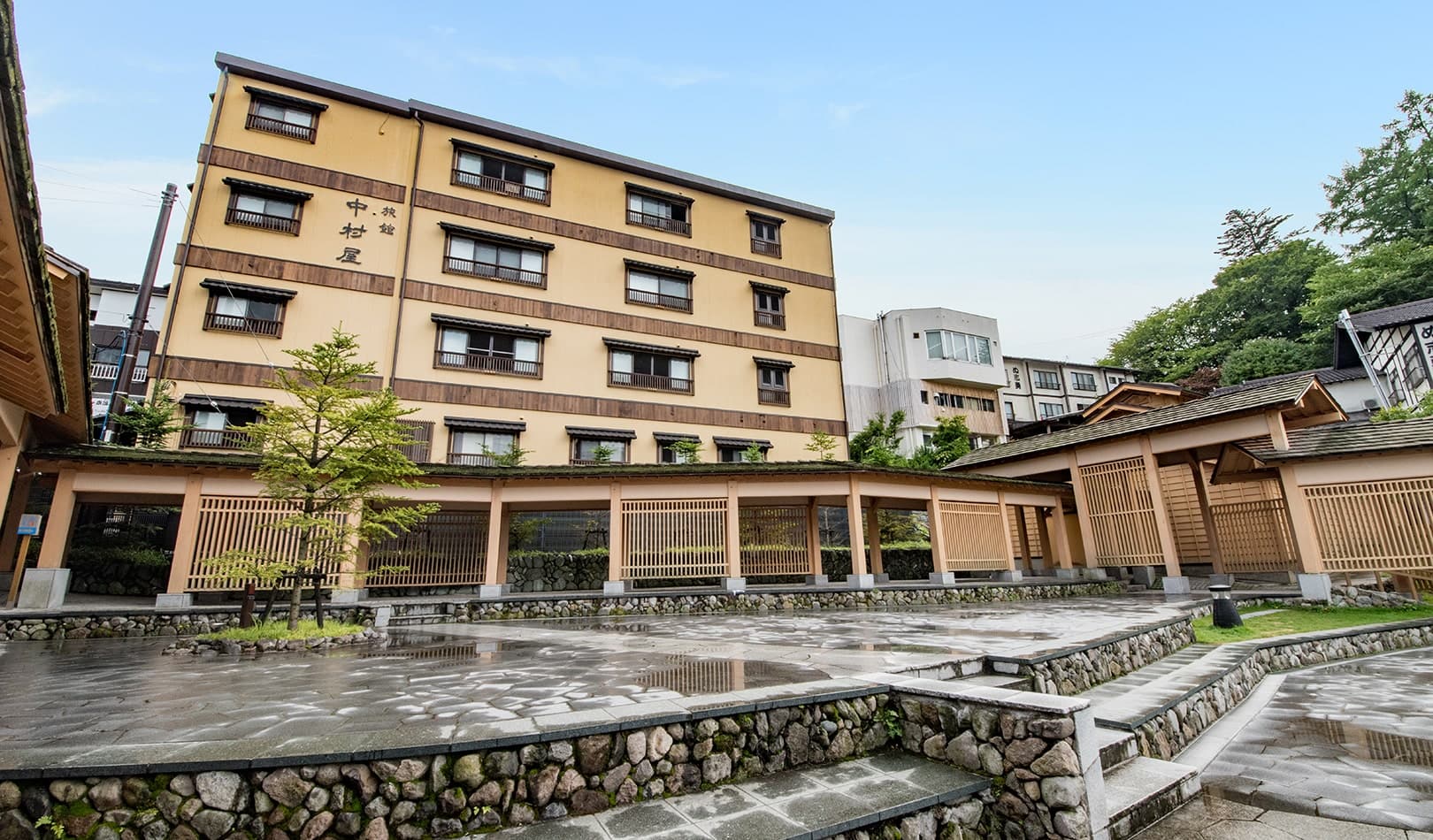
6. Osakaya — Best mid-range one minute from Yubatake
Best for: Mid-range travellers who want Yubatake-source water at half the Naraya price, plus reservable in-room private baths on upper tiers.
At a glance: 31 rooms · ~$150–$350 USD · 1-minute walk from Yubatake · Draws water from Yubatake-gen-sen.
The onsen: Two public baths plus reservable kashikiri private baths, all fed from the Yubatake source — the same headline water that runs through the wooden sluice at the centre of town. Some upper-tier rooms have a private open-air bath.
The kaiseki: Half-board Joshu kaiseki in a communal dining hall — quality is consistent rather than spectacular, with Joshu wagyu and river fish on the standard course. Breakfast follows the multi-tray Japanese template.
Standout detail: Osakaya's price-to-water ratio is the most aggressive on the list. You are paying mid-range rates for the same headline source that feeds the most-photographed feature in town — the most efficient pick for first-timers on a budget who still want real Kusatsu water.
Honest trade-off: Rooms are functional rather than design-led — clean, comfortable, not photogenic. Communal dining at standard tiers is fine for solo travellers but reduces the romance for couples; pay up to a private-dining tier if that matters. Rates run $150–$350 per person per night with two meals [approximate; verify current availability]. You can browse [Osakaya's Yubatake-source bath](/en/ryokans/kusatsu-osakaya) on our directory.
Tip
**Yubatake-front tip:** The illumination runs from sunset until midnight. The best viewing window from a guest room is 8:30pm to 9:30pm — late enough that the dinner crowds have dispersed, early enough that lighting is still in full swing. Request 'yubatake-gawa' (湯畑側) explicitly when booking Osakaya, Hotel Ichii or Yubatake Souan.
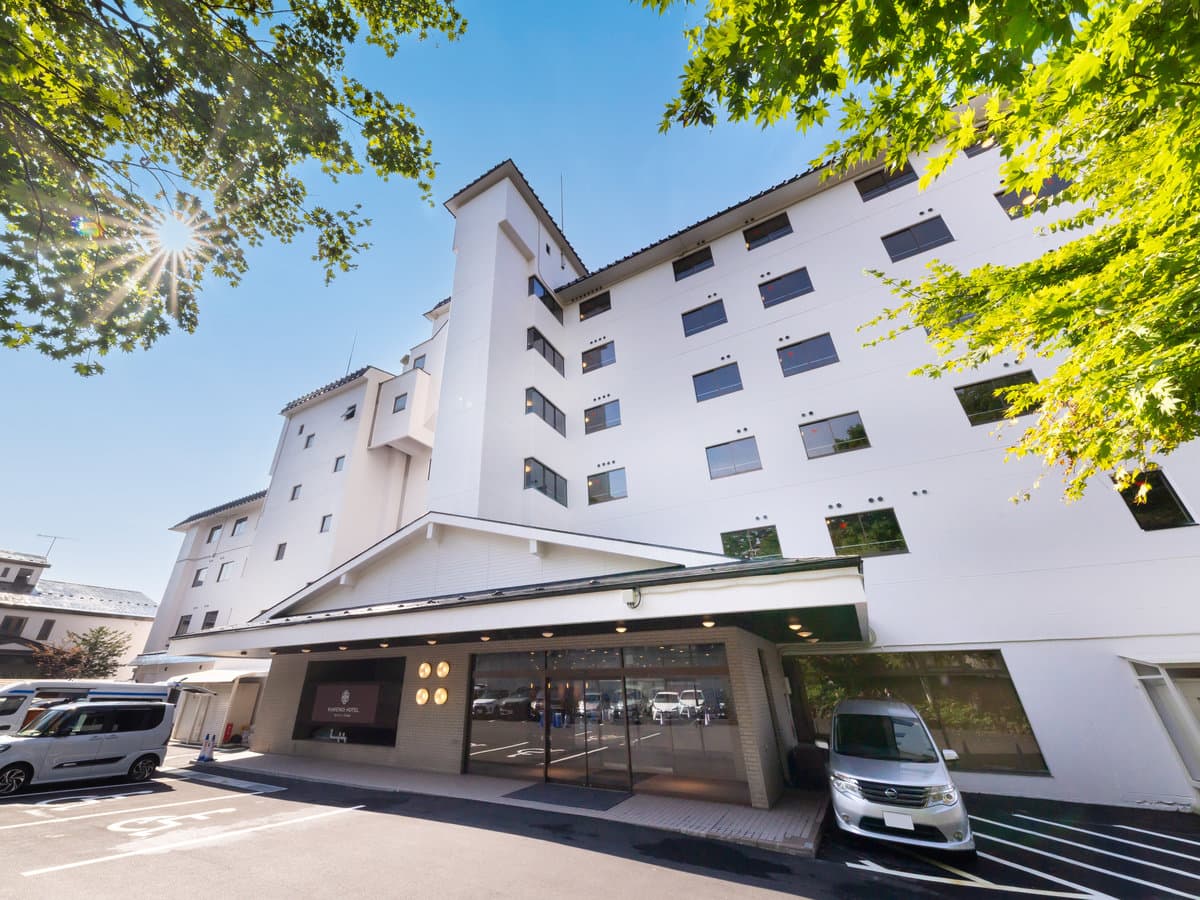
7. Kusatsu Hotel 1913 — Best Taisho-era charm at mid-range
Best for: Architecture lovers who want a wooden, creaking, heritage building over a renovated modern interior.
At a glance: 40 rooms · ~$130–$300 USD · 5-minute walk from Yubatake · Built 1913 (Taisho era).
The onsen: Indoor and outdoor public baths fed by a kakenagashi free-flowing system, plus a reservable kashikiri family bath. Some rooms have a private bath. The bath buildings are wooden, period-appropriate and a working part of the architectural story.
The kaiseki: This is where the property surprised me — the kaiseki finale was a small ceramic pot of yamame (river trout) cooked over a single binchotan coal at the table. The fish came from the Agatsuma river three kilometres downhill, the pot was Mashiko-yaki and the rice was Koshihikari from Numata, an hour away. That is the entire Gunma plate in one course: river, mountain, kiln, rice paddy. For more on the morning meal, see our [Japanese ryokan breakfast](/en/blog/japanese-breakfast-ryokan) guide.
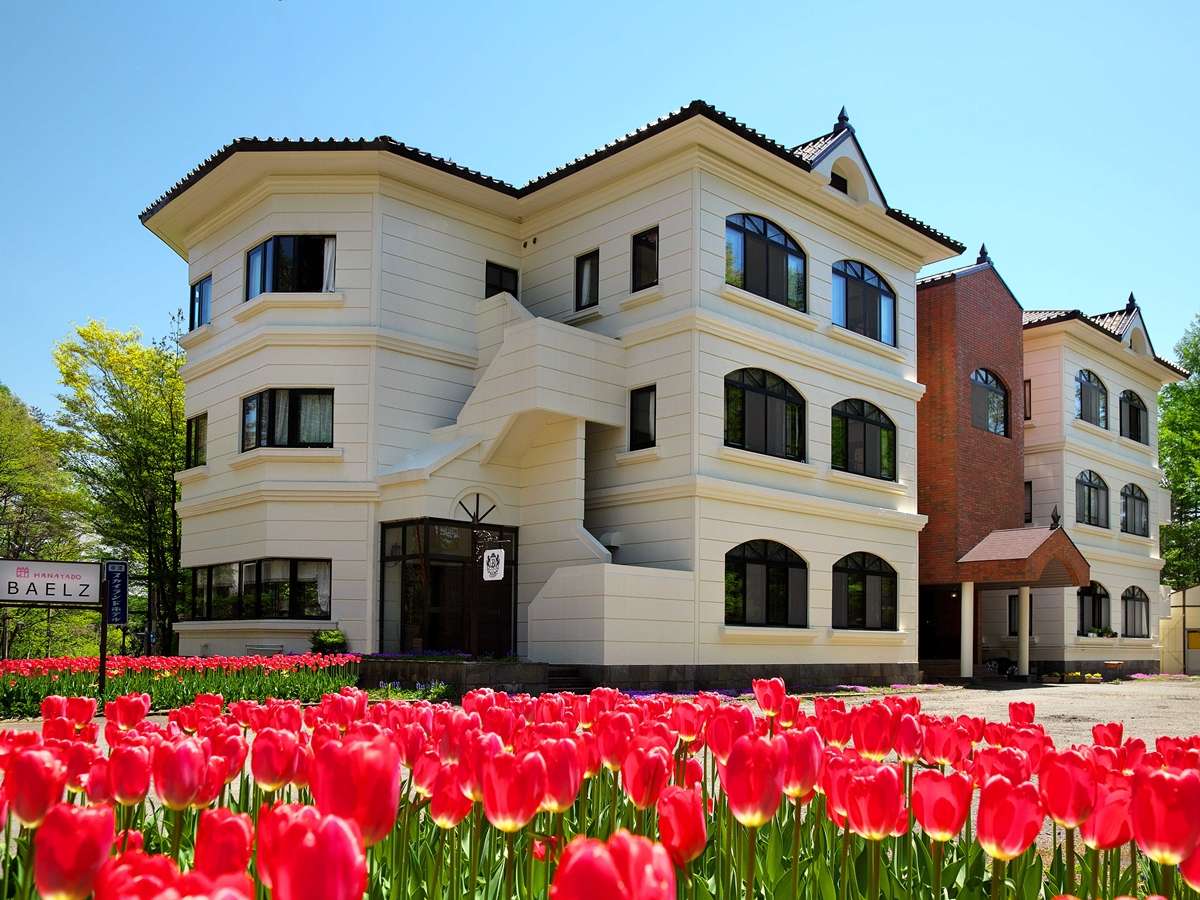
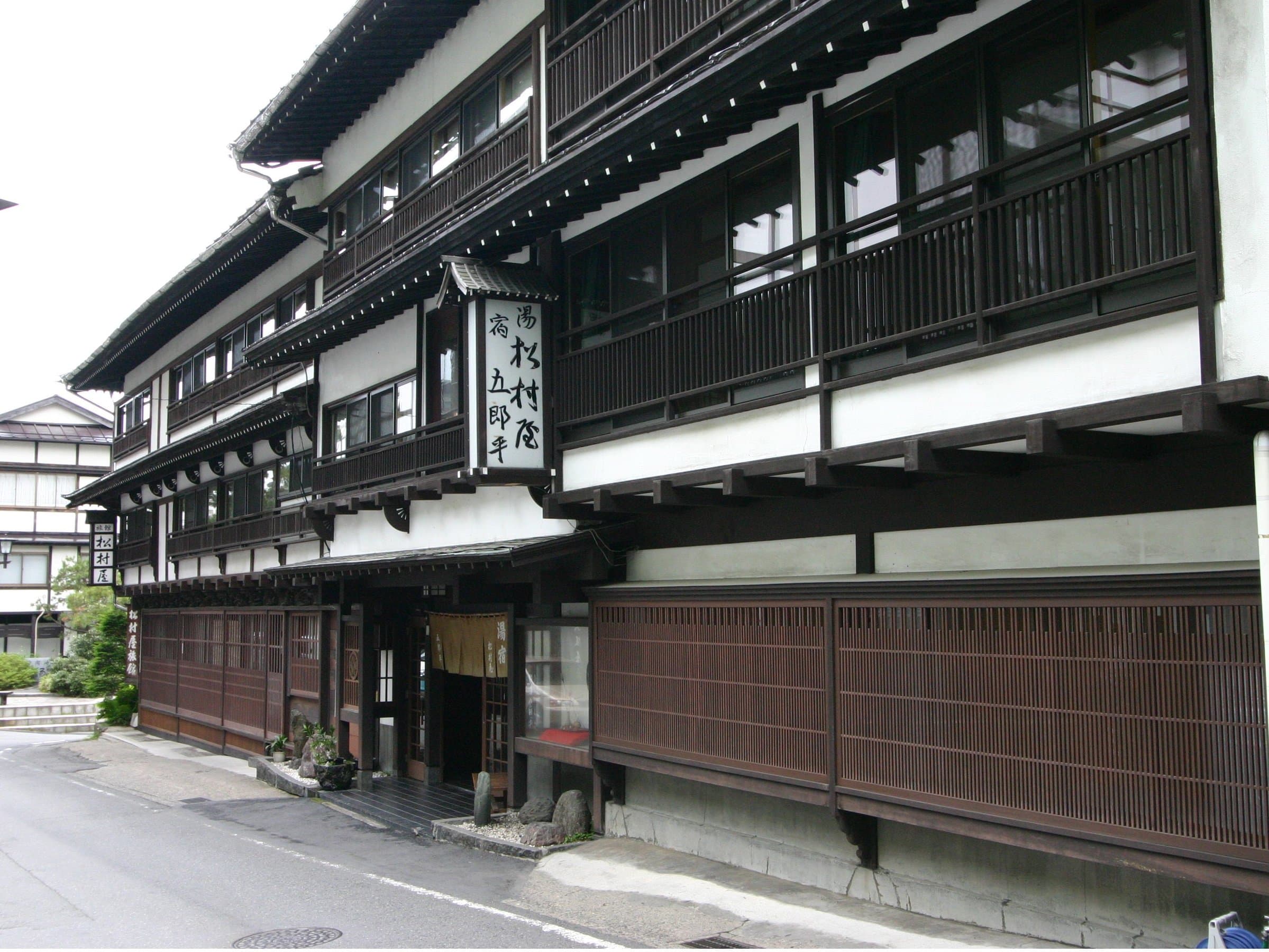
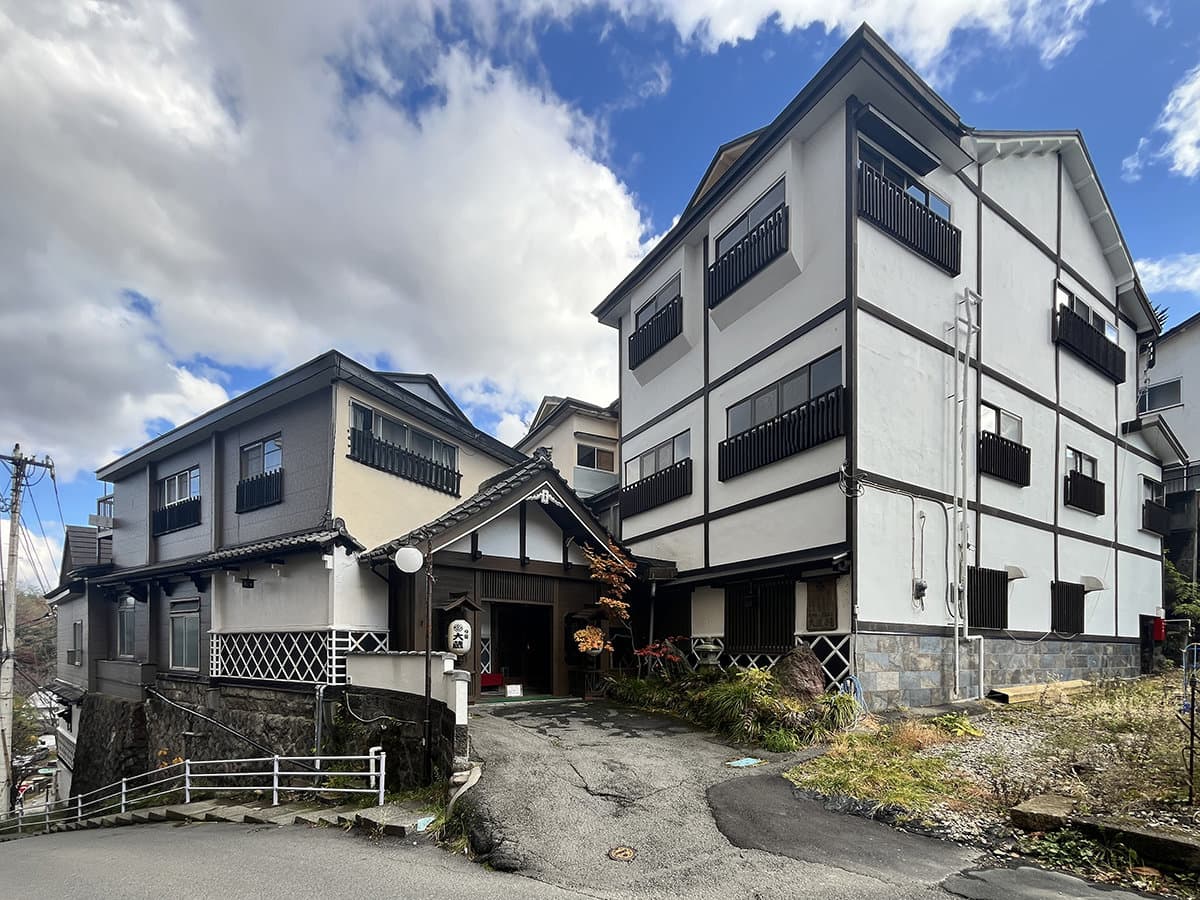
Standout detail: [The 1913 Taisho-era Kusatsu Hotel](/en/ryokans/kusatsu-hotel) is registered as a Tangible Cultural Property of Japan, and the wooden facade — white plaster offset by dark cedar trim — is genuinely from the original 1913 construction. You are sleeping in heritage architecture, not a heritage-themed renovation.
Honest trade-off: Heritage means heritage. Floors creak, soundproofing is what it was in 1913, and a few older rooms run cold in deep winter despite supplemental heating. Ask for a renovated wing room if either point matters. Rates run $130–$300 per person per night with two meals [approximate; verify current availability].
8. Oyado Konoha — Best hillside mid-range with 23-bath access
Best for: Skiers and bath-hoppers who want sister-property access to Tokinoniwa's 23-bath complex at mid-range pricing.
At a glance: 48 rooms · ~$180–$350 USD · Hillside, shuttle to Yubatake · Sister property to Yuyado Tokinoniwa.
The onsen: On-property indoor and outdoor public baths plus full shared access to Tokinoniwa's 23-bath complex via a free internal shuttle. No in-room private rotenburo at this tier — that is the trade-off versus Tokinoniwa itself.
The kaiseki: Half-board Joshu kaiseki featuring Gunma beef, river fish and a generous seasonal hassun. The property is famous for complimentary late-night ramen service after dinner — a touch that sounds gimmicky until you have soaked for two hours and need the carbohydrates.
Standout detail: [Oyado Konoha (sister property to Tokinoniwa)](/en/ryokans/kusatsu-konoha) is the cheapest way into Tokinoniwa's 23-bath system. If you spend a stay rotating baths rather than sitting in your room, this is the most cost-efficient property on the list. The free Kusatsu Onsen Ski Resort shuttle from December through March makes it the strongest ski-combo pick.
Honest trade-off: Hillside means a shuttle ride to Yubatake. The shuttle runs every 30 minutes most evenings, but late-night returns can require a taxi. If you are doing nightly Yubatake walks, factor the shuttle gap in. Rates run $180–$350 per person per night with two meals [approximate; verify current availability].
Tip
**Ski-combo tip:** The Kusatsu Onsen Ski Resort 2025–26 season runs late December through early April, and the resort is roughly 10 minutes by shuttle from Konoha and most luxury Kusatsu ryokans [verified ANA Japan Travel Planner 2026-05-07]. Confirm the shuttle schedule when booking — most properties run fixed morning departures and afternoon returns rather than on-demand service. See our [winter onsen towns](/en/blog/best-winter-onsen) ranking for the wider snow-onsen context.
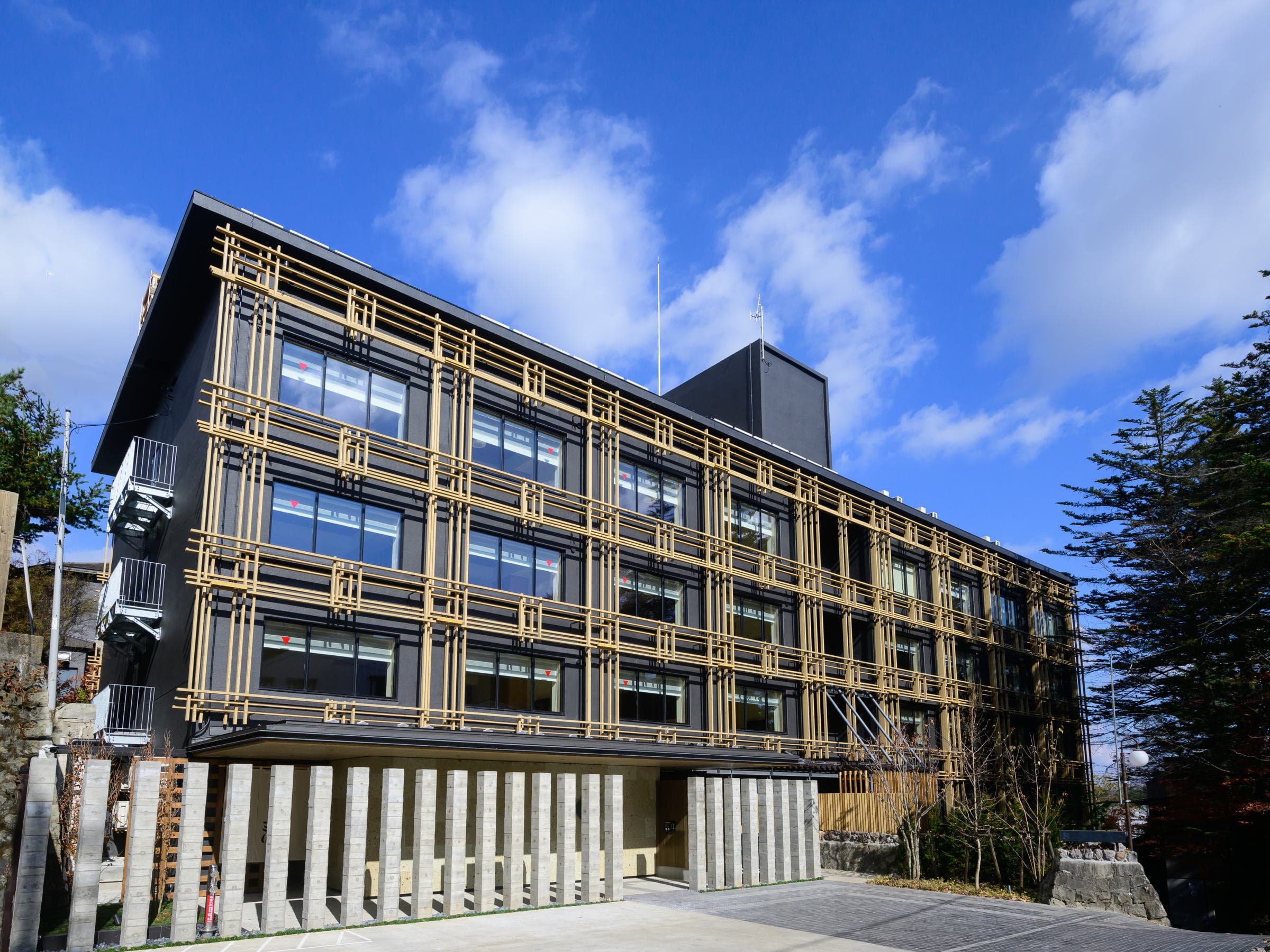
9. Yubatake Souan — Best budget room-only Meiji townhouse
Best for: Solo travellers, budget couples and bath-hoppers who plan to eat at local izakaya rather than commit to kaiseki.
At a glance: 16 rooms · ~$90–$200 USD · Steps from Yubatake · Meiji-era wooden building converted into a stylish room-only inn.
The onsen: A small but characterful onsen bath fed from the Yubatake area. Some upper-tier rooms have a private bath. The on-site foot-bath cafe is open to the public and often busy — a feature, not a bug, if you want to feel embedded in town life.
The kaiseki: None. Souan is an explicit room-only operation. The trade-off is freedom — you eat where you want, when you want, for what you want to spend. Local izakaya, ramen and the foot-bath cafe itself cover most evening meals. For more tactics, see our [budget ryokan tips](/en/blog/budget-ryokan-tips) guide.
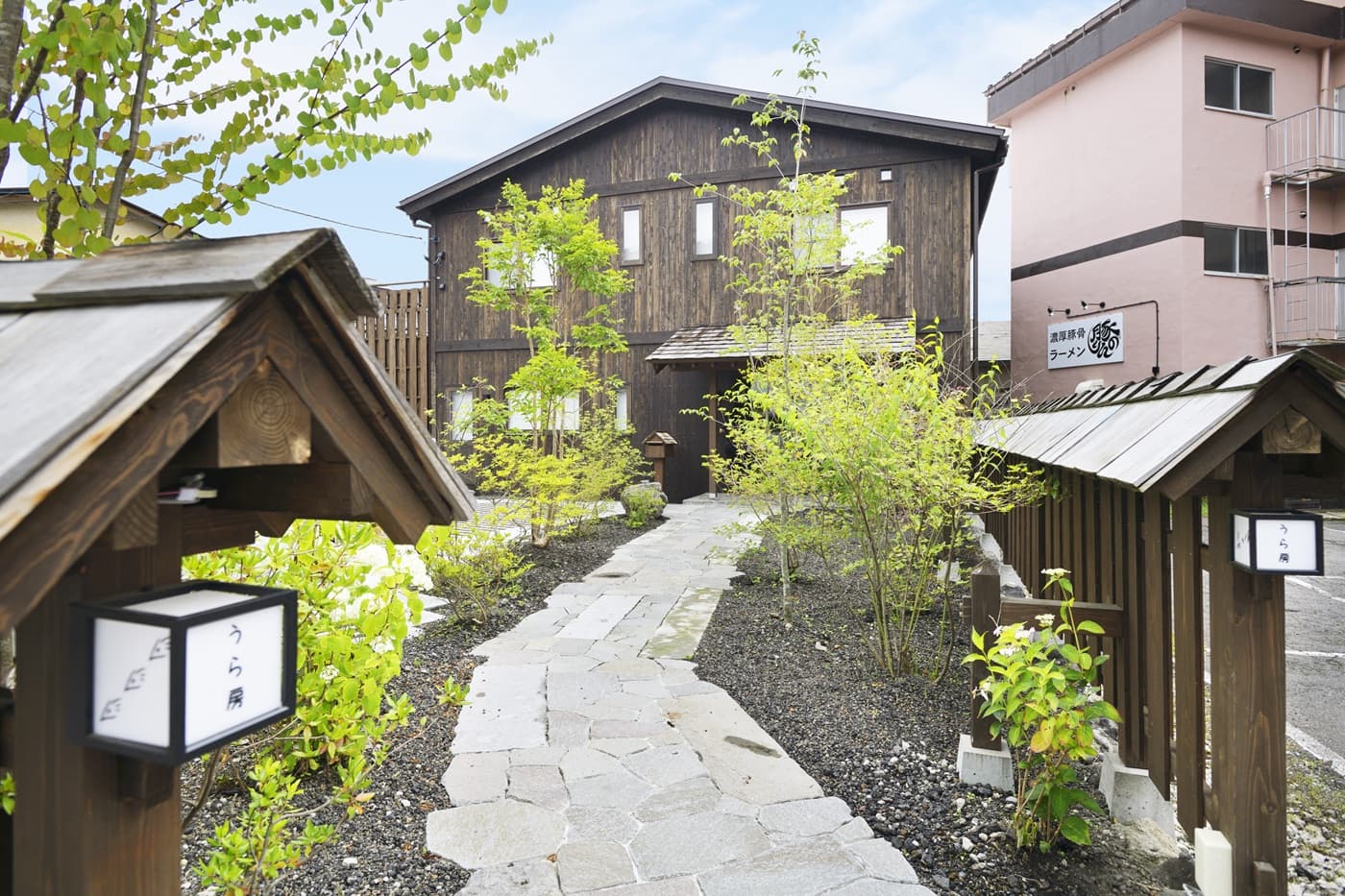
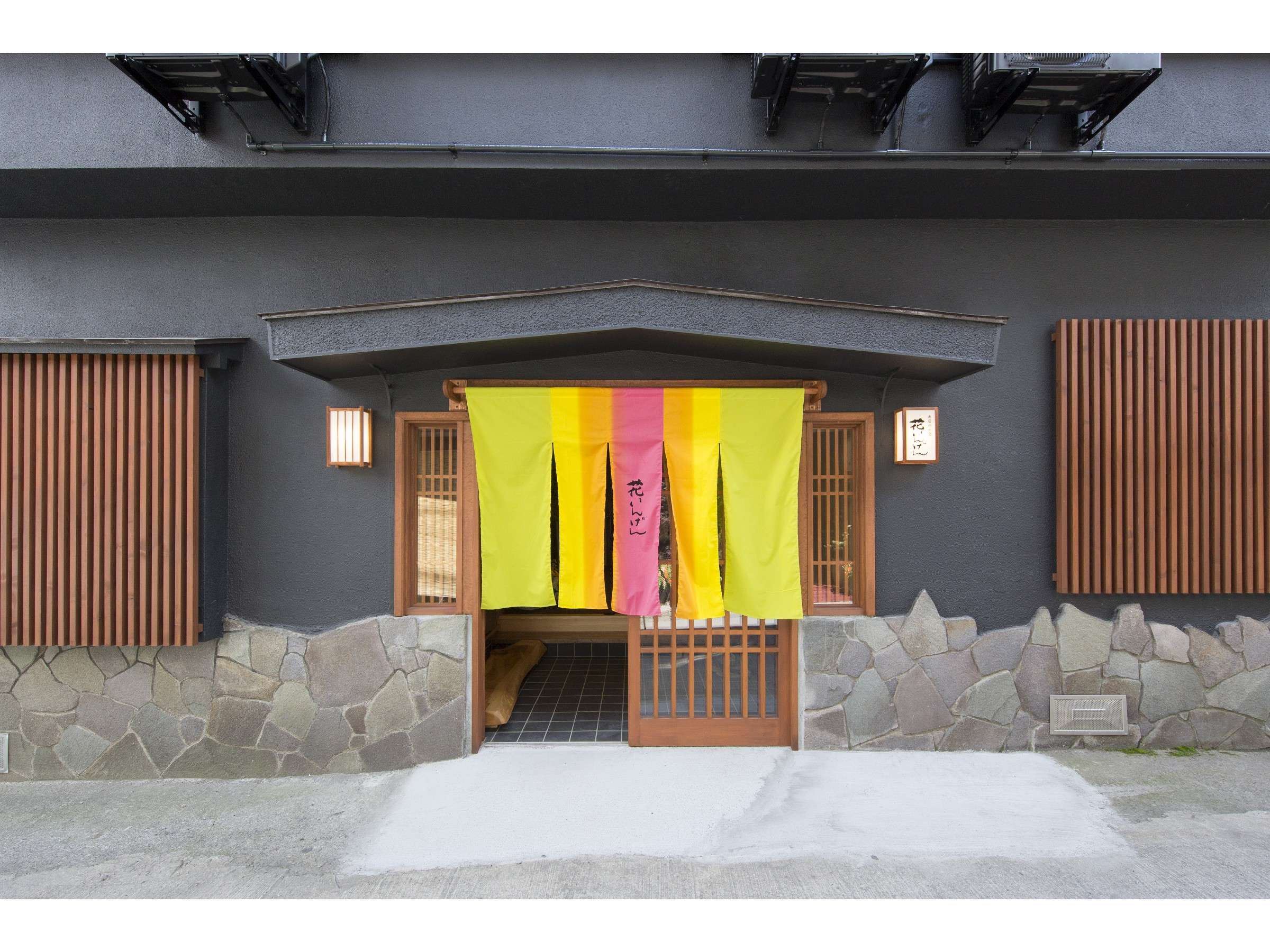
Standout detail: The building is a converted Meiji-era wooden townhouse — exposed beams, narrow corridors, period sliding doors — restyled with a contemporary boutique sensibility. For the price, the design quality is genuinely above tier; this is the rare budget pick that does not feel like a budget pick.
Honest trade-off: No kaiseki means no in-room dinner experience. If the romance of yukata-and-kaiseki-by-low-table is the reason you are coming to a ryokan, Souan is the wrong choice. The 16-room scale also means it books out three to four months ahead for spring and autumn weekends. Rates run $90–$200 per person per night, room-only [approximate; verify current availability]. You can see [Yubatake Souan room-only details](/en/ryokans/kusatsu-souan) on our directory page.
Yubatake and the three sotoyu: the Kusatsu primer
Almost every English guide says 'three free public baths for ryokan guests', and almost every English guide gets the mechanism wrong. Here is the correct version.
The three sotoyu (外湯) — Shirahata-no-yu, Chinoiri-no-yu and Jizo-no-yu — are local-managed public baths in the Kusatsu village core. Most participating ryokans hand you a 入湯手形 (Nyuto-Tegata) on check-in, a small wooden or paper token granting entry. Walk-in tourists without a participating ryokan reservation cannot enter these three. Naraya, Boun, Tsutsujitei and Tokinoniwa all participate; budget room-only inns may not — confirm at booking.
The three paid public baths — Otakinoyu, Gozanoyu and Sainokawara — are different. They are open to everyone, ryokan guest or not, and charge ¥800 to ¥900 per entry [verified Kusatsu Onsen Public Baths 2026-05-07]. Sainokawara is the famous outdoor bath in a riverside park, with seasonal hours — 7am–8pm April through November, 9am–8pm December through March [verified Visit Gunma 2026-05-07]. Otakinoyu is the place to learn the awase-yu method — four tubs at 38°C, 40°C, 42°C and 44–46°C arranged as a step ladder.
The angle for the iconic Yubatake photograph is from the southwest side of the channel, facing northeast, in the 30 minutes after sunset — that is when the steam columns frame the lamps cleanly. By 11pm on a weekday in February I have walked the whole channel with only a single resident cat for company.
Yumomi: the water-cooling performance at Netsu-no-yu
Yumomi (湯もみ) is a traditional cooling ritual in which performers stir Kusatsu's scalding source water with 180-centimetre cedar paddles while singing the local folk song Kusatsu Yoi Toko. The performance runs six times daily at Netsu-no-yu on the edge of Yubatake — at 9:30am, 10:00am, 10:30am, 3:30pm, 4:00pm and 4:30pm — for about ¥600 per adult [verified Kusatsu Onsen Tourism Assoc 2026-05-07]. On weekends and holidays between 11:30am and 2pm, audience members can pay ¥250 to try the paddle themselves.
Every guide tells you about the six daily shows; almost none tells you which is best. The 4:00pm performance is the most photographed — tour buses cluster between 3:30 and 4:30. The 9:30am show is half-empty, you can sit centre-front, and the morning light through Netsu-no-yu's upper windows hits the steam at the angle that makes every photo look like a 1960s NHK documentary. Go at 9:30am.
Sulfur, skin and silver: how to bathe in Kusatsu without surprises
Kusatsu's water is the most acidic of any major onsen town in Japan — pH 1.6 to 2.1 across the named sources, classified as a hydrogen-sulfide / acidic spring [verified Onsenista 2026-05-07]. That chemistry is the reason a single soak feels like skin treatment rather than a warm bath, and the reason Kusatsu requires a few specific precautions other onsen towns do not.
Skin response. Acidic water is bactericidal. Most bathers feel a mild tingle across the shoulders and behind the knees. Sensitive-skin guests should soak no more than 10 minutes per session, rinse with the agari-yu (finishing fresh-water tap, not the spring) before exiting, and alternate sulfur and non-sulfur days. If you have shaved within the past 12 hours, do not splash water on your face.
Silver and brass. Hydrogen sulfide aerosolises. Silver sulfide forms within minutes of contact, and walking past Yubatake or standing in a steam plume is enough to tarnish a silver chain under your collar. Toothpaste will not fix the patina once it is deep. Leave silver, brass and pearl-mounted jewellery in your safe. Stainless steel, gold, platinum and titanium are unaffected.
Two nights, not one. Single-night Kusatsu trips waste the water. The town's ancient Yu-Mawari (湯廻り) ritual — visiting all sotoyu in sequence over multiple days — exists because one rotation is not the dose. On a one-night stay you get the experience; on a two-night stay your skin texture changes, mild sinus clearing kicks in, and sleep depth shifts noticeably.
Tip
**Sensitive-skin tip:** Soak for a maximum of 10 minutes per session. Rinse with agari-yu fresh-water tap (not the spring) before exiting. Alternate sulfur and non-sulfur days where possible — a non-sulfur option is a private bath fed by a different source on the property. Read our [first-timer onsen etiquette guide](/en/blog/onsen-etiquette-foreigners) before your first soak.
How to choose your Kusatsu ryokan by trip type
Kusatsu is small enough that no ryokan is meaningfully far from town centre — the Yubatake is the gravitational point and almost everything is a 1- to 5-minute walk or short shuttle away. The trip-type decision matrix below resolves the most common reader questions in one place.
First-time couples on a milestone trip: Tsutsujitei for ultra-private 10-room seclusion, or Naraya for oldest-source water with Yubatake walking access.
Tattooed travellers: Tokinoniwa is the frictionless choice — every room has a private rotenburo, no kashikiri reservation needed. The three sotoyu are also explicitly tattoo-welcoming. See our [tattoo-friendly ryokans](/en/blog/tattoo-friendly-ryokans) cross-reference.
Families with young kids: Hotel Ichii at the standard tier — large rooms, communal dining, a bath complex big enough that nobody feels crowded, and Yubatake-front rooms for the illumination. Our [ryokans with kids](/en/blog/ryokan-with-kids) guide covers the broader logistics.
Skiers in the December–March window: Konoha for the resort shuttle and 23-bath complex access. Tokinoniwa for the upgrade option from the same family.
Budget travellers and bath-hoppers: Yubatake Souan room-only at the centre of town, eating at local izakaya and rotating sotoyu and paid public baths across two days.
Sensitive-skin guests: Boun is the gentlest of the heritage luxury options — Wataya is the softer of its two springs and the staff brief you on bathing rhythm at check-in.
Getting to Kusatsu: train, bus and the Karuizawa combo
The route from Tokyo to Kusatsu is straightforward but does not involve a shinkansen — that is the most common first-timer surprise.
Four steps, in order:
1. From Ueno or Shinjuku, take the Limited Express Kusatsu (JR) to Naganohara-Kusatsuguchi — about 2.5 hours, JR Pass valid [verified ANA Japan Travel Planner 2026-05-07]. This is the fastest rail option. 2. From Naganohara-Kusatsuguchi, board the JR Kanto bus to Kusatsu Onsen Bus Terminal — about 25 minutes, around ¥710. Most ryokans are within 5 to 10 minutes of the terminal on foot. 3. Alternative: the Shinjuku highway bus runs about 4 hours non-stop directly to Kusatsu Onsen Bus Terminal, bypassing Naganohara. JR Pass does not cover it. 4. Karuizawa combo: the JR Kanto bus runs between Kusatsu Onsen and Karuizawa Station in roughly 80 minutes. Two nights in Kusatsu plus one in Karuizawa, then the Hokuriku Shinkansen back to Tokyo, is one of the most efficient itinerary loops in the region.
Luggage tip: send the big suitcase via Yamato Takkyubin from your Tokyo hotel direct to your ryokan (about ¥2,000 per bag, next-day delivery). Arriving in Kusatsu with only an overnight bag is the cleaner solution.
Best time of year for a Kusatsu ryokan stay
The four-season picture, in priority order for an overnight stay.
Mid-December through March for snow and skiing. The Kusatsu Onsen Ski Resort is 10 minutes by shuttle and runs a long season; the steam-versus-snow contrast at Yubatake is the strongest visual the town offers. Sainokawara outdoor baths are open 9am–8pm in this window — one of the few places in Japan where you can soak in pH 1.8 sulfur water with snow falling on your hair. Book ski-combo properties — Konoha or Tokinoniwa — by October.
Late October through early November for autumn foliage. Joshinetsu Kogen National Park surrounds Kusatsu, and the larch and maple turnover at 1,200 metres elevation is spectacular. Mid-week stays in this window have far better availability than the foliage peak weekends.
Early August for the Kusatsu Onsen Festival. Three days of mikoshi processions, fireworks and special yumomi shows. Rates spike 20–30% across the festival window; book three months ahead.
Avoid late April through early May (Golden Week surcharges). Late January through early March offers the best mid-week availability across the luxury tier.
If Kusatsu is one stop on a wider trip, our guide to [Japan's best onsen towns](/en/blog/best-onsen-towns-japan) maps out where to head next, and our [winter onsen ranking](/en/blog/best-winter-onsen) covers the snow side of the calendar.
Kusatsu ryokan FAQ
Which is the best ryokan in Kusatsu Onsen?
For ultra-luxury seclusion, Tsutsujitei — 10 rooms inside 5,000 tsubo of private woodland. For oldest-source heritage one minute from Yubatake, Naraya (established 1877, Shirahata source). For Yubatake-front mid-range with illumination views from the room, Hotel Ichii. For boutique room-only stays under $200, Yubatake Souan.
How many days should I stay in Kusatsu?
Two days and one night is the standard Kusatsu trip — but two nights is the better one. One night gives you the dusk Yubatake, dinner, one onsen rotation and breakfast. Two nights add the second-day skin response, the half-empty 9:30am yumomi, the full Yu-Mawari sotoyu rotation, and time for a Mount Shirane day trip or a Karuizawa side combo.
Are Kusatsu ryokans walking distance from Yubatake?
Most are within 1 to 5 minutes on foot. Hotel Ichii sits directly on Yubatake; Naraya, Osakaya and Yubatake Souan are 1 minute away; Boun and Kusatsu Hotel 1913 are 3 to 5 minutes. Tsutsujitei, Tokinoniwa and Konoha are hillside or out-of-town and run shuttles.
Is Kusatsu's sulfur water safe for sensitive skin?
Kusatsu's pH 1.6–2.1 is the most acidic onsen water in Japan. It is bactericidal but can irritate sensitive skin and tarnishes silver jewellery. Most ryokans recommend a 10-minute maximum soak, rinsing with the agari-yu fresh-water tap before exiting, and alternating sulfur and non-sulfur days [verified Onsenista 2026-05-07].
How do I get to Kusatsu Onsen from Tokyo?
Take the Limited Express Kusatsu (JR) from Ueno or Shinjuku to Naganohara-Kusatsuguchi — about 2.5 hours, JR Pass valid — then a 25-minute JR Kanto bus to Kusatsu Onsen Bus Terminal. There is no direct shinkansen. The Shinjuku highway bus runs about 4 hours non-stop direct.
Can I combine Kusatsu Onsen with skiing?
Yes. Kusatsu Onsen Ski Resort is 10 minutes by shuttle, with a December-through-early-April season. Konoha and Tokinoniwa run dedicated ski shuttles; most luxury ryokans offer lift-discount packages.
How is Kusatsu different from Hakone?
Kusatsu is sulfur-acidic alpine onsen at 1,200 metres with the strongest water in Japan, no Tokyo day-trip option, and a winter ski combo. Hakone is varied spring chemistry at lower elevation, Mt Fuji views, and easy 90-minute access from Tokyo. See [our Japan-wide onsen comparison](/en/blog/best-onsen-towns-japan), and [how a ryokan compares to a hotel](/en/blog/ryokan-vs-hotel).
Are Kusatsu ryokans tattoo-friendly?
Kusatsu is unusually welcoming for a major onsen town — all three free sotoyu accept tattoos officially, and the paid public baths follow similar policy. For ryokan baths, Tokinoniwa is the frictionless pick because every room has a private rotenburo. See our [tattoo-friendly ryokans](/en/blog/tattoo-friendly-ryokans) directory.
Final thoughts: bathing in the most acidic water in Japan
The case for an overnight in Kusatsu is structural, not aspirational. The town runs on day-tripper time during the day and ryokan-guest time at night, and choosing where to sleep is how you choose which version of Kusatsu you see — the busy daytime Yubatake or the half-empty, fully illuminated midnight one. Tsutsujitei for ultra-private 10-room seclusion. Tokinoniwa for an in-room private rotenburo in every suite. Boun for 425 years of heritage and two source waters. Naraya for the original Shirahata source one minute from Yubatake. Hotel Ichii for Yubatake-front rooms at mid-range pricing. Osakaya for Yubatake-source water at the most efficient price. Kusatsu Hotel 1913 for genuine Taisho-era architecture. Konoha for ski combo and 23-bath access. Yubatake Souan for boutique budget room-only.
Dates matter as much as property. A late-January night at Naraya with snow falling on Sainokawara is a different trip from a late-October stay at Konoha during the larch turn. Cross-check the ski calendar and your own tolerance for pH 1.8 water before you commit.
When you are ready, jump to the individual ryokan pages linked above, or browse [our full Kusatsu directory](/en/area/kusatsu). If Kusatsu is one stop in a longer trip, our [Miyajima ryokan picks](/en/blog/best-ryokans-miyajima) round out the route.
在我第三次沿著國道292號的髮夾彎攀上海拔超過1,000公尺時,公車駛入長野原草津口前整整一分鐘,我就先聞到了硫磺味。爬升的途中車廂空氣已悄悄轉變,等您把行李箱拖下草津巴士總站時,那股氣味已不容錯認——清冽、富含礦物、帶點輕微的火柴頭焦味;當地人住到第二天就不再察覺。這股氣味宣告您已抵達日本酸性最強的溫泉鄉,而您訂下的旅館,將是您面對「足以在九天內腐蝕鐵釘」的強悍溫泉時的避風港。
至2025年3月底為止的一整年內,草津迎來史上最高的4,019,418人次訪客——首度突破400萬人[資料來源:草津町公所via Essential Japan,資料來源驗證 2026-05-07]。這個數字告訴您整座溫泉鄉有多熱鬧,卻沒告訴您該如何在創業於1598年的歷史老舖、每間客房皆附私人露天風呂的全套房隱居名宿,以及由明治時期町家改裝、純住宿不附餐的平價小宿之間做出選擇。最後核實:2026年5月。
過去五年間共四度造訪——兩次是隆冬帶滑雪板、一次夏天、一次秋天——本文九間旅館中我親自入住過三間,其餘也都實地參訪。以下推薦皆反映親身經驗。本文是「分區精選旅館」系列繼箱根、京都、高山、由布院與[宮島](/zh-tw/blog/best-ryokans-miyajima)之後的第六篇。
本指南依奢華、中價位與平價三個級別盤點9間草津旅館——誠實點出每間的弱項、多數指南漏掉的「下午5點後外湯時段」,以及任何英文資訊都從未完整說明的「銀飾警告」。如果您對旅館文化還完全陌生,建議先閱讀我們的[第一次入住旅館完整指南](/zh-tw/blog/first-time-ryokan-guide),本文便能專注探討草津獨有的特色。
草津溫泉最佳旅館:50字快速解答
草津溫泉首選旅館為[躑躅亭](/zh-tw/ryokans/kusatsu-tsutsujitei)——僅10間客房、隱身於5,000坪私人林地的頂級隱密旅館,懷石於私人包廂內供應。追求每間客房皆附私人露天風呂的全套房體驗,請選[湯宿季の庭](/zh-tw/ryokans/kusatsu-tokinoniwa);想體驗歷史奢華,請選1598年創業的[草津溫泉望雲](/zh-tw/ryokans/kusatsu-boun);想品嚐草津最古老的源泉,請選[奈良屋](/zh-tw/ryokans/kusatsu-naraya);中價位的湯畑第一排請選[Hotel Ichii](/zh-tw/ryokans/kusatsu-ichii);最具質感的平價之選則是[湯畑草庵](/zh-tw/ryokans/kusatsu-souan)。
Tip
**揭露聲明:** Japan Ryokan Guide 在您透過合作連結預訂時可獲得佣金。我們不接受旅館付費收錄或排序——本文每間旅館皆依品質擇優選入。佣金收入用以維持本目錄六種語言版本的免費瀏覽。
Tip
**打包小提醒:** 銀製、黃銅與含珍珠的飾品請留在東京飯店保險箱內。草津pH 2.0的硫磺水只要泡一次就會讓銀飾發黑變色,即使只是走過街道上的蒸氣柱,您身上的銀飾也會接觸到微量硫化氫。不鏽鋼、黃金、鉑金與鈦金屬則安全無虞。
快速比較:草津9間旅館一覽
| # | 旅館 | 級別 | 起價(美元) | 步行至湯畑 | 適合對象 | |---|---|---|---|---|---| | 1 | [躑躅亭](/zh-tw/ryokans/kusatsu-tsutsujitei) | 奢華 | $400 | 接駁車 | 想要極致私密、僅10間客房的情侶 | | 2 | [湯宿季の庭](/zh-tw/ryokans/kusatsu-tokinoniwa) | 奢華 | $300 | 接駁車 | 客房附私人露天風呂的套房住宿 | | 3 | [草津溫泉望雲](/zh-tw/ryokans/kusatsu-boun) | 奢華 | $250 | 3分鐘 | 歷史控——1598年創業、雙源泉 | | 4 | [奈良屋](/zh-tw/ryokans/kusatsu-naraya) | 奢華 | $350 | 1分鐘 | 想體驗草津最古老源泉(白旗)的玩家 | | 5 | [Hotel Ichii](/zh-tw/ryokans/kusatsu-ichii) | 中價位 | $120 | 0分鐘 | 湯畑第一排、可看夜間點燈 | | 6 | [大坂屋](/zh-tw/ryokans/kusatsu-osakaya) | 中價位 | $150 | 1分鐘 | 想以中價位享用湯畑源泉 | | 7 | [Kusatsu Hotel 1913](/zh-tw/ryokans/kusatsu-hotel) | 中價位 | $130 | 5分鐘 | 大正時代木造建築愛好者 | | 8 | [御宿木の葉](/zh-tw/ryokans/kusatsu-konoha) | 中價位 | $180 | 接駁車 | 滑雪結合與季の庭23湯共通 | | 9 | [湯畑草庵](/zh-tw/ryokans/kusatsu-souan) | 平價 | $90 | 1分鐘 | 純住宿的精緻明治町家 |
為何要在草津溫泉過夜
是的——在草津過夜是您能為群馬之旅做的最大升級。 三座免費外湯約於下午5點對非住客關閉、最後一班開往長野原的公車約在下午4點50分發車、湯畑點燈則於日落點亮、持續到午夜。日歸遊客根本看不到草津經典的夜景,也無法在當地交班後進入外湯。
草津位於海拔1,200公尺、活火山草津白根山東麓,其熱液系統造就了全日本最豐沛的天然溫泉湧出量——六大命名源泉每分鐘合計湧出超過32,300公升[資料來源:Nippon.com,資料來源驗證 2026-05-07]。位於市街中央的湯畑(湯畑)並不像多數照片所呈現的池子;它其實是一條60公尺長的木造冷卻水道,將約70°C的源泉水冷卻至可入浴的溫度。水聲不停歇,宛如小型急流;多數夜晚因下山的下坡風盛行,蒸氣會朝東北方流動。
睡在草津與日歸最關鍵的結構性差異,就是晚上11點半的湯畑——點燈、半空、聲響鮮活——而這個畫面,只屬於市街中已備好布團的住客。
我們如何篩選這9間旅館
我們以五個標準逐一檢視草津所有營業中的旅館:步行至湯畑的分鐘數、源泉接續方式(草津六大溫泉中由哪一處提供)、是否提供私人浴池、以上州和牛與群馬山產為主軸的懷石料理,以及英文可讀的訂房系統。最終九間通過門檻——四間奢華、四間中價位、一間平價——也就是本文毫無保留推薦的這九間。
本名單中沒有任何旅館付費入選。所有物件皆從本站收錄、橫跨25個溫泉地、224間經過審查的旅館資料庫中,依實住經驗與設施數據評選而出。如需更多脈絡,本站[草津完整目錄](/zh-tw/area/kusatsu)收錄市內所有營業中的旅館,[旅館與飯店的差異比較](/zh-tw/blog/ryokan-vs-hotel)則說明令多數初訪者困惑的「含晚餐定價」模式。
簡單說明以下會出現的價位概念。草津旅館每晚價格從湯畑草庵約90美元的明治町家純住宿,到躑躅亭頂級套房約800美元不等。 含懷石與溫泉的中價位傳統旅館,每人每晚約150至350美元(含早晚餐)。如需更深入的[全日本旅館每晚價格](/zh-tw/blog/ryokan-cost-per-night)分析,請參考本站定價指南。
1. 躑躅亭 — 頂級隱密名宿首選
最適合 紀念日旅行的情侶——10間客房、5,000坪私人林地,與日歸版的草津零交集。
簡覽 10間客房 · 約400–800美元 · 距離湯畑短程接駁的私人林地。
溫泉 源泉私接至共用石造大浴場,高樓層套房內附客房私人露天風呂。硫磺強度為草津滿格水準(pH 1.6–2.1)[資料來源:Onsenista,資料來源驗證 2026-05-07],並透過合せ湯冷卻手法略加緩和。
懷石料理 在私人包廂供應的全套懷石料理——絕無共用大廳。上州和牛是主角,搭配吾妻川魚、當季山菜與群馬產白米。早餐則為層層托盤的正統日式組合,同樣於包廂內供應。
最大亮點 這是草津唯一在您與街市之間拉出實質距離的旅館。從房間步行五分鐘您已置身杉木林,而非穿著浴衣穿過紀念品商店街。本站[全國奢華旅館排行](/zh-tw/blog/luxury-ryokans-japan)是天然的延伸閱讀。
誠實取捨 您將失去步行至湯畑的便利。多數夜晚接駁車已能解決,但若您認為「晚上11點穿浴衣在點燈下散步」是首要訴求,奈良屋或Hotel Ichii更合適。價格約每人每晚400至800美元(含早晚餐)[參考價;請確認當前空房]。可在我們的目錄[預訂躑躅亭客房](/zh-tw/ryokans/kusatsu-tsutsujitei)。
2. 湯宿季の庭 — 全套房附私人露天風呂首選
最適合 想要每間客房都附私人露天風呂的情侶與有刺青的旅客——免預約貸切、免擔心公共浴池。
簡覽 56間客房 · 約300–600美元 · 山坡位置、接駁車至湯畑 · 御宿木の葉的姊妹館(共用23湯設施)。
溫泉 每間客房皆附自家源泉的私人露天風呂。除此之外,23種共用浴池(露天、室內石造、檜木、合せ湯冷卻槽與主題湯)構成草津規模最大的溫泉浴池群之一。
懷石料理 半膳懷石以上州和牛、川魚(山女魚)與山菜八寸為主軸。用餐於私人包廂進行,而非客房內——比躑躅亭略少一些私密感,但仍遠優於一般飯店水準。
最大亮點 23座共用浴池加上客房內的露天風呂,住兩晚也不會泡到同一座浴池。對有刺青的旅客而言,這是市內最無摩擦的選項——您的私人浴池真的就是您的,不是排隊等貸切的時段。
誠實取捨 您不在湯畑旁。多數夜晚接駁車已能解決,但您無法穿著拖鞋慢慢晃下去看點燈。如果浴衣+燈下散步是本次旅程的封面畫面,請改訂奈良屋或Hotel Ichii。價格約每人每晚300至600美元(含早晚餐)[參考價;請確認當前空房]。可在我們的目錄[查看湯宿季の庭全套房平面圖](/zh-tw/ryokans/kusatsu-tokinoniwa)。
Tip
**訂房小撇步:** 季の庭與姊妹館御宿木の葉透過免費的內部接駁車共用同一座23湯設施。訂下較便宜的木の葉、再搭接駁車過去,等於以低約四成的房價享受相同的浴池使用權——這是櫃台會親口確認、卻沒有任何英文評論寫出來的小撇步。
3. 草津溫泉望雲 — 歷史奢華首選(創業1598年)
最適合 想入住本文最古老、持續營業旅館的日本回頭客——可在兩種命名源泉間輪流泡湯。
簡覽 42間客房 · 約250–550美元 · 距湯畑步行3分鐘 · 創業於1598年——已連續營運逾425年。
溫泉 六座源泉掛流大浴場,由兩種命名源泉(萬代鉱、綿之湯)供水。室內外動線兼具,並可預約家庭貸切浴池。本館客房不附私人露天風呂——這裡的浴池故事重點在源泉的歷史血統。
懷石料理 樸實的上州懷石,以群馬牛、吾妻川魚與當季山菜為主軸。早餐是於餐廳供應的正統多托盤日式組合。服務節奏不疾不徐、訓練有素,這是只有經營了四百年的旅館才端得出來的款待。
最大亮點 兩種源泉意味著一趟住宿就能體驗兩種泡湯感受——萬代鉱性格更鮮明、水溫稍高;綿之湯較為柔和,初次入浴者也能適應。櫃台人員在我入住時,便以印好的圖解向我解說兩者差異,還附上「在海拔1,200公尺管理血壓變化」用的「頭頂濕毛巾」訣竅。
誠實取捨 並非新派精品旅館。部分走廊已顯歲月、客房依館棟差異甚大——若您在意室內美感,請於訂房時指定整修過的客房。價格約每人每晚250至550美元(含早晚餐)[參考價;請確認當前空房]。可在目錄頁[查詢草津溫泉望雲房價](/zh-tw/ryokans/kusatsu-boun)。
4. 奈良屋 — 草津原生源泉首選
最適合 為水質而來草津的溫泉玩家——奈良屋汲取的是草津六大源泉中最古老的「白旗之湯」。
簡覽 36間客房 · 約350–700美元 · 距湯畑步行1分鐘 · 創業於1877年。
溫泉 三座室內、三座戶外浴池皆由白旗源泉供水——草津六湯中酸性最強,也是德川時期旅人遠道而來的目的地。水質為pH 1.6–1.8滿格強度、具殺菌力,若您過去12小時內刮過鬍鬚或除毛,將會明顯刺痛。較高樓層客房可預約客房私人浴池。
懷石料理 私人包廂內供應的精緻上州懷石——上州和牛涮涮鍋、吾妻山女魚、當季八寸,並有專為當地水質搭配的清酒酒單。早餐堪稱本名單中最佳之一。
最大亮點 之前的旅程中,我曾忘了在西河原泡湯前取下一只細銀手鐲——八分鐘的浸泡換來十二小時的氧化,銀色從亮面變成槍金灰。奈良屋櫃台後方放著一個盛裝旅客遺忘飾品的小漆盤,並備有四種語言的提醒告示。連奢華旅館都要把警告寫成多語版本,您就知道這裡的水有多強。
誠實取捨 從望雲跳到這裡的價差確實存在,「最古老源泉」的溢價有部分是無形的——若您嚐不出pH值的差異,這筆花費難以合理化。價格約每人每晚350至700美元(含早晚餐)[參考價;請確認當前空房]。完整介紹見[奈良屋白旗之湯介紹頁](/zh-tw/ryokans/kusatsu-naraya)。
Tip
**源泉小撇步:** 奈良屋汲自白旗之湯,為草津六大命名源泉中最古老的一處。請向櫃台索取「源泉巡り」(源泉巡禮,源泉巡り)地圖——上面標示街上每座浴池的源泉來源。望雲汲取萬代鉱與綿之湯;大坂屋汲取湯畑源泉;Hotel Ichii直接從湯畑取水。把它當作葡萄酒的風土。
5. Hotel Ichii — 湯畑正面第一排首選
最適合 想讓臥室窗戶直接俯瞰冒著蒸氣的湯畑的初訪者與攝影玩家。
簡覽 110間客房 · 約120–300美元 · 0分鐘步行——本館正面就對著湯畑 · 300年歷史老舖。
溫泉 大型室內外大浴場直接由湯畑源泉供水,並附可預約家庭貸切浴池。本館客房不附私人露天風呂,但公共浴池規模在草津中價位旅館中最大。
懷石料理 半膳懷石於私人包廂(高級房型)或共用大廳(標準房型)供應。上州和牛、川魚、當季蔬菜。早餐為多碟式日式組合,並附小型西式區,方便不吃米飯的孩童。
最大亮點 110間客房中有23間正面朝湯畑。訂下其中一間,就能在日出時看蒸氣柱、晚上9點從窗邊看點燈。從西南向客房,日落後30分鐘內以f/2.8拍攝,即可將蒸氣映在燈光前——這正是多數草津經典照片的取景角度。
誠實取捨 110間客房的規模感受得到。服務專業而非貼身,尖峰時段check-in可能排隊。請於訂房時明確指定「湯畑側」(湯畑側)客房——若不主動要求,可能以同價拿到背面的房間。價格約每人每晚120至300美元(含早晚餐)[參考價;請確認當前空房]。可在目錄頁[查看Hotel Ichii湯畑景觀房](/zh-tw/ryokans/kusatsu-ichii)。
6. 大坂屋 — 距湯畑1分鐘的中價位首選
最適合 想以奈良屋一半價格享用湯畑源泉的中價位旅客,高級房型還可預約客房私人浴池。
簡覽 31間客房 · 約150–350美元 · 距湯畑步行1分鐘 · 汲取湯畑源泉。
溫泉 兩座大浴場與可預約的貸切私人浴池,全部由湯畑源泉供水——也就是穿過市街中央木造水道的同一脈招牌名水。部分高級房型附客房露天風呂。
懷石料理 半膳上州懷石於共用餐廳供應——品質穩定而非驚豔,標準套餐皆有上州和牛與川魚。早餐為標準多托盤日式組合。
最大亮點 大坂屋的「價格/水質比」在本名單中最具殺傷力。以中價位享用市內最常入鏡名景的同一脈源泉——對既預算有限、又想體驗真正草津水質的初訪者,是CP值最高的選擇。
誠實取捨 客房以實用為主、設計感不強——乾淨、舒適,但不上鏡。標準房型的共用餐對單人旅客沒問題,但會減損情侶旅行的氛圍;若您在意氣氛,可加價升級至私人包廂用餐房型。價格約每人每晚150至350美元(含早晚餐)[參考價;請確認當前空房]。可瀏覽[大坂屋湯畑源泉浴池](/zh-tw/ryokans/kusatsu-osakaya)目錄頁。
Tip
**湯畑第一排小撇步:** 點燈時間從日落到午夜。從客房欣賞的最佳時段是晚上8點半到9點半——晚到夜餐人潮已散,又早到燈光仍處於滿格狀態。預訂大坂屋、Hotel Ichii或湯畑草庵時,請明確指定「湯畑側」(湯畑側)客房。
7. Kusatsu Hotel 1913 — 中價位大正風情首選
最適合 偏好木造、會嘎吱作響的歷史建築,勝過翻新後現代內裝的建築愛好者。
簡覽 40間客房 · 約130–300美元 · 距湯畑步行5分鐘 · 1913年(大正時期)建成。
溫泉 室內外大浴場採源泉掛流系統供水,並附可預約家庭貸切浴池。部分客房附私人浴池。浴場建築為木造、符合年代背景,且實際是建築敘事的一部分。
懷石料理 這裡的料理超出預期——懷石尾聲是一只小陶鍋,用單顆備長炭在桌邊慢煮山女魚。魚來自下游三公里的吾妻川,鍋是益子燒,米則是來自一小時車程外沼田的越光米。一道菜囊括整個群馬風土:河、山、窯、稻田。如需了解早餐內容,請參考本站[日式旅館早餐指南](/zh-tw/blog/japanese-breakfast-ryokan)。
最大亮點 [1913年建成的大正時期Kusatsu Hotel](/zh-tw/ryokans/kusatsu-hotel)被指定為日本登錄有形文化財,木造正立面——白色灰泥襯深色杉木邊飾——確實出自1913年原始建築。您是睡在歷史建築裡,不是住在「歷史風格」的翻修館。
誠實取捨 歷史就是歷史。地板會嘎吱作響、隔音停留在1913年水準,部分舊客房在隆冬即使有輔助暖氣仍偏冷。若您在意這兩點,請指定整修過的館棟客房。價格約每人每晚130至300美元(含早晚餐)[參考價;請確認當前空房]。
8. 御宿木の葉 — 山坡中價位+23湯通用首選
最適合 想以中價位取得季の庭23湯設施使用權的滑雪客與「巡湯派」。
簡覽 48間客房 · 約180–350美元 · 山坡位置、接駁車至湯畑 · 湯宿季の庭的姊妹館。
溫泉 本館室內外大浴場,加上透過免費內部接駁車完整共用季の庭的23湯設施。本價位客房不附私人露天風呂——這是與季の庭本館之間的取捨。
懷石料理 半膳上州懷石以群馬牛、川魚與當季豐盛八寸為主。本館以晚餐後免費供應宵夜拉麵聞名——聽來像噱頭,但您泡湯兩小時後就會明白為何需要這碗碳水。
最大亮點 [御宿木の葉(季の庭姊妹館)](/zh-tw/ryokans/kusatsu-konoha)是進入季の庭23湯系統的最便宜路徑。如果您打算整趟住宿不停泡湯而非待在房內,這是本名單中CP值最高的選擇。12月至3月還有免費的草津溫泉滑雪場接駁車,是滑雪結合住宿的最強選項。
誠實取捨 山坡位置代表前往湯畑須搭接駁。多數晚上接駁車每30分鐘一班,但深夜返回可能需要計程車。如果您每晚都打算前往湯畑散步,請把接駁空檔納入考量。價格約每人每晚180至350美元(含早晚餐)[參考價;請確認當前空房]。
Tip
**滑雪結合小撇步:** 草津溫泉滑雪場2025–26雪季從12月底至4月初開放,距木の葉與多數草津奢華旅館約10分鐘接駁車程[資料來源:ANA Japan Travel Planner,資料來源驗證 2026-05-07]。訂房時請確認接駁時刻——多數旅館採固定上午出發、下午返程的班次,而非隨叫隨到。本站[冬季溫泉鄉排行](/zh-tw/blog/best-winter-onsen)有更廣泛的雪季溫泉脈絡。
9. 湯畑草庵 — 純住宿明治町家平價首選
最適合 計畫到當地居酒屋用餐、不打算綁在懷石上的單人旅客、預算情侶與「巡湯派」。
簡覽 16間客房 · 約90–200美元 · 距湯畑數步之遙 · 由明治時期木造町家改裝而成、頗具質感的純住宿小宿。
溫泉 一座規模不大但具個性的浴池,由湯畑周邊源泉供水。部分高級房型附私人浴池。館內附設足湯咖啡廳對外開放、人潮不少——若您想感受融入街市生活的氛圍,這是優點而非缺點。
懷石料理 無。草庵明確採純住宿型態。取捨的回報是自由——您要在哪裡吃、何時吃、花多少錢都自己決定。當地居酒屋、拉麵與足湯咖啡廳本身就能涵蓋多數晚餐。如需更多策略,請參考本站[平價旅館攻略](/zh-tw/blog/budget-ryokan-tips)。
最大亮點 此館為改裝過的明治時期木造町家——裸露樑柱、狹窄走廊、年代感的拉門——並以當代精品設計重新詮釋。以這個價格而言,設計品質實實在在地超越其等級;這是少數不會讓您覺得「果然是平價旅館」的平價旅館。
誠實取捨 沒有懷石就沒有客房晚餐體驗。如果您是衝著「浴衣+低矮餐桌懷石」的浪漫而入住旅館,草庵不是對的選擇。16間客房的規模也代表春秋週末會在三到四個月前訂滿。價格約每人每晚90至200美元,純住宿[參考價;請確認當前空房]。可在目錄頁[查看湯畑草庵純住宿房型](/zh-tw/ryokans/kusatsu-souan)。
湯畑與三座外湯:草津入門課
幾乎所有英文指南都寫「三座旅館住客專用的免費公共浴池」,而幾乎所有英文指南都寫錯了機制。以下才是正確版本。
三座外湯(外湯) ——白旗之湯、千代之湯(千代の湯)與地藏之湯——是位於草津市街核心、由地方管理的公共浴池。多數參與計畫的旅館會在check-in時遞給您一張入湯手形(入湯手形),這是一片小小的木牌或紙券,作為入浴憑證。沒有訂下參與計畫旅館的散客遊客無法進入這三座外湯。奈良屋、望雲、躑躅亭與季の庭皆為加盟旅館;純住宿的平價小宿可能未加盟——訂房時請務必確認。
三座付費公共浴池 ——大瀧乃湯、御座之湯(御座の湯)與西河原(西の河原)——則屬於另一個系統。它們開放給所有人,不論是否為旅館住客,每次入浴¥800至¥900[資料來源:草津溫泉公共浴場,資料來源驗證 2026-05-07]。西河原是位於河畔公園、知名的露天浴池,採季節時段——4月至11月為上午7點至晚上8點,12月至3月為上午9點至晚上8點[資料來源:Visit Gunma,資料來源驗證 2026-05-07]。大瀧乃湯則是學習「合せ湯」入浴法的場所——四座38°C、40°C、42°C與44–46°C的浴池排成階梯。
標誌性湯畑照片的拍攝角度,是站在水道西南側、面向東北方向、日落後30分鐘內取景——此時蒸氣柱會清晰地框住燈火。我曾在二月平日的晚上11點獨自走完整條水道,沿途只有一隻當地的貓陪伴。
湯揉:熱乃湯的水溫表演儀式
湯揉(湯揉)是一項傳統冷卻儀式:表演者以180公分長的杉木板攪動草津滾燙的源泉水,並合唱當地民謠《草津良い處》。 表演每天於湯畑邊的熱乃湯舉行六場——上午9點半、10點、10點半,下午3點半、4點、4點半——每位成人約¥600[資料來源:草津溫泉觀光協會,資料來源驗證 2026-05-07]。週末與假日11點半至下午2點之間,觀眾可加付¥250親自體驗持板攪湯。
所有指南都告訴您每天有六場,卻幾乎沒有人告訴您哪一場最好。下午4點場最常被拍到——3點半到4點半是遊覽車蜂擁的時段。上午9點半的場次半空、可坐到正中央前排,且熱乃湯上方天窗的晨光會以最理想的角度射入蒸氣,讓每張照片看起來都像1960年代NHK紀錄片。請選9點半。
硫磺、肌膚與銀飾:在草津泡湯的「無驚喜」守則
草津的水是日本所有大型溫泉鄉中酸性最強——pH 1.6至2.1橫跨各命名源泉,分類為硫化氫泉/酸性泉[資料來源:Onsenista,資料來源驗證 2026-05-07]。這個化學特性正是泡一次就像護膚療程的原因,也是草津需要幾項其他溫泉鄉不需要、特定預防措施的原因。
肌膚反應。 酸性水具殺菌力。多數泡湯者會在肩膀與膝蓋後側感到輕微刺麻。敏感肌客人每次入浴請勿超過10分鐘,出浴前請以「上がり湯」(沖洗用清水龍頭,非源泉水)沖淨,並交替安排硫磺與非硫磺的日子。若您過去12小時內刮過鬍鬚或除毛,請勿將水撥到臉上。
銀飾與黃銅。 硫化氫會氣溶膠化。硫化銀只需數分鐘接觸即會生成,光是走過湯畑或站在蒸氣柱裡,就足以讓藏在領口下的銀鏈發黑。一旦氧化深入,牙膏也救不回。請將銀製、黃銅與含珍珠飾品留在保險箱。不鏽鋼、黃金、鉑金與鈦金屬則不受影響。
請住兩晚,而非一晚。 一晚行程浪費了這池水。草津自古便有「湯廻り(湯廻り)」儀式——多日內依序巡訪各外湯——正因為一輪不足以充分入浴。一晚住宿讓您體驗到這款水;兩晚住宿才會讓您的膚質改變、輕微鼻竇暢通感啟動、睡眠深度也會明顯不同。
Tip
**敏感肌小撇步:** 每次入浴最多10分鐘。出浴前請以上がり湯清水龍頭(非源泉)沖淨。盡量交替安排硫磺與非硫磺的日子——非硫磺的選項可選擇館內由不同源泉供水的私人浴池。第一次泡湯前,請先閱讀本站[初次泡湯禮儀指南](/zh-tw/blog/onsen-etiquette-foreigners)。
如何依旅行型態選擇您的草津旅館
草津的腹地不大,沒有任何旅館會離市街中心明顯偏遠——湯畑就是引力中心,幾乎所有物件都在步行1至5分鐘或短程接駁範圍內。以下旅行型態決策表,一次解決最常見的讀者問題。
紀念日初訪情侶: 想要極致私密、僅10間客房的隱密體驗,請選躑躅亭;想要原生源泉水加上湯畑步行距離,請選奈良屋。
有刺青的旅客: 季の庭是最無摩擦的選擇——每間客房皆附私人露天風呂,免預約貸切。三座外湯也明確接受刺青客人。請參考本站[允許刺青的旅館](/zh-tw/blog/tattoo-friendly-ryokans)交叉清單。
帶幼童的家庭: 標準房型的Hotel Ichii——客房寬敞、共用餐、浴池規模大到不會擁擠,並有湯畑側客房可看點燈。本站[親子入住旅館](/zh-tw/blog/ryokan-with-kids)指南涵蓋更廣的相關規劃。
12月至3月的滑雪客: 木の葉提供雪場接駁與23湯使用權。同集團還可從季の庭本館升級。
預算旅客與「巡湯派」: 市街中心的湯畑草庵採純住宿,搭配當地居酒屋用餐,並在兩天內輪流體驗外湯與付費公共浴池。
敏感肌客人: 望雲是歷史奢華選項中最溫和的——綿之湯為兩種源泉中較柔和者,櫃台會在check-in時為您解說泡湯節奏。
如何抵達草津:列車、巴士與輕井澤組合
從東京前往草津的路線單純,但「不會搭到新幹線」——這是初訪者最常見的意外。
四個步驟,依序進行:
1. 從上野或新宿搭乘特急草津(JR)至長野原草津口——約2.5小時,JR Pass可使用[資料來源:ANA Japan Travel Planner,資料來源驗證 2026-05-07]。這是最快的鐵路選項。 2. 從長野原草津口轉乘JR關東巴士至草津溫泉巴士總站——約25分鐘、單程約¥710。多數旅館距巴士總站步行5至10分鐘以內。 3. 替代方案:新宿高速巴士約4小時直達草津溫泉巴士總站,無需經由長野原。JR Pass不適用。 4. 輕井澤組合: JR關東巴士在草津溫泉與輕井澤站之間運行,約80分鐘。在草津住兩晚加輕井澤住一晚,再搭北陸新幹線回東京,是本地區效率最高的行程環線之一。
行李小撇步:請從東京飯店以「Yamato宅急便」直接寄送大型行李箱至旅館(每件約¥2,000、隔日送達)。只帶一個過夜小包抵達草津,是最俐落的解法。
入住草津旅館的最佳季節
依過夜入住的優先順序,四季概觀如下。
12月中旬至3月,雪景與滑雪。 草津溫泉滑雪場接駁車程10分鐘、雪季漫長;湯畑「蒸氣對雪」的對比是市區最強烈的視覺。此期間西河原露天浴池營業時間為上午9點至晚上8點——是日本少數您能在pH 1.8硫磺水中、頂著飄落白雪入浴的場所之一。滑雪結合的物件——木の葉或季の庭——請於10月前訂房。
10月底至11月初,賞楓。 草津被上信越高原國立公園包圍,海拔1,200公尺處的落葉松與楓葉換季景色相當壯觀。此期間平日入住的空房遠優於賞楓尖峰的週末。
8月初,草津溫泉感謝祭。 為期三天的神輿遊行、煙火與特別湯揉表演。整個祭典期間房價將上漲20–30%;請於三個月前訂房。
請避開4月底至5月初(黃金週加價)。 1月底至3月初則是奢華等級平日空房最佳的時段。
如果草津是您行程中的一站,本站[日本最佳溫泉鄉](/zh-tw/blog/best-onsen-towns-japan)指南可指引您下一站去哪,[冬季溫泉排行](/zh-tw/blog/best-winter-onsen)則涵蓋雪季的另一面。
草津旅館常見問題
草津溫泉哪間旅館最好?
極致隱密首選躑躅亭——10間客房藏身於5,000坪私人林地。離湯畑1分鐘的最古老源泉歷史名宿首選奈良屋(創業1877年、白旗源泉)。湯畑第一排、客房直接看點燈的中價位首選Hotel Ichii。200美元以下的精緻純住宿首選湯畑草庵。
草津該住幾天?
兩天一夜是草津的標準行程——但兩夜更佳。 一晚讓您體驗黃昏湯畑、晚餐、一輪溫泉與早餐。兩晚則加上第二天的肌膚反應、半空的上午9點半湯揉、完整的湯廻外湯巡禮,以及前往草津白根山的一日來回或輕井澤側邊組合。
草津旅館距湯畑可步行嗎?
多數在步行1至5分鐘以內。Hotel Ichii就在湯畑旁;奈良屋、大坂屋與湯畑草庵步行1分鐘;望雲與Kusatsu Hotel 1913步行3至5分鐘。躑躅亭、季の庭與木の葉位於山坡或郊區,皆有接駁車。
草津的硫磺水適合敏感肌嗎?
草津pH 1.6–2.1為日本酸性最強的溫泉水。具殺菌力,但可能刺激敏感肌、並會讓銀飾發黑。多數旅館建議單次最多浸泡10分鐘、出浴前以「上がり湯」清水龍頭沖淨,並交替安排硫磺與非硫磺日[資料來源:Onsenista,資料來源驗證 2026-05-07]。
從東京如何抵達草津溫泉?
從上野或新宿搭乘特急草津(JR)至長野原草津口——約2.5小時、JR Pass可使用——再轉乘25分鐘的JR關東巴士至草津溫泉巴士總站。並無直達新幹線。新宿高速巴士則約4小時直達。
草津溫泉能與滑雪結合嗎?
可以。草津溫泉滑雪場接駁車程10分鐘,雪季從12月至4月初。木の葉與季の庭運行專屬滑雪接駁車;多數奢華旅館提供纜車優惠方案。
草津與箱根有何不同?
草津是海拔1,200公尺的硫磺酸性高山溫泉、擁有日本最強水質、無從東京當日來回的選項,並可與冬季滑雪結合。箱根則是海拔較低的多元水質溫泉、可遠眺富士山,從東京90分鐘即達。請參考[本站全國溫泉比較](/zh-tw/blog/best-onsen-towns-japan),與[旅館與飯店的差異比較](/zh-tw/blog/ryokan-vs-hotel)。
草津旅館允許刺青嗎?
草津在大型溫泉鄉中對刺青客人異常友善——三座免費外湯皆官方允許刺青入浴,付費公共浴池亦比照辦理。旅館浴池中,季の庭最無摩擦,因為每間客房都附私人露天風呂。請參考本站[允許刺青的旅館](/zh-tw/blog/tattoo-friendly-ryokans)目錄。
結語:在日本酸性最強的水裡入浴
在草津過夜的理由是結構性的,不是憧憬性的。整座溫泉鄉白天運行於日歸客的時間軸上、夜晚運行於旅館住客的時間軸上;選擇住哪裡,就是在選擇您看到的是哪一個版本的草津——白天忙碌的湯畑,還是半空、完全點亮、午夜時分的湯畑。躑躅亭 提供極致私密、僅10間客房的隱密體驗。季の庭 在每間套房都附客房私人露天風呂。望雲 提供425年歷史與雙源泉。奈良屋 提供距湯畑1分鐘的原生白旗源泉。Hotel Ichii 以中價位提供湯畑第一排客房。大坂屋 以最高效率的價格提供湯畑源泉。Kusatsu Hotel 1913 提供原汁原味的大正時期建築。木の葉 提供滑雪結合與23湯使用權。湯畑草庵 提供精緻平價的純住宿選擇。
日期與物件同樣重要。1月底在奈良屋、雪花飄落西河原的夜晚,與10月底在木の葉、落葉松換色的住宿,是兩種完全不同的旅程。請在敲定行程前同時查對雪季行事曆,以及您對pH 1.8強水的耐受度。
準備好之後,請點選文中各旅館連結逕至個別介紹頁,或瀏覽[本站完整草津目錄](/zh-tw/area/kusatsu)。如果草津只是您整段旅程中的一站,本站[宮島旅館推薦](/zh-tw/blog/best-ryokans-miyajima)能完整補上路線。
FAQ
Frequently asked questions
Which is the best ryokan in Kusatsu Onsen?+
For ultra-luxury seclusion, Tsutsujitei offers 10 rooms inside 5,000 tsubo of private woodland. Naraya is best for the oldest Shirahata source water, one minute from Yubatake. Hotel Ichii provides Yubatake-front rooms with illumination views at a mid-range price, while Yubatake Souan is ideal for stylish room-only stays under $200.
How many days should I stay in Kusatsu Onsen?+
While two days and one night is standard, a two-night stay is recommended for a richer experience. This allows for the second-day skin response, a half-empty 9:30 am yumomi performance, a full Yu-Mawari sotoyu rotation, and time for a Mount Shirane day trip or Karuizawa side combo.
Are Kusatsu ryokans walking distance from Yubatake?+
Most Kusatsu ryokans are within 1 to 5 minutes on foot from Yubatake. Hotel Ichii is directly on Yubatake, while Naraya, Osakaya, and Yubatake Souan are 1 minute away. Some luxury properties like Tsutsujitei, Tokinoniwa, and Konoha are hillside and provide shuttles.
Is Kusatsu's sulfur water safe for sensitive skin?+
Kusatsu's pH 1.6–2.1 water is the most acidic in Japan, making it bactericidal but potentially irritating for sensitive skin. Ryokans advise a maximum 10-minute soak, rinsing with fresh agari-yu water before exiting, and alternating sulfur and non-sulfur bathing days to prevent irritation. It also tarnishes silver jewelry.
How do I get to Kusatsu Onsen from Tokyo?+
From Tokyo, take the Limited Express Kusatsu (JR) from Ueno or Shinjuku to Naganohara-Kusatsuguchi (approx. 2.5 hours, JR Pass valid). Then, board a 25-minute JR Kanto bus to Kusatsu Onsen Bus Terminal. Alternatively, a 4-hour non-stop Shinjuku highway bus goes directly to Kusatsu.
Are Kusatsu ryokans tattoo-friendly?+
Kusatsu is notably welcoming for a major onsen town. All three free sotoyu officially accept tattoos, and paid public baths have similar policies. For ryokan baths, Tokinoniwa is ideal as every room features a private rotenburo, eliminating public bath concerns for tattooed guests.
草津溫泉有什麼推薦的溫泉旅館嗎?+
若想體驗極致奢華隱密,つつじ亭提供10間客房,坐落於5,000坪私人林地中。奈良屋以最古老的白旗源泉聞名,距離湯畑僅一分鐘。ホテル一井提供湯畑前的客房,可欣賞夜間點燈景緻,價格屬中價位。而湯畑草菴則適合預算在200美元以下,追求時尚純住宿的旅客。
草津溫泉建議待幾天呢?+
雖然兩天一夜是標準行程,但建議停留兩晚,以獲得更豐富的體驗。這樣您將有時間觀察第二天的肌膚反應,享受人潮較少的上午9:30湯揉表演,完整體驗湯巡り外湯,並安排白根山一日遊或搭配輕井澤行程。
草津的溫泉旅館走路就能到湯畑嗎?+
大多數草津的溫泉旅館距離湯畑步行1到5分鐘即可抵達。ホテル一井就在湯畑旁,而奈良屋、大阪屋和湯畑草菴則僅需1分鐘。不過,有些高級旅館如つつじ亭、季の庭和木の葉位於山坡上,會提供接駁服務。
草津的硫磺泉水對敏感性肌膚安全嗎?+
草津溫泉的pH值為1.6–2.1,是日本酸度最高的溫泉水,具殺菌作用,但可能刺激敏感性肌膚。旅館建議浸泡最長10分鐘,離開前用新鮮的上がり湯沖洗,並可硫磺泉與非硫磺泉交替泡,以防刺激。它也會使銀飾變色。
從東京怎麼去草津溫泉?+
從東京出發,可從上野或新宿搭乘JR特急草津號到長野原草津口(約2.5小時,可使用JR Pass)。然後轉搭25分鐘的JR關東巴士至草津溫泉巴士總站。另一選擇是從新宿搭乘約4小時的直達高速巴士前往草津。
草津的溫泉旅館對有刺青的客人友善嗎?+
作為一個主要的溫泉鄉,草津對有刺青的客人相當友善。所有三個免費外湯都官方允許刺青,付費公共浴場的政策也類似。對於旅館內的浴池,季の庭是理想選擇,因為每間客房都設有私人露天風呂,消除了有刺青旅客對公共浴池的顧慮。