On my third trip up the Route 292 switchbacks above 1,000 metres, I started recognising the sulfur a full minute before the bus pulled into Naganohara-Kusatsuguchi. The cabin air shifts somewhere on the climb, and by the time you drag a suitcase out at Kusatsu Bus Terminal it is unmistakable — a clean, mineral, slightly burnt-match note that locals stop noticing by day two. The smell signals that you have arrived in the most acidic onsen town in Japan, and that the ryokan you have booked will be your shelter from a hot spring strong enough to corrode an iron nail in nine days.
In the year ending March 2025, Kusatsu welcomed a record 4,019,418 visitors — its first time over four million [verified Kusatsu Town Authority via Essential Japan 2026-05-07]. That number tells you the town is busy, but not how to choose between a 1598-founded heritage inn, an all-suite retreat with private open-air baths in every room, and a Meiji-era townhouse converted into a budget room-only stay. Last verified: May 2026.
Over four visits across five years — twice in deep winter with skis, once in summer, once in autumn — I have stayed at three of the nine ryokans on this list and toured the rest. The picks below reflect that direct experience. This is the sixth installment of our best-ryokans-by-area series after Hakone, Kyoto, Takayama, Yufuin and [Miyajima](/en/blog/best-ryokans-miyajima).
This guide ranks nine Kusatsu ryokans across luxury, mid-range and budget tiers — with honest weaknesses for each, the post-5pm sotoyu window most guides miss, and the silver-jewellery warning that no English content explains in full. If you are new to ryokan culture, our [first-time ryokan guide](/en/blog/first-time-ryokan-guide) covers the basics so this article can focus on what makes Kusatsu specifically different.
Best Ryokans in Kusatsu Onsen: the 50-word answer
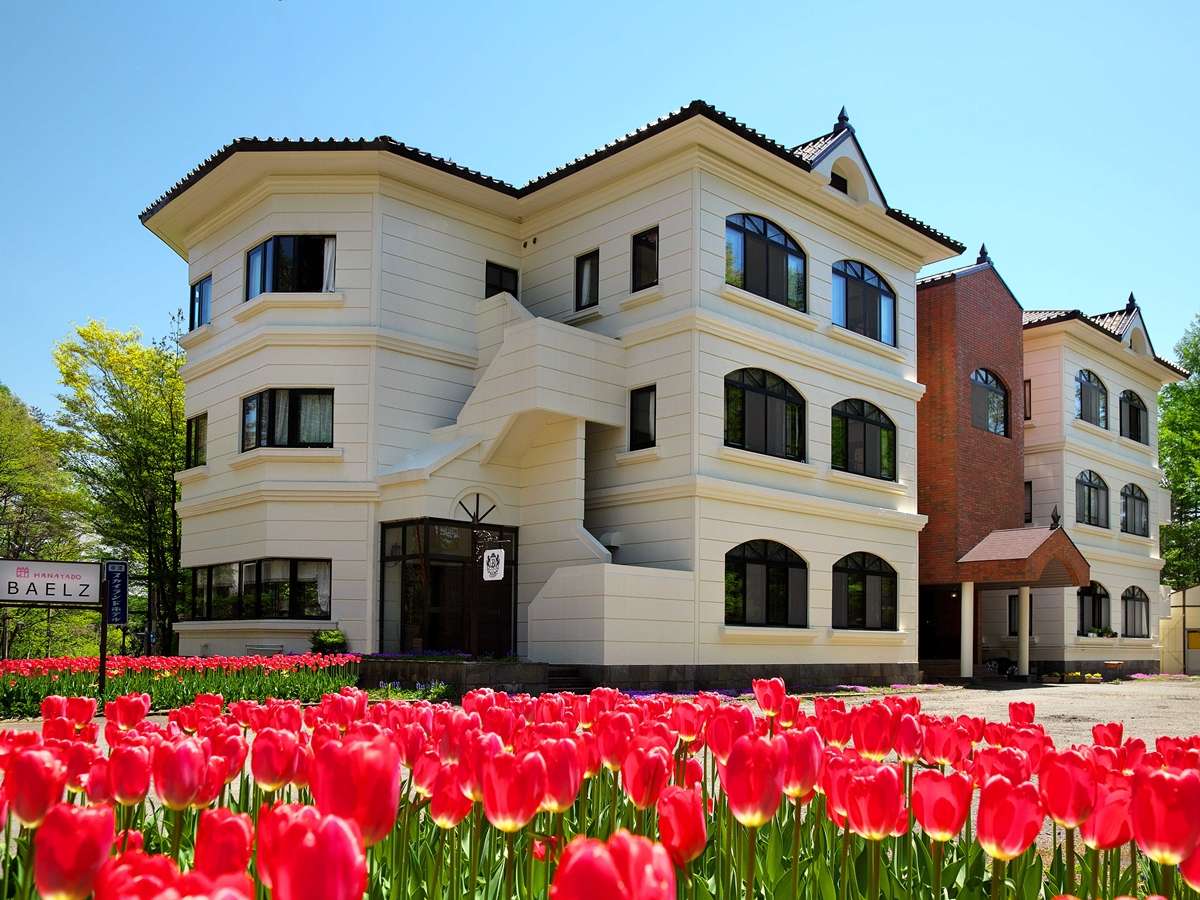
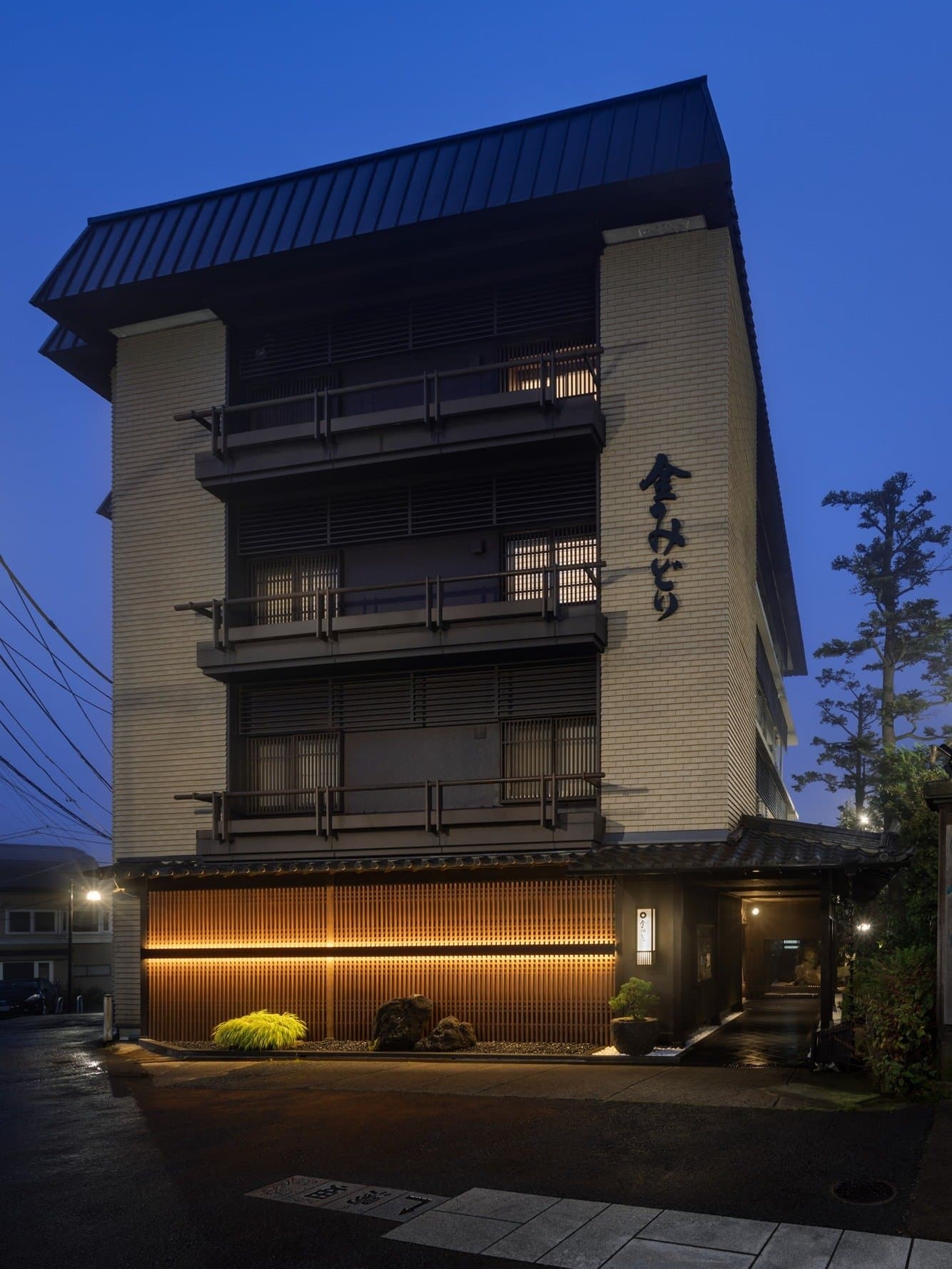
The best ryokan in Kusatsu Onsen overall is [Tsutsujitei](/en/ryokans/kusatsu-tsutsujitei) — a 10-room ultra-luxury retreat hidden within 5,000 tsubo of private woodland, with kaiseki served in private dining rooms. For all-suite stays with a private open-air bath in every room, [Yuyado Tokinoniwa](/en/ryokans/kusatsu-tokinoniwa); for heritage luxury, the 1598-founded [Kusatsu Onsen Boun](/en/ryokans/kusatsu-boun); for the original Kusatsu source water, [Naraya](/en/ryokans/kusatsu-naraya); for Yubatake-front mid-range, [Hotel Ichii](/en/ryokans/kusatsu-ichii); for the cheapest stylish budget pick, [Yubatake Souan](/en/ryokans/kusatsu-souan).
Tip
**Disclosure:** Japan Ryokan Guide earns a commission when you book through partner links. We do not accept payment from ryokans for inclusion or placement — every property here was selected on merit. The commission keeps the directory free in six languages.
Tip
**Pack tip:** Leave silver, brass and pearl-mounted jewelry in your hotel safe in Tokyo. Kusatsu's pH 2.0 sulfur water tarnishes silver in a single soak, and even walking past a steam plume on the village street exposes any silver you are wearing to trace hydrogen sulfide. Stainless steel, gold, platinum and titanium are the safe bets.
Quick-Compare: 9 Kusatsu ryokans at a glance
| # | Ryokan | Tier | From (USD) | Min to Yubatake | Best For | |---|---|---|---|---|---| | 1 | [Tsutsujitei](/en/ryokans/kusatsu-tsutsujitei) | Luxury | $400 | Shuttle | Couples wanting ultra-private 10-room seclusion | | 2 | [Yuyado Tokinoniwa](/en/ryokans/kusatsu-tokinoniwa) | Luxury | $300 | Shuttle | Suite stays with in-room private open-air bath | | 3 | [Kusatsu Onsen Boun](/en/ryokans/kusatsu-boun) | Luxury | $250 | 3 min | Heritage seekers — founded 1598, two source waters | | 4 | [Naraya](/en/ryokans/kusatsu-naraya) | Luxury | $350 | 1 min | Connoisseurs of Kusatsu's oldest source (Shirahata) | | 5 | [Hotel Ichii](/en/ryokans/kusatsu-ichii) | Mid | $120 | 0 min | Yubatake-front rooms with illumination views | | 6 | [Osakaya](/en/ryokans/kusatsu-osakaya) | Mid | $150 | 1 min | Yubatake-source water at mid-range price | | 7 | [Kusatsu Hotel 1913](/en/ryokans/kusatsu-hotel) | Mid | $130 | 5 min | Taisho-era wooden architecture lovers | | 8 | [Oyado Konoha](/en/ryokans/kusatsu-konoha) | Mid | $180 | Shuttle | Ski combo and 23-bath access via Tokinoniwa | | 9 | [Yubatake Souan](/en/ryokans/kusatsu-souan) | Budget | $90 | 1 min | Boutique room-only Meiji townhouse stays |
Why stay overnight in Kusatsu Onsen
Yes — staying overnight in Kusatsu is the single biggest upgrade you can make to a Gunma trip. The three free sotoyu close to non-guests around 5pm, the last bus to Naganohara leaves at roughly 4:50pm, and the Yubatake illumination only switches on at sunset and runs until midnight. A day-tripper literally cannot see the iconic Kusatsu photo, and cannot enter the sotoyu after the local shift change.
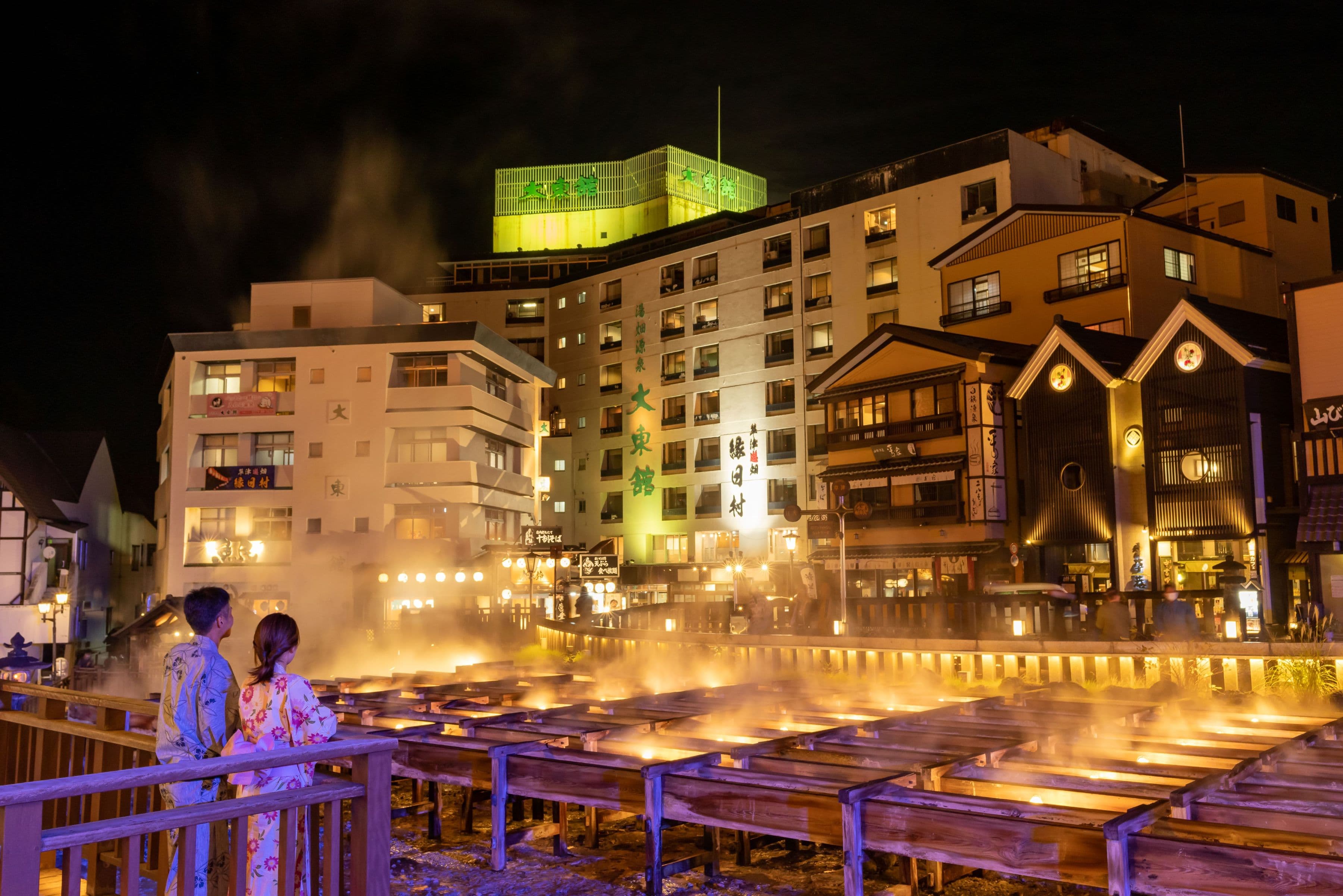
Kusatsu sits at 1,200 metres at the eastern foot of Mount Kusatsu-Shirane, an active volcano whose hydrothermal system produces the most prolific natural hot-spring flow in Japan — over 32,300 litres per minute across six named sources [verified Nippon.com 2026-05-07]. The Yubatake (湯畑) at the centre of town is not a pond as most photos suggest; it is a 60-metre wooden sluice cooling source water from roughly 70°C down to bath temperature. The sound is constant — like a small rapids — and the steam rolls northeast on most evenings because of the prevailing katabatic flow off the mountain.
The structural difference between sleeping in Kusatsu and day-tripping is the night Yubatake at 11:30pm — illuminated, half-empty and audibly alive — which exists only for guests who already have a futon waiting somewhere in town.
How we picked these 9 ryokans
We screened every operating ryokan in Kusatsu against five criteria: walking minutes to Yubatake, source-water access (which of Kusatsu's six springs feeds the bath), private-bath availability, kaiseki centred on Joshu wagyu and Gunma mountain produce, and English-readable booking. Nine properties cleared the bar — four luxury, four mid-range and one budget — and these are the nine we recommend without hedging.
No ryokan on this list paid to be included. Properties are drawn from our database of 224 vetted ryokans across 25 onsen destinations, ranked by lived experience and amenity data. For broader context, our [full Kusatsu directory](/en/area/kusatsu) lists every open ryokan in town, and [how a ryokan compares to a hotel](/en/blog/ryokan-vs-hotel) covers the dinner-included pricing model that confuses most first-timers.
A quick orientation on the price tiers below. Kusatsu ryokans range from about $90 per night for a stylish room-only Meiji townhouse at Yubatake Souan to roughly $800 per night for the top suites at Tsutsujitei. Mid-range traditional ryokans with kaiseki and onsen typically cost $150–$350 per person per night with two meals included. For a deeper breakdown of [how much a ryokan costs per night](/en/blog/ryokan-cost-per-night) across Japan, our pricing guide has the full picture.
1. Tsutsujitei — Best ultra-luxury hideaway
Best for: Couples on a milestone trip who want 10 rooms, 5,000 tsubo of private forest, and zero crossover with day-tripper Kusatsu.
At a glance: 10 rooms · ~$400–$800 USD · Private woodland a short shuttle from Yubatake.
The onsen: Source water piped privately into communal stone baths and in-room private open-air rotenburo on the higher-tier suites. Sulfur intensity is full Kusatsu strength (pH 1.6–2.1) [verified Onsenista 2026-05-07], softened slightly by the awase-yu cooling pattern.
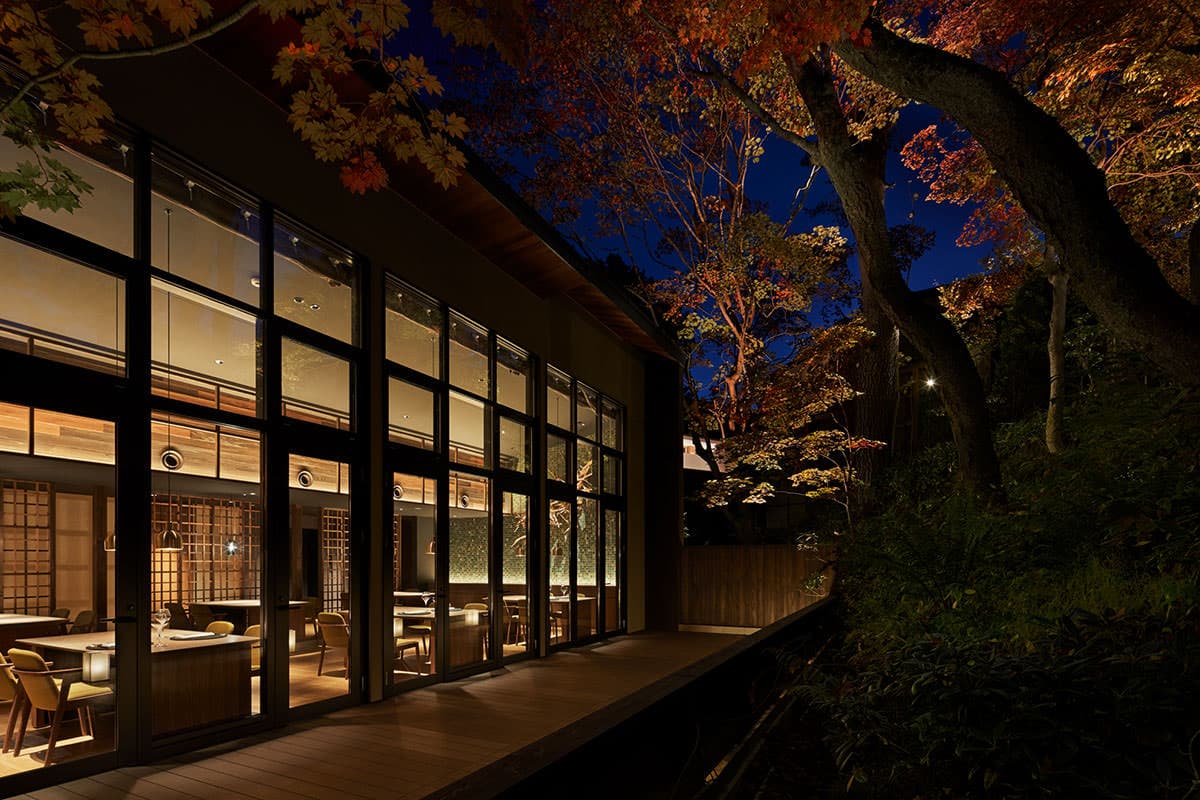
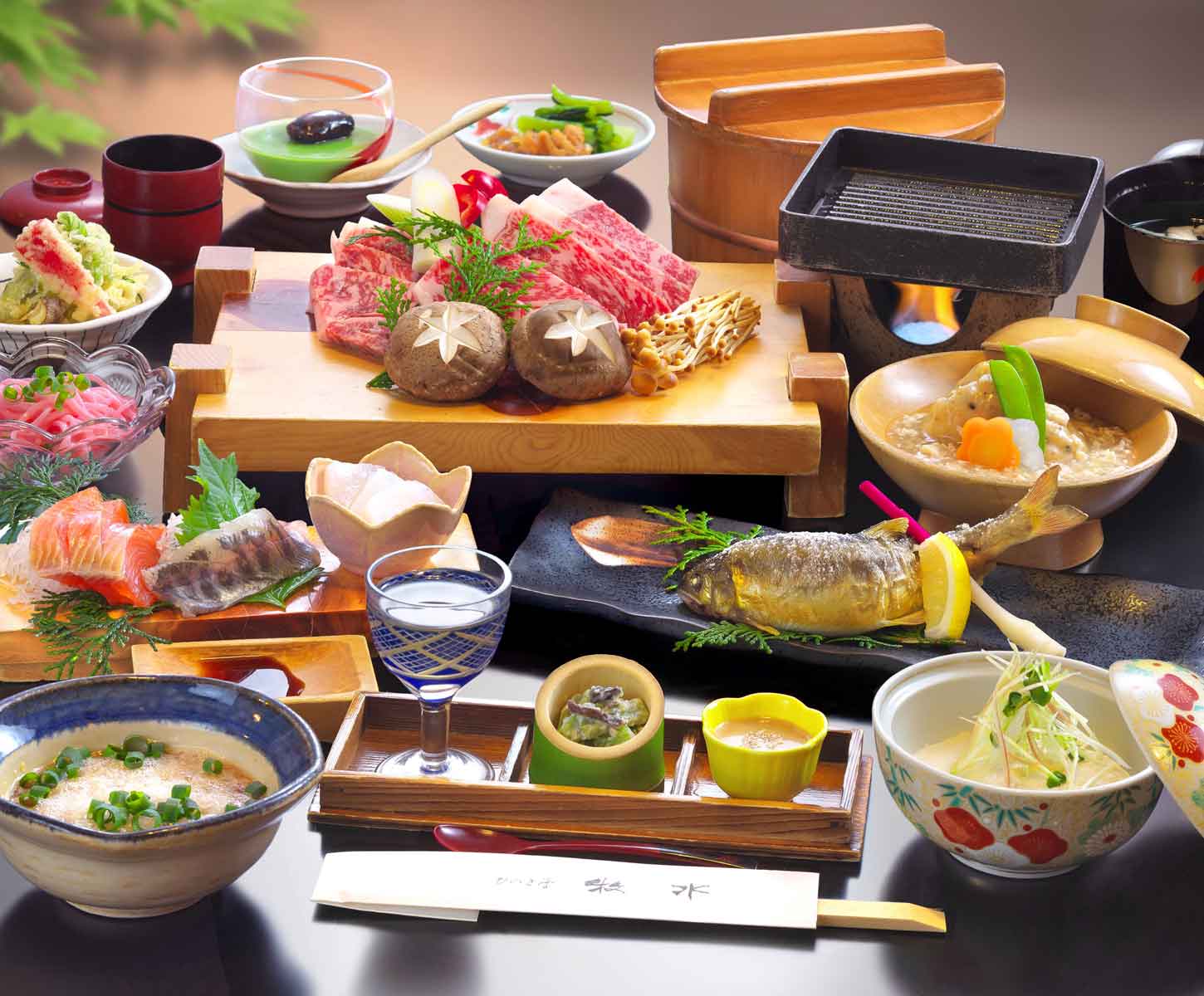
The kaiseki: Full-course kaiseki served in private dining rooms — never a communal hall. Joshu wagyu features prominently, alongside Agatsuma river fish, mountain vegetables foraged seasonally and Gunma rice. Breakfast is a multi-tray Japanese spread served the same way.
Standout detail: This is the only Kusatsu ryokan that puts genuine physical distance between you and the town. Walk five minutes from your room and you are in cedar forest, not in a yukata stroll past souvenir shops. Our [nationwide luxury ryokan rankings](/en/blog/luxury-ryokans-japan) make a natural companion read.
Honest trade-off: You give up Yubatake walking access. The shuttle solves most evenings, but if yukata-strolling under the illumination at 11pm is the priority, Naraya or Hotel Ichii will fit better. Rates run $400–$800 per person per night with two meals [approximate; verify current availability]. You can [book a room at Tsutsujitei](/en/ryokans/kusatsu-tsutsujitei) on our directory.
2. Yuyado Tokinoniwa — Best all-suite with private open-air bath
Best for: Couples and tattooed travellers who want a private rotenburo in every single room — no kashikiri reservation, no public-bath anxiety.
At a glance: 56 rooms · ~$300–$600 USD · Hillside, shuttle to Yubatake · Sister property to Oyado Konoha (shared 23-bath complex).
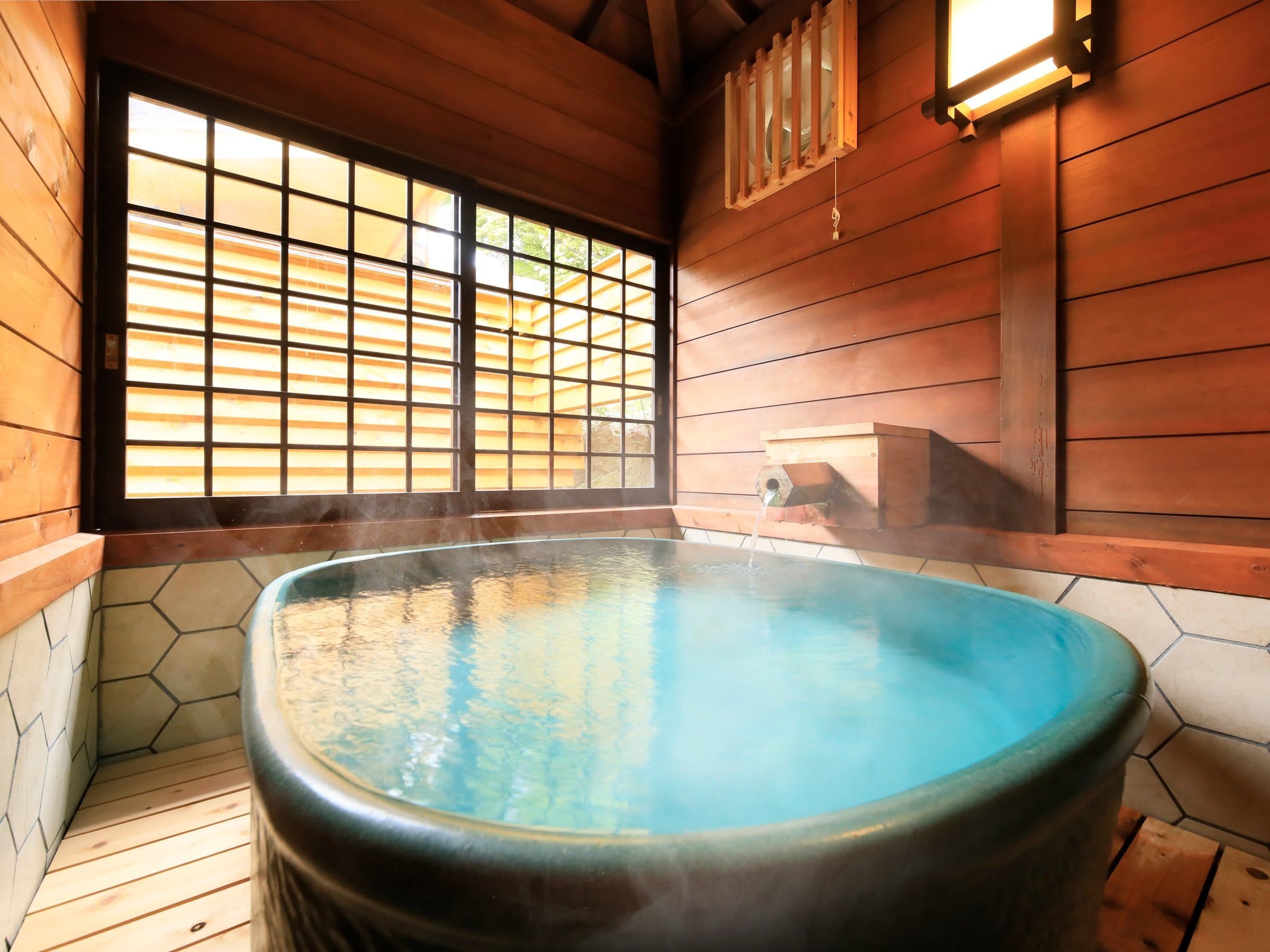
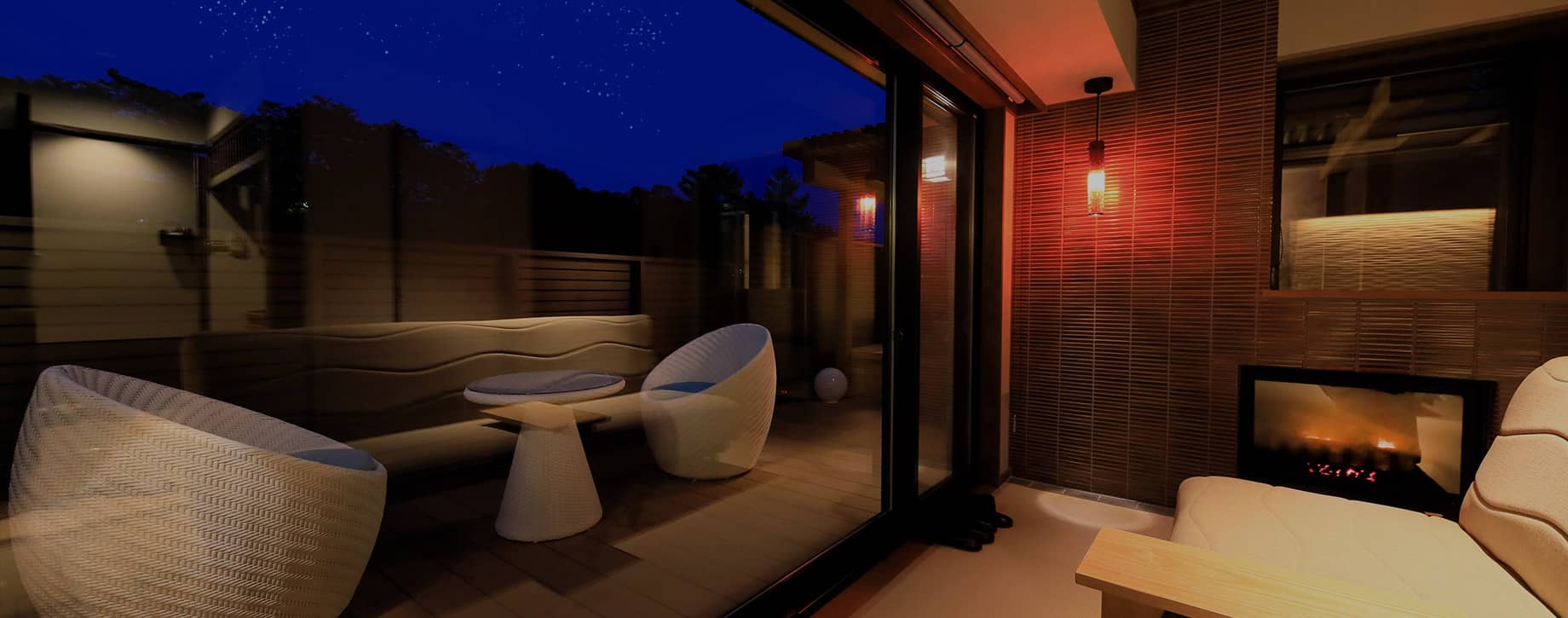
The onsen: Every guest room has a private open-air bath fed by the property's own source. On top of that, the 23 communal bath types (rotenburo, indoor stone, cypress, awase-yu cooling tubs and themed baths) form one of the largest onsen complexes in Kusatsu.
The kaiseki: Half-board kaiseki centred on Joshu wagyu, river trout (yamame) and mountain vegetable hassun courses. Dining is in private alcoves rather than guest rooms — slightly less intimate than Tsutsujitei but still well above hotel standards.
Standout detail: With 23 communal baths plus an in-room rotenburo, a two-night stay rotates without repeating a single bath. For tattooed travellers this is the most frictionless property in town — your private bath is genuinely yours, not a queue-managed kashikiri slot.
Honest trade-off: You are not on the Yubatake. The shuttle solves most evenings, but you will not stumble down to the illumination in slippers. If yukata walks under the lamps is the trip's headline image, book Naraya or Ichii instead. Rates run $300–$600 per person per night with two meals [approximate; verify current availability]. You can [see Yuyado Tokinoniwa's all-suite floor plan](/en/ryokans/kusatsu-tokinoniwa) on our directory.
Tip
**Booking tip:** Tokinoniwa and its sister property Oyado Konoha share the same 23-bath complex via a free internal shuttle. Booking the cheaper Konoha and using the shuttle gives you the same bath access for roughly 40% less per night — a tactic the front desk will confirm but that no English review surfaces.
3. Kusatsu Onsen Boun — Best heritage luxury (founded 1598)
Best for: Repeat Japan travellers who want the oldest continuously operating ryokan on this list, alternating between two named source waters.
At a glance: 42 rooms · ~$250–$550 USD · 3-minute walk from Yubatake · Founded 1598 — over 425 years of continuous operation.
The onsen: Six free-flowing kakenagashi baths fed by two named natural spring sources (Bandaiko and Wataya). Indoor and outdoor sections, plus reservable family kashikiri baths. No in-room private rotenburo — the bath story here is the heritage of the source.
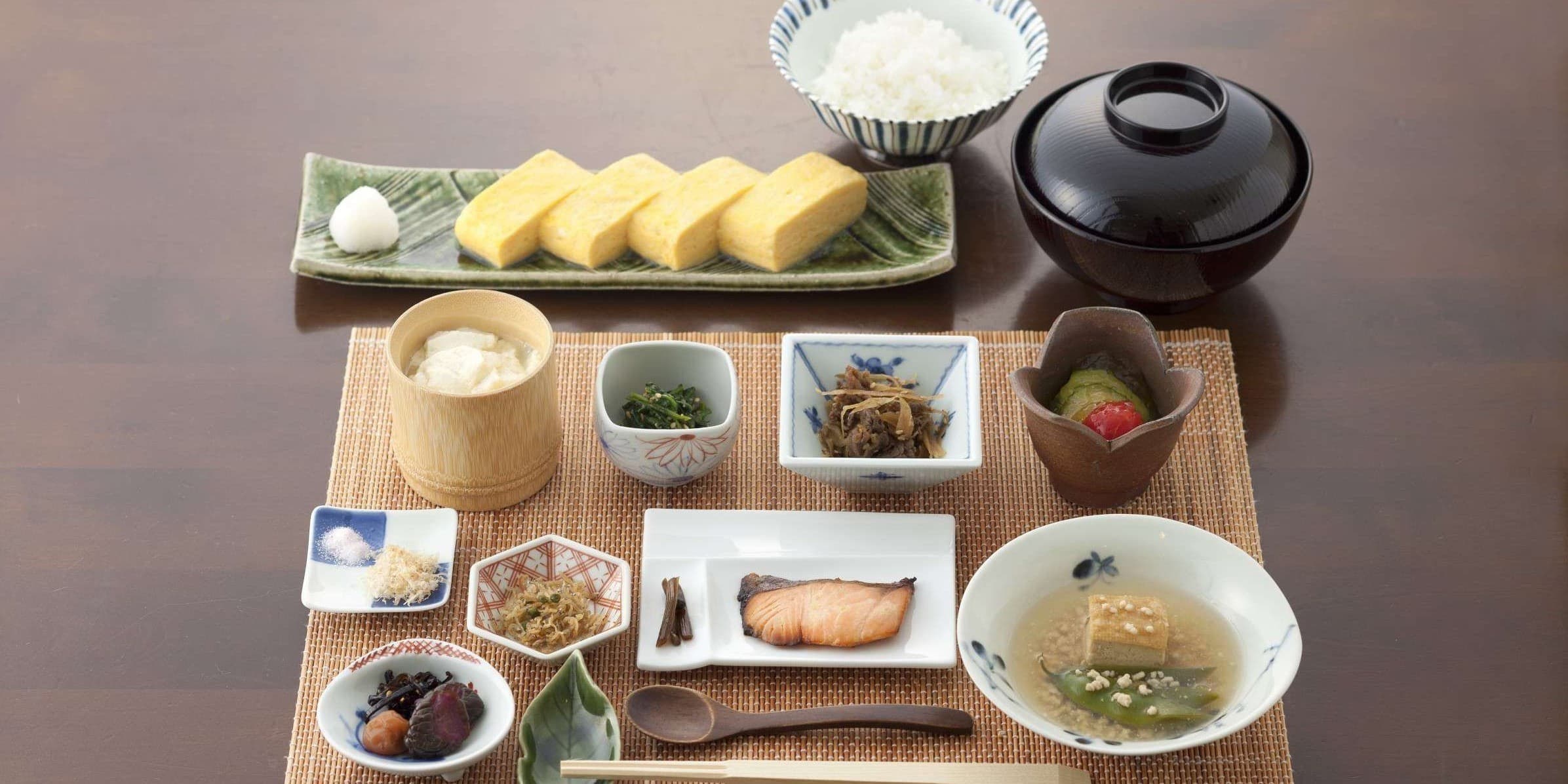
The kaiseki: Honest Joshu kaiseki centred on Gunma beef, Agatsuma river fish and seasonal mountain vegetables. Breakfast is a proper multi-tray Japanese set in the dining hall. Service is the unhurried, deeply trained welcome only properties that have been doing this for four centuries deliver.
Standout detail: Two distinct sources mean two distinct bathing experiences in one stay — Bandaiko is the more characterful, slightly hotter source; Wataya is softer and easier on first-time bathers. Front-desk staff briefed me on the difference at check-in with a printed diagram, complete with a towel-on-head trick for managing blood-pressure shifts at 1,200 metres elevation.
Honest trade-off: Not a modern boutique. Some corridors show their age, and rooms vary widely by wing — specify a refurbished room at booking if interior aesthetics matter. Rates run $250–$550 per person per night with two meals [approximate; verify current availability]. You can [check rates at Kusatsu Onsen Boun](/en/ryokans/kusatsu-boun) on our directory.
4. Naraya — Best for the original Kusatsu source water
Best for: Onsen connoisseurs who came to Kusatsu for the water chemistry — Naraya draws Shirahata-no-yu, the oldest of Kusatsu's six sources.
At a glance: 36 rooms · ~$350–$700 USD · 1-minute walk from Yubatake · Established 1877.
The onsen: Three indoor and three outdoor baths fed by Shirahata source — the most acidic of the six Kusatsu springs and the one Tokugawa-era visitors travelled here for. The water is full pH 1.6–1.8 strength, antibacterial, and stings if you have shaved in the past 12 hours. Reservable in-room private baths are available on higher tiers.
The kaiseki: Refined Joshu kaiseki in private dining rooms — Joshu wagyu shabu-shabu, Agatsuma yamame trout, seasonal hassun and a sake list curated specifically against the local water. Breakfast is one of the best on this list.
Standout detail: I forgot to remove a thin silver band before my first soak at Sainokawara on a previous trip — eight minutes of water, twelve hours of patina, and the ring went from polished to gunmetal grey. The front desk at Naraya keeps a small lacquer tray of forgotten jewellery behind the counter and a printed sign in four languages. That the warning is multilingual at a luxury property tells you exactly how strong the water is.
Honest trade-off: The price step from Boun is real, and the 'oldest source' premium is partly intangible — if you cannot taste a pH difference, the spend is hard to rationalise. Rates run $350–$700 per person per night with two meals [approximate; verify current availability]. The full breakdown lives on [Naraya's Shirahata-no-Yu page](/en/ryokans/kusatsu-naraya).
Tip
**Source tip:** Naraya draws from Shirahata-no-yu, the oldest of Kusatsu's six named sources. Ask the front desk for the gensen-meguri (源泉巡り) map — it shows which named source feeds each bath in town. Boun draws Bandaiko and Wataya; Osakaya draws Yubatake-gen-sen; Hotel Ichii draws directly from the Yubatake itself. Treat it like wine terroir.
5. Hotel Ichii — Best right on Yubatake
Best for: First-time visitors and photographers who want their bedroom window to look directly over the steaming Yubatake.
At a glance: 110 rooms · ~$120–$300 USD · 0-minute walk — the property faces Yubatake directly · 300-year-old institution.
The onsen: A large indoor and outdoor public bath complex fed directly from the Yubatake source, plus reservable kashikiri family baths. No in-room private rotenburo, but the public baths are the largest of any mid-range Kusatsu property.
The kaiseki: Half-board kaiseki served in private dining rooms (premium tiers) or a communal hall (standard tiers). Joshu wagyu, river fish, seasonal vegetables. Breakfast is a multi-dish Japanese set with a small Western corner for kids who refuse rice in the morning.
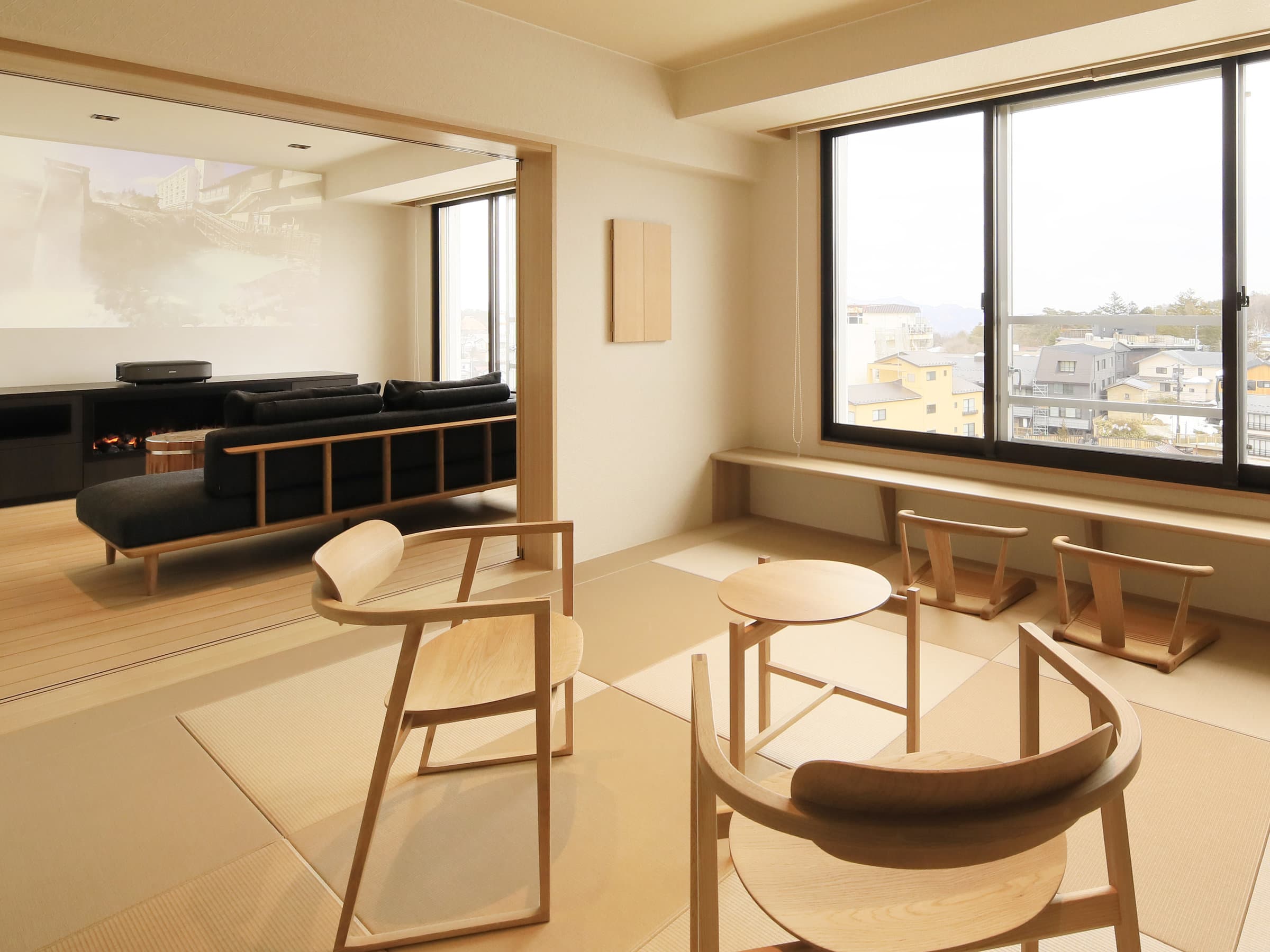
Standout detail: Of the 110 rooms, 23 face Yubatake directly. Booking one means you wake to the steam columns at sunrise and watch the illumination from your window at 9pm. From the southwest-facing rooms you can shoot at f/2.8 in the 30 minutes after sunset and frame the steam against the lamps — the angle most iconic Kusatsu photos use.
Honest trade-off: The 110-room scale shows. Service is professional rather than personal, and check-in can queue at peak hours. Specify a yubatake-gawa (湯畑側) room at booking — without that explicit request, you may end up back-facing at the same rate. Rates run $120–$300 per person per night with two meals [approximate; verify current availability]. You can [see Hotel Ichii's Yubatake-view rooms](/en/ryokans/kusatsu-ichii) on our directory.
6. Osakaya — Best mid-range one minute from Yubatake
Best for: Mid-range travellers who want Yubatake-source water at half the Naraya price, plus reservable in-room private baths on upper tiers.
At a glance: 31 rooms · ~$150–$350 USD · 1-minute walk from Yubatake · Draws water from Yubatake-gen-sen.
The onsen: Two public baths plus reservable kashikiri private baths, all fed from the Yubatake source — the same headline water that runs through the wooden sluice at the centre of town. Some upper-tier rooms have a private open-air bath.
The kaiseki: Half-board Joshu kaiseki in a communal dining hall — quality is consistent rather than spectacular, with Joshu wagyu and river fish on the standard course. Breakfast follows the multi-tray Japanese template.
Standout detail: Osakaya's price-to-water ratio is the most aggressive on the list. You are paying mid-range rates for the same headline source that feeds the most-photographed feature in town — the most efficient pick for first-timers on a budget who still want real Kusatsu water.
Honest trade-off: Rooms are functional rather than design-led — clean, comfortable, not photogenic. Communal dining at standard tiers is fine for solo travellers but reduces the romance for couples; pay up to a private-dining tier if that matters. Rates run $150–$350 per person per night with two meals [approximate; verify current availability]. You can browse [Osakaya's Yubatake-source bath](/en/ryokans/kusatsu-osakaya) on our directory.
Tip
**Yubatake-front tip:** The illumination runs from sunset until midnight. The best viewing window from a guest room is 8:30pm to 9:30pm — late enough that the dinner crowds have dispersed, early enough that lighting is still in full swing. Request 'yubatake-gawa' (湯畑側) explicitly when booking Osakaya, Hotel Ichii or Yubatake Souan.
7. Kusatsu Hotel 1913 — Best Taisho-era charm at mid-range
Best for: Architecture lovers who want a wooden, creaking, heritage building over a renovated modern interior.
At a glance: 40 rooms · ~$130–$300 USD · 5-minute walk from Yubatake · Built 1913 (Taisho era).
The onsen: Indoor and outdoor public baths fed by a kakenagashi free-flowing system, plus a reservable kashikiri family bath. Some rooms have a private bath. The bath buildings are wooden, period-appropriate and a working part of the architectural story.
The kaiseki: This is where the property surprised me — the kaiseki finale was a small ceramic pot of yamame (river trout) cooked over a single binchotan coal at the table. The fish came from the Agatsuma river three kilometres downhill, the pot was Mashiko-yaki and the rice was Koshihikari from Numata, an hour away. That is the entire Gunma plate in one course: river, mountain, kiln, rice paddy. For more on the morning meal, see our [Japanese ryokan breakfast](/en/blog/japanese-breakfast-ryokan) guide.
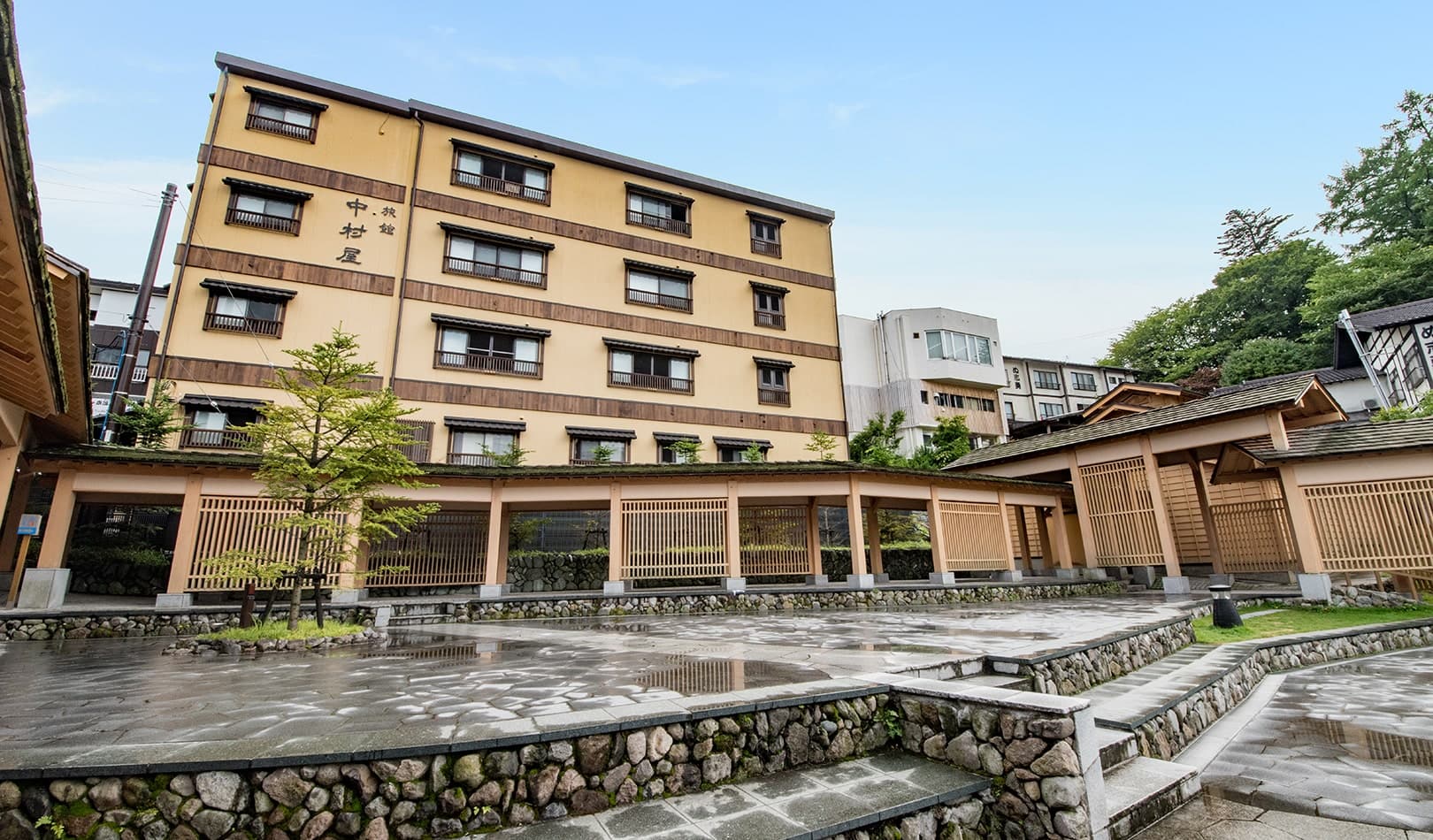
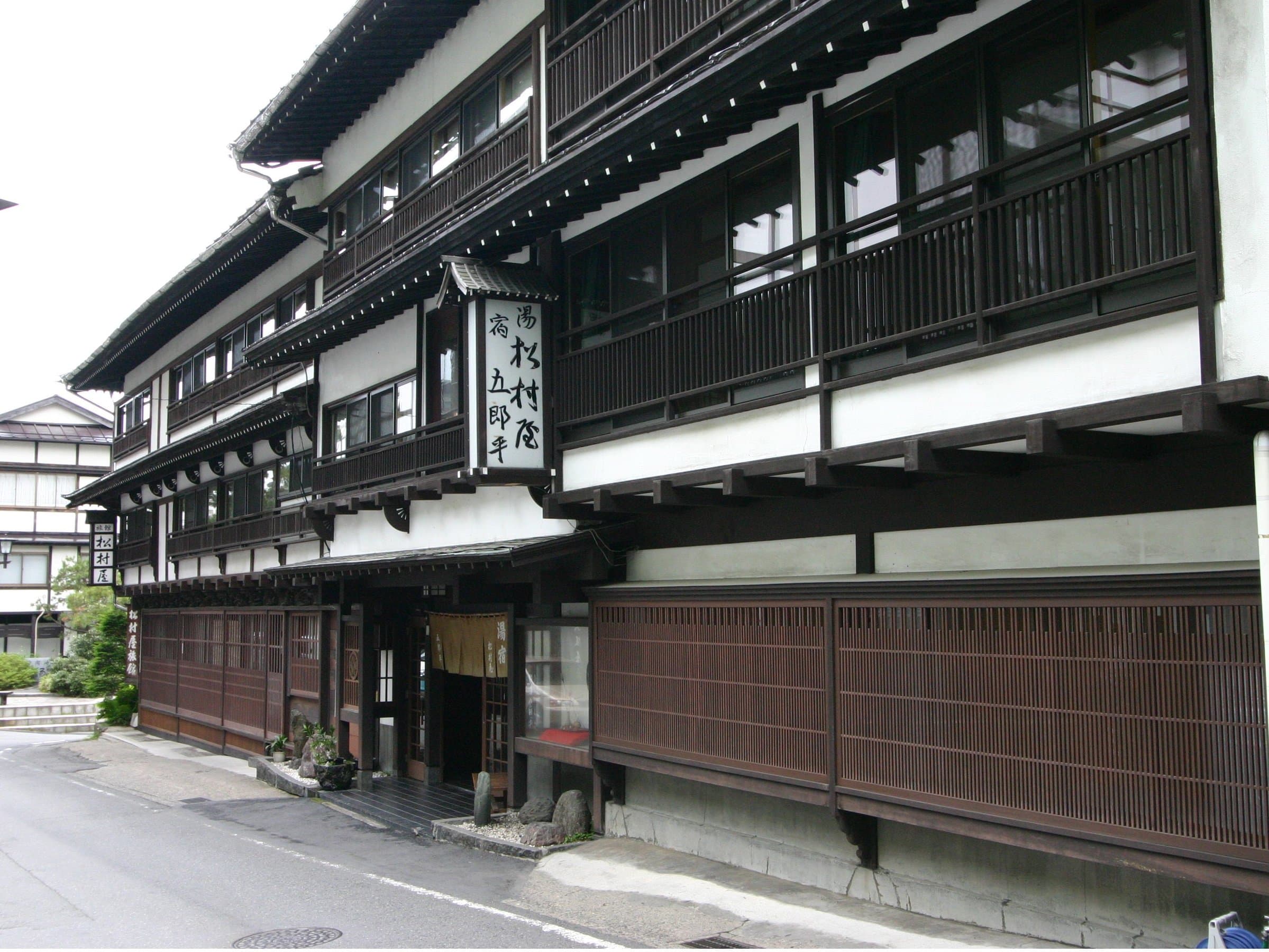
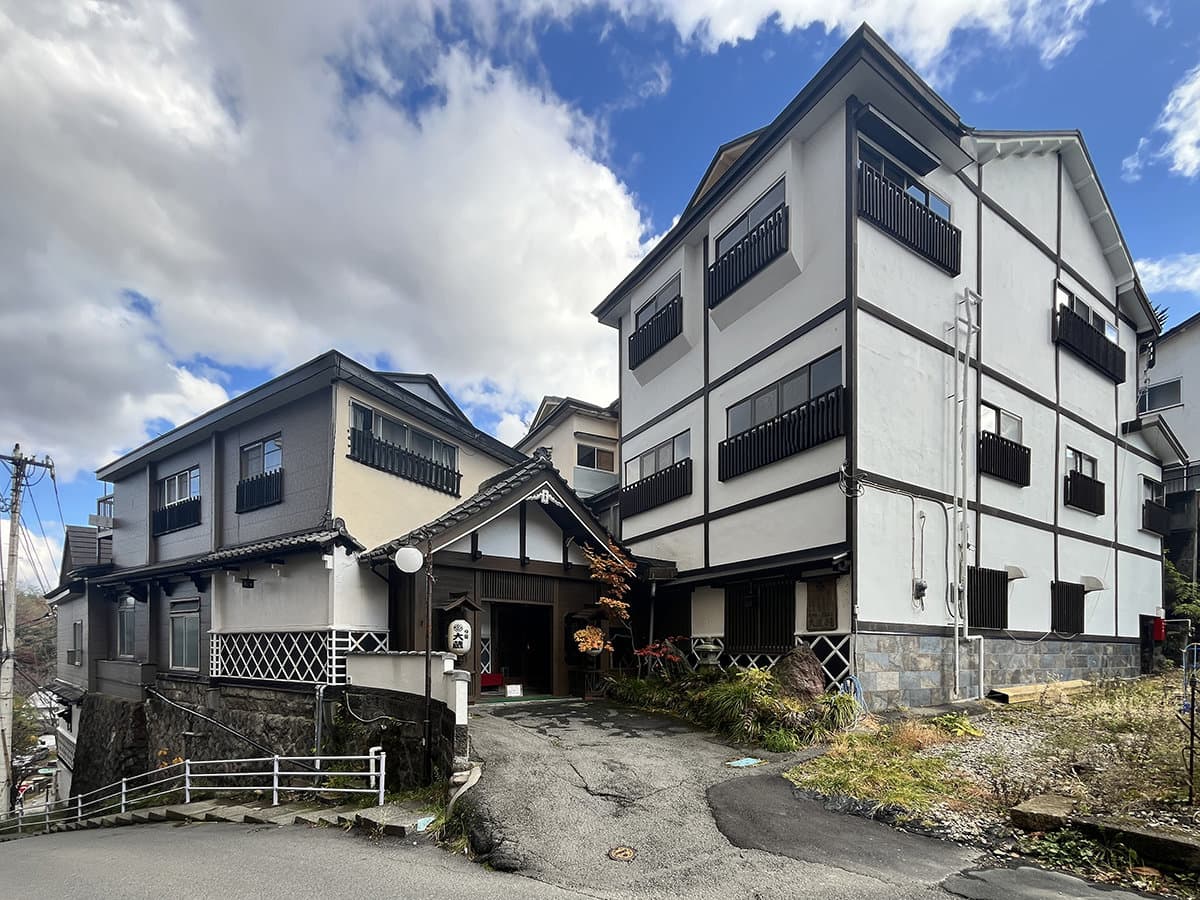
Standout detail: [The 1913 Taisho-era Kusatsu Hotel](/en/ryokans/kusatsu-hotel) is registered as a Tangible Cultural Property of Japan, and the wooden facade — white plaster offset by dark cedar trim — is genuinely from the original 1913 construction. You are sleeping in heritage architecture, not a heritage-themed renovation.
Honest trade-off: Heritage means heritage. Floors creak, soundproofing is what it was in 1913, and a few older rooms run cold in deep winter despite supplemental heating. Ask for a renovated wing room if either point matters. Rates run $130–$300 per person per night with two meals [approximate; verify current availability].
8. Oyado Konoha — Best hillside mid-range with 23-bath access
Best for: Skiers and bath-hoppers who want sister-property access to Tokinoniwa's 23-bath complex at mid-range pricing.
At a glance: 48 rooms · ~$180–$350 USD · Hillside, shuttle to Yubatake · Sister property to Yuyado Tokinoniwa.
The onsen: On-property indoor and outdoor public baths plus full shared access to Tokinoniwa's 23-bath complex via a free internal shuttle. No in-room private rotenburo at this tier — that is the trade-off versus Tokinoniwa itself.
The kaiseki: Half-board Joshu kaiseki featuring Gunma beef, river fish and a generous seasonal hassun. The property is famous for complimentary late-night ramen service after dinner — a touch that sounds gimmicky until you have soaked for two hours and need the carbohydrates.
Standout detail: [Oyado Konoha (sister property to Tokinoniwa)](/en/ryokans/kusatsu-konoha) is the cheapest way into Tokinoniwa's 23-bath system. If you spend a stay rotating baths rather than sitting in your room, this is the most cost-efficient property on the list. The free Kusatsu Onsen Ski Resort shuttle from December through March makes it the strongest ski-combo pick.
Honest trade-off: Hillside means a shuttle ride to Yubatake. The shuttle runs every 30 minutes most evenings, but late-night returns can require a taxi. If you are doing nightly Yubatake walks, factor the shuttle gap in. Rates run $180–$350 per person per night with two meals [approximate; verify current availability].
Tip
**Ski-combo tip:** The Kusatsu Onsen Ski Resort 2025–26 season runs late December through early April, and the resort is roughly 10 minutes by shuttle from Konoha and most luxury Kusatsu ryokans [verified ANA Japan Travel Planner 2026-05-07]. Confirm the shuttle schedule when booking — most properties run fixed morning departures and afternoon returns rather than on-demand service. See our [winter onsen towns](/en/blog/best-winter-onsen) ranking for the wider snow-onsen context.
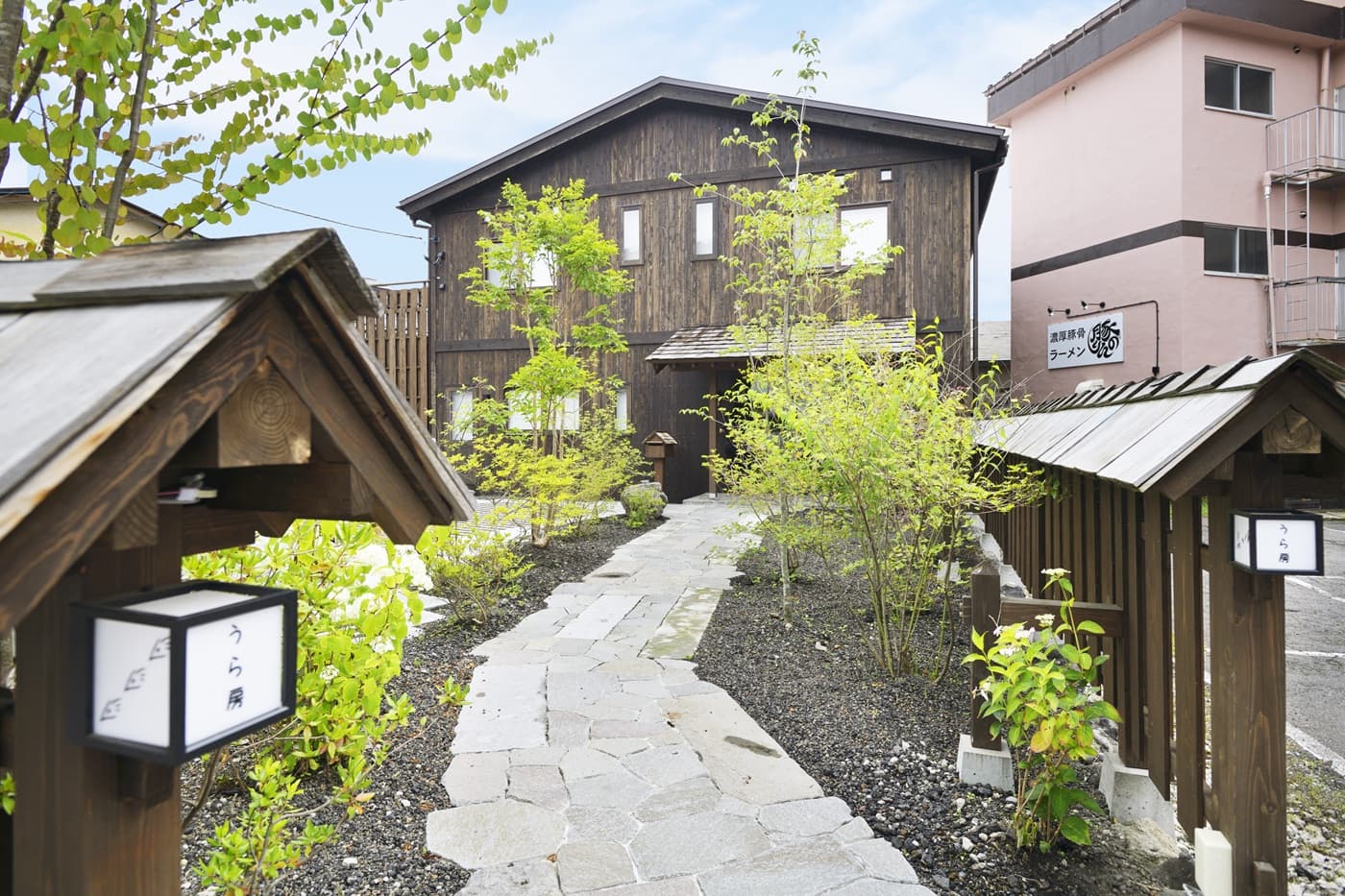
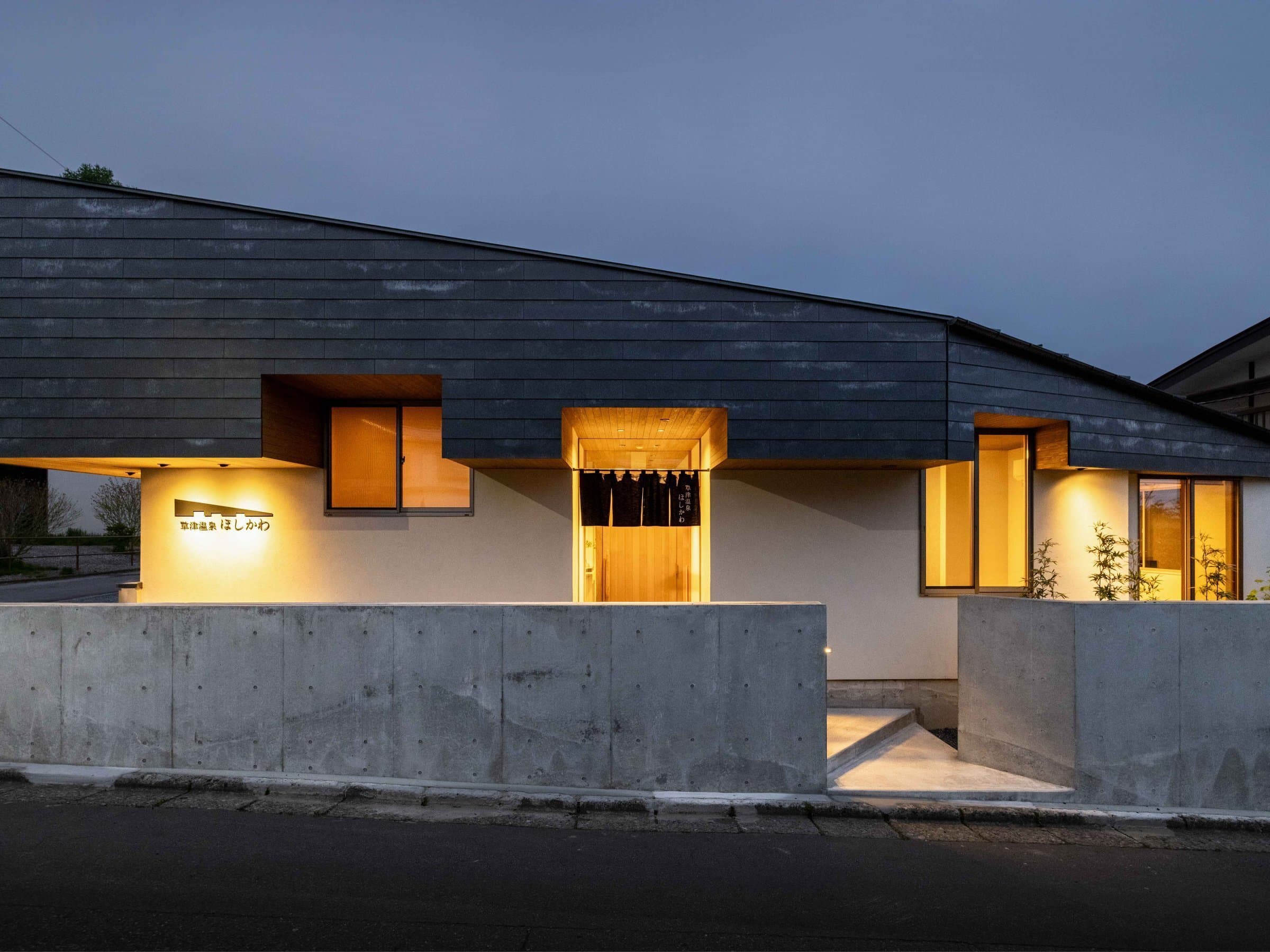
9. Yubatake Souan — Best budget room-only Meiji townhouse
Best for: Solo travellers, budget couples and bath-hoppers who plan to eat at local izakaya rather than commit to kaiseki.
At a glance: 16 rooms · ~$90–$200 USD · Steps from Yubatake · Meiji-era wooden building converted into a stylish room-only inn.
The onsen: A small but characterful onsen bath fed from the Yubatake area. Some upper-tier rooms have a private bath. The on-site foot-bath cafe is open to the public and often busy — a feature, not a bug, if you want to feel embedded in town life.
The kaiseki: None. Souan is an explicit room-only operation. The trade-off is freedom — you eat where you want, when you want, for what you want to spend. Local izakaya, ramen and the foot-bath cafe itself cover most evening meals. For more tactics, see our [budget ryokan tips](/en/blog/budget-ryokan-tips) guide.
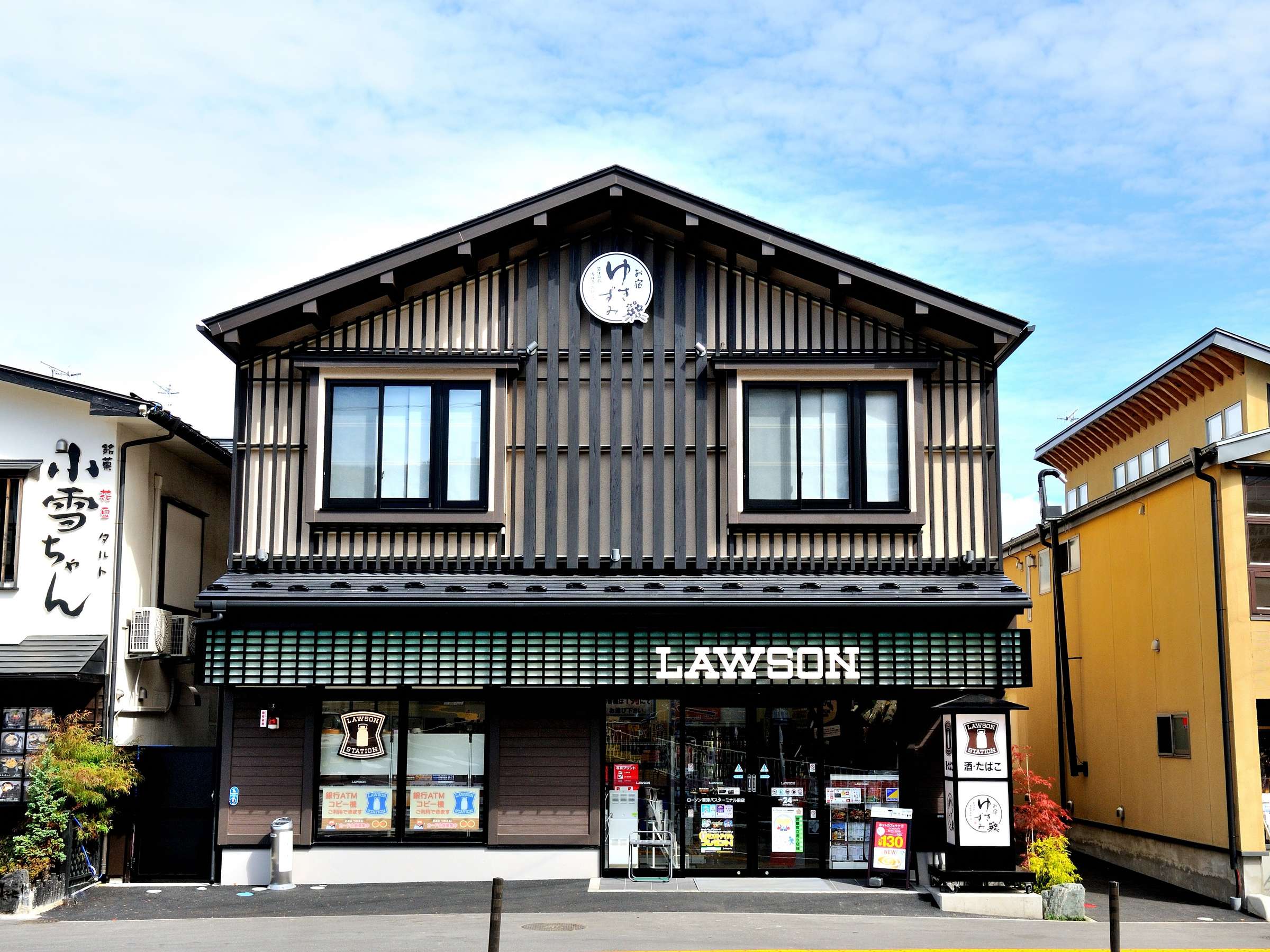
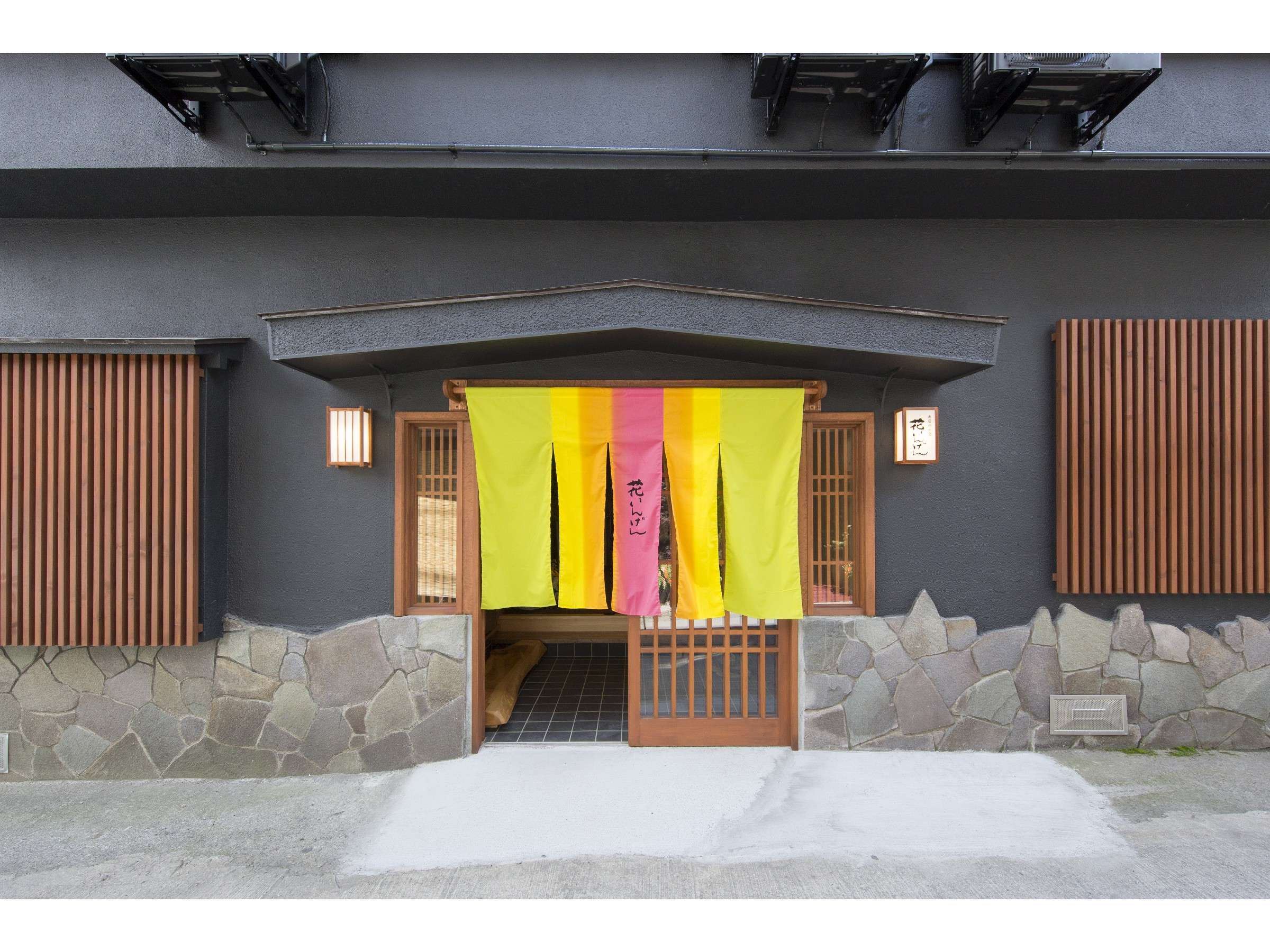
Standout detail: The building is a converted Meiji-era wooden townhouse — exposed beams, narrow corridors, period sliding doors — restyled with a contemporary boutique sensibility. For the price, the design quality is genuinely above tier; this is the rare budget pick that does not feel like a budget pick.
Honest trade-off: No kaiseki means no in-room dinner experience. If the romance of yukata-and-kaiseki-by-low-table is the reason you are coming to a ryokan, Souan is the wrong choice. The 16-room scale also means it books out three to four months ahead for spring and autumn weekends. Rates run $90–$200 per person per night, room-only [approximate; verify current availability]. You can see [Yubatake Souan room-only details](/en/ryokans/kusatsu-souan) on our directory page.
Yubatake and the three sotoyu: the Kusatsu primer
Almost every English guide says 'three free public baths for ryokan guests', and almost every English guide gets the mechanism wrong. Here is the correct version.
The three sotoyu (外湯) — Shirahata-no-yu, Chinoiri-no-yu and Jizo-no-yu — are local-managed public baths in the Kusatsu village core. Most participating ryokans hand you a 入湯手形 (Nyuto-Tegata) on check-in, a small wooden or paper token granting entry. Walk-in tourists without a participating ryokan reservation cannot enter these three. Naraya, Boun, Tsutsujitei and Tokinoniwa all participate; budget room-only inns may not — confirm at booking.
The three paid public baths — Otakinoyu, Gozanoyu and Sainokawara — are different. They are open to everyone, ryokan guest or not, and charge ¥800 to ¥900 per entry [verified Kusatsu Onsen Public Baths 2026-05-07]. Sainokawara is the famous outdoor bath in a riverside park, with seasonal hours — 7am–8pm April through November, 9am–8pm December through March [verified Visit Gunma 2026-05-07]. Otakinoyu is the place to learn the awase-yu method — four tubs at 38°C, 40°C, 42°C and 44–46°C arranged as a step ladder.
The angle for the iconic Yubatake photograph is from the southwest side of the channel, facing northeast, in the 30 minutes after sunset — that is when the steam columns frame the lamps cleanly. By 11pm on a weekday in February I have walked the whole channel with only a single resident cat for company.
Yumomi: the water-cooling performance at Netsu-no-yu
Yumomi (湯もみ) is a traditional cooling ritual in which performers stir Kusatsu's scalding source water with 180-centimetre cedar paddles while singing the local folk song Kusatsu Yoi Toko. The performance runs six times daily at Netsu-no-yu on the edge of Yubatake — at 9:30am, 10:00am, 10:30am, 3:30pm, 4:00pm and 4:30pm — for about ¥600 per adult [verified Kusatsu Onsen Tourism Assoc 2026-05-07]. On weekends and holidays between 11:30am and 2pm, audience members can pay ¥250 to try the paddle themselves.
Every guide tells you about the six daily shows; almost none tells you which is best. The 4:00pm performance is the most photographed — tour buses cluster between 3:30 and 4:30. The 9:30am show is half-empty, you can sit centre-front, and the morning light through Netsu-no-yu's upper windows hits the steam at the angle that makes every photo look like a 1960s NHK documentary. Go at 9:30am.
Sulfur, skin and silver: how to bathe in Kusatsu without surprises
Kusatsu's water is the most acidic of any major onsen town in Japan — pH 1.6 to 2.1 across the named sources, classified as a hydrogen-sulfide / acidic spring [verified Onsenista 2026-05-07]. That chemistry is the reason a single soak feels like skin treatment rather than a warm bath, and the reason Kusatsu requires a few specific precautions other onsen towns do not.
Skin response. Acidic water is bactericidal. Most bathers feel a mild tingle across the shoulders and behind the knees. Sensitive-skin guests should soak no more than 10 minutes per session, rinse with the agari-yu (finishing fresh-water tap, not the spring) before exiting, and alternate sulfur and non-sulfur days. If you have shaved within the past 12 hours, do not splash water on your face.
Silver and brass. Hydrogen sulfide aerosolises. Silver sulfide forms within minutes of contact, and walking past Yubatake or standing in a steam plume is enough to tarnish a silver chain under your collar. Toothpaste will not fix the patina once it is deep. Leave silver, brass and pearl-mounted jewellery in your safe. Stainless steel, gold, platinum and titanium are unaffected.
Two nights, not one. Single-night Kusatsu trips waste the water. The town's ancient Yu-Mawari (湯廻り) ritual — visiting all sotoyu in sequence over multiple days — exists because one rotation is not the dose. On a one-night stay you get the experience; on a two-night stay your skin texture changes, mild sinus clearing kicks in, and sleep depth shifts noticeably.
Tip
**Sensitive-skin tip:** Soak for a maximum of 10 minutes per session. Rinse with agari-yu fresh-water tap (not the spring) before exiting. Alternate sulfur and non-sulfur days where possible — a non-sulfur option is a private bath fed by a different source on the property. Read our [first-timer onsen etiquette guide](/en/blog/onsen-etiquette-foreigners) before your first soak.
How to choose your Kusatsu ryokan by trip type
Kusatsu is small enough that no ryokan is meaningfully far from town centre — the Yubatake is the gravitational point and almost everything is a 1- to 5-minute walk or short shuttle away. The trip-type decision matrix below resolves the most common reader questions in one place.
First-time couples on a milestone trip: Tsutsujitei for ultra-private 10-room seclusion, or Naraya for oldest-source water with Yubatake walking access.
Tattooed travellers: Tokinoniwa is the frictionless choice — every room has a private rotenburo, no kashikiri reservation needed. The three sotoyu are also explicitly tattoo-welcoming. See our [tattoo-friendly ryokans](/en/blog/tattoo-friendly-ryokans) cross-reference.
Families with young kids: Hotel Ichii at the standard tier — large rooms, communal dining, a bath complex big enough that nobody feels crowded, and Yubatake-front rooms for the illumination. Our [ryokans with kids](/en/blog/ryokan-with-kids) guide covers the broader logistics.
Skiers in the December–March window: Konoha for the resort shuttle and 23-bath complex access. Tokinoniwa for the upgrade option from the same family.
Budget travellers and bath-hoppers: Yubatake Souan room-only at the centre of town, eating at local izakaya and rotating sotoyu and paid public baths across two days.
Sensitive-skin guests: Boun is the gentlest of the heritage luxury options — Wataya is the softer of its two springs and the staff brief you on bathing rhythm at check-in.
Getting to Kusatsu: train, bus and the Karuizawa combo
The route from Tokyo to Kusatsu is straightforward but does not involve a shinkansen — that is the most common first-timer surprise.
Four steps, in order:
1. From Ueno or Shinjuku, take the Limited Express Kusatsu (JR) to Naganohara-Kusatsuguchi — about 2.5 hours, JR Pass valid [verified ANA Japan Travel Planner 2026-05-07]. This is the fastest rail option. 2. From Naganohara-Kusatsuguchi, board the JR Kanto bus to Kusatsu Onsen Bus Terminal — about 25 minutes, around ¥710. Most ryokans are within 5 to 10 minutes of the terminal on foot. 3. Alternative: the Shinjuku highway bus runs about 4 hours non-stop directly to Kusatsu Onsen Bus Terminal, bypassing Naganohara. JR Pass does not cover it. 4. Karuizawa combo: the JR Kanto bus runs between Kusatsu Onsen and Karuizawa Station in roughly 80 minutes. Two nights in Kusatsu plus one in Karuizawa, then the Hokuriku Shinkansen back to Tokyo, is one of the most efficient itinerary loops in the region.
Luggage tip: send the big suitcase via Yamato Takkyubin from your Tokyo hotel direct to your ryokan (about ¥2,000 per bag, next-day delivery). Arriving in Kusatsu with only an overnight bag is the cleaner solution.
Best time of year for a Kusatsu ryokan stay
The four-season picture, in priority order for an overnight stay.
Mid-December through March for snow and skiing. The Kusatsu Onsen Ski Resort is 10 minutes by shuttle and runs a long season; the steam-versus-snow contrast at Yubatake is the strongest visual the town offers. Sainokawara outdoor baths are open 9am–8pm in this window — one of the few places in Japan where you can soak in pH 1.8 sulfur water with snow falling on your hair. Book ski-combo properties — Konoha or Tokinoniwa — by October.
Late October through early November for autumn foliage. Joshinetsu Kogen National Park surrounds Kusatsu, and the larch and maple turnover at 1,200 metres elevation is spectacular. Mid-week stays in this window have far better availability than the foliage peak weekends.
Early August for the Kusatsu Onsen Festival. Three days of mikoshi processions, fireworks and special yumomi shows. Rates spike 20–30% across the festival window; book three months ahead.
Avoid late April through early May (Golden Week surcharges). Late January through early March offers the best mid-week availability across the luxury tier.
If Kusatsu is one stop on a wider trip, our guide to [Japan's best onsen towns](/en/blog/best-onsen-towns-japan) maps out where to head next, and our [winter onsen ranking](/en/blog/best-winter-onsen) covers the snow side of the calendar.
Kusatsu ryokan FAQ
Which is the best ryokan in Kusatsu Onsen?
For ultra-luxury seclusion, Tsutsujitei — 10 rooms inside 5,000 tsubo of private woodland. For oldest-source heritage one minute from Yubatake, Naraya (established 1877, Shirahata source). For Yubatake-front mid-range with illumination views from the room, Hotel Ichii. For boutique room-only stays under $200, Yubatake Souan.
How many days should I stay in Kusatsu?
Two days and one night is the standard Kusatsu trip — but two nights is the better one. One night gives you the dusk Yubatake, dinner, one onsen rotation and breakfast. Two nights add the second-day skin response, the half-empty 9:30am yumomi, the full Yu-Mawari sotoyu rotation, and time for a Mount Shirane day trip or a Karuizawa side combo.
Are Kusatsu ryokans walking distance from Yubatake?
Most are within 1 to 5 minutes on foot. Hotel Ichii sits directly on Yubatake; Naraya, Osakaya and Yubatake Souan are 1 minute away; Boun and Kusatsu Hotel 1913 are 3 to 5 minutes. Tsutsujitei, Tokinoniwa and Konoha are hillside or out-of-town and run shuttles.
Is Kusatsu's sulfur water safe for sensitive skin?
Kusatsu's pH 1.6–2.1 is the most acidic onsen water in Japan. It is bactericidal but can irritate sensitive skin and tarnishes silver jewellery. Most ryokans recommend a 10-minute maximum soak, rinsing with the agari-yu fresh-water tap before exiting, and alternating sulfur and non-sulfur days [verified Onsenista 2026-05-07].
How do I get to Kusatsu Onsen from Tokyo?
Take the Limited Express Kusatsu (JR) from Ueno or Shinjuku to Naganohara-Kusatsuguchi — about 2.5 hours, JR Pass valid — then a 25-minute JR Kanto bus to Kusatsu Onsen Bus Terminal. There is no direct shinkansen. The Shinjuku highway bus runs about 4 hours non-stop direct.
Can I combine Kusatsu Onsen with skiing?
Yes. Kusatsu Onsen Ski Resort is 10 minutes by shuttle, with a December-through-early-April season. Konoha and Tokinoniwa run dedicated ski shuttles; most luxury ryokans offer lift-discount packages.
How is Kusatsu different from Hakone?
Kusatsu is sulfur-acidic alpine onsen at 1,200 metres with the strongest water in Japan, no Tokyo day-trip option, and a winter ski combo. Hakone is varied spring chemistry at lower elevation, Mt Fuji views, and easy 90-minute access from Tokyo. See [our Japan-wide onsen comparison](/en/blog/best-onsen-towns-japan), and [how a ryokan compares to a hotel](/en/blog/ryokan-vs-hotel).
Are Kusatsu ryokans tattoo-friendly?
Kusatsu is unusually welcoming for a major onsen town — all three free sotoyu accept tattoos officially, and the paid public baths follow similar policy. For ryokan baths, Tokinoniwa is the frictionless pick because every room has a private rotenburo. See our [tattoo-friendly ryokans](/en/blog/tattoo-friendly-ryokans) directory.
Final thoughts: bathing in the most acidic water in Japan
The case for an overnight in Kusatsu is structural, not aspirational. The town runs on day-tripper time during the day and ryokan-guest time at night, and choosing where to sleep is how you choose which version of Kusatsu you see — the busy daytime Yubatake or the half-empty, fully illuminated midnight one. Tsutsujitei for ultra-private 10-room seclusion. Tokinoniwa for an in-room private rotenburo in every suite. Boun for 425 years of heritage and two source waters. Naraya for the original Shirahata source one minute from Yubatake. Hotel Ichii for Yubatake-front rooms at mid-range pricing. Osakaya for Yubatake-source water at the most efficient price. Kusatsu Hotel 1913 for genuine Taisho-era architecture. Konoha for ski combo and 23-bath access. Yubatake Souan for boutique budget room-only.
Dates matter as much as property. A late-January night at Naraya with snow falling on Sainokawara is a different trip from a late-October stay at Konoha during the larch turn. Cross-check the ski calendar and your own tolerance for pH 1.8 water before you commit.
When you are ready, jump to the individual ryokan pages linked above, or browse [our full Kusatsu directory](/en/area/kusatsu). If Kusatsu is one stop in a longer trip, our [Miyajima ryokan picks](/en/blog/best-ryokans-miyajima) round out the route.
標高1,000メートル超の国道292号、九十九折りのカーブを上るのは3度目の旅でした。バスが長野原草津口に滑り込む1分も前に、私は硫黄の匂いに気づくようになっていました。山を上る途中のどこかで車内の空気が変わり、草津バスターミナルでスーツケースを引きずり下ろす頃には、もう疑いようがありません——清らかで、ミネラルを含み、わずかに焦げたマッチのような香り。地元の人は2日もすれば気づかなくなるその匂いは、日本でもっとも酸性の強い温泉地に到着したことを告げ、これから泊まる旅館が、9日間で鉄釘を腐食させるほどの源泉から自分を守ってくれるシェルターであることを思い出させます。
2025年3月期、草津は過去最多の4,019,418人を迎え、初めて400万人台を突破しました [出典確認済み 草津町・Essential Japan 2026-05-07]。その数字は町の賑わいを示しますが、1598年創業の老舗、客室すべてに専用露天風呂が付いた全室スイートの隠れ家、そして明治期の町家を改装した素泊まりの宿——どう選べばいいかまでは教えてくれません。最終確認日:2026年5月。
5年間で4回——スキー目的の真冬2回、夏に1回、秋に1回——この9軒のうち3軒に実際に泊まり、残りも見て回りました。以下のセレクションは、その直接の経験にもとづいています。本記事は、箱根、京都、高山、由布院、[宮島](/ja/blog/best-ryokans-miyajima)に続く「エリア別おすすめ旅館シリーズ」の第6弾です。
このガイドでは、高級・中級・リーズナブルの3つの価格帯から草津の旅館9軒をランク付けし、各宿の正直な弱点、多くのガイドが見落とす午後5時以降の外湯の時間帯、そして英語コンテンツが説明しきれていない銀製アクセサリーの注意点まで紹介します。旅館文化そのものが初めての方は、[はじめての旅館宿泊ガイド](/ja/blog/first-time-ryokan-guide)で基礎を押さえてからお読みください。本記事では、草津ならではのポイントに集中して解説します。
草津温泉のおすすめ旅館:50字でわかる結論
草津温泉で総合ベストの旅館は[躑躅亭(つつじてい)](/ja/ryokans/kusatsu-tsutsujitei)です ——5,000坪の私有林に隠された全10室の超高級隠れ家で、懐石料理は個室食事処で供されます。客室すべてに専用露天風呂を備えた全室スイートなら[湯宿 季の庭](/ja/ryokans/kusatsu-tokinoniwa)、由緒ある高級宿なら1598年創業の[草津温泉 望雲](/ja/ryokans/kusatsu-boun)、草津最古の源泉を求めるなら[奈良屋](/ja/ryokans/kusatsu-naraya)、湯畑前の中級なら[ホテル一井](/ja/ryokans/kusatsu-ichii)、リーズナブルでも洗練を求めるなら[湯畑草菴](/ja/ryokans/kusatsu-souan)が答えです。
Tip
**開示事項:** Japan Ryokan Guideは、提携リンクを経由してご予約いただいた際に手数料を受け取っています。掲載や順位については旅館側からの支払いを一切受け取っていません——本記事のすべての宿は、編集判断のみで選定しています。この手数料が、6言語で無料の旅館ディレクトリ運営を支えています。
Tip
**持ち物のコツ:** 銀・真鍮・パールをあしらったアクセサリーは、東京のホテルのセーフティボックスに置いてきてください。草津のpH 2.0の硫黄泉は、たった一度の入浴で銀を変色させます。村の通りで湯けむりのそばを歩くだけでも、身につけている銀製品は微量の硫化水素にさらされます。安全なのはステンレス、金、プラチナ、チタンです。
一目でわかる比較表:草津の旅館9選
| # | 旅館 | 価格帯 | 1泊(USD) | 湯畑まで徒歩 | こんな方に | |---|---|---|---|---|---| | 1 | [躑躅亭](/ja/ryokans/kusatsu-tsutsujitei) | 高級 | $400 | シャトル | 全10室の超プライベート空間を求めるカップル | | 2 | [湯宿 季の庭](/ja/ryokans/kusatsu-tokinoniwa) | 高級 | $300 | シャトル | 客室露天風呂付きスイートを求める方 | | 3 | [草津温泉 望雲](/ja/ryokans/kusatsu-boun) | 高級 | $250 | 3分 | 1598年創業・2源泉の老舗を求める方 | | 4 | [奈良屋](/ja/ryokans/kusatsu-naraya) | 高級 | $350 | 1分 | 草津最古の源泉「白旗」を味わいたい愛好家 | | 5 | [ホテル一井](/ja/ryokans/kusatsu-ichii) | 中級 | $120 | 0分 | 湯畑前の客室でライトアップを楽しみたい方 | | 6 | [大坂屋](/ja/ryokans/kusatsu-osakaya) | 中級 | $150 | 1分 | 中級価格で湯畑源泉に浸かりたい方 | | 7 | [草津ホテル1913](/ja/ryokans/kusatsu-hotel) | 中級 | $130 | 5分 | 大正期の木造建築を愛する方 | | 8 | [お宿 木の葉](/ja/ryokans/kusatsu-konoha) | 中級 | $180 | シャトル | スキーと季の庭の23湯巡りを楽しみたい方 | | 9 | [湯畑草菴](/ja/ryokans/kusatsu-souan) | リーズナブル | $90 | 1分 | 明治の町家を改装したブティック素泊まり |
草津温泉に泊まるべき理由
はい——草津での宿泊は、群馬旅行に加えられる単一最大のアップグレードです。 3つの無料の外湯は午後5時頃に日帰り客向けに閉まり、長野原行きの最終バスはおよそ午後4時50分発、湯畑のライトアップは日没から午前0時までしか点灯しません。日帰り客は、草津を象徴するあの写真を撮ることはできず、地元のシフトが切り替わったあとの外湯にも入れません。
草津は活火山・草津白根山の東麓、標高1,200メートルに位置し、その地熱系から日本最大級の自然湧出量——6本の名付けられた源泉の合計で毎分32,300リットルを超える湯——が湧き出ています [出典確認済み Nippon.com 2026-05-07]。町の中心にある湯畑(湯畑)は、多くの写真が示すような池ではありません。約60メートルの木製の樋で、約70℃の源泉を入浴可能な温度まで冷ます仕組みです。音は絶え間なく——小さな急流のように——夕方には山からの斜面風(カタバ風)に乗って蒸気が北東へと流れていきます。
草津に泊まるのと日帰りで来るのとの構造的な違いは、午後11時半の夜の湯畑にあります。ライトアップされ、人影もまばらで、それでも音は生きている——すでに町のどこかに布団を敷いて待っている宿泊客だけに許される時間帯なのです。
選定基準:9軒はどう選んだか
草津で営業中のすべての旅館を、5つの基準で精査しました。湯畑までの徒歩分数、源泉アクセス(草津の6源泉のうちどれが浴槽に注がれているか)、専用風呂の有無、上州和牛と群馬の山の幸を中心とした懐石、そして英語で対応可能な予約システムです。条件をクリアしたのは9軒——高級4軒、中級4軒、リーズナブル1軒——いずれも自信を持っておすすめできる宿です。
このリストには、掲載料を支払った旅館は1軒もありません。全国25の温泉地で精査した224軒の旅館データベースから、実体験とアメニティ情報をもとに選定しています。さらに広い文脈で見たい方は、[草津エリアの全旅館ディレクトリ](/ja/area/kusatsu)で町内の現役旅館を網羅していますし、[旅館とホテルの違い](/ja/blog/ryokan-vs-hotel)では、初めての方が混乱しがちな2食付きの料金構造も解説しています。
以下の価格帯について、簡単に整理しておきます。草津の旅館は、湯畑草菴の明治の町家を改装した素泊まりで1泊約90ドルから、躑躅亭の最上スイートで1泊約800ドルまで幅があります。 懐石と温泉が付いた中級の伝統旅館は、1泊1人あたり2食付きで150〜350ドルが目安です。日本各地の[1泊あたりの旅館料金](/ja/blog/ryokan-cost-per-night)について深く知りたい方には、価格ガイドが全体像を示しています。
1. 躑躅亭 — 超高級・隠れ家ベスト
こんな方に 記念の旅にぴったりのカップル——10室、5,000坪の私有林、日帰り客の草津とは交わらない静寂を求める方。
概要 客室10室・1泊1人あたり約400〜800ドル・湯畑からは短いシャトル送迎で結ばれた私有林の中。
温泉 源泉を引き込んだ共用石風呂と、上位スイートには客室露天風呂を完備。硫黄の濃度はフル草津強度(pH 1.6〜2.1) [出典確認済み Onsenista 2026-05-07] で、合わせ湯のクールダウン方式によりやや角が取れています。
懐石料理 フルコースの懐石料理を、共用の食事処ではなく個室の食事処で。上州和牛が主役級の存在感を放ち、吾妻川の川魚、四季の山菜、群馬米が脇を固めます。朝食も多皿仕立ての和定食を、同じスタイルで供してくれます。
特筆すべき点 草津で唯一、町と物理的な距離を置いた立地。客室から5分歩けば、土産物屋を浴衣で散策する町並みではなく、杉の森のなかにいます。日本各地で比較したい方には、[全国の高級旅館ランキング](/ja/blog/luxury-ryokans-japan)が自然な併読です。
正直なトレードオフ 湯畑への徒歩アクセスは諦めることになります。シャトルで多くの夜は補えますが、午後11時にライトアップ下を浴衣でそぞろ歩きたいのが優先なら、奈良屋やホテル一井のほうが合います。料金は 1泊1人あたり2食付きで400〜800ドル [概算;最新の空室状況は要確認]。[躑躅亭の予約](/ja/ryokans/kusatsu-tsutsujitei)はディレクトリページから可能です。
2. 湯宿 季の庭 — 客室露天風呂付きベスト
こんな方に 客室1部屋ごとに専用露天風呂が欲しいカップル、貸切予約や大浴場での気疲れを避けたいタトゥーのある旅行者。
概要 客室56室・1泊1人あたり約300〜600ドル・高台立地、湯畑へはシャトル・姉妹館「お宿 木の葉」と23湯施設を共有。
温泉 全客室に専用露天風呂を完備し、宿独自の源泉を引いています。さらに23種の共用浴場(露天、屋内石風呂、檜、合わせ湯のクールダウン浴槽、テーマ湯)は、草津でも最大級の温泉施設です。
懐石料理 半月御膳の懐石は、上州和牛、川魚(ヤマメ)、山菜の八寸を中心に展開。客室食ではなく半個室での提供で、躑躅亭ほど親密ではないものの、ホテルの食事を大きく上回ります。
特筆すべき点 23の共用浴場と客室露天風呂を合わせれば、2泊しても同じ湯に2度入らずに済みます。タトゥーのある旅行者にとっては、町でもっとも気兼ねの少ない宿——客室の風呂は本当にあなたのものであり、貸切の予約待ちではありません。
正直なトレードオフ 湯畑前の立地ではないこと。シャトルで多くの夜は補えますが、スリッパでふらりとライトアップを見に行く距離ではありません。浴衣でそぞろ歩く湯畑の夜が旅のメインビジュアルなら、奈良屋か一井を選んでください。料金は 1泊1人あたり2食付きで300〜600ドル [概算;最新の空室状況は要確認]。[湯宿 季の庭の全室スイート間取り](/ja/ryokans/kusatsu-tokinoniwa)はディレクトリでご覧いただけます。
Tip
**予約のコツ:** 季の庭と姉妹館の「お宿 木の葉」は、無料の館内シャトルで結ばれ、同じ23湯施設を共有しています。リーズナブルな木の葉を予約してシャトル経由で利用すれば、同じ風呂アクセスを1泊あたり約40%安く享受できます——フロントは確認してくれる戦術ですが、英語のレビューには表に出てきません。
3. 草津温泉 望雲 — 老舗高級ベスト(1598年創業)
こんな方に 本リストでもっとも長く営業している老舗旅館で、2つの名付けられた源泉を行き来したいリピーターの方。
概要 客室42室・1泊1人あたり約250〜550ドル・湯畑から徒歩3分・1598年創業——425年以上の連続営業。
温泉 2つの名付けられた天然源泉(万代鉱・綿の湯)から引いた、源泉かけ流しの6湯。屋内・屋外の浴槽に加え、予約制の貸切家族風呂もあります。客室露天風呂はなく——ここの風呂の物語は、源泉そのものの由緒です。
懐石料理 上州和牛、吾妻川の川魚、四季の山菜を中心とした、誠実な上州懐石。朝食はきちんとした多皿仕立ての和定食を共用の食事処で。サービスは、4世紀にわたって続けてきた宿だけが届けられる、ゆったりと深く訓練された歓待です。
特筆すべき点 2つの異なる源泉が、1度の滞在で2つの異なる入浴体験を生み出します——万代鉱はより個性的でやや熱め、綿の湯はやわらかく、初心者にも入りやすい湯。チェックイン時、フロントスタッフは標高1,200メートルでの血圧変動を抑えるために頭にタオルを乗せるコツまで含め、印刷した図解でその違いを丁寧に説明してくれました。
正直なトレードオフ モダンなブティックではありません。年季の入った廊下もあれば、棟ごとに客室の差は大きいので、内装の美しさを重視するなら予約時に改装済み客室を指定してください。料金は 1泊1人あたり2食付きで250〜550ドル [概算;最新の空室状況は要確認]。[草津温泉 望雲の料金確認](/ja/ryokans/kusatsu-boun)はディレクトリでどうぞ。
4. 奈良屋 — 草津最古の源泉ベスト
こんな方に 水質目当てで草津に来た温泉愛好家——奈良屋は草津6源泉のうちもっとも古い「白旗の湯」を引いています。
概要 客室36室・1泊1人あたり約350〜700ドル・湯畑から徒歩1分・1877年創業。
温泉 白旗源泉から注がれる屋内3湯・露天3湯。草津6源泉のなかでもっとも酸性度が強く、徳川期の旅人がはるばる目指した源泉です。pH 1.6〜1.8のフル強度で、抗菌作用が高く、過去12時間以内にひげを剃っているとピリッとしみます。上位プランには予約制の貸切風呂もあります。
懐石料理 個室食事処で供される洗練された上州懐石——上州和牛のしゃぶしゃぶ、吾妻ヤマメ、四季の八寸、地元の水質に合わせて厳選された日本酒のラインナップ。朝食は本リスト屈指の完成度です。
特筆すべき点 過去の旅で西の河原に入る前に細い銀のリングを外し忘れたことがあります——湯に浸かったのは8分、12時間で皮膜が育ち、磨き上げられていたリングはガンメタル色に変わっていました。奈良屋のフロントには、忘れ物のアクセサリーを置く小さな漆塗りのお盆と、4言語の案内板があります。注意書きが多言語で掲げられている事実こそが、この湯の強さを何より雄弁に物語っています。
正直なトレードオフ 望雲との価格差は実体としてあり、「最古の源泉」というプレミアムは半分は感覚的なものです——pHの違いを体感できなければ、その対価を正当化するのは難しい。料金は 1泊1人あたり2食付きで350〜700ドル [概算;最新の空室状況は要確認]。詳細は[奈良屋・白旗の湯のページ](/ja/ryokans/kusatsu-naraya)に掲載しています。
Tip
**源泉のコツ:** 奈良屋は草津6源泉のうちもっとも古い白旗の湯を引いています。フロントで源泉巡り(源泉巡り)の地図を頼んでみてください——町内のどの浴場がどの源泉から注がれているかが一目でわかります。望雲は万代鉱と綿の湯、大坂屋は湯畑源泉、ホテル一井は湯畑そのものから直接。ワインのテロワールのように扱う価値があります。
5. ホテル一井 — 湯畑前ベスト
こんな方に 客室の窓から立ちのぼる湯畑の蒸気を直接見たい、はじめての訪問者やフォトグラファー。
概要 客室110室・1泊1人あたり約120〜300ドル・徒歩0分——湯畑に正面で面する立地・創業300年の老舗。
温泉 湯畑源泉から直接引いた大規模な屋内・屋外の大浴場と、予約制の貸切家族風呂を備えます。客室露天風呂はありませんが、共用大浴場は中級草津の宿としては最大規模です。
懐石料理 半月御膳の懐石を、上位プランは個室食事処、標準プランは共用の食事処で提供。上州和牛、川魚、四季の野菜が中心。朝食は多皿仕立ての和定食に、朝食でご飯を拒むお子様向けに小ぶりの洋食コーナーも併設されています。
特筆すべき点 110室のうち23室が湯畑に正面で向いています。その客室を予約すれば、夜明けに湯気の柱で目覚め、午後9時には窓越しにライトアップを眺められます。南西向きの客室からは、日没後30分のあいだF/2.8で蒸気と灯篭を切り取ることができ——草津の象徴的な写真の多くが採るアングルです。
正直なトレードオフ 110室規模の弊害は出ます。サービスは個人的というよりプロフェッショナルで、繁忙時間帯はチェックインに行列ができることも。予約時に湯畑側の客室を明確にリクエストしてください——その指定がないと、同じ料金で裏向き客室になりかねません。料金は 1泊1人あたり2食付きで120〜300ドル [概算;最新の空室状況は要確認]。[ホテル一井の湯畑ビュー客室](/ja/ryokans/kusatsu-ichii)はディレクトリでご覧いただけます。
6. 大坂屋 — 湯畑徒歩1分の中級ベスト
こんな方に 奈良屋の半額で湯畑源泉に浸かりたい中級派、上位プランで予約制の客室風呂も狙いたい方。
概要 客室31室・1泊1人あたり約150〜350ドル・湯畑から徒歩1分・湯畑源泉から直接引湯。
温泉 共用大浴場2湯と予約制の貸切風呂を完備。すべて湯畑源泉——町の中心の木製の樋を流れる、あの主役の湯です。一部の上位客室には専用露天風呂が付きます。
懐石料理 半月御膳の上州懐石を共用の食事処で。質は突出より安定型で、標準コースには上州和牛と川魚が並びます。朝食は多皿仕立ての和定食という基本形。
特筆すべき点 大坂屋の「料金対水質」のコスパは、本リストでもっとも攻めています。町でもっとも撮影されている主役の源泉に、中級価格で浸かれる——リーズナブルに本物の草津の湯を味わいたい初訪問者にはもっとも効率の良い選択です。
正直なトレードオフ 客室はデザイン主導というより機能的——清潔で快適だが、写真映えはしません。標準プランの共用食事処は一人旅には問題ない一方、カップルにはロマンスを欠く面も。気になる方は個室食プランへの加算を。料金は 1泊1人あたり2食付きで150〜350ドル [概算;最新の空室状況は要確認]。[大坂屋・湯畑源泉の湯](/ja/ryokans/kusatsu-osakaya)はディレクトリで詳細を。
Tip
**湯畑前のコツ:** ライトアップは日没から午前0時まで。客室から眺めるベストの時間帯は午後8時30分から9時30分——夕食客が散り、点灯はまだフルの状態です。大坂屋・ホテル一井・湯畑草菴を予約する際は、**湯畑側**を明確にリクエストしてください。
7. 草津ホテル1913 — 中級・大正ロマンベスト
こんな方に リノベ済みのモダンな内装よりも、軋む木の音が残る歴史ある建物を好む建築好きの方。
概要 客室40室・1泊1人あたり約130〜300ドル・湯畑から徒歩5分・1913年(大正2年)築。
温泉 屋内・露天の共用浴場が源泉かけ流し方式で運用され、予約制の貸切家族風呂も備わります。一部の客室には専用風呂もあり。風呂棟は木造で、時代相応——建築物語の生きた一部です。
懐石料理 ここの懐石は、私の予想を心地よく裏切ってくれました——フィナーレに登場したのは、テーブルの備長炭1つで仕立てる小さな益子焼の土鍋に入ったヤマメ(川魚)です。魚は3キロ下流の吾妻川、土鍋は益子焼、米は1時間離れた沼田産のコシヒカリ——たった一品に群馬の全要素(川・山・窯・水田)が同居していました。朝食について深く知りたい方は、[本格的な日本旅館の朝食](/ja/blog/japanese-breakfast-ryokan)ガイドをどうぞ。
特筆すべき点 [大正2年築の草津ホテル1913](/ja/ryokans/kusatsu-hotel)は国の登録有形文化財に指定されており、白漆喰に焦げ茶の杉縁取りという木造ファサードは、紛れもなく1913年の創建当時のものです。眠るのは、歴史テーマの再現ではなく、本物の文化財建築の中。
正直なトレードオフ 文化財は文化財として受け止める必要があります。床は軋み、防音性能は1913年当時のまま、補助暖房を入れても真冬は冷える古い客室もあります。気になる方は予約時にリノベ済み棟をリクエストしてください。料金は 1泊1人あたり2食付きで130〜300ドル [概算;最新の空室状況は要確認]。
8. お宿 木の葉 — 高台中級・23湯巡りアクセスベスト
こんな方に 中級価格で姉妹館・季の庭の23湯施設にアクセスしたい、スキーヤーや風呂巡り派。
概要 客室48室・1泊1人あたり約180〜350ドル・高台立地、湯畑へはシャトル・湯宿 季の庭の姉妹館。
温泉 館内に屋内・露天の共用浴場を備え、無料の館内シャトルで季の庭の23湯施設にもフルアクセス。このプライスティアでは客室露天風呂はなく——その点が季の庭本館との引き換えです。
懐石料理 半月御膳の上州懐石は、上州和牛、川魚、四季の八寸が見どころ。夕食後の無料夜食ラーメンが名物で——聞くと演出くさく感じますが、2時間も湯に浸かったあとには、本気で炭水化物が必要になります。
特筆すべき点 [お宿 木の葉(季の庭の姉妹館)](/ja/ryokans/kusatsu-konoha)は、季の庭の23湯施設に入る最安ルート。客室で過ごすより風呂を巡るタイプの旅なら、本リストでもっともコスパの高い宿です。12月から3月までは草津温泉スキー場への無料シャトルが運行され、スキー旅としては最強の選択肢になります。
正直なトレードオフ 高台立地ゆえに、湯畑へはシャトル移動。多くの夜は30分間隔で運行されますが、深夜の戻りはタクシーが必要なことも。毎晩湯畑を歩くなら、シャトルの空白時間を計画に織り込んでください。料金は 1泊1人あたり2食付きで180〜350ドル [概算;最新の空室状況は要確認]。
Tip
**スキー連泊のコツ:** 草津温泉スキー場の2025〜26年シーズンは12月下旬から4月上旬まで運営され、スキー場は木の葉と多くの高級草津旅館からシャトルで約10分です [出典確認済み ANA Japan Travel Planner 2026-05-07]。シャトルは大半の宿が午前発・午後戻りの固定運行です——予約時に必ず時刻を確認してください。雪と温泉の文脈をより広く知りたい方は、[冬の温泉地ランキング](/ja/blog/best-winter-onsen)もどうぞ。
9. 湯畑草菴 — リーズナブル・明治町家素泊まりベスト
こんな方に 一人旅、低予算カップル、懐石にこだわらず地元の居酒屋で食べたい風呂巡り派。
概要 客室16室・1泊1人あたり約90〜200ドル・湯畑からすぐ・明治期の木造建築を改装した、洗練された素泊まりの宿。
温泉 湯畑エリアから引いた、小ぶりながら個性的な温泉。一部の上位客室には専用風呂も。館内併設の足湯カフェは一般にも開放され、いつも賑わっています——町の生活に溶け込みたいなら、欠点ではなく魅力です。
懐石料理 提供なし。草菴はあくまで素泊まりの宿です。引き換えに、自由が手に入る——どこで、いつ、いくらで食べるかを選べます。地元の居酒屋、ラーメン、足湯カフェ自体で、夕食はだいたい賄えます。戦術についてもっと知りたい方は、[リーズナブル旅館のコツ](/ja/blog/budget-ryokan-tips)ガイドをどうぞ。
特筆すべき点 建物は明治の木造町家を改装したもの——剥き出しの梁、細い廊下、時代物の引き戸を、現代のブティック感性で再構築しています。この価格でこのデザイン質は、明らかに上の階層——「リーズナブルに見えないリーズナブル」という稀有な選択肢です。
正直なトレードオフ 懐石なし、すなわち客室での夕食体験はありません。浴衣で低い座卓を囲む懐石のロマンが旅館を選ぶ理由なら、草菴は誤った選択です。16室規模なので、春と秋の週末は3〜4か月前に埋まります。料金は 1泊1人あたり90〜200ドル、素泊まり [概算;最新の空室状況は要確認]。[湯畑草菴・素泊まりプランの詳細](/ja/ryokans/kusatsu-souan)はディレクトリページから。
湯畑と3つの外湯:草津入門
ほとんどの英語ガイドは「旅館宿泊客向けの3つの無料外湯」と書きますが、その仕組みについてはほぼ間違って伝えています。正しい説明を以下にまとめます。
3つの外湯(外湯) ——白旗の湯、千代の湯、地蔵の湯——は、草津の村の中心部で地元が管理する公衆浴場です。提携旅館の多くは、チェックイン時に小さな木札または紙札の「入湯手形(入湯手形)」を渡してくれ、これが入浴の通行証になります。提携旅館を予約していない通りすがりの観光客は、この3湯には入れません。奈良屋、望雲、躑躅亭、季の庭はすべて参加していますが、リーズナブルな素泊まり宿は不参加の場合もあるため、予約時に確認してください。
3つの有料公衆浴場 ——大滝乃湯、御座之湯、西の河原(西の河原)——はまったく別物です。誰でも入れる施設で、料金は1回800〜900円 [出典確認済み 草津温泉公衆浴場 2026-05-07]。西の河原は河岸公園にある有名な露天風呂で、季節営業——4〜11月は午前7時〜午後8時、12〜3月は午前9時〜午後8時 [出典確認済み Visit Gunma 2026-05-07]。大滝乃湯は「合わせ湯」を学ぶ場——38℃、40℃、42℃、44〜46℃の4槽が階段状に並びます。
湯畑の象徴的な写真を撮るなら、樋の南西側から北東を向く構図、日没後30分が勝負——蒸気の柱が灯篭をきれいに切り取ってくれる時間帯です。2月の平日、午後11時には、案内役の地元猫1匹を伴って、樋全体を独り占めで歩いたこともあります。
湯もみ:熱乃湯の湯もみ実演
湯もみ(湯もみ)は、180センチの杉板で草津の熱い源泉をかき混ぜながら、地元民謡「草津良いとこ」を歌う伝統的な冷却の儀式です。 実演は湯畑のほとり、熱乃湯で1日6回——午前9時30分、10時、10時30分、午後3時30分、4時、4時30分——大人1人約600円で行われます [出典確認済み 草津温泉観光協会 2026-05-07]。土日祝の午前11時30分から午後2時の間は、観客も250円で実際に板を握る体験ができます。
どのガイドも1日6回の実演には触れますが、どれが一番いいかまでは語りません。午後4時の回は撮影者でいちばん混む時間で——観光バスが3時30分から4時30分にかけて殺到します。午前9時30分の回は半分も埋まらず、最前列中央に座れて、熱乃湯の上窓から差す朝日が蒸気を切り取る角度は、1960年代のNHKドキュメンタリーのような画になります。狙うべきは午前9時30分の回、これが結論です。
硫黄、肌、銀製品:草津で驚かないための入浴術
草津の水は、日本の主要な温泉地のなかでもっとも酸性度が高く——名付けられた源泉でpH 1.6〜2.1、「硫黄泉・酸性泉」に分類されます [出典確認済み Onsenista 2026-05-07]。この水質こそが、一度の入浴で「温まる風呂」というよりも「肌のトリートメント」のように感じる理由であり、他の温泉地にはない注意点を草津に求める理由でもあります。
肌の反応について。 酸性の水は殺菌力があります。多くの入浴者は、肩や膝裏に軽いピリつきを感じます。敏感肌の方は1回の入浴を10分以内にとどめ、上がる前に上がり湯(仕上げの真水。源泉ではない)で流し、硫黄日と非硫黄日を交互に組むのがおすすめです。過去12時間以内にひげを剃った方は、顔に湯をかけないでください。
銀と真鍮について。 硫化水素はエアロゾル化します。銀は接触から数分で硫化銀の皮膜ができ、湯畑のそばを歩いたり蒸気の中に立つだけで、襟元の銀のチェーンは色が変わります。皮膜が深くなると、歯磨き粉では戻りません。銀・真鍮・パール装飾のアクセサリーは、セーフティボックスに置いていきましょう。ステンレス、金、プラチナ、チタンは影響を受けません。
1泊ではなく2泊。 1泊だけの草津は湯がもったいない。古来の「湯廻り(湯廻り)」——複数日かけて外湯をすべて巡る慣習——が存在するのは、1巡では「効き目」に達しないからです。1泊では「体験」までしか届かず、2泊するとはじめて、肌のキメが変わり、軽い副鼻腔の通りが良くなり、睡眠の深さが目に見えて変わります。
Tip
**敏感肌のコツ:** 1回の入浴は最大10分。上がる前に上がり湯(源泉ではなく、仕上げの真水のカラン)で流してください。可能なら硫黄日と非硫黄日を交互に——非硫黄の選択肢は、館内の別源泉から引いた専用風呂です。はじめての入浴前には、[初心者向けの温泉マナーガイド](/ja/blog/onsen-etiquette-foreigners)もどうぞ。
旅のスタイル別・草津の旅館の選び方
草津は小さな町で、どの旅館も町の中心から実質的に遠くない——湯畑を中心に、ほぼすべては徒歩1〜5分か短いシャトル圏内です。読者から多い質問に、旅のスタイル別の決定マトリクスで答えていきます。
記念旅のはじめてのカップル: 全10室・超プライベート空間の躑躅亭、または最古の源泉に湯畑徒歩アクセスを兼ねる奈良屋。
タトゥーのある旅行者: 季の庭が摩擦のない選択肢——全客室に専用露天風呂、貸切予約も不要です。3つの外湯も明示的にタトゥー歓迎。[タトゥーOKの旅館](/ja/blog/tattoo-friendly-ryokans)も併せてどうぞ。
お子様連れご家族: ホテル一井の標準プラン——広めの客室、共用食事処、混雑を感じない大規模な風呂施設、湯畑前の客室でライトアップも楽しめます。広い文脈は[お子様連れにおすすめの旅館](/ja/blog/ryokan-with-kids)ガイドが補ってくれます。
12〜3月のスキーヤー: 木の葉のスキー場シャトルと23湯巡りアクセス。同じ系列で上位の選択肢を求めるなら季の庭。
リーズナブル派・風呂巡り派: 湯畑草菴の素泊まりを町の中心に置き、地元の居酒屋で食事をしながら、外湯と有料公衆浴場を2日間で巡ります。
敏感肌の方: 望雲が老舗高級のなかでもっとも穏やかな選択肢——綿の湯は2源泉のうちやわらかいほうで、チェックイン時にスタッフが入浴リズムを丁寧に説明してくれます。
草津へのアクセス:電車、バス、軽井沢連携
東京から草津までのルートはシンプルですが、新幹線は使いません——これが初訪問者にもっとも多いサプライズです。
4ステップ、順番どおりに:
1. 上野または新宿から、特急 草津(JR)で長野原草津口まで——約2時間30分、JRパス対応 [出典確認済み ANA Japan Travel Planner 2026-05-07]。これが最速の鉄道ルート。 2. 長野原草津口からJR関東バスで草津温泉バスターミナルへ——約25分、約710円。本リストの旅館の多くは、ターミナルから徒歩5〜10分です。 3. 別ルート:新宿発の高速バスは約4時間、ノンストップで草津温泉バスターミナルまで直行——長野原を経由しません。JRパス非対応。 4. 軽井沢連携: JR関東バスは草津温泉と軽井沢駅を約80分で結びます。草津2泊+軽井沢1泊、東京へは北陸新幹線で戻る——このエリアでもっとも効率の良い周遊ルートのひとつです。
荷物のコツ:大型のスーツケースは、東京のホテルからヤマト運輸の宅急便で旅館まで直送(翌日配達、1個あたり約2,000円)。1泊用の鞄ひとつで草津に降り立つ——これがいちばんスマートな解です。
草津に泊まるベストシーズン
1泊滞在のための、四季のベスト優先順位はこちらです。
12月中旬から3月:雪とスキー。 草津温泉スキー場はシャトルで10分、シーズンも長く運営されます。湯畑で「湯けむり×雪」のコントラストは、町がもっとも強く見せる絵——西の河原の露天風呂はこの時期、午前9時から午後8時まで営業し、pH 1.8の硫黄泉に肩まで浸かりながら、髪に雪が落ちてくる体験ができる、日本でも数少ない場所のひとつです。スキー連携プラン(木の葉・季の庭)は10月までに予約を。
10月下旬から11月上旬:紅葉。 草津を取り囲む上信越高原国立公園では、標高1,200メートルでカラマツとカエデが入れ替わる絨毯が壮観。紅葉ピークの週末より、平日のほうが空室は格段に取りやすい時期です。
8月初旬:草津温泉感謝祭。 神輿、花火、特別湯もみが3日間。期間中の料金は20〜30%上乗せ——3か月前の予約をおすすめします。
避けたいのは4月下旬から5月上旬(ゴールデンウィーク割増)。 1月下旬から3月上旬の平日は、高級プランで空室を取りやすい黄金時間帯です。
草津が長旅の中の1スポットなら、[日本の代表的な温泉地](/ja/blog/best-onsen-towns-japan)が次の目的地を案内してくれますし、[冬の温泉地ランキング](/ja/blog/best-winter-onsen)はカレンダーの雪側を補完してくれます。
草津の旅館FAQ
草津温泉でいちばん良い旅館は?
超高級・隠れ家なら躑躅亭——5,000坪の私有林の中、全10室。湯畑徒歩1分の最古源泉なら奈良屋(1877年創業、白旗源泉)。湯畑前の中級で、客室からライトアップを楽しみたいならホテル一井。200ドル以下のブティック素泊まりなら湯畑草菴。
草津には何泊するのがいい?
1泊2日が標準形ですが、2泊のほうがおすすめです。 1泊では、夕暮れの湯畑、夕食、温泉1巡、朝食までは味わえます。2泊にすると、2日目の肌の反応、空いている午前9時30分の湯もみ、湯廻り(外湯巡り)の完全な巡回、白根山日帰り、または軽井沢連携までが視野に入ってきます。
草津の旅館は湯畑から徒歩圏?
ほとんどは徒歩1〜5分以内。ホテル一井は湯畑に正面で面し、奈良屋・大坂屋・湯畑草菴は徒歩1分、望雲と草津ホテル1913は徒歩3〜5分。躑躅亭、季の庭、木の葉は高台または郊外で、シャトル送迎を運行しています。
草津の硫黄泉は敏感肌でも大丈夫?
草津のpH 1.6〜2.1は、日本でもっとも酸性度の強い温泉水です。殺菌力がある一方、敏感肌を刺激することがあり、銀製アクセサリーを変色させます。多くの旅館は、入浴1回10分以内、上がる前に上がり湯(仕上げの真水のカラン)ですすぐこと、硫黄日と非硫黄日を交互に組むことを推奨しています [出典確認済み Onsenista 2026-05-07]。
東京から草津温泉へのアクセスは?
上野または新宿から特急 草津(JR)で長野原草津口へ——約2時間30分、JRパス対応——その後、JR関東バスで25分、草津温泉バスターミナルへ。新幹線の直通はありません。新宿発の高速バスはノンストップで約4時間で直行します。
草津温泉とスキーは組み合わせられる?
はい。草津温泉スキー場はシャトルで10分、12月から4月上旬までのシーズン。木の葉と季の庭は専用のスキーシャトルを運行し、多くの高級旅館はリフト割引パッケージを用意しています。
草津と箱根はどう違う?
草津は標高1,200メートルの硫黄・酸性のアルプス温泉で、日本最強クラスの水質、東京日帰り不可、冬はスキー連携が魅力。箱根はより低標高で泉質のバリエーションが豊富、富士山ビュー、東京から90分でアクセスできます。詳しくは[全国の温泉地比較](/ja/blog/best-onsen-towns-japan)、そして[旅館とホテルの違い](/ja/blog/ryokan-vs-hotel)もどうぞ。
草津の旅館はタトゥーOK?
草津は主要な温泉地としては珍しくタトゥーに寛容で——3つの無料外湯はすべて公式にタトゥー対応、有料公衆浴場も同様の方針です。旅館の風呂では、全客室に専用露天風呂を備えた季の庭が摩擦のない選択肢。詳しくは[タトゥーOKの旅館](/ja/blog/tattoo-friendly-ryokans)ディレクトリをご覧ください。
おわりに:日本でもっとも酸性の強い湯に浸かる
草津に1泊する理由は、憧れではなく構造的なものです。町は日中は日帰り客の時間で動き、夜は旅館宿泊客の時間で動く——どこに泊まるかで、見える草津の顔が決まります。日中の賑わう湯畑か、人影もまばらでフルに灯る真夜中の湯畑か。躑躅亭は、全10室の超プライベート空間を求める方に。季の庭は、客室すべてに専用露天風呂を求める方に。望雲は、425年の老舗と2源泉を求める方に。奈良屋は、湯畑徒歩1分で最古の白旗源泉を求める方に。ホテル一井は、湯畑前の客室を中級価格で求める方に。大坂屋は、湯畑源泉をもっとも効率の良い価格で求める方に。草津ホテル1913は、本物の大正建築を求める方に。木の葉は、スキー連携と23湯巡りを求める方に。湯畑草菴は、ブティックでリーズナブルな素泊まりを求める方に。
日付は宿そのものと同じくらい重要です。1月下旬の奈良屋、西の河原に雪が落ちる夜は、10月下旬のカラマツの色づきの中で過ごす木の葉とは別の旅。決定前に、スキーカレンダーとご自身のpH 1.8への耐性を必ずチェックしておきましょう。
準備が整ったら、上記の各旅館ページへどうぞ。さらに広く眺めたいなら、[草津エリアの全旅館ディレクトリ](/ja/area/kusatsu)もどうぞ。草津が長旅の中の1スポットなら、[宮島のおすすめ旅館](/ja/blog/best-ryokans-miyajima)が、ルート全体を補ってくれるはずです。
FAQ
Frequently asked questions
Which is the best ryokan in Kusatsu Onsen?+
For ultra-luxury seclusion, Tsutsujitei offers 10 rooms inside 5,000 tsubo of private woodland. Naraya is best for the oldest Shirahata source water, one minute from Yubatake. Hotel Ichii provides Yubatake-front rooms with illumination views at a mid-range price, while Yubatake Souan is ideal for stylish room-only stays under $200.
How many days should I stay in Kusatsu Onsen?+
While two days and one night is standard, a two-night stay is recommended for a richer experience. This allows for the second-day skin response, a half-empty 9:30 am yumomi performance, a full Yu-Mawari sotoyu rotation, and time for a Mount Shirane day trip or Karuizawa side combo.
Are Kusatsu ryokans walking distance from Yubatake?+
Most Kusatsu ryokans are within 1 to 5 minutes on foot from Yubatake. Hotel Ichii is directly on Yubatake, while Naraya, Osakaya, and Yubatake Souan are 1 minute away. Some luxury properties like Tsutsujitei, Tokinoniwa, and Konoha are hillside and provide shuttles.
Is Kusatsu's sulfur water safe for sensitive skin?+
Kusatsu's pH 1.6–2.1 water is the most acidic in Japan, making it bactericidal but potentially irritating for sensitive skin. Ryokans advise a maximum 10-minute soak, rinsing with fresh agari-yu water before exiting, and alternating sulfur and non-sulfur bathing days to prevent irritation. It also tarnishes silver jewelry.
How do I get to Kusatsu Onsen from Tokyo?+
From Tokyo, take the Limited Express Kusatsu (JR) from Ueno or Shinjuku to Naganohara-Kusatsuguchi (approx. 2.5 hours, JR Pass valid). Then, board a 25-minute JR Kanto bus to Kusatsu Onsen Bus Terminal. Alternatively, a 4-hour non-stop Shinjuku highway bus goes directly to Kusatsu.
Are Kusatsu ryokans tattoo-friendly?+
Kusatsu is notably welcoming for a major onsen town. All three free sotoyu officially accept tattoos, and paid public baths have similar policies. For ryokan baths, Tokinoniwa is ideal as every room features a private rotenburo, eliminating public bath concerns for tattooed guests.
草津温泉で一番おすすめの旅館はどこですか?+
超高級な隠れ家をお求めなら、5,000坪の私有林に10室のみのつつじ亭がおすすめです。湯畑から1分の奈良屋は、最古の白旗源泉が楽しめます。ホテル一井は、湯畑に面した部屋からライトアップを眺められ、手頃な価格帯です。湯畑草菴は、200ドル以下のスタイリッシュな素泊まりに最適です。
草津温泉には何日滞在するのがおすすめですか?+
1泊2日が一般的ですが、より充実した体験のためには2泊をおすすめします。これにより、2日目の肌の反応、比較的空いている午前9時30分の湯もみショー、湯めぐり外湯巡りの完遂、そして白根山への日帰り旅行や軽井沢との組み合わせを楽しむ時間が生まれます。
草津の旅館は湯畑から歩いて行ける距離ですか?+
ほとんどの草津の旅館は湯畑から徒歩1〜5分圏内です。ホテル一井は湯畑に直接面しており、奈良屋、大阪屋、湯畑草菴は徒歩1分です。つつじ亭、季の庭、木の葉のような一部の高級旅館は丘の上に位置しており、シャトルバスを提供しています。
草津温泉の硫黄泉は敏感肌でも大丈夫ですか?+
草津温泉のpH1.6~2.1の湯は日本で最も酸性が強く、殺菌効果がある一方で、敏感肌には刺激となる可能性があります。旅館では、入浴は最大10分、出る前には上がり湯で洗い流すこと、刺激を防ぐために硫黄泉とそれ以外の入浴日を交互にすることを推奨しています。また、銀製品は変色します。
東京から草津温泉へはどうやって行きますか?+
東京からは、上野または新宿から特急草津(JR)で長野原草津口まで約2.5時間(JRパス利用可)。そこからJR関東バスで草津温泉バスターミナルまで25分です。または、新宿から直行の高速バスで草津まで約4時間です。
草津温泉の旅館はタトゥーがあっても利用できますか?+
主要な温泉街としては珍しく、草津はタトゥーに寛容です。3つの無料外湯はすべて公式にタトゥーを許可しており、有料の共同浴場も同様のポリシーです。旅館の浴場については、全室に露天風呂が付いている季の庭が、タトゥーのあるお客様にとって共同浴場の心配が不要なため理想的です。
ご予約はこちら
人気の旅館から選んで予約
3つの予約サイトの空室・価格を見比べてください。

Tsutsujitei
つつじ亭
Kusatsu·$$$
予約リンク経由で手数料が発生する場合がありますが、追加費用はかかりません。